I recently attended a great Young Adult Getaway hosted by the Church of God General Conference. Around 60 (somewhat) young adults got together and had a great time fellowshipping with one another, learning about God, and worshipping God together. The theme for the weekend was “Find Your People” based on a book by Jennie Allen. Especially after living through the social changes brought about by social media and the pandemic, we probably can all relate to feeling both more socially connected and socially isolated than ever before. I can spend hours scrolling to see the engagement and pregnancy announcements from people I went to high school with (that I haven’t seen or spoken to in years), but I don’t feel like I have time to deeply connect with my present-day family and friends. The getaway focused on how we can connect with people – which is an essential yet often overlooked part of the Christian faith.
While we were there, I spoke about one uncomfortable aspect of connecting with others in a Christian context: holding others accountable. When we first become a Christian, we may think that our fellowship with others is all based on the love we show each other… which is actually true. But, early on in our walk with Christ, our idea of love is based on what we see in movies and TV shows. Love supports each other no matter what. It speaks encouragement (only) and never criticism. It does not judge. Love never makes the other person feel bad. So, we think, based on this understanding of love, that our Christian relationships should follow the same blueprint, but this is not the case.
Our understanding of what love is changes when we become a Christian. Jesus did say, “By this all people will know that you are my disciples, if you have love for one another” (John 13:35). But, at the same time our idea of love has changed. John later says in 1 John 4: 10-12, “This is love: not that we loved God, but that he loved us and sent his Son as an atoning sacrifice for our sins. Dear friends, since God so loved us, we also ought to love one another. No one has ever seen God; but if we love one another, God lives in us and his love is made complete in us.” Love becomes much more about self sacrifice than mindless tolerance, much more about spurring each other on than accepting where we are currently at.
Paul recognizes this. As I’ve read through his letters, a common Pauline trait has stood out to me; he is a master at accountability. In his letters, he is constantly calling his fellow brothers and sisters in Christ to higher standards and encouraging them to hold fast to the standard set before them in Christ. This is especially true in his letters to the Corinthians. In today’s reading, we see Paul continue to do this. He tells them, “Therefore, since we have these promises, dear friends, let us purify ourselves from everything that contaminates body and spirit, perfecting holiness out of reverence for God” (v. 1). But, he doesn’t say this because he dislikes the Corinthians in any way. Instead he tells them later on, “I do not say this to condemn you; I have said before that you have such a place in our hearts that we would live or die with you. I have spoken to you with great frankness; I take great pride in you.” (v. 3-4a). Paul deeply cares about the Corinthian church, which is why it is so important to him that they live right in the eyes of God.
We also are called to live right and hold others accountable. How are you spurring others on to love and good deeds (Heb. 10:24) today?
~ Cayce Fletcher
Questions for Application:
Do you feel more connected or more isolated when you think about your everyday life? Who are ‘your people’ that you live close by that can spur you on in the faith?
Have you ever experienced accountability (whether it was you holding someone accountable or someone else holding you accountable)? What was that experience like?
How does accountability strengthen our Christian walk?
One of the major themes of the Bible is God making a broken people holy. Holiness is a characteristic of God; in fact, God is repeatedly called the “Holy One of Israel” throughout scripture. But, what is holiness? “The Hebrew word for “holiness” is qōdes, a word that highlights the realm of the sacred in contrast to everything common and profane.” (See here for more info.) Holiness describes what is sacred or set apart. God is the ultimate holy one, and he sets the bar for what is holy or sacred. We can determine if something is holy by comparing it to the standard that God has set for us.
Unfortunately, after the fall, we were not a holy people anymore. We would die if we were in the presence of God because of this fact. God’s ministry of reconciliation which we read about yesterday is all about God bringing us back into relationship with him. God cannot lessen his holiness, but he can redeem us and make us more holy. This is what the whole Bible is about. God making his chosen people holy. In the Old Testament, God made his people holy through sacrifices and the law. The law could not completely redeem us though. So, in the New Testament, the new covenant was establish in which God was making us holy – reconciling us to himself – through Christ. We are saved through this reconciliation (2 Cor. 6:2).
At the end of the chapter we read today, we see some important warnings that Paul gave to the Corinthians encouraging them to remain holy. In verses 16-18, it says,
“As God has said:
“I will live with them
and walk among them,
and I will be their God,
and they will be my people.”
Therefore,
“Come out from them
and be separate,
says the Lord.
Touch no unclean thing,
and I will receive you.”
And,
“I will be a Father to you,
and you will be my sons and daughters,
says the Lord Almighty.”
We are called to be set apart, called to be holy. Our lifestyles should reflect that. This requires discipline and an awareness of our habits. Are we living in a way that shows we are set apart? Or are we living just like the world? When we live a holy life, we have the promise of a deep and personal relationship with God. He will walk among us. He will be a Father to us. That promise is worth all the sacrifices that we make.
~ Cayce Fletcher
Questions for Application:
When you read the word ‘holiness’, what kind of feelings does it stir in you? Do you think that become holy is a worthwhile pursuit?
What does a holy lifestyle look like?
One characteristic of being holy described in this chapter is in verse 14: “Do not be yoked together with unbelievers.” What do you think this verse means? Why is this important in our pursuit of holiness?
Most of our lives are spent trying to make sure that we are doing all we can to live bigger and better. We spend years in school so that we can get a good job and make good money. Then, we can buy a nice house/car (which we may sell later on to get a bigger and better house/car). We accumulate lots of stuff that we can eventually pass on to our kids – which may not actually want any of it. It seems kind of pointless when you describe it this way, but this is truly what we talk about when we say we are pursuing the American Dream. It’s a materialistic pursuit of wealth and things… that ultimately prove meaningless when held against the gospel of Christ.
Though the concerns of the Romans and Jews were different than what we worry about today, we still see the distractions that can come from the pursuit of things other than God. These idols could be wealth (and Rome had its own version of the American Dream), but it could also be power, status, or a legalistic self-righteousness. All of these idols are forms of the old self that should have been put to death with Christ.
In 2 Cor. 5:14-15, Paul says, “For Christ’s love compels us, because we are convinced that one died for all, and therefore all died. And he died for all, that those who live should no longer live for themselves but for him who died for them and was raised again.” This is such a counter-cultural statement. We are not living for ourselves anymore. We are not trying to pursue lives that are bigger and better according to the world’s standards. We have “died” to that pursuit and are raised again. We no longer live for ourselves but instead we live for Christ.
This is what it means to be a new creation. In verse 17, it says, “Therefore, if anyone is in Christ, the new creation has come: The old has gone, the new is here!” When we are raised with Christ, our concerns change to the concerns of Christ. What is the concern of Christ? Verses 18-19 say, “All this is from God, who reconciled us to himself through Christ and gave us the ministry of reconciliation: that God was reconciling the world to himself in Christ, not counting people’s sins against them. And he has committed to us the message of reconciliation.” We are being reconciled to God so that we can become the righteousness of God. Praise God! We have been made new!
~ Cayce Fletcher
Questions for Application:
What are some of the things that you spend time pursuing? What are things that distract you from God?
Do you believe that these distractions are idols?
If you are a believer, you are a new creation in Christ. Do you live in a way that shows that you are a new creation? How?
Growing up, I loved to run in races. I never had the fastest time, but I loved the sense of community that came from everyone pursuing the same goal: finish the run. Even though I don’t run as much as I used to, I still see the power of pursuing a unified goal in my family, my job, my church, and my community. We encourage one another to set our eyes on the more important things even when we may not feel like doing so on our own.
In today’s reading, Paul continues to give a defense of his ministry. He tells the Corinthian church, “Rather, we have renounced secret and shameful ways; we do not use deception, nor do we distort the word of God. On the contrary, by setting forth the truth plainly we commend ourselves to everyone’s conscience in the sight of God” (2 Cor. 4:2). Paul speaks plainly about the gospel and does not try to manipulate or somehow warp the message of the cross to be more pleasing to others. Even so, this message is so winsome that it wins people over anyway.
This being said, just because the message itself is convincing and life-changing, it doesn’t mean that Paul became rich and famous, living a life of ease. His life was difficult and the only thing that kept him going was the reminder of his purpose and his commitment to reaching his goals. During Paul’s ministry which started with him being blind for three days, he was almost stoned to death, bitten by a snake, shipwrecked, and kept under house arrest. He left for Rome towards the end of his life knowing that he was going to be killed there. A martyr, he was beheaded by the Roman emperor Nero. Despite the difficulties of his life, he recognized that the message that he was speaking was too important to keep hidden. In 2 Corinthians 4:16-17, he says, “Therefore we do not lose heart. Though outwardly we are wasting away, yet inwardly we are being renewed day by day. For our light and momentary troubles are achieving for us an eternal glory that far outweighs them all.” The troubles that he faced did not destroy him. Instead, they renewed him day by day because Paul recognized that through his troubles the gospel was being spread even more effectively!
So, how can we grow to have the same mentality as Paul? In verse 18, he says, “So we fix our eyes not on what is seen, but on what is unseen, since what is seen is temporary, but what is unseen is eternal.” Just like a runner in the race, we have to keep our eyes set on the finish line. We need to keep our mind set on the eternal. If we do that, the distractions of the present day start to fade away. What are your eyes fixed on? Live life in light of eternity.
~ Cayce Fletcher
Questions for Application:
What do you say the goal, mission, or purpose of your life is?
Are you facing difficulties that keep you from reaching this goal?
How might these difficulties be renewing you day by day? What could be some of the lessons or benefits from these difficulties?
As a middle school teacher, I have an ‘in’ for knowing what’s currently trending whether it’s the Visco girls and HydroFlasks of a few years ago or the devious licks of the past year. Because of TikTok and Instagram, these trends spread like wildfire among my students, and they tend to burn out just as quickly. Quick-moving trends aren’t new either. I remember silly bands and Hollister jackets from my middle school days almost 15 years ago. The common theme with these fads and trends is that they spread like crazy and then are soon forgotten. Facebook was just beginning to grow in popularity when I was younger, so it may seem strange that such fads existed. But, as everyone can tell you, this is just part of humanity and culture. We tend to jump on things that are popular and want to be a part of them. Because of this, we sacrifice time and money accumulating junk and doing some pretty stupid stuff just so that we feel like we are part of the crowd.
In today’s reading, Paul is addressing the Corinthians and pointing out reasons why the Corinthians should trust his apostleship (or authority about the gospel). He is encouraging the Corinthians to rely on the Spirit to be transformed into the image of Christ. Paul knows the power of this transforming Spirit from his own experience and so speaks with boldness to the Corinthians (v.12). As he describes the difference between the law and the new covenant of Christ, he points to how Moses communicated with God compared to how we are able to through Christ. When Moses talked with God in the wilderness, his face would shine (Ex. 34:35). The Israelites were so terrified of this that they begged Moses to wear a veil when he returned. With the new covenant, the veil was torn (Matt. 27:51), and through Christ, we can see the glory of God.
In verses 17-18, Paul says, “Now the Lord is the Spirit, and where the Spirit of the Lord is, there is freedom. And we all, who with unveiled faces contemplate the Lord’s glory, are being transformed into his image with ever-increasing glory, which comes from the Lord, who is the Spirit.” A poet, William Blake, said, “We become what we behold.” When I think of the trends and fads I see in culture, I think of people who are beholding (or seeing) so many things around them that they feel like they need to buy or participate in. Watching the culture around them makes them want to become more like the culture around them. Pretty soon, they are stealing bathroom vanities because they saw it on TikTok (a true story that happened at my school). We don’t want to become more like the world, but if all we are beholding comes from the world, what can we expect? We need to spend more time beholding God by spending time in prayer and his word. Only then can we be ‘transformed into the same image from one degree of glory to another.’
~ Cayce Fletcher
Questions for Application:
What is a trend or fad that you see in culture? Is it something you find beneficial to society or detrimental to society?
What do you behold daily? How is what you are beholding affecting the way that you live?
What does it mean to be ‘transformed into the same image [of Christ] from one degree of glory to another’? What would a person who was in the image of Christ look like?
Growing up around a group of girls, I’ve definitely had my fair share of girl drama. You know the kind: Side eyes, lack of confrontation, passive aggressive comments, and lots of gossip. Basically, this drama is the basis for the movie Mean Girls and a lot of hurt and pain in young girls everywhere. Most of these conflicts were caused by a simple misunderstanding that snowballed into a big ol’ mess. But, in every instance, the only way that we were able to get over the issues and become friends again was to truly forgive each other. That forgiveness generally required one person to repent of what they had been doing – gossiping about someone else, for instance – and then another person to acknowledge their repentance and move on. We read about a similar, but more serious, situation in 2 Corinthians today.
2 Corinthians is a letter written from a place of vulnerability as Paul defends his mission and apostleship to some who thought the grace he showed to them was a sign of weakness. The fourth letter written to the Corinthian church (see more info here), it is a letter filled with the personal pains and testimony of Paul.
Today’s reading begins with Paul referencing a letter (lost in history) where he addressed some concerns that he had with the Corinthian church. Most of the issues that Paul is discussing in verses 5-11 are most likely about the man in 1 Corinthians 5 who was living immorally with his father’s wife (his stepmom). Pretty gross, right? In 1 Corinthians 5, Paul tells the church that they should not associate with this man anymore because he claimed to be a believer but was acting in a way that was totally opposite from that. By 2 Corinthians 2, the man had apparently repented, but the Corinthian church was refusing to associate with him still. In verses 7-8, Paul says, “Now instead, you ought to forgive and comfort him, so that he will not be overwhelmed by excessive sorrow. I urge you, therefore, to reaffirm your love for him.” After he had repented, Paul encouraged the people in the church to welcome the sinner back into their community.
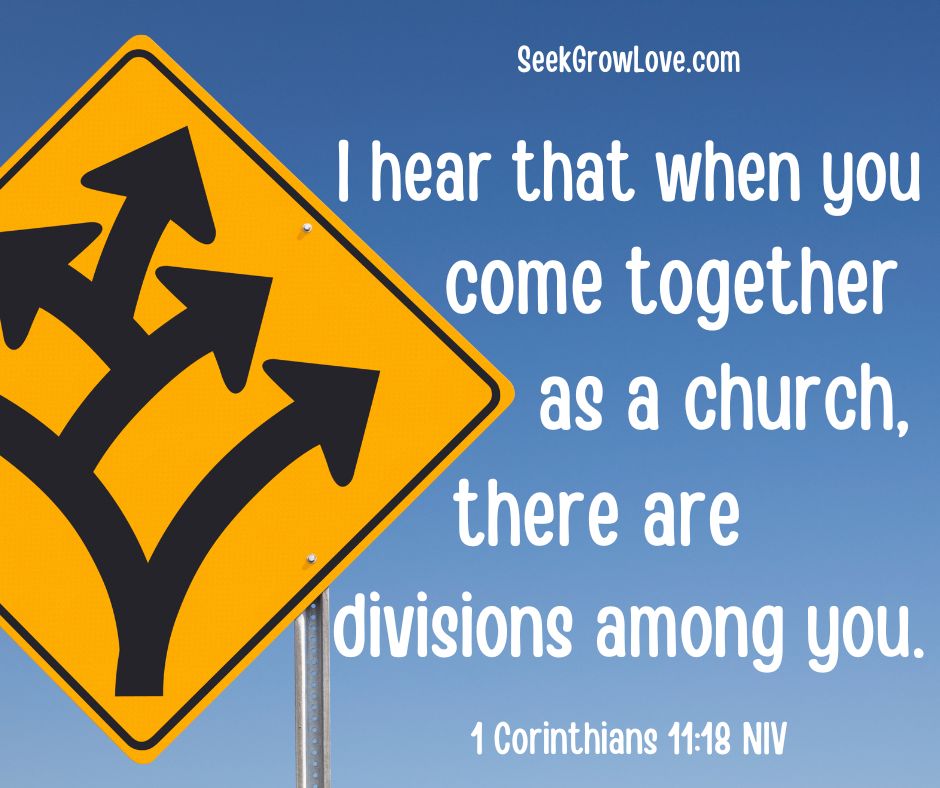
Even though the man had committed a serious sin, Paul recognizes what’s at stake in this conflict. In verses 10-11, he goes on to say, “Anyone you forgive, I also forgive. And what I have forgiven—if there was anything to forgive—I have forgiven in the sight of Christ for your sake, in order that Satan might not outwit us. For we are not unaware of his schemes.” Paul encourages them to forgive the man not just for the man’s sake, so he would be welcomed back into the family of God. He also encourages them to forgive so that ‘Satan might not outwit us. For we are not unaware of his schemes.’ When we deal with conflict in the church, we are not just working through the conflict for our own benefit. We are working to maintain the witness and effectiveness of the church. Conflict in the church is part of the spiritual battles that we face in this life (Eph. 6:10-11, 2 Cor. 10:4-5, James 4:7). When we work through our conflict towards forgiveness and unity with people who have truly repented from sin, we are working against Satan’s schemes. He comes to kill and destroy (John 10:10) and to cause divisions among believers. But, we can take heart and stand against it through the power of the Holy Spirit.
~ Cayce Fletcher
Questions for Application:
When was the last time you faced a conflict? Did you try to resolve that conflict with the other person? How?
What is the meaning of true forgiveness? How should forgiveness characterize how we interact with our friends and family as believers in Jesus?
Are there situations where we should be hesitant to forgive? Look up the following verses to read more about forgiveness: Eph. 4:32, Matt. 6:14-15, Luke 17:3-4, Mark 11:25.
I graduated from Atlanta Bible College in 2003. I worked with a couple small churches after that, but found my “calling” in helping people through grief. Next month, my wife, Hannah, and I will celebrate our 18th wedding anniversary. Our marriage is almost old enough to vote. We have four children ranging in age from 12 to 3. In November 2021, we bought a purebred english mastiff puppy. We call her “Zippers” for her propensity to chew on jacket closures. This is the lens through which I see things, my source for some great sermon illustrations and the perspective from which I write today.
I am my parent’s oldest child. I was the first grandchild on both sides of the family. I had three whole years of life experience before my sister was born. I felt like I was practically an adult at age 13 when my youngest brother was born. When I went through grade school in DeKalb, Illinois, each student attended kindergarten through 4th grade at the elementary school closest to his or her home. Then “the whole city” converged on Clinton Rosette Middle School for 5th and 6th grade. Then, everyone transferred to Huntley Middle School for 7th and 8th grade. Finally, everyone went on to the last building of the journey, DeKalb High School. That means when I was a big 7th grader, my 4th grade little sister was still “two whole buildings behind me” in “baby school”, at Carl Littlejohn Elementary. I didn’t let her forget it. I mean it had “Little”, right there in the name. My sister and I would fight like cats and dogs growing up but if anyone else tried to mess with her, they’d better look out. Being “the big brother” or “the oldest” was a big part of my identity growing up. As adults, the three year chasm between my sister and I, does not seem so important. She’s about to finish her master’s degree and will probably make more money than me. My brother can definitely grow better facial hair than me. When we are together people have mistakenly thought he was my older brother. I’ll admit I don’t love having my sense of identity challenged. I think some of the early Christians in Corinth might have felt the same.
In 1998, I “officially” started dating the preacher’s kid, a “PK”, as they say. I quickly learned that people (including myself) make certain assumptions about how a pastor’s family members ought to behave. Sometimes there are unrealistic expectations. When you date a preacher’s daughter, people have some expectations for you too. Some are unspoken. Most of them should be. A lot of them aren’t. Churches are funny that way. People feel safe saying things they shouldn’t, or wouldn’t say elsewhere. If someone perceives you as too perfect, or not perfect enough, they might feel the need to take you down a notch, or give themselves a little ego boost by comparison. It’s kind of like social media.
Sometimes the point of what people are trying to say is correct, but it is lost because of the way they say it. If we aren’t careful, even discussing certain topics can ignite a public opinion forest fire. Polarizing material is pumped into our televisions and handheld devices every day. Maybe that’s why they call them devices; because they are so divisive. Lifelong friendships have been destroyed over which “side of the aisle” a person stands on certain topics. Gender equality is one of these “hot button topics”. At first glance it might look like 1 Corinthians 11 is “too hot for TV”. I suggest that it is not, but reader discretion is advised.
What is Paul talking about with all this head covering business in the first part of this chapter? Is he suggesting that women are somehow less important than men? Not at all.
As I understand it, the tradition of the time was for women to cover her head (and in some cases, her face too) while in public as a symbol of faithfulness to her husband. She was saving her beauty “for his eyes only”. An online Bible commentary on the subject explained that it was not completely unlike the message that would be conveyed by a woman wearing a big diamond engagement ring in today’s American culture. It said she is taken. It said, don’t event try to flirt with her. Prostitutes on the other hand, would not have covered their head in public. They wanted to draw attention to themselves. To do that in church, when the focus was supposed to be on worship, would have been quite provocative. Can you imagine if a woman came into church wearing “barely there beach attire” nowadays? It would be distracting for both men and women alike as was the case in the time Paul wrote this letter to the church in Corinth.
In case there was any question as to where Paul stood in regards to the value of women. He clears it up in 1 Corinthians 11:12 when he says: “For as woman came from man, so also man is born of woman. But everything comes from God.” So in the first part of 1 Corinthians chapter 11 Paul tries to build unity in the church by asking people to be modest.
The second half of 1 Corinthians chapter 11 is less controversial. Paul admonishes the Corinthians for abusing the opportunity for unity through communion. People in that time were eating without waiting for each other and totally missing the point of the exercise. It reminds me of obedient mastiffs and “Boy’s night waffles”.
My wife, Hannah, is a nurse. When my oldest son, Carter was little, Hannah would usually work the evening shift at the hospital. So when she worked, Carter and I had “‘Boy’s night!” Sometimes, I would make waffles and sausage for supper and we would load them all up with all the toppings we both liked: Chocolate chips, blueberries, strawberries, whipped cream, etc. Hannah would never buy all that stuff. So we called them “Boy’s Night Waffles”. As we had more kids, Carter still wanted Boy’s Night Waffles. But it became increasingly difficult with four children. It was like conducting an uncooperative orchestra to have all the waffles warm and the toppings cold and help the kids cut their food into reasonable bites so we could all eat at the same time. Now on the rare occasion that we have Boy’s Night Waffles, I just have the kids start eating as their food is handed to them. We don’t even try to eat at the same time on waffle night.
English mastiffs like our dog, are sometimes called gentle giants. They are known for their size. They are one of the largest breeds there is. A female, like ours, can easily be around 150 pounds. They can be intimidating looking, but they are generally very calm and don’t need a ton of vigorous exercise. These qualities match our family pretty well. I hope to use our dog Zippers as a therapy dog, so I have been going to obedience classes with her one or two times per week ever since she was small. A large part of what we do in class is walk in circles reminding her to watch me and not ahead of me or behind me. When we get to a doorway we practice having her wait and not allowing her to just run right in or out. When we put food in front of her she has to leave it until we say a release word. Zippers is pretty good at the waiting part. She’s not so good at the release word part. We have tried “OK” and “Free” and “Eat”. A lot of times she will not start eating unless one of us sits beside her. Paul would probably like this dog.
As I see it, 1 Corinthians Chapter 11 is meant to remind the reader, (originally, Christians at the church of Corinth in about 55 AD), about the importance of unity. Paul says he is glad that the Corinthians are following his teaching and traditions but, he wants to remind them that it is more important to follow Christ than following himself. He encourages the church to be modest and build unity over division.
-Brian Froehlich
Application Questions:
What traditions in your church have become a part of its identity?
What are some behavioral differences you notice when you visit another congregation?
What are two or three attitude adjustments your church should consider for the sake of unity?
How does the Corinthian Communion service compare to those you have participated in?
Idolatry has been going on for all of human history. It is as old as sin, because when we stop worshiping God we naturally start to worship something else that is not God, and when we do this we give it an importance and a prominent position in our life that it should not have.
The ancient Israelites dealt with the idols and sacrifices to Baal and Ashera, the early Christians in Corinth lived in a culture that worshiped Apollo, Athena, and the Emperor.
The worship of these idols defined the culture of the day and helped to form a part of the social life of many people. For many, accepting Christ and walking away from the worship of Apollo meant losing all of their friends and community, and a part of their identity. So many of them tried to keep a foot in both worlds. They would go to Christian services and be a part of that community, and they would offer meat to idols and try to maintain their position in society. They would argue that eating meat and talking with friends was not bad, but they missed the point.
18 Look at the Jews. They ate the animals that were brought to God as gifts in worship and put on the altar. Did this not show they were sharing with God? 19 What do I mean? Am I saying that a false god or the food brought to it in worship is worth anything? 20 No, not at all! I am saying that the people who do not know God bring gifts of animals in worship. But they have given them to demons, not to God. You do not want to have any share with demons. 21 You cannot drink from the cup of the Lord and from the cup of demons. You cannot eat at the Lord’s table and at the demon’s table. 22 Are we trying to make the Lord jealous? Do we think we are stronger than the Lord?
It is not the meat they are eating that is bad, but the context, the community and the mindset. If they accidentally happened to eat some of the meat that was offered at a pagan altar, they would get some tasty protein and that is about it, but if they seek out a community of people that are offering sacrifices to, and worshiping something other than God in order to maintain their social standing and public image, then that is sin. They have elevated their pride and their image and have put that ahead of God’s will, and when they join in with the idol worship they show the non-believers that God means less to them than the idols.
27 If a person who is not a Christian wants you to eat with him, and you want to go, eat anything that is on the table. Ask no questions about the food. Then your heart will not say it is wrong. 28 But if someone says, “This meat has been given as a gift to false gods in worship,” do not eat it. In that way, it will not hurt the faith of the one who told you and his heart will have peace. 29 How the other person feels is important. We are not free to do things that will hurt another person. 30 If I can give thanks to God for my food, why should anyone say that I am wrong about eating food I can give thanks for? 31 So if you eat or drink or whatever you do, do everything to honor God
In every context our mindset should be to honor God. Because we are Christians all of our actions send a message to others about who God is, and when we are hypocritical or give in to social pressures, that hurts the faith of all who see it.
-Chris Mattison
Application Questions:
Do you have anything that you are trying to keep in your life that could be an idol? Maybe a group of friends that party a bit too hard, but you don’t want to lose them as friends? Or an unhealthy obsession with social media and how others view you, instead of how God sees you?
The early part of this chapter looks back at the Old Testament times and how angry God gets at idolatry, why do you think God gets jealous and angry when his people turn to idols instead of to him?
Do you need to be more aware of the struggles of those around you and give up some of your freedoms so that you can honor God and help grow their faith?
Do you not know that in a race all the runners run, but only one gets the prize? Run in such a way as to get the prize. (1 Corinthians 9: 24)
Being competitive is sometimes presented in a negative light. Probably because competition can bring out the ‘jerk’ in people. That’s too bad, because in his letter to the Corinthians, Paul is telling them (and us) to lean into that competitive spirit.
Paul is using this as an analogy, by the way, he’s not telling us that we are in competition with other believers. He uses two phrases that I hope will inspire you as you run your race.
“strict training”
Athletes preparing for a big competition don’t eat whatever they want and binge Netflix all day. What do they do instead? They do things that will help them succeed in their goal. (Winning!) Paul’s goal, and ours, is “a crown that will last forever.”
How do we train for eternal life?
The word obey comes to mind. In order to obey we need to really know Scripture. If we want to hear the words “Well done, good and faithful servant,” we need to know what the Master expects of us. And we need to do it, even when it’s hard. Just like the athlete in training gets off the couch and goes to practice, even when he’s tired, we need to obey even when it doesn’t make sense to our human sensibilities.
“do not run aimlessly”
If you’ve ever been to a kid’s sporting event, you know that there are players that do not have their head in the game. They are wandering around the field, chatting with friends, maybe even picking flowers in the grass. Adorable.
Not so adorable when it’s adults in an Olympic competition and not cute when we’re talking about forever.
So many of us say that we are sharing our faith by the way that we live our lives. But how much of that is a cop-out because we’re not comfortable evangelizing? If we are actively sharing our faith through our life, we will be intentional in planning ways to do it. We won’t just be going about our life, wandering aimlessly along.
I encourage you today to make a training plan. How are you getting ready for Christ’s return? I also encourage you to make a game plan. How are you looking for ways to share your faith with those around you?
-Susan Landry
(Editor’s Note: Sorry this was sent out later today. It’s been fun hearing from a variety of writers this week, but today’s scheduled writer ran into a health issue and was unable to write. So, we went back in time and found this great devotion from 2019 – thank you, Susan – definitely good enough to read again. God bless you as you Seek, Grow and Love!)
Questions for Reflection and Discussion
How often do you remember that you are training for a crown that will last forever? If we remembered this more often how might it change our hearts, our schedules, our free time, our priorities, our training routine? What could you do differently this week, remembering the goal of your training and perhaps making it a little more “strict” than it has been lately?
Are there any ways in which God may say you have been running aimlessly? What adjustments do you think Paul would suggest? Are you willing to do them?
While we now live in an era where information is at the tips of our fingers, just a few swipes and searches away, knowledge still holds as much power as ever. At the beginning of this chapter, Paul reminds us of this crucial fact when he says, “… But knowledge puffs up while love builds up. Those who think they know something do not yet know as they ought to know. But whoever loves God is known by God.” (1 Corinthians 8:1b-3) Here, Paul highlights how gaining knowledge can lead to becoming arrogant and result in divisions between people. He then explains the flip side of this coin: love. By using what we do know for the benefit of others, we can become better leaders in the church and set an example for how to live a life like Christ. To better elaborate on this concept, Paul addresses a question the people of Corinth had for him concerning eating food sacrificed to idols.
Later in the chapter, Paul states, “… yet for us there is but one God, the Father, from whom all things came and for whom we live; and there is but one Lord, Jesus Christ, through whom all things came and through whom we live But not everyone possesses this knowledge…” (1 Corinthians 8:6-7a) Since Christians are aware that all things come from God, it was clear at the time that the meat in the markets was just meat, despite its old use in rituals to idols past. As more experienced Christians were aware of this fact, they would eat the meat casually as they should; however, as Paul states, not everyone knows this information. To the average individual, seeing the meat could still serve as a reminder of the idols of the past, and witnessing Christians eating this same meat could cause confusion and make one deviate in their faith. It’s here where Paul warns us, “Be careful, however, that the exercise of your rights does not become a stumbling block to the weak.” (1 Corinthians 8:9)
The rest of the chapter really speaks for itself as Paul describes how wounding someone with knowledge by being that stumbling block also hurts yourself. In verses 11-13, Paul writes, “So this weak brother or sister, for whom Christ died, is destroyed by your knowledge. When you sin against them in this way and wound their weak conscience, you sin against Christ. Therefore, if what I eat causes my brother or sister to fall into sin, I will never eat meat again, so that I will not cause them to fall.” The result of not being responsible with our knowledge is devastating because not only do we sin against the individuals concerned, but we also sin against Christ. However, as mentioned previously, there is a flip side to all of this. If we are responsible with this powerful knowledge and use it lovingly, then we can build upon one another. It’s no easy feat of course—like giving up meat for good, as Paul describes—but by preventing the fall of those around us, we can continue to raise our commitment to Christ together.
— Austin Kizer
Questions for Reflection and Discussion
How do you use your knowledge to grow closer to Christ? Do your actions and applications of this knowledge show other people your firmness in faith, or are you sending mixed signals?
A unique phrase in this chapter was “stumbling block for the weak”. What are different stumbling blocks that the world throws at us, and how can we combat them to stay firm in our faith?
With knowledge about Christianity becoming more accessible to people worldwide, it’s important to hone in on the areas that we can directly impact. Discuss how Christians in this modern day can share their knowledge and build relationships with people in their community.








 Seek Grow Love