When the Glory Filled the Temple

1 Kings 7-8

Psalm 60

1 Corinthians 10

-Devotion by Brian Froehlich (IL)

After years of planning and construction, the temple was finally complete.

1 Kings chapters 7–8 describe the finishing details, the furnishings, and finally the moment when the ark of the covenant was brought into the temple. Then something extraordinary happened:

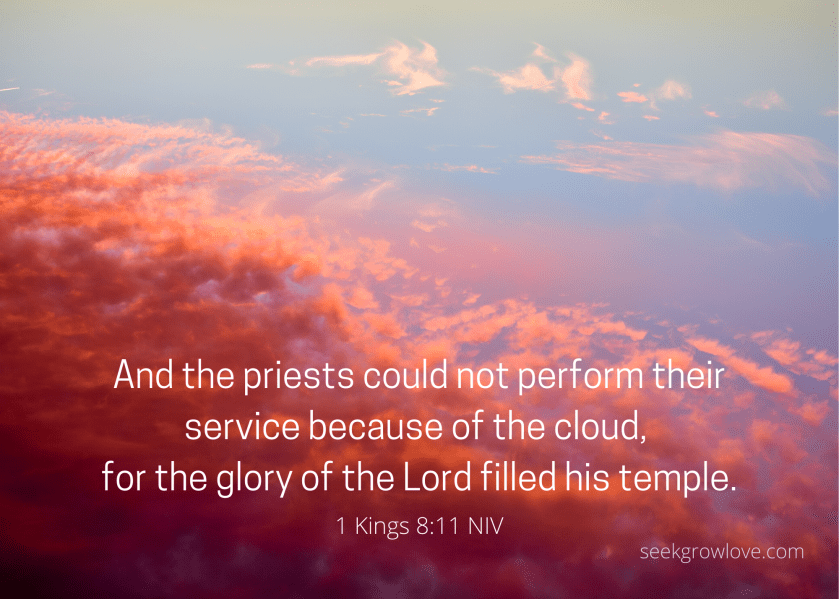
“The cloud filled the temple of the LORD… for the glory of the LORD filled his temple.”
— 1 Kings 8:10-11

It was a visible reminder that God was truly present among His people.

What a moment that must have been.

The musicians played.
The priests stood ministering.
The nation gathered together.
And suddenly the glory of God filled the temple so powerfully that the priests could not continue their work.

Yet Solomon understood something critically important. During his prayer of dedication, he asked:

“Will God really dwell on earth? The heavens, even the highest heaven, cannot contain you…”

Solomon recognized that the temple was never meant to shrink God down into a building. God is greater than any structure humanity could ever create.

That truth still matters today.

People often become attached to religious places, traditions, or outward appearances while neglecting the condition of the heart. Church buildings can be beautiful. Traditions can be meaningful. Worship gatherings can be emotional.

But none of those things automatically guarantee genuine faithfulness.

God has always desired more than outward religion.

He wants hearts that seek Him sincerely.

One of the most beautiful parts of Solomon’s prayer is how often he asks God to hear people when they repent and turn back toward Him. Solomon understood that the people would fail. He knew there would be sin, hardship, exile, drought, conflict, and brokenness.

But he also understood that God is merciful.

Again and again throughout Scripture, we see this pattern:

People drift.
God calls them back.
Mercy remains available.

That does not mean sin has no consequences. Israel would eventually experience painful judgment because of rebellion. But even judgment never completely erased God’s promises.

The temple itself pointed forward to something greater.

The prophets later described a future age where God’s presence would fully dwell with His people in peace and righteousness. The Bible’s ultimate hope is not escape from creation, but restoration of creation under God’s Kingdom.

One day the earth itself will be filled with God’s glory.

No more corruption.
No more idolatry.
No more death.

That future reality is far greater than even Solomon’s magnificent temple.

Three Things to Remember

  1. God is greater than any building.

Even Solomon knew the temple could not contain the fullness of God.

  1. God desires sincere hearts, not empty religion.

Outward worship means little without inward faithfulness.

  1. God’s ultimate plan is restoration.

The temple pointed forward to God dwelling fully with His people in His coming Kingdom.

The glory filling the temple was breathtaking.

But it was only a glimpse of something even greater still to come.

Reflection Questions

  1. Why do you think God’s plan included a tabernacle, then temple, then church? What similarities might there be between being a part of a church today and going to the temple of Solomon’s day? What is your favorite part of being a part of a church?
  2. Consider your own heart. Are you more concerned with outward appearances, traditions and religious places than with a sincere, faithful heart of love? How can you tell what the health of your heart is towards God? What can be done to create a more faithful heart?
  3. What is your experience with glimpsing the glory of God? Where? When? Do you look for it? What are you looking forward to most about when His full glory will be revealed?

Prayer

Dear God – I praise You for giving life and love. I thank You for Your mercy towards me. I thank You for Your plan of salvation and Your plan for the ages, that we can look forward to a time when we are surrounded by Your full glory on display. Until then, I pray for a heart totally devoted to You. I thank You for the church. Help us to use it to draw ourselves and others closer to You and Your Son, but never to replace You. In Your son’s name, I pray

A House for God

1 Kings 5-6

Psalm 59

1 Corinthians 9

-Devotion by Brian Froehlich (IL)

Solomon began building the temple.

For generations, Israel had worshiped in the tabernacle — a movable tent that reminded the people that God traveled with them through the wilderness. But now the kingdom was established, the enemies were subdued, and Solomon prepared to build a permanent house dedicated to the LORD.

1 Kings describes enormous effort, careful planning, costly materials, and incredible craftsmanship. Cedar from Lebanon. Gold overlays. Carved cherubim. Skilled laborers. Massive stones carefully prepared before they ever arrived at the building site.

One detail stands out powerfully:

“No hammer, chisel or any other iron tool was heard at the temple site while it was being built.”
— 1 Kings 6:7

The stones were shaped beforehand.

Quietly.
Carefully.
Intentionally.

That image says something profound about how God works.

Most of God’s shaping happens long before anyone sees the finished result.

We often want instant transformation.
Immediate answers.
Quick spiritual growth.

But God usually builds people the same way the temple was built — through quiet preparation over time.

Difficult seasons shape us.
Disappointments shape us.
Waiting shapes us.
Faithfulness in ordinary moments shapes us.

And much of that shaping happens where nobody else can see it.

But there is an even bigger lesson in these chapters.

As glorious as the temple was, Solomon himself understood that no building could fully contain God. Later, he would openly admit that “the heavens, even the highest heaven, cannot contain” Him.

The temple was never supposed to reduce God to a location. It was meant to remind people of His presence, holiness, and covenant.

Sadly, many people still confuse religious structures with genuine faith.

A beautiful church building is not the same thing as obedience.
Religious activity is not the same thing as a transformed heart.

God has always wanted more than ceremonies.
He wants faithful people.

The temple also pointed forward to something greater.

Throughout Scripture, the ultimate hope is not merely access to a building, but restored fellowship with God Himself through His appointed King and the coming Kingdom of God.

One day, according to the prophets and the teachings of Jesus, God’s presence will fully dwell with redeemed humanity in a restored earth where death itself is defeated.

That is the destination toward which the temple pointed.

Not just architecture.
Not just ritual.
But restoration.

Three Things to Remember

  1. God often shapes us quietly.

Much of the Lord’s work happens in hidden seasons before the final result is visible.

  1. Religious structures are not enough.

God desires obedient hearts, not merely outward ceremonies.

  1. The temple pointed toward a greater future.

The Bible’s story moves toward resurrection, restoration, and God dwelling with His people forever.

Sometimes we become discouraged because we do not yet see what God is building in our lives.

But the stones of the temple probably did not understand the blueprint either.

Still, the Builder did.

And He still does.

Reflection Questions

  1. Where have you seen pieces of God’s plan for you prepared beforehand? What pieces might God be molding right now for future presentation?
  2. What sort of boxes/buildings/separate activities do people sometimes try to keep God in? Why is this not God’s desire? What does He deserve instead?
  3. Take a step back and look not at your schedule today but God’s Big Picture Plan. What are you most excited about the Coming Kingdom and pieces building up to that? What still needs to be done? How can you mold your schedule today better in anticipation of what God is planning for the future?

Prayer

Dear God – You are an awesome God with an awesome plan. Thank You for including me in Your plans. Help me build only what You want me to build with the days that You have given to me. May I see You at work and do what is pleasing to You.

Wisdom is More than Intelligence

1 Kings 3–4

Psalm 59

1 Corinthians 8

-Devotion by Brian Froehlich (IL)

When Solomon became king, God gave him an incredible opportunity.

He could ask for anything.

Power.
Riches.
Military victory.
Long life.

Instead, Solomon asked for wisdom.

That request pleased God because Solomon recognized something many people never do: leadership without wisdom is dangerous.

1 Kings chapter 3 shows a young king who understood his own limitations. Solomon did not pretend to know everything. He admitted that he needed God’s help to govern rightly.

And that humility mattered.

One of the most famous moments in Solomon’s life came shortly afterward when two women came before him, both claiming the same baby as their own. Solomon’s shocking proposal revealed the true mother because real love was willing to sacrifice personal rights to preserve life.

True wisdom does more than impress people.
It reveals the heart.

That is still true today.

Our world often confuses wisdom with education, confidence, or internet knowledge. But biblical wisdom is deeper than information. Wisdom is the ability to see situations through God’s perspective and respond in ways that reflect His character.

A person can be highly educated and still make foolish decisions.
A person can speak confidently and still be spiritually blind.

Wisdom begins with recognizing our dependence upon God.

But there is also a warning quietly woven into these chapters.

Even while Solomon loved God, cracks were already forming beneath the surface. The text mentions that he married Pharaoh’s daughter and that the people were still sacrificing at the high places.

At first glance, those details may seem minor. But small compromises often become major disasters later.

Very few people wake up one morning and decide to destroy their lives. Usually, hearts drift slowly.

One tolerated compromise at a time.
One rationalization at a time.
One neglected prayer at a time.

That is why wisdom is not merely knowing what is right. Wisdom is continually choosing what is right.

Solomon’s kingdom experienced peace, prosperity, and influence unlike almost anything Israel had ever seen. Yet even the greatest earthly kingdom could not fully satisfy the human heart or permanently solve the problem of sin and death.

Like David before him, Solomon’s story ultimately points beyond himself.

The Bible’s hope is not merely that humanity would someday produce a wise king. The hope is that God would provide the perfect King — one greater than Solomon — who would rule with complete righteousness forever.

And that future kingdom still lies ahead.

Three Things to Remember

  1. Wisdom begins with humility.

Solomon became wise when he admitted he needed God’s help.

  1. Small compromises matter.

The seeds of future failure are often planted long before anyone notices them.

  1. Earthly success is never the final answer.

Even Solomon’s glorious kingdom could not replace humanity’s need for resurrection, restoration, and God’s coming Kingdom.

We live in a world overflowing with information but starving for wisdom.

So before asking God for more influence, more money, or more success, perhaps we should begin where Solomon did:

“Lord, give me wisdom.”

Reflection Questions

  1. Are you humble enough to seek and ask for wisdom?
  2. Consider this definition – “Wisdom is the ability to see situations through God’s perspective and respond in ways that reflect His character.” Choose a situation you have been in recently. What might wisdom see? How might wisdom respond?
  3. How can we learn more about God’s perspective and His character so we can more often follow in God’s wise way rather than our own often foolish way?
  4. What should we do, where should we be, who should we be with, while asking God for wisdom?
  5. What do you think is a wise judgment/decision/action you made? What is a foolish one ? What made it foolish? Were there any small compromises that led up to this foolishness?

Prayer

Dear God – I pray for wisdom. You are the wise and all-knowing, always righteous God and I need You. Help me see Your perspective and reflect Your character in both big and small decisions, judgments and actions in my life. Show me what is right and what is wrong and give me perseverance to do, think, say, choose what is right. Show me where small compromises are leading me astray.

Finishing Well Matters

1 Kings 1-2

Psalm 58

1 Corinthians 7

-Devotion by Brian Froehlich (IL)

David was old. Weak. Near death. And yet the future of the kingdom still depended on what happened in those final moments.

1 Kings opens with confusion, ambition, and uncertainty. Adonijah tried to take the throne for himself while David was still alive. He gathered supporters, hosted public celebrations, and acted like the kingdom already belonged to him. But God had already chosen Solomon.

There is an important lesson here: Not everyone who promotes themselves has been appointed by God.

Adonijah looked impressive. He sounded royal. He had influential friends. But appearances are not the same as obedience.

Meanwhile, David gave Solomon final instructions before his death. He did not simply tell his son how to rule politically. He told him how to live spiritually:

“Walk in obedience to him, and keep his decrees and commands…” — 1 Kings 2:3

David understood something many people never learn: success is not measured merely by how long we live, how much we accumulate, or how powerful we become. A life is measured by faithfulness to God.

Even David himself was a reminder of that truth. His life had victories and failures, courage and sin, repentance and heartbreak. Yet through it all, David still trusted the promises of God. He died looking ahead to a kingdom he would not fully see in his lifetime.

That hope matters.

The Scriptures repeatedly point beyond temporary kingdoms toward the coming Kingdom of God — a kingdom ruled by the promised Son of David. David himself knew he would one day rest in the grave awaiting resurrection and restoration under God’s final King.

That is our hope too.

Not escape from earth. Not floating away forever somewhere distant. But resurrection, restoration, and life in God’s coming kingdom.

The beginning of Solomon’s reign reminds us that every generation must choose whether it will submit to God’s wisdom or chase its own ambitions.

And the ending of David’s life reminds us of another truth: Starting well is good. Finishing well is better.

Three Things to Remember

1. Self-promotion is not the same as God’s calling.

Adonijah exalted himself, but God had already chosen someone else.

2. The condition of the heart matters more than outward success.

David’s final concern was Solomon’s obedience to God.

3. Our ultimate hope is still future.

Like David, we wait for the fulfillment of God’s promises and the resurrection of the dead. The world teaches us to chase comfort, status, and recognition now. But Scripture constantly points us forward.

Toward a better King. A better kingdom. And a better future than this world can offer.

Reflection Questions

  1. How do you tend to measure success in your own life or in the lives of others?
  2. “A life is measured by faithfulness to God.” How is your life measuring up?
  3. What have you started well that still needs to be finished well? What steps can you take toward that purpose?
  4. Who has shared spiritual wisdom with you? What spiritual wisdom have you gained thus far that you can pass along?
  5. What evidence can you find regarding David’s view of death? How is it like or unlike yours?

Prayer

Dear God – I thank You for the wisdom found in Your book and in Your people. Help me grow in wisdom, seeing what is most important, and faithfully living in obedience to You. Thank You for the promises You give, including the coming resurrection and kingdom with the Son of David (who is Your Son, too). In his name I pray.

Faith That Moves…or Fear That Rushes

1 Samuel 13-14Psalm 48Romans 2

-Devotion by Brian K Froehlich – posted on his facebook page on April 11, 2026, where he has been writing and sharing his thoughts as he is reading through the Bible chronologically this year.

There are moments in life where everything seems to hang in the balance. The pressure builds. The clock is ticking. The outcome feels uncertain. And in those moments, what we believe about God is revealed—not by what we say, but by what we do.

That is exactly where we find Saul and Jonathan in these chapters. Two men. Two responses. Two very different outcomes.

Let’s walk through the story together.

Saul has been made king. The people have what they asked for. But almost immediately, we see the tension. The Philistines are gathering. Their army is overwhelming—chariots, soldiers, numbers beyond counting. Meanwhile, Israel is afraid. People are hiding in caves, in holes, anywhere they can find safety.

And Saul is waiting.

He was told to wait for Samuel. Seven days. Wait for God’s instruction. Wait for the offering. Wait for the moment when God would act.

But waiting is hard when fear is loud.

The people are scattering. The pressure is rising. And Saul makes a decision: “Bring me the offering.”

He steps into a role that was not his. He offers the sacrifice himself.

And just as he finishes… Samuel arrives.

The timing is almost painful. If Saul had just waited a little longer.

Samuel’s words cut straight to the heart: “You have done a foolish thing.”

Not because Saul didn’t care. Not because he didn’t want victory. But because he did not trust God enough to wait.

There is a difference between acting in leadership and acting out of fear. Saul’s decision was not rooted in faith—it was rooted in panic.

And here is the lesson for us:

Impatience often looks like responsibility. It feels like we are doing something necessary. But if it steps outside of what God has said, it is not faith—it is fear in motion.

Saul explains himself. “The men were scattering… the Philistines were assembling… I felt compelled.”

“I felt compelled.”

How often do we make decisions based on what we feel in the moment instead of what we know to be true about God?

Saul had clear instruction. But pressure made him rewrite it.

And Samuel tells him something sobering: his kingdom will not endure. God is seeking a man after His own heart.

Now the story shifts.

If chapter 13 shows us fear-driven leadership, chapter 14 shows us faith in action.

Jonathan, Saul’s son, quietly tells his armor-bearer, “Come, let’s go over to the outpost of those uncircumcised men. Perhaps the Lord will act on our behalf.”

Listen to that carefully.

“Perhaps the Lord will act.”

This is not doubt. This is humility. Jonathan is not presuming on God—but he is also not paralyzed by uncertainty.

He continues: “Nothing can hinder the Lord from saving, whether by many or by few.”

That is faith.

Faith is not having all the answers. Faith is knowing who God is, even when the outcome is unclear.

Jonathan doesn’t wait for perfect conditions. He steps forward based on what he knows about God’s character.

And his armor-bearer responds with one of the most beautiful lines in Scripture: “Do all that you have in mind… I am with you heart and soul.”

Faith has a way of spreading. Courage invites courage.

Jonathan proposes a sign. If the Philistines call them up, they will go—trusting that God has given them victory.

And that is exactly what happens.

Two men climb up a cliff, exposed, vulnerable, outnumbered.

And God moves.

They strike down about twenty men. Panic spreads through the camp. The ground shakes. Confusion overtakes the enemy. What began as a small act of faith becomes a sweeping victory.

Here is the contrast:

Saul had the army, the position, the authority—and acted in fear.

Jonathan had none of those things—and acted in faith.

One rushed ahead without God.

The other stepped forward trusting God.

But the story doesn’t end there.

Saul, seeing the confusion in the Philistine camp, joins the battle. Victory is within reach. But then Saul makes another rash decision.

He puts the army under an oath: no one is to eat until evening, until he has avenged himself on his enemies.

Notice the wording—“until I have avenged myself.”

This is no longer about God’s victory. It has become personal.

The result? The army grows weak. They are exhausted. They cannot fully pursue the enemy.

Jonathan, who did not hear the oath, tastes some honey. His strength returns. And he says plainly, “My father has made trouble for the country.”

It is a powerful moment. The one who acted in faith sees clearly. The one who acted in fear continues to complicate the situation.

Later, the people are so famished that they begin to sin by eating meat with the blood still in it—something God had clearly forbidden.

Fear leads to impatience. Impatience leads to poor decisions. Poor decisions lead others into trouble.

And Saul almost puts Jonathan to death for breaking the oath—until the people intervene and save him.

So what do we take from all of this?

First, waiting on God is not weakness. It is trust. Saul’s failure was not a lack of action—it was a lack of trust in God’s timing.

Second, faith does not require certainty—it requires confidence in who God is. Jonathan did not know exactly what would happen, but he knew God was able.

Third, leadership that is driven by fear will always create burdens. Leadership that is grounded in faith will bring clarity and life.

And finally, small acts of faith can change everything.

Jonathan did not have a large army. He did not have a perfect plan. He simply stepped forward in trust.

And God used that.

There may be areas in life right now where the pressure feels overwhelming. Where the timing feels uncertain. Where the temptation is to act quickly just to relieve the tension.

But these chapters remind us:

Do not let fear make your decisions for you.

Wait when God says wait.

Move when faith calls you forward.

Trust that the God who saves “by many or by few” is still at work.

And remember—He is not limited by your resources, your position, or your circumstances.

He is looking for hearts that trust Him.

Reflection Questions

  1. Brian wrote, “Impatience often looks like responsibility. It feels like we are doing something necessary. But if it steps outside of what God has said, it is not faith—it is fear in motion.” Can you think of a time when you were acting with fear in motion? What was the outcome? What might have been better?
  2. “How often do we make decisions based on what we feel in the moment instead of what we know to be true about God?” What do you know to be true about God regardless of your feelings?
  3. What can you do during the difficult waiting times?
  4. What might God be calling you to do to move forward in faith? Is there another person who could help add courage and faith to this forward, God-honoring movement? Pray about it. Find out what God thinks.

Prayer

Dear Heavenly Father, You are a God of power, righteousness, and perfect timing and direction. Help me wait well in waiting seasons and courageously move in faith to follow Your lead and help me know the difference. I confess the times my fear, impatience, and lack of faith have led me away from You and what You have said is best. Help me honor You in my waiting and in my moving.

I Believe…God is King and He Appoints the King We Need (Part 2)

1 Samuel 11-12Psalm 47Romans 1

Today we are sharing the second half of Brian K Froehlich’s devotion on 1 Samuel 9-12 which he posted on his facebook page on April 11, 2026. Brian has faithfully been writing and sharing his thoughts as he reads through the Bible chronologically this year. Become his facebook friend and read along with his I Believe series.

1 Samuel 11 – A Real Victory

Saul leads Israel against the Ammonites (11:6–11).

God’s Spirit comes on him.

He unites the people.

He wins a decisive victory.

This is important.

Saul is not useless.

He is not a joke.

There is real success here.

And the people say:

“Now establish the kingdom in Saul’s hands!” (11:15)

It feels like everything is working.

But success does not always mean approval.

Sometimes God allows something to work

to show something deeper.

1 Samuel 12 – The Truth Comes Out

Samuel gathers the people and speaks plainly.

First, he asks:

“Have I wronged you?” (12:3)

They answer:

“No.”

Samuel has been faithful.

Then he reminds them:

God delivered you from Egypt.

God saved you again and again.

God raised up leaders when you cried out.

And yet…

“When you saw that Nahash king of the Ammonites was moving against you, you said, ‘No, we want a king to rule over us’—even though the LORD your God was your king.” (12:12)

There it is again.

God was already their King.

Their problem was not lack of leadership.

Their problem was lack of trust.

The Key Lesson from These Chapters

God says:

“They have rejected Me as their king.” (1 Samuel 8:7)

But what does God do?

He gives them a king anyway.

A man:

Saul

This is the pattern:

God is the King.

God appoints a human king.

That king rules under God.

That matches what God had already said:

“Be sure to appoint over you a king the LORD your God chooses.” (Deuteronomy 17:15)

The king is chosen by God.

The king is under God.

Why Saul Was Not Enough

Saul had:

• The look

• The opportunity

• The support

But he could not fix the real problem.

Because the real problem was not enemies.

It was sin.

It was the human heart.

Then Comes David

A better king.

“A man after His own heart.” (1 Samuel 13:14)

But even David fails.

So the Bible keeps pointing forward.

God promises:

“Your throne will be established forever.” (2 Samuel 7:16)

A future King is coming.

The One Who Could Do the Job

From David’s line comes:

Jesus Christ

And the Bible describes Him clearly:

“For there is one God and one mediator between God and mankind, the man Christ Jesus.” (1 Timothy 2:5)

A man.

The right man.

He is:

• “A man accredited by God” (Acts 2:22)

• The one God raised (Acts 2:24)

• The one God made Lord and Messiah (Acts 2:36)

And Jesus says:

“All authority… has been given to me.” (Matthew 28:18)

Given.

Not taken.

How the Story Ends

Even at the end, Scripture says:

“He hands over the kingdom to God the Father.” (1 Corinthians 15:24)

God remains the King.

The Son rules under Him.

Bringing It All Together

1 Samuel 9–12 is not just about Saul.

It is about a pattern:

God is the King.

People struggle to trust Him.

God appoints a human ruler.

Saul wasn’t the one.

David wasn’t the one.

But God never stopped working.

The Final Truth

We trust and receive the man Christ Jesus

to lead our world back to God.

Not because He replaced God.

But because God chose Him.

Because He obeyed perfectly.

Because He overcame sin.

Because He was raised to life.

Saul couldn’t do it.

David couldn’t do it.

Jesus WAS the one for the job.

Jesus IS the one for the job.

Jesus WILL BE the one for the job.

Reflection Questions

  1. What are your impressions of Samuel?
  2. What does the Bible tell us about who Jesus is? What is his relationship with God? What is his relationship with man? What jobs has he already done, is doing now, and will do?

Prayer

Dear God, I praise You for Your perfect plan. You are the All Wise & All Powerful King deserving of my allegiance, love, and obedience. Thank you for the incredible gift of Your Son to draw us close to You, to mediate between God and man, to show us how to please You, to conquer sin, and destroy the enemy, to rule for a time and then hand Your kingdom back to his Father and God. I desire to be a faithful, loving, obedient subject of You and Your perfectly chosen & anointed Messiah. Please show me how to serve well.

I Believe… God Is Not a Good Luck Charm

1 Samuel 7-8Psalm 46Acts 27

-Devotion by Brian Froehlich (IL) – Brian has been writing devotions on his facebook page this year as he reads along with a chronological Bible reading plan. Great job sharing God’s Word, Brian! Today’s devotion covers 1 Samuel 4-8.

I believe God is not something we carry. He is Someone we follow.

And in 1 Samuel 4–8, Israel had to learn that the hard way.

In 1 Samuel 4, Israel goes into battle against the Philistines—and they lose.

Instead of asking, “Why did this happen?” or “Are we right with God?” they ask, “What can we bring into battle next time?”

So they come up with a plan.

“Let’s bring the ark of the covenant.”

Not to worship. Not to repent. Not to seek God. Just… bring the box.

They treated the ark like a good luck charm.

When the ark shows up, Israel shouts so loudly the ground shakes. The Philistines hear it and panic: “God has come into the camp!”

But here’s the problem—God hadn’t.

They brought the symbol, but ignored the God behind it.

And the result? Israel loses again. Thirty thousand die. The ark is captured. Eli’s sons are killed. And a woman names her child Ichabod, saying, “The glory has departed from Israel.”

They had the object, but they lost the presence.

I believe this still happens today. People carry Bibles, wear crosses, sit in church pews—but they are not walking with God.

God is not a charm you carry. He is a King you follow.

In 1 Samuel 5–6, the Philistines take the ark and place it in the temple of their god Dagon.

The next morning, Dagon is face down before the ark.

They set him back up.

The next morning, he has fallen again—this time his head and hands are broken off.

God didn’t need Israel to defend Him. He handled it Himself.

Then tumors break out among the people. Panic spreads from city to city. They finally say, “Send it back!”

They put the ark on a cart with two cows and say, “If this goes back to Israel, we’ll know it was God.”

It goes straight back.

Because God does not need help proving He is God.

I believe we forget this. We argue like God is fragile. We panic like truth is losing.

God is not on trial. He is still on the throne.

Then in 1 Samuel 6, the ark returns to Israel. The people rejoice.

But then something sobering happens.

Some men look into the ark—and they die.

There is something in us that wants to look.

Even when we know we shouldn’t, we want to see.

It reminds me of what happened after the assassination of Abraham Lincoln.

When he died in 1865, his body was placed on a funeral train that traveled across the country. In city after city, thousands of people lined up. They waited for hours—sometimes all night—just for a few seconds to look at his face.

Not touch. Not speak. Just look.

But it didn’t stop there.

After he was buried, his body was moved multiple times. Reburied. Relocated for security. There was even an attempted grave robbery.

And over the years, his casket was opened again and again.

Not once. Not twice. Multiple times.

Each time—people looking. Checking. Confirming. Curious.

The last time was in 1901. More than 35 years after his death, they opened it again just to make sure he was still there.

A teenage boy named Fleetwood Lindley was allowed to step forward and look inside. He later said Lincoln’s face was still recognizable.

And that boy lived until 1963.

Think about that.

For nearly 100 years after Lincoln died, someone could still say, “I saw him.”

There is something deep in human nature that doesn’t just want to hear—we want to see for ourselves.

And that same instinct shows up in 1 Samuel.

The ark wasn’t just a box. It represented the presence of God.

And the people thought, “What’s inside? Let me just look. Just a quick peek.”

But God had already made it clear—this is not something you handle casually.

This is not something you open out of curiosity.

Because what starts as curiosity quickly becomes irreverence.

And irreverence in the presence of a holy God is deadly.

Not everything sacred is meant to be opened.

In 1 Samuel 7, the people finally ask the right question: “Who can stand in the presence of the Lord, this holy God?”

And Samuel gives the right answer: “If you are returning to the Lord with all your hearts, then rid yourselves of the foreign gods.”

Repentance—not rituals.

They gather. They fast. They confess, “We have sinned against the Lord.”

And when the Philistines come again, this time God thunders from heaven and throws them into confusion.

Israel wins.

Samuel sets up a stone and calls it Ebenezer—“Thus far the Lord has helped us.”

Notice the difference.

Before, they carried the ark into battle.

Now, they come to God in repentance.

Before, they tried to use God.

Now, they submit to Him.

And that changes everything.

I believe victory doesn’t come from having God near you. It comes from being right with Him.

Then in 1 Samuel 8, the people come to Samuel and say, “Give us a king.”

Why?

“So we can be like all the other nations.”

God tells Samuel, “It is not you they have rejected, but they have rejected me as their king.”

They didn’t want “no king.”

They wanted a king they could see. Control. Be like everyone else.

Samuel warns them—a king will take your sons, your daughters, your fields, your money.

And they say, “We still want a king.”

I believe this is still true.

People say they want freedom. They say they want no king. But they don’t.

They just want a king they can manage.

But God does not compete with other kings.

He calls you to surrender to Him.

I believe God is not a tool to use. God is not weak and in need of defense. God is holy—not casual. And God alone is worthy to be King.

So the question is not, “Do you have God with you?”

The question is: Are you with Him?

Because you can carry the ark and still lose the battle.

But if you return to Him with all your heart, you will find that He was never lost at all.

Reflection Questions

  1. It’s hard to get the right answers when you ask the wrong questions. What wrong questions do people ask today? When have you found yourself asking the wrong questions? What are better questions to ask?
  2. Is there a time when your lack of repentance got you into deeper trouble? What happens when you repent? Is there something you need to repent of right now?
  3. What or who do you want to be the leader of your life? Do your actions andd attitudes agree with the answer you gave? What does submitting to God look like?
  4. How has God helped you thus far? How will you remember these things?

Prayer

Dear God, You are a holy, righteous God, maker of heaven and earth, the only true God, the One who sits on the throne today with your Son at Your right hand. How amazing that the King of the Universe wants to have a relationship with me! Help me to not take You for granted, God, or treat You irreverently. Help me see clearly what I need to repent of, that I will repent, submit and be right with You.

How I Do It

2 Corinthians 1

June 18

When people find out what I do for a living (Funeral Director/Embalmer and Deputy Coroner) they usually respond with some variation of the following: “I don’t know how you do it”.  “How do you get used to it?”  Or “I don’t think I could do your job.”  I have never known quite how to respond to those statements.  Saying  “Oh, I think you could”, doesn’t  seem quite right.  Neither does “You’re probably right about that.”

I’ve decided that I’m going to start asking what part of my job, specifically, they think they would not be able to handle.  If they mean they don’t know how I get used to the smells, my answer would truthfully be “I don’t”…  It’s a tough part of the job.  My tongue-in-cheek answer would be “Mouth breathing and repeated formaldehyde exposure have helped.”  (I think I’ve partially embalmed my olfactory over the years of inhalation of embalming chemical fumes).   If they mean they don’t know how I can be a comforting presence when people are grieving, I have an answer for that too.  It is because God has comforted me.

In 2 Corinthians Chapter 1, Paul writes:

“Praise be to the God and Father of our Lord Jesus Christ, the Father of compassion and the God of all comfort, who comforts us in all our troubles, so that we can comfort those in any trouble with the comfort we ourselves receive from God.” (verses 3&4)

When I was 7 years old my infant brother, Zachary, died a few short hours after birth. He was born with a hernia of his diaphragm. I never got to see him alive.  I never got to hold him.  We had a place ready for him at our house,  but we never got to bring him home from the hospital.   Despite what people said, I knew he certainly didn’t get to go to “a better place”.  The first and only time I ever saw him was in a tiny casket in the back of the Oregon Church of God.  Pastors Hollis Partlowe, and a new young minister at the church by the name of Michael Hoffman, co-officiated my brother’s funeral.  Pastor David Cheatwood of the Blessed Hope Bible Church also counseled and  comforted our family in the years that followed.

God,  through the ministry of these three Pastors, my Sunday school teachers and several other  faithful brothers and sisters in our church like Alan and Darlene Shaw,  Dave and Bertha Hixon and Rita Gillette  comforted me.  Through that experience, I learned the fullness of the gospel.  I learned that the gospel was not  merely that there was a perfect man who lived 2000 years ago who was falsely accused and  died on a cross.  The gospel is that, that man, CHRIST JESUS, only needed to borrow a tomb for a few days.  The gospel is, that I will have an opportunity to see my brother Zachary alive someday and walk with him on streets made of gold!   

In mortuary school I learned a lot about caskets.  I learned a lot about how they are made and the proper terminology for each of their different parts.  We had to be able to identify and differentiate between the “ogee” and  the  “overlay”.  We had to be able to explain why a person may want or not want a casket with a gasket.  (Every time I say that, it reminds me of the Dr. Seuss  book “Wocket in my Pocket.”). It would all be very depressing If I didn’t know that in the end, a casket is just a time capsule to be opened at the ribbon cutting of the new Jerusalem.  I picture graves bursting open right before the wedding supper of the lamb.  When I get a person dressed and placed in their casket, I’m really helping one of the wedding guests get their socks on for the party!

In this same Chapter Paul also writes “we do not write you anything you cannot read or understand.” Sometimes we just need to think about that.  If our message is something that cannot be understood, it just might not be Biblical. 

God created perfect people in a perfect garden on a perfect earth.  Sin caused those people to be cast out of the Garden and they lost access to the tree of life.  Therefore we all die.  We all need to consider casket gaskets. 

The entire Bible lays out plainly God’s plan to restore the perfection of his original creation and our access to Him and his tree of life.  The good news is just as Jesus arose from the grave, no casket on the market will be able to hold us when the last trumpet sounds.  We shall rise. 

That is how I am able to do what I do.  Next time you have to make funeral arrangements ask your funeral director about their long term lease programs on caskets.  We won’t be needing them forever!

-Brian Froehlich

Application Questions

  1. When you think of the word “comfort” what comes to mind?
  2. What brings you comfort in times of stress?
  3. What are some jobs you would not want or could not do?
  1. We know we won’t be needing our caskets forever.  If we could lease one until Resurrection day, how long do you think we would need it? 
  2. Are you living like you are expecting the imminent return of Christ?  What would you do differently today if you knew the date of his return?

Trust Issues

1 Corinthians 16

June 17

1 Corinthians Chapter 16 begins with Paul directing the Corinthians to set aside some money on the first day of the week.  He wants them to budget their charitable donations before they spend their money on other things during the week .  From this chapter alone it may not be immediately clear what the fundraiser was for.   Through supplemental materials we can see that the common consensus was that Paul was raising funds for the Christian Jews living in Jerusalem. They were being persecuted for their Christianity and there were many impoverished widows to support. Paul was collecting donations from many of the Gentile churches he had helped to establish, including the church in Corinth. (Partially sourced from Bibleref.com). Paul does not want to handle the money directly but plans to write letters of reference or maybe even personally  accompany delegates to deliver the money to Jerusalem so that the recipients know they can trust the source.

The chapter also talks about several people that will be visiting the Corinthians.  The Corinthians are instructed to trust and accept these visitors as ministers officially recognized by Paul himself.

Finally Paul closes his lengthy letter with well wishes and invites the Corinthians  to authenticate his handwriting.

As I read this chapter, it seems to me that the Corinthians may have had trust issues.  Paul seems to be challenging them to trust in God’s provision through the week even though they give charitably at the beginning of the week.  He directs them to trust the visitors he sends their way and finally he invites them to verify that the letter is really from him in case they don’t trust its content.

-Brian Froehlich

Questions for Reflection and Discussion

  1.  Do you ever distrust someone’s motives?
  2. Was there a reason that person lost your trust?
  3. Do you ever struggle to fully trust God?
  4. Is there a reason God has given you to not trust him?
  5. What is God calling you to trust him with in your life today?

The Final Enemy

1 Corinthians 15

June 16

When I was a kid, I amassed a pretty good collection of action figures.  I had a lot of He-Man and Teenage Mutant Ninja Turtle toys.  I even had a few from the lesser known franchise Silverhawks.  Transformer toys (the cars and trucks that convert to robots and visa versa) were popular then, too.  I didn’t have many officially licensed Transformers, but several of the toys I did have, could be rapidly changed from one configuration to another in some way.   With just a squeeze of the figures legs, a flip of a switch or a dip in hot or icy cold water and the figure’s costume or facial expression might change.

It seemed easier to tell the difference between heros and villains in the 80’s than it is now.  For example, The evil Skeletor was He-Man’s  enemy.  You could tell just by looking at Skeletor, “he was a bad dude”.  He had a face like a skeleton and always dressed in all dark clothing.   In the cartoons on Saturday mornings, he would cackle with delight at the misfortune of others while I ate Cap’n Crunch.

I still have most of my toys from when I was a kid, but especially those action figures.  I didn’t destroy stuff like some kids do; like MY KIDS do.  (Remember a few days ago, “puddles” and “Whacko”.) At this point I figure I’d better save those old toys  just in case I don’t ever find that savings bond, or my pension fails to keep up with inflation.  Sometimes old toys have a lot of value.  Sometimes the value isn’t monetary.

My toys helped me explore the differences between good and evil and imagine epic battles.  They helped me envision how just when the world seems to be at its darkest possible moment and we feel powerless to the evil closing in around us, our Messiah will return and save the day.

1 Corinthians 15 is one of my three favorite Chapters of the whole Bible.  It paints a vivid picture of a war story more intense and dramatic than any Hollywood blockbuster.  The chapter is chocked full of memorable quotes such as:

“The last enemy to be destroyed is death.”

1 Corinthians 15:26 NIV

“Listen, I tell you a mystery: We will not all sleep, but we will all be changed—in a flash, in the twinkling of an eye, at the last trumpet. For the trumpet will sound, the dead will be raised imperishable, and we will be changed.

1 Corinthians 15:52 NIV

“Where, O death, is your victory? Where, O death, is your sting?””

1 Corinthians 15:55 NIV

So often, people seem to forget that the Bible calls death the enemy, not the reward.  It is in fact the LAST ENEMY to be destroyed.  It is like the “boss” at the end of a video game.

My favorite restaurant in my hometown, DeKalb, Illinois is Pizza Villa. 

In the basement of Pizza Villa there is a small arcade.  Some of their video games have changed over the years but for as long as I can remember two have been the same. 

They have always had a plastic egg dispenser that has a Fred Flinstone inside that spins around slowly when you put a quarter in it.  Fred says “Yab ah Dab Ah doo. Yab ah Dab Ah doo” twice and a little plastic “Dino egg” falls out with some cheap prize inside.  Maybe it’s a plastic spider ring or an old tootsie roll.  The prizes aren’t worth a quarter but the nostalgia of the experience is priceless.  Then there is  a four player Teenage Mutant Ninja “Turtles in Time”  game.  It’s pretty much a “must play” every time I’m there.  As you may already know, the Ninja Turtle’s final enemy is “Shredder”.  Before you get to face Shredder in the video game though, you have to beat several other opponents that gradually increase in formidability.  Among them, is a huge fly character that I’ve never known the name of, a giant humanoid hippo named Bebop and a rhinoceros named Rocksteady.

I can’t tell you how many quarters my Dad, my buddies and I have plunked into that machine over the years trying to beat Rocksteady.  We could definitely get that horn nosed beast blinking and jumping around faster (a sign that he was taking on damage).  We feverishly thrashed the joy stick and hit “A B B A A B” over and over, desperately trying to deliver just the right combination of bow staff blows and ninja kicks.  I would bargain for more quarters as a kid.  Now,  when my kids get to that spot in the game, they will beg me for “just one more quarter?!” as they watch the final seconds tick away.       There never seems to be enough “pizza power” or pocket change to finish him off.  I’ve never seen anyone beat the game.

Some people seem to think that Satan is God’s final enemy and death is just one of his attack moves. They act like we can put on some kind of invincibility shield by saying the promise of eternal life means we don’t really even die, that we just go somewhere else, maybe even “a better place” immediately.   (Remember the Bingo card I wish I had?).

Satan’s first lie was that Adam and Eve would not really die.  He tried to put a positive spin on sin.  He made it appear as though sin was a pathway to a higher consciousness of some kind; an avenue to special powers or secret knowledge; a way to become almost an equal with God. 

What Satan was actually doing was setting up an ambush by the enemy of death.  In the Garden of Eden, Adam and Eve had access to the tree of life.  As long as they ate from it, they would continue to live.  They were protected from death.  Satan knew he needed to get them out on their own and away from the tree of life for them to be vulnerable to death.  The plan worked. 

Separation from God and the life sustaining properties of the tree of life was the wage of their disobedience (sin).  That separation resulted in death.  Their flesh decayed and they returned to the dust from which they were made.  Absolutely predictable, scientifically repeatable decay takes place when a human body dies.  The changes a dead body goes through are EXACTLY what God said they would be.  Every time.

Without obedience to God we cannot be in his presence.  Without being in his presence we do not have access to the tree of life.  Without access to the tree of life our bodies will grow tired and weak and we are vulnerable to be overcome by the enemy of death.  We spend our lives fighting off gradually more formidable foot soldiers of death that attack when we are isolated by our disobedience.  You know the ones: loneliness, poverty, obesity…when we get to the end we have no energy left to fight off the final enemy- death.   I can’t tell you how much money people have spent trying to keep fighting off death.  Sometimes we make bargains with our father at the last minute for just a little longer. Nobody beats the game. Death wins every time.

It stings to realize that. 

I vividly remember my first bee sting.  I was about 6 years old.  I was helping my dad clean out a little ski boat we had on a trailer in our driveway. I moved a pile of life jackets and disturbed a bee.  It was like life switched to slow motion for a minute.  I saw the little thing wiggle it’s bottom against my arm as it deposited its dagger.  I felt the pain pulsing up my arm.  I cried and gnashed my teeth.  I flailed my arm, but the damage was already done.  It stung me.  My dad removed the stinger and I held an ice cube against the spot to numb it.  Eventually the sting was gone, but the memory wasn’t.  Every time I hear the word “sting” I think of that incident.  As a Funeral Director and a Deputy Coroner,  when I meet with a grieving family, I often see the sting of death in their eyes.  I can almost feel it.  Death stings.  The enemy of death has not been destroyed. 

1 Corinthians 15 tells us there is a day coming when things will be changed faster than a transforming action figure.  We will be made imperishable and the sting from the enemy of death will be no more.  Death itself, the final enemy, will be defeated.

Let us cherish these truths more than our most beloved childhood toys.  Like a box of favorite action figures, let us pass these promises on to our children and their children.  When their savings bonds and pension plans fall short may their hope in Christ sustain them.

-Brian Froehlich

Application questions:

  1. What was your favorite Saturday morning Cartoon? Did you ever have any of the corresponding toys? Do you still have them?
  2. Besides a bee sting, or the sting of death what are some other things that “sting”?
  3. What comes to your mind when you hear the word “enemy”?
  4. How do you define the word “destroy”?
  5. What will it mean for the enemy of death to be destroyed?