Meeting the Mission

john 10 27

Throughout this week,  we have laid the groundwork that leads us from the call to the kingdom.  We considered how Jesus sought those who were seeking something better, and how those men recognized the call, the voice of their master (John 10:27).  Next, we considered how the heavens declare our salvation, and the continuing metaphor we have in the heavens declaring the glory of God (Psalm 19) and His salvation plan for mankind.  Knowing this, we applied this knowledge to God’s presence even in the darkest points in our lives – in the highest heavens he is there, but also in the deepest chasm (Psalm 139:8). His Spirit is promised and available to those who ask to receive it.  When we accept Jesus into our lives, we not only receive the Spirit of God, but also the weight of the cross – not our sin, which Jesus has paid for once and for all – but the daily responsibility to carry the name of the Lord with us wherever we go. Finally, we looked at how faith should be our great motivator.  It assures us when we don’t see God working the way we desire that he is working all things together for those who love him (Rom 8:28). The culmination of this hope comes when we arrive home. We will not be returning, but experiencing for the first time the place we have been called, where the light has been leading, where the Presence of God is close and real, where the cross paved a way for us, and the plan, having all who have believed and waited, rewarded together (Heb 11:39-40).

It is a beautiful story unfolding before us, but right now, we’re in the middle.  The part in between being called and being home. So where does our mission begin?  It begins with prayer. Prayer is our conversation with God, admonishing him, asking for repentance, lifting up concerns, and seeking his will.  Paul tells us that we should pray repetitively or without ceasing (2 Thes 5:17) constantly thanking Him, seeking His word, and listening for His voice.  It is the best way to align ourselves with his will for our lives. These are everyday acts of spiritual warriors, the same as someone who runs or lifts every day in preparation for a marathon.  In Acts 9, Saul is blinded when He sees Jesus Christ standing before him on the Road to Damascus, but it is Ananias, a man most likely practicing his faith in his hometown, that is called to a great mission.  Risking his life to go before the Christian persecutor, he speaks to him, ““Brother Saul, the Lord—Jesus, who appeared to you on the road as you were coming here—has sent me so that you may see again and be filled with the Holy Spirit.” With these words, the course of Paul’s life and Christianity are forever changed.

For some of us, our mission will lead us to a foreign country, a great stage, or into a dramatic change of circumstance; however, we are all called to be faithful, seeking opportunities for God to use us as a vessel to speak peace and hope into the lives of those around us in the present; Many lives are lived, fearing God and keeping his commandments, in hometowns before neighbors, coworkers, or fellow students, a task that is can be ironically harder. We continually pray for those who are within our reach and influence, attuning ourselves to the will of God.  When we are faithful, we most assuredly will be ready for the harder things God calls us to as we will reach out and unabashedly share His Kingdom, leaving behind our ego, leaving behind our reputation, and even leaving behind our lives – in a moment or daily, knowing our mission is met.

-Aaron Winner

Thank you, Aaron for writing this week!  We did miss you at FUEL, but we are thankful for your continued commitment to God’s mission in your life.  Aaron recently shared his newest recorded song: How Great You Are.  Thank you for pointing us to the One who is Great!

Broken

my flesh and my heart may fail, but God is the strength of my heart and my portion forever-4

When suiting up for battle, the biggest lie the enemy tells you is that you’re too broken to be loved by God. The whispers in your head that you are damaged goods, scuffed and bruised, attempt to overpower the innate value that you have because you are God’s child. By trying to hide your brokenness, you fight for the wrong side. Brokenness isn’t meant to be hidden, but embraced.

Scars become stories. Think of the physical scars you have—all those little gashes and scratches tell of what you have been healed from. Scars no longer hurt; instead, they are signs of victory. Just like your body repairs your physical wounds, God has healed you from your brokenness and sin. He has picked up your shattered pieces, brushed off the dust, and glued you back together. Your brokenness is a sign of victory. Jesus conquered death, and in doing so conquered your sin. When you weep and wallow in your brokenness, you send Jesus right back to the grave.

Kintsugi is the ancient Japanese art of repairing broken pottery with gold. When a piece of pottery is dropped, it isn’t thrown out. Instead, it is restored and made even more valuable. This, in essence, is the gospel. You were crushed under the weight of your sin, but God, through the sacrifice of His son, pieced you back together. Where you see your life shattered to pieces on the ground, He sees restoration. If the Creator of the entire universe embraces your brokenness, you should, too.

Moses killed a man. David had an affair. Jonah ran away. Rahab was a prostitute. Noah got drunk. Paul murdered Christians. God could have left these details out, but He didn’t; He transforms broken people and puts them on pedestals to bring glory and honor to His name.

Let’s take a closer look at the story of Rahab, which is found in the second chapter of Joshua. Rahab had lived a promiscuous life as a prostitute, yet God redeems her. Joshua, the leader of the Israelites searching for the Promised Land, sent two spies to the city of Jericho, hoping to conquer the land of Canaan. When the officials of Jericho tried to hunt down the spies, they found safety in the home of Rahab. When the officials come knocking at Rahab’s door, she hides the spies on her rooftop under stalks of flax. This same woman who used to live a life of sin and shame helped save God’s chosen people. This same woman who used to live a life of sin and shame is an ancestor of Jesus, God’s own precious son (Matthew 1:5).

When the enemy stares into your eyes and tells you that you are broken, embrace it, knowing that your brokenness doesn’t define you; your Savior does.

~Mackenzie McClain

Surrender

mackenzie day 2

Shouting “surrender!” into battle may seem counterintuitive, but I am not suggesting that you surrender to your enemy; instead, surrender to your God. To surrender means to choose a place of vulnerability, giving up control, to give authority to a different power.  In a country where you’re told to control your own destiny and to pull yourself up by your own bootstraps, surrender does not come naturally. You must understand that letting go and letting God is not weakness; instead, it takes great strength.

If you want to see God work in your life, you first have to give him something to work with. Today, we are going to read about a man who chose a place of vulnerability so that God would be glorified. The whole story is found in 1 Kings chapter 18, so give it a read, but in the meantime, I’ll give you a quick summary.

Israel is in the midst of a three-year draught as a punishment for their idol-worshipping, until God tells Elijah that it’s finally time to confront Ahab. Elijah arranges for Ahab to gather 450 prophets of Baal on Mount Carmel. He says to the people of Israel, “How long will you waver between two opinions? If the LORD is God, follow him; but if Baal is God, follow him” (1 Kings 18:21). Elijah, being the only prophet of the one true God left, challenges the 450 prophets of Baal to a competition. The two teams set up altars and placed a bull on top. The god, Baal or Yahweh, to answer with fire will be declared the one true God.

As the 450 prophets call out to and dance for Baal, Elijah taunts them, saying maybe Baal is busy or maybe sleeping. The prophets of Baal grow more and more frustrated, so Elijah calls them all to his altar. Elijah, surrounded by all these people that oppose him, has surrendered all of his control to his God. He surrenders himself even further as he created a trench around the altar filled with water. Elijah has no intentions for personal gain, but has instead surrendered everything into God’s own hands, which he knows are much more powerful than his own. God, of course, delivers and sends fire to the altar. All the people “fell prostrate and cried, ‘The LORD—He is God! The LORD—He is God!” (1 Kings 18:39). Then comes the icing on top, God sends rain.

That same God who sent fire to an altar drenched in water and made it rain after years of drought is the same God who is fighting on your side. Surrendering isn’t so scary when you’re leaving it all in God’s hands, which are far more capable than your own. This year, let “Surrender!” be your battle cry.

“Those who leave everything in God’s hands will eventually see God’s hands in everything.”

~Mackenzie McClain

Live a Changed Life

Luke 12

Be PreparedforHis Return

In the Old Testament God set up the Jewish religious system through Moses as a way to set them apart.  By the time of Jesus the Israelites had turned away from God so many times it gets hard to count, and they had turned the law into something unrecognizable from its original intent and had given into greed, hypocrisy and selfishness.  Jesus spent much of his time on earth battling and rebuking the Pharisees who epitomized all of the flaws with the Jewish religious system of the time.  Knowing that the church will have a strong Jewish culture with these traditions and tendencies and that they will be persecuted after he is gone, Jesus gives the advice found in Luke 12.

First in Luke 12:1-3  he warns them against hypocrisy because that is the quickest way to errode the witness and testimony of the church.  Similarly for us today, if we want to reach those around us for Christ, then we have to be consistent in our actions and words.  If you are a different person on Sunday than the rest of the week, or if your friends outside of church are genuinely surprised that you are a Christian because they cannot tell by your actions, then you need to evaluate your heart.


Then in Luke 12:4-12 he warns them to fear God more than the world and the government and people who are persecuting them.  We are also given a promise that when we boldly stand up for Jesus despite the physical consequences he will stand up for us before God.  As believers in Jesus we cannot stand idly on the sidelines.  Now that we have the knowledge of our sin, and the fact that Jesus died for our sins and requires us to live a life set apart we have to make a choice and stand up for it every day.


In Luke 12:13-34 Jesus warns his disciples against greed, and being bad stewards of the things that God has given us.  Of those who are given much, much will be required.  This is true for riches as well and talents and abilities.  If we knowingly put ourselves before the Kingdom and spend all our time and talents on ourselves and buying worldly items and position and popularity then we will be held accountable for those actions.  If we are living a truly changed life for the gospel then we should be using our money and talents to further the gospel in any way we can.  If we put God first in this then he will take care of our physical needs as well.


Finally in the rest of the chapter he tells them to be watchful for his return, and to not grow complacent.  The entire Old Testament led up to the ministry of Jesus and everybody in Israel knew the scriptures and should have known that Jesus was the Messiah, but they did not interpret the events correctly, and their hearts were not ready.  Similarly we have been given a promise of the return of Jesus in the future and need to be always ready for his return.  We cannot grow complacent in our Christianity.  We cannot let sin creep back into our lives and we cannot allow our passion and fire for the gospel to dwindle.   We should also be familiar with the prophecies of his return so that when they start to be fulfilled we can be prepared for his return.  We do not want to miss out like many of the Israelites of Jesus’ time did.

-Chris Mattison

Allow Me to Introduce You to Luke…

Luke 1_4


 “I too decided, after investigating everything carefully from the very first, to write an orderly account for you, most excellent Theophilus,  so that you may know the truth concerning the things about which you have been instructed.”    Luke 1:3-4

If you have grown up in the church like myself, you were probably taught basic theology at a young age. I sang the songs, made the crafts, remembered my memory verses, and before I realized it, I had formed beliefs. Everything seemed so simple.

As we grow older, everything becomes complicated. We look at all the denominations around us, with many differing perspectives, and that child-like belief starts to become muddled by all of the confusion. This is the point where we ask ourselves, “What do I really believe?”

This is why I love Luke. His in-depth account of the Lord Jesus Christ from his birth through his resurrection not only gives us insight into the Son of God in an intimate way, it gives us backing to the beliefs that we hold dear.

Regardless of any creed, doctrine, or ideal, I know, without a doubt, that I can sit down and read Luke’s account of the story of Jesus and know that it is true. That validity is such a faith builder and invigorates me to dive deeper into the gospel.

This week, we are going back to our roots. Let’s start from the beginning together shall we? Because, sometimes, in order to jump forward, we have to get back to the basics.


-Leslie Jones

How Do You Crown Your King?

John 18-19

PastedGraphic-1

Friday, June 2

(This is a longer post. Please give yourself ample time to read it and pray over the questions at the end.)
Interesting trivia: the Greek Orthodox Church fasts every Wednesday and Friday. Every single one. Why? There are reasons to believe the Jews began this practice of fasting and that they carried it on. Beyond that, they also add a religious and theological reason: on Wednesday Christ was betrayed and on Friday Christ was killed. Every single week they remind themselves that they are in some way responsible for the Son of God hanging on the Cross.
These are the chapters we read this week in John 18-19. They tell the story of Jesus’ betrayal, torture, crucifixion and death through the eyes of John. What can we learn from this?
First, Jesus said, “Am I not to drink the cup the Father has given Me?” (John 18:11) Jesus accepted that this was the way that God had given him, and did not want to resist this way with violence. We can be so much like Peter, who cut off the ear of Malchus. We can be so  quick to violence. But Jesus, even with these men sent to kill him, his worst enemies on earth, was about peace, love and healing. Luke 22:51 expounds the story by finishing up the scene. “But Jesus responded, “No more of this!” And touching his ear, He healed him.”
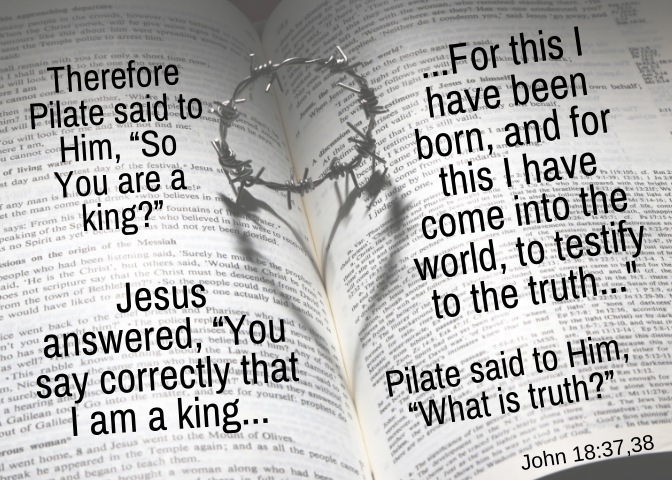
That’s because Jesus is not focused on the injustice of what is being done to him. He is not looking for his personal justice. Jesus is, instead, focusing on his God-given destiny and duty. When being questioned by Pilate, he says “You say that I’m a king.” Jesus goes on to say,  “I was born for this, and I have come into the world for this: to testify to the truth. Everyone who is of the truth listens to My voice.”(John 18:37) Jesus is focused, in the middle of supreme injustice and false imprisonment, on why he was born, the reason for his existing. And what is that purpose? Not to disparage any evangelical preacher, but Jesus did not merely come to do three days’ work. Instead, he came to “testify to the truth.” The truth is humans need to be saved from their sins, he is that salvation, he is the only way to salvation, eternal life and the spirit will be given to those who seek this truth.
In the midst of this, we also see a picture of the world. Now, I’m of a specific bent that says God does not control every facet of the universe. God does not predetermine or force my hand and only make me act as he wants me or wills me to act. However, this does not mean that the world is completely and utterly out of control. In a way that is completely unknown to me, a way that I daresay we should call a mystery, God controls certain events, outcomes, or situations. Here, Jesus seems to take comfort in the fact that his own torture and death is not outside of the plan of God. God knew, “If my Son goes among the Jews and tells them the truth, they will crucify him. I will give humanity the authority to do so.” God isn’t wringing his hands in heaven saying, “I wish I could do something, but I’m not strong enough!” Nor is God a puppet master with all the strings making his marionettes dance. He is working out his will inside the real, free, true choices of humanity.
Interestingly, Pilate may have gotten it. Pilate, according to all the history books was a brutal and bloodthirsty man ready to squash any rebellion with the slightest whiff. But I think he understood who he was talking to in Jesus and what the Jews were asking of him. He seems to have answered his own question “What is truth?” And he answers it with the inscription above Jesus’ head “Jesus the Nazarene, the King of the Jews” written in every common language. The truth is that in this suffering, we see the ultimate juxtaposition. A savior killed like a slave, a righteous man made wretched, a King on a cross. THAT’S the symbol we gravitate toward. That’s the symbol that defines Christianity. It is a cross that shows the greatest moment of humanity, depravity and sin, and the greatest moment of the God-granted mercy, compassion and love.
Then, Jesus dies. There’s no fanfare in the book of John. It is interesting that what happens in the other gospels, the earthquake and the darkness and the resurrection of righteous ones, are summarily overlooked or forgotten. They pale in comparison to the fact that the King of the Jews, the bread of life, the water of life, the SON OF GOD is hanging dead on a cross. This man, who only loved, who only wanted the best. Who demanded that the pharisees live the same life they demanded of everyone else. Who said “turn the other cheek” and “do not judge unless you are ready to be judged”. Who said “blessed are the meek, blessed are the poor, blessed are the persecuted.” This man who lived a life of perfect relationship and obedience to God, is hanging limp on a cross, covered in blood and bodily fluids. His arms and legs are no longer straining against the nails because he feels the pain no longer. His body bears the marks of scourging. His face is beaten beyond recognition, and above the bruises and laceration that disfigure the face of the Messiah, sits a crown of thorns, a gift from humanity to inaugurate our King.
There are many questions to ask of ourselves after this.
Do you treat your enemies with love and respect?
In times of trouble do you rest secure in the knowledge that you have a larger purpose than simply existing for today?
Do you even know what the larger purpose of your life is? Do you know specifically what the goal of your life is?
Do you rest secure in the knowledge that God is ultimately in control, whatever that might mean?
But above all of this is: what does it mean, FOR YOU, that the Son of God died on a cross? What does it mean for you that Jesus was tortured unjustly by a religious institution that couldn’t handle the fact that they were, in fact, broken and messed up and needed some saving? What does it mean for you that you were just as much responsible for the death of Jesus as Pilate and Caiaphas?
What will you do? We’ve place the crown of thorns of his head.
Will we cast our crown before him and acknowledge that Jesus is not only the King of the Jews, but the King of Kings and the Lord of Lords?
Will you commit to making him YOUR Lord, the Lord of every part of your life?
In Christ,
Jake Ballard