Still Relevant Today

Leviticus 17-19

If you ask anyone about what Jesus taught his followers to do, there is usually a wide variety of responses: however, most of the answers you will receive will focus on his command to “love your neighbor”. Indeed, this was considered the second greatest commandment by Jesus:

The greatest commandment is, ‘Hear, O Israel! The Lord our God is one Lord; and you shall love the Lord your God with all your heart, and with all your soul, and with all your mind, and with all your strength.’ The second is this, ‘You shall love your neighbor as yourself.’ There is no other commandment greater than these.” – Mark 12:29-31 NASB1995

However, most people today would be shocked to learn where Jesus got this second greatest commandment from: the book of Leviticus!! In Leviticus 19:18, we find out that God has always desired His people to love their neighbor as themselves, even in a book that most modern readers want to throw away because it doesn’t seem “relevant” anymore. While we don’t have animal sacrifices and aren’t bound to certain ritualistic laws found in this book any longer, it is still a relevant book for Christian living: in the book of Leviticus, we not only find the second greatest commandment (according to Jesus), but also what loving our neighbor as ourselves looks like. How are we supposed to “love our neighbor as ourselves”?

Beginning in chapter 17, we begin a new section within Leviticus, oftentimes called the Holiness Code: in this new section, God stops directing instructions to the priests and begins addressing the people of Israel directly. In this Holiness Code are very relevant and practical ways that we can “love our neighbor as ourselves”. Among the descriptions in chapters 18 and 19 are:

  • Not pursuing improper sexual unions (still relevant today)
  • Not sacrificing your children to other false gods (still relevant today)
  • Showing reverence for your parents (still relevant today)
  • Leaving some of your wealth for the poor and needy (still relevant today)
  • Not stealing or lying (still relevant today)
  • Not withholding pay from someone you hired (still relevant today)
  • Having fair judgment in court (still relevant today)
  • Not hating or bearing a grudge against your neighbor (still relevant today)

As we can see, most of the Holiness Code is still proper for us to practice under the New Covenant (if not all of it), as we seek to love our neighbors as ourselves. There is one more part to loving our neighbor that we need to focus on and re-learn in our society today, but may be difficult to hear.

… you may surely correct your neighbor, but shall not incur sin because of him.” – Leviticus 19:17b NASB1995

When I’ve made some bad decisions in my life, there have been people who have called me out on it and tried to correct my actions: in the moment, I didn’t enjoy it at all and felt “attacked”, but I learned quickly that they were only concerned, loved me deeply, and wanted me to do better. True love for our neighbor doesn’t turn a blind eye to their sins or allow them to continue down a dangerous road because we don’t want to “hurt their feelings”: true love is difficult, because it is hard to warn someone when they are doing the wrong things that could hurt them or others. Jesus knew this and commanded us to do the same thing.

If your brother sins, rebuke him; and if he repents, forgive him.” – Luke 17:3

In our current world where we are very sensitive towards the emotional needs of our friends and family (which is good), we cannot ignore the clear commands from Scripture to step into their lives and help them see their need for change. If you want to truly love your neighbor as yourself and fulfill the second greatest command in Scripture, you MUST call your loved ones out when the moment calls for it: it is super uncomfortable and can feel damaging at first when they inevitably get upset, but could be the most life-changing and loving thing you ever did for them. Nobody has everything figured out perfectly until Jesus comes back, and if we are Christians, we will want to live the best we can until that Day comes: however, sometimes that comes with the pain of admitting we were wrong.

If someone you love is making choices that are damaging to their life (and spiritual life), don’t be afraid to say something: it is the most loving and difficult thing you can do for them.

-Talon Paul

Reflection Questions

  1. Suppose we do a really good job of loving God – why would He care if we also love others or not? Have you ever met anyone who did a really good job of loving God but wasn’t very loving toward others?
  2. Who has been there to love you by correcting you? Looking back, is there any time in your life when you wish someone would’ve shown love to you by correcting you – even if you might not have appreciated it at the time?
  3. Are you aware of any current situations where God might want you to love your neighbor by lovingly correcting – speaking the truth in love? What might that look like? Is it a job you have been trying to avoid? What happens if we don’t do it? There is a lot of sin in the world. Does God want us to spend all of our time correcting? How do I decide when it is the loving thing to correct?

Dear Church in Laodicea – and You

OLD TESTAMENT: Jeremiah 43-45

POETRY: Psalm 119:73-80

NEW TESTAMENT: Revelation 3:14-22

Rev. 3:14-22 – Letter to Laodicea

You’ve made it to the last letter!   Thank you, as always, for joining me as we grow in our faith walk.  It is always a pleasure and a growth experience for me as well!

Laodicea is one church briefly mentioned outside of these Revelation verses.  While writing to the Colossians, Paul also mentions the church in Laodicea, encouraging them throughout his letter there, and reminding the Colossians that this letter was meant for the Laodiceans as well (Colossians 4:16).  By some verses, it seems that Paul himself did not travel there, but did have fellow believers he was connected with that traveled there on his behalf and supported the ministry.  There is some scholarly debate as to if Paul ever wrote Laodicea a letter directly that may be hidden in one of the other New Testament books, or lost, or simply is a misunderstanding of translation.  A mystery you could choose to explore yourself… but not our main point for today.

Laodicea was a very wealthy, abundant city.  When destroyed by an earthquake, they refused to take Roman funds but instead paid themselves to rebuild it back to its prosperous state.  It was full of strong, independent, rich people.  And yet, it is listed as a church with no positive attributes and only rebuke from Jesus. In fact, Jesus writes of his desire to spit or vomit them out (v.16). Ouch.  

So, what’s so bad about being lukewarm?  At least they weren’t called spiritually dead like in Sardis, right?? Well, Sardis was at least doing something, and there were a few members still actively living out the truths of Jesus’ ministry.  It seems that Laodicea was truly doing nothing… they weren’t being useful in any capacity, and were so inflated with their own sense of self that they didn’t even notice they were really poor, blind, and naked (v.17)!  They had turned their hearts so far towards their own wealth and recognition, that they truly just abandoned their faith.  Maybe they still met at church for a social gathering, but there was no discussion, no action, no edification, no growth.  They weren’t doing one thing wrong, they were doing absolutely nothing.

To correct this, Jesus gives them advice to buy gold from him that has been refined by fire, clothes to cover their nakedness, and salve to heal their blindness (v.18).  In the context of this particular church and city, this probably felt a bit like a slap in the face.  They had their own gold, they made their own beautiful linens, and they even were known for their medicinal salve! Why would anyone tell them they needed to go anywhere else to get those things?  Well, Jesus was trying to point out the fact that what he was “selling” was nothing they could find in their own material possessions. He was intending to knock them down a few notches and realize what they needed was God’s grace, and that wasn’t something they could just buy at one of their various stores around town!

In verse 19, Jesus reminds this church that he rebukes and corrects the people he loves.  One thing this church has going for them, that really every single person has, is that Jesus loves them enough to call them out!  In this letter he reminds them that he is present, he is knocking at their door, calling for them, with an invitation to spend time with him (v.20).  Jesus is actively pursuing this group of people with a desire to include them, to lift them up to a place of majesty (v.21).  He deeply wants them to be part of the Kingdom, but they needed to first recognize how much they needed him to get there.  There is a destruction coming that they aren’t going to be able to pay for themselves… and Jesus wants them to be on the side of redemption instead.

When we experience worldly wealth and success, we run the risk of becoming lukewarm in our faith, because we lose the recognition of our true need for God.  We must have a level of humility and respect (or fear!) for the Creator of all things in order to really put our faith in action daily!  We are dependent on God for so much more than we may consciously think throughout our days, but when we ignore how we desperately need His Grace, His Son, and His plan for salvation, we miss out on the opportunity to be in His Kingdom.  Not to mention so many other blessings we could experience in this current life!

My prayer for anyone reading these devotions this week is that you were able to find something that spoke to you.  Whether it was conviction, encouragement, or an idea for how to apply it in your home and church, I hope you found something in it for you.  I pray it was a blessing and that you continue to dive deeper in Scripture to continue strengthening your faith!  

Reflection Questions:

  • Have there been seasons in your life where you “forgot” to rely on God?  Have there been seasons where you were reminded of just how much you needed Him?  What were the biggest differences in your life at those times?
  • What barriers do you see in your life that prevent you from relying on God, and may get in the way of you focusing too much on your sense of self?
  • If you’re anything like me, you probably saw a bit of yourself in each letter.  When reflecting on each letter, which do you resonate with the most?  Re-read Jesus’ correction for the church you feel most like, and see how you can apply that rebuke to your life this week. 

-Sarah Johnson

Wounds from a Friend

Old Testament: 2 Kings 9 & 10

Poetry: Proverbs 27

New Testament: Luke 10:1-24

The Proverbs are, in many cases, fairly self explanatory. Don’t be lazy, don’t be a wicked ruler, don’t be foolish but be wise, be a righteous ruler, be diligent in your work. Each Proverb has it’s own meaning but they go along those lines. But some are not so self explanatory. They are counterintuitive.

A short example is found in 28:27. If you want to be prosperous and blessed, to never be in want, then we give our money to the poor. The world, our own sinful heads, and many economists believe that the way to grow our wealth and not be in want is to hoard our money. But that’s not the way God works. It is only in generosity and giving that we will be blessed. This comes from the fact that God will bless and many times he blesses us through the care of others in our time of struggle and hardship.

Also, 27:5-6 doesn’t seem to be true in the moment. I don’t like to be rebuked. I don’t like it when a friend calls me out on the garbage way I am acting. But the Proverb teaches us that we should delight when a friend rebukes us because their correction comes from a place of love and they want our life to be one of wisdom and righteousness. This is especially true for  our brothers and sisters in our local church. Many times, we may feel judged by the people of our church, but more often than not, they are wanting the BEST for us. The “wounds” they give are better than any kisses of those who tell us we have nothing wrong with us. There could be people who act like a friend and hurt you in terrible ways, but here we mean TRUE friendship, TRUE companionship, TRUE love from a brother or sister in Christ. That true love is shown in forgiveness and compassion, especially in our moments of weakness and humility. Many times, when we are sinning and are fearing the rebuke of those people, we hide our sin away, like 28:13 says. But counterintuitively, by hiding our sins, we only hurt ourselves more when they are brought to light in some other way. We need to confess our sins and turn away from them. When we do, compassion and forgiveness are waiting for us from the people of God and from God himself.

Jake Ballard

(originally posted for SeekGrowLove June 17, 2020)

Reflection Questions

  1. What other proverbs have you run across that seem counterintuitive and the opposite of how the world thinks or operates? How is God’s wisdom better than the world’s?
  2. Can you think of a time a true friend gave you correction or a rebuke? Can you think of a time you, as a true friend, gave correction or rebuke? What is the value of correcting a friend? What problems can develop if we don’t correct in love, or if we don’t accept the correction given in true love?

Wise Words Regarding Sin & Discipline

Hebrews 12

Hebrews 12 1b

Welcome back friends!

Today we’re talking about sin and discipline.  Very bright and happy topics I know!

To start off let’s take a look at verse 1: “Therefore, since we are surrounded by such a great cloud of witnesses, let us throw off everything that hinders and the sin that so easily entangles.  And let us run with perseverance the race marked out for us,”  I want to focus on the sin that so easily entangles.  We are told to throw off everything that hinders us because there is a great cloud of witnesses.  And if we remember from yesterday, we were just reminded that God has a perfect plan for us that will come someday, so this verse is reminding us to keep pushing and running the race until that day.  So why does the author specifically mention sin?  Wouldn’t that be included in the things that hinder us?

Now, obviously I am not the author of this book so truthfully, I don’t know exactly why it was written this way!  However, as I was reading it my eye was drawn specifically to the phrasing of “sin that so easily entangles us”.  I know for me personally at least, you almost forget that sin can creep into our lives SO easily!  People who grow up in the faith tend to recognize (and hopefully avoid) what we term as “big sins”, don’t we?  I’m talking things like sexual immorality, murder, drunkenness, etc… We are quick to recognize those and turn our nose up at them.  But what about things such as lying? Or jealousy, anger, greed, anxiousness and impure thoughts?  Sin is sin no matter what.  When we ignore the “smaller” sins, that’s when they easily entangle us!  The bigger issue is not that we are sinners, because everyone is and everyone has been offered the same grace.  The issue is when we fail to recognize our own sin and shake it off in order to keep running the race.

And now that we’ve covered sin… we get to move on to the discipline.  Yay?

Verse 6 reads “…Because the LORD disciplines the one he loves, and he chastens everyone he accepts as his son.”  This is a common message that is still hard for me to grasp at times.  God disciplines, corrects, humbles, however you want to word it, BECAUSE He loves us.  He is working to create a righteous and peaceful life for us (vs. 11).  Verse 8 even says that if we do not undergo discipline, we are not true sons and daughters!

I am not a parent, but I do have the joy of watching a lot of un-biological nieces and nephews, as I refer to them.  I love my kiddos!  Just the other day one of the kids I was watching kept trying to stick his finger in an electrical outlet.  I continued to swat his hand away and tell him no.  Not so surprisingly, he started crying with his head thrown back and huge tears falling from his eyes.  Obviously, my intent was never to upset him, but I also didn’t care!  I wanted to make sure he was safe and understood how dangerous that could be.  I think God works in similar ways.  He knows that our sins in our life are going to lead us to pain and suffering.  When I was watching that little boy, I could not believe how frequently he went back to the same outlet despite my corrections, almost like he didn’t even notice I was steering him away from it!  I wonder what God is thinking when we keep trying to go back to the same thing He knows is going to hurt us not matter how often He corrects us.

God loves us.  He loves us as sinners and disciplines us in order to protect us from ourselves.  He will one day give to us a kingdom that will not be shaken and because of that, we should worship Him with reverence and awe (vs. 28).  In what areas of your life is God correcting you?  Do you even realize it yet?  Although the discipline may be painful now, rejoice in what it will create later!

-Sarah Blanchard

Recognizing Wisdom – Proverbs 14

Prov 14-12 corrected
Have you ever found it easier to see the right thing for someone else to do than for yourself?  There is a reason for that.  We often times can tell someone what to do but can’t seem to do it for ourselves.
For example:
25 A truthful witness saves lives,
But he who utters lies is treacherous
 
In this proverb we see that lying only brings destruction.  We ourselves hate being lied to.  We hate seeing people live a lie. We know how much damage it can do.  We know this but I bet if I asked if you have ever lied or lived a lie you would probably say yes.  I bet if I asked you if you knew how to correct that in someone else’s life you would have an answer almost immediately.  It is so easy to see the foolishness in someone else.  Its easy to know what to do to correct their wrong behavior.  But I bet it is harder to correct in yourself.  Why can we see the answer to foolishness in others easily but have such a difficult time correcting it in our own lives? 
   The answer is we have no emotional ties to their sin.  We won’t have to deal with the consequences of trying to correct our behavior.  I can tell you how to correct your behavior all day long because I don’t have to do it.  I don’t have to deal with the mess.  But if I have to correct a sin I know what that will take, and often times I don’t want to deal with the pain and hurt that comes with going back and fixing issues like lying bring about.
Read Proverbs 14 and see if you can see any foolishness in your life that you need to correct.  Are their verses in this chapter that really resonate with you?  Can you see the foolishness in those verses?  Can you recognize the wisdom it takes to realize that some of these verses apply to you.  Are you willing to recognize the wise thing to do and apply it to your life?  Your foolish ways become harder and harder to stop the longer you wait. 
The very first verse illustrates this perfectly:
The wise woman builds her house,
But the foolish woman tears it down with her own hands.
 
Are you tearing your life apart by not recognizing wisdom?
I’m praying for you.
Andy Cisneros

Scripture: Our Corrective Lens – Proverbs 12

reading-glasses-in-use

Today brings our weeks study of Proverbs 6-12 to a close.  Chapter 12 is a continuation of the antithetical Proverbs and there are some real beauties in here and they range through quite a spectrum of wise and unwise behaviors.

It leads off with a really good set of contrasts: “Whoever loves discipline loves knowledge, but whoever hates correction is stupid.”  It doesn’t get much plainer than this:  A wise person willingly accepts discipline, but if you hate to be corrected by another you are stupid.

ted williams

Everybody makes mistakes.  I’m a big baseball fan.  I’ve always enjoyed playing and watching baseball.  The amazing thing about baseball is that the BEST baseball players fail between 60 and 70% of the time.  That’s right!  The best hitters usually have batting averages around .300, sometimes .350 and very rarely (like Ted Williams was the last one who did it and that was more than 70 years ago) someone will bat .400.  But even if you’re the greatest hitter of all time, you still FAIL to hit the ball 6 out of 10 times.  What is it that sets great hitters apart from the rest of us?  They learn from their mistakes.  They study film of their mistakes.  And they listen to their coaches who help them to correct what would appear to us to be very minor mistakes.  You get to be a great hitter by accepting correction, from learning from your mistakes.  That requires a lot of humility.

The same is true in the rest of our lives.  We all make mistakes.  Often we catch our own mistakes and take steps to correct them.  But sometimes we don’t even see our own mistakes.  Sometimes someone else sees our mistake and offers a word of correction.  A wise person willingly listens to correction and attempts to change their behavior… a foolish person refuses to receive or learn from the correction of others and so they fail to improve their actions.

The whole foundation of the gospel message in the Bible is a openness to correction and a willingness to change.  Jesus himself began his ministry by calling people to “repent, and believe the good news.”  To repent means to change your direction.

As you read through the Bible, God will use His word to bring to your mind and heart his corrective word.  You will see areas where you need to change.  You’ll see a passage like “Diligent hands will rule but laziness ends in forced labor.”  You might read that passage and realize, deep down, that this is an issue in your life.  You might blame other people for some of your problems, you might make excuses for why you do or don’t do certain things, but the fact is, you might actually be lazy.  I’m not saying you are lazy because, well, I don’t even know you.  You might be a diligent, hard working person and that’s great.  But then again, you might be lazy.  Your laziness may cause you to procrastinate and put off doing things that you need to do but don’t enjoy.  Your laziness may be costing you good grades in school, or a promotion at work.  Your laziness may because causing conflict in your marriage as your spouse resents that they have to work harder to make up for your laziness.  Your laziness might be keeping you from going to Church on Sundays or serving in a ministry at your Church where you might be very gifted and very helpful.  I don’t know if you’re lazy or not, but you need to at least take a hard look and ask yourself “does this Proverb apply to me?”  If you’re not sure, ask someone important in your life who really knows you and isn’t afraid to speak truth into your life and ask them “Do you every observe laziness in me?”  And if they say, yes, then you might want to consider that you may be lazy and you might want to become more aware of ways that laziness manifests itself in your daily life.  And you might begin asking God to help you change, understanding that it won’t happen overnight.

all scripture is God-breathed

But know this, no positive change can happen in any area of your life until you are ready to receive correction.  God’s Word, the Bible is powerful.  In one place the Bible refers to itself as a double-edged sword.  It’s able to dig deep inside of you.  It is able to help you change if you allow it to do it’s work in your life.  II Timothy 3:16 says it very well: “All Scripture is inspired by God and is useful to teach us what is true and to make us realize what is wrong in our lives. It corrects us when we are wrong and teaches us to do what is right.” (New Living Translation).

Almost exactly a year ago I had surgery to remove cancer from my body.  I let a surgeon cut through my skin and muscle to get to where the cancer was and very carefully cut it out.  Why?  Because I don’t want to die from cancer any sooner than necessary.  As I think about it today,  I gave that surgeon an awesome responsibility.  And to be honest, before the surgery I was afraid.  Who is this man with a knife that I’m entrusting with my body, my life?  I’m glad I did it, because here I am a year later and I’m still alive and I have a whole lot less cancer in my body then I did then and I’ve got a whole lot better chance of living longer now because I trusted him to perform surgery on my life.

“The fear of the LORD is the beginning of Wisdom, and knowledge of the Holy One is understanding”. (Proverbs 9:10).  I trust my awesome God to use His word to go to work removing all the bad stuff in my life and bringing me to wholeness and salvation.  God does this through his word and through Jesus Christ, who was pierced for our transgressions.  It takes some cutting and some bleeding to bring us life, and to bring us eternal life.  I trust God my awesome God, do you?

~ Jeff Fletcher

Unveiling the Past, Present and Future…And Then Repent!

Monday, July 17

revelation1-8

Revelation 1-3

The final book of the Bible is known as the Book of Revelation.  It is also known as the Apocalypse.  Apocalypse mean “unveiling”.  It has the idea of that which was hidden has now been unveiled or brought out into the open to be seen.  There are other passages in the Bible that contain apocalyptic material (parts of the book of Daniel and Ezekiel are two) but this is the only book of the Bible that is fully apocalyptic.
Revelation can be a little confusing (ok, a lot confusing).  A big part of this confusion comes from the challenge of pinning down the proper timeline.  It contains material that was past, present and future to the writer, John, who wrote toward the end of the first century.  The angel who gave this revelation to John said: “Write, therefore, what you have seen, what is now and what will take place later.”(Rev. 1:19).  There are different “schools of interpretation” that see Revelation as mostly focusing on John’s time period (end of first century in the Roman empire), others see it as being fulfilled progressively over the past 2000 years of the Church, and others see it as still to be fulfilled in the future.  This is compounded by the use of symbol and imagery that fill the visions of Revelation.  A lot of time can be spent trying to discuss and debate these issues, but for our purposes I’d like to focus on basic principles found in Revelation that can be of value to our lives as followers of Jesus today.
In chapters 1-3 a focus is on letters written to seven Churches throughout Asia.  John is writing to them as a pastor who at the time was living in isolation on an island in the Mediterranean sea.  He can’t be physically present with his churches, but he is with them in spirit and wants to encourage and instruct them, to help them stay strong during a time when many believers were suffering persecution by the Roman empire.  Imagine what it would be like to try to encourage Christians today living in places like Pakistan, or Egypt, or Sudan or Syria, where Christians were being killed because of their allegiance of Jesus Christ rather than to Mohammed.  What kinds of encouragement would Christians whose family members, friends and fellow believers were dying for their faith need to help them not lose faith?
In the Roman Empire during John’s time of writing it was required by law for citizens to declare allegiance to Caesar by publicly declaring Caesar to be Lord.  Jewish people were largely exempt from making such declarations (but not always).  Often Christians came under the umbrella of the Jewish exemption, but now always.  Thousands of Christians died as a result of religious persecution during the early Roman empire.  John writes to offer encouragement to keep faithful to their commitment to God and to Jesus Christ in the midst of such persecution.  The challenges we face today may not be the same type that first century Christians faced, yet we still have challenges, struggles and temptations.
Chapters 2 and 3 of Revelation contain words of exhortation and correction to the various Churches to which John is writing.  Each Church had many good things happening for which they were praised, but several also had not so good things going on for which they needed to be corrected.  One of the common themes of each letter to each Church was a call to repentance.  To repent means to turn around or change direction.  To the Church at Ephesus, John said that you have “lost your first love.”  They were just going through the motions of their faith, without the passion.  Perhaps you can relate to that.  Anyone who has been a Christian for a while has to be aware the danger of “just going through the motions” and losing their passion for God.  John is trying to get them fired up again.  John says: “repent” and do the things you did at first.  Most Christians, start out enthusiastic… they read the Bible a lot, they pray a lot, they tell their friends about God and their faith a lot, and they consciously seek to get closer to God and do things to please God.  But over time, they lose the passion, lose the drive… become complacent.  John says- get back to the love and passion you first had for Jesus.
Maybe this is you.  If it is… let it be a wake up call.  If this isn’t you, then keep reading through Revelation 2 and 3.  Look at what is said to each of the seven churches.  Is there anything that rings a bell?  Is there anything there that applies to you?  I’m guessing there is.  Read it… and then repent.
-Jeff Fletcher

How to Be Stupid

Proverbs 11-13

prov-12-1

Tuesday, January 24


How have you used your “fountain of life” today (Proverbs 10:11)?  Did you know when to keep it shut?  Can you think of a time when you used it (your mouth) to nourish others?   In today’s readings there are several more excellent verses reminding us again of the power of our words.  And of course we know that “With Great Power Comes Great Responsibility”.  Some verses worthy of being great refrigerator verses are:

11:12 – A man who lacks judgment derides his neighbor, but a man of understanding holds his tongue.
12:18 – Reckless words pierce like a sword, but the tongue of the wise brings healing.
12:28 – An anxious heart weighs a man down, but a kind word cheers him up.
13:3 – He who guards his lips guards his life, but he who speaks rashly will come to ruin.

My guess is we can all quickly think of a time when someone’s words pierced us, and also a time when someone’s words healed us.  Can you also think of a recent time when your own words pierced another?  What about brought healing or cheered up someone?   How can we make a better plan for our mouth so we don’t just say the first thing that comes to mind, which can lead to ruin?

How about experimenting with ranking your mouth at the end of each day for the next week or two.  A big fat score of 0 would be for a day filled with piercing words spoken rashly: accusations, angry outbursts, rudeness, gossip, lies or twisted truths, put-downs (even in jest? It’s not really funny), boasting, manipulating, cursing and foul language, I’m sure you can think of more.  And of course our goal would be a shining 10 score for a day full of polite speech, genuine compliments, thankfulness, apologies, forgiveness extended, words of encouragement and sometimes sympathy, morsels of truth at just the right moment, Godly wisdom and Bible verses shared – and none of that nastiness that automatically pull your score down.  From day to day be looking for ways to grow your own score.  Be more mindful of how you use your words  – and sometimes more appropriately, your gift of silence – and the impact it has on those around you.   Hold yourself accountable for the proper use of your fountain of life.  For only then will you be called righteous.  (10:11)

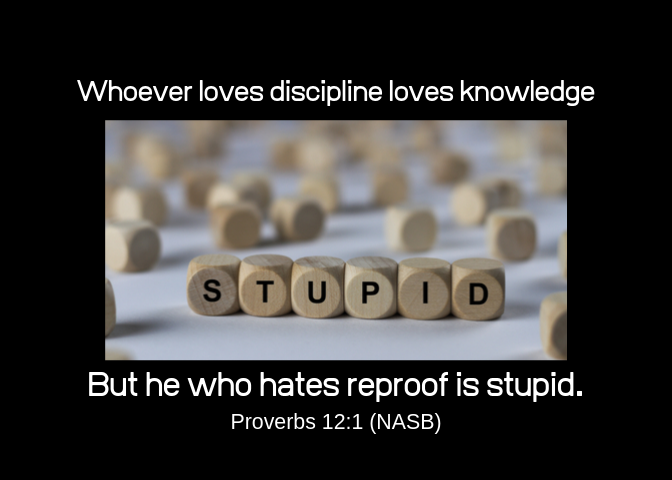
There is so much more wisdom and lessons for the one seeking to live a righteous life!  Come to think of it – Proverbs also has great advice if you are aiming to be a stupid fool.   Solomon could have titled Proverbs, “How to Be STUPID”.  Proverbs 12:1 is a great start: “Whoever loves discipline loves knowledge, but he who hates correction is STUPID.”   And, since reading it once isn’t always enough . . .

13:1 – He who ignores discipline comes to poverty and shame, but whoever heeds correction is honored

13:10 – Pride only breeds quarrels, but wisdom is found in those who take advice

12:15 – The way of a fool seems right to him, but a wise man listens to advice

Raise your hand if you think you are right most of the time.  My hand goes up.  Guilty as charged.  No doubt it is my pride that makes me think I am right and they are wrong.  Sometimes, I AM right.  But, when I am WISE I will realize and accept that I am also sometimes wrong.  I have been, am and will be wrong, in need of correction and discipline and sorely in need of advice.  Why should I even LOVE discipline (12:1)  – because I want more and more to be as Godly as possible (Be holy, because I am holy – I Peter 1:16)– and right now there is still a pretty huge gap between God’s holiness and mine.   Dear God, help me grow a more humble spirit that accepts correction well.

So many great proverbs, so little time.  We sadly won’t go into detail about the sluggard, pig snout, chasing fantasies or husband’s crown or so many others.  But just one last nugget for those who want to be wise. “He who walks with the wise grows wise, but a companion of fools suffers harm” (13:20). If you desire to avoid harm (and I sure hope you do) – choose your companions carefully.  Don’t waste your time searching for perfect people to be friends with – that can be a real disappointment.  But choose to spend your time side by side with those who are seeking to grow closer and closer to the Father.
Keep Growing!
God Bless,
Marcia Railton