I have appreciated the opportunity to read and share my thoughts with you across these seven days. We’ve traced the unfolding drama of the divided kings and kingdoms of Israel. We’ve watched the culture shift, the crowd move to and fro, and the pressure rise and fall, but through their stories, one truth rings clear: the faithful know that wisdom comes from God alone.
“How long will you waver between two opinions? If the Lord is God, follow him; but if Baal is God, follow him.” (1 Kings 18:21)
Looking momentarily at my own nation, America is a nation with deep Judeo-Christian roots, as many of our founding documents demonstrate a commitment to God as the architect of the law that governs us. Our motto makes mention of our trust in God, we proclaim His work in our patriotic songs, open government functions with prayer, and swear in our presidents with their hand on His Word. I am one of many who believe the blessings we enjoy as a nation—even in today’s troubling times—can be attributed to the enduring declaration that the God of Israel and the Father of Jesus Christ reigns here. Sadly, more and more are living on borrowed blessings as the altars of moral revision, self-importance, and political convenience are being fashioned and raised.
Today, we look to the prophet Elijah, who lived as a lone voice for the Lord in a nation God had once richly blessed. Elijah wasn’t trendy or tribal. His conversations with God were authentic and intimate, and he took action as one who was swiftly obedient. His faith was so personal that he was often fully dependent on the Lord even for his next meal—fed by ravens and sustained by a jar of oil and flour that never ran dry. How ready would we be to fight off the enemies of God, to recite and rely on His promises, and even to expect miracles in His name, if we lived with this kind of faithfulness?
Each of us is called to that kind of personal, committed, lived-out faith. It may seem like faith is inherited—passed down through our nation’s heritage or through family and friends—but true faith is never proximal. Hanging with a spiritual crowd, attending high-energy worship services, or serving on a ministry team are not guarantors of a relationship with the Lord. Personal faith is born in the discomfort of repentance, in the surrendering of fear, and in the offering up of our possessions. These are the intimate things God desires from us. In the abandonment of self, we begin to hear God’s call clearly—and are emboldened because we know our Creator personally.
“At the time of sacrifice, the prophet Elijah stepped forward and prayed: ‘Lord, the God of Abraham, Isaac and Israel, let it be known today that you are God in Israel and that I am your servant and have done all these things at your command. Answer me, Lord, answer me, so these people will know that you, Lord, are God, and that you are turning their hearts back again.” – 1 Kings 18:36–37
In this week’s reading, we’ve seen that change in a nation is inevitable. I pray that “In God We Trust” will continue to stand as a reminder of our nation’s steadfastness for the Lord. But however long it endures, let it always point us to something greater—our personal relationship with God, built through surrender, obedience, and faith. If the Lord is God, stand for Him—even if you stand alone. Because at the end of the day, it’s personal.
-Aaron Winner
Reflection Questions
What character traits do you find in Elijah? Is there one you would like to have more of in your life? How would you go about adding more?
Music has always been a huge part of my life. From singing along to Veggie Tales songs in the car to being dressed up in my Sunday Best doing a ‘special’ on Sunday Mornings, from an early age I was taught the importance and beauty of song sung in worship.
I still like to sing and dance to ‘I Like Bananas’ around a campfire, but my understanding of worship has expanded and grown. Just singing doesn’t mean that we are worshipping God, and sometimes the most worshipful moments are done in silence. We all know the days where we are going through the motions in a Church service, singing familiar words without it ever truly reaching our hearts.
What should a heart of worship look like?
In today’s reading, we see Psalm after Psalm of praise and worship. Importantly, the Psalms show the heart behind worshipping God.
A heart of worship is:
Based on the character of God, not the quality of our voices. We don’t sing praises because we ‘sound good.’ We sing praises because God is the ultimate thing that is worthy of praise. We sing because he has truly done ‘marvelous things.’
Grounded in the truth of scripture, not the beat of the song. The Psalms repeat the truth again and again: “The Lord reigns.” Why? Because the transformative power of worship is focused on repeating the truths of scripture to ourselves. We can praise God and weather difficult circumstances because God reigns.
Focused on remembrance, not emotions. Our summer camps were always a highlight of the year because we loved the worship. But the truly quality of worship isn’t based on the quality of the band. It’s based on the way we remind ourselves of the goodness and faithfulness of God and praise him for it.
One of my son’s favorite places to go is Dollywood Theme Park in Tennessee. He loves the decorations, the shows, and the food, but his favorite thing to do is ride the rollercoasters. I’ve never been a huge fan – I’m deathly afraid of heights and don’t like the feeling of being slung around. But, you can tell the joy (and a little fear) on his face as he clicks up to the first big drop and then races down through the twists and turns. Of course, at the very end, he always turns to me and says, “Can we ride it again?”
David’s life was definitely a roller coaster ride. He was sent to watch sheep by his father while Samuel came to pick the king, only to be called from the fields and anointed. He was elevated to be a part of King Saul’s court, only to be forced to flee for his life at night. He spent 15 years running from Saul, only to finally be crowned king. And this isn’t to mention Bathsheba, Abasolom, and the census.
So many highs and so many lows.
But, through it all David remained faithful.
We can see the contrast between the highs and lows as we read Psalm 57 and David’s song in 2 Samuel 22.
In Psalm 57:4, David cries out, “My soul is in the midst of lions; I lie down amid fiery beasts— the children of man, whose teeth are spears and arrows, whose tongues are sharp swords.” But still, he praises God.
In 2 Samuel 22:17-20, he exclaims, “[God] sent from on high, he took me; he drew me out of many waters. He rescued me from my strong enemy, from those who hated me, for they were too mighty for me. They confronted me in the day of my calamity, but the Lord was my support. He brought me out into a broad place; he rescued me, because he delighted in me.”
In both the highs and lows, David cried out to God. He praises God. He finds refuge in God.
You may be stuck on the roller coaster now. You may be in the lowest of lows, or you may be high on that mountaintop. But, wherever you are, remember God is there with you.
Wait on the Lord. Put your trust in God. He is faithful. He will walk you through it.
Have you experienced a low time in your life? Where did you turn for comfort and support at this time? How did you see God’s faithfulness in this time?
How does remembering God’s past faithfulness help you to navigate your present circumstances?
What are some ways that you can incorporate more worship into your life?
One Sabbath day, Paul came to a synagogue in Antioch (a city in modern-day Turkey) and sat down to listen to the law and scriptures. After the reading was down, Paul got up and gave a sermon. Nestled in the middle of his speech is this interesting passage, “After [God] had removed [Saul], [God] raised up David to be their king, of whom he testified and said, ‘I have found in David the son of Jesse a man after my heart, who will do all my will.” (Acts 13:22)
How amazing it would be to be known as a man (or woman) after God’s own heart! Of all the epitaphs that we could put on our tombstones, this would be the highest praise.
But, we know that there is more to David’s life than just this statement. In fact, it seems a little incongruous to describe the man who sent Uriah to die because of his sin and who sent an Angel of the Lord on his people because of his decision to do a census as a man after God’s own heart.
I think the Psalms we read today – the cries written from David’s own heart – show how he reflected the heart of God.
In the Psalms, we see that:
David understood that God loves righteousness and hates evil. David repeats the truth to himself that God does not delight in wickedness. When he comes to God in prayer, he describes his wickedness as wounds that stink and fester. This bleak picture demonstrates his view of sin: it is evil and something from which you should flee.
David understood the importance of confession. David’s harsh view of sin did not mean that he was blameless. We know that he slipped and fell multiple times and had to deal with the consequences of his actions. Still, when David veered from the good and right path, he recognized it and he turned back toward God. He didn’t minimize sin, and once he humbled himself, he didn’t stay in his sin. Instead, he confessed and repented.
David longed for God. He longed for God’s temple, God’s favor, and God’s very presence. He longed for it as deer pants for streams of water. He describes his soul as thirsting for God. And we know that God is the author and sustainer of life. As the very best thing, he is the ultimate thing we should long for.
To be a man after God’s own heart didn’t mean that David had to be perfectly sinless. No human is able to do that in this lifetime. Instead, being a man after God’s heart means that we are trying to make our heart – our priorities, desires, and understandings – match the heart of God.
If we want to be people after God’s own heart, we should:
The Kingdom of Israel is in the midst of a terrible civil war. Brother had turned against brother and sons against their fathers. The battle was over. Absalom, the rebellious son, had been killed.
At first glance, it seems like David should be rejoicing. He was king again over Israel. Instead, he was caught up in his grief.
Joab told him in 2 Samuel 19:5-7, “You have today covered with shame the faces of all your servants, who have this day saved your life and the lives of your sons and your daughters and the lives of your wives and your concubines, because you love those who hate you and hate those who love you. For you have made it clear today that commanders and servants are nothing to you, for today I know that if Absalom were alive and all of us were dead today, then you would be pleased. Now therefore arise, go out and speak kindly to your servants, for I swear by the Lord, if you do not go, not a man will stay with you this night, and this will be worse for you than all the evil that has come upon you from your youth until now.”
Then, David picked himself up out of the sackcloth and ashes and made his way back to Jerusalem to take back the throne.
This passage strikes me in the way that David has to navigate the circumstances that appear. People grovel at his feet while double-crossing their masters. Political turmoil and intrigue roil underneath the surface as another revolt occurs. A famine stretches the land to its breaking point, and difficult decisions have to be made.
David has to live wisely to save not only himself but also the entire nation from more war, brokenness, and suffering.
And through it all, we see this: our choices carry weight.
What does wise living look like?
Wise Living means stepping out of our circumstances to fulfill our God-given role. Grieving is a necessary part of life. It has its place as we mourn those we love. But, we cannot stay in a place of grief forever. We have to move on and step into our calling.
Wise Living means pursuing reconciliation without compromising truth. As David worked to restore peace in Jerusalem, he had to act as judge over the people who supported him and revolted under him. Through it all, David was not led by vengeance.
Wise Living means recognizing the long-term consequences of sin. In a heartbreaking scene, we see how to pay the blood guilt of Saul a mother who had to lose her sons. Our sin can cause brokenness in our lives, our families’ lives, and the lives of future generations.
Wise Living is a radical decision in this world, but ultimately, it leads to righteousness. How are you pursuing wisdom in this broken world today?
This week we are choosing past devotions to repost, but I had a hard time choosing just one – so here are 3 for you! SeekGrowLove today!
ON PSALM 27 –
(from 2021) You may have noticed that the SeekGrowLove blog features a key verse: “You will seek me and find me when you seek me with all your heart” from Jeremiah 29:13. The LORD confirms that our seeking is worth it, because ultimately, we will find Him. However, there is an important requirement; we need to seek with all our heart. What does this phrase “with all our heart” really look like? How can we seek “with all our heart”? Perhaps “with all our heart” seeking is completely and sincerely devoted. Maybe determined and enthusiastic. This type of seeking is relentless, full of passion for what is right. It can’t be stopped. Psalm 27:4 states, “The one thing I ask from the Lord, this only do I seek: that I may dwell in the house of the Lord all the days of my life, to gaze on the beauty of the Lord and to seek him in his temple.” Verse 8 continues, “My heart says of you, ‘Seek His face!’ Your face, Lord, I will seek.’” You can hear the determination in that statement. The writer wants to be in the presence of the LORD. They are completely and sincerely devoted. Enthusiastic for the presence of the LORD. They are pursuing him ‘with all their heart.’
This is what the LORD desires for us. “The Lord looks down from heaven on all mankind to see if there are any who understand, any who seek God.” (Psalm 14:2) He wants us to seek him wholeheartedly. Passionately. Relentlessly. In life, we can be distracted with many pursuits, desires, and distractions. However, we can choose to refocus on the one who matters. We can choose to seek “with all our heart.” The benefits of this type of “with all our heart” seeking is great. Matthew 6:33 says, “Seek first the kingdom of God and His righteousness.” This desire to be close to God will be rewarded. We are rewarded today with our close loving relationship with God and later when we see Him face to face. So, if you start to feel discouraged or distracted, remember who our seeking will lead to: “Look! God’s dwelling place is now among the people, and he will dwell with them. They will be his people, and God himself will be with them and be their God. He will wipe every tear from their eyes. There will be no more death or mourning or crying or pain, for the old order of things has passed away.” (Revelation 21:3,4)
-Rebecca Dauksas (originally posted February 25, 2021 for SeekGrowLove)
ON PSALM 34 –
In yesterday’s lesson, I neglected to point out a story from 1 Samuel 21 that is relevant to today’s reading. When David ran away from Saul, he escaped to Gath (enemy territory) so Saul wouldn’t keep chasing him. The king’s servants pointed out that David was the man about which they sang, “Saul has slain his thousands, and David his tens of thousands.”
David took these words to heart and was very much afraid, so he pretended he was insane – scratching on the doors, and letting his saliva run down his beard. When the king saw this, he thought David was crazy, and sent him away.
David wrote Psalm 34 after this experience. Here are some verses that stand out to me.
V 3, “Glorify the Lord with me; let us exalt his name together.”
V 4, “I sought the Lord, and he answered me; he delivered me from all my fears.”
V 6, “This poor man called, and the Lord heard him; he saved him out of all his troubles.”
V 7, “The angel of the Lord encamps around those who fear him, and he delivers them.”
V 8, “Taste and see that the Lord is good; blessed is the man who takes refuge in him.”
V 12-14, “Whoever of you loves life and desires to see many good days, keep your tongue from evil and your lips from speaking lies. Turn from evil and do good; seek peace and pursue it.”
V 15, “The eyes of the Lord are on the righteous and his ears are attentive to their cry;”
V 19, “A righteous man may have many troubles, but the Lord delivers him from them all’
We need to be quick to praise God for whatever he does for us, just like David did. It’s easy to cry out to God when times are tough, but sometimes it’s harder to remember to praise Him and let others know what He has done for us. This is important too.
What I really like about this chapter are the multiple times that David points out that we will experience difficult times, but God sees us through those times. I like the image conveyed by verse 7. When I’m going through a hard time, it’s comforting to imagine God sending an angel to protect me. This doesn’t mean I won’t have difficulties, but God sees me through. God is attentive to the righteous.
In verse 8, I picture David saying, “I’ve been through some hard times, but I’ve remained faithful to God, and God has pulled me through. I want to encourage you to develop a close relationship with the Lord. Once you experience that relationship and experience His helping you through those difficulties, then you too can understand how good God is.”
I have to echo David’s words, because I’ve been there. So I encourage you too, “Taste and see that the Lord is good; blessed is the man who takes refuge in him.”
–Steve Mattison (originally posted April 14, 2020 for SeekGrowLove)
ON PSALM 52 –
For the Christian it is considered a “no brainer” that our trust is supposed to be found in God. But so often the stresses and worries of the world come against us, and we may forget that we serve a mighty God who cares deeply for us.
Here in Psalm 52 we are shown a great contrast between David here and his enemy. David wrote this Psalm during the time when he was constantly on the run from Saul, who was chasing him down to kill him, out of jealousy. David lost many years of his life running from Saul but he never lost his trust in God. At this time David had amassed a group of strong men who were ready to fight for him, but Saul, having the armies of Israel behind him, had the greater strength. David had support from people who gave him food and supplies as he ran from place to place, but Saul had all the riches of Israel behind him. But the important thing is that David had God with him, and God had promised him the throne of Israel that Saul currently sat on.
David was able to stay strong in his faith because he had seen God help him against overwhelming odds again and again, the most notable time was when he took on the nine foot tall giant, Goliath all on his own. There were actually two times during David’s years of running, that we are told about, where David had the chance to rely on his own strength to defeat Saul. Once was when Saul went to relieve himself in a cave, not knowing that David was hiding in the cave. The other time, the Bible says that God caused the entire army that was with Saul to go into a deep sleep and David was able to sneak right up next to Saul. Both times the man who was with David encouraged him to kill Saul and take the throne. But each time David refused, saying that he would not harm the Lord’s anointed. It would have been so easy for David to trust in his own strength in that moment, and no longer have to keep running for his life, but just like when David faced Goliath, David put his trust in God and not in himself. And because David did trust God, he never had to draw his sword against Saul or anyone in his family. In one single battle, Saul and all of his sons were taken out by the Philistines. God provided David the throne without David having to shed blood. David’s faith in what probably seemed like the hopeless situation of being relentlessly chased down by King Saul, paid off in the end. Years later after David had become king, he penned another Psalm, in which he said, “Some trust in chariots and some in horses but we trust in the name of the Lord our God.” I hope and pray each day to have the kind of faith and trust in God like David had, and I hope you do as well.
-Jonny Smith (originally posted February 22, 2023 for SeekGrowLove)
Reflection Questions
Is there a time you have trusted in God through a tough situation? What was the result? Who have you seen trust God through a tough situation and emerge with an even stronger faith in God?
What do you sometimes put your trust in instead? How does that work? Why?
What has God shown about Himself in your reading today?
Misunderstandings! Ever been misunderstood and frustrated?! It’s what happened to Moses and the people he led. The LORD told Moses to take vengeance on Midian. Among them Balaam was also killed with the sword, but the women were kept alive. This upset Moses! The women through Balaam’s counsel caused the Israelites to sin in baal worship. … Moses worked out a solution.
Then two of the tribes wanted to settle east of the Jordan River with their abundant livestock. This upset Moses again! How could their brothers go to war while they sat there?! After a lengthy response he heard their intended promise to cross over with them to help them fight and after return to their livestock and cities.
It can be frustrating to be misunderstood. That’s why it’s important to listen and be patient with others. “Know this, my beloved brothers: let every person be quick to hear, slow to speak, slow to anger; for the anger of man does not produce the righteousness of God.” James 1:19
Lastly, let’s not skip over the AMAZING travel journal of chapter 33, and like my Bible geography teacher/husband would say, “It shows these are real places and a real God.” Many of these places are still called that to this day, and it’s from some 3,400 years ago! Pictured above on the left is an aerial view of the Jerusalem/Jericho area looking to the north of Israel with snow capped Mount Hermon on the northern tip. Did you know that there’s a ski resort up there with 14 ski runs and 5 chair lifts?! YES! One winter on the same weekend one of our boys was skiing up there with friends while the other was snorkeling in the Red Sea (on the southern tip)! Don’t misunderstand Israel, it’s a BEAUTIFUL place! 🙂
-Stephanie Schlegel
REFLECTION QUESTIONS:
1. Do you get angry when you’re misunderstood? How can you be quicker to listen to the person before responding in words and anger?
2. How do you clarify yourself? In anger? With patience? Kindly? Today, try to respond better to a misunderstanding, and ask God’s help to do so.
3. Have you ever kept a travel journal of the places you’ve been? What would people think if they found it 3,400 years later?! :0
A census, a bunch of Hebrew names… seems difficult right?! More so in English, it’s easier in Hebrew, and the names have so much meaning! 🙂 When I first lived in Israel and learned Hebrew, names were difficult… Achinoam, Yonatan, Shaked! Hebrew names have meaning seen in the letters themselves, unlike English, so that makes it easier! It’s surprising how many adults I meet in America that don’t know what their name means. In the Israeli hospitals where our children were born NO ONE ever asked what the new baby’s name was! The baby was identified by the mother’s first name and her mother and father. Then later named within 30 days after they were born according to their personality/character. They don’t measure the length of the baby either so as to not stretch it out after being curled up inside the womb.
Moses wasn’t allowed to lead these new people into the Promised Land. So he asked that God pick a new leader over the people. “Let the LORD, the God of the spirits of all flesh, appoint a man over the congregation who shall go out before them and come in before them, who shall lead them out and bring them in, that the congregation of the LORD may not be as sheep that have no shepherd.” (27:16,17)
The LORD chose Joshua, “a man in whom is the Spirit.”(27:18) Interestingly, the Hebrew name of Joshua is basically Jesus/Yeshua. They have the same meaning, the LORD saves. Like Joshua was chosen by God to lead the Israelites into the Promised Land, so Yeshua was chosen by God to lead all people into the Promised Kingdom to those who trust in him. Both were chosen to shepherd and lead the people.
“I am the good shepherd. The good shepherd lays down his life for the sheep.” John 10:11
-Stephanie Schlegel
REFLECTION QUESTIONS
1. What does your name mean?! Have you seen any special connections in your name over your life span?
2. How can calling someone a bad name be hurtful? What effect does it have on people to call them a good name?!
3. What are we known for? Isn’t it a great compliment of Joshua that he was filled with the Spirit? May we be filled with the fullness of God and walk in His Spirit like Joshua did.
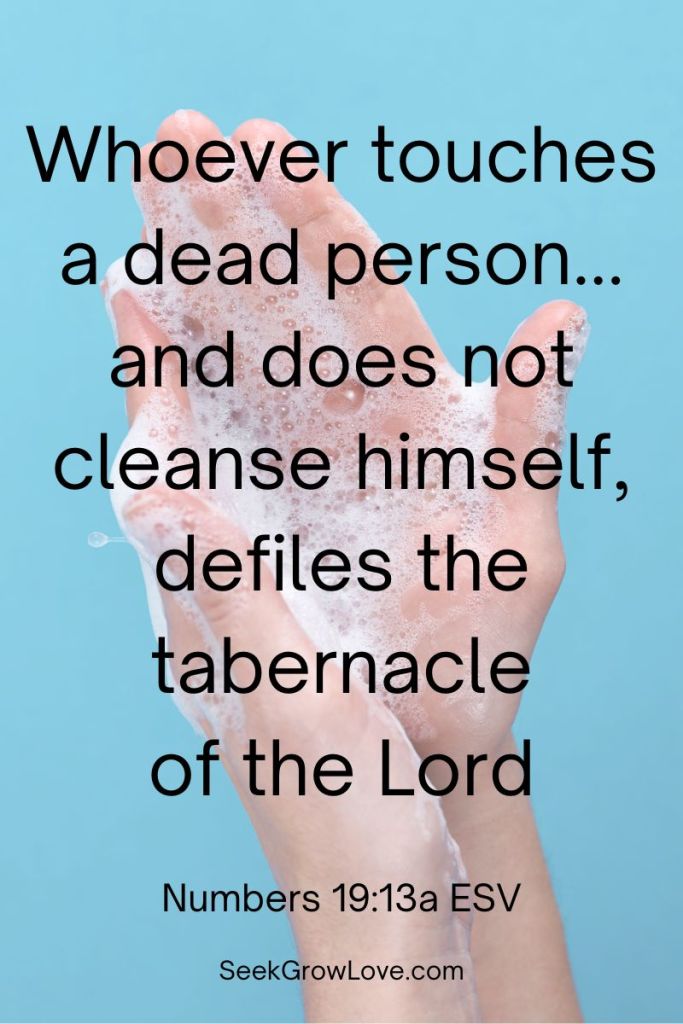
Back in 1847 a doctor named Ignaz Semmelweis noticed that, through several events, women who had died of postnatal fever had been attended during the birth by doctors who had just done autopsies. Semmelweis came up with the idea that doctors should wash their hands between autopsies and births. And all of us collectively think… well yeah! Of course! But this was not part of the course of a doctor’s day at the time. In fact, many doctors were offended at the suggestion they weren’t clean. Semmelweis was absolutely ridiculed and eventually driven mad. He was placed in an asylum where he died within two weeks, ironically from an infection, after being beaten by prison guards. Perhaps these doctors should have referred to today’s reading. After discussing the duties of the Levites in Numbers 18, Numbers 19 discusses being “unclean” for 7 days after touching a corpse for any reason. Definitely something these doctors should have taken note of.
Much is said about what is clean and unclean in the Pentateuch. The Israelites certainly benefited physically from not touching dead bodies or eating pork. Some issues of cleanliness could not be helped, such as touching the dead or having a monthly period. In these cases, people were unclean for a time and then had to wash themselves in special ceremonies and offer sacrifices. But God did not delineate what was clean and unclean just for hygiene’s sake. God also wanted the Israelites to be set apart, different than the rest of the world, holy.
We are to come before Him with clean hands and pure hearts (Psalm 24: 4). But there are times when we become unclean and need someone who can wash us white as snow. Praise God for providing the sacrifice that completely cleans us, His Son, Jesus Christ.
We’ve come a long way since 1847. Hand washing is the first skill nurses have to demonstrate before moving on to other skills. As you wash your hands today, keep in mind the One who cleans you completely!
-Maria Knowlton
Reflection Questions
What can we learn from Ignaz? What can we learn from the doctors who ridiculed Ignaz, believing that they themselves were clean?
Does God still want His people today, the church, to be clean, holy and set apart? What does that look like? What does it look like to have a church that is dirty/stained, unholy and blending in with the world?
Are there any common practices today that you think might be making many Christians unclean before the Lord?
What is the only way you can come before God clean? If you accept Jesus as Lord of your life, are there still things you do that make you clean and unclean? How might Numbers have been preparing God’s people for Jesus?
Some of you may be old enough to remember the old Sunday School song, “12 Men Went to Canaan Land” and you held up your ten fingers and then gave the double thumbs down when you sang “10 were bad.” Then you held up two fingers and gave two thumbs up while you sang “and 2 were good!”
In today’s reading we see the stark difference between fear and faith and why 10 were bad and two were good.
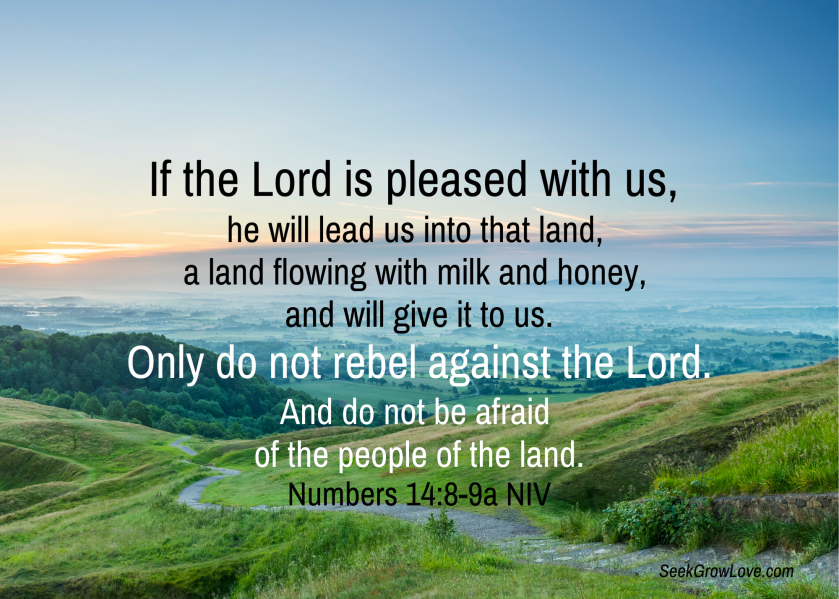
In chapter 13, twelve spies, one from each tribe in Israel, came to scope out the land of Canaan, the land flowing with milk and honey, the land God had promised.
In his commentary, David Guzik, reminds readers that there was no need for this reconnaissance mission. According to Ezekiel 20:6, God had already searched this land and promised it to them. So some people were already distrusting God from the beginning.
“Some saw giants big and strong,” 10 of the Israelite spies came back with scary accounts of many giants in the land that made the spy’s look like grasshoppers. One theologian stated that “fear performed the miracle of adding a cubit to the stature.” 😉 and on top of that, the city is heavily guarded! Obviously, there was NO way to defeat them!
“Some saw grapes in clusters long.” All of the spies agreed that the land was made of fertile soil and it would be easy to grow wonderful food there. This was definitely the place God had promised them!
“Some saw God was in it all,” But only two spies, Joshua and Caleb, had unshakable faith that God would deliver what He had promised and bring them into this land.
I love how F.B. Meyer put it, “ They saw the same spectacles in their survey of the land; but the result in one case was panic, in the other confidence and peace. What made the difference? It lay in this, that the 10 spies compared themselves with the giants, whilst the two compared the giants with God.” WOW! Did that statement convict you?!? It sure convicted me!
It’s easy for us to figure out who was good and bad back in the Old Testament. Hindsight from over 3000 years ago is 20/20. But what about you? When troubles come your way, which spy describes your response? Are you comparing you to your troubles, or your troubles to God?
“10 Were Bad and 2 Were Good!” Which one are you?
-Maria Knowlton
Reflection Questions
How is Caleb described in Numbers 14:24? is there anyone you know today who could also wear that description well?
“10 Were Bad and 2 Were Good!” Which one are you? Do you generally compare yourself to your troubles and experience fear and panic? Or, do you more often compare your troubles to your God and rest in faith and peace?
What was the reward for Caleb and Joshua? What was the punishment for the 10 spies? What was the punishment for all those who listened to and trusted the report of the spies? Who are you listening to today? How does who you listen to today determine whether you will receive a reward or punishment?







 Seek Grow Love