It’s hunting season here in Ohio! All around the countryside, hunters are sneaking though the fields, climbing tree stands, and checking their trail cams. The deer are careful and on alert, listening and sniffing the air for the sign of trouble. Failure to sniff out the enemy can have deadly results for the hunted.
As Christians, we have to be on guard against temptations and situations that can cause us to fall away from the Lord God. 1 Peter 5:8 warns us to “Be alert and of sober mind. Your enemy the devil prowls around like a roaring lion looking for someone to devour”. Peter, in his letter to the Christians across Asia Minor (modern Turkey), has tried to encourage the believers to stand firm in the face of persecution. Instead of getting revenge or lashing out against people who have hurt us, Peter encourages us to rejoice in our sufferings and be thankful for the opportunity to do good to those who hurt us (1 Peter 3:8-12).
It is easy to want to strike back, to say something hurtful, or to defend ourselves. But God has a higher purpose in mind behind our suffering. He wants to shape and mold us into mature Christians. Sometimes, we have to endure hard times to allow that change towards maturity to occur. It is tempting to want to respond in kind to those who hurt us. We have to stand firm and resist the urge to take the bait!
Peter reminds the Christians that this is a sneaky trap, set by our enemy, the devil. We have to be on the alert, and watchful to avoid falling into the traps set by the enemy. Like deer trying to avoid the hunter, we avoid the traps of temptation by seeking to do God’s will. Peter asks us to be alert and sober minded. Resisting the temptation to lash out at our enemies or to hurt other people is not easy. But the more we resist, the easier it is to stand firm against the schemes of the devil. God wants us to trust Him. As we obey Him, He will “restore you and make you strong, firm and steadfast” (1 Peter 5:10).
At the beginning of Jesus’ ministry, we read of his baptism. This is a special moment of God clearly anointing Jesus with his spirit as he says, “This is my son, with whom I am well pleased.” Jesus is anointed and commissioned in that moment to go and preach the gospel of the Kingdom – which is what he does in Matthew 4:17.
In between the anointing and commencing of his ministry, we read of a curious episode in Jesus’ life. He is led by the Spirit into the wilderness to be tempted by the devil.
The devil shows Jesus three things to entice him to reject God in disobedience. He tells Jesus to turn the stones to bread, to command the angels to come and rescue him, and to elevate himself physically and figuratively so that the world will bow down to him.
Interestingly, these things aren’t necessarily the same struggles we may be tempted by. In one Bible Study I was teaching about this passage, one of my friends looked puzzled and mentioned that he would think that Jesus would have been tempted with ‘the lust of the eyes’ because that is such a ubiquitous struggle for our society. But, I think that this instance is more than Jesus staying strong against the seven deadly sins – though he does and remains sinless throughout his temptations.
In each instance, the devil says, ‘Just show your power to do these things. Show yourself to be like God.’ The devil knows that Jesus has the authority to do the things that he is tempting Jesus with. Jesus also has the power to do those things. But, Jesus knows that he must remain obedient. Jesus is not God, and Jesus knows that the only reason he has the power and authority to do supernatural things is because God has granted him that authority.
These temptations echo the first temptations in the garden. The ancient serpent also tempted Adam and Eve with the chance to become ‘like God.’ Instead of trusting in God and remaining obedient to his word, Adam and Eve trusted the serpent and grabbed at the chance for the knowledge of Good and Evil. Of course, the serpent’s promises were empty and brought death, not happiness.
We are also tempted. Yes, temptations mean that we have to be sure to follow the law of God and live righteously. But, more than that, temptations mean that we have to trust that God knows what is best for our lives. Jesus could have looked at his situation in the wilderness (that he was led to by God) and decided that he knew best. In that moment, he could have rejected God, acted disobediently, and sinned.
But, he didn’t.
Instead, his obedience required him to humble himself and trust God. Ultimately, this proved to be a training ground for what would be required of him later on. Philippians 2:8 says, “He humbled himself by becoming obedient to the point of death — even to death on a cross.”
We have to take the same path. We don’t know best. We have to trust God and his word.
We can take comfort in the end of the story, too. Jesus wasn’t exalted by the devil, but we know that the thing the devil tempted him with will come true because Jesus was obedient. One day, every knee will bow and every tongue confess that Jesus Christ is Lord.
We wait in hope for that day, and we live in obedience today.
Cayce Fletcher writes and podcasts at amorebeautifullifecollective.com. Check out the blog and other resources to help you create a life you love and cultivate your heart for God. This free resource here will help you take your Bible study one step further with a Bible reading tracker, Bible study reflection page, and more.
Reflection Questions
How are the temptations of Jesus in the wilderness similar to and different from the temptations of Adam and Eve in the garden?
How does Jesus fight against temptation? How can you better equip yourself to fight against temptation?
Why did God lead Jesus to the wilderness? How was Jesus’ time in the wilderness preparation for the rest of his ministry?
Ephesians 6:10-13 – “…Finally, be strong in the Lord and in his mighty power…”
If you were to look at the different video playlists I have curated in my Youtube profile, you’d see that a majority of them are workout exercise videos. I have playlists for upper body strength, lower body strength, pilates and barre workouts, HIIT and stretching videos. What can I say, I need variety in my life if I’m going to pursue a lifestyle that includes regular exercise.
But physical strength and endurance is not what the apostle Paul is talking about in the sixth chapter in his letter to the Ephesian church.
Nor is Paul referring to mental toughness. The kind of fortitude that prisoners of war or persecuted believers must endure when they are held captive in inhumane environments.
Paul writes the words, “be strong in the Lord and in his mighty power”. These words are almost identical to what we read in Joshua 1, verse 9, “Have I not commanded you? Be strong and courageous. Do not be terrified; do not be discouraged, for the LORD your God will be with you wherever you go.”
Joshua was preparing for a physical battle that had spiritual consequences. We probably are not preparing for a physical battle; however, if we are actively pursuing a life centered on the Gospel message, we are indeed engaging in a battle that has spiritual consequences.
So what does it mean to be “strong in the Lord and in his mighty power”?
First, I think it means that we must recognize that if we are going to do anything in the name of Jesus, we are stepping into battle against the devil’s schemes. We become a threat that must be neutralized. A soldier prepares for battle by donning on their tactical gear. We need to do likewise.
Second, “be(ing) strong in the Lord and in his mighty power” means that our own efforts, our intelligence, our will power, our connections, our resources are insufficient protection for what we are up against. If it were up to only us, then our efforts would be whooped before we even really got started.
Once we acknowledge that we are in a battle and we are without adequate protection, what are we left with? We will only be successful in spiritual warfare with our faith. A faith that says:
We believe that God is who He says He is.
We believe that nothing is impossible for God.
We believe that God is faithful to His people.
We believe that God will fight for us.
We believe that God has already won the ultimate battle.
When we cling to these truths, we are “strong in the Lord and in his mighty power” and we can withstand any kind of opposition that we are tasked to face and endure. And we will be victorious.
For whatever battle you might be facing today, remember that you are not alone. You serve a God who loves you and has empowered you with His Holy Spirit to stand firm and do great things. Keep the faith and believe.
-Bethany Ligon
Reflection Questions
How strong are you – physically, mentally, and spiritually? Of these three areas in which do you spend more workout time developing? How does one go about strengthening spiritual muscles? Why are spiritual muscles important?
What do you believe about God and His Son Jesus and how does believing each statement help prepare you for spiritual battle?
What do the devil’s schemes look like? When does he win battles? What can you do to stand against him in God’s power?
It was the spirit that led Jesus into the wilderness to be tested. It was the devil who tempted him. God does test us, like a father tests his children, allowing us to make a choice between his will and our own, but he does not tempt us to do evil, nor can he be tempted, as everything already belongs to him and therefore wouldn’t be tempting.
God does not tempt with sin, but he does test his children so that they can learn obedience, to overcome sin and become people of character, for their own good, for their survival and for other good things he desires for us. We’ll pass the test every time if we choose his will over our own, just like his son Jesus did.
The devil’s temptations to cause Jesus to sin were cunning. With the first temptation, (Luke 4:3 “If You are the Son of God, tell this stone to become bread.”) the devil raises doubt about Jesus’s identity. He then targets Jesus’s need, his hunger, as a result of his fasting. When you are so hungry and deprived of your need to eat, it can be the most powerful time in your life because you have no choice but to cry out to God for help.
This was a very crafty temptation for Jesus, because both he and the devil knew who he was. He was the Son of God. God had already granted him authority and power, which he continued to grow in, which he could have used to meet his hunger need by performing a miracle for himself at his will. But he didn’t. Instead, his response was God’s will (Luke 4:4: And Jesus answered him, “It is written, ‘Man shall not live on bread alone.’”).
The temptation was taken right out of God’s playbook, when he tested his firstborn son, the children of Israel in the wilderness. What is new is knowing the devil’s part in this temptation towards Jesus. Jesus goes straight to God’s will in the matter, referencing Deuteronomy 8:1-10 with his response. The testing was meant to test obedience and build the character trait of humility, as is clear from that passage.
Keep in mind though that it looks like God’s testing came after his firstborn son already tried to put him to the test by blaming him for their hardships and lack of needs in the wilderness. God is Israel’s father. He is going to take care of his children, but they needed to learn to obey and trust him. Our good God sent them bread from heaven despite their evil response because he loved them. It didn’t always fare so well in God’s response to their constant rebellion, but you can see throughout scripture that God was patient and long-suffering with his people.
The second temptation was tempting because the devil was offering the world as Jesus’s kingdom right then and there, if only he’d worship him. Satan is called the god of this world, which meant that he had the power to give Jesus the kingdom. Jesus knew through scripture that through serving God, he was going to gain the whole world and more, but he had to die first. It would have been very tempting for him to set up his kingdom straight away, without having to die first. But his response was to serve God by carrying out his will for him in his plan of salvation (Luke 4:8 8 Jesus answered him, “It is written, ‘You shall worship the Lord your God and serve Him only.”).
Jesus’s response came from Deuteronomy 6, where God gave the children of Israel the first and great commandment, which is to listen; Yahweh is God, Yahweh alone. Love Yahweh God with all your heart, soul, and might. They were told to do this so that they would remember him, fearing him only, and worshipping him, and swearing by his name (Deut. 6:13). They were to remember what Yahweh did, bringing them out of slavery and into the promised land to serve him. He told them these things for their good always and for their survival (Deut. 6:24).
Jesus trusted his father. He knew that God was faithful to do what he said he’d do, and he loved his father. He also knew from scripture that he had to die to be able to bring us with him. He chose us. He chose God’s will.
With the third temptation, the devil tries to provoke Jesus to prove that he is the Christ on his terms. He quotes from Psalm 91, telling Jesus that God will protect him if he performs the miracle that he wants him to do to show everyone that he is indeed who God said he was.
This is tempting because proving that he is the Son of God, the Messiah, could remove a lot of suffering from his life. Picture Jesus performing the miracle from the temple pinnacle in Jerusalem, in front of all the religious leaders. If they saw him doing this act, in front of everyone, from that location, they all would have known for certain that Jesus was the Christ. They probably would have set him up as their king, rather than trying to continuously kill him. Because Jesus chooses not to reveal his identity to anyone, except on God’s terms, it appears that like David, Jesus was always “on the run” from his enemies, because they doubted that he was the Messiah. Falsely claiming to be so was an offense worthy of death to the Jews.
But Jesus wasn’t really just “on the run” from his enemies. He was choosing to do God’s will at every step in his ministry. For the most part, he was on the move because his father told him to preach the kingdom of God to the various cities he was sent to.
The life Jesus chose was hard. He told us often that he spoke his father’s words, not his own. His father’s words were met with resistance and hate from most, except from those to whom it was given to know the things of God. Jesus’s response was the harder, but better route. He chose God’s will. He said, 12”…It is said, ‘You shall not put the Lord your God to the test.’”
This quote comes from Deut. 6:16. It references the bread incident from the first temptation. Again, we’re told what this was all about in Deut. 8:1-10. God does things his way for our own good, for our salvation, and to give us good things. But we have to trust him by doing it his way, even if his ways are harder than what we think ours will be.
If Jesus would have performed the miracle that the devil tempted him with, he would have been no better than God’s firstborn son, who put him to the test in the wilderness. They remembered their former slavery to Egypt, thinking it was far superior to their journey in the wilderness on the way to God’s promised land. The wilderness was hard. Many of them died there, never getting to see the promised land.
Similarly, if Jesus had proved to all that he was the Messiah by choosing his own will over God’s, the seemingly better route to go, he too would have put God to the test. Instead, he never blames God for his circumstances. He endures, looking at his hope, and thinking about all those he will save by choosing God’s will.
The devil left him, but only until another opportune time. Many of the things he said to Jesus make their comeback through the lips of religious leaders, as we’ll see through their interactions with Jesus in the rest of Luke’s narrative.
There were people who admired Jesus, but still doubted his identity. There were people, particularly those in his hometown, who asked Jesus to heal and perform miracles. When they don’t receive what they want from Jesus, which looks like a request for proof because of their doubt that he was the Messiah, they are denied, and they hate him for it. They attempt to push him off a cliff! Jesus doesn’t budge in following his God’s will, despite the consequences from men.
It is interesting that after the devil’s temptations, that Jesus quotes from scripture in Isaiah 61. We’ll eventually read in the rest of Luke’s narrative that Jesus lives out these proclamations from Luke 4:18-19.
Mixed in the quote is a quote from Isaiah 35 (recovery of sight to the blind). Jesus will indeed perform this miracle too. He’s even going to do it in Jerusalem, proving that he is the Son of God for many to take note of, but it will be on God’s time, and it is to the people God chooses for Jesus to reveal himself to as the Son of God, for God’s own purposes. When you read about this, and the other “Messiah” miracles, be careful to investigate the details so that you will know the exact truth about the things you are learning.
-Juliet Taylor – It’s been a joy to write again for SeekGrowLove.com and I’ve grown tremendously from doing it, so thank you Marcia! Hello Seekers! I am a Biblical Unitarian (BU) living in Tennessee with my husband, Wes Taylor, and our two boys, John and James. God has given me a BU church (Higher Ground), the best BU friend (Amy Swanson) to go through this race to the Kingdom with, an online church to fellowship with (Allegiance to the King), and a profession (Behavior Analyst/Sleep Consultant) that allows me time to study God’s word. God is good!
Questions
God cannot be tempted, because there’s no way to get him to desire anything that he doesn’t already have or will have at his will, as he’s the creator of all. But he can be tested (although we shouldn’t, knowing the consequences). In what ways do people test God in our time?
Similarly, God does not tempt us to sin, but he does test us like a father tests his child for her own good. In what ways do you think God has tested you?
What other “Messiah” miracle does Jesus perform in Jerusalem (hint: it’s mentioned in Isaiah 35).
On several occasions, I have had the opportunity to witness the changing of the guard at the Tomb of the Unknown Soldier at Arlington National Cemetery. The precision with which this exercise takes place is practically mesmerizing. But what I find even more fascinating are the tales that are told of when those on duty face extraordinary weather events and refuse to take shelter. They hold their ground.
Paul concludes his letter to the Ephesians with more words of wisdom and encouragement. He reminds his readers that they will face the devil’s schemes and that they better be prepared.
Preparation for battle takes many forms: from the physical training to acquiring the best equipment. But the most important thing is to have the mindset of a warrior. What Paul is telling the Ephesian church and you and I is that we HAVE to believe that God is who He says He is. We MUST take heart and have faith that He will do what He says He will do. We CANNOT have ‘Plan B’. We NEED to remain strong and determined regardless of the circumstances.
The enemy will do whatever it takes to try to take us off course. We’ll be faced with trials and temptations; things that challenge our fortitude and things that might distract us from our purpose. Our reputations may be questioned; our relationships threatened; our resources depleted – but we can put on the belt of truth, the breastplate of righteousness, helmet of salvation, and have our feet fitted with the readiness that comes from the gospel of peace. We can pick up the shield of faith and the sword of the Spirit and choose to stand and face whatever comes our way.
You are a mighty warrior of the Most High. It’s time to hold your ground and take a stand.
-Bethany Ligon
Questions for Reflection and Discussion
What is the purpose of each piece of armor described in Ephesians 6?
What do the devil’s attacks and schemes look like for you right now? What attacks have you already faced victoriously?
Which piece do you more often forget to put on? What is the danger of going into battle without this piece of armor?
In Luke chapter four, we finally get to see the beginning of Jesus’ ministry. However, before we get there, Jesus spent forty days and forty nights in the wilderness by himself with no food. He was led into the wilderness by the Holy Spirit. We are never told the purpose of the Spirit leading Jesus to the wilderness, but I imagine it served as a great time for Jesus to focus in on God all by himself before he began his earthly ministry.
While Jesus was in the wilderness for forty days, the devil came to tempt Jesus. Three times the devil tempted Jesus, but he had zero success. To combat the temptation, Jesus responded each time with scripture (verses 4, 8 and 12). Scripture offers us a great way to combat temptation, as Jesus demonstrated here. Psalm 119:11 supports this notion, as it states, “I have stored up your word in my heart, that I might not sin against you.”
Whenever we are confronted with temptation, as we all are, a great way to resist and combat that temptation is by quoting scripture. Now, this is only possible if you have scripture memorized in the first place. This is a big reason why it is important to store God’s Word in our hearts.
After Jesus withstood the temptation of the devil in the wilderness, Jesus officially began his earthly ministry in his hometown of Nazareth. He did not have quite the warm welcoming, as the Jews tried to throw him off of a cliff (Luke 4:29). This was just the beginning of the Jews seeking to end and kill Jesus. They were constantly taken back by Jesus’ bold claims that he makes. In the end, the Jews send him to the Roman government to have him killed because Jesus claimed to be the Son of God (Matthew 26:54). The Jews seldom got along with Jesus because they did not believe that he was the Christ, the Son of God.
Luke chapter four ends with Jesus telling us his purpose, as Jesus states, “I must proclaim the good news of the kingdom of God to the other towns also, because that is why I was sent,” (Luke 4:43). Jesus himself stated that his purpose was to preach the good news of the kingdom of God. From the very beginning of his ministry, he preached all about the Kingdom. The message of the kingdom was at the heart of Jesus’ ministry, and it should be at the heart of our ministry as well.
There are a handful of ways to think about the meaning of the death of Jesus. From a Jewish point of view Jesus was killed because he was a false prophet. From a Roman point of view, he gathered a large following that was counter-cultural to Roman authority, so they executed him. Or if you’re a muslim, Jesus wasn’t killed at all on the cross. Almost all people recognize that Jesus actually did die, but the question is why? The New Testament has several different ways of understanding why Jesus died. These include, Jesus died to destroy the works of the devil, to satisfy God’s need for justice, to justify us apart from Torah or the law, and to give us eternal life. However, the most ubiquitous reason the New Testament gives as to why Jesus died, is that he died for our sins.
“Grace to you and peace from God our father and the Lord Jesus Christ who gave himself for our sins so that he might rescue us from this present evil age…” Gal.1.3-4
“…he bore our sins in his body on the cross…” I Pet. 2.24
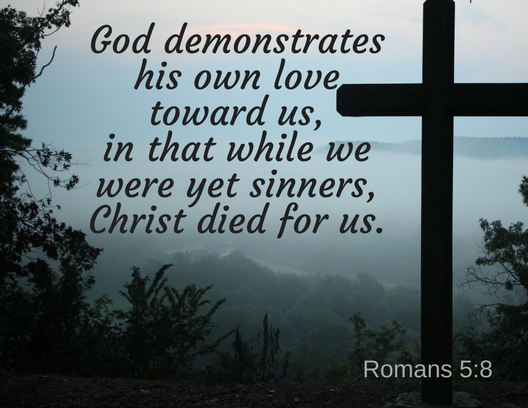
“God demonstrates his own love toward us, in that while we were yet sinners, Christ died for us” – Rom. 5.8
“…when he had taken the cup and given thanks, he gave it to them, saying, ‘drink from it, all of you; for this is my blood of the covenant, which is poured out for many for the forgiveness of sin’” – Matt. 26.27-28
The reason Jesus’ death is so significant is because it solves the problem of sin. Sin is a barrier between us and God, it is impossible for us to be in the presence of God because he is holy and perfect and we are not. Jesus’ death satisfies God’s need for justice. The cost of sin has been paid for by Jesus. So through Jesus we can have a renewed relationship with God through Jesus. Apart from Jesus, God sees us as worthy of wrath and death, he sees all our mistakes and rebellion. But in Jesus, he sees us being right before him and clean and pure. Because of Jesus we are able to be in the presence of God. Jesus’ death is the means by which we can enter the kingdom. Hope, forgiveness, contentedness, and so much more can be found when someone accepts the gift of Jesus’ death for them.
For someone to be restored to God and to be a part of the kingdom when it comes, they must accept Jesus’ death. Through Jesus’ death all can live.



 Seek Grow Love