Me Against the World

John 15

John 15 19

Does it feel like some days everyone hates you?

We’ve all been there; we say or do something different and it blows up in our faces.
Sometimes, this is probably justified. When we say or do something bad, it may be good for the people in our lives to call us out. While there are many things wrong with political movements like #blacklivesmatter or #metoo, their goal is admirable: there ARE times when those in power, like police, need to be held accountable; there are some people who are victims of sexual assault and harassment that are afraid to speak out due to the backlash. While you have not done anything like those called out in these movements, I’m sure you’ve had moments when your friends turned against you when you did something to hurt a mutual friendship, or maybe bullied a kid. And we can see that this is justice, in a way. We feel like (and on some level, know) we deserve it.
But there are days when you say what you believe is truth and it backfires. There are days when you are asked what you believe and everyone around you mocks you and belittles you for it, or tells you that you are on a dangerous path for not agreeing with their view of God. There are days when you do the right and righteous thing, and it seems like people around you think you have done something terrible…
Jesus lets us know this won’t be uncommon. He teaches in John 15:18, “If the world hates you, understand that it hated Me before it hated you.” In our day, we can see this is true in a small scale. On some issues, we love people, but hate sinful actions performed. When a man believes that he can’t make a wedding cake for a gay couple, he is sued and taken to court. In many circles, he is considered a bigot. Very recently, another Christian political commentator gave a speech entitled “Men are not women.” That speech created a protest movement, and he was assaulted with liquid that smelled like bleach. While these are hotly charged political issues, both of these men were standing on what they believed were biblical, moral principles, and were hated for their views.
This is because we are not of the world. We don’t go along with the system the world offers. Christ calls us to live in love differently. One could argue that if these men had just lived like Jesus, then they wouldn’t have encountered any problem. Love wins, right? But Jesus points out that he is hated by the system of the world, AND HE WAS PERFECT. Christ lived a life full of grace and truth (John 1). But that did not endear him to the world.
When it seem the world is against you, stop and think:
Did I do something wrong? If so, fix it.
If not, is the world against you and it is not related to the Bible? Maybe it is wise to think about what they are saying.
However, if the world is against you and you are standing on Scripture, then stand strong. Don’t be shocked, because they first hated Jesus. Stand strong, in truth and love, and God will stand with you.
(For a throw back, watch this clip … https://www.youtube.com/watch?v=f_o6QHdIG4I // For some rock, listen to this … https://www.youtube.com/watch?v=3kiwluGZdJQ )
-Jake Ballard

The Spirit of God

JOHN 14

John 14 16

Today, we will continue what we started yesterday, what scholars call “The Upper Room Discourse.” Many people believe that the teaching of Jesus from John 13-17 were all taught to the disciples the night before he died. (They were in the upper room of a house, hence the name.) When Jesus speaks, he encourages the disciples to not be troubled. Though he will not be with them in person, he promises something else. What does he promise?
A counselor. (v16) The Spirit of Truth. (v. 17)
Jesus says that the Spirit will come, who will counsel the disciples and guide them into all truth.
What is the Holy Spirit?
This is a question that has perplexed theologians in Churches around the world for quite some time. Jesus says here that he will send the Spirit, and that he will come to be with his disciples. Is he the Spirit? No, because it’s clear in John that there is a difference between Jesus and the Spirit. And that same difference is found in verse 26 in regards to the Spirit and the Father. So the Spirit is something other than the Father and the Son. This have led some to conclude that the Spirit is a distinct person, being, or entity, but this is problematic, because in many ways the Spirit is described in non-personal terms. (Spirit comes from the Greek word πνευμα, meaning wind, breath or spirit.) It is poured out, given, and we are baptized into it. However, at the same time, the Book of Acts, and here in John, Jesus and his early followers listen to the Spirit deciding things and guiding and teaching.
So what is the Spirit? Another name for God or Jesus, or the power of God in action, or even a Person?
I don’t know.
For a long time, the words “I don’t know” made me terribly uncomfortable. They made me feel weak, like I wasn’t living up to my potential. (In truth, being a nerd AND a member of the CoG, I was getting social AND theological pressure to know everything.) However, I’ve come to know that I CAN’T know completely; the language about the Spirit is not about knowing and controlling but about submitting, relating and embracing. When the Spirit guides the disciples in the book of Acts, they submit, not ask what is guiding them. When Paul is encouraging his brothers and sisters to love in Corinth he writes “The grace of the Lord Jesus Christ, and the love of God, and the fellowship of the Holy Spirit be with all of you.” When the Spirit comes, the Spirit is coming from God and in the name of Jesus. Do I trust Jesus enough to allow whatever the Spirit is to effect me in such a way that the Spirit changes me?
As you read this language in John about Spirit and what the Spirit will do, don’t get lost in the weeds asking questions about what the Spirit is. At some point, there can be a time and place for that discussion. But today, right here and now, ask God to send that Spirit in the name of Christ into your life. When Jesus breathed on his disciples (John 20:22) and gave them his Spirit, when fire fell in Acts 2 and they were refilled in Acts 4, those disciples were more concerned about how God was going to help them live tomorrow. If you need the power of God on a Monday morning (or evening or night) what you need is to say with me…
“Lord I don’t know everything, but I know that I need your Spirit.”
And that is a prayer God will answer in the name of Jesus.
-Jake Ballard

Holy Week and Dirty Feet

John 13

John 13 14 (1)

Today is Palm Sunday. Your pastor probably talked about it, and the kids probably sang about. In the Christian tradition writ large, the names of the days of the week are used to express different stages of the auspicious moment. Palm Sunday kicks off everything as the day that the crowds celebrate Jesus and call him their king. Monday and Tuesday don’t have special names. Wednesday is called “Spy” Wednesday, signifying the betrayal of Judas to seek a time to sell out his master. Friday we call “Good”, not in that it is a happy occasion, but in that it was a day when the goodness of God was revealed and we were able to be saved. Holy Saturday comes next and then it is Easter/Resurrection Sunday.
Today, in John 13, we read what is traditionally associated with Maundy Thursday. Jesus takes off his outer garment and gets down and washes his disciples feet. To give context, in a culture where everyone walked it was dusty, baths were not as common as they are today and soap was less aromatic – touching feet would be gross. The disciples knew that the one who washed feet would be a servant. But Jesus, the master, the rabbi, the Christ, the King who was just regaled with Palm branches and crowds shouting his praise, is now quietly washing their feet. The disciples, being with him for at least 3 years are used to his weird antics and personal teaching style.
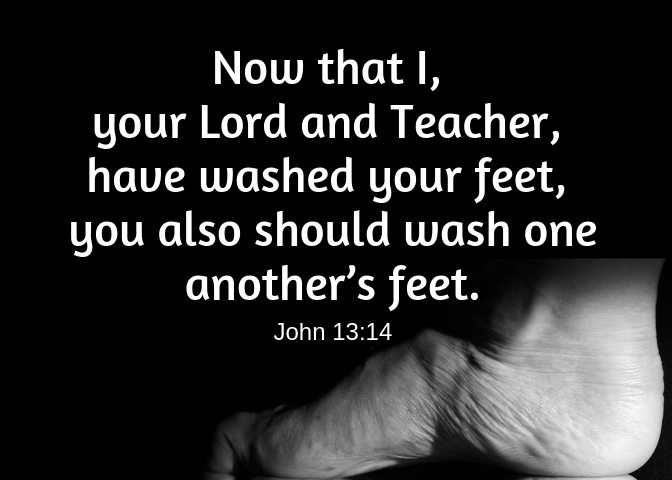
But Peter, never one to be silent, says “No way Jesus!” And who can blame him. The king doesn’t do the slaves’ work. The king has his slaves wash his feet. That’s how the world works. But Jesus lets Peter know that his kingdom works differently. The King serves, and the King’s advisors should serve, and future rulers should serve. If you want to be like Jesus, it’s not about being a King and being served. Jesus said “I did not come to be served but to serve and to give my life as a ransom for many.” He expects us to do the same. “So if I, your Lord and Teacher, have washed your feet, you also ought to wash one another’s feet. For I have given you an example that you also should do just as I have done for you.” (John‬ ‭13:14-15‬ ‭HCSB‬‬)
I’ve got a challenge. Actually DO it. Jesus gave us an example in this moment. Of course this means we should make ourselves servants and try to serve people everyday. But one way to make yourself humble is to grab your stinky younger siblings, or your mom or dad or grandparents or friend, and actually wash their feet. If you can, today or this week, actually get a group together and have the oldest person wash the next oldest person’s feet and down the line. It is a humbling experience. After you wash their feet and dry them off, pray for that person, and then pass the bucket and the towel until everyone has been washed. Then talk about the experience. Was it weird? Did you think it was OK? Do you think it made sense for Peter to feel a little weird? How would you react if Jesus tried to serve you?
Once you answer these questions and any others, read John 13:1-38. Remember that Jesus served people he knew would betray him and deny him; how much more should we serve those who we know love us: our friends, grandparents, aunts and uncles, moms and dads, brothers and sisters… even when they’re stinky.
Jake Ballard

Opposite Reactions – Opposite End Results

John 12

John 12 46

John 12 opens with Jesus attending a dinner held in Jesus’ honor.  Lazarus, whom Jesus had raised from the dead was among those eating at the table.

While he was there, a large crowd came, not only to see Jesus, but also to see Lazarus, whom Jesus had raised from the dead.  Then we read… 10 So the chief priests made plans to kill Lazarus as well, 11 for on account of him many of the Jews were going over to Jesus and believing in him.

I am astounded at the lengths to which the religious leaders of Jesus’ day would go to deny Jesus.  They saw all the miracles, but rejected Jesus anyway.  Even after Jesus raised Lazarus from the dead, they still wouldn’t believe.  And because so many others believed, the religious leaders wanted to kill Lazarus again, to stop people from following Jesus.  Wow.

At this same meal, we see someone with an opposite reaction.  While Jesus was reclining at the table, Mary, Lazarus’ sister, poured expensive perfume on Jesus’ feet, and wiped his feet with her hair.  We’re told the perfume was worth a year’s wages.  We’re told in Matthew 26:13, where we also find this story, Jesus said,” 13 Truly I tell you, wherever this gospel is preached throughout the world, what she has done will also be told, in memory of her.”   And indeed, we’re still talking about this today.

Much later in John 12, we find this in verses 44-46:  44 Then Jesus cried out, “Whoever believes in me does not believe in me only, but in the one who sent me. 45 The one who looks at me is seeing the one who sent me. 46 I have come into the world as a light, so that no one who believes in me should stay in darkness.

The chapter closes like this… “the very words I have spoken will condemn them at the last day. 49 For I did not speak on my own, but the Father who sent me commanded me to say all that I have spoken. 50 I know that his command leads to eternal life. So whatever I say is just what the Father has told me to say.”

So again, we have a decision to make.  Will we believe in Jesus, honor him like Mary did with our actions and our wealth, and live in his light?  This leads to eternal life.

Or will we reject him, like the religious leaders of his day, and stay in darkness (and be condemned at the last day)?

I choose life.  What about you?

-Steve Mattison


Stake Your Life on This

John 11

John 11 25

In John 11, Jesus received word that his dear friend was very sick, and yet Jesus stayed where he was for two more days before heading to Bethany, where Lazarus was.  When he finally got there, Lazarus had been dead for four days.

Martha, Lazarus’ sister came out to meet with Jesus, and we have a record of their incredible conversation.

21 “Lord,” Martha said to Jesus, “if you had been here, my brother would not have died. 22 But I know that even now God will give you whatever you ask.”

23 Jesus said to her, “Your brother will rise again.”

24 Martha answered, “I know he will rise again in the resurrection at the last day.”

25 Jesus said to her, “I am the resurrection and the life. The one who believes in me will live, even though they die; 26 and whoever lives by believing in me will never die. Do you believe this?”

27 “Yes, Lord,” she replied, “I believe that you are the Messiah, the Son of God, who is to come into the world.”

I love these incredible statements of faith:  If Jesus had only been there, he could have healed Lazarus.  Even now, God would give Jesus anything Jesus asked.  “I know he will rise again in the resurrection at the last day.”  “I believe you are the Messiah, the Son of God.”

No wonder Jesus loved this family.  They were devout followers of Christ with amazing faith.

You know the rest of the story.  Jesus told them to roll away the stone.  Martha said basically, “he’s going to stink, he’s been dead four days.”

40 Then Jesus said, “Did I not tell you that if you believe, you will see the glory of God?”

Then Jesus called in a loud voice, “Lazarus, come out.”  And the dead man came out!

Many people believed in Jesus because of this miracle.  But not everyone believed. The Pharisees’ response was, “If we let him go on like this, everyone will believe in him…” and they plotted to kill him.

How is it possible to have such diametrically opposed reactions?  Unfortunately, we see a similar range of reactions to Jesus today, from faithful devotion to hostility.

I don’t know about you, but I want to have the same reaction Martha demonstrated.  And I’m staking my life on verses 25 and 26.  I want to encourage you – do the same.  And I’ll look forward to seeing you at the last day.

-Steve Mattison


Don’t be Mutton

John 10

John 10 14

In John chapter 10, we find Jesus telling a story about shepherds and sheep.  A person who is hired to protect the sheep will run away when his own life is in danger (like when a wolf comes), and abandons the sheep.  The true shepherd will put his life in harm’s way to defend his sheep.  Then we find this gem in verses 14 through 18:

14 “I am the good shepherd; I know my sheep and my sheep know me—15 just as the Father knows me and I know the Father—and I lay down my life for the sheep. 16 I have other sheep that are not of this sheep pen. I must bring them also. They too will listen to my voice, and there shall be one flock and one shepherd. 17 The reason my Father loves me is that I lay down my life—only to take it up again. 18 No one takes it from me, but I lay it down of my own accord. I have authority to lay it down and authority to take it up again. This command I received from my Father.”

I see a couple of things in these verses that I’d like to comment on.

We all know that we are his sheep, and that Jesus laid down his life for his sheep.  We may be less focused on Jesus’ comment that he has other sheep not of this sheep pen that will listen to his voice and be part of the same flock.  In Jesus’ day, he was talking with the Jews, who thought they were the exclusive people who could have a relationship with God.  Jesus was pointing out that non-Jews would also come to God through Jesus.

Then we see this phrase in verse 17 that says God loves Jesus because Jesus is going to lay down his life.  I believe Jesus was saying that it was his decision whether or not to completely obey God.  He had the authority to obey, and lose his life.  He also had the authority to disobey, and retain his life.  My interpretation for all of this is:  Jesus had complete free will to do whatever he chose to do, just like we have free will.  It’s just that Jesus always chose to do God’s will.  This is exemplified in Jesus’ willingness to follow God’s will, no matter what, even to the point of suffering and dying.  And God loves that fact about Jesus.  (As an aside, this attribute of Jesus is undoubtedly why God said, “This is my son in whom I am well pleased, listen to him.”)

You might be thinking, “This is a nice story, but how does it apply to me?”

I’m glad you asked.

First, I want God to be pleased with me.  And I project from this story that if I am obedient to God like Jesus was obedient to God, I will please God.  So, I’d like to challenge you to be completely obedient to God as well.

Second, I might tend to think, like the Jews, that I, or my church, or my denomination have an exclusive relationship with God.  I need to remember that Jesus is the Good Shepherd, not me, and he (not me) gets to decide who are and who are not his sheep.

Finally, we see from this passage that Jesus knows his sheep, and his sheep know him.  Wolves are prowling around outside the sheep pen.  If you’re not in the protection of the pen, being protected by the Shepherd, you’re going to be mutton.  So if you don’t know Jesus, there’s no time like today.

-Steve Mattison

In the Pool of Siloam

John 9

John 9 35 36.png

In John 9, we see the story of Jesus healing the man born blind.  You know the story… Jesus spat on the ground, made some mud, put the mud on the man’s eyes, and had him go wash in the Pool of Siloam.  After the man washed, he could see.

We’re told the story again as he told his neighbors the story.  Then, we’re told again as he told the Pharisees the story.

The Pharisees are so hung up on the fact that Jesus did this on the Sabbath (and therefore broke the law, so therefore he must be a sinner), that they totally miss the magnitude of the miracle.  They were saying Jesus was a sinner, others were saying, “How can a sinner do such miraculous signs?”  So they were divided.

The Pharisees didn’t even believe the man had been blind, so they called his parents to testify that he was their son, and he was born blind.  The Pharisees asked him again how he came to see, since Jesus was clearly a sinner, in their mind.  The man had a great response:  25 He replied, “Whether he is a sinner or not, I don’t know. One thing I do know. I was blind but now I see!”

The man then scolded the Pharisees for not knowing who Jesus was, since no one had ever opened the eyes of a man born blind.  Clearly Jesus couldn’t do this if he was not from God.  And if they were really God’s representatives, they should know Jesus.

At this, the Pharisees heaped insults on him, and threw him out of the church.

Jesus found the man, and asked him if he believed in the Son of Man?  (This was a favorite title Jesus used of himself.)  I love the exchange that followed:  36 “Who is he, sir?” the man asked. “Tell me so that I may believe in him.”

37 Jesus said, “You have now seen him; in fact, he is the one speaking with you.”

38 Then the man said, “Lord, I believe,” and he worshiped him.

This man recognized the amazing transformation Jesus made on his life, he believed, and worshiped Jesus.

For those of us who were born and raised in the church, it’s sometimes hard to recognize the amazing transformation Jesus has made (or should have made) in our lives.  We don’t necessarily acknowledge that “I once was blind, but now I see.”  And how often are we overwhelmed and say, “Lord, I believe” and worship him?

The Pharisees, even though they knew what to look for in a Messiah, were blind to who Jesus was, despite amazing miracles.

So who are you most like in this story?  The man born blind, or the Pharisees?

If you haven’t yet received Jesus as your Lord and Savior, ask him today, “tell me so that I may believe.”  And for the rest of us, today is a good day to focus on Jesus, say, “Lord, I believe”, and worship him.

–Steve Mattison


IF you Believe, THEN…

John 8

John 8 31 32

As we have read repeatedly in the last two chapters, we see again in John 8:30, 30 Even as he spoke, many believed in him.

Then Jesus shared this powerful truth:

31 To the Jews who had believed him, Jesus said, “If you hold to my teaching, you are really my disciples. 32 Then you will know the truth, and the truth will set you free.”

This passage points out that while belief is important, belief alone is insufficient.  If I’m completely honest, I don’t like the implications of this passage.  I want to just believe and know I’m ok.  Unfortunately, I see a similar warning in James 2:19, where we’re told, “Even the demons believe – and shudder.”

Now Jesus has my attention.  If belief alone isn’t enough, what does He expect? I interpret these two verses as Jesus giving his followers a series of If .. Then conditions:

  1. If you hold to my teaching (which I interpret as meaning: you need to live your life like Jesus told you and demonstrated to you).
  2. Then you are really my disciples (meaning, you’re not really His follower unless you do what He told you to do.)
  3. If you are really my disciples, then you will know the truth. (This suggests to me that people can’t even understand the truth unless they are really Jesus’ disciples.)
  4. Finally, when one knows the truth, the truth will set them free.


The believers Jesus was talking to had the same reaction I tend to have.  Wait a minute, set me free?  I’m not a slave.


Jesus went on to say that anyone who sins is a slave to sin, and Jesus came to set people free from sin.


This is really interesting to me.  As members of a denomination that claims to have the faith of Abraham, we may tend to think we have a corner on the market for faith and truth.  But how focused are we on the holiness message Jesus is sharing in this passage?  This should challenge us.

Verses 35 and 36 go on to say, 35 Now a slave has no permanent place in the family, but a son belongs to it forever. 36 So if the Son sets you free, you will be free indeed.

I don’t know about you, but I want a permanent place in God’s family.  But to have that place, I need to be set free – first, from sin, and ultimately from death.


This requires adding to belief:

  1. Following Jesus’ teaching
  2. Becoming his disciple
  3. Knowing the truth
  4. Having Him set me free.

Sign me up!  How about you?

-Steve Mattison

Judging Jesus

John 7

John 7 24

In John 7, we see multiple examples of people struggling to believe in Jesus because he didn’t fit their expectations of the Messiah.

In verse 27, the people were saying, 27 But we know where this man is from; when the Messiah comes, no one will know where he is from.” I don’t know what scripture or teaching they were relying on, but they were confused, and it prevented their believing.

Despite his not meeting their expectations, verse 31 tells us, 31 Still, many in the crowd believed in him.  They said, “When the Messiah comes, will he perform more signs than this man?”

The religious leaders heard the crowd whispering about him, and sent temple guards to arrest Jesus.

40 On hearing his words, some of the people said, “Surely this man is the Prophet.”

41 Others said, “He is the Messiah.”

Still others asked, “How can the Messiah come from Galilee? 42 Does not Scripture say that the Messiah will come from David’s descendants and from Bethlehem, the town where David lived?” 43 Thus the people were divided because of Jesus. 44 Some wanted to seize him, but no one laid a hand on him.

45 Finally the temple guards went back to the chief priests and the Pharisees, who asked them, “Why didn’t you bring him in?”

46 “No one ever spoke the way this man does,” the guards replied.

47 “You mean he has deceived you also?” the Pharisees retorted. 48 “Have any of the rulers or of the Pharisees believed in him? 49 No! But this mob that knows nothing of the law—there is a curse on them.”


We see three general categories of people in John 7.

First, some people just believed in Jesus because of the miracles he did and because of his teaching.

Second, some wanted to believe, but they knew some scripture (like the Messiah was to come from Bethlehem), and they thought they knew some facts (like Jesus came from Galilee, and not from Bethlehem), and they couldn’t reconcile the two – so they struggled to believe.

Third, we see the religious leaders, who knew the scriptures far better than the common people, but flatly rejected Jesus — partially because he broke the letter of the law by healing people on the Sabbath, and partially because he was disrupting their hold on the religious establishment of their day.

It’s easy to look back at those people and think, “They were so stupid.  Why didn’t they just believe?”  What about us?  Are we any better?  Do we have pre-conceived expectations of God, or Jesus, or Christianity that just don’t seem to fit our knowledge or experiences, so we’re struggling?  Have we studied the Bible so much that we already “know it all” (like the Pharisees), and are relying more on our knowledge of scripture than relying on our relationship with God and His son?  Or will we take Jesus at his word, as recorded in John 7: 24… 24 Stop judging by mere appearances, but instead judge correctly.”

The good news is, regardless of whatever you decided before, you get to make your choice again today.  Choose wisely.


–Steve Mattison


Easy Life vs. Eternal Life

John 6 27 a

John 6


John 6 is a great example of the total disconnect between Jesus, and what he had to offer, versus the people following Jesus, and what they wanted.

The chapter starts with Jesus feeding 5000 men.  (I don’t even have space to discuss Jesus’ walking on the water right after that miracle.)  Once his followers enjoyed a free meal, they wanted more.  The chapter then has this recurring theme where the people want more food, and Jesus wants to focus on something more eternal.

I’ll paraphrase the story:

Jesus: You’re only following me to get more food.  You shouldn’t focus on food that spoils, but the food that I’ll give you that will endure eternally.

People:  Do a miracle for us.  Moses fed our ancestors in the desert. (Hint)

Jesus: I’m the true bread from heaven to give life to the world.

People: Feed us.

Jesus:  39 And this is the will of him who sent me, that I shall lose none of all those he has given me, but raise them up at the last day. 40 For my Father’s will is that everyone who looks to the Son and believes in him shall have eternal life, and I will raise them up at the last day.”

People:  Grumble

Jesus: 48 I am the bread of life. 49 Your ancestors ate the manna in the wilderness, yet they died. 50 But here is the bread that comes down from heaven, which anyone may eat and not die. 51 I am the living bread that came down from heaven. Whoever eats this bread will live forever. This bread is my flesh, which I will give for the life of the world.”

People:  Grumble about eating Jesus’ flesh.

Jesus: 54 Whoever eats my flesh and drinks my blood has eternal life, and I will raise them up at the last day.  58 This is the bread that came down from heaven. Your ancestors ate manna and died, but whoever feeds on this bread will live forever.”

People: Desert Jesus.

Jesus then asked the twelve disciples, “Are you going to leave too?”

I love Peter’s answer, “Lord, to whom shall we go?  You have the words of eternal life.  We believe and know that you are the Holy One of God.”


Application:

In Jesus’ day, I assume the people had to work pretty hard to acquire food.  If Jesus could have just supplied all the food they would have needed for the rest of their lives, life would have been so much easier.  After all, God wants us to have an easy life, right?

Jesus was focused on doing God’s will, and looking forward to the resurrection.  Four times in this chapter, Jesus repeats that he will raise people up at the last day.  Five times he talks about eternal life.

How often do we focus on (and pray for and long for) God making life easy for us?  Jesus is clearly pointing out that we just need to “believe in the one he [God] has sent.”  Live for Him, and look forward to the resurrection.

So, where will you focus today?


–Steve Mattison