The struggle of the Corinthian church continues in today’s reading: 1 Corinthians 9-11. In these chapters Paul addresses issues the church was having regarding worship and communion, while continuing to argue his point about permissible food. What I love most about this section is we really get to see Paul’s heart.
Paul had a love for people. Having experienced the amazing transformative love of Christ himself, he eagerly sought to share this with others. All people. Jew, Greek, male or female. Paul was willing to eat, drink, and share the Gospel with anyone.
Paul had a love for his mission. He considered it an “opportunity” to preach the Gospel (9:18 NLT). He was strong in his convictions and took it seriously. He was purposeful (9:26).
Today, we live very different lives from Paul. We live in a very different world than the one Paul lived. Yet the things that mattered most to Paul need to be what matters most to us. Paul’s work is not yet finished. We, as the church, need to continue what he and the other Apostles started. Love each other. Love others. Most importantly, love God. In our busy world today, may we never lose sight of this. May we see each day as an opportunity to be a light in the darkness.
Reflection Questions
What opportunities to share the Gospel has God given to you? What have you done with those opportunities?
How do you show your love for God? How do you show your love for people? Is there a group of people that you have not tried loving yet? How could you love more and more?
Rather than just complaining about the darkness, or fearing the darkness, or condemning the darkness, how can we be a light in the darkness?
I really enjoyed today’s reading. Paul had some zingers that actually got me laughing – my favorite being 8:2. In our reading today, we learn this letter is a response to one from the Corinthians (7:1). After a lengthy introduction in chapters 1-4, Paul gets right to addressing some specific concerns regarding the Corinthian church. There is a lot that can be discussed here, but the key seemed to be Paul encouraging the Corinthian church to remove distractions and get back to the business of spreading the Gospel.
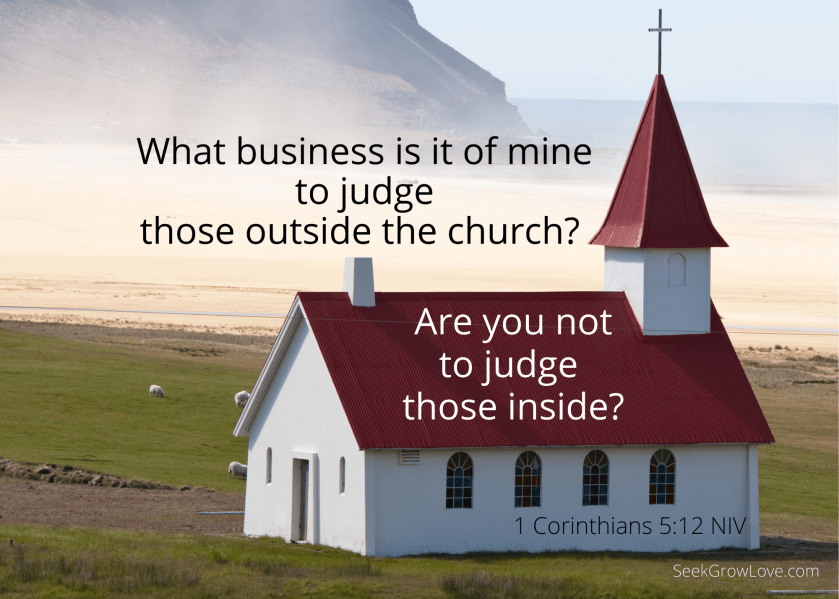
Earlier this week I wrote about how the early church was moving in the days of the Apostles. In today’s reading, we see a church that has come to a standstill. It seems the Cornintian church lost focus on spreading the Gospel and what it meant to be the body of Christ. Paul mentions when he told the church to stay away from people “who indulge in sexual sin, or are greedy, or cheat people, or worship idols” he was referring specifically to believers who partake in these actions (5:10 NLT). Paul plainly puts that to stay away from all such people, you’d have to leave this earth – that was another one of those zingers I found humorous. The problem Paul has with the Corinthians is they are allowing a man living in sexual sin with this step mother to be an active member of their church. It’s a distraction. It’s giving the church a bad name, as Paul writes even pagans don’t tolerate such behavior. Paul is NOT telling the church to avoid sinners, but he is telling us to get the sin out of the church. There is a difference. Allowing one who is actively participating in sin with no signs of repentance within the church causes a distraction. Discord can break out amongst the people in the church over the issue. I believe Paul is also concerned with the Corinthians giving the church a bad name, in turn hindering the spread of “sincerity and truth” (5:8 NLT). He continues this idea in chapter 6, regarding the Corinthians use of the public courts to settle disputes. He doesn’t like that this is being done in front of non-believers. Why? Because, it is distracting from the Gospel message. It’s the same way with the issues of marriage and food discussed in chapters 7 and 8.
We have to remember the church was on a mission. Our New Testament stories and scripture come from what the early church did. Paul understood the importance of the movement and the urgency to share the Gospel. It seemed this specific Corinthian church had forgotten. Paul is urging the Corinthians to remove distractions and get back to the business of the church. I believe that is the biggest take away from today’s scripture. It’s not about whether we should be married or not, whether we eat this or that. It’s not even about what people we should avoid or allow in the church. It’s about refocusing the efforts of the church to do the work of Christ. Jesus tells us the two most important commandments are to love God and secondly love others. That is the movement to which Paul wants the Corinthians to return. It must be our focus as well. Paul sums it up pretty nicely in his opening statement in chapter 8, “But while knowledge makes us feel important, it is love that strengthens the church” (verse 1 NLT).
Reflection Questions
What distractions have gotten in the way of you intentionally spreading the Gospel? How can you minimize them (or eliminate them or use them to your advantage – depending on what your distractions are) so that you focus more on how to best love God and love others which must include spreading the good news?
What should our response be to sin in the church? What should our response be to sin outside of the church? Why the difference? What happens when we get it mixed up and treat outside sin as we are supposed to treat inside sin? What happens when we get it mixed up and treat inside sin as we are supposed to treat outside sin?
After reading the whole Bible passage today, re-read 1 Corinthians 8:2. What is Paul saying in this verse? Why is he saying it? What can you learn from it? And how could you put it into practice?
What do you think God wants you personally to learn and put into practice today from this letter from Paul to the church in Corinth?
When Marcia initially asked me to write the devotions for this week, I briefly glanced at what the daily passages would be. When I saw some Corinthians, I remember thinking, Cool, I like Corinthians – it’s got some good stuff like the love chapter and resurrection chapter. Oh golly, did I underestimate the book of 1 Corinthians. I mean, I know Paul wrote some “hard to understand” things (2 Peter 3:16 NLT). I just didn’t realize, until today, I would have to write a response to some of these things.
Teaching, wisdom, and humility are some overarching themes in today’s text from 1 Corinthians chapters 1-4. Upon my first read through, I was stumped, and really wishing someone smarter than me had these chapters. I longed to search through my old notes from Bible college to see what my professor had to say. I have all my old notes – and Bob Jones, if you’re reading this, I have my handouts organized by theme in TWO collapsible file portfolios. 🙂 Unfortunately, everything is labeled somewhere in a box that has yet to be unearthed since my getting married and moving from Nebraska to Missouri. It then occurred to me I could spend hours diving deeper into the complexity of these four chapters with the aid of the internet. Seeing as it was 2pm Wednesday afternoon, Marcia needs my devotion tonight, and I’ve got a Thanksgiving Bible Study dinner at 5:30, I decided that wasn’t the way to go. So, I got out my interlinear Greek New Testament and started reading again, this time briefly summarizing the main ideas as I went. What I came up with was the Emilee Christian Simplified Version of 1 Corinthians 1-4. Doing this helped me better understand what Paul meant. I will share with you what I came up with, in hopes it does the same for you. This may be more informal than what you are used to reading – bear with me, please!
1:1-3: Paul and Sosthenes are writing a letter to the Corinthian church.
1:4-9: Speaking as Paul: I thank God for you. God loves you. God wants to use your church.
1:10-17: I hear you’ve been fighting – knock it off!
1:18-20: Earthly wisdom has no power against the cross.
1:21-31: God likes to use the weak and unexpected things of this world to further show His power. Side note – I particularly like this section and immediately thought of these four seemingly unexpected things God has used: a manger, shepherds, fishermen, and women as first witnesses to the resurrection.
2:1-5: When I came to you, I spoke in plain simple terms so you would understand that Gospel message.
2:6-11: I use more complex language while speaking to spiritually mature believers. This is different from worldly wisdom. Perhaps people were accusing Paul of using worldly ideas to explain the Gospel and this is his defense.
2:12-15: I’m talking about spiritual matters that do not make sense to those attempting to understand with worldly wisdom.
3: 1-3: Remember when I came to you I simplified things. I am still having to simplify things because your arguing and disagreeing is preventing you from understanding more complex spiritual thought.
3: 4-9: Summarizes what they’ve been arguing about. Explains that it doesn’t matter who brought you to the faith in Christ, what’s important is that you now have faith in Christ.
3:10-15: Christ is the foundation of our faith. Anyone may build upon this foundation by spreading the Good News. God’s judgment will reveal if one has done a good or bad job at expanding the foundation. We mere humans don’t need to burden ourselves with making those judgments.
3:16-17: The Church is God’s holy temple so behave and be holy – get your act together Corinthians!
3:18: Sounds like Paul saying he hopes the proud get knocked down a few pegs so they will in turn learn true wisdom.
3:19-20: Again there is a difference between God’s wisdom and the world’s understanding.
3:21-22: Don’t be boastful, don’t be prideful – all things belong to Christ who belongs to God.
4:1-5: It’s God’s place to judge.
4:6-7: So quit arguing about who is better – it’s not your job, it’s God’s.
4:8-13: Seriously, quit bickering over us Apostles! It’s rough enough out here spreading the Gospel we don’t need to deal with your infighting, too.
4:14:I’m not trying to shame you in saying these things, but you need to be disciplined because you are acting like children.
4:15-16:I feel responsible for your faith because I was the one who first told you about Christ – so I’ve got a right to call you out when you’re acting like children. Shape up. Do better.
4:17: I’m sending Timothy to help you.
4:18-21: I hear you want me to come visit, but is that what you really want? Because if I came to visit you now I would be mad and disappointed. Get your act together so that when I do come, we can have a good visit.
Food for Thought: I have to wonder if writing in lengthy complex statements was sort of Paul’s point. In trying to put spiritual things into the context and words of men, it seemed to me to make less sense. Is that a part of Paul’s argument? Perhaps Paul is demonstrating that to have complete understanding of God is foolish and what we should seek is to have faith.
Reflection Questions
What are some examples of what the world says is wise that God says is foolishness? When have you found yourself switching over from worldly wisdom to Godly wisdom?
If Paul came to your church, or wrote a letter to you, what might he say?
What arguments have you allowed to come between you and your brothers and sisters at church? What can you do to fix the problem?
We revisit the story of the early church in today’s reading of Acts 18:19-19:41. In this section we meet Apollos, an influential Jew converting many to Christ. Paul concludes his second missionary journey and begins his third. There is an encounter with the Holy Spirit and men of Ephesus. We learn about God giving Paul the ability to perform miraculous signs. We get a story about demon casting and see how God can use all things for His good. Finally, this section ends with a huge riot in Ephesus. So much happened in this section, but the undercurrent was the movement in the church, the believers. I think it’s worth taking a closer look at what the believers were actually doing, so we can follow their example.
In today’s reading, the collective term “the believers” is first used in 18:23 when “Paul went back through Galatia and Phrygia, visiting and strengthening all the believers” (NLT). Here, the church is seen hosting Paul and allowing themselves to be encouraged and strengthened through his teachings. In various letters Paul commends hospitality. The church is supposed to be a hospitable place. Soon many families will gather together for the holiday season. While this can cause stress, I challenge you to consider it a blessing and an opportunity to share God’s love by welcoming people into your home.
The believers were also strengthened by Paul’s visit. We, too, need to allow ourselves to be encouraged. It is important we put ourselves in situations where we can feel revitalized. Find what reignites your passion for the Gospel. Maybe that’s simply going to church on a weekly basis. It could be attending a Bible Study, instead of leading one. Time alone in the Word. Church Camp or conferences. Attending a Christian concert. I think it is worth noting that while the early believers were welcoming and serving Paul, they also allowed themselves to be served as Paul’s visit strengthened their faith.
Next we see believers teaching, correcting, and learning. I love the story in Acts 18:24-26. We meet Apollos, a man on fire for the Lord. In Ephesus, he meets Priscilla and Aquila, two students of Paul’s. Scripture says Priscilla and Aquila pulled Apollos aside and “explained the way of God more accurately” (18:26 NLT). They did not publicly call out Apollos, telling him he was wrong. Rather quietly and respectfully this couple sought to fill in the gaps in Apollos’ understanding of scripture. Furthermore, Apollos welcomed their knowledge. He was not so prideful, he could not learn. This is such a wonderful example of church conflict being resolved peacefully. We can learn from these early believers to have open hearts, ready to search scripture to receive truth, and share our own perspective and understanding of scripture in non-threatening ways.
This next part of Apollos’ story especially intrigues me. Apollos has a desire to go to Achaia and shared it with his fellow believers. They in turn encourage him to go. We can follow this example by sharing with our brothers and sisters in the church our desires, hopes, plans. From little side stories like these, it is clear to me the church is meant to act as a unit, not one sole individual acting on his or her own. Apollos allowed himself to be encouraged by his fellow believers then set off to do the work God planned for him. Here we see the church in movement by sharing and encouraging.
These believers in Ephesus not only encourage Apollos to go to Achaia, but intercede on his behalf. They write to their friends in Achaia asking them to welcome Apollos. Again, it is a short and sweet detail in this grand passage of Paul’s journeys. Yet, it shows how the early church was moving and interacting with one another during the time of the Apostles. It serves as a reminder to us how we should be interacting with one another. How can you intercede for those brothers and sisters around you? Are there unmet needs you may be able to provide?
Looking into Chapter 19 Paul has some interesting interactions with the people of Ephesus. These twelve men were like Apollos believing in “John’s Baptism,” understanding the repentant side of the story, but not quite grasping the Jesus-new-life part. This new creation baptism was something Paul personally experienced. Essentially, he provides these Ephesian men with the rest of the story and they are “baptized in the name of the Lord Jesus” (19:5 NLT). So, what are members of the church doing here? Getting baptized. Baptism is a public declaration of our faith. This symbolic action helps solidify our understanding of a new life in Christ. How can we follow the example here from the early church? Get baptized. Baptism has meant all sorts of different things to different people. However, in my opinion, scripture has made it pretty clear. Baptism is our call to action after hearing, believing, and accepting the Gospel. Baptism is not a necessity to our salvation but a consequence. It is what the early church did, it is what we should do.
The next time “believers” are collectively mentioned as a group is in Acts 19:18. In the aftermath of the Sons of Sceva story, believers still practicing sorcery and incantation confess and repent by burning books associated with sorcery. While I am certainly not advocating for the burning of books, it is the action of physically turning away from their sin that is notable here. The church today can follow this example. The church is made up of humans. We are going to make mistakes, mess up, have our good and bad days. On the bad days, it is important we take responsibility. When the Ephesian people turned away from their sin “the message about the Lord spread widely and had a powerful effect” (20 NLT). This shows that repentance is not just for the sake of the sinner but can be used for spreading the Gospel.
Finally, the last time we see the believers in this section is during the riot in Ephesus. Here, the believers are seen as protecting and defending Paul. I found the small details in this story fascinating. In Acts 19:30 the believers prevent Paul from entering the amphitheater where the rioting was taking place. While some of Paul’s companions are swept up in the chaos, Paul is held back. The Greek word used here is translated as “would not allow.” Eventually, the people are calmed down and dispersed with nothing more than shouting and confusion to show for their rioting. I have to wonder if the situation would have been made worse had Paul been present. Even some of Paul’s friends who were province officials sensed Paul would be in danger had he gone with the rioters. While we may not be facing an angry mob head on, in what ways can we protect and defend our fellow believers? Does your church have connections with missionaries who are in danger? Can you financially contribute to these organizations? Can you organize prayer for these people? Are there justice groups for which you could be involved? The early church played a role in protecting and defending other believers, so how can we?
The believers of the early church are seen acting in so many ways throughout this section. They are welcoming. Receptive of encouragement. They are teachers, correcting and learning from one another. They are involved in each other’s lives. They are responsive to the call of baptism. They are repentant. Lastly they are seen as protecting and defending. My hope is by further looking at their actions we can seek action as well. May we learn from the example of the early church and may their actions guide us as we continue the spread of the Gospel, two thousand years later.
Reflection Questions
From above: “How can you intercede for those brothers and sisters around you? Are there unmet needs you may be able to provide? “
And, “The early church played a role in protecting and defending other believers, so how can we?”
How can you be more like the early church believers today?
After spending the last two days discussing unity, today’s reading from 2 Thessalonians may seem counterintuitive as there appear to be a lot of divisive factors. In Paul’s explanation of the second coming there is clear division between the saved believers and evil doers. What I find interesting is who is doing the dividing.
Paul makes it clear God will take care of Evil. There is a plan. While we may not have all the details of how said plan will work out, verses like 2:8 make it pretty obvious a plan exists. Today’s text seems to be saying it is God’s job to judge and take care of evil; it is our job to love and teach.
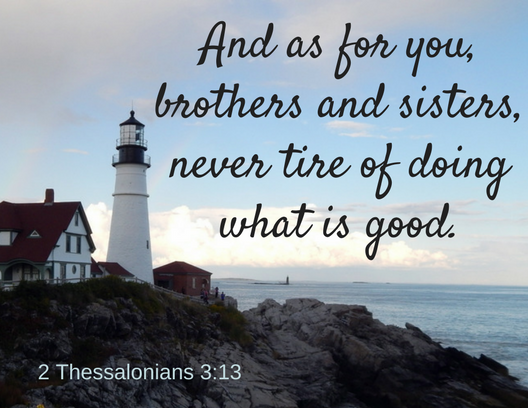
Throughout both letters to the Thessalonians, Paul commends their ability to love one another and remain faithful. In this letter, Paul specifically instructs them to “never tire of doing good” (3:13). The Greek word used here is kalopiountes meaning “to do well, act honorably, do what is right. From Kalos and poieo; to do well, ie Live virtuously” (Strong’s 2569). We know from Paul’s other writings he regards love as the greatest virtue (1 Corinthians 13:13). Basically, after discussing God’s plan to vanquish evil, Paul instructs the Thessalonians to show love. I think there is significance in the order he presents these topics. Our response to God’s judgment upon the earth is to love.
Yet, it’s also clear Paul does not equate love with acceptance. Again, Paul warns against idleness. Here is where I believe the call to teach comes. While we are not called to judge, we’re also not called to hold the truth to ourselves. In fact, Paul even instructs the Thessalonians to “warn” the ones who “refuse to obey what we say in this letter” (3:14 NLT). As Paul did with the Athens people, we need to find a way to express the Gospel Truth to those with destructive ways of living. This takes faith. This takes action. This takes love.
Reflection Questions
What are your thoughts on the statement: “Our response to God’s judgment upon the earth is to love”?
What does a loving warning look and sound like? Have you ever received one? Have you ever given one? Is there a person to whom God is asking you to give a loving warning? Pray about it.
When have you been guilty of holding the truth to yourself? How could you respond next time?
How will you show your faith, action and love this week?
The book of 1 Thessalonians covers a lot. Shout out to the Wednesday night Bible study group at Jaynes Street in Omaha, NE and Pastor Isaac! Last Spring we took our time diving into all Paul had to say in his letter to the church in Thessalonica. This sparked some great discussions and I recommend a deeper study into this book. While reading through it this time around, I was struck by one theme in particular: unity. We live in a world with so much division. In this letter, Paul urges us to get along with everyone and gives us a few pointers on how to do so.
First, Paul advises us to “live a quiet life, minding your own business” (4:11 NLT). It’s interesting how this comes after his instructions for holy living. In yesterday’s reading we saw Paul correcting a group of people for their unholy idol worship and leading them in love towards the truth. Christians are given clear instructions to be ambassadors for Christ, sharing the good news. I believe there is a right way and a wrong way to go about doing that. Basically, avoid causing drama for drama’s sake. If you want to offer your opinion, make sure it is done with the right heart and mindset. Treat others with dignity and respect. Let that be the first thing people notice about you, rather than preachy words for holier living.
It is clear from this letter, and others, that a strong work ethic was important to Paul. Paul was proud of his ability to support himself through his tentmaking trade while he was a missionary. He urges believers to “work with their hands…then people who are not believers will respect the way you live, and you will not need to depend on others” (4:11 & 12 NLT). I believe Paul is wanting the church to take an active role in society, not a passive one. We can be a people set apart, holy, and chosen by God while still serving the unchurched.
How do we do this? How do we live transformed without shunning the world? It’s quite easy, actually. “Be patient with everyone” and “do good to each other and to all people” (5:14 & 15). I hope my sarcastic humor is coming through these typed words. It is certainly not easy to remain patient with all people. Simply put, there are a lot of idiots out there – ourselves included. God has remained faithful and patient with us. Give this patience to others. Even those with whom you disagree. Yesterday, Paul approached the Athens people with patience. He didn’t accuse them of pagan worship, but rather approached them as a group of misunderstood people whom he sought to lead towards truth. I wonder what it would be like if we treated those with differing ideas from us as toddlers who truly know no better.
Finally, there was one place where the theme of unity struck me the most, in reading Paul’s words for the hope of the resurrection. This might seem an odd place to find unity as there are differing end of life and end of time doctrine. Those in the church of God Conference know this especially all too well. While passages like this seem to support a sleep of the dead theology, Paul’s intentions for writing these words on the resurrection were not so much to teach as they were to encourage. The hope of the resurrection is not meant to cause division but to encourage us in the future glory we will share with Jesus. The timeline and order of events is not as important as the actual event. We know that there will be a day where we will be with the Lord forever. THAT is our hope. This is not to say that the when, the where, the how, are not also important, but they don’t seem to be Paul’s focus of his resurrection writings to the Thessalonians. More than once Paul mentions how he doesn’t need to write to the church about such things as they are already aware (5:1, 5:4). Rather Paul says he is writing about the resurrection to “encourage each other” and “build each other up” (4:18, 5:11 NLT). Until today, I had only looked at this resurrection passage as supporting a particular doctrine. When I read Paul’s closing statements as to why he wrote such things I was hit with the sad realization that we as Christians, myself included, have allowed the hope of the resurrection to be a dividing point in our faith rather than something that unites us.
Reflection Questions
I challenge you today to look for ways you have allowed divisions to occur between you and others. How can we take Paul’s instructions for unity and apply in our lives, today?
How do we live transformed without shunning the world?




 Seek Grow Love