In today’s reading, we see more examples of Saul’s rebellion against God and his hatred of David. Ahimelech the priest had inquired of the Lord for David. In his rage, Saul ordered that not only Ahimelech, but all the priests must be killed – so Doeg the Edomite, one of Saul’s goons, killed 85 priests, then went to their town and killed every man, woman, and child (and its cattle, donkeys, and sheep). In chapter 23, Saul chased David and tried to kill him multiple times.
In chapter 24, David finally has his opportunity for revenge. Saul was again chasing David. David and his men were hiding in the Desert of En Gedi. Saul and 3000 chosen troops were in hot pursuit. Along the way, Saul needed to go to the bathroom. He wanted a little privacy, so he stepped into a cave to relieve himself. Little did he know that David and his men were hiding further back in that very cave.
If you were David, what would you have done? Would you have eliminated the threat to your life, and ushered in your reign as king? To be perfectly honest, I think that’s exactly what I would have done. David’s men encouraged David to kill Saul, but instead, David crept up to Saul, and cut off the corner of Saul’s robe.
Afterward, David was conscience stricken and said, “The Lord forbid that I should do such a thing to my master, the Lord’s anointed, or lift my hand against him; for he is the anointed of the Lord.”
Wow! Clearly Saul was a scoundrel, but David spared his life because God had made him king. I think we can learn a lesson or two from David’s respect for the office of authority, even when the man in the office wasn’t worthy of respect.
This is exactly what we’re told to do in 1 Peter 2:13-14 – “For the Lord’s sake, submit to all human authority—whether the king as head of state, or the officials he has appointed. For the king has sent them to punish those who do wrong and to honor those who do right.”
David’s actions also remind me of Romans 12:17-18 – “Never pay back evil with more evil. Do things in such a way that everyone can see you are honorable. Do all that you can to live in peace with everyone.”
So too, we need to submit to authority, even when we don’t like the person in authority, or what they are doing. Also, we need to be intentional about never repaying evil for evil.
To finish today’s story, because David had spared Saul’s life, Saul promised to leave David alone, and returned home (for now). David and his men went up to their stronghold. God had protected David yet again.
Steve Mattison
(originally posted April 13, 2020 for SeekGrowLove)
Reflection Questions
What do you admire about David?
When have you found it difficult to pass when given the opportunity for revenge, a cutting comment, or having the last word? What is the world’s position on paying back evil for evil? What is God’s? What is the advantage to leaving it up to God to be the judge, rather than taking out revenge for wrongs done against us?
In what ways do you think God wants to see Christians submit to authority today?
Today’s reading, found in 1 Samuel chapters 18 through 20, highlights how far Saul has fallen from his successes of chapter 14. (Remember from chapter 15, that Saul had deliberately disobeyed a direct command from God, and things have been going from bad to worse for him since.)
In 18:10-11, we read, “The very next day a tormenting spirit from God overwhelmed Saul, and he began to rave in his house like a madman. David was playing the harp, as he did each day. But Saul had a spear in his hand, and he suddenly hurled it at David, intending to pin him to the wall. But David escaped him twice.”
Once Saul decided to abandon God, God not only abandoned Saul, God tormented Saul. This should be a lesson to us – never disobey God – there are always negative consequences.
Saul became jealous of David, after David had killed Goliath, because the women of Israel sang this song, “Saul has killed his thousands, and David his ten thousands.” As a result of his jealousy, Saul tried to kill David with his spear in 18:11 and again in 19:10. Saul also tried to kill David by having the Philistines kill him in 18:17, 21, 25. In 19:1, Saul urged his servants and his son Jonathan to assassinate David. In 19:15, Saul ordered his men to bring David (and his bed) to Saul to be killed, when Saul thought David was sick in bed. In 19:20, 21 and 22 Saul unsuccessfully sent troops to get David three times.
In 20:30, Saul boiled with rage at his own son, Jonathan, who was friends with David, and in 20:33, Saul hurled his spear at Jonathan, intending to kill him.
So much for Saul, what about David?
If you were David, how would you react? What would you do?
Remember that Samuel had anointed David in chapter 16, and declared that David would be the next king over Israel. So what did David do? He wrote some songs about this. Let’s see what he said in those songs…
David wrote Psalm 59 when Saul sent his soldiers to watch David’s house in order to kill him. This psalm starts out, “Rescue me from my enemies, O God. Protect me from those who have come to destroy me. Rescue me from these criminals; save me from these murderers. They have set an ambush for me…”. This makes sense. David was in trouble, so he cried out to God for help. David continues in verse 9, “You are my strength; I wait for you to rescue me, for you, O God, are my fortress.”
Then an astounding thing happens. David starts praising God – in advance of God’s rescuing him. Psalm 59 ends with, “But as for me, I will sing about your power. Each morning, I will sing with joy about your unfailing love. For you have been my refuge, a place of safety when I am in distress. O my strength, to you I sing praises, for you, O God, are my refuge, the God who shows me unfailing love.”
David, the man after God’s own heart was actually praising God when he was literally afraid for his life. This shows his great faith that God will indeed rescue him. Maybe this is one of the reasons he was called a “man after God’s own heart.”
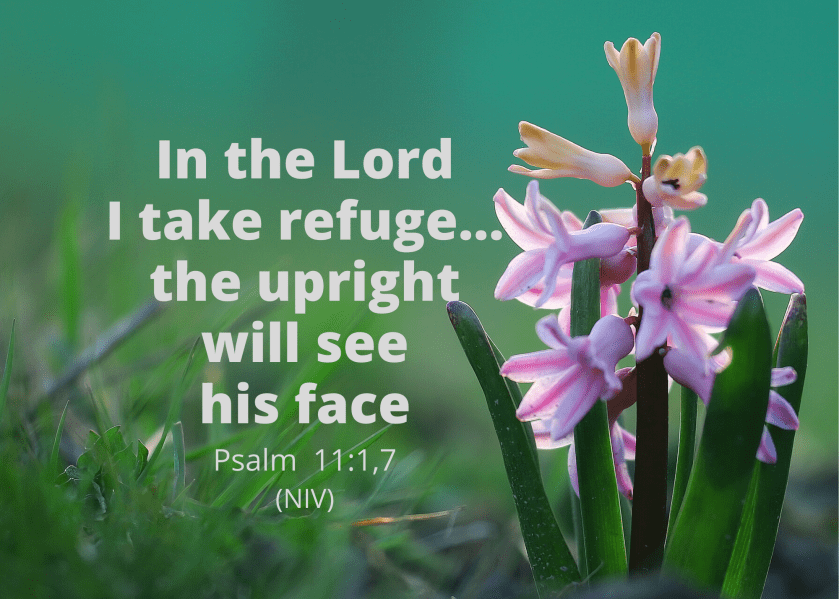
Psalm 11, the other chapter from today’s reading also shows David’s faith through difficulty. It starts out, “I trust in the Lord for protection…”, and ends with “For the righteous Lord loves justice. The virtuous will see his face.”
I believe David’s response is a good example for us. When times are tough, it’s natural to cry out to God for help. We need to move on from just asking for help, and follow David’s example to also have faith and praise God, even before the answer comes. And in the process, we, too, may become people after God’s own heart.
–Steve Mattison
(originally posted April 12, 2020 for SeekGrowLove.com)
Reflection Questions
Compare and contrast Saul and David based upon what we know from 1 Samuel.
What do you see in your own life that is similar to Saul? And David?
What does it look like to show faith in God during the difficulty?
What difficulty (big or small) have you recently found yourself in, in which you can practice giving God praise even before the answer comes?
Being raised as a pastor’s kid, I probably took for granted the accessibility of all things church related. Being a Christian was something that was easily practiced because of the environment I was constantly in. I asked Jesus to come into my heart when I was 5 years old. I was baptized the summer before my eighth grade. But it wasn’t until I went off to college that I really realized that my faith was my own responsibility. If I was going to have Christian friends, I needed to find them on my own. If I was going to attend a mid-week Bible study, I needed to find it on my own. If I was going to attend a Sunday morning service, I needed to find it on my own. Mom and Dad weren’t there to guide and direct me. If I wanted to continue to build up my faith, it was now up to me.
As we read through King Saul’s life, we see that he was hand selected and groomed to take on the role of leading Israel – everything was handed to him. And as a result, he never really owned the responsibility of the position he was put in. He never connected the dots of being the leader of God’s people and having a relationship with God himself.
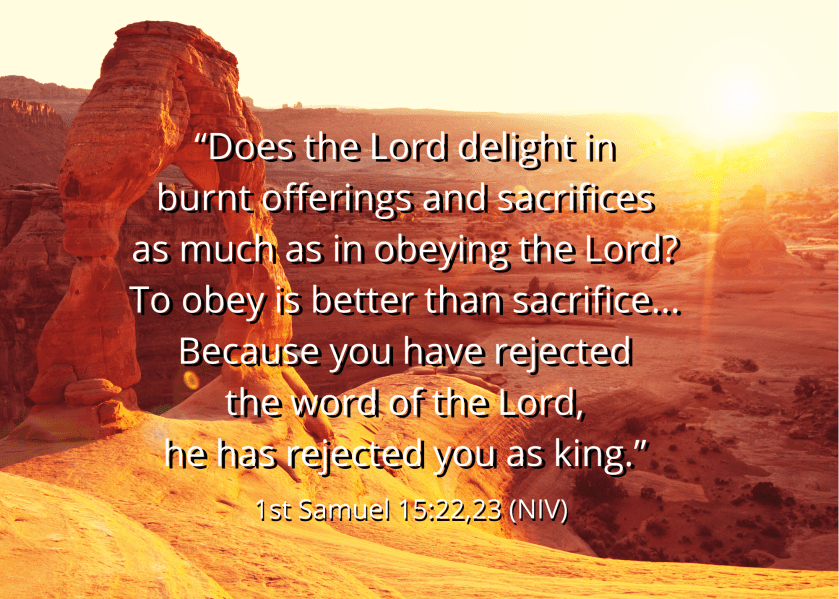
This is particularly evident in 1 Samuel 15. Saul has carried out God’s instructions of taking up arms against the Amalekites. Once Israel wins the battle, they were supposed to destroy everything: man, woman, child, cattle, sheep, camels and donkeys. Nothing was to be spared. But…that’s not what Saul did. He kept the best of the spoils. He claims that he was going to use the prime plunder as a sacrifice.
Here’s how I know that Saul didn’t own his relationship with God: in verses 21 and 30 of chapter 15, Saul refers to the LORD as Samuel’s God.
“…the best of what was devoted to God, in order to sacrifice them to the LORD your God at Gilgal.” (v 21)
“…come back with me, so that I may worship the LORD your God.” (v 30)
Saul didn’t understand his disobedience because he hadn’t bothered to grow a relationship with the One who made him king of Israel.
More than anything God desires to have a relationship with us. He wants us to seek Him more than any other person or pursue any other passion. When we grow our relationship with Him, we come to know the things that please Him as well as the things that displease Him. As we grow our relationship with God, our hearts swell with love for Him, His word, and His people. And when our hearts are full of love, obedience comes naturally.
Bethany Ligon
(originally posted for SeekGrowLove April 11, 2020)
Reflection Questions
Why is obeying Him important to God?
Have you ever felt like God is just someone else’s God?
Today’s chapters 23-25 (and 22) are like an action movie with a lot of suspense! Balak, King of Moab, looked out at the numerous Israelites camped nearby and was greatly afraid. He called upon a sorcerer to come and curse them, which God didn’t allow him to curse but blessed them!
Interestingly, Balaam (sorcerer) was confronted three times to go, three times his donkey refused to proceed and was hit, and three times he built seven altars and sacrificed a bull and ram on each (21x). Not sure of the significance of the tresome repeats but does show the intensity of the situation!
The Spirit of God came upon Balaam and he blessed Israel three times. In the three different oracles a meaningful phrase struck me with each one.
“How can I curse whom God has not cursed? How can I denounce whom the LORD has not denounced?” (23:8)
“God is not man, that he should lie, or a son of man, that he should change his mind.” (23:19)
“A star shall come out of Jacob, and a scepter shall rise out of Israel.” (24:17)
These biblical accounts are written in past, present, and future. God has not cursed or denounced the Israalites. God is not a man, nor past nor will be! Lastly, God will have a future dynasty in Israel.
This is not what Balak wanted to hear, but Balaam obeyed God’s command to only say what he was told to say. Unfortunately, he advised Balak further on how he could bring harm to Israel, and his advice unfortunately worked. The Israelite men were seduced by the foreign women to worship their gods, which brought great anger to the God of Israel. Sadly, more than 20,000 were killed in the plague as a result.
Do you have God’s number on speed dial? It’s easy to remember …Jeremiah 33:3
“Call to me and I will answer you, and will tell you great and hidden things that you have not known.For thus says the LORD, the God of Israel.”
He’s ALWAYS available, never sleeping anytime of the day.
-Stephanie Schlegel
REFLECTION QUESTIONS
1. Who do you call upon for help? Depends what kind of help we need, right?
2. What’s God’s “phone number?” Do we go to the throne or phone when we need help?
3. Is there something today that you’re afraid of? What care needs to be cast upon Him today because He cares for you?
I have had a few different titles and roles in my life, pastor, reverend, spiritual director, chaplain, doctor. Of all of them, the one that I am most proud is Dad/Papa/Grandpa. If you do not know me from Adam, I have eleven children, six sons/daughters in law, and fifteen, soon to be sixteen grandchildren. Along with my wife Karen who I talked about earlier this week, these are my greatest loves and joys on this whole earth. One of Proverbs we looked at earlier this week included the following: “Grandchildren are the crown of the aged, and the glory of children is their fathers.” (Proverbs 17:6). This speaks of the importance of our families to our lives.
In today’s Proverb, I want to look at verse 7, which also speaks of the importance of family: “The righteous who walks in his integrity—blessed are his children after him!” (Proverbs 20:7). Growing up in the United States I have been exposed to important words like freedom. As a person who has spent the majority of my life in more conservative institutions I have been surrounded by ideas of “rugged individualism.” Since the emergence of neoliberalism in the 1970’s there has been this ongoing emphasis of personal responsibility. I grew up when the threat of Communist expansion was at a high point. Being surrounded by that cultural mindset it is easy to drift over into hyper-individualism. But is this what the Bible teaches?
There is a sense in which ultimately we are all responsible for the decisions that we make in life. If I make the decision to sin, I am the one who is answerable to God for my sin. I can’t say “it was my parents’ fault” or “it was my wife’s fault”. If you go back to the beginning of the Bible and the story of Adam and Eve in the garden, you can see how quick everyone was to try to shift the blame onto someone else. Adam famously tried to blame Eve, (or was he really blaming God?) “This woman that you made, she gave me the fruit”. The woman in turn blamed the serpent. God was having none of it.
A clear spiritual principle of the Bible is- each individual is accountable for their sins. Ezekiel 18:19-20 spells it out in very clear terms: “Yet you say, ‘Why should not the son suffer for the iniquity of the father?’ When the son has done what is just and right, and has been careful to observe all my statutes, he shall surely live. The soul who sins shall die. The son shall not suffer for the iniquity of the father, nor the father suffer for the iniquity of the son. The righteousness of the righteous shall be upon himself, and the wickedness of the wicked shall be upon himself.”
You could have the most wonderful, godly, spiritual parents in the world, but you do not automatically get to ride their coattails into the Kingdom of God. Once you reach a place of accountability, you alone are responsible for your commitment to follow Jesus Christ, or not. There are no legacy Christians. At the opposite extreme, you might have had the worst parents in all the world and suffered abuse or deprivation, maybe they never taught you about God or brought you to Sunday School or Vacation Bible School. You are still responsible when you grow to maturity. There are many people who came from terrible childhoods with not good parental spiritual support who meet Jesus Christ and allow him to transform their lives. From a spiritual/legal accountability standpoint, you are ultimately responsible for your sins and accepting Jesus Christ and following him.
Having said all of that, let me also say that we do NOT live only for ourselves. All of my children are now adults and they are accountable to God, but as a parent, I am accountable to God for how I parent my children. This was a clear principle give to God’s people, Israel from a very early time. Deuteronomy 6:6-7 says: “And these words that I command you today shall be on your heart. You shall teach them diligently to your children, and shall talk of them when you sit in your house, and when you walk by the way, and when you lie down, and when you rise.” Parents are instructed by God to diligently instruct their children in the teachings of God.
It became fashionable in the 1960’s in America for parents to say “I’m not going to impose my religious faith and values on my children. I’ll let them decide for themselves.” That is one of the stupidest ideas in the history of ideas. The world is constantly trying to impose its values on children. It begins with some of the baby books designed to be read to babies and toddlers, children’s television shows, childhood education in schools, social media, the music and entertainment industry, advertising, their peers etc…Everyone tries to impose their values on children, especially those who try to tell parents not to impose their values on children. God says to parents, you have got to start indoctrinating (aka teaching good doctrine to) your children with God’s teaching from the time they are small. Talk about God and God’s teachings to your children all day long.
I’m writing to some of you who are now or soon expect to be parents, and even for you younger ones, file this away so that if you do become a parent you will remember it. How you live your life and how faithfully you teach your children will have a major influence on them. Proverbs 22:6 says that we should “train up a child in the way he (she) should go”. Should is a word that contains judgment. You need to decide what is right and wrong in God’s word and you need to train your child to adopt those same values. There is no 100% guarantee that you will be successful and that your children will choose to follow your training and God’s Word when they grow up, but you can do all that is in your power to set them up for success.
I was blessed with a mother and father who loved God, brought me to Church throughout my childhood, practiced prayer in the home and demonstrated their faith in God and taught me to do the same. Were they perfect? No, no parent is. But they helped to prepare me to choose to live a life of faith as an adult. Did I have failures and setbacks in living as a follower of Jesus. Absolutely. I am 100% responsible for my sinful choices both as a teenager and now as a 60-year-old man. But I have been the blessed recipient of having had parents of faith. I have tried to pass along those benefits to my children. Was I a perfect Dad? Are you kidding? I have eleven eyewitnesses who could tell you stories about some of the stupid and sinful stuff that their dad has done. (Good thing they have a really good mom). And yet, I hope that I was able to teach and model faith to my children diligently, and continue to try to live out my faith today (I think I’ve gotten a little better at figuring out how to be a good dad as I’ve gotten older). Now, some of them are parents and having to navigate the same thing in their lives. Now they are responsible for how they parent their children.
Sorry, but when you stand before the Lord, you can’t blame your parents for your sinful choices, you are responsible. You are also responsible for how you parent any children God gives you, and you can help to better set them up for spiritual success by teaching them diligently God’s Word, until the time that they themselves are accountable to God. Faith is learned and lived in a community. We are responsible for how we live it in our families, in our churches, and in our world.
~ Jeff Fletcher
QUESTIONS:
How have your parents influenced you to follow (or not follow) God?
What values do you want to pass on to your current or future children?
What responsibility do parents have to pass on their faith to their children?
How can you prepare yourself to pass on this faith well to the next generation?
I have spent the last 3 years of my life and academic studies focusing on the subject of human flourishing. Let me ask you a question this morning…Are you flourishing in your life? Would you like to? To flourish is to grow healthy, to thrive. I believe it is God’s ultimate goal for us to flourish. If you look at the Bible from beginning to end, it is all about flourishing. In Genesis God creates the heavens and the earth. He fills the earth with abundant plant and animal life and that places humans on the earth to act as his stewards. Humanities first job was to cultivate and enjoy a flourishing garden. God’s first command to humans was “be fruitful and multiply.” That is all flourishing language. At the end of the Bible, in Revelation 22 it shows the culmination of God’s plan to live with humans on a restores and renewed earth where there is flourishing. There is a picture of a river flowing from God’s throne and along the banks of the river are the tree of life that bears fruit all year long and whose leaves bring healing. This is, once again, flourishing language.
Throughout his ministry, Jesus uses the language of flourishing as well. He says things like “I have come that they might have abundant life.” (John 10:10). That is the language of flourishing. In John 15 he says that he is the vine and we are the branches. We must remain connected to him to bear fruit. This is flourishing language. Later, the Apostle Paul picks up this same language of flourishing. In Galatians 5:22-23 he speaks of the “fruit of the spirit” as love, joy, peace, patience, etc… This is most definitely flourishing language.
God wants His children to flourish. As we know, in order for a plant to flourish it needs certain conditions. It needs good soil with good nutrients, it needs the right amounts of sunlight and rain, it needs to be nurtured, weeds to be pulled, pruning, pests and parasites need to be kept away. In the same way, God’s children need to have conditions that are favorable to our flourishing. God lays these out throughout the Bible.
The week we are going to focus on Proverbs. I think it is helpful for us to think of the Proverbs as very simple and clear instructions on how to spiritually, emotionally, relationally and even physically flourish. To learn how to grow a flourishing garden you might want to talk to a wise and seasoned gardener who can give you insights into how to get the most flourishing. How to prepare the soil, when to plan the seeds of plants, how deep to plant, how far apart to space them, how much watering is needed, do they need more sun or more shade, when and how to prune. Proverbs give these kinds of practical wisdom instructions to help God’s people flourish.
Consider one of the short Proverbs in today’s reading: “Gracious words are like a honeycomb, sweetness to the soul and health to the body.” (Proverbs 16:24). Raw honey has health benefits, it contains antioxidants and other good things, and it tastes sweet. I remember as a child seeing my very English grandfather put a giant teaspoon of honey into his cup of tea which he drank several times a day. He lived to be almost 100 (hey maybe I need to start putting honey in my tea?). So honey tastes good and is good for you, win-win, right? In that same way, in our spiritual, emotional and relational life, speaking gracious words or words that are full of grace also taste good and are good for you. Jesus is the ultimate example of what a flourishing human life looks like and it was said of Jesus that he was “full of grace and truth.” (John 1:14). Colossians 4:6 says: “Let your speech always be gracious, seasoned with salt, so that you may know how you ought to answer each person.”
Maybe I am just getting old, but it seems to me that people are often not very gracious in the ways they speak to each other. In many ways, social media makes it easier to speak very ungracious words to others behind the safety of anonymity or the filter of a phone or computer screen. Now, when I hear someone speaking graciously in public or on social media, I am like, “Wow, that was nice to hear for a change.”
God wants us, His children, to experience flourishing lives. One way toward flourishing is to monitor how we speak and intentionally choose to speak words that convey grace to others. We do not always have to agree with others and even Jesus spoke truth to his opponents, but even hard truth can be spoken with grace. That is part of being wise in our speaking and that is one-step towards a fruitful, productive and flourishing life.
~ Jeff Fletcher
Jeff is a pastor and chaplain who lives in the beautiful mountains of Virginia. He has spent his life in ministry and recently earned his doctorate from Vanderbilt University. He has a large, loving family and is very active in all the COG events and ministries.
Questions:
In what ways are you flourishing in your life? Where do you feel like you are not flourishing?
Have you noticed flourishing language in the Bible before? How does the Bible speak about flourishing? What is flourishing according to the Bible?
How does the wisdom of Proverbs help you to flourish in your life?
I believe that many readers of these devotions are currently students, while for some of you your school days are long in the past. Well, please adjust your memory as necessary and imagine the following situation: you’ve written a research paper with a required word count, and you run out of things to say (at least in the amount of time you gave yourself to write it). Your imagination is tapped. The letter of the law tells you the requirement, but you just can’t get your brain to produce any more useful ideas on the subject. What might you do? Perhaps you make one of your quotations longer to get the paper to reach the limit. If you were being a bit more cautious you might find spots to put in two or three shorter quotations so that your teacher won’t think that was what you did, instead of having one long quotation.
Well Hebrews is the New Testament book which depends the most on quotations, it has the most quotations and draws on them steadily to make its points about God’s intentions. Much of its argument about high priests uses Psalm 110 (which is itself the most quoted text in the New Testament, with Psalm 110:1 the most quoted individual verse in the Bible). And starting in Hebrews 8:8 we have the longest quotation in the New Testament, but I guarantee that it isn’t there for padding. For one thing the average length of a Greek letter at the time was only 90 words – more philosophical letters ran to 250 words. But even the short book of Philemon is 355 words. The book of Hebrews is nearly 5,000 words. Padding was not required. This information may be treated only as trivia, or we may think about why Hebrews depended so much on the Old Testament, as foundation for what it tells us. Consider the possibility that for some Christians this was one of the first “New Testament” works they had contact with – they may have known stories of Jesus by word of mouth, but their Bible may have been almost entirely the Old Testament, and this letter was attempting to guide how they viewed it by careful argument. On the off chance that you have been skipping over the quotations all this time because you assume they don’t add anything to the main story, do please read today’s text in full (and you probably should go back over the earlier ones too).
Hebrews 8:1 begins by restating some facts about Jesus: that he became our high priest and is at God’s right hand. Hebrews seven had discussed these facts, but alongside many other issues, now the author (who you may recall I choose to call Herb, for simplicity) refocuses our attention on these core points from Psalm 110:1, 4. Going from that foundation verse two makes the additional point that in heaven Jesus ministers in “the sanctuary,” that is “the true tabernacle” or sacred tent, pitched by God rather than man. Moses was given very specific instructions about what the tabernacle on earth should be like, and he was told that the tabernacle reflected the greater reality which exists in heaven. Several of the Psalms also refer to the heavens as a tent set up by God. The comparison might not seem as smooth if it were drawn between the heavens and the Temple which Solomon spent years building in Jerusalem, but the book of Hebrews doesn’t discuss the Temple worship, it emphasizes the worship that took place in the wilderness.
Having brought his audience back to first principles, Herb says in the next few verses some things that will be expanded on in chapters nine and ten. That doesn’t mean he is saying things that his audience wasn’t aware of. For example, in 8:3 he says that it is necessary for Jesus to have “something to offer” as a high priest. Herb says this only a few verses after having stated in 7:27 that Jesus “offered himself.” I think this fact was familiar to everyone involved in Christianity. But Herb is walking his readers through his argument, making the case he set out to make.
The quote beginning in Hebrews 8:8, from Jeremiah 31:31-34, will also be part of the discussion in the next two chapters of the book. It shows that during the time of the first covenant a need was stated – by God – for an improvement in the relationship of God and the people. All along the way God recognized needs and took steps to fill them. The same God brought about the first covenant and the second covenant. It was not some error in the first that resulted in the second, God planned for the developments that took place. While Jeremiah 31:31-34 says that the time is coming when no one would need to teach anyone the Laws (v. 10) it does not say that the content provided in the Law would be changing. Jeremiah simply said a new way was coming for God’s law to be given to God’s people, and that a way will come for sins to be forgiven. But we know that these changes involved more, and that the content of what people are meant to take in has changed between the first and second covenants. The law of love is a simpler message than the hundreds of laws contained in Leviticus, and through the Holy Spirit what God desires will be written “on our hearts” (v. 10). There is a different kind of relationship possible with God now than before.
Jesus said, in the Sermon on the Mount, that he did not come “to abolish the Law” but to “fulfill” the Law (Matthew 5:17). Perhaps some scholar of the Law could have anticipated that for the Law, which no one had ever successfully kept, to be fulfilled might be just what was required to bring change. Maybe Jesus’ words would have disturbed that scholar. Then again, a scholar of the Law who could anticipate such matters may also have foreseen that this was in God’s plan. Ultimately it was the ministry of Jesus at the true tabernacle, in heaven, which allowed the first covenant to be obsolete and disappear.
Lord, thank you for writing your will on my heart to let me understand you better. I don’t understand you as well now as I someday will be able to, but I am glad to know you more than I once did. It is good to love you, and to feel your love. Merciful Lord, help us to offer your mercy in your great strength. Amen.
Reflection Questions
We might sometimes think of the second covenant as very different from the first, but both covenants come from the God who took the people “by the hand to lead them out of the land of Egypt” (v. 9) – God loved and cared for the people of the first covenant, it is God who was rejected. What does the history of Israel show us about how God handles human rejection?
It seems likely that the first audience of the book of Hebrews knew the Old Testament better than most of us do, which may have helped them to understand the book of Hebrews better than we do. When you run into an Old Testament quotation you do not understand well, do you try to follow up on its context in the Old Testament?
How do you see the “law of love,” for God and neighbor, as differing from the law expressed in the first covenant? Is the issue that people are being freed from ceremonial issues? Are Christians being given more trust and leeway?
In Hebrews 7 the author of Hebrews (who for simplicity I’ll call “Herb”) describes Jesus’ greatness, particularly as a high priest. Herb is following a pattern we recognize, he has compared Jesus to angels, Moses, Joshua, and now Levitical high priests and says ‘that was good, but he is greater.’ The style of argument he is using was one employed by rabbis, it emphasized moving from a lesser thing (never a thing without value) to a greater thing. In the case of the priesthood connected to the Levites Herb compares it with a priesthood connected to Melchizedek, who has almost no known history (see Genesis 14:18-20, Psalm 110), and ties that to Jesus’ High Priesthood.
When Melchizedek and Abraham met it was several hundred years before the Levitical priesthood began with Aaron’s family, and before the Law which records instructions for those priests. There was no Ark of the Covenant then, and no Tabernacle to house it. It is difficult to imagine what form Melchizedek’s service toward God took, and for whose benefit it was provided. Should we suppose that Melchizedek and Abraham met often, and that the first frequently ministered to the second? We are told that Melchizedek was not only a priest but also the king of Salem (that city seems to have been at or near the site of Jerusalem, Psalm 76:2). Might Salem, under Melchizedek’s leadership, have been faithful to God?
We may find Melchizedek mysterious, rather like Balaam who operated as a prophet separately from the Hebrew people in Moses’ day (and ended up turning away from God). But Herb’s description in Hebrews 7:3 makes Melchizedek’s life sound even less clear, getting into whether we know who this priest-king’s parents were, or when he was born or died, as though Melchizedek had no birth or death. Herb’s point really is that Melchizedek was never stated to have become a priest based on inheriting the position, and that it is never mentioned that anyone took up his role as a priest after him. This is following a second style of reasoning accepted among rabbis, one in which you didn’t need to assume the reality of things which scripture left unstated. This allowed Herb to draw connections to Jesus, as one who did not inherit a priestly role from a parent, and who would never stop serving in his role as high priest. That was in contrast with the carefully kept genealogies of the Levitical system – there were tens of thousands of priests living in the New Testament period, each of whom gained their title through their father, and each of whom was to retire at age 50 (Numbers 8:25) – the order of Melchizedek was not joined based on birth records and was not temporary, but was through the permanent oath of God declaring membership (v. 21, 28; Psalm 110:4). So Herb’s statement “made like the Son of God, he remains a priest perpetually” (3b), paired with him saying that Melchizedek “lives on,” (8) may not just involve the rabbinical argument about an unstated death being assumed not to have occurred – it may refer to Melchizedek retaining his status as priest when he is resurrected. Melchizedek will continue to serve alongside the high priest of his order.
Hebrews repeatedly points to Jesus as the fulfillment of God’s plans and calls believers to follow Jesus to gain perfection / maturity / completion (the Greek term doesn’t translate simply). We are told in 7:19 that “the Law made nothing perfect,” but 7:28 says that “the word of the oath, which came after the Law, appoints a Son, made perfect forever.” Now of course when Herb tells us to join with Jesus he doesn’t mean that believers will stop sinning in this life, after all in 7:25 he describes Jesus as “able also to save forever [completely] those who draw near to God through Him, since He always lives to make intercession for them” (you see the point, people don’t need intercession unless they are still doing wrong; by the way, where 7:25 says “forever” and I note the Greek was more like “completely” that wasn’t the same Greek term as I was mentioning Herb used related to “perfection” and “completion.” I am sort of in the habit by now of noting with translations that say things like “forever” or “eternal” what word they should have said, though, because – say it with me – there was no New Testament word for eternal). As chapter six reminded us, a high priest never took the task on for himself, God made the choice, and when God provided us with Jesus we got the best (and only) high priest possible for the purpose of bringing us fully into contact with God.
I’m not sure if people in the church today think very often about how salvation works, but Herb felt it needed clarification and provided some in his book. We have read about Jews who were concerned over the idea of the Law continuing to be followed in the Church, a meeting was held at Jerusalem with apostles and other leaders to discuss that. At one point Paul addressed the issue by pointing to how God interacted with faithful Abraham, centuries before the Law. Paul showed that obedience to the Law was not required to please God, God was more interested in faith. Herb describes something similar with the priesthood, showing that it existed in Abraham’s time well before Aaron or Levi’s line and so the Levitical priesthood was not required for making connections to God. Herb also showed that Levi effectively tithed to Melchizedek when Abraham gave him a tenth of the spoils of battle, which Herb said meant that the earlier line of priesthood was greater than the later one.
Such interpretations as Paul and Herb wrote, or the many statements interpreting prophecies in the Bible, do not result from authors ‘putting together the pieces’ for what they wanted to support. I don’t think they could have been so fortunate in locating such details anyway. Rather we are talking about a God who shaped event, prophecy, and interpretation. Just as God chose Abram, by His own will, from whom to make a great nation, God also determined that He would use Abram as the starting point to reach the world. God’s choice involved setting up a whole imperfect system to put the Hebrew people on their path, creating a nation and a history and a culture that prepared the way for Jesus. Jesus then opened the way for people from the world; Jesus also provided for better things than the Hebrew people had been experiencing. It can be mindboggling to think about all the steps of the plan God put in place. I tend to wonder if some of those steps along the way were interchangeable, based upon whether certain people would follow through or fail in what they were called upon to do. What I am certain about is that God’s plan was never going to fail.
Thank you, Lord, for your plan, which you have been preparing for so very long. Thank you that we do not have to depend upon who gave us birth in this world to determine if we may enter your kingdom, but that you allow us to become inheritors of your kingdom through a relationship with your son Jesus. I may come into the relationship fallen, but he can lift me up. However dirty I seemed to myself, he was able to wash me clean. However useless I have felt, he can make me useful. As inheritors with him please help us each to joyfully work in your plan, caring and serving as he does for the will of his Father. And please help me be eager to serve him, let me help in ways I have not yet even been of help. Thank you, Amen.
~ Daniel Smead
Reflection Questions
Do you find it encouraging to think that your future is not based on your past, but on your connection to Jesus?
Hebrews 7:25 says that Jesus is able to save completely “those who draw near to God through” Jesus – do you see this more as part of the cautionary language in the book, saying salvation calls for drawing near to God, or as part of the promissory language of the book, pledging that we are able to draw near to God? How might a difference in outlook on that point affect someone’s life? How have you drawn nearer to God in the last few months?
Perhaps it will seem to be a side issue, but we are told we will be priests in the coming age (Revelation 5:10). If the offer had existed through the Levitical order almost no Christians would be eligible – they are not Levites, they are not male, they are the wrong age, etc. But as members of the Melchizedite order alongside Jesus we are not subject to those restrictions, and we can serve with our High Priest Jesus for centuries. How can you honor God today?
Is it possible to lose your salvation? The author of Hebrews thinks that this is a real possibility. It can happen. In Hebrews 3:12, he wrote, “Take care, brethren, that there not be in any one of you an evil, unbelieving heart that falls away from the living God.” In Hebrews 6:5, he writes about those who “…. have fallen away, it is impossible to renew them again to repentance…” Truly, these are very troubling words to read and to contemplate. We might wonder to ourselves, “I have gone too far? Have I sinned too much? Have I ruined my chances with God?” For each one of us are sinners. We are imperfect. We are prone to sin. We get distracted. We get discouraged. We get apathetic. Each of us can think of people who, at one time, sincerely followed Christ. They attended church. They lived good lives. Their faith seemed genuine. However, now things are different. They live as though they had never known the Lord. In some cases, they have openly embraced evil. The way of Christ has been rejected by them. Has their salvation been lost?
What is it to be saved? It may be helpful to think of salvation in terms of past, present and future. In the past tense, you have been saved. Christ died on the cross for your sins some 2000 years ago. The work is done. His blood covers all who come to Him in faith. Each one of you fondly remembers the day when you came to Christ. On that day, whether decades ago or only days ago, you were justified before God by the blood of Christ. So, you have been saved. In the future tense, you will be saved. Salvation, life eternal, is not yet in your possession. You are saved now only in hope and in promise. The resurrection at the return of Jesus Christ is when salvation will become yours. You will be saved. That is the past and future of salvation. What about the present? You are now being saved. You have been saved in the past. You are being saved in the present. You will be saved in the future. So, you are being saved. The present work of salvation in us has been called “sanctification.” It is a process. It is to grow into the image of Christ. God, by His Spirit, is working in you to change you and transform you. However, the Apostle Paul recognized that there is an ongoing struggle within each Christian. While we hope in the age to come, we still live in this present evil age. Paul in Romans 12:2 urged Christians “…do not be conformed to this world, but be transformed by the renewing of your mind…” Another common theme in the writings of Paul is the encouragement to live by the “Spirit” and not by the “flesh.” It is no wonder that Paul looked at the Christian life as a contest that must be won, a race that must be completed, a journey that must be finished, and a battle that must be waged. To be a Christian is to be actively engaged against sin and evil in your life. The book of Hebrews draws from the rich history of Israel to make the point. The people of Israel were saved from slavery in Egypt by God’s mighty works. The people of Israel left Egypt with the goal of entering the Promised Land. However, between the past and the future, between Egypt and the Promised Land was the wilderness. The wilderness wanderings are what tested the people of Israel for 40 years. The wilderness tried their faith and challenged their hope. Then, the people of Israel lived in the shadow of God’s presence. They had seen the mighty works of God. God fed them daily with the manna. He gave them water out of the rock to drink. However, as incredible as it may seem, many of them remained disobedient. They grumbled and complained. They wanted to go back to Egypt! Hebrews 4:1,2 comments, “Therefore, let us fear if, while a promise remains of entering His rest, any one of you may have come short of it. For indeed we have had the good news preached to us, just as they also; but the word they heard did not profit them, because it was not united by faith in those who heard.” In the same way, we Christians find ourselves in a “wilderness” of sorts. Behind us lay our sins and our old way of life. Before us lay the Promised Land, the kingdom of God, eternal life. However, you are now walking through the wilderness of this present evil age. The wilderness is what can make you or break you. The wilderness experience will reveal who and what you really are. You have to keep your eyes upon the distant Promised Land.
Hebrews 6:4,5 observes, “For in the case of those who have once been enlightened and have tasted the heavenly gift and have been made partakers of the Holy Spirit, and have tasted the good word of God and the powers of the age to come and then have fallen away, it is impossible to renew them to repentance, since they again crucify the Son of God and put Him to open shame.” This verse is not declaring a penalty against those who have fallen away. Rather, it is simply describing the reality of the human heart. Some of the Israelites of old were apparently untouched by the wonders that they had seen. They had short memories. They were easily discouraged by obstacles. They didn’t trust the God who had saved them. They returned to their old ways. In the same way, some Christians after tasting “the good word of God and the powers of the age to come” have fallen away. They were unimpressed by what God had done in them. They were no longer moved by the sacrifice that Jesus made on the cross. After God had revealed His glory to them, what further could God do to convince them now? If you have seen miracles and all you can do is yawn, what more can God do with you? I believe God, in His grace, would allow repentance in these cases. However, can such a hardened heart be able to repent? If you have already proven yourself resistant to the Holy Spirit, you have rendered yourself blind and deaf to the saving gospel message. It is a though God has cooked you a wonderful gourmet meal with the best ingredients. However, you have no taste for what God is serving. So, you won’t be back because you have no appetite for what God is serving. Hebrews reads, “…it is impossible to renew them to repentance….” You have headed back to Egypt and have forsaken the Promised Land. What could convince you change your course now? God had given you his best and you didn’t want it.
However, it is not the intent of Hebrews to discourage, but to encourage. Hebrews 6:9 reads, “But, beloved, we are convinced of better things concerning you….” Hebrews 6:11 adds, “And we desire that each one of you show the same diligence so as to realize the full assurance of hope until the end…” The book of Hebrews, taken as a whole, is a word of encouragement. Don’t give up. Don’t quit. Don’t be discouraged. Don’t be overcome by sin. Have hope. Have faith in the promise of God. For God is faithful. For you will find troubles and challenges in the wilderness. So, brothers and sisters, if you are reading these words, you have not yet given up. You are not lost. You are still seeking the Promised Land. Hebrews 10:35,36,39 sums up this message: “Therefore don’t throw away your confidence which has great reward. For you have need of endurance, so that when you have done the will of God, you may receive what was promised….but we are not those who shrink back to destruction, but of those who have faith to the preserving of the soul.” So, the wilderness road may have beaten up a bit. You may have wandered in the wrong direction at times. Perhaps you had temporarily lost your way. You might have encountered obstacles. However, you are still on the road with your eyes focused on the Promised Land. Keep going and don’t give up.
-Scott Deane
Reflection Questions
Why is it important to know what you believe about salvation?
Have you accepted Jesus and been baptized? Are you assured of your salvation?
What are some reminders you can put into your everyday routine to point you to living a gospel-centered life so that you don’t forget your primary calling?
In yesterday’s devotion, we were reminded of the importance of obedience and the dangers of disobedience. Even though the passages that we read yesterday were years and years removed from our reading today in Isaiah, similar themes run through both. Israel was continuously going through a sin-cycle of disobedience, discipline, and then a decision to return to God. In Isaiah 1, we see the harsh consequences of sin again. Verse 5 says, “Why will you still be struck down? Why will you continue to rebel? The whole head is sick and the whole heart is faint.” Sin has eternal consequences, and it also has consequences in our daily life. Because of the Israelites’ sin, their home was destroyed, and all of the things that they loved were taken away. Even though sin was destroying them from the inside out, they still refused to submit to God.
In many ways, we can talk about sin with the same language that we use for other negative repetitive behaviors, like addiction. People who are addicted to something keep returning to it even if the actual desire to do the thing isn’t there. They may actually hate the thing that they do, but they can’t seem to stop themselves from returning to it (which sounds a lot like my relationship with social media). Israel continued to return to sin despite the pain that it caused.
In verses 18-20, we see a promise to the Israelites. It says, “Come now, let us reason together, says the LORD: though your sins are like scarlet, they shall be as white as snow; though they are red like crimson, they shall become like wool. If you are willing and obedient, you shall eat the good of the land; but if you refuse and rebel, you shall be eaten by the sword; for the mouth of the LORD has spoken.” On their own, Israel could never break out of the sin cycle. When they rested on their own power, they fell back into disobedience.
But, we don’t have to rely on our own power to break our addiction to sin. This promise for the Israelites – the promise to be made clean, to be freed from sin – found its fulfillment in the sacrifice of Jesus on the cross. 2 Corinthians 1:20 says, “For all the promises of God find their Yes in him.” We now have been grafted into the body of Christ. The promise that was given to Israel has been given to us as well. This is why we can break the sin-cycle in our lives. We don’t have to rely on our own works; we find our rest in him. Hebrews 4:9-11 says, “So then, there remains a Sabbath rest for the people of God, for whoever has entered God’s rest has also rested from his works as God did from his. Let us therefore strive to enter that rest, so that no one may fall by the same sort of disobedience.” We can enter into this state of rest because Jesus has done the work for us. He was the sacrifice that made us clean. Just like the Israelites waited for the Promised Land, we wait in hope for the Kingdom, our eternal glorious place of rest. We have to hold fast to the truth and choose to live rightly.
How then should we live? Isaiah describes a life that is lived rightly: “Wash yourselves; make yourselves clean; remove the evil of your deeds from before my eyes; cease to do evil, learn to do good; seek justice, correct oppression; bring justice to the fatherless, plead the widow’s cause.” (Isaiah 1:16-17).
Let’s pursue righteousness as we wait for the fulfillment of the promises of God.







 Seek Grow Love