Each morning as I open and check my email inbox, I am compelled to clean out and delete all of the spam messages that are delivered as well. Every time, I “block sender” and yet those pesky messages still show up! Have you ever noticed how similar some of the spam messages are to a legitimate vendor or service? Most are easily identified as junk, but every once in a while, I need to look a bit more closely to see if it’s the real deal or not. According to a CBS report in April 2025 over $16.6 BILLION was lost due to fraudulent emails, text messages, and phone calls in the previous year. Imposters are very persistent and clever in disguising themselves as valid and trustworthy sources.
In Isaiah chapters 44-48, God emphasises that He alone is God, there is no other and none are like Him. In fact, there are nine times within this section that a variation of this phrase is stated.
Isaiah 44:6
Isaiah 45:5, 6, 14, 18, 21, 22
Isaiah 46:9
Isaiah 48:12 (variation)
As God’s people had been captured by Babylon, they were surrounded by false, fake gods. Through the prophet Isaiah, God makes it crystal clear who the REAL God is.
The false, fake gods are man made. The one, true God made man and the entire universe.
The false, fake gods are unable to speak and fulfill promises. The one, true God not only claims things to come, but works to see those claims come to fruition.
The false, fake gods have no power, authority, or sovereignty. The one, true God orchestrates unlikely foreign leaders to rescue His people.
The false, fake gods cannot provide salvation. The one, true God is salvation for His people.
As a reader of this passage of Scripture, it’s tempting to think, “How could someone be duped by a false, fake god?”. But when you never seek and study the one, true God, it becomes a challenge to distinguish between the imposter and the authentic. When you are familiar with the characteristics, the qualities, the patterns, the motivations, and the promises of the one, true God, it becomes easier to discriminate against the attempts of the false, fake gods.
So spend a little extra time today in the presence of the one, true God so your heart and mind can confidently claim, “There is no other; there is none like You”.
Reflection Questions
What are some “false, fake gods” or imposters in your life that compete for your attention, trust, or hope?
How can you become more familiar with God so you’re not fooled by spiritual imposters?
Finish this prayer: “God, there is no other; there is none like You because…”
If you’re like me, you’ve purchased an “assembly required” item and unpacked the contents without thumbing through the instructions. “How hard could it be to turn a few screws and boards into a bookshelf?” Halfway through the build, you realize you used the wrong board in one section, another is fitted upside down, and in your haste, you’re now down at least one screw. Necessity may be the mother of invention, but sometimes innovation comes from darker places—with consequences far greater than a shoddy IKEA build. Pride and fear can quickly lead us into folly as we try to adjust and adapt without seeking counsel. Likewise, our spiritual life was never meant to be self-driven, self-led, or self-defined. To build our relationship with God, we are called to be faithful to His instructions and selfless in their pursuit.
In today’s reading, King Jeroboam is appointed as the new leader of Israel. As he takes the reins, he surveys the political pieces of a recently split kingdom. His people had long worshiped in Jerusalem, which remained part of the rival kingdom of Judah. Jeroboam feared that his people’s loyalty would ultimately shift back to Rehoboam, king of Judah, from the anointed house of David. Instead of consulting the God of Abraham, Isaac, and Jacob or one of His prophets, Jeroboam devises his own solution to keep the people close to home.
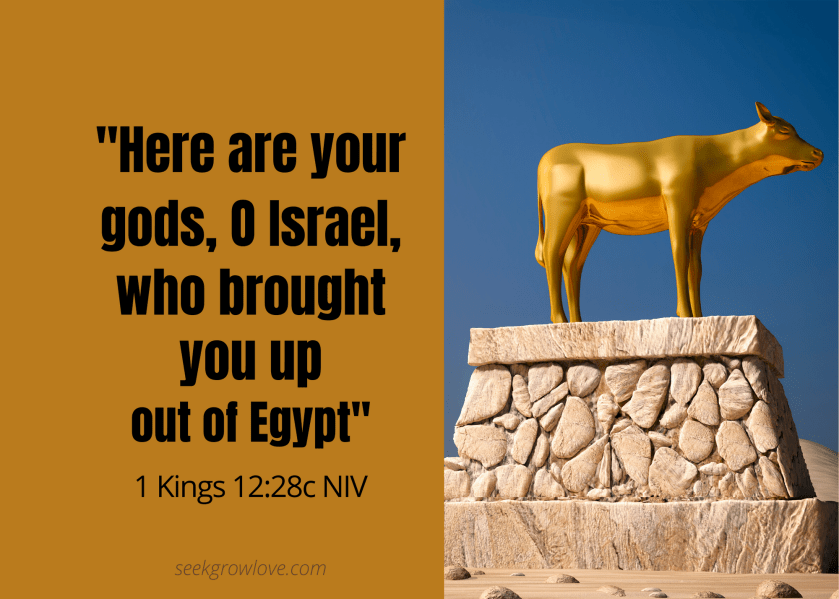
“Jeroboam thought to himself, ‘The kingdom will now likely revert to the house of David…'” So the king made two golden calves. He said to the people, ‘It is too much for you to go up to Jerusalem. Here are your gods, Israel, who brought you up out of Egypt.'” (1 Kings 12:26, 28)
Jeroboam took up his place as both the political and spiritual leader of Israel, but motivated by fear and a desire for control, he led God’s people astray. He created false idols, counterfeit altars, and bogus festivals—all in an attempt to keep his people from returning to the holy city of Jerusalem. Leaving behind the moral clarity of God’s commands, it became easier and more accessible to engage in a made-up religion that appeared similar on the surface to what they knew to be true. They were working with the same pieces, but some were flipped upside down, some placed in the wrong spot, and others lost along the way. As their worship moved farther from Jerusalem, the distance between Israel and God grew greater.
There is a stark warning here for the adjustments and innovations we see in the Church today. We must be careful that our worship, ministry, and evangelism do not favor convenience over obedience or comfort over conviction. If we fail to heed this warning, we may end up with well-developed systems that contain many of the same pieces—but are no longer building the Kingdom of God. Instead, we risk creating idols and events that offer no eternal hope. Granted, we may not be fashioning golden calves, but when we prioritize comfort over truth, we risk building spiritual lives rooted in fear, insecurity, and pride—lives that are void of God’s instruction.
It has never been about innovating what works for us or embracing a “you do you” mentality. God demands surrender and faithfulness in our daily worship, which means we will likely find ourselves worshiping in the city of our enemies from time to time. Resist the urge to craft a god who fits us. Instead, let us be molded to fit His purpose and to build His Kingdom according to His Gospel instructions.
-Aaron Winner
Reflection Questions
What problems do you think God saw in Jeroboam? Do you think God ever sees these same problems in you?
What does God desire from us – in our worship and in the way we live our lives?
What are your thoughts about the following: “If we fail to heed this warning, we may end up with well-developed systems that contain many of the same pieces—but are no longer building the Kingdom of God” ? Have you seen this occur? How can we better heed this warning for our lives and for our church and for the Kingdom of God?
It’s OK if you don’t, because most people wouldn’t because we don’t normally know the number of names of ancient gods of dead civilizations.
But Marduk had fifty!
Two of my kids have four names, and sometimes that feels like three too many!
Why did he have that many?
Because scholars rarely agree on anything, there are many different reasons for this, but there was a common idea in the ancient world that what happened in the physical world was merely an echo of what was happening in the spiritual world. When Babylon took over other cities, they would claim that the god of Babylon, that is, Marduk, had defeated the god or gods of the city or tribe they just defeated. Marduk got a lot of name because Babylon overcame many enemies and they merged together the defeated gods with the great god so that he supplanted even their chief deity by the end of the poem of creation of the Babylonians.
The school-yard-like taunt between the ancient nations was “My god is bigger than your god!”
This is where we make it to our story today. The Philistines worship a god named Dagon/Dagan, and so when they defeat the Israelites, they wheel the Ark into the temple of Dagon. Because he is bigger, better and stronger than YHWH; right? At least, that’s what the Philistines think. But the destroyed, worshipping statue of their god boasts different things.
The Old Testament is full of imagery of the great power of God over other “gods.” In the Exodus, God is powerful over the Egyptian deities; he turns off Ra and brings low Pharaoh, among others. In the exile, God is shown to be powerful over his foes in both the last part of Job (where YHWH is subtlety compared to many gods) and in the return from exile, where his people walk free in the year he declared he would bring them back. Here in 1 Samuel, Dagan “worships” God by falling prostrate before him, and the Philistines, while trying to taunt and control God, decide the ark is more trouble than it’s worth.
Some ancient gods have no reality at all; the power of other gods seem to come from demons. (1 Corinthians 10:20) But no matter their reality, their falsehood, their existence or the lack thereof,
Our God is greater.
Our God is better.
“My God is better than your god!” And he actually is!
-Jake Ballard
Reflection Questions:
Marduk. Enlil. Baal. Zeus. Jupiter. There are many gods of the ancient world that claim the title of top God. How can we know there can be only one true God? How would you talk to a friend who is open to the existence of multiple gods or even multiple pantheons of gods? How would you tailor your message to speak to them.
We shouldn’t ignore the two different plagues. Why did the Philistines have a plague affect them? Why did the people of Beth Shemesh have a plague affect them? What do these two plagues teach us about God?
“REXBURG, Idaho – The five-bedroom house sits on pastoral acreage in the rural U.S. countryside. At a price less than $180,000, it seemed a steal.
But a bargain it wasn’t. Ben and Amber Sessions soon realized the dream home they’d purchased in Idaho for their growing family in 2009 was infested with hundreds upon hundreds of garter snakes.
The ground surrounding the home appeared to move at times, it was so thick with snakes. Throngs of snakes crawled beneath the home’s siding. At night, the young couple said they would lie awake and listen to slithering inside the walls.
“It was like living in one of those horror movies,” said Ben Sessions, 31.”
I wonder if this nightmare could have been avoided with a house inspection before this young couple purchased this home. I imagine in the excitement of buying a home for a great price and naively trusting their realtor that the stories about snakes in the area were a myth, a home inspector probably didn’t seem necessary.
In Jeremiah 43-45, God is the home inspector. Through Jeremiah, God warns the Judeans not to go to Egypt. Though this warning was not due to snakes, but worse, false gods. Depending on what Wikipedia article you read, the Egyptians of the time had between 1500 to 2000 false gods. While the gods did not actually exist, the people who worshiped them certainly did and were the “influencers” of their time. God knew that if the Judeans went to Egypt, they would quickly fall in step with the practices of the Egyptian culture. In fact, many of the women were already worshiping the “Queen of Heaven,” the goddess of sex and war. God does not accept practicing sexual immorality (which He reminds us again through Jude, which just HAPPENS to be our New Testament reading for the day. Coincidence? I think not!). Even more so, God is a jealous God and does not accept worshiping other gods. Besides all that, we were already told that God told the people NO. And that should have been that.
While it’s highly unlikely you will find yourself in a house overrun with snakes or a culture overrun with false gods, are there things in your life you are heading into without the benefit of a “home inspector?” Is it safe and wise to go where you are heading? Be wise and design your plans with the help of the Lord and a Christ-following mentor. I am not just writing to just the teens here. All of us, of any age, need the wisdom only God can provide, often through a mentor.
The young people in the snake story and the Judeans in Jeremiah had their own plans and didn’t let things like lack of a home inspection or God’s blessing get in the way of their plans. Sadly, the young couple had to go into bankruptcy to get out of the house and the people who went to Egypt were destroyed. Do not follow in their paths.
-Maria Knowlton
Reflection Questions
Can you think of a time when you chose to do it your way instead of God’s way? What was the result? What might have happened instead if you would have done it God’s way?
If you ask God to inspect your home/life, what might He point out as red flags to be cautious of or totally remove for your safety and the safety of others? What reinforcements would He recommend you add in order to create a stronger home?
In the end, whose word will stand – God’s or yours? How do you know? Knowing that, how should you life today?
Jude Introduction
The book of Jude was written by Jude, the brother of James and believed to also be the half-brother of Jesus (Matthew 13:55 and 1 Corinthians 9:5).
The book of Jude is very similar to 2 Peter 2, urgently warning against false teachers who have slipped in among the believers. It warns against falling away from the faith, giving as examples the Israelites who were delivered from Egypt but were later destroyed, and angels who did not keep their positions of authority but abandoned their own home. Jude wanted to not only make people aware of false teachers, but also to encourage believers to fight for the truth.
I’ll close with Jude 1:22, “Be merciful to those who doubt, snatch others from the fire and save them; to others show mercy, mixed with fear – hating even the clothing stained by corrupted flesh.”
Yesterday’s Psalm (104) gave a history lesson on creation. Today’s Psalm (105) gives an overview of God at work during the years of Abraham, Isaac, Jacob, Joseph and Moses. God makes a great history teacher – He was there when it all happened and He knows clearly the lessons that ought to be learned to celebrate the good parts of the past and to prevent the tragedy of history repeating the ugly parts. The inspired Psalmist wrote: “Remember the wonders he has done, his miracles, and the judgments he pronounced.” (Psalm 105:5). We would do well to remember and be in awe of the amazing miraculous ways God has worked in the past to help teach and provide for His children. And, we must not forget the times He has taught (and will teach) with punishment and judgment those who have turned their backs on Him.
Our passage in Jeremiah today speaks of God as a teacher. Unfortunately, it is at a time when, “Each of you is following the stubbornness of his evil heart instead of obeying me.” (Jeremiah 16:12 – see the recurring stubborn heart problem we talked of earlier this week). Because of their disobedience and collection of false gods (one false god is too many) the lesson coming wasn’t going to be a pleasant one. God says, “Therefore, I will teach them – this time I will teach them my power and might. Then they will know that my name is the LORD.” (Jeremiah 16:21 NIV)
I love the idea of God being a teacher. We chose the name Moriah for our first born daughter, partly because of the reminder to always keep God first, even above our precious children (Moriah was the name of the mountain God sent Abraham to when He tested his faith and allegiance to Him). And, then when I found out Moriah means “God is my teacher” in Hebrew, it became an automatic favorite. This world tries to teach us many lies. I pray me and my family (and you and yours) will listen to and learn from God instead. And, if we learn the lesson well to put Him first and seek Him always, perhaps we will be saved the agony of the lessons He has reserved for those who have turned to false gods and neglect following His words. May we be busy listening to, and doing, what the Teacher says.
Jeremiah gives a good example of what kind of a student we ought to be. He says to God, “When your words came, I ate them; they were my joy and my heart’s delight, for I bear your name, O LORD God Almighty.” (Jeremiah 15:16) What teacher wouldn’t love having a student like this – one who listens, loves, devours, and receives great joy from the Teacher’s words and also takes pride in calling themselves the Teacher’s student. In fact, God told him if he repents (turns from evil) and speaks worthy not worthless words, he will use Jeremiah as his spokesman (Jeremiah 15:19 – perhaps a promotion to teacher’s aide?)
A good teacher knows the subject matter well – God does. He made the world and everything in it. He knows everything. He is the one and only omniscient being.
A great teacher must also know his students well – God does. What are the students’ strengths, their weaknesses, their needs, their fears? What motivates them, what distracts them, what do they already know, what do they still need to learn today, what do they need to be truly successful? How many hairs are on their head? God knows! In Jeremiah 16:17 God says, “My eyes are on all their ways; they are not hidden from me, nor is their sin concealed from my eyes.” The all-knowing, all-seeing teacher doesn’t miss a thing.
And, of course, the very best teacher not only knows each student backward and forward, inside and out, but that teacher loves each and every child to pieces, and is willing to sacrifice for that child’s benefit – God does! He loved you so much that He gave His one and only Son so that you, His student, could have life. His love doesn’t mean punishments won’t be given when earned. After all, punishment is a powerful way to teach a needed lesson. But through it all, never doubt, He knows, He loves and He teaches.
If God is the teacher, what kind of student are you? Are you the child who is easily distracted and zones out during the lesson, missing what the Teacher wants you to know? Are you the one who is making jokes during class to gain the attention and praise of your classmates? Do you deserve several time-outs a day due to your lack of self-control – throwing pencils across the room and getting caught up in sin? Are you a student with a stubborn heart problem and way too many gods in your life? (Hint: the most important math lesson is – the correct number of Gods is ONE and He is the Almighty Creator and Teacher who gives the final grades.). Or, are you a student who is feasting on the Teacher’s words, seeking Him, repenting, and searching for worthy words in an effort to help other students hear His words, too?
Report cards are coming – for you, your family, your church, and all nations. What will the Teacher say about you?
“Look to the LORD and his strength; seek his face always.” Psalm 105:4
-Marcia Railton
Today’s Bible reading passages can be read or listened to at BibleGateway.com here – Jeremiah 15-16 and Psalm 105
There’s nothing quite like being misunderstood! Have you ever felt that way – misunderstood? It happens to all of us and usually things sort themselves out one way or another but being misunderstood really put the apostles in danger in Acts 14. Along with the gospel message that they were to share, God had given them a portion of His holy spirit to be able to work miracles in those who would believe. Innocently enough the apostles began to share the message and then a lame man was healed and made strong again in the presence of all the people. This could have resulted in many more coming to belief in Jesus but instead the miracle resulted in the people thinking that their false gods were responsible and that they were manifesting themselves in Barnabas and Paul.
Talk about misunderstanding! Barnabas and Paul were mortified that the people were attributing greatness to them and thought that their false gods had done the miracle instead of the Almighty God of heaven and Earth. It became such a terrible situation that they even dragged Paul out and stoned him! What a terrible misunderstanding.
Have we ever tried to share the gospel with someone or a group of people and it went terribly wrong – with people ending up with wrong ideas or wrong impressions of what you said or did? Just remember you are not alone – the disciples had the same experience. Thankfully in our day and age stoning has gone out of fashion but tabloid lies and rumors abound. Social media can quickly make or break people’s opinions and ideas whether they get the right idea or the wrong one! Speaking from experience I had something I said unfortunately taken in the wrong way on social media due to how I phrased my response – oh the backlash! Live and learn. We must season our lives with prayer and ask God to direct our words and actions so that they will be taken in the correct manner. My prayer is that we would always be understood clearly whenever it comes to the gospel so that the work of the Lord may abound.
-Merry Peterson
Today’s Bible reading passages can be read or listened at BibleGateway here – 2 Samuel 9-10 and Acts 14
I was a teenager when the movie Raiders of the Lost Ark first hit the theatres. It instantly became one of my all-time favorite movies. I love the Indiana Jones character and this particular adventure, searching for the Ark of the Covenant, was especially cool to me because it drew from Biblical themes. The Ark of the Covenant was a real thing containing real power. What would happen if it was found and fell into the wrong hands, like the Nazi’s? It was a great story. It got pretty intense toward the end when they tried to open the Ark. Spoiler alert: it doesn’t end well for the Nazi’s.
The Nazi’s in the story should have spent less time plotting the genocide of the Jews and global domination and more time reading their Bibles, because the story of the Ark in 1 Samuel 5-6 should have discouraged them from having anything to do with the Ark. (I know, Raiders of the Lost Ark is fiction- but what happens to the Philistines in today’s reading is True).
One thing we know from reading the Bible is that God doesn’t like to share His glory with idols. God is the one True God and He alone created everything, gives life, sends rain to produce crops and blesses people with fertility. God takes it very personally when people build statues for other “so called” gods and give them credit for sending rain or helping babies to be born.
I find the story of the Philistines stealing the Ark of the Covenant and bringing it in the temple of their “god” Dagon humorous. Dagon was the main god of the Philistines and they offered sacrifices to Dagon so that they could have fertility- their cattle, and their wives. They wanted lots of cattle to feed their bellies, and they wanted lots of sons to grow up and serve in the army to fight their enemies. So they prayed and offered sacrifices to Dagon so that Dagon would make their cows and their wives fertile.
We might excuse the ignorance of the Philistines because maybe they didn’t know any better, maybe no one told them the Truth about the True God. But God made it quite clear to His chosen people, Israel, that they were to worship and serve God alone. But they were often tempted to worship other gods. Several stories in the Old Testament show how God was superior and defeated other “so called” gods. Elijah called down fire from heaven and defeated the prophets of Baal. Samson’s last act after he had been captured and blinded was to push down the pillars of the temple to Dagon and kill a bunch of the Philistines. And here, when the Ark of the Covenant is brought into another temple of Dagon, The statue of Dagon falls down the first time, then falls down again breaking the idol into pieces. The Philistines of that town are afraid so they send the Ark to another town. There, everybody gets tumors and they end up in a panic. Everywhere the stolen Ark is taken trouble comes to the Philistines, so finally they bring the Ark back to Israel along with a guilt offering (golden tumors and rats, what a thoughtful gift).
The Philistines had trouble discerning fact from fiction- the true God, YHWH, the God of Israel, vs. Dagon, a statue that was quite brittle when it fell to the ground.
Truth matters. In today’s reading in John 18, after Jesus is arrested and brought to trial, he appears before Pilate, who is the highest representative of the Roman Empire in the region who ultimately decides all capital cases, who lives and who dies.
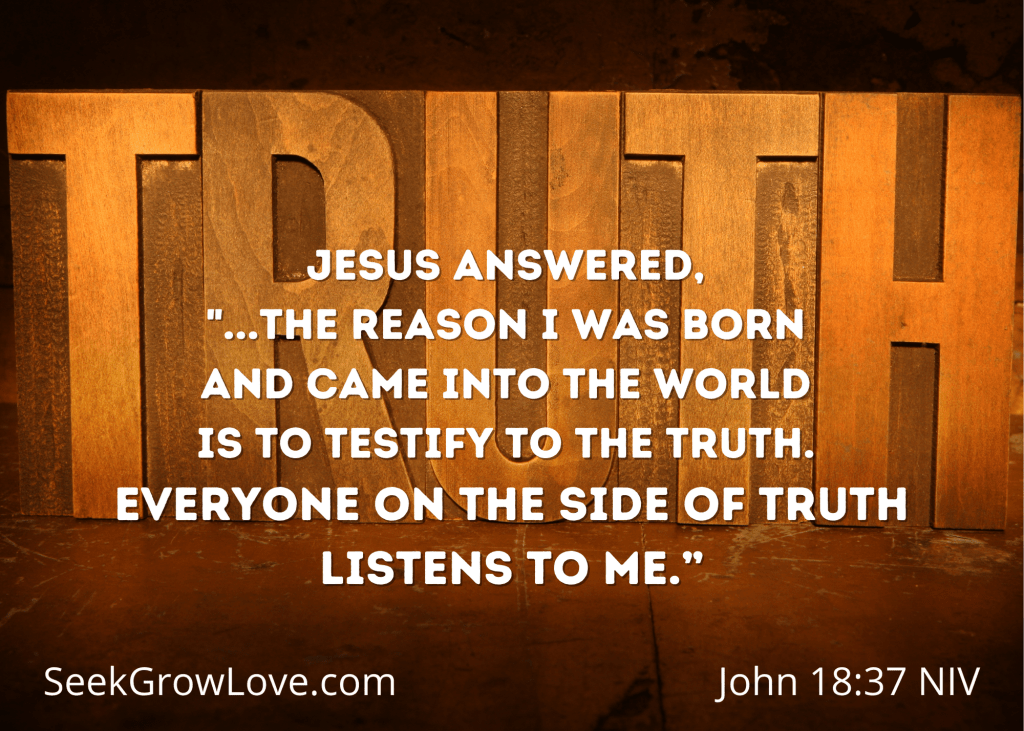
Pilate is a politician caught between his boss, Caesar, who has tasked him to keep the Jewish people in line and the Jewish people who can turn on him and cause trouble. He has to carefully consider the political implications of what he’s being asked to do. Like many politicians and people in charge, he is more of a pragmatist than anything else. What is going to work out to my best interests here? He asks Jesus some questions and Jesus gives an answer that he finds quaint. Jesus answered: “The reason I was born and came into the world is to testify to the truth. Everyone on the side of truth listens to me.”
Truth? How naïve. You might imagine the amusement (or scorn) in Pilate’s response when he asks Jesus: “What is Truth?”
If the idea of truth was a quaint notion to a first century Roman politician, it’s become reviled and scorned by 20th and 21st century intellectuals. We live in a time of Postmodernism. Absolute truth has been replaced by relativism. Truth is whatever the people who have the power to control government, the news, the arts and higher education say it is. Truth is what Facebook, or Twitter, or Google’s “fact checkers” say it is.
Whether you and I like it or not we are in the midst of a culture war. It’s the same one that’s been going on since the serpent tempted Eve to question God. It’s the same one that was going on in the temple of Dagon when the stolen Ark was brought in, it’s the same one that was going on when the Jewish leaders lied about Jesus and brought him to Rome to be condemned and executed, it’s the one that was going on when Pilate asked, “What is truth?” It’s going on today in a society where the things we’ve always believed about God and virtue, right and wrong, and pretty obvious things like basic human biology, are all being questioned and redefined. Gender isn’t about biology it is a social construct. If you start introducing facts or science or Truth, you will receive as much scorn as Jesus received from Pilate. But it is a culture war and Jesus told Pilate that there are two sides: one side is false and the other is true. Jesus said that if you are on the side of Truth you listen to Jesus. Pilate chose his side, and so he did what was politically correct and had Jesus crucified to appease the Jewish people. The question you and I must ask ourselves is whose side am I on? Am I on the side of Truth, that listens to the words of Jesus? Pick a side.
-Jeff Fletcher
Today’s Bible reading can be read or listened to at BibleGateway here – 1 Samuel 5-6 and John 18
We have learned so much as we finish the book of Leviticus. Chapter 26 begins with a warning from the LORD. The Israelites are told not to make any object to became an object of worship. We can look at the Israelites throughout their history and become very critical. They succumb many times to the worship of idols. Every generation had to make the choice to follow the LORD God or to worship the false gods that the Israelites had allowed into their culture. Even future Kings would face this choice and unfortunately many choose to devote their lives to idols. But I also have to wonder if we are not making that same choice today? Are there false gods in our lives? For example, we don’t create our own electronic devices and bow down to them, but perhaps we spend hours surfing, checking out what is on social media, texting, gaming, … When something is receiving our focus and taking our attention away from God, we should consider it a negative. We are allowing something to get in the way of our relationship with God. Anything or any person that negatively affects our connection with God is a modern-day idol. In Colossians we are told that sexual immorality, impurity, lust, evil desires and greed are idolatry. (Col. 3:5) It states that we should put these actions to death. But it is not enough just to remove the idols, we need for God to change our hearts. When our hearts are filled with love for God, our actions start to align with what God wants us to do.
As God explained to the Israelites, they needed to observe His Sabbaths, show reverence for His sanctuary, follow His decrees and obey His commands to receive amazing blessings. Then He would walk among them, He would be their God and they would be His people. How incredible is that?! We are presented with a choice to make today as well. We can enter into a loving relationship with God. We can ask Him to make our love for Him and others strong. We can invite God to be the center of our lives. We can place our focus on His Son Jesus Christ. We can live in His presence by the power of His spirit. God is still reaching out to us, His people. He offers us blessings and the greatest one is to be in His presence.
May he strengthen your hearts so that you will be blameless and holy in the presence of our God and Father when our Lord Jesus comes with all his holy ones. 1 Thessalonians 3:13
After Moses goes back to Egypt and starts trying to get things going with the exodus it backfires on him and he is starting to have doubts (Exodus 5). God replies
Exodus 6:6-8
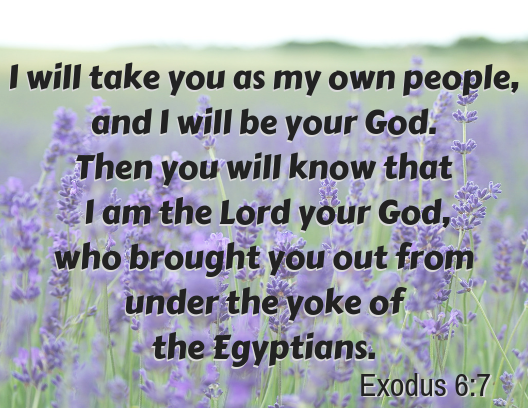
6 “Therefore, say to the Israelites: ‘I am the Lord, and I will bring you out from under the yoke of the Egyptians. I will free you from being slaves to them, and I will redeem you with an outstretched arm and with mighty acts of judgment. 7 I will take you as my own people, and I will be your God. Then you will know that I am the Lord your God, who brought you out from under the yoke of the Egyptians. 8 And I will bring you to the land I swore with uplifted hand to give to Abraham, to Isaac and to Jacob. I will give it to you as a possession. I am the Lord.’”
God is ready to go. He is done with people doubting him, and he is ready to show his power. To do this he sends the ten plagues on Egypt. (Exodus 7-11) Each of the plagues was very symbolic and directly attacked the gods and culture of the Egyptians. I’ll cover just a few of them here and their symbolism.
The plague of blood turned the water of the Nile river into blood, which killed the fish and other things in the river. The Nile was the source of life in Egypt and was represented by the god Osiris. God shows that he is more powerful than Osiris and that refusing him brings death.
The plague of gnats/lice was a really fun time. The dust became gnats that covered everything. This was an insult to the god Set who was the god over the desert. This also was directed towards the priests and magicians who prided themselves on being pure and clean, but God was pointing out their sin and uncleanness to everybody.
The plague of livestock involved all of the Egyptian cattle dying. This attacks many of the Egyptian gods because many of them take the form of cattle. This came right after Moses says that the Egyptians would stone the Israelites for sacrificing cattle and livestock to God. God is telling Pharaoh that he can either give up some of his cattle to God, or lose them all.
The plague of the firstborn involved an angel of God killing all of the firstborn in Egypt that were not covered by the passover blood of the lamb. This obviously killed a lot of people but it also was a direct attack on Pharaoh who was supposed to be a god in Egypt but could not protect his own son from the wrath of God.
Each of these plagues tore down a god or aspect of Egyptian society that the Israelites had adopted and showed that it did not bring life or an escape from sin, but only brought death in the end and that only God is worthy of being worshiped and followed.
I hope that once we come to Christ it is obvious which aspects of our old lives were only bringing sin and pain. Sometimes though we do not realize which things in our society are against God and many Christians continue to live in their old ways. We need to pray and be wise in our life choices to make sure we are not putting any idols before God, because one day Christ will return and most parts of the book of Revelation make the plagues look like a walk in the park.
On that happy note, I’ll see you guys back here tomorrow 🙂
GOD’s Story is the best story. GOD’s words are the best words. If I want to live my life to please Him, I must be grounded in His Word, for that is where I find Him, where I learn about Him, and where I begin to grow my relationship with Him. The world is full of false gods and it becomes so easy to be led astray by what the glittery, selfish world offers instead of taking ahold of the solid promises and expectations God lays out in His Word. I believe Satan is pretty happy to see people who enjoy calling themselves Christians who spend very little time in God’s Word.
Can you imagine a person who loves Marvel – wears Marvel, spouts Marvel trivia, plays Marvel games, etc …… but has never seen any Marvel movies – not even a trailer. It seems ridiculous, doesn’t it! So too, is the Christ follower who doesn’t look to the book that Christ followed – ridiculous – and even dangerous – for himself and for those who would follow that poor example.
If we know God’s Word is important… what gets in the way? Time, of course, is the number one answer. But, not a very valid one. We all find time to do what we really want to do – including perhaps a few movies or TV shows every week to unwind, some “brain games” (ie-device time) to keep us mentally sharp, some physical activity to keep our shape (or lose our current shape), but how do we remember to do the daily upkeep for our most important spiritual life?
I think sometimes our problem is that is just seems so overwhelming to open the big book. Where do I start? What if I don’t understand it? It is such a big book! This week we are going to do an overview of the importance of God’s Word – as well as providing an outline for how the book is laid out. Where do I find the stories of Jesus? Of Moses and David? What makes the book of James different from Esther? Where in the world is the book of Habakkuk – and why is it there?
Today – read as much of Psalm 119 as you can (go ahead, I challenge you – read the whole chapter). Be looking for what good comes from God’s Word (and his laws, statutes, promises, commandments, which are all found in the gift of God – the Bible).
God bless you as you seek Him in His Word!
Marcia Railton





 Seek Grow Love