
Devotion by Tom Siderius (MI)
Matthew 14:13-16(NLT) As soon as Jesus heard the news, he left in a boat to a remote area to be alone. But the crowds heard where he was headed and followed on foot from many towns. 14 Jesus saw the huge crowd as he stepped from the boat, and he had compassion on them and healed their sick.
15 That evening the disciples came to him and said, “This is a remote place, and it’s already getting late. Send the crowds away so they can go to the villages and buy food for themselves.”
16 But Jesus said, “That isn’t necessary—you feed them.”
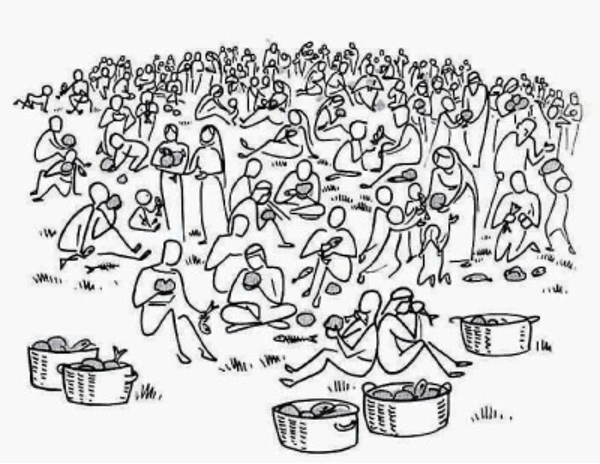
As we read in Matthew 14 today, we find the “feeding of the five thousand”, a famous story of Jesus doing a notable miracle. But what is the real lesson and reason for doing this miracle? The disciples are very logical and show common sense. “Send the people away to the local Kroger or Aldi and let them buy their own supper while the shops are still open”. For most people their bread would be the staple of their diet, and where most of their calories would come from. As we read the Word, we see the emphasis on bread as sustenance for us repeatedly.
Try to be one of the disciples in this situation. Five thousand with nothing to eat and Jesus just says Hey you feed them!! No prob Jesus we’ll get right on that, lets see. Hey Matthew what’s in the lunch pail you brought? Hello John how about those granola bars you have in your pockets? Hey, Peter and Andrew, how about those sandwiches your Mom made for lunch for us?
Sorry, Jesus, only 5 loaves and a couple of salt fish, not going to get it done, lets go with our plan.
Matthew 14:18-21(NLT) “Bring them here,” he said. 19 Then he told the people to sit down on the grass. Jesus took the five loaves and two fish, looked up toward heaven, and blessed them. Then, breaking the loaves into pieces, he gave the bread to the disciples, who distributed it to the people. 20 They all ate as much as they wanted, and afterward, the disciples picked up twelve baskets of leftovers. 21 About 5,000 men were fed that day, in addition to all the women and children!
Wow what a miracle and how about those leftovers they’ll be eating for days!! Actually, Jesus is using this as a teachable moment for all his disciples both then and now. It is not about the miracle but rather that we would trust God for our sufficiency and nourishment, not our own ability to take care of every situation we find ourselves in. If you examine your life, you will see the hand of God feeding you all through it. Only by His grace and mercy does the rain fall on the just and also the unjust.
What did it take to bring the bread to your table today?
Why are we always so hungry?
John 6:29-40(NLT) Jesus told them, “This is the only work God wants from you: Believe in the one he has sent.” 30 They answered, “Show us a miraculous sign if you want us to believe in you. What can you do? 31 After all, our ancestors ate manna while they journeyed through the wilderness! The Scriptures say, ‘Moses gave them bread from heaven to eat.’”
32 Jesus said, “I tell you the truth, Moses didn’t give you bread from heaven. My Father did. And now he offers you the true bread from heaven. 33 The true bread of God is the one who comes down from heaven and gives life to the world.”
34 “Sir,” they said, “give us that bread every day.”
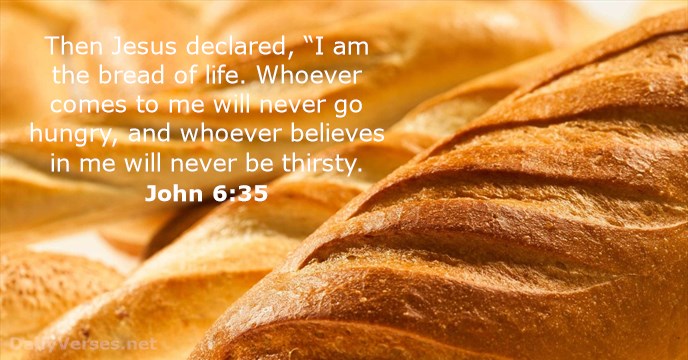
35 Jesus replied, “I am the bread of life. Whoever comes to me will never be hungry again. Whoever believes in me will never be thirsty. 36 But you haven’t believed in me even though you have seen me. 37 However, those the Father has given me will come to me, and I will never reject them. 38 For I have come down from heaven to do the will of God who sent me, not to do my own will. 39 And this is the will of God, that I should not lose even one of all those he has given me, but that I should raise them up at the last day. 40 For it is my Father’s will that all who see his Son and believe in him should have eternal life. I will raise them up at the last day.”
What is the bread of life we all desire to have?
How can we give it to others?
True believing in our Father and God and the Son He has sent is the only good work that we can do. Nothing else we can do has real value except to believe and act on that belief walking day by day with our Father and our brother Jesus Christ. Beware of the temptations and the sin of religion in this world and see that our help and sufficiency for our lives can only come from the God that loves us and has called us to Him.
Mark 8:14-21(NLT) But the disciples had forgotten to bring any food. They had only one loaf of bread with them in the boat. 15 As they were crossing the lake, Jesus warned them, “Watch out! Beware of the yeast of the Pharisees and of Herod.” 16 At this they began to argue with each other because they hadn’t brought any bread. 17 Jesus knew what they were saying, so he said, “Why are you arguing about having no bread? Don’t you know or understand even yet? Are your hearts too hard to take it in? 18 ‘You have eyes—can’t you see? You have ears—can’t you hear?’ Don’t you remember anything at all? 19 When I fed the 5,000 with five loaves of bread, how many baskets of leftovers did you pick up afterward?”
“Twelve,” they said.
20 “And when I fed the 4,000 with seven loaves, how many large baskets of leftovers did you pick up?”
“Seven,” they said.
21 “Don’t you understand yet?” he asked them.
You feed them!!
Reflection Questions:
See questions in bold above
Prayer:
Father God help us to look to you for our help in time of need, and for our very lives. Thank you for your sufficiency for every day’s challenges and opportunities as we believe your Word. Help us to become like our big brother Christ as people we see have needs that we can minister to. We thank you every day for calling us to this time and place of fellowship and love. In Jesus’ name we pray.
 Seek Grow Love