Potty Talk

Titus 1

Thursday, September 15, 2022

POOP.

That was the very first word my then-4-year-old son taught himself to write, all on his own. (Proud homeschooling mama here…)

Like many boys his age, he was fascinated with all things disgusting. It was rare for even a few minutes to pass – especially at supper time! – without him making reference to some sort of bodily function, and laughing hysterically at the mere mention of it while the rest of us just prayed it would stop. My other son, now four years old, has followed suit and is also obsessed with preschool potty humor. To him, every funny noise is flatulence; every repulsive smell must be lingering from the bathroom, and it is all hilarious. Even if we explain that the sound was just a balloon releasing air or the smell was simply spoiled food, he entertains himself for a long while with the (pleasant?) thoughts of bodily functions in the house. He cannot seem to get his mind away from potty talk. 

As humankind, we, too, can become stuck in thought patterns or ideas and continue to feed those beliefs. In verses 15 and 16, Paul writes to Titus, “To the pure, all things are pure, but to those who are corrupted and do not believe, nothing is pure. In fact, both their minds and consciences are corrupted. They claim to know God, but by their actions they deny him. They are detestable, disobedient and unfit for doing anything good.” Now, I am not at all implying that innocent preschoolers have corrupted consciences; that was simply a humorous and relatable example about what happens when our minds are focused on one kind of thing. However, there are many people who continue to feed, to themselves and others, lies and negativity and unpleasant thoughts, which are contrary to God. As believers, we are called to live pure lives, demonstrating the redemption of Jesus’ sacrifice. We can claim to know God, but if we deny him by living without pure motives, we have lost our testimonies and are guilty of corrupted minds. Paul calls those kinds of people “detestable, disobedient, unfit for doing anything good.” Ouch. I don’t want those labels assigned to me. When my mind begins to dwell in negativity, judgmentalism, or even perversion, God often brings these lyrics to my mind: 

Give us clean hands; give us pure hearts. 

Let us not lift our souls to another… 

Oh God, let us be a generation that seeks, 

seeks Your face, O God of Jacob. 

In this book of Titus, much like he did in 2 Timothy, Paul is addressing the issue of “meaningless talk and deception” among rebellious people. Such tendencies must have been rampant then as they still are today. He calls believers to rebuke people who demonstrate this behavior so they will be “sound in the faith.” He also sets high standards for leaders within the church in verses 6-8: “An elder must be blameless, faithful to his wife, a man whose children believe and are not open to the charge of being wild and disobedient. Since an overseer manages God’s household, he must be blameless—not overbearing, not quick-tempered, not given to drunkenness, not violent, not pursuing dishonest gain. Rather, he must be hospitable, one who loves what is good, who is self-controlled, upright, holy and disciplined. He must hold firmly to the trustworthy message as it has been taught, so that he can encourage others by sound doctrine and refute those who oppose it.” 

Whew! I’m glad I’m not expected to follow such stringent guidelines, aren’t you? Not so fast. Though these qualifications are given to a specific church, they can still be applicable guidelines for our church leaders – and attenders! – today. Since our leaders are also human and prone to stumble like the rest of us, we must continue to pray for them as they seek God and lead His people. And, as Christians aiming to honor God and constantly growing in our faith, we too should aspire to live up to similar expectations as we serve and connect with our local bodies of believers. I’ll close with this verse that seems to fit with this passage and is a good reminder about how we should think (and therefore how we should behave, since our thoughts influence our actions): 

Finally, brothers and sisters, whatever is true, whatever is noble, whatever is right, whatever is pure, whatever is lovely, whatever is admirable—if anything is excellent or praiseworthy—think about such things. Whatever you have learned or received or heard from me, or seen in me—put it into practice.

Philippians 4:8-9

-Rachel Cain

Reflection Questions: 

With which of the qualifications in verses 6-8 do you most struggle? Pray for God to help lead you to overcome it. 

Most of us who are reading this claim to know God, but have denied him by our actions at times. What are some ways you have done this? Ask God for His strength to live fully for him.
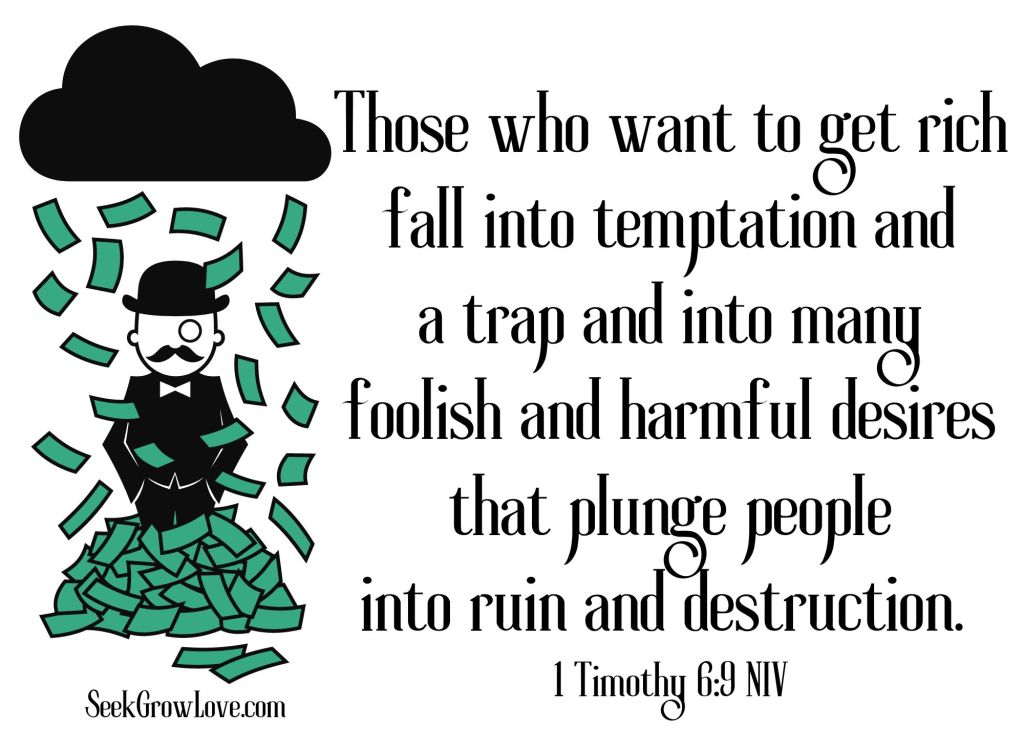
Want to Get Rich?

1 Timothy 6

(Today’s devotion will be on 1 Timothy 6. Tomorrow we will jump back to 1 Timothy 5. Thanks for being flexible with us!)

Friday, September 9, 2022

 “Hey Jesse are you going to buy a lottery ticket?” A group of my coworkers had been talking about the jackpot because the lottery had reached over a billion dollars. The conversation that followed that question was followed with speculation of what the group of us would buy or what we would do with the money. Many, if not all, said they would have quit their jobs and bought extravagant things. Some even said they would invest it and be smart with the money. And some said they would give most of it away and keep enough to live on for the rest of their life. My answer to the question was “No, I mean of course it would be nice to have that money but I know I would probably spend all of it and end up in debt, broke, or dead.”

I think the lottery is a good example of what the world reaches for but doesn’t understand. Money may be able to buy you a boat, a cool new car, house, vacation, or whatever. However those things are only temporary and don’t satisfy the one thing we all strive to achieve in our lives. CONTENTMENT. No, not fugitives selling wintergreen lifesavers out of a tent, but contentment. The understanding of knowing what you have right now is enough. Just read what Paul in 1 Timothy 5:6-9 says “But godliness actually is a means of great gain when accompanied by contentment. For we have brought nothing into the world, so we cannot take anything out of it either. If we have food and covering, with these we shall be content. But those who want to get rich fall into temptation and a snare and many foolish and harmful desires which plunge men into ruin and destruction.”

Money is not bad, however if you aren’t content without it, what makes you think you will be content with it? I can tell you from experience you won’t be,  unless you are trying to attain only to godliness first. Then everything else ordinarily falls into place and we become content. Something I struggle with, and I am sure you do as well, everyday. The understanding that God takes care of His people when they are seeking him is scattered all throughout the Bible. My favorite example and probably most prominent is Matthew 6:33 “Seek ye first the kingdom of god and his righteousness, and all these things shall be handed unto you.” (I recommend reading the whole chapter to get the gist of what “all these things” Jesus is speaking about. No the lottery isn’t one of those things.) Seeking God is where we find our ultimate contentment. With him we don’t have to worry about plunging ourselves into ruin and destruction as many of the past lottery winners have done. Instead, we live our lives knowing we are content.

-Jesse Allen

Application Questions

  1. What do you think Paul meant when he said, “But godliness with contentment is great gain.” (1 Timothy 6:6)?
  2. How does your contentment rank? Without ‘getting’ any more – how can you boost your contentment level with what you have right now?
  3. Explain how the Love of Money can be the root of all kinds of evil. Have you seen an example of this?

Grace Poured Out

1 Timothy 1

Monday, September 5

It is easy to make mistakes when you don’t know you are making them. My job is GIS mapping, and I create maps of construction permits, plans, and various other things. These maps usually take between 9-18 hours of work to complete and they are needed in order for us to move to another project. The other day I finished a project and went to start another one and accidentally switched the new project for the old one and rewrote and saved over my completed project! Before I could realize my mistake I had completed the next project in the same file, therefore losing my project all together. This is a big mistake that can delay a project by 1-2 days. Fortunately for me I am new and it was my first time doing this, so with that I was given a lot of grace, and was just asked to do the project again. A lot of mistakes come from doing something new and not knowing what we are doing.

Paul in 1 Timothy 1:12-14 admits that he had acted in ignorance when persecuting the Christians. He had no idea that he was in the wrong and kept going, similar to a botched project. He admits his fault and God gives him grace by placing him in charge of all those who he was persecuting. Paul says in verse 13 “. . . yet I was shown mercy because I acted in unbelief”. When he was persecuting the Christians he had no idea of God’s plan, he refused to admit he was wrong, but God shows him mercy through recognizing he may not understand what is going on. Many of us make mistakes without knowing they are mistakes until it is too late. This is true especially with God, God gives us mercy everyday when we are making mistakes. Even the big ones and even if we repeat the mistake God still is good and forgives us.

-Jesse Allen

Questions for Reflection and Discussion

  1. What spiritual truths or expectations were you once ignorant of?
  2. How did God get through to you – and show you grace for your past mistakes?

Rejoice Always

1 Thessalonians 5

Thursday, September 1, 2022

I have always loved 1 Thessalonians 5:16.  It is a very short verse.  In fact, in Greek, it is the shortest verse with only 2 words that combined have a total of 14 characters, whereas John 11:35 is 3 words with a combined total of 16 characters.  However, this verse has a big message behind those two words.
1 Thessalonians 5:16 is all about joy.  It commands you to have joy and to express it all the time.  This is a command that is repeated throughout many other passages in the Bible, including Philippians 4:4 and Psalm 32:11.  But, how many of us are constantly showing joy?  We all have times in our lives when it is hard to show joy.  For some people it may be the morning when they just woke up.  For others it might be right after finding out bad news.  Whatever it may be, you have had it try to stop you from feeling joy.  But, we need to each make the choice to choose joy.  In choosing joy, you are choosing to focus not on the problems you are momentarily facing, but on the gifts that God has given you.  We need to not choose joy sometimes, but all the time.


However, having joy all the time only partially fulfills what you are being commanded to do in 1 Thessalonians 5:16.  You are supposed to be rejoicing!  Rejoicing is more than just having the feeling of joy.  It is expressing that feeling of joy.  When I think of showing joy, I think of the song “I’ve Got Joy,” which says,


“I’ve got joy down in my heart,
Deep, deep down in my heart!
J-O-Y down in my heart,
Deep deep down in my heart!
Jesus put it there
And nothing can destroy it!
I’ve got joy down in my heart,
Deep, deep down in my heart!”


I love singing this song and it always brings a smile to my face when everyone is doing the motions for it.  But what makes this song even better are the little changes my family has made to the song, which were inspired by our friend Jeff.  Instead of singing the lyrics, “joy down in my heart, deep, deep down in my heart,” we sing, “joy exploding out of his head, deep, deep out of his head.”  We should all have such evident joy that the only way to describe it to others is to say that it is exploding out of your head.  Not only should it be exploding out of our heads sometimes, but it should be exploding out of our heads all the time, as we obey the command to rejoice always.


However, that is not the end to the slight changes my family has made to this song.  Instead of singing the lyrics, “And nothing can destroy it,” we sing, “And nothing can contain it.”  Our joy should not only always be exploding out of our heads, but we shouldn’t let anything stop it from exploding.  Nothing should be allowed to contain our joy inside our heads!  Our joy should always be exploding out!

-Kaitlyn Hamilton

Questions for Reflection and Discussion

  1. On a scale of 1-10 how well do you choose joy? On the same scale, how well do you express that joy? One more time, on the same scale, how well do you express that joy all of the time?
  2. What do you sometimes allow to steal, destroy or contain your joy?
  3. We know life can be hard. We also know God is good. What blessings from God can you choose to focus on today? (Visit yesterday’s devotion if you need a blessing to start your list.)

To Wander or To Dwell

Philippians 4

Tuesday, August 23, 2022

Our minds wander. We can’t help it. Our brain is processing hundreds or even thousands of stimuli a minute through our fantastic five senses. In the midst of a great conversation, a beautifully delivered sermon, the most engaging of lessons, or important advice, we can be interrupted by a stimulus that snowballs into full-blown distraction.  It begins with the slightest tinge of pain, a quick movement entering peripherals, a muted rapping, a whiff of a smoke, or an unexpected bitter flavor rolling across our tongue.  Our mind goes into troubleshooting mode.  It begins to play out all of the possible threads to a perceived threat and searches for the worst case scenario, so it can prepare the nervous system to react.  We place much trust in our senses but in turn, we create narratives that do not exist in order to protect our bodies from ill-perceived observation.

When we allow the responses to take over, we are experiencing, on some level, psychosis. The lines between what is fact and fiction begin to blur.  We begin to believe lies and have adulterated perceptions.  We begin to live in the dark and the undesirable.  We begin to worship terrible and disgraceful moments we have self-induced.  We think about such things, and replay them over and over again, fiction becoming “our” truth.   I know it because I have been there. On my darkest days, I contort and twist every action into a gospel of fear, pain, and anxiety.  Wandering minds, when not properly anchored to Christ, can be our undoing.  First, and foremost, if we are in this place, we must pray for God to guard our hearts and quiet our minds.

“Do not be anxious about anything, but in every situation, by prayer and petition, with thanksgiving, present your requests to God. And the peace of God, which transcends all understanding, will guard your hearts and your minds in Christ Jesus. Finally, brothers and sisters, whatever is true, whatever is noble, whatever is right, whatever is pure, whatever is lovely, whatever is admirable—if anything is excellent or praiseworthy—think about such things. Whatever you have learned or received or heard from me, or seen in me—put it into practice. And the God of peace will be with you.” 1 Philippians 4:7-9

Don’t take the bait.  Don’t respond to the stimulus.  Instead, plant your feet even deeper into the foundation of Jesus Christ and stay.  Dwell here, rent free.  What is true? You are first and foremost loved by God.  The Creator of the heavens and the earth is the Creator of your very life.  You declare God with your very existence because he has fearfully and wonderfully made YOU (Psalm 139:14).  What is pure? The blood of Christ has sanctified you.  While there may be sin in your life, you are washed white as snow through repentance.  There is no sin greater than the Lamb of God’s sacrifice.  (Romans 3:23-24)  What is noble? You have an inheritance that makes you a royal priesthood.  You are from an adopted bloodline that will reign alongside Christ. (Revelation 5:10)  What is lovely? How beautiful are your feet when you bring Good News, proclaiming that your God reigns and brings living peace in the midst of the tumult of life (Isaiah 52:7) What is admirable?  You have not laid your eyes on Jesus, and therefore, you are greatly blessed for your belief (John 20:29)  What is excellent and worthy of praise? On my worst days, God confronts me.  He loves and comforts me.  He leads me beside still waters. He restores my soul.  He doesn’t take His promises from me.  I can walk through the darkest valley.  Hit rock bottom.  And guess who’s there?  My God.  (Psalm 23) He doesn’t see me for my shortcomings. He loves the faithful, but equally loves the prodigal (Luke 15:22-24).  He is the shepherd to the ninety-nine and the one (Matt 18:12).  Do not be deceived by your senses or your wanderings.  Let your mind dwell only on these things.

-Aaron Winner

Questions for Reflection and Discussion

  1. When has being led by your thoughts and feelings and senses led you into a troubled place? Do you often tend toward anxious thoughts? What has helped you in the past?
  2. How do you rate at bringing every situation before God in prayer and petition and with thanksgiving?
  3. What do you let your mind dwell on?
  4. What does the world say is the secret to peace? What does God say?

Update Your Status

Philippians 3

Monday, August 22, 2022

Paul had more religious credentials than any of the original twelve apostles of Christ.  His resume started in his infancy.  He was circumcised on the eighth day, his family strictly adhering to God’s rule.  His heritage came from the tribe of Benjamin, who were faithful warriors of God.  He was disciplined and studious, becoming a Pharisee. He passionately persecuted the church, having a direct hand in the stoning of Stephen. In so doing, he obtained and maintained a fleshly status that would easily make him an important member of the Sanhedrin in no time.  But that’s all it was.  Someone who lived with a long list of labels, accomplishments, and titles, but ultimately, will be a victim of the same death as those who live without them.

“If someone else thinks they have reasons to put confidence in the flesh, I have more: circumcised on the eighth day, of the people of Israel, of the tribe of Benjamin, a Hebrew of Hebrews; in regard to the law, a Pharisee; as for zeal, persecuting the church; as for righteousness based on the law, faultless.”  Philippians 3:4b-6

Status, which once was predetermined by feudal, caste, tribal or class systems, is now something that changes with our emotions or musings. Our connotation of the word has changed with the invention of social media..  The evolution of “status-ifying” oneself, has led to the rapid (d)evolution of a crushing identity problem.  Occupation, education, pronouns, history, trauma, gender, race, family, and religion have become our most featured bullet points. We become these things or sometimes, these identities are thrust upon us.  As unpopular as this messaging may be in my place and time, the words of Paul still ring true: It’s all garbage.  Every. Single. Bit.  Anything that doesn’t have eternal value is a name or stigma I no longer bear under the lordship of Jesus Christ.

“But whatever were gains to me I now consider loss for the sake of Christ. What is more, I consider everything a loss because of the surpassing worth of knowing Christ Jesus my Lord, for whose sake I have lost all things. I consider them garbage, that I may gain Christ  and be found in him, not having a righteousness of my own that comes from the law, but that which is through faith in Christ—the righteousness that comes from God on the basis of faith.”  Philippians 3:7-9

We are not simply made righteous by calling ourselves Christian.  Neither are we made holy because we’re a good mom, dad, or child.  Nor are we not justified because of our bloodline or heritage.  And we are not forgiven because we found a new definition for the same old sin. We are “status-ified” by Christ. So, what exactly is it?  We are, through faith, redeemed and adopted Children of God. It is not our first status.  It is our ONLY status. In his letter to the Galatians, Paul states there isn’t slave, free, man, woman, Jew, or Greek, meaning every title, other than that achieved through faith in Jesus Christ, is negligible, conditional, or temporary, — even dead. When we acknowledge him, He grabs hold of us and doesn’t let go. His Father calls us to resurrection and the treasure that is stored in heaven, ready to descend with the promised return of Jesus Christ, and on that day, there is only one group placed in the Lamb’s Book of Life: those who are saved by faith in Jesus Christ.  Hit the refresh button, and take a good, long look.  It might be time to update your status.

“I want to know Christ—yes, to know the power of his resurrection and participation in his sufferings, becoming like him in his death, and so, somehow, attaining to the resurrection from the dead.” Philippians 3:10,11

-Aaron Winner

Questions for Reflection and Discussion

  1. IF you were to follow the ways of the world what COULD you use to give yourself status?
  2. What is the eternal value of each item you listed in question 1?
  3. What will/does it look like to reorder your life to gain Christ instead?

Walk in Humility

Philippians 2

Sunday, August 21, 2022

For many of us, the last few weeks we have been reestablishing our school time routines.  The lackadaisical jazz of summer has transitioned into the tight structure of a concert march. Alarms begin to sound once more and the the score begins. Many times, my day begins with a morning run.  I pride myself in the ability to time this run in such a way that I squeeze in all my other to-dos before the school day (like shower, pack, dress, eat breakfast) and be in the school building with a minute to spare.  Everything was again like clockwork – run, shower, pack, breakfast – until I had an important realization as I crossed the threshold of the school door and met the flow of air streaming from the vent:  I had not stopped sweating since my run.  My body still thought it was summer.  My shirt was now mostly covered in sweat, and it didn’t show signs of slowing.  I walked down the hallway, was questioned multiple times about the appearance of showering in my shirt, but I was committed to going about my day with a sweat-filled shirt and a pride-filled attitude.  Fortunately, through the insistence of an administrator, I took up the offer of a sweat-free replacement. I finally humbled myself, and let my pride go.

Humility comes easier when you are sweating through your shirt with nothing else to wear, but it is more difficult to be humble when you’re on top.  You’re in charge.  You’re the boss. You’re the expert. You’re the best. When you have a history of achieving or exceeding large and meaningful goals. We beam with pride because we feel we “are” or “have” something. When our ego wins, we make a case for why we are better than others. We expect God to acknowledge us more, and when he doesn’t, oftentimes, we deny Him completely, becoming our own god, roleplaying as the savior, the judge, and the ultimate source of “being” in our own life. Pride becomes our sweat-filled shirt – it’s not a good look.

“Do nothing out of selfish ambition or vain conceit [vainglory]. Rather, in humility value others above yourselves, not looking to your own interests but each of you to the interests of the others. In your relationships with one another, have the same mindset as Christ Jesus.” Philippians 2:3-5

If there was anyone to ever walk upon this earth with pride, it should have been Jesus Christ.  He is the closest to God a human will ever get, yet “being in the form of God, he didn’t see equality with God as something to be grasped.” (Philippians 2:6) Here is the deepest of theologies about the nature and relationship of Jesus Christ to his Father.  Jesus Christ serves God Almighty alone, and we should do the same (see: the greatest commandment, Matt 22:37,38)   Jesus didn’t care he was viewed as an amatuer by many of the Pharisees. Who cares? He didn’t identify himself in the status in the company he kept.  Not on his radar  All he could lay his eyes upon was in his grasp. (Matt 4:8,9) He flatly refused.  He had a critical role to play for our Heavenly Father.  He chose humility, a life of service, knowing that His Father exalts those who humble themselves to His will, and also humbles those who choose to lift themselves higher than others (Luke 14:11; Phil 2:9-11)

Likewise, we are called and mandated to be humble. Less of me and less of you until only Jesus remains. How do we do this? In all our ways acknowledge Him (Prov 3:6), but are ready to give up time, effort, energy (life) for someone else (Matt 20:28) so they may know the Kingdom of God.  We can still be ambitious, but it must be driven by God, not simply a feather in the cap or degree on the wall. We can look for glory, but it is bestowed upon our heavenly Father, not to us. We must be on our knees, known more for the top of our head than the self-satisfaction of our face. We must minister to those who can give us no status or possessions in return, only a life given over to our Lord and Savior, Jesus Christ. We are to walk in humility, no longer run away with our pride.

“Therefore, my dear friends, as you have always obeyed—not only in my presence, but now much more in my absence—continue to work out your salvation with fear and trembling, for it is God who works in you to will and to act in order to fulfill his good purpose.” Philippians 2:12,13

-Aaron Winner

Questions for Reflection

  1. When does your pride and ego prevent you from being Christ-like?
  2. Would you rather humble yourself before God or be humbled by God?
  3. How can you fix prideful attitudes?

Take Your Stand

Ephesians 6

Friday, August 19, 2022

On several occasions, I have had the opportunity to witness the changing of the guard at the Tomb of the Unknown Soldier at Arlington National Cemetery. The precision with which this exercise takes place is practically mesmerizing. But what I find even more fascinating are the tales that are told of when those on duty face extraordinary weather events and refuse to take shelter. They hold their ground. 

Paul concludes his letter to the Ephesians with more words of wisdom and encouragement. He reminds his readers that they will face the devil’s schemes and that they better be prepared. 

Preparation for battle takes many forms: from the physical training to acquiring the best equipment. But the most important thing is to have the mindset of a warrior. What Paul is telling the Ephesian church and you and I is that we HAVE to believe that God is who He says He is. We MUST take heart and have faith that He will do what He says He will do. We CANNOT have ‘Plan B’. We NEED to remain strong and determined regardless of the circumstances. 

The enemy will do whatever it takes to try to take us off course. We’ll be faced with trials and temptations; things that challenge our fortitude and things that might distract us from our purpose. Our reputations may be questioned; our relationships threatened; our resources depleted – but we can put on the belt of truth, the breastplate of righteousness, helmet of salvation, and have our feet fitted with the readiness that comes from the gospel of peace. We can pick up the shield of faith and the sword of the Spirit and choose to stand and face whatever comes our way. 

You are a mighty warrior of the Most High. It’s time to hold your ground and take a stand.

-Bethany Ligon

Questions for Reflection and Discussion

  1. What is the purpose of each piece of armor described in Ephesians 6?
  2. What do the devil’s attacks and schemes look like for you right now? What attacks have you already faced victoriously?
  3. Which piece do you more often forget to put on? What is the danger of going into battle without this piece of armor?

All New!

Wednesday, August 17, 2022

Ephesians 4

One of the most important things a teacher does at the beginning of the school year is establish and practice procedures and routines. From how to enter and exit a classroom, to how to hand in paperwork, to technology expectations, and even knowing how to interact with partners and small groups – these procedures, when done with consistency and proficiency, will create a positive and inclusive classroom environment. 

One would think that a high school teacher wouldn’t have to spend time on such things, but even sixteen year olds need a reminder every now and then about when it is and when it is not an appropriate time to ask to use the restroom. 

But when these kinds of procedures are practiced throughout a school, it builds a culture of excellence. The standards for behavior and academic performance are raised and students find themselves meeting those expectations. 

As I read through Ephesians chapter four, I recognize Paul explaining to the Ephesian believers what a holy lifestyle should look like; what kind of behaviors are acceptable and the kinds of behaviors that are not – especially when it comes to their attitudes and speech. 

Being a believer in Christ should be reflected in how we think about and present ourselves. We no longer engage in unholy behaviors – that’s the old self. The new self is transformed to be righteous and holy. And this should be evident in our day-to-day interactions with others. 

Paul also explains that as a member of God’s family, we each play an important role. When we collaborate with one another amazing things take place for the sake of the Gospel. 

It is important to note that living a holy lifestyle takes intentional effort – it doesn’t just happen. We have to work at it. Much like a classroom teacher spends significant time at the beginning of the school year establishing procedures, regular reminders are key to maintaining a smooth-running classroom. Likewise, if we intend on continuing to grow up spiritually, we also need regular reminders of what a mature believer says and does. This is why the study of scripture and community fellowship is so valuable. As we associate with like-minded believers we are encouraged to continue putting on the new self and working towards becoming the person God has designed us to be, righteous and holy.

-Bethany Ligon

Application Questions

  1. Looking at Ephesians 4 again, what “old self” attitudes, actions, or mindsets does Paul tell the believers to get rid of. In your own “old self”, what have you been (or are currently, or ought to be) working on removing?
  2. Describe the “new self”.
  3. Looking at your own life, what percentage are you “New Self” – are you still walking around in “old self” socks? What will it take to boost that “new self” percentage higher?

A Super Power Story

Ephesians 3

Tuesday, August 16, 2022

Ephesians 3:16 – I pray that out of his glorious riches he may strengthen you with power through his Spirit in your inner being…

As a fan of superhero movies, I really like understanding the origins of how regular people acquired their superpowers. Whether it was from a spider bite or from the released energy of a crashed light-speed engine, it’s fun to see how their skills develop over time.

In the book of Ephesians, the author, the apostle Paul, is writing to a church of new Gentile believers. The origin story of these Christians most likely includes a history of idol worship and pagan rituals. Learning to believe in one true God was a new concept for them. Not only that, they were being introduced to a Messiah who made it possible to be in a personal relationship with the God of all heaven and Earth. They were learning that this personal relationship with God meant that they had a job to do: to participate in the sharing of the Gospel. And this participation would require them to rely on the power of God to accomplish all that He was calling them to do.

In my imagination, I think that the experiences of these new believers learning to lean into the power of God is a little similar to superheroes learning to use their powers. New discoveries of what might be possible; determining how and when to use these gifts and for whom; and probably failing every now and again. 

For some superheroes, the more that they use their power, the stronger they become. 

As believers in Christ, our faith also grows more powerful the more we exercise it. I sometimes wonder what might be possible if I could get out of my own way, completely, and totally rely on the power of God. I wonder if this happened if I might be more like the original disciples who healed, ministered, and preached to hundreds and thousands. 

I know that with each passing year my faith in God grows as new and different circumstances require me to lean into the power He offers. I think that is why this particular prayer that Paul prays for the Ephesians is one of my favorite passages of Scripture. In Ephesians chapter 3, verses 16 through 21, I read one of the most encouraging prayers that is offered up to believers. When I read this portion, I am strengthened in my faith and my desire to serve God grows. I want to see what God can do in and through me. I want to put on my super suit and get to work.

So how about it? Will you join me in the adventure of a lifetime?

-Bethany Ligon

Application Questions

  1. How would you tell the story of how you got your power? Where does it come from? How did you get it? What do you do with it? What could you do with it?
  2. Re-read Paul’s prayer in Ephesians 3:14-21. Does this sound like your prayer list for your church, your family and yourself? What do you like best about Paul’s prayer? What could you add to your prayers?