
YHWH is Salvation

*Old Testament Reading: Isaiah 49-50

Poetry Reading: Psalm 83

New Testament Reading: Mark 14

In this week’s readings, I notice the parallel between the OT and NT readings. While I will focus on the Isaiah passages, if you are finishing up Mark instead, you will certainly notice the connections.

The reason I personally chose to focus on Isaiah is because comparatively to Psalms and Mark, I am far less knowledgeable, and it is always a book I want to take the time to “study more.” In addition to that, I’m enjoying a Christian historical fiction book series loaned to me by some friends that is set in Jesus’s time, but told from a Jewish family’s perspective. They have all sorts of questions about the book of Isaiah and their awaited Messiah, and as I have enjoyed seeing those connections unfold in the book, I thought I just might enjoy a deeper look at Isaiah this week myself.

Isaiah grew up during an affluent and successful time overall during the reigns of King Uzziah of Judah and King Jeroboam II of Israel. Economically and politically, things were going pretty well.  In addition to being born in a prosperous time, many commentators suggest that as son of Amoz, Isaiah had access to the royal family itself and was born into a cultivated upper class. Of course, riches and power don’t last forever, particularly when nations and individuals prioritize those things over following the LORD. In fact, his call to prophesy aligned historically with the increasing threat of Assyria toward Israel. Isaiah’s name means “YHWH is salvation” and the book shares the story of salvation and redemption that transcends challenging times of collapsing kingdoms and disobedient hearts.

In today’s reading of Isaiah 49-50, we come into this book of prophecy a little over halfway through, finding ourselves amidst one of four poems sometimes referred to as “servant songs” by commentators.   They are poems worth reading and are reflected in the New Testament when the Messiah comes on the scene.  I enjoyed how both 49:1 and 49:5 quickly reference the LORD’s calling and forming being from the womb. I think in America, amidst the chaotic noise on this subject, it is far to0 easy to gloss over its significance. Having had the opportunity to work with children who are born prematurely, seeing God’s creation itself at an age when a child should ideally still be “in the womb” combined with the overarching message of what is fortunately still the best selling book of all time (The Bible!), it isn’t poetic “fluff” when we see the emphasis on God’s prenatal calling on His intentional creation as part of His sovereign plan.

Chapter 49’s poem includes a servant ready to restore the nation to the LORD. And not just the tribes of Jacob mentioned in verse 6, but “that my salvation may reach to the ends of the earth.” We see a God who doesn’t forsake His people even during dark days, and Chapter 49 concludes with glory given to the LORD through that relationship. “And humanity shall know that I, the LORD, am your savior, your redeemer, the Mighty One of Jacob.” -(Isaiah 49:26)

In Chapter 50 we see prophecy of a servant who was not rebellious, who would not be ashamed, and who trusted and relied upon the LORD. We are challenged to do the same and to obey the LORD’s Messiah, walking in light.

Such great hope in the words “Behold the LORD God helps me. Who is he who condemns me?” -Isaiah 50:9

-Jennifer Hall

Reflection Questions:

1. How have your growing up years in the United States been similar or different to Isaiah’s growing up years in a prosperous Jerusalem? How might prosperity and power affect a nation’s spiritual health?

2. Have you ever felt forsaken by the LORD or outside of his reach of forgiveness? What do the messages of these poems say about redemption and salvation?

3. How might the LORD receive glory through the plan He has had for you since before you were in the womb?
The Shack of Your Choice

Nehemiah 7-8

Nehemiah’s vision is complete.  The wall of Jerusalem has been repaired and the Jews reestablished their home, yet there is much to contemplate.  It would be easy to focus on what isn’t present at this moment.  Generations have passed away in captivity and exile, to close their eyes in death as slaves.  The present state of a skeletal city is a reminder that there is still so much work left to do to bring Israel to its former glory.  There are fears of the future and the foes taking camp around a city that is trying to put itself back on the map.  Instead of being driven by doubt, regret, or worry, Nehemiah and the priest of Israel establish the completion of the wall as a time to celebrate the return of God’s people.

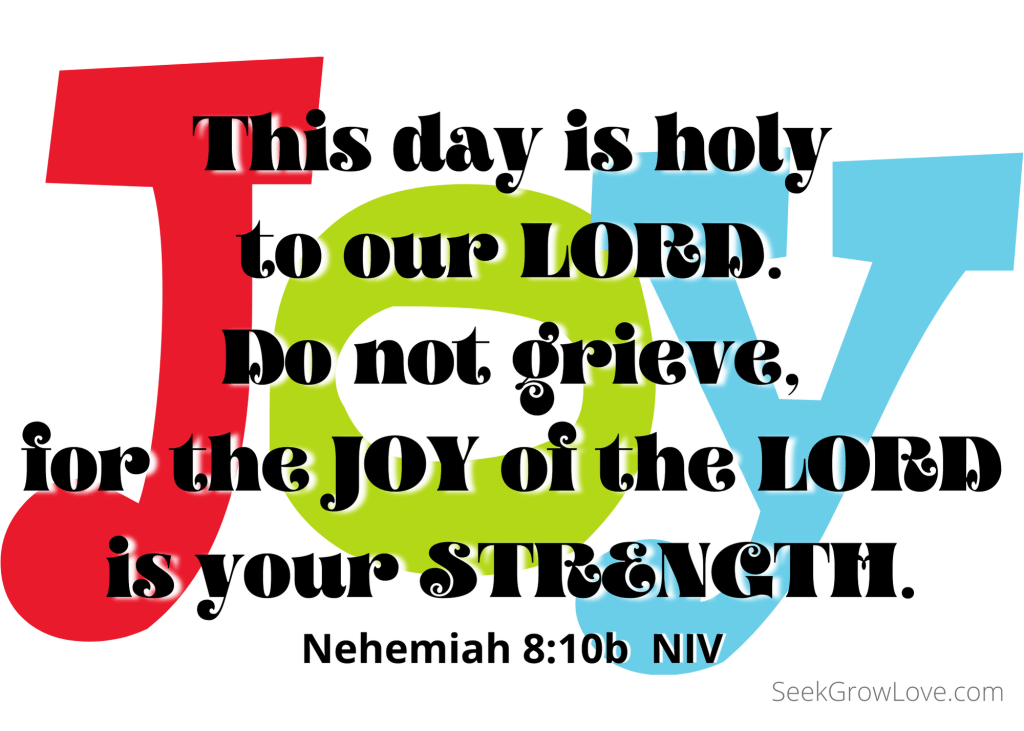
Nehemiah said, “Go and enjoy choice food and sweet drinks, and send some to those who have nothing prepared. This day is holy to our Lord. Do not grieve, for the joy of the Lord is your strength.” – Nehemiah 8:10

As God’s timing would have it, the completion of the wall shared a seam with the Festival of Tabernacles of the Feast of Booths and the words shared from the Laws of Moses.  You may be familiar with this week-long celebration from your earlier reading this year, but this might be a good time to summarize the origin and purpose of this festival.  God had redeemed his people, the Hebrews, out of enslavement in Egypt.  He did this through sending a series of plagues to Egypt, parting the Red Sea, and giving his commandments.  There were a few bumps in the road.  The Jews spent a great deal of time wandering in the desert because of their lack of faith and disobedience, yet he remained with them wherever they were, and he still blessed them with receiving the Promised Land, the very place where Nehemiah and those who followed him out of exile had returned.

We don’t serve a God who is solely responsible for the harvest.  We don’t serve a God who is solely responsible for the rain. We serve a God who works in the harvest, and works in the rain, but also works on the days that are in between. We may endure a great deal of prosperity or adversity, but ultimately, we take count of the blessings and realize that compared to eternity and the Kingdom of God, we are just living in booths, moving, temporary structures built from our feeble attempts to gather a few sticks or a few bricks.  After a long journey, we may seek to call it home, but it won’t be, right?  It is only a place to eat a few meals and get some rest until we no longer want it, it is destroyed by the elements, or someone else is enjoying it because we are pushing up daisies. 

The whole company that had returned from exile built temporary shelters and lived in them. From the days of Joshua son of Nun until that day, the Israelites had not celebrated it like this. And their joy was very great. Day after day, from the first day to the last, Ezra read from the Book of the Law of God. – Nehemiah 8:17,18a

Therefore our home as we wait is not established in a certain location, but is rooted in the Word of God – in our Savior Christ Jesus, The Word and Cornerstone. Additionally, His Word, is the saving knowledge of the Gospel testified to by the Living Word, that is meant to be shared with all, especially those who have not prepared (v.10).  The harvest has not yet come, so we could be freshly stepping out of captivity, like the Hebrew or those returning from Babylon.  If this be the case, there is a lot to do to ensure our initial success – like create some solid boundaries.  Maybe we feel as though we are in exile, we are a far cry from the person who was once called Christian. Listen to God’s calling.  Recognize his blessings.  There is a promised land, even for those who wander (and truly, only for those who wander).  No matter the season, God is there, and the greatest of harvest is coming soon.  Enjoy this spectacular vista from the shack of your (but really, God’s) choice.

-Aaron Winner


Today’s Bible reading passages can be read or listened to at BibleGateway here – Nehemiah 7-8 and 1 Corinthians 10

Sent and Thankful

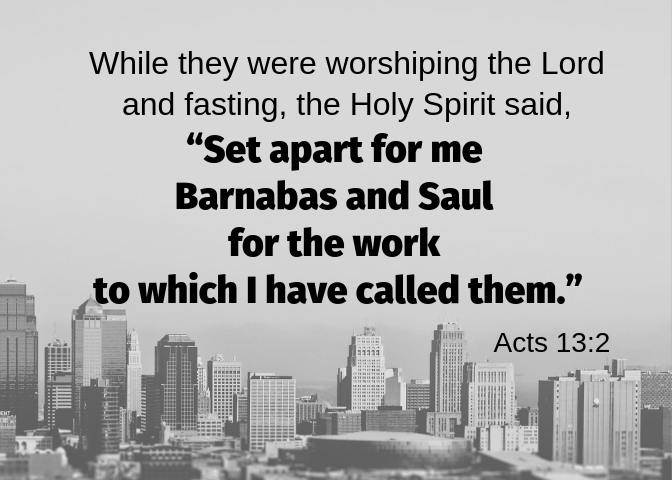
Acts 13 2

Acts 13

“The two of them, sent on their way by the Holy Spirit…” Acts 13:4
Is God calling you? When’s the last time you’ve looked and watched somebody go on a missions trip? Go up front at church and speak? Or teach a class? Do you ever think ‘I should be doing that.’ Maybe God is calling you to do that. When have you ever allowed the Holy Spirit to speak to you and send you out to do God’s work? God has equipped and called each and every one of us to go do great things for the glory of His Kingdom. Nothing brings more joy than recognizing the purpose that God has made you for. Heavenly Father, help me to open my mind and heart to where You are calling me.
Open your ears and heart and listen for God’s voice in the less obvious places.
Acts 13:13-52
“We tell you the good news.  What God promised our fathers, he has fulfilled for us, their children, by raising up Jesus.” Acts 13: 32–33
I have served in many churches throughout the United States. I have been blessed to go out and have many chances to work with youth and adults alike. To see ministries started, buildings put up and peoples’ lives changed.  But for me nothing compares to watching someone who serves the Lord. Men and women from our congregations serving me, helping, guiding  me.  Missionaries since Paul and Barnabas have risked their lives to spread God’s word in my place. Pastors and teachers have come before me and expressed their faith so that I could have a chance to know the LORD.
And Jesus died on the cross for my sins.   Nothing I can do can compare with these sacrifices, and spreading God’s word is a way for me to remember my blessings and express my thanks.
Lord, show me where I can serve you and give me the strength to respond. Help me to express thanks for others’ sacrifices through action.
-Andy Cisneros

Serving – and Delegating

Acts 6

Acts 6 3 4

At first glance it appears that some of the old behaviors of the disciples are creeping back in. It almost sounds like they are saying “we are too good to serve tables.” But we see that is far from the truth. They are actually so busy serving that they are not keeping up with all of their other duties and people are going hungry!

They were actually listening when Jesus said things about the greatest being servants – maybe it kicked in the night before Jesus was sent to the cross, when Jesus got down and washed their feet. Either way, they finally understand the importance of service.

So in light of being overwhelmed with too much to do they take a page out of Jethro’s playbook. (Exodus 18) They realize more work could get done if they find qualified leaders to take over some of their duties. They find 7 people who can take care of serving the tables, which will allow the disciples to focus on their other responsibilities. Specifically, they could focus on their calling – “prayer and ministry of the word.”

While it frees up the disciples it also allows others in the church to be involved. It is important to get involved in your church – to share the load so it is not just a few people overburdened. We each have and bring different talents that make up the body.  The church is most effective when all of the body is working together.

Is your church missing it’s hands, feet, ears…etc. because you are not involved? Or is it possible you are too busy doing good things that you are missing out on what God has really called you to?

I challenge you to find your place in service.


-John Wincapaw