What kind of fruit are you producing? 

In Jeremiah, God calls for reform in ways and actions, emphasizing the importance of genuine faith over mere ritual. The teachings remind us to pursue justice, avoid idolatry, and maintain moral integrity. Jesus highlights that one’s heart influences life’s outcomes, urging us to nourish our spirits with good influences for fruitful living.

Jer 7-8

Ps 124

Luke 6

-Devotion by Cayce Fletcher

Reading through the books of the prophets can sometimes feel like you’re hearing the same things on repeat. But rather than become desensitized to what you read, remember this: If it’s repeated, it’s important. 

What themes have we seen hit on again and again through these opening chapters of Jeremiah? 

Jeremiah 7:3–4 says, “Reform your ways and your actions, and I will let you live in this place. Do not trust in deceptive words and say, ‘This is the temple of the Lord, the temple of the Lord, the temple of the Lord!’” This call from God summarizes what has been repeated across all the preceding chapters. 

We learn: 

  1. God desires relationship with us. He wants to live in communion with us, but that can only happen in keeping with his holy character. 
  2. We have to reform our ways and actions. We come just as we are, but we cannot stay that way. 
  3. The natural bent of people is to soften sin and ritualize it. We live with fake religion, acting like if we just go through the motions of religion, that will be enough to ‘make God happy.’ 

Of course, nothing that we can do is ultimately enough to balance the ledgers of sin and righteousness in God’s book. Jesus paid it all, and all to him I owe. 

After we have accepted Jesus and committed to following after him as Lord of our lives, what then must we do? 

Jeremiah describes the types of things expected from us: 

  • We must “deal with each other justly” (v. 5–7). This looks like not being a bully to the people weaker than us—whether that’s the foreigner, widow, or fatherless. We cannot pervert justice and shed innocent blood. 
  • We must not “follow other gods to your own harm” (v. 7). Pursuing idolatry may feel good and right in the moment, but it will only result in pain in the end. God created in his perfect wisdom. When we choose to go our own way, we are choosing to reject that wisdom—which often just results in pain. 
  • We must not “steal and murder, commit adultery and perjury” (v. 9). What may look like a random collection of sins is actually a reference to ‘the big 10.’ Jeremiah is reminding us that we have to take a high view of the gravity of sin and avoid it at all costs. 

From this passage we learn that we must treat each other rightly, be faithful to God, and pursue holiness (rejecting sin). 

How do we have a life defined by these principles? In Luke 6, we read Jesus’ words: “No good tree bears bad fruit, nor does a bad tree bear good fruit. Each tree is recognized by its own fruit. People do not pick figs from thornbushes, or grapes from briers. A good man brings good things out of the good stored up in his heart, and an evil man brings evil things out of the evil stored up in his heart. For the mouth speaks what the heart is full of” (v. 43-45).

Out of what we have stored up in our heart comes the fruit of our lives. If we want to have good fruit and live in the way that God is calling us to, we have to be feeding ourselves good things. Then from the good stored up, we will produce a life of lovely fruit. 

What does it practically look like to feed ourselves good things?

  • Spend time in Scripture before the world gets the first word. We are constantly being discipled by something. Make a habit of reading God’s Word—not simply to check a box, but to allow it to shape what you believe is true, good, and worth pursuing.
  • Pay attention to what you consume. Think about the music you listen to, the shows you watch, the books you read, and especially what you scroll through. Ask yourself: What is this teaching me to love? What is it teaching me to laugh at, desire, envy, or accept? Not everything we consume has to be explicitly Christian, but we should notice what is shaping our hearts.
  • Surround yourself with people who point you toward God. We need relationships where we can talk about more than schedules, work, kids, and what happened this week. Spend time with people who will remind you of truth, encourage you toward faithfulness, and lovingly correct you when you need it.
  • Fill the ordinary moments with good things. Listen to Scripture while you drive. Put on worship music while you clean. Memorize a verse and think about it throughout the day. Talk about what you’re learning with your family. Small choices repeated over time determine what gets “stored up” in our hearts.

We cannot expect to continually fill our hearts with what is shallow, worldly, or sinful and somehow produce godly fruit. What we store up matters.

What are we storing up in our hearts? And what kind of fruit is it producing in our lives?

May we be a people who pursue what is good, holy, and righteous. For we are judged by our fruit. 

Cayce Fletcher is a wife and mom of three. In addition to homeschooling and other ministry projects, she writes and podcasts at amorebeautifullifecollective.com about faith, motherhood, and theology. 

Reflection Questions

  1. Look through the list of things we can learn from this passage in Jeremiah. Where do you see yourself excelling or falling short? 
  2. What kind of fruit is your life producing? Think about your attitude and actions. What are you leaving in your ‘wake’? 
  3. What is one practical way that you can add more ‘good things’ to your life this week? 

Prayer

Dear Lord, thank you for being a God who always calls us back no matter what our current circumstances are. You are a good and holy God. May our actions reflect your character. Please fill our lives with the good things that produce good fruit—and please let us produce fruit that is in keeping with those good things. Soli Deo gloria. In Jesus’ Name, Amen. 
SGL.2026.CalendarDownload

Fruit in the Wilderness

Genesis 9-11, Proverbs 6, Matthew 3

Devotion by Marcia Railton (IN)

You might not expect a man who works in the wilderness and eats locusts and wild honey to talk much about fruit. But here in Matthew 3 we hear from just such a man, one who is often referred to as John the Baptist, speaking twice of fruit.

Perhaps his most famous line is, “Repent, for the kingdom of heaven has come near!” (Matthew 3:2 NASB). It is such an effective charge and accurate description of the ministry given by God, that Jesus will also say the exact same thing when he begins his preaching in the next chapter (Matthew 4:17). The kingdom of heaven is a term used only by Matthew, and he, a Jew who was very careful about his use of “God”, spoke often of the kingdom of heaven. The other gospel and New Testament writers did not use the term kingdom of heaven but rather called it the kingdom of God. In the Old Testament neither phrase was used, but the people of God were definitely looking for the promised Messiah, the Chosen and Anointed One of God who would save them, and they too were looking forward to a kingdom set up by the God of heaven, an everlasting kingdom (such as Daniel 2:44). As the Messiah, Jesus Christ, was now ready to begin his preaching ministry on earth the kingdom was closer than it had ever been before! The time to repent had certainly come!

As John addresses some of his audience, the Pharisees and Sadducees (who in their pride and self-righteousness will reject the Messiah), John calls them a “brood of vipers” (or offspring of vipers), referring to being poisonous, spiritually speaking. Perhaps this sounds familiar to us because on more than one occasion Jesus will use the same term for them as well (Matthew 12:34 and again in 23:33).

So with the “pleasantries” aside, John gets right to the meat, or perhaps in this case, the fruit of his preaching saying: “Therefore produce fruit consistent with repentance; 9 and do not assume that you can say to yourselves, ‘We have Abraham as our father’; for I tell you that God is able, from these stones, to raise up children for Abraham. 10 And the axe is already laid at the root of the trees; therefore, every tree that does not bear good fruit is being cut down and thrown into the fire” (Matthew 3:8-10 NASB). Having told his listeners to repent he now tells them to bear fruit consistent with repentance. In other words, don’t tell me that you repent – show me that you repent. To repent is much more than recognizing or even saying that you have been and done wrong. To truly repent requires a change, a movement, an actual TURN from sin. A visible, tangible, positive, nourishing, healthy “fruit” that is evidence of the inner heart change.

The Jewish Pharisees and Sadducees were relying on their genealogy, their fancy titles, their turned up noses, their faithful fathers, their long lists of human made rules, their strict checkmarks. God wasn’t impressed. John was sent to prepare the people for Jesus. He said, repent, it’s time to change. Jesus would also repeat John’s words: “Every tree that does not bear good fruit is cut down and thrown into the fire” (Matthew 7:19). It is important. Eternal life and death important. Are you bearing good fruit consistent with repentance?

Reflection Questions

  1. What have you repented of? What do you need to repent of? Beyond saying you are sorry, what will it look like to change and turn from sin? What will the fruit in keeping with repentance look like in your life?
  2. John the Baptizer was known for his message of repentance and the act of baptizing, and in fact Jesus’ baptism by John also happens in this chapter, when the voice from heaven (that would be God) acknowledges that Jesus is His beloved and pleasing Son (I love that part!). How does John’s message of repentance and the act of baptism go hand and hand? Why do you think the perfect Son of God was baptized?
  3. Jesus continues the fruit theme a few chapters later saying, “You will know them by their fruit” (Matthew 7:19). What fruit are you known by: good fruit or bad? Give an example of each (good and bad) that you have grown in the past? What type of good fruit do you want to grow today and in the future? What is required to grow this good fruit?

Prayer

Dear God, we thank you for your beloved and pleasing Son, your chosen Messiah, and the example and teaching he brought and the kingdom that is closer today than it was yesterday. Thank you for John who prepared the way for Jesus. Help us also prepare others to meet Jesus. Thank you for the opportunity you give us to repent and turn from sin towards You and Your better way. Help me not be like a Pharisee who proudly thought they had it all together. Show me, Lord, where I need to change, what I need to repent of, and what good fruit you want me to bear. Help be honestly see and get rid of bad fruit in my life so I am prepared for Your Son’s return. In his name we pray, Amen.

Showing your Light through what you Say

Matt 12 33


The last few days I have been talking about following the Light which is Jesus, and yesterday I gave an example of how to show our light through forgiving others. I will continue along with another way we can show our light to others. I truly believe that one of the simplest ways people show who they are is through what they say. It can be one of the most obvious ways to show your light in the world and for the world to notice that there is something different about you.


Whether it be foul language or gossiping, people will see who we truly are by the things that we say. We have the ability to be a hindering block or a light to those around us. The way we speak can either confirm to people that we are different or that we, as Christians, are just like the world. Jesus makes it clear we are to be different in how we speak.


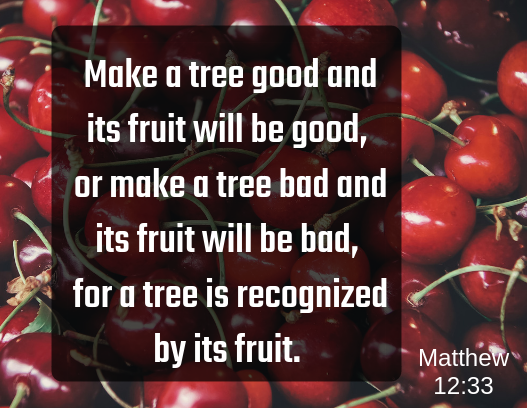
33 “Make a tree good and its fruit will be good, or make a tree bad and its fruit will be bad, for a tree is recognized by its fruit.

34 You brood of vipers, how can you who are evil say anything good? For the mouth speaks what the heart is full of.

35 A good man brings good things out of the good stored up in him, and an evil man brings evil things out of the evil stored up in him.” – Matthew 12:33-35


Theses verses warn us that if we put bad things into our hearts and minds they will eventually come out through what we say or what we say about others. We often fall for the lie that what we say and how we talk doesn’t matter that much, but in the book of James we can see just how important it is to watch what we say.


“Those who consider themselves religious and yet do not keep a tight rein on their tongues deceive themselves, and their religion is worthless.”- James 1:26


We want to make sure we are being the light by what we say. We need to make people wonder what it is that make us different from the rest of the world, and I promise you that people will notice!


-Luke Elwell