It is easy to get discouraged. It happens all the time. As Christians, Christmas is a special time of year. Our hearts turn to the Christ child and the miracle that is the birth of God’s son. While this gives us hope, we live in a fast paced, difficult world. All around us people are hurting. Evil seems to grow every day. Unbelievers ask us “Where is your Jesus”? Before long, we find ourselves depressed and doubting the goodness of God. At least I do.
The writer of Hebrews knew there would be days like this. That is why he spent so much time writing in his letter to the Hebrews that “we can have confidence to enter the Most Holy Place by the blood of Jesus” (we can go before God Himself through our prayers)…so let us draw near to God with a sincere heart and with the full assurance that faith brings… (Hebrews 10:19-22a). The wise writer knew that the people of God were hurting. He continues by encouraging them to “consider how we may spur one another on toward love and good deeds, not giving up meeting together, as some are in the habit of doing, but ENCOURAGING one another… (10:24).
Sometimes the Christmas season can be lonely. We remember Christmas’ of long ago and the fun we shared with people that we loved. Parents, brothers and sisters, friends…perhaps gone now and only existing within our hearts. As children of God, we can trust in the incredible hope that is found only in Jesus. It is our duty, to help each other and encourage each other to keep on living…and loving. Each of us pushing each other onwards towards good deeds – and new, happy memories.
In this Christmas season, my hope is that you dear reader will remember the love of Christ, the forgiveness and grace of the Father, and the promise of the coming Kingdom of God.
Questions for Discussion:
Who might you “spur on to love and good deeds” this Christmas season? (10:24)
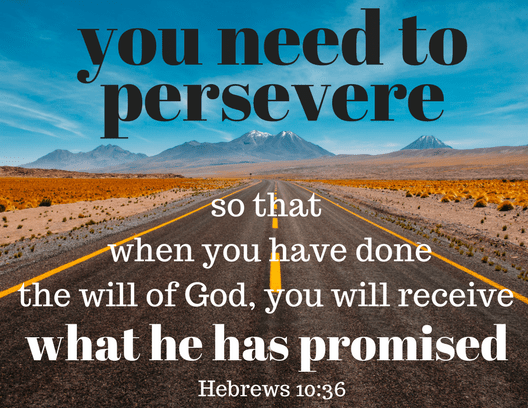
What does it mean to “persevere” in the faith? (Hebrews 10:36)
“You showed sympathy to the prisoners” (Hebrews 10:34). I don’t know what that phrase brings to your mind. Maybe you see something from a television program or a movie, someone behind a sheet of glass holding a telephone receiver. Perhaps you have visited a prisoner at some point, for a prison ministry, or a relative or friend. You may think of sending letters, or helping prisoners readjust after their release. The issues under discussion in Hebrews were rather different. With the Roman empire it was expected that the relatives and friends of a prisoner would provide their food and other physical needs, though there might be some small rations. Christians became known for taking care of fellow believers who had been arrested for their faith, as well as other prisoners in need. But that meant people helping Christians ran the risk of getting accused of being Christians themselves. That’s probably where the next part of the verse came in, that they “accepted joyfully the seizure” of their property – they continued with their behavior even though it risked them being identified and targeted. They didn’t shy away from risk to guard themselves. It isn’t mentioned here but Christians during the Roman empire also became known for caring for plague victims when others would not, taking in orphans, collecting clothes to give to the poor, and generally being good to others.
In the fourth century the Emperor Julian would become very frustrated about the contrast between the Christians and the pagans. In a letter he wrote: “Why then do we think that this is sufficient and do not observe how the kindness of Christians to strangers, their care for the burial of their dead, and the sobriety of their lifestyle has done the most to advance their cause? Each of these things, I think, ought really to be practiced by us.”
In Hebrews 10 we find that Herb (my choice of a simple name for the book’s author) returned to issues he addressed in chapter six about a person surrendering their faith in Jesus (6:4-8; 10:26-31). These comments are directly paired in both chapters with the statement that Herb’s audience is not like that, which is shown by the fact that they have been ministering to believers (6:9‑12; 10:32-39). For Herb to defend his audience this way should be an obvious route to take. What are Christians told to do? “I am giving you a new commandment, that you love one another; just as I have loved you, that you also love one another. By this all people will know that you are My disciples: if you have love for one another.” (John 13:34‑35). Yes, that isn’t the only thing for Christians to do, but it is a huge example: “This is His commandment, that we believe in the name of His Son Jesus Christ, and love one another, just as He commanded us. The one who keeps His commandments remains in Him, and He in him. We know by this that He remains in us, by the Spirit whom He has given us.” (1 John 3:23-24). And the call to love isn’t necessarily simple or easy, either. The very fact that Jesus said “just as I have loved you” should put this at a high level, for Jesus loves at a high level.
Hebrews 10 began by comparing the priests who stood in the tabernacle day after day offering sacrifices to Jesus and the single sacrifice he offered before he sat at God’s right hand. Herb wants us to understand that what Jesus did is much more powerful than all those earlier sacrifices. And because it is so much more powerful it calls more powerfully for our response. Herb says: “let us draw near with a sincere heart in full assurance of faith, having our hearts sprinkled clean from an evil conscience and our bodies washed with pure water. Let us hold fast the confession of our hope without wavering, for He who promised is faithful; and let us consider how to stimulate one another to love and good deeds” (v. 22-24). Those verses give a complicated image. The idea of being “sprinkled clean” plays off the sprinkling of the blood by the high priest once a year over everything that needed to be cleansed in the Holy of Holies – but Herb says that our hearts are part of what Jesus cleansed. There are no more evil consciences for us, we can have pure consciences and serve wholeheartedly, having been washed with pure water, referring to our baptisms. This is very similar to 1 Peter 3:21-22, “baptism now saves you – not the removal of dirt from the flesh, but an appeal to God for a good conscience – through the resurrection of Jesus Christ, who is at the right hand of God”. We are to hold to the confession of our hope that came with that baptism – because the fact of being baptized, to Herb, doesn’t mean what is so often called baptism today (the sprinkling of a baby, with no knowledge of what it means) but the choice made by a believer to state their understanding in front of at least one other person, confessing hope in the promises of God involving Jesus and the future. He who promised is faithful, so we should not waver in our commitment. By having made that choice each one of us becomes part of the body of Christ, which is a collective group. Recognizing that we are part of that group should remind us that we have support with each other, and also that we have responsibility and commitment for each other, so we need to think about how we can stimulate each other to love and good deeds.
One of my seminary teachers noted that there are two possible interpretations of Hebrews 10:25. It is often used to advocate for attendance at worship services using the phrase “assembling together” to refer to ‘not meeting on a regular basis,’ as a matter of habit. But the Greek word for the assembling or gathering here is the one used in 2 Thessalonians 2:1, and it has been suggested that it could be saying not to forsake our being gathered together with Jesus at his return – so not, by your choices, giving up on being a part of the resurrection with him. More like “Don’t forsake being part of the resurrection gathering, as some are in the manner of, but encourage each other to be there at that day, all the more as you see it drawing near.” Either meaning could work. (The term translated as “habit” also gets translated “manner.”)
Hebrews 10:31, which says “It is a terrifying thing to fall into the hands of the living God,” should be read along with verse 27 that refers to “a terrifying expectation of judgment and the fury of a fire which will consume the adversaries.” We are still speaking of the adversaries of God being consumed, not simply tortured in some ongoing way (as some versions of theology would have it). I see no conflict in this. Notably Hebrews 10:26 references Numbers 15:30, showing that Herb had that part of the book in his mind when he was writing this section about fire and judgment. And Numbers 16 may well be the section he was pointing his readers to for a consideration of how terrifying God could be when passing judgment. God doesn’t need to be a demented torturer to be scary. I don’t think that Korah was complacent when he faced the results of his revolt. Endless suffering is not required for God’s wrath to be respected. If all we were concerned about was what came after this life we would have no concerns about anything in this one. But we have proven ourselves well capable of being concerned about what happens now.
In the last part of the chapter Herb wants his audience to proclaim that they are not giving up on Jesus. He doesn’t want any doubt on that point. He says “do not throw away your confidence, which has a great reward” (v. 35). He quotes God saying:
“My righteous one shall live by faith;
And if he shrinks back, My soul has no pleasure in him.”
But Herb tells his audience “we are not of those who shrink back to destruction, but of those who have faith to the preserving of the soul.” (v. 39).
Lord, it really is a terrible thing to think of anyone giving up on their confidence in your son. I read the book of Hebrews and I think I understand the concern it expresses, the passion which Herb felt about his readers. He didn’t want to say that any of them might turn away, but he didn’t want to stop urging them to remain vigilant. He just really wanted them all to be safe in the end. He wanted to tell them about how dangerous it would be to turn away from the sacrifice that Jesus made, because there is only one sacrifice in the new covenant, but he also wanted to say that it is up to you to judge – because if they thought they might have stepped too far then they might despair and not turn back to Jesus. Everything was a balancing act and the focus was always on getting as many as possible to devote themselves to the Lord. I am glad for your mercy, Lord, because I know so many people who I know need it, including me. Please help us to serve you better. Please help us to grow. Help us to love. Thank you again. Amen.
-Daniel Smead
Reflection Questions
1. Do you value being at church services with other believers? Do you feel that you are a part of the worship? Are you growing? Are you open to others? If not, how could that change?
2. Herb wants his audience to be revived in their faith, to be passionate about Jesus against the risk of persecution. What if they weren’t warned about the risk of persecution when they first became Christians, and meeting opposition took them off guard, how might that affect their attitudes?
3. Are you open to challenging yourself to a Love Like Jesus Day? Of course we are always supposed to do that. But how about consciously checking your actions for one day, all your thoughts, words, deeds, measuring yourself against Jesus and trying to amp your love to Jesus-levels? What do you think it will look like?
Chapter 10 contains one of the five major warning passages in Hebrews, which makes up the second half of the chapter. It is this section that we will focus on as it functions in a very unique way in this context.
Leading up to verse 26 where the warning begins, the author has now fully explained the perfect sacrifice and the forgiveness that is now possible which was not available under the old covenant. And so, as the author concludes, “where there is forgiveness of these sins, another sacrificial offering for sin is no longer required” (v. 18). This is valid so long as certain conditions are met as the author will go on to describe.
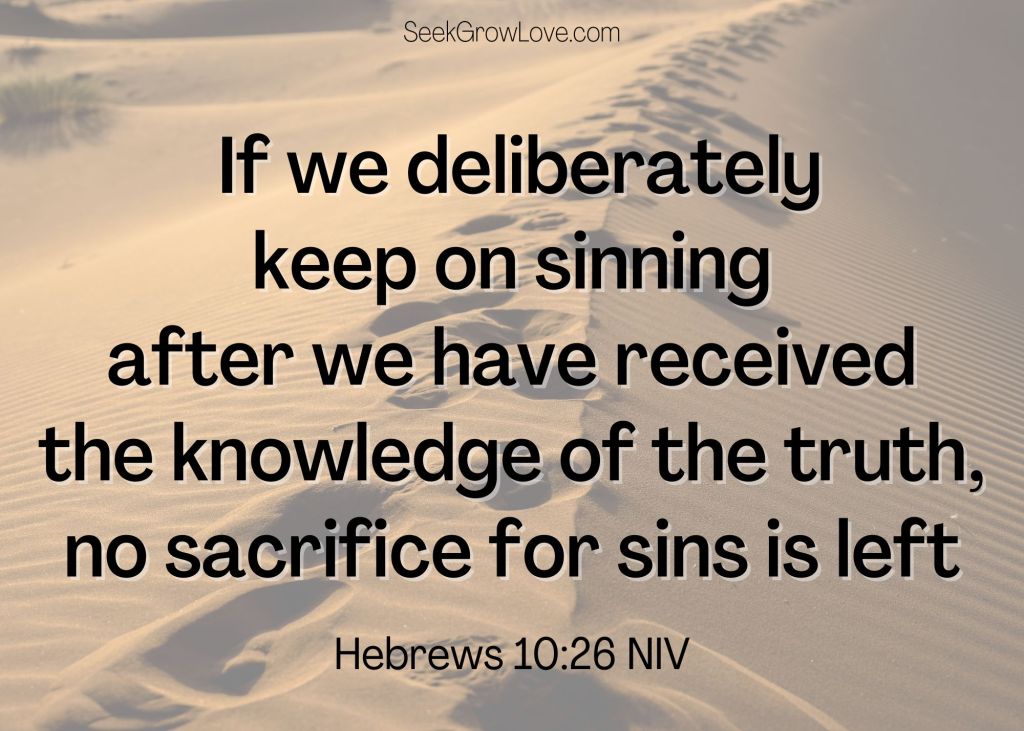
The warning passage begins: “For if we deliberately continue sinning after receiving the knowledge of the truth, there no longer remains a sacrifice for sins, but a terrifying expectation of judgment and the fury of a fire that is about to consume the adversaries” (vv. 26-27).
For those who choose to continue willfully committing sin after coming to know the truth about Christ’s sacrifice, it says “there no longer remains a sacrifice for sins.” What does it mean that there is “no longer” a sacrifice for sins? The author has just gone to great lengths to show the perfect sacrifice of Christ, and such an offering as Christ’s is the only one that is able to “perfect forever those who are sanctified” (v. 14).
If Christ’s sacrifice is the only sacrifice that is sufficient to take away sins forever, and since the author made it clear that the old covenant sacrifices could never “take away sins” (v. 11), then if a person disregards the cleansing and sanctification that is brought about through Christ by willfully continuing to sin, then they have no other recourse to fall back on for forgiveness. Christ’s sacrifice is the only offering that can remove the defilement of sin. Therefore, repudiating Christ and disregarding the knowledge of the truth leaves a person with nowhere else to turn. And that is why the author says that such a person only has to look forward to a “terrifying expectation of judgment and the fury of a fire.”
It is God’s will that we turn away from sin and embrace Christ’s sacrifice on our behalf so that we may be forgiven and cleansed from sin and have “our hearts sprinkled clean from an evil conscience” (v. 22). The means by which we can have this purification in our hearts and minds has already been provided by God through Christ.
And this is why the author warns the reader that they must not fall away and turn aside from the knowledge of the sacrifice of Christ. At the end of the chapter, in one of the final exhortations, the author asserts, “So don’t throw away your confidence, which has a great reward. For you need endurance, so that after you have done God’s will, you may receive what was promised” (vv. 35-36).
In Christ, there is forgiveness from sin now and forevermore. But outside of Christ, we have no hope and no provision for sin. If we will endure in the faith, holding onto the perfect sacrifice of Christ, then we will have done the will of God and will receive the reward of what he promised—everlasting life.
-Jerry Wierwille
Questions
What 4 things are we told to do in Hebrews 10:22-25 (“Let us…” -in NIV – do what 4 things?). Which of these 4 do you think you do most regularly already (though, still with some room for improvement)? Which one would you like to concentrate on doing better this month? How?
Who has spurred you on to love and good deeds? How did they do it?
Who has been an encouragement to you? How did they do it?
How often have you wanted to run away or turn away from God? Perhaps it was shame, guilt, or maybe despair that was making you unable to even look at your own self in the mirror, let alone approach God. Those feelings of regret, shame, fear, and a guilty conscience often make us want to crawl in a hole and hide. Fear is a powerful emotion and pushes us away from God. But the words of Paul tell us that we no longer have to feel that way. We no longer have any reason to run away or turn away from God. We no longer have to hide in shame and disgust. We no longer have to be fearful of who we are, or what we think we are. Instead of running away from God, we can run to Him, and fall into His loving arms. When we run to God into His loving arms we are entering the most holy place. Paul calls it such in Hebrews 10:19. That should take your breath away. Just think about it. No matter who you think you are, or what you are, you can enter the holy place, into the very presence of God Himself. But Paul says one more thing that is almost too good to be true. He does not say that we have to crawl into that holy place, hide behind someone else, or that we have to enter wearing sack cloth and ashes. We don’t even have to sneak in the back door so no one sees us. No, he says we can come into that holy place in God’s presence with CONFIDENCE. Wow! How often do we enter a classroom about to take a test, and go in feeling confident? But Paul says we can enter the presence of God feeling confident!
How is that possible? Is this all just a dream or make believe?
No, it is real. Very real.
Let Paul explain.
“Therefore, brothers, since we have confidence to enter the holy places by the blood of Jesus, by the new and living way that He opened for us through the curtain, that is, through His flesh, and since we have a great priest over the house of God, let us draw near with a true heart in full assurance of faith.” (Hebrews 10:19-22a)
We no longer have any excuse for running away from God, turning away from God, or hiding in shame or despair. Instead we can approach God and enter His presence without fear but rather with confidence. Paul even tells us to come up close, draw near, maybe so close that we feel as if we are sitting in His lap just as we would sit comfortably in our dad’s lap as a child. Paul tells us in Romans 8:15 “For you did not receive the spirit of slavery to fall back into fear, but you have received the Spirit of adoption as sons, by whom we cry, ‘Abba! Father!” We are no longer a slave to fear. Instead, we have been adopted by God, and we are His children. We call Him Father! We are surrounded by the arms of God our Father. And all of this is possible because of the blood of Jesus.
Paul calls this a new and living way (Hebrews 10:20). Instead of fear and guilt we’ve been liberated from our bondage and shown a new way of living. Our sin is washed away with pure water, and our guilty conscience is wiped clean (Hebrews 10:22). That guilty conscience, which we often lug around in our heart, has been wiped clean. The chains are broken, we’ve been redeemed. I know, it is almost too hard to imagine or fathom. We can hardly understand something so great and wonderful. But it is real. Now, without fear or guilt, we can fall into His loving arms because Jesus has opened the door for us. His blood became the pathway into God’s presence! No more sin and guilt! We have been set free!


 Seek Grow Love