
Able to Save Completely

OLD TESTAMENT: Isaiah 19-21

POETRY: Song of Songs 1

NEW TESTAMENT: Hebrews 7

The whole point of the letter to the Hebrews, it seems, was to show them how much better Jesus and the New Covenant were than anyone, or anything, that God used or worked through to fulfill his plan of salvation in the past. I think the writer is doing this because the Hebrews needed to hear it. In chapters 5 and 6, they were just scolded because they had become poor listeners, in need of milk like infants, instead of solid food.

I have a hunch that meant that they had heard the gospel, took it to heart, maybe applied it for a time when they were still excited about it, then slumped back into their old ways over time. They didn’t train themselves in it to distinguish between good and evil for the sake of endurance. I think they were getting sluggish and therefore falling back into their old habits/ways of life, because it’s so much easier to continue what you are used to, especially if there’s persecution for doing it God’s way. For them, their old habits were those pertaining to the law of Moses.

It’s hard for me to be too harsh however, as we’ll soon read about what they had already endured for the gospel’s sake (e.g., having their homes taken away and enduring it with joy). If people like that were in need of some rebuke and encouragement, I can only imagine what I need.

To make the point (about Jesus being better) in chapter 7, the writer applies these “better” characteristics and principles of Melchizedek to Jesus and the New Covenant, to help explain why Jesus’s priesthood in the New Covenant is far superior to the Levitical priesthood under the Old Covenant.

The writer is quick to point out that Melchizedek’s name means something that can easily be applied to, and understood of, Jesus. Melchizedek means “King of Righteousness” and he’s the king over Salem (now Jerusalem). That makes him the righteous king over the land of peace. That can easily be applied to Jesus (but he’s better). Jesus is THE king of righteousness (always doing his father’s will). He is not only going to rule over the land of peace from his father David’s throne, in Jerusalem, he’ll rule the entire world from there in peace in the kingdom age.  

Oh, and the Levitical priests served Melchizedek, so Melchizedek’s priesthood is the better priesthood (and Jesus is a priest after his order, so he’s better yet). The Levitical priests paid Melchizedek a tithe because Levi was in the loins of his father Abraham when Abraham paid it (I’ve come to expect the writers of the New Testament to talk like this; we all should). The point is—the one after Melchizedek’s priesthood is far superior to the priests after the Levitical priesthood the infant acting Hebrews were following.

Like Melchizedek’s priesthood, Jesus’s priesthood was made by God (after his exaltation). He was chosen, or made perfect by God, because he fulfilled his role in his father’s plan of salvation through his suffering. That’s much better than obtaining the priesthood based on genealogy like the Levitical priesthood.

Better still, God swore an oath, that if another priest should arise after the order of Melchizedek, his priesthood would never die. That oath is fulfilled in Jesus, by the power of an indestructible life. That means that he always lives to make intercession for those who come to God through him. He’s always available to save someone. That’s much better than being after the order of Aaron, where there’s continuous turnover as each predecessor dies. And they can’t save.  

It seems like the writer to the Hebrews had some pretty profound words to share with them to get them out of their sluggish state of life. Thankfully, we have a great high priest to help us out of our sluggish state of life too. He set up a system where brothers and sisters in the body exhort each other to do good works and discipline each other when we are falling short (by training each other to distinguish between good and evil). If you’ve become sluggish, consider how great a high priest you’ve got, and get going by following him. Train yourselves as a body, with Christ as your head, to distinguish between good and evil, and then do good.   

-Juliet Taylor

Reflection Questions

1. New Testament writers often apply characteristics of people or things from the Old Testament to the New to help in their apologetics. One of these examples is that of Melchizedek. Some have interpreted that Jesus is Melchizedek incarnate. It’s nonsense, but unfortunately, we’re reading someone else’s mail over 2,000 years after it was written. We’re going to lack in some understanding as they would have understood things 2,000 + years ago. What is something you notice in this chapter that needs a little more exploration in understanding?

2. Jesus’s priesthood was made perfect by God, the Levitical priesthood was not. Perfection for a priest came after the sinless man Jesus chose to suffer and die for us, always being faithful to God’s will. Levitical priests were made priests because of their genealogy. What do you think perfection means in this chapter?

3. Hebrews 7:25 says, “Therefore He is able also to save forever those who draw near to God through Him, since He always lives to make intercession for them.” What do you think this means?

A Better Hope

Hebrews 7

Sunday, September 25, 2022.

We can’t jump right into chapter 7 without revisiting the last few verses in 6.  In the end of the previous chapter we are discussing Jesus being regarded as a high priest forever in the order of Melchizedek.  (Gesundheit!)

The beginning of chapter 7 explains who Melchizedek was for the readers and, in a way, giving Jesus some street cred.  The author clearly wants to stress the place of power and importance this King was in (vs. 4) and why it was important that Jesus came from his order.  Verse 15 and 16 explain a little more on why Jesus was to come from his order- it’s because his ancestry doesn’t exactly lead to priesthood!  Coming from a carpenter and a seemingly average woman isn’t a common start for someone so deserving of our praise and worship.  I think the author here was trying to give Jesus some more credibility for the Hebrews he was writing to.

Verse 18 and 19 has some of my favorite language in it!  “The former regulation is set aside because it was weak and useless (for the law made nothing perfect), and a better hope is introduced, by which we draw near to God.”  Why do we need Jesus?  Because the old law was weak, useless, and made nothing perfect!  Couldn’t be more clear than that.  With our new hope (Jesus), we are able to draw near to God and have a close personal relationship with Him.  Before Jesus, the law required sacrifice and prevented people from having that personal relationship with God that we all know and love.  After Jesus, or rather after Jesus’ death and resurrection and ascension, we are saved completely and always have a connection to God through Jesus’ intercession (vs. 25).  How amazing is that?

In the last few verses of chapter 7 the author again is explaining how lucky we are to have Jesus and why we should come to him!  He is not only perfect and blameless, but he also sacrificed himself once for the forgiveness of all sins (vs. 26-27).  Past, present, and future.  He took care of them all!  As someone who has grown up in the church it’s easy for me to unconsciously be aware of this fact.  I know Jesus died for all of my sins.  Big and little, from when I was born to where I am now, and where I’ll be tomorrow.  But I’m guilty of forgetting, or at least not recognizing how important that is for my life.  If I try and place myself in the shoes of the people who were reading this letter for the first time in that setting, how overwhelmed with grace and love would I be?  I no longer have to sacrifice by the old law, because there is a new oath that has been appointed by a forever-perfect Savior.  Can you imagine the relief, love, and astonishment you might have as someone hearing that for the first time?  Why is it different for us today, simply because we already know?

Today and throughout this week I encourage you to pause and consciously reflect on the gift of Jesus Christ.  Recognize his sacrifice and thank him for the relationship he allows us to have with our Heavenly Father!

-Sarah (Blanchard) Johnson

(originally posted for SeekGrowLove on February 11, 2018)

Application Questions

  1. What does it mean to you to have Jesus acting as high priest, not from the line of Levi but from the order of Melchizedek?
  2. Is Jesus the only way to draw near to God? Why?
  3. What are some things “we” in general hope for? How does Jesus offer a better hope? Who do you know who needs to know about this better hope?

No Daily Patch Needed

Hebrews 7

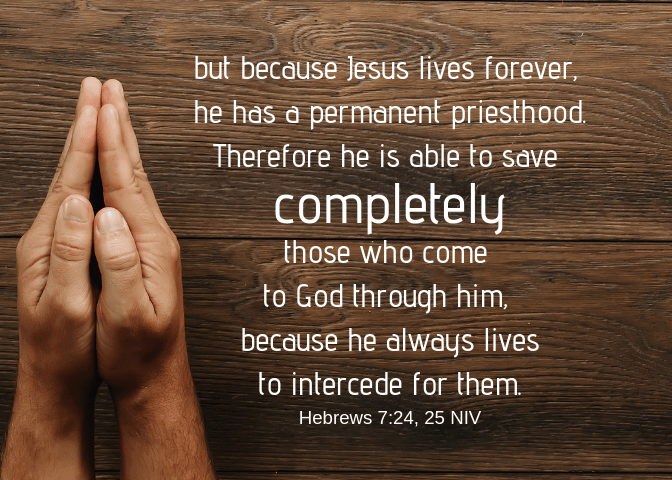
Hebrews 7 24 25 NIV

So often when we pray for ourselves or for others, we are concerned about certain specific things that are happening in the present moment of our life or their life.  This is okay, because sometimes we feel so overwhelmed by a situation or weakness in our life, that we want immediate help.  We fall on our faces or knees and plead for help in this particular situation or with this particular weakness, but never see the whole picture.  That’s because we are human, after all.  We often can’t see past the present moment. We want to put patches on what is torn or broken. We feel the pain right now, we experience the embarrassment of a sin and hope no one else notices, or we share in part with another in their present experience.  All of that is well and good as we plead for ourselves and intercede for others.  But then a new day comes, laced with all the same trials, tribulations, and temptations of life all over again and we look for another patch.

That was the life of a priest before the time of Christ.  Before a priest could do his job of offering up sacrifices for the sins of others, he first had to take care of his own personal business—his own sins, his own cares, his own violations.  So, each day, as he lit the fire to begin his godly work, he took inventory of the sins of his people and his own sins (Hebrews 7: 27).  Day after day, moment by moment, his mind raced with all these shortcomings.  His job was difficult and exhausting.

Then Christ came and became the high priest, and He holds this position permanently and forever (Hebrews 7:24).  He was after-all, “holy, innocent, unstained, separated from sinners, and exalted above the heavens” (Hebrews 7: 26).  Not only that but “He has no need, like those high priests, to offer sacrifices daily, first for his own sins and then for those of the people, since he did this once for all when he offered up himself” (Hebrews 7:27).   The daily grind of fire building, killing a sacrifice, inner-searching, and finally offering up prayers ended.  Jesus paid it all.

That does not mean we do not pray for others or ourselves.  Indeed Peter says that we are to be “a royal priesthood” (I Pet 2:9), meaning we are to pray for others.  But unless and until we accept without question and wholly the atonement of Jesus in our lives, the daily grind of being a priest will continue for us. We will never get out of that cycle of embarrassment, regret, remorse and the need to pray for that “daily patch” to cover our sins along with the sins of those for whom we pray.

Jesus lives to make intersession for us (Hebrews 7:25), He prays for us continually.  It is because of His intercession that we can do our work of intercession for others.  It is all possible because Jesus has saved us to the uttermost.  No daily patch needed.  Jesus saves us totally and at all times.  Once we believe this as a little child of God, and we draw near to God through Him, He is able to save us to the uttermost! (Hebrews 7: 25).  Then, with full assurance of our own atonement, we can put our full energy into praying for others which is our greatest work.

Luke Elwell