Tâmîym, ʼâbad, kâlâh and kârath

Psalm 37 22

            Today, we are in the middle of the week and we find ourselves in the middle of our Lectio Divina (Sacred Reading) of Psalm 37.* Today’s reading is a little more in-depth, so if you’re in a hurry you might wish to come back to this at a time later today when you can invest a few minutes into reading/praying.  My goal here is not just to give you a fish and feed you for a day but to teach you how to fish so you can learn to feed yourself for the rest of your life (and feed others).

            Remember, the purpose of Lectio is to draw us into God’s presence and rest through reading, meditating upon and praying with the Bible.  While the goal is not simply intellectual understanding, but relationship with God, it is still important that when we read and meditate we are doing so correctly.  We want to be as accurate as possible about the meaning of God’s Word.  We want to think about what it actually says and what it meant when it was written and what it means for us today.  It wouldn’t make much sense to spend a lot of time meditating upon something that was not correct.

            If you have internet access, there are some tools readily available which cost nothing and can help you.

            One tool is Bible Gateway.  I began working in a Christian bookstore when I was attending George Mason University back in 1982.  I became aware of a lot of different Bible translations that were available (beyond the King James).  I started building a library of various Bible translations and nearly 40 years later I have over 50 different translations on my bookshelves.  You can now get almost every one of those translations (and many more) on Bible Gateway.  Choose the text you wish to study, and choose which translations you wish to use and you can see a side by side comparison of the texts.  This can be helpful when you are studying a Biblical passage.  It can help you understand the nuances of meaning.  Some translations are more or less word for word, while others are more thought for thought.  There are also paraphrase versions which attempt to convey the meaning in modern contextual language.

            The second tool is Blue Letter Bible.  While the available translations are fewer than on Bible Gateway, BLB allows you to do a detailed analysis and word study of various words.  You can look up the original Hebrew/Aramaic or Greek words and see some of the various ways that word is used in the Bible and have a greater understanding of what the Bible was saying back when originally written and you bridge that into modern day language/ways of thinking and speaking.

            With that said, I’ve identified 4 key words that are used in today’s reading and give you a summary of the word meaning and usage in the Bible:

תָּמִים tâmîym, taw-meem’;  entire (literally, figuratively or morally); also   integrity, truth:—without blemish, complete, full, perfect, sincerely, sound, without spot, undefiled, upright, whole.

אָבַד ʼâbad, aw-bad’; to wander away, i.e. lose oneself; by implication to perish:—break, destroy(-uction), not escape, fail, lose, (cause to, make) perish, spend, be undone, utterly, be void of, have no way to flee.

כָּלָה kâlâh, kaw-law’; to end, to cease, be finished, perish, consume, destroy (utterly), be done, , expire, fail, faint, finish, fulfill, wholly reap, make clean riddance, spend, take away, waste.

כָּרַת kârath, kaw-rath’; to cut off, down or asunder, by implication, to destroy or consume; destroy, fail, lose, perish.

With that background in place, you are ready to proceed with today’s Lectio Divina reading of Psalm 37:18-22.

  1. Read.  Read through the passage slowly, at least 3 times:

18 The blameless (תָּמִים tâmîym, taw-meem’) spend their days under the Lord’s care,
and their inheritance will endure forever.
19 In times of disaster they will not wither;
in days of famine they will enjoy plenty.

20 But the wicked will perish (אָבַד ʼâbad, aw-bad’):
Though the Lord’s enemies are like the flowers of the field,
they will be consumed (כָּלָה kâlâh, kaw-law’), they will go up in smoke.

21 The wicked borrow and do not repay,
but the righteous give generously;
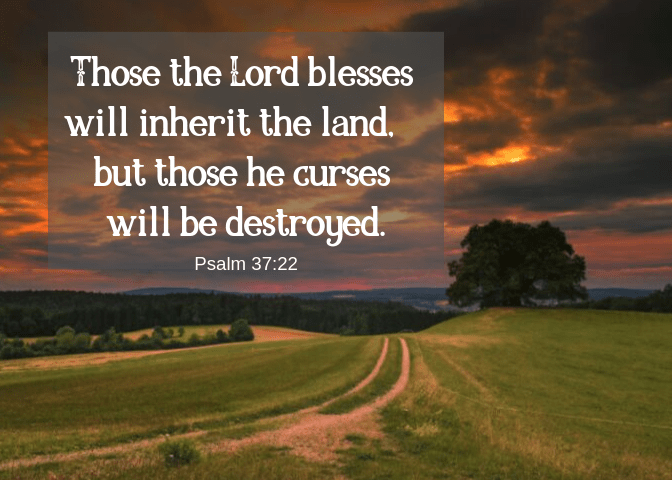
22 those the Lord blesses will inherit the land,
but those he curses will be destroyed (כָּרַת kârath, kaw-rath’)

  1. Meditate.  Choose a word or phrase from the text to  meditate upon/ think deeply about.

For me, I chose 3 words- perish, consumed, and destroyed.  Those who are wicked will perish, be consumed and destroyed.  The Hebrew abad contains the idea of wander away, lose oneself, have no way to flee, be destroyed.

            As I think about what this means I’m reminded of the story of Christopher McCandless whose story is recounted in the book “Into the Wild” (and later movie) written by Jon Krakauer.  Chris was just a few years younger than me and grew up just a few miles from me in Northern Virginia.  After college he decided to ditch everything and walk into the wilderness of Alaska and live off the land.  Unfortunately, he did almost no preparation and he lacked the minimal survival skills necessary for such an adventure.  He crossed through a small stream and found temporary shelter in an abandoned school bus.  Unfortunately, within a short time the stream swelled to an un-crossable raging torrent and Chris was essentially trapped.  He spent weeks and months unable to escape that spot and soon ran out of food and was forced to forage.  He ended up dying of poisoning from eating poisonous berries.

            I tell that brief story because it illustrates the meaning of abad, kalah and karath.  He wandered away and got lost, trapped and had nowhere to flee to and his own foolishness ultimately destroyed his life.  That’s what the Psalm says is happening or will happen to the wicked.  I know that sometimes people have trouble thinking that a loving God would punish or destroy people.  As I think about this Psalm, the greater nuance emerges – God doesn’t choose to punish anyone.  Ultimately we end up punishing ourselves when we wander off the path that God has given us to life.  It’s a matter of cause and effect.

A few weeks ago I went hiking in Zion National Park in Utah.  A gorgeous place.  It had paths and the signs on the paths warned “stay on the path- it is dangerous and life threatening if you leave the path.”  I stayed on the path, it was difficult at times, but I remained safe and returned alive.  Had I veered off the path and ended up falling down a steep embankment to my death, then I alone would have been responsible for my destruction, not the park rangers, or God.

            This Psalm is like the sign on the path: stick to the path or you’ll destroy yourself.  But if you stick to the path, you’ll be blessed with a beautiful inheritance God has planned for you.

            As I personalize this reading I have to ask myself.  When have I gotten off the path God told me to stay on?  Have I ever wandered and gotten lost?  Isaiah 53 says that I, like everyone else, am like a sheep that sometimes wanders away.  How has Jesus, the good shepherd, come searching for me when I’ve wandered astray?  How does the Gospel reveal God’s merciful love and grace that sends his son to seek and save me when I’m lost.  How am I called by Jesus to do this same work of seeking those who are lost and leading them back to the path?

            You might choose a different word or phrase upon which to reflect, but that is an example of how my deep reading of a short part of this text raises some important issues in my mind and heart.

  1.  Pray– I pray a prayer of gratitude to God for loving me enough to go looking for me when I get off the path.  I pray a prayer of confession to God, for I am still “prone to wander” off the path.  I recognize the important mission that I’ve been given by God to join the search for others who have gone off the path and the responsibility I have to point the people in my care- my family, my Church, my co-workers, my community, to the one who guides them back to the right path and helps them stay on the path, Jesus.  I invite you to bring to prayer whatever you’ve been meditating upon.
  2. Rest in God.  I’m so grateful to God for his mercy and love.  I’ve been lost, but now I’m safely in the arms of my loving God.  I invite you to rest in God too.

-Pastor Jeff Fletcher

*If you are unfamiliar with the Lectio Divina method of prayer/scripture study please refer back to the Sunday, August 11th  devotion.
Wealthy?

psalm 37 16

Today, we continue with our Lectio Divina (Sacred Reading)* of Psalm 37.  Today we look at verses 12-17.

This section of the Psalm contrasts the way of the wicked and the way of the righteous.

The word wicked is an English translation of the Hebrew word רָשָׁע râshâʻ, raw-shaw’ which means  morally wrong, an (actively) bad person:— condemned, guilty, ungodly, wicked (man), that did wrong.

The word righteous is an English translation of the Hebrew word צַדִּיק tsaddîyq, tsad-deek’ meaning just:—just, lawful, righteous (man).

There are those who are actively bad, wicked, ungodly and those who are actively doing what is just or right in following God’s teachings found in the Bible.  With this in mind take some time to Read, Meditate, Pray and Rest in God utilizing this section of Psalm 37.

1. Read: Read the following sections slowly, at least 3 times:

12 The wicked plot against the righteous
and gnash their teeth at them;
13 but the Lord laughs at the wicked,
for he knows their day is coming.

14 The wicked draw the sword
and bend the bow
to bring down the poor and needy,
to slay those whose ways are upright.
15 But their swords will pierce their own hearts,
and their bows will be broken.

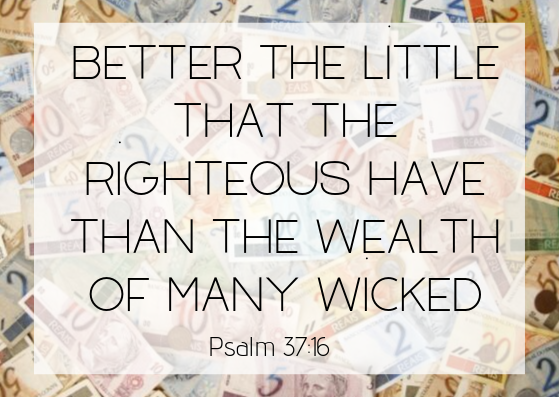
16 Better the little that the righteous have
than the wealth of many wicked;
17 for the power of the wicked will be broken,
but the Lord upholds the righteous.


2.  Meditate:  Choose a word or phrase that really speaks to you and spend some time meditating (thinking deeply about, chewing on it mentally, emotionally, spiritually).

The section that stood out to me today was verse 16: “Better the little that the righteous have than the wealth of many wicked.”  He seems to be linking the righteous to the poor and the wicked to having wealth.  I wonder why he makes those associations?  Are all wealthy people wicked, morally wrong, actively bad?

What about the rich young man who came to Jesus and asked Jesus what he had to do to inherit eternal life?  He apparently was a righteous man in that he kept all of the law/Torah that was required of a righteous Jewish person of his day.  Yet still there was something that was preventing him from experiencing the fullness of the life of the Age to Come/Kingdom of God/Eternal Life that Jesus was offering.  According to Jesus, it was his wealth.  He was unwilling to let go of his wealth and follow Jesus and it resulted in sadness. (If you want to read about that story it’s found in Luke 18:18-23 as well as in other Gospels).

In 1 Timothy 6:10 it says that “the love of money is the root of all kinds of evil.”  So clearly throughout the Bible there is some sort of correlation between wealth and evil.  It would be a stretch to say that all wealthy people are evil, after all, Abraham was a man of God and he was righteous.  But we counter that with Judas, who sold Jesus for 30 pieces of silver because he was greedy.  So there certainly is a strong potential for wealth to be associated with wickedness.  Jesus said you can’t serve God and Mammon (Money).  If you love money it will prevent you from loving God rightly.

To personalize this a bit for myself I must ask: am I wealthy?  I live in a pretty nice house.  I have enough money to buy groceries.  I have access to excellent health benefits through my work.  I have money to go on a vacation. I have access to good, clean drinking water.  I have reliable transportation- my cars aren’t fancy but they get me where I need to go.  If you compare me to actors in Hollywood or hedge fund managers on Wall street, or Bill Gates or Warren Buffet or Sam Walton’s children, then I’m not wealthy.  If you compare me to most of the people living in places like Malawi and Mozambique, South America or India, yes, I’m very wealthy.  So in light of this Psalm I must ask, am I using my wealth in a just way, a right way, or am I using it in a wicked way, or have I used wicked means to obtain my wealth?

As you can see, meditating on one little verse can crack open a whole lot of questions and issues.  That is what it did for me.  Perhaps you spent time meditating on a different verse which cracked open a whole different set of questions or issues for you.  Maybe you were wrestling with verse 13.  What does it mean that the Lord “laughs at the wicked”?  Is that a scornful laugh? Is He laughing at them because he knows how ridiculous they are and that, in the end the righteous, who appear to be the losers in this worlds system will actually emerge as the winners in God’s kingdom?


3.  Pray:  Whatever verse you choose to meditate on – take the issue to God in prayer.  Talk it over with God.  Bring him your questions.  Bring him your complaints.  Bring him your fears.  Bring him your gratitude and joy.  Bring whatever comes up during your time of reading and meditating.  Do you have some sinful attitudes toward money that could potentially get you into trouble?  Is there something you need to confess to God?  Do not just speak, also take time to listen.  Sometimes God speaks to you in various ways, so pay attention.


4.  Rest in God:  As you come to an end of your prayer, spend some time resting in God.  Even if this produced unease, guilt, a need to repent, know that God’s grace is sufficient.  Remember Zacchaeus, the wicked and greedy tax collector.  He met Jesus and his grace and acceptance, it led Zacchaeus to repent and change his attitude toward money (he paid back those he had extorted and gave money to the poor), and then he went and had dinner with Jesus and I’m certain had a wonderful time visiting with our savior.  Through Jesus’ grace, you can spend time with God, our Father and rest in him.

-Pastor Jeff Fletcher

*If you are unfamiliar with the Lectio Divina method of prayer/scripture study please refer to the Sunday, August 11th devotion.

Be Still

psalm 37 7a (2)

Happy Monday!

This week we are focusing on only 1 chapter, Psalm 37.  We are reading a few verses each day and we are using a Lectio Divina (Sacred Reading) format.  If you are unfamiliar with Lectio Divina go back and read Sunday’s devotion which gives the explanation.  Go ahead… I’ll wait!

Remember:

  1. Read
  2. Meditate
  3. Pray
  4. Rest in God

(Note, this does not lend itself to being on the go.  It is better when you have a few minutes to sit and quietly read, reflect and pray).

Psalm 37:5-11

5 Commit your way to the Lord;

trust in him and he will do this:

6 He will make your righteous reward shine like the dawn,

your vindication like the noonday sun.

7 Be still before the Lord

and wait patiently for him;

do not fret when people succeed in their ways,

when they carry out their wicked schemes.

8 Refrain from anger and turn from wrath;

do not fret—it leads only to evil.

9 For those who are evil will be destroyed,

but those who hope in the Lord will inherit the land.

10 A little while, and the wicked will be no more;

though you look for them, they will not be found.

11 But the meek will inherit the land

and enjoy peace and prosperity.

  1. Read through this slowly, several times. (at least 3)
  2. Choose a word or phrase that especially speaks to you.  Spend some time chewing over that word or phrase.  I chose “be still before the Lord and wait patiently for him.”  What does it mean for me to “be still before the Lord?”  Is this talking about my body?  My mind?  My heart?  Is there any area of my life about which I’m feeling restless or disturbed?  What is causing that restlessness?  Am I having trouble being patient about something?  Can I name what that is?  Why might I be having trouble being patient about this particular issue?  Am I habitually impatient or is this unusual for me? Wait!  I’m still not being still.  Breathe.  Let go of my thoughts and simply “be still.”
  3. Pray.  Bring whatever has arisen to God in prayer.  Have a conversation with God as you would with any other good friend or loved one.  Trust that whatever you bring to God, God will hear and will understand.
  4. Rest in God.  After you pray, simply release whatever has caused you to be “un-still” and rest in God’s love for you.

(Note: verse 11 is one that Jesus himself quoted in his Sermon on the Mt.  You might want to reflect on this verse.  What does it mean to be meek?  What does it mean to inherit the land, or earth as Jesus phrased it in Matthew 5:5?  What does your understanding of your future inheritance look like?  Here it seems that we are promised earth or land as inheritance as opposed to heaven.  How does a future eternity on earth sound as a hoped for reward?)

There are many fruitful issues that could emerge with each verse.  Can you see how Lectio Divina as a way of reading the Bible can really open up a Bible verse and immerse you in the text and bring you into conversation with God?  If you practice these skills every day this week you will have in your spiritual toolbox a great resource for growing in your relationship with God.

Pastor Jeff Fletcher

Delight in the Lord

Psalm 37 4a

For this week’s devotions I’m going to focus, again on the Psalms.  Earlier this year we looked at 7 different types of Psalms and had an example of each.
This week I want to look at only one Psalm.  Each day we will consider a section of the Psalm and I’m going to invite you to use it in your devotional time.  Some of you may be familiar with the way I’m going to ask you to read this Psalm, it’s called Lectio Divina.  If you’re familiar, great!  If not, I’ll give you a brief introduction.

Lectio Divina is a Latin term which simply means “sacred reading” .  It’s been around for a long time.  It’s simply a way of meditatively and prayerfully reading a short passage of scripture in a way that leads into prayer and time in God’s presence.  There are 4 stages to Lectio Divina: Read, Meditate, Pray, Rest in God.
1.        Read.    Take a short passage of scripture and read through it several times.  Read it in a personal way.  You’re not reading it to prepare a lesson or a sermon or to share it with someone else.  You are reading it to allow God to speak to you through His word.
2.       Meditate.   As you read, choose a single word or short phrase that really speaks to you and think about it (To meditate is to chew on it with your mind, internalize it, and chew on it some more engaging your whole person, thoughts, feelings etc… think about how a cow ruminates on grass or hay).
3.        Pray.   After spending time meditating on that word or phrase and really personalizing it, then bring it to God in prayer.  Does it lead you to praise God?  Does it lead you to thank God?  Does it raise questions that you need to bring to God?  Does it call forth a sense of guilt for a sin that you need to confess to God?  Whatever it brings forth in you, bring that to God in prayer and spend some time talking to God about whatever it is that your reading and meditation has brought to mind.
4.       Rest in God.  The final stage of lectio divina is to simply bring you into God’s presence.  You know how great it is when you are with someone you love and you can just enjoy being present with them…  no one’s looking at their phone, no one’s talking or really doing anything other than simply enjoying being in the other’s presence?  Do that with God.  Just spend some time enjoying God’s presence.

That’s really all there is to it.  If you Google Lectio Divina or look it up in books on Christian spirituality you may find other fancy words like: Lectio, Meditatio, Oratorio, Contemplacio etc… They are all just Latin words that mean the same thing: Read, Meditate, Pray, Rest in God.
I hope you’ll try it this week.

I’ve chosen Psalm 37 to look at every day this week.  I’ve chosen this Psalm because I’ve been spending a lot of time this year meditating on this one Psalm, especially verse 4.

Today, I want to look at the first 4 verses:
“Do not fret because of those who are evil or be envious of those who do wrong;
for like the grass they will soon wither, like green plants they will soon die away.
Trust in the Lord and do good; dwell in the land and enjoy safe pasture.
Take delight in the Lord, and he will give you the desires of your heart.”

Read:
As I read through this there are several things that immediately catch my attention.  How often do I fret because of those who are evil?  Do I see the junk that people do and find myself stewing over it?  How can they do that stuff?  What is WRONG with them?
As I dig a little deeper –  Am I ever envious of those who do wrong?  Do I ever look at the rich, the good looking, the famous, the powerful and see the terrible lifestyle choices they always seem to make, and then get ticked off because they have all the goodies?  Do I envy their money or the stuff their money can buy?
How often am I guilty of looking at what other people are doing instead of looking at God and making sure that I’m doing what God has called me to do?  I see an invitation to Trust God and do what I know is right and let God worry about the results.
But it’s the last verse that really captures my heart: “Take delight in the Lord.”
What does it mean to delight in something?  Three of my grandchildren all turned one this summer.  I got to be present at one of their birthday parties, and I saw videos of the other two who live in Minnesota.  In each case it was amazing to see them “take delight” in their birthday “smash cakes”.  They would dig in, squeeze it, taste it and get really excited.  I still remember the looks of delight on their faces.
You might take delight in tasting delicious food, seeing an old friend or family member, your favorite sports team winning the championship, seeing an “A” on your paper, trying on your wedding dress (or seeing your bride walk down the aisle toward you in that dress).
God wants us to delight in Him more than anything else.

 Mediate:

Spend some time thinking about what it means to delight in God.  When have you delighted in God?  What was it like?
Pray:

Spend some time talking with God about what you’ve been thinking about delighting in Him.


Rest:

Now, delight in God.  Spend some time just enjoying God’s presence.


Pastor Jeff Fletcher

Fit to Rule

PSALMS

psalm 99 5


This week we’ve been looking at seven different types of psalms: wisdom, royal, lament, imprecatory, thanksgiving, pilgrimage and today we look at the 7th type: enthronement.

The enthronement psalms celebrate the important truth that God is king over all of his creation.  God cares for his people as a good king/shepherd is supposed to care for his people.  Psalm 23 is a kind of enthronement Psalm as David, who is himself the shepherd king of Israel, ultimately looks to God as the true shepherd king.

Psalm 99 is a good example of an enthronement psalm:

Psalm 99

The Lord reigns,
let the nations tremble;
he sits enthroned between the cherubim,
let the earth shake.
Great is the Lord in Zion;
he is exalted over all the nations.
Let them praise your great and awesome name—
he is holy.

The King is mighty, he loves justice—
you have established equity;
in Jacob you have done
what is just and right.
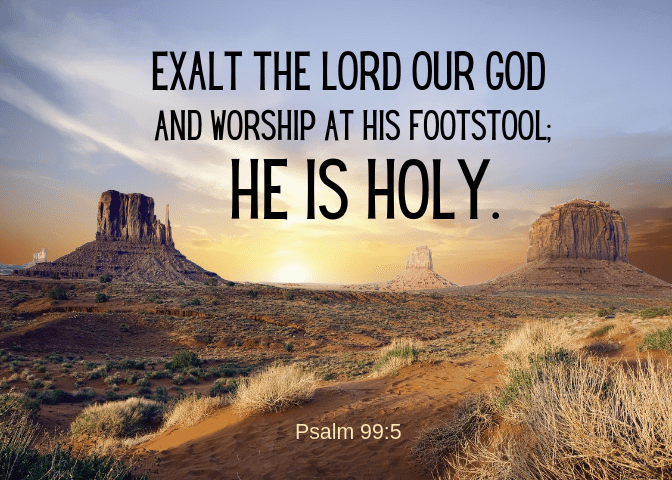
Exalt the Lord our God
and worship at his footstool;
he is holy.

Moses and Aaron were among his priests,
Samuel was among those who called on his name;
they called on the Lord
and he answered them.
He spoke to them from the pillar of cloud;
they kept his statutes and the decrees he gave them.

Lord our God,
you answered them;
you were to Israel a forgiving God,
though you punished their misdeeds.
Exalt the Lord our God
and worship at his holy mountain,
for the Lord our God is holy.


This psalms celebrate God as worthy to be worshipped, so it contains elements of worship similar to psalms of thanksgiving, but here the focus is particularly on God’s sovereign rule over all creation.

The Lord reigns.  Often we look at our world and see how seriously screwed up our political leaders are and how badly they botch up their duties as leaders.  But we must remember that they are mere humans, flawed men and women just like us.  There is only one who is truly fit to rule in righteousness over all of creation.  There is only one of us both holy and just but also merciful and forgiving even in his judgment.  It is the LORD, YHWH.  He is God and he alone is fit to rule over all of creation.  The enthronement psalms are a joyful way of acknowledging that God is in control of everything.  My mom used to have a sign on her refrigerator that said: Relax, God’s in Charge.  The enthronement psalms remind us that God is in charge, we are in great hands.

As we close out this week of psalms I hope that you come to appreciate the depth, diversity and richness of the psalms.  There is literally a psalm for every occasion.  For learning and growing, for giving thanks, for traveling, for worshipping, for complaining and asking for help in times of pain, and even when you’re angry and feel like getting revenge against those who have hurt you.  There’s a psalm for every occasion.   I hope that you will read them, and pray them (you can also learn how to sing them) and make them seep into your spirit and become a part of your prayer language and your life, just as they were for Jesus, who frequently could be found with the psalms on his tongue as he spoke and prayed.

-Jeff Fletcher


On Your Journey

Psalms

Psalm 121 1 2


We’re discussing seven different types of psalms and how to make them a regular part of our worship.  Today we consider pilgrimage psalms.  A pilgrimage is a journey to a place that holds special spiritual value to the person making the pilgrimage.  In ancient Israel those who lived outside of Jerusalem would make several pilgrimages each year to come to Jerusalem to worship at the temple and celebrate various feasts which commemorated important elements of Israel’s sacred story.  We know that Jesus was arrested and crucified at the beginning of the Passover celebration.

As people made their pilgrimage to Jerusalem they would sing joyful and festive psalms that would help them recall God’s goodness.  If you’ve ever travelled to a special place and event like Fuel, or General Conference, Christian Worker’s Seminar, or summer youth camp, you know that the excitement builds as you journey and get closer to the event.  Sometimes people sing some of the songs that gave meaning and joy to their previous times at those places.

Imagine as the pilgrims get closer to Jerusalem.  As Jerusalem is on a mountain they can see it from a distance.  As they climb Mt. Zion to get closer to the city and the temple of God their excitement grows and they begin enjoying an attitude of worship by singing and recalling God’s blessings.

Psalm 121 is a great example of a pilgrimage psalm:

Psalm 121

A song of ascents.

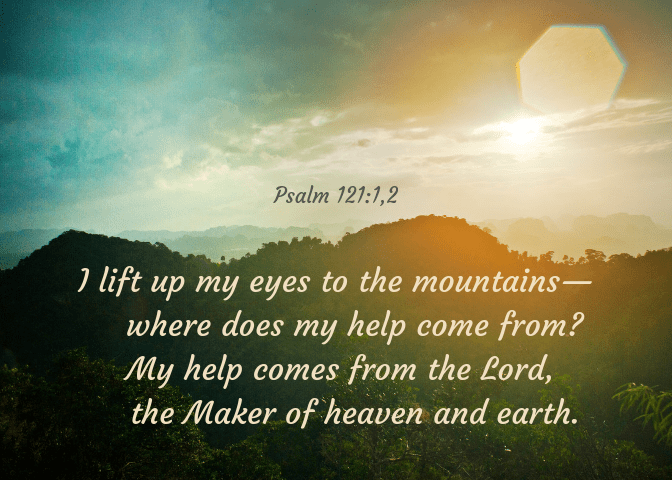
I lift up my eyes to the mountains—
where does my help come from?
My help comes from the Lord,
the Maker of heaven and earth.

He will not let your foot slip—
he who watches over you will not slumber;
indeed, he who watches over Israel
will neither slumber nor sleep.

The Lord watches over you—
the Lord is your shade at your right hand;
the sun will not harm you by day,
nor the moon by night.

The Lord will keep you from all harm—
he will watch over your life;
the Lord will watch over your coming and going
both now and forevermore.

This serves as a reminder that as you journey on your way, God is with you.  God is your helper who watches over you wherever you go.  How comforting and assuring to know that God is with you on your journey through life.  Even during those times where you might not know what’s waiting for you around the next corner or over the next hill, God is there, and he doesn’t go to sleep on the job.

-Jeff Fletcher

Don’t Forget – Give Thanks

FREE THEME WEEK – Psalms!

Psalm 150 6

This week we’ve been looking at seven different types of psalms, musical prayers that have been used for thousands of years first by the people of Israel and then by the Church as part of our worship and devotional life.  The first two types of psalms we looked at were wisdom and royal psalms.  The second two types of psalms were lament and imprecatory, these were a bit more challenging- not all of the psalms are about happy themes.

Today we are going to look at much happier psalms, the psalms of thanksgiving.  These are, perhaps, some of the better known psalms as they speak joyfully in praise of God.

The very last psalm, ends the psalms in a resounding crescendo of praise and thanksgiving”:

Psalm 150

Praise the Lord.

Praise God in his sanctuary;
praise him in his mighty heavens.
Praise him for his acts of power;
praise him for his surpassing greatness.
Praise him with the sounding of the trumpet,
praise him with the harp and lyre,
praise him with timbrel and dancing,
praise him with the strings and pipe,
praise him with the clash of cymbals,
praise him with resounding cymbals.

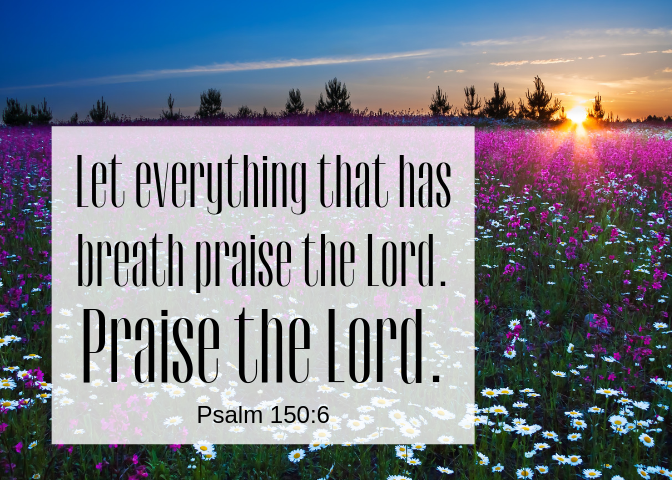
Let everything that has breath praise the Lord.

Praise the Lord.


Let everything that has breath praise the Lord.  These psalms speak for themselves about the joy of worshipping our great and powerful God.  God is worthy of our praise and thanksgiving.

Romans 1:21 gives the consequences of one who fails to offer to God the thanksgiving God deserves: “ For although they knew God, they neither glorified him as God nor gave thanks to him, but their thinking became futile and their foolish hearts were darkened.”  How tragic to fail to give to God the glory and thanks he so richly deserves.  A number of Biblical theologians see in this passage Paul’s reference to the rebellion of Adam and Eve in the garden, who failed to show thanks to God for the good gifts of creation and chose instead to listen to the voice of the serpent calling them to aspire to be like god.  Failure to give thanks to God is the original sin of humanity.  It may also be referencing Israel’s original story of the Exodus.  After God frees Israel from slavery in Egypt, they enter the wilderness, and while God is giving his instructions to Moses on Mt. Sinai, his people are down below making a golden calf to worship.  They trade the worship of God for idols made by human hands.  When we choose to worship anything in place of the one true God we are guilty of idolatry.

Throughout the psalms we are called to reject the original sin of not giving thanks to God and to worship God alone.  Worship is one reason that the Church gathers regularly.  We are not to forsake gathering as the Church for the purpose of worshiping God (Hebrews 10:24-25).  The psalms provide a rich and extensive songbook for us to use in our worship, both as a Church when we gather and in our times of private worship.  I read the psalms everyday as it helps me to join that several thousand year old congregation that joins together to worship and give thanks to God.

-Jeff Fletcher


Mercy & Grace – OR – a Cosmic Butt-Kicking

FREE THEME WEEK – Psalms!

Psalm 69 24

This week we are looking at seven different types of psalms.  So far we’ve seen wisdom, royal and lament.  Today we are looking at, perhaps, the most difficult of all, imprecatory.  Imprecatory means, quite simply, to call down a curse upon another.

Now, this is kind of tricky for Christians.  After all, Jesus taught us that we are supposed to forgive as we want to be forgiven.  We are supposed to love our enemies, right?  So how exactly can we justify praying imprecatory psalms as Christians?

Let’s look at an example of an imprecatory Psalm 69.

Save me, O God,
for the waters have come up to my neck.
I sink in the miry depths,
where there is no foothold.
I have come into the deep waters;
the floods engulf me.
I am worn out calling for help;
my throat is parched.
My eyes fail,
looking for my God.
Those who hate me without reason
outnumber the hairs of my head;
many are my enemies without cause,
those who seek to destroy me.
I am forced to restore
what I did not steal.


It starts out quite similar to a psalm of lament, as we discussed on Tuesday.  “Help God! Things are going badly.  I’m sinking.  Everyone is out to get me!  I’m all alone!”

He goes on to appeal to God for help.

19 You know how I am scorned, disgraced and shamed;
all my enemies are before you.
20 Scorn has broken my heart
and has left me helpless;
I looked for sympathy, but there was none,
for comforters, but I found none.
21 They put gall in my food
and gave me vinegar for my thirst.

Again, this has a familiar ring to it.  The gospel writers used this scripture to point to Jesus on the cross- remember when he said he was thirsty and they gave him vinegar to drink?

So far, we are still lamenting.  It’s dark, but it’s about to turn darker:

22 May the table set before them become a snare;
may it become retribution and a trap.
23 May their eyes be darkened so they cannot see,
and their backs be bent forever.
24 Pour out your wrath on them;
let your fierce anger overtake them.
25 May their place be deserted;
let there be no one to dwell in their tents.
26 For they persecute those you wound
and talk about the pain of those you hurt.
27 Charge them with crime upon crime;
do not let them share in your salvation.
28 May they be blotted out of the book of life
and not be listed with the righteous.


Yikes! It just got real!  The person doesn’t just want God to save him, he wants God to crush his enemies.

“Pour out your wrath on them!”  “May they be blotted out of the book of life.”  Wow!  That’s pretty intense.

“May their place be deserted.”  Luke quoted that verse in the book of Acts when he talked about the need to replace Judas as one of the 12 Apostles.

How does this kind of call for God to damn your enemies fit within the overall message of the gospel of Jesus’ love and forgiveness?

Time and space doesn’t permit the kind of deep digging we might need to do to really get this, but I’ll take a stab at it.  When people hurt us, I mean really hurt us, our normal reaction is to want to hurt them back.  The desire to get revenge and retaliate when wronged is pretty normal, if we’re being honest.  So what do we do with that hurt, that anger, that pain?

Well, we know that some people take a gun and go shoot people at school or at work.  Some people take to social media and try to destroy another person’s life and reputation.  If you’re Carrie Underwood: “I dug my key into the side
Of his pretty little low Mercedes Benz
Carved my name into his leather seat
I took a Louisville slugger to both head lights
Slashed a hole in all 4 tires
And maybe next time he’ll think before he cheats.”

Sure, who among us hasn’t wanted to do that, and worse?

But as Christians we’re supposed to love our enemies.

Paul says in Romans 12

17 Do not repay anyone evil for evil. Be careful to do what is right in the eyes of everyone. 18 If it is possible, as far as it depends on you, live at peace with everyone. 19 Do not take revenge, my dear friends, but leave room for God’s wrath, for it is written: “It is mine to avenge; I will repay,” says the Lord. 20 On the contrary:

“If your enemy is hungry, feed him;
if he is thirsty, give him something to drink.
In doing this, you will heap burning coals on his head.”

21 Do not be overcome by evil, but overcome evil with good.

Yes, there’s a lot in there about how we are supposed to not pay people back, we’re supposed to love.  Sandwiched in the middle of it all is “leave room for God’s wrath.”  Yes, God is a God of tremendous love, grace, mercy and forgiveness and he offers even the worst of sinners the chance for mercy and forgiveness- but he also knows how to do wrath.  He knows how to punish the unrepentant- and the Bible makes it clear that he will do so.

I don’t know who deserves mercy and grace and who deserves a cosmic butt-kicking, and neither did the Apostle Paul, and neither do you.  So we leave it to God.  Imprecatory prayers are simply ways that we say to God,  “I’m hurting and I want to hurt back, but I’m not going to.  I’m going to trust you to deal with this person the way you choose. (but here’s my pain and rage-fueled suggestion for how I’d like you to do it)”

-Jeff Fletcher


Alone?

FREE THEME WEEK – Psalms!

Psalm 22 1

This week we are looking at seven different types of psalms.  The first was a psalm of wisdom and the second was a royal psalm.  The third type of psalm is a lament psalm.

Life is not always easy.  I know that’s a real shocker for most of you but it is true.  Bad things happen.  People fail tests.  Relationships go sour.  People get hurt physically, emotionally, spiritually.  Sometimes people suffer in unimaginable ways and sometimes people die.   Sometimes it’s hard to find the words to express our pain during difficult times.  Sometimes this is true for individuals and sometimes it’s true from communities.

There are musical styles that express pain.  The blues are all about coping with pain.  Taylor Swift has written a song about every breakup she’s ever had.  Play many a country music song backwards and you get your truck back, your dog back and your woman back.

God doesn’t expect us to ignore pain or paint a pretend smile on our face and act like everything’s great when it isn’t.  Fortunately, God provides us a language to help us work through pain.  Psalms of lament.  The Bible is full of psalms of lament both for individuals and for communities.  The book of Lamentations is an entire book of laments after the fall of Jerusalem and their exile into Babylon.

Psalm 22 is an example of a psalm of lament.  I won’t include the whole psalm here but I’ll share enough for you to get the idea:

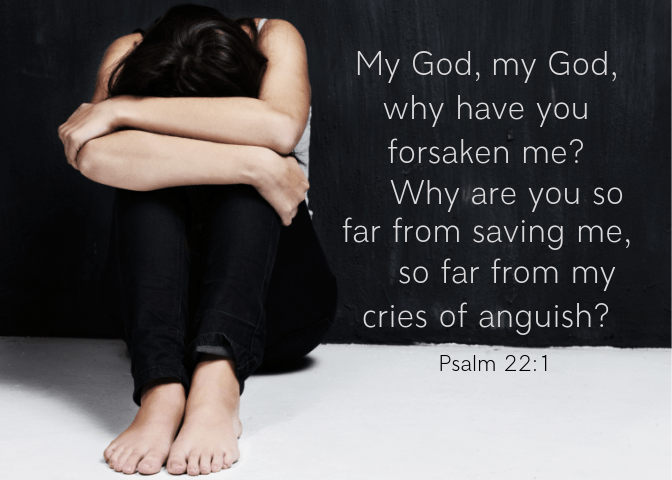
My God, my God, why have you forsaken me?
Why are you so far from saving me,
so far from my cries of anguish?
My God, I cry out by day, but you do not answer,
by night, but I find no rest.

This is a person who is clearly in pain.  Their pain is multiplied by the fact that they feel that God is no-where to be found.  “God, where are you?”  “God I’m hurting.”  “God can’t you see how badly I’m suffering here?”  “God, why aren’t you listening to my cry?”  “God, I need you, O I need you!”

If these words sound familiar to you, it may be because these are the words that Jesus cried out while he was being crucified.  Jesus suffered every way that we suffer and his greatest suffering came when he felt God’s absence.  There are times in our lives when God seems so close and so real and those times are wonderful.  But there are also times when God feels so very far away. Psalms of lament take our feelings of suffering, of abandonment, of God’s absence and help us to give words to them.  It also helps us to know that we are not alone in feeling alone.

9Yet you brought me out of the womb;
you made me trust in you, even at my mother’s breast.
10 From birth I was cast on you;
from my mother’s womb you have been my God.

11 Do not be far from me,
for trouble is near
and there is no one to help.

The one who is suffering here pleads their case before God.  “You’ve been there my whole life”  “I’ve trusted you since I was a baby”  “God, come here… I’m scared, I’m all alone.”  Whether it is physical pain, emotional pain, spiritual pain or often a combination of all three, it hurts when you feel like you’re all alone. The Psalms of lament help us to find the words to cry out to God out of a mixture of faith and fear.

25 From you comes the theme of my praise in the great assembly;
before those who fear you I will fulfill my vows.
26 The poor will eat and be satisfied;
those who seek the Lord will praise him—
may your hearts live forever!

Even though his situation feels hopeless… even though it seems like she is doomed, yet there is hope.  As bad as it feels, as alone as she seems, as desperate and lost and needy and broken, there is hope that one day things will be better, that one day there will be a chance to testify about God’s faithfulness.

Bad thing happen to God’s people too.  We don’t have to pretend that everything’s great when it’s not.  Don’t just read the happy psalms.  Just like Jesus committed Psalm 22 to memory so that when he was at the point of deepest agony he had the words to pray his pain to God, learn to pray the psalms of lament, both for yourself and for those you love who may also feel alone in their suffering.

-Jeff Fletcher


You can read the whole beautiful Psalm of lament here – https://www.biblegateway.com/passage/?search=Psalm+22&version=NIV

The Winning Side

Psalm 110 1

FREE THEME – Psalms

This week we are looking at seven different types of psalms.  Yesterday we looked at a wisdom psalm.  Today we are looking at a royal psalm.

The Psalms were written at a time and in a culture where kings ruled.  Israel was governed by either David or his heir.  David was hand chosen by God to be God’s anointed king.  They literally poured oil over the king’s head and face to symbolize being anointed by God to rule.  This anointed one was literally the Messiah or messianic/anointed king.  When God set David apart as king God promised him that his heir would rule over God’s people forever.  This rule would begin at Jerusalem or Zion but would extend ultimately over all the earth.

Psalm 110 is a promise that the anointed king would rule, that God would give him victory over God’s enemies.

Vs. 4 makes a curious statement- this king will also be a priest, but not the typical priest.  In Israel, to serve as priest in the temple one had to be a descendant of the tribe of Levi.  But David and his family were descendants from the tribe of Judah, which was the ruling tribe.  This descendant of David would be a different kind of priest.  Just as Melchizedek was a priest in the time of Abraham, long before Levi was ever  born, this kind of priesthood was a greater kind of priest than the Levitical priest.

All of this finally makes sense when we understand how Jesus fits into the picture.  Jesus is the fulfillment of this psalm.  He is an heir of David, he will rule as King, he is also a priest but not in the temple of Jerusalem.   As a priest he offers up his own body as a sacrifice to God.  He doesn’t enter the holy of holies in the Temple of Jerusalem, he ascends to the heavens and enters into the immediate presence of God, where he continues to serve as our priest, until the day comes when he returns to the earth to rule over all the earth following the final battle when the kingdoms and kings of the earth will all bow before Christ as King of Kings and Lord of Lords.  This royal psalm points us to Jesus.

Everyone wants to be on the winning side.  This reminds us that if we choose to follow Jesus and give our lives to Jesus, we will be on the winning side at the last battle.

Psalm 110

Of David. A psalm.

The Lord says to my lord:

“Sit at my right hand
until I make your enemies
a footstool for your feet.”

The Lord will extend your mighty scepter from Zion, saying,
“Rule in the midst of your enemies!”
Your troops will be willing
on your day of battle.
Arrayed in holy splendor,
your young men will come to you
like dew from the morning’s womb.

The Lord has sworn
and will not change his mind:
“You are a priest forever,
in the order of Melchizedek.”

The Lord is at your right hand;
he will crush kings on the day of his wrath.
He will judge the nations, heaping up the dead
and crushing the rulers of the whole earth.
He will drink from a brook along the way,
and so he will lift his head high.