Just Two Choices

A Free Theme Week into the Book of Psalms

Psalm 1 6

Greetings!  I’m introducing a week of devotions based on the Psalms.  There are 150 psalms in the Bible. (Note there are Protestant Bible translations and Catholic Bible translations.  The psalm number has a variation in Catholic translations.  I’ll be following the psalm numbering in Protestant versions ie. NIV, KJV, NRSV etc…)

The word psalm comes from the Hebrew word “mizmor” and means melody.  When translated into Greek it is “psalmos” which means song for the harp or the plucking of strings.  The key is that they are musical pieces.  Just as we sing hymns and praise and worship songs in church, the psalms were written to be sung as part of worship.  Most of the Psalms have been used in Jewish and later Christian worship settings for over 3,000 years (and you thought Frank Sinatra or the Beatles was old music).

Not all psalms are alike.  Different commentators call them different things and they are grouped differently.  I like the following 7 groupings:  1.Wisdom, 2. Royal, 3. Lament, 4.Imprecatory, 5.Thanksgiving, 6. Pilgrimage, 7. Enthronement.  During this week I’ll focus on a different type of Psalm and give the description and brief example each day.

Let me also talk to you a bit about how I incorporate psalms into my daily worship.  For hundreds of years men who live in monastic communities or monks have used the psalms as part of their daily worship.  In many communities they sing/pray/chant through the entire Book of Psalms every month.

A few years ago I came across an idea for going through the entire Book of Psalms every month using 5 psalms a day.  On the first day of the month read Psalm 1, 31, 61,91 and 121, the next day read Psalm 2,32,62,92,122.  Whatever day of the month you are on, read that, and then add 30 and keep going up by 30.  That way, in 30 days you will read all 150 psalms.  I break this up during the day: one when I first get up, one mid-morning, one at lunch time, one at supper time and one at the end of the day.  This way I surround my day and fill my day with these prayers and songs to God.  You don’t have to do it that way, but you might want to try it, or whatever way works for you. (On months with 31 days I just pick a few of my favorites for day 31).

The first type of psalm is a wisdom psalm.  It’s a kind of teaching psalm pointing out the way to live a Godly life.  An example of a wisdom Psalm is Psalm 1.

Psalm 1

Blessed is the one
who does not walk in step with the wicked
or stand in the way that sinners take
or sit in the company of mockers,
but whose delight is in the law of the Lord,
and who meditates on his law day and night.
That person is like a tree planted by streams of water,
which yields its fruit in season
and whose leaf does not wither—
whatever they do prospers.

Not so the wicked!
They are like chaff
that the wind blows away.
Therefore the wicked will not stand in the judgment,
nor sinners in the assembly of the righteous.

6 For the Lord watches over the way of the righteous,
but the way of the wicked leads to destruction.


This psalm is a simple but clear message about the choices we have in life.  This theme has been taken up by many through history.  Robert Frost talked about having a choice to take one of two paths and he took “the road less travelled” and that it made all the difference.  Jesus talked about wide gates and narrow gates and the importance of following his path “I am the way, the truth and the life.”  Even the classic rock band Led Zeppelin sang “yes, there are two paths you can go by, but in the long run, there’s still time to change the road you’re on.”

This psalm teaches us that we do have choices.  We can follow the path of the righteous or we can follow the path of the wicked.  The path of the righteous is the “right or correct path.”  This path is the path of one who follows God’s instructions.  The law of the Lord is not so much a law like a legal code as much as an instruction about the way to live.  Jesus showed his disciples/students how to live a life that was faithful to God.  Those who follow this path delight in following God’s instructions for life and spend time meditating upon, praying about, thinking about God’s instructions.  What do you spend your time thinking about, focusing on, absorbing?  The person who is fully absorbed in God’s ways will live a fruitful and prosperous life.  That doesn’t necessarily mean they will be financially wealthy, but they will be successful in the way that God defines success, they will be godly, they will have life.

The other path is the path that leads to destruction.  This is the path that does not end well.  If I told you that there was a fork in the road: if you go right, you’ll end up at Disney World and a lifetime of fun and adventure, if you go to the left, you’ll be at the garbage dump and there’s no turning back.  I’m guessing you’d choose Mickey over a trash heap.  It all boils down to a simple choice.  If you feel like you’re currently heading on the wrong path, there’s good news “there’s still time to change the road you’re on.”

-Jeff Fletcher

God’s Word in My Life

isaiah 55 11

                I grew up in the Church.  From the time I was a baby I’ve been in Church.  I’ve been taught the Bible my entire life.  As a preacher’s kid I sat and listened to my dad preach every Sunday.  I remember as a child sitting in Sunday School and being captivated by the flannel graph stories (look it up, it’s a real thing).  I would see the picture of the ark, and the different animals gathered 2×2 going into the ark.

                I still have my first Bible.  It was an illustrated children’s Bible, it had a zippered case.  I read the Bible stories and enjoyed looking at the pictures.  When I was six my mom taught me to say the 66 books of the Bible in order.  It made it much easier to follow along and look up verses.  I could also easily win the “sword drills” a kind of contest to see who could look up various verses the fastest.  I even learned to memorize some verses.  John 3:16, Psalm 23 and John 11:35 were some of my early favorites.  I like John 11:35 because at church camps they often had you quote a verse from memory as you were in the lunch line.  John 11:35 was the shortest and easiest verse in the whole Bible to memorize: “Jesus wept.”

                I was baptized when I was eleven and I began to take my Bible study more seriously.  I would read whole chapters and whole books of the Bible.  I became aware that not all people read the Bible exactly the same way.  The Church I attended came to certain conclusions about what the Bible said, and people of different denominations came to different conclusions.  Sometimes their conclusions didn’t make sense to me and I wondered why they didn’t see things the same way that my Church did.  I puzzled over this for many years.

                When I graduated from high school and began college my goal was to become a doctor.  I wanted to help people, and make a decent living.  Doctors checked off both those boxes.  But while I was in college I got a part time job working in a Christian bookstore.  I had some friendly discussions with my boss who was a Christian but from a different denomination.  As I shared with him what I believed he shocked me by saying that he didn’t think what I believed was right, and he wasn’t convinced that it was Christian.  Now I had a job on my hands.  To show from the Bible that what I believed was indeed Christian.  He and I spent the next year debating the Bible.  Literally, he would make a premise and give his defense.  I would read it, and write my response.  Then I would make a premise and give my defense, and he would read it and give his response.  Over the next year we traded hundreds of pages.  I found myself staying up late every night pouring through the Bible looking up verses (this was long before internet searches).  I was thinking about the Bible day and night.  So much so that I wasn’t really spending much time reading the class material at college.  Somehow economics, biology, philosophy, psychology and sociology just weren’t as interesting to me as Matthew, Mark, Luke and John.

                One night I realized that what I really enjoyed doing was studying the Bible.  Then I realized that if this was my passion then it didn’t make sense to study to become a doctor, I should study to become a pastor.  I made my decision to leave the university and to attend Bible College. (By the way, you don’t need to become a pastor in order to make the Bible central to your life.  We need good doctors, lawyers, teachers, carpenters, mothers and ditch diggers who immerse themselves in the Bible as well.)

                As I was getting ready to leave for  Bible college I said my goodbyes to my friends and co-workers.  After a year of studying and debating the Bible with me my boss said, “You haven’t convinced me to believe as you believe, but you have convinced me that what you believe is Christian.”  I felt I had achieved a small win.

                For more than 30 years I’ve been reading, meditating upon, teaching, preaching, writing about, and counseling others with the Bible.  It is the foundation of my whole life.  I’ve read small passages slowly and repetitively so they could sink deeply in (lectio divina).  I’ve read large portions quickly to see the grand sweep of God’s story.  I once read the entire Bible in a two week period of time.  (8 hours a day for 2 weeks and you can read it cover to cover).  It was amazing!

                Do I regret choosing to be a pastor instead of a doctor?  Well, I make less money as a pastor than I would have made as a doctor.  But I realize something very important.  Doctors are very important but they don’t have all the answers.  This came to light several years ago when I became a hospital chaplain.  One day I was called in to sit with a young mother  whose husband had been in a serious accident.  The doctors were trying to save his life.  She was in the waiting room with two small children hoping that he would survive.  I sat with her and prayed with her.  Eventually, two young doctors came into the waiting room.  They were residents,  which means they were young in their practice.  They stood before the woman and told her that they had done all that they could, unfortunately, they couldn’t save her husband.  They then looked at each other, and then looked at me and said, “We’ll leave you to talk with the chaplain” and they left the room.  I realized that this was what God had called me to be.  The one who people turn to when all else had failed and their world has fallen apart and not even the best of science and technology can fix it.  When all that humanity can do comes up short, we are left with God and God’s Word.  And that is by far the most powerful thing in all the world.  God’s Word Never Fails.  A passage of the Bible that has been important all my life comes from Isaiah 55.  God’s Word will accomplish what God desires.  May you immerse yourself in the only truth that can truly save.

Isaiah 55:6-13

Seek the Lord while he may be found;
call on him while he is near.
Let the wicked forsake their ways
and the unrighteous their thoughts.
Let them turn to the Lord, and he will have mercy on them,
and to our God, for he will freely pardon.

 “For my thoughts are not your thoughts,
neither are your ways my ways,”
declares the Lord.

 “As the heavens are higher than the earth,
so are my ways higher than your ways
and my thoughts than your thoughts.

 As the rain and the snow
come down from heaven,
and do not return to it
without watering the earth
and making it bud and flourish,
so that it yields seed for the sower and bread for the eater,
 so is my word that goes out from my mouth:
It will not return to me empty,
but will accomplish what I desire
and achieve the purpose for which I sent it.

 You will go out in joy
and be led forth in peace;
the mountains and hills
will burst into song before you,
and all the trees of the field
will clap their hands.
Instead of the thornbush will grow the juniper,
and instead of briers the myrtle will grow.
This will be for the Lord’s renown,
for an everlasting sign,
that will endure forever.”

J.Jeffrey Fletcher, MDiv, BTh, CSD,  Chaplain, Valley Health

You Died

Col 3 3

Colossians 3:1-3

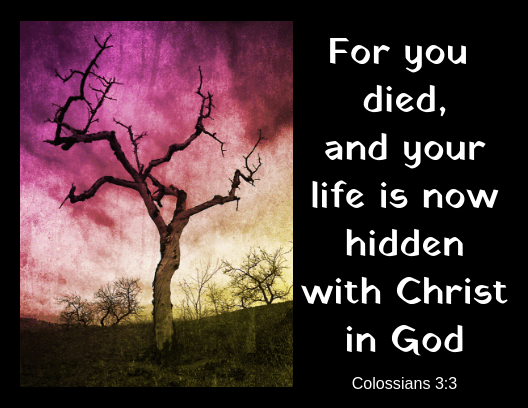
3 Since, then, you have been raised with Christ, set your hearts on things above, where Christ is, seated at the right hand of God. 2 Set your minds on things above, not on earthly things. 3 For you died, and your life is now hidden with Christ in God. 4 When Christ, who is your life, appears, then you also will appear with him in glory.

I wonder how those believers in Jesus understood those words when Paul first penned that letter to them. “you died, and your life is now hidden with Christ in God”. He told them that they died. What would it have meant to them to hear that they had died? Obviously they were still physically alive and breathing. They were not zombies or vampires or other popular dead, but not fully dead creatures. What part of them was dead.

Sometimes today we speak metaphorically about death. “I’m brain dead” means that I did something without thinking it through, it was silly or stupid. “I’m dead tired” means that I need some sleep.

I think that Paul was telling the believers in Christ at Colossi that when they were baptized into Jesus Christ, that part of their nature that was under the control of “the flesh” or their brokenness and alienation from God had died. Apart from Christ, that which drives us or controls us is sin living within us. When we come to Christ, that part that controls us is put to death. Our focus is no longer to satisfy our sinful desires. We live by the spirit of God, our life is now found in God. It has not yet been fully revealed. We are still living under the influence of sin, and the new nature has not yet been fully realized in our daily living. That process, known as sanctification, is ongoing. It requires, as Paul goes on to say, a daily putting to death of things like “immorality, evil desires, greed, rage, malice, slander”.

We’re baptized into Christ, then you died, and rose again. Your new nature has not yet been fully revealed and won’t be until the coming of Jesus, but as you live as a follower of Jesus in this present age, you die to your old self a little more each day as you live by the spirit of God in practical ways.

-Jeff Fletcher

Labor Pains

1 Thess 5 3 (1)

I Thessalonians 5:1-3

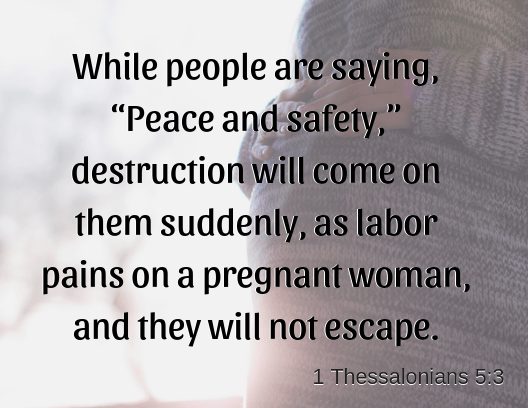
Now, brothers and sisters, about times and dates we do not need to write to you, 2 for you know very well that the day of the Lord will come like a thief in the night. 3 While people are saying, “Peace and safety,” destruction will come on them suddenly, as labor pains on a pregnant woman, and they will not escape.

While I’ve never been a pregnant woman, I’ve been married to one who gave birth eleven times… so I’m pretty well acquainted with the whole “sudden labor pains” phenomena. Fun fact… my youngest son, James, came so quickly that I acted as his midwife. We were at home… no midwife in sight…. And she said “I need to push”…and I tried to persuade her to wait. (Don’t ever tell a woman in labor about to push a baby out to wait, if you know what’s good for you). She did NOT wait. She had reached the point of no return.

Paul uses this analogy to help us understand both the suddenness and inevitability of the return of Jesus. His return will happen suddenly.

It’s been a nearly 2000 year long labor… but it’s getting close. Jesus is coming soon. Are you ready?

-Jeff Fletcher

God’s Party

Luke 15 32

Thursday, November 22, 2018  Thanksgiving USA

Luke 15:32

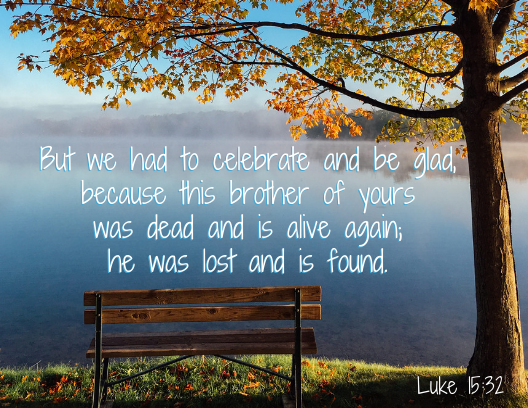
“But we had to celebrate and be glad, because this brother of yours was dead and is alive again; he was lost and is found.’”

Some people envision God to be somber or angry and punishing. I love this story Jesus told. We often refer to it as the Prodigal Son, with the focus on the bad boy who turned his life around. But I think it has more to do with showing us how much our Father Loves us, and how much joy it brings to him to be in relationship with us. Jesus came to show those whose view of God was somber and dutiful that God is first and foremost about relationship.

God throws a party when we respond to his offer of relationship. Shouldn’t we?

-Jeff Fletcher

To Encourage One Another

1 thess 4 16

I Thessalonians 4:13-18

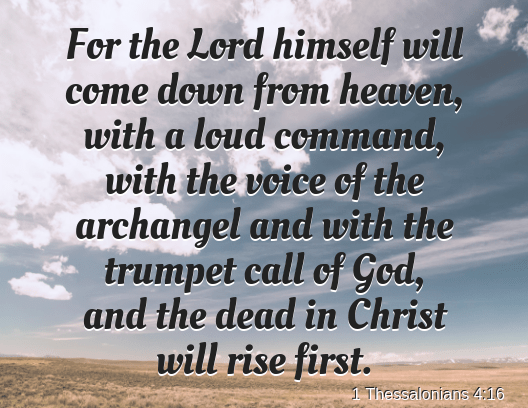
13 Brothers and sisters, we do not want you to be uninformed about those who sleep in death, so that you do not grieve like the rest of mankind, who have no hope. 14 For we believe that Jesus died and rose again, and so we believe that God will bring with Jesus those who have fallen asleep in him. 15 According to the Lord’s word, we tell you that we who are still alive, who are left until the coming of the Lord, will certainly not precede those who have fallen asleep. 16 For the Lord himself will come down from heaven, with a loud command, with the voice of the archangel and with the trumpet call of God, and the dead in Christ will rise first. 17 After that, we who are still alive and are left will be caught up together with them in the clouds to meet the Lord in the air. And so we will be with the Lord forever. 18 Therefore encourage one another with these words.

The first Christians lived in anticipation of the near return of Jesus from heaven. He left by rising up into the clouds…. He said he would come back in the same way to bring their reward, the fullness of the Kingdom of God. They hoped that he would come in their lifetime. As his coming, or parousia, took longer than they anticipated, some of the believers began to die. This left those still living concerned. What’s going to happen to those who died before Jesus returned, would they miss out on his Kingdom when he returns?

Paul writes this letter out of a pastoral concern to give encouragement to these grieving (and scared) believers. He clearly tells them what will happen. Those who are still alive when Jesus comes will not have any advantage over those who died. In fact, when Jesus returns the trumpet will sound and those who have died will actually be the first to rise-they will come up from out of their graves to meet Jesus in the air. After they have risen, the living believers will rise up to join them and meet Jesus in the air together with those who died.

He then gives the assurance that we will be with the Lord forever. This is the fulfillment of our hope… life in the coming Age. The present, evil age will come to an end, and the kingdom of God, beginning with Jesus’ reign over all the earth will begin.

Paul concludes his letter by encouraging the church to comfort each other with these words. It was intended to offer comfort and hope to grieving believers whose loved ones had died before the coming of Jesus.

Today, as we wait for the return of Jesus, just as in the first century, believers die while waiting for Jesus. While nothing can take away the grief of losing someone we love, we can still receive, and give comfort to one another with the knowledge that when Christ returns, the dead in Christ will rise first, we will rise up to meet them with Jesus, and then, we will be with them and with the lord forever.

Personally, I’ve got several people that I can’t wait to see again. I’m sure you do too.

-Jeff Fletcher

Winning Respect

1 Thess 4 11

I Thessalonians 4:9-12

9 Now about your love for one another we do not need to write to you, for you yourselves have been taught by God to love each other. 10 And in fact, you do love all of God’s family throughout Macedonia. Yet we urge you, brothers and sisters, to do so more and more, 11 and to make it your ambition to lead a quiet life: You should mind your own business and work with your hands, just as we told you, 12 so that your daily life may win the respect of outsiders and so that you will not be dependent on anybody.

I find these verses to be quite fascinating. Paul was writing to believers who were living in the first century in the Roman Empire. Their lives as disciples of Jesus were to stand out from the lives of those outside of the community of Jesus. They needed to live lives that earned the respect of those outside of the Church. Paul’s instruction on how they were to do this is what I find so interesting: lead a quiet life, mind your own business, work with your hands, do not be dependent on others. In that society, Paul believed that non-believers would be more open to hearing the message of Jesus Christ if his followers lived lives worthy of respect, focused, hard working, quiet. There’s nothing flashy or exciting about this counsel, simply to live a steady and hard working life.

As disciples of Jesus today it’s becoming increasingly more challenging to win the respect of people outside of the Church. Perhaps we need to go back to Paul’s simple and undramatic counsel and live out that lifestyle.

-Jeff Fletcher

Holy and Honorable and Radically Counter Cultural

1 Thess 4 4.png

I Thessalonians 4:3-8

3 It is God’s will that you should be sanctified: that you should avoid sexual immorality; 4 that each of you should learn to control your own body[a] in a way that is holy and honorable, 5 not in passionate lust like the pagans, who do not know God; 6 and that in this matter no one should wrong or take advantage of a brother or sister. The Lord will punish all those who commit such sins, as we told you and warned you before. 7 For God did not call us to be impure, but to live a holy life. 8 Therefore, anyone who rejects this instruction does not reject a human being but God, the very God who gives you his Holy Spirit.

Paul was writing this to Christians in the first century. He was calling them to live holy lives (set apart for God) in a culture where there was a great deal of immoral behavior that was accepted by society, but which went against God’s standards. Paul contrasts the believers call to live a holy and honorable life that is vastly different from the “passionate lust” that marked the life of the pagan. He warned that God would punish sexual sin and that to reject Paul’s teaching on this was to reject God.

I can’t imagine how difficult it must be for a young person or a new believer to navigate sexual morality in this age today. It’s gotta be tough. It was tough enough for me as I was a child of the 60’s and 70’s and there was plenty of confusion in society then, but at least the Church still gave a clear and for the most part unified message of what right and wrong was all about. But today, young adults are bombarded with images and messages about sexuality that are far different. So much that the Bible clearly speaks of as a departure from God’s path is considered normal by today’s society. To even question such things as premarital sex, homosexual activity, homosexual marriage, serial monogamy etc… is to be considered narrow, judgmental, or even a hate monger. So young people and those who become followers of Jesus Christ later in life face challenges in understanding and adapting to a Biblical world-view regarding sexuality. Exactly the way it was in the first century when Paul wrote this letter.

I note that Paul says that each of us must “learn to control [our] own body”. It’s a process of learning. There are difficult lessons to be learned. As most of us who have had to learn something new realize, learning is a process which takes time and seldom happens without mistakes. Those believers who are more seasoned in their walk with the Lord should remember this, and while teaching faithfulness to God to young and new believers should remember that is it is a process and be patient with those who are still learning. And even be patient with ourselves, for learning something so radically counter cultural is never easy and we are all capable of making mistakes. Truth must always be mixed with grace.

-Pastor Jeff Fletcher

Time for Your Examination

Psalm 139 23 24

Psalm 139: 1, 23-24

“You have searched me, Lord, and you know me.

Search me, God, and know my heart; test me and know my anxious thoughts.

See if there is any offensive way in me, and lead me in the way everlasting.”

I imagine that most of us don’t really enjoy being examined by a doctor. I know I dread it when I go to the doctor’s office and one of the first things they do is ask me to stand on the scale. “Really? I have a sore throat, I’m sure that has nothing to do with how much I weigh.” That’s what I think to myself, but still I dutifully comply. I stand on the scale (why does the doctor’s scale always weigh 5 lb. heavier than the one in my house)?.

Physicians examine us so that they can have an idea of what’s going on inside of us. Is everything functioning properly. Are all the vital organs working the way they are supposed to? Do changes need to be made? Often, at the end of the visit there is a prescription given for some medicine for us to take. Or sometimes a recommendation to make a lifestyle change. Or sometimes, the need for further tests. Sometimes, what is needed is a radical, invasive procedure where they cut into your body… surgery. Most of those things are unpleasant. Sometimes, we avoid going to the doctor all together so that we can avoid hearing his diagnosis. We figure, what I don’t know won’t hurt me.

Spiritually, we sometimes act the same way. We are afraid to go to God and let him give an honest, accurate assessment of our spiritual health. But we need it. We need it more than we need our physical health. We need God to search us… to examine us… to look deep into our hearts and understand our values, our motives, our loves and our hates. We need God to look deep within and discover where our anxious thoughts lie. We need God to call us out on our offensive ways… the ways that hurt others, the ways that hurt ourselves. We need God to prescribe for us the changes that need to be made so that we can experience greater spiritual health.

The hardest prayer, and the most important prayer you can pray, is a prayer of examination to God… “Search me, O God, and know my heart.” Maybe its time you made an appointment with God for an examination. Come to think of it, maybe its time for me to do that too.

-Pastor Jeff Fletcher

Unveiling the Past, Present and Future…And Then Repent!

Monday, July 17

revelation1-8

Revelation 1-3

The final book of the Bible is known as the Book of Revelation.  It is also known as the Apocalypse.  Apocalypse mean “unveiling”.  It has the idea of that which was hidden has now been unveiled or brought out into the open to be seen.  There are other passages in the Bible that contain apocalyptic material (parts of the book of Daniel and Ezekiel are two) but this is the only book of the Bible that is fully apocalyptic.
Revelation can be a little confusing (ok, a lot confusing).  A big part of this confusion comes from the challenge of pinning down the proper timeline.  It contains material that was past, present and future to the writer, John, who wrote toward the end of the first century.  The angel who gave this revelation to John said: “Write, therefore, what you have seen, what is now and what will take place later.”(Rev. 1:19).  There are different “schools of interpretation” that see Revelation as mostly focusing on John’s time period (end of first century in the Roman empire), others see it as being fulfilled progressively over the past 2000 years of the Church, and others see it as still to be fulfilled in the future.  This is compounded by the use of symbol and imagery that fill the visions of Revelation.  A lot of time can be spent trying to discuss and debate these issues, but for our purposes I’d like to focus on basic principles found in Revelation that can be of value to our lives as followers of Jesus today.
In chapters 1-3 a focus is on letters written to seven Churches throughout Asia.  John is writing to them as a pastor who at the time was living in isolation on an island in the Mediterranean sea.  He can’t be physically present with his churches, but he is with them in spirit and wants to encourage and instruct them, to help them stay strong during a time when many believers were suffering persecution by the Roman empire.  Imagine what it would be like to try to encourage Christians today living in places like Pakistan, or Egypt, or Sudan or Syria, where Christians were being killed because of their allegiance of Jesus Christ rather than to Mohammed.  What kinds of encouragement would Christians whose family members, friends and fellow believers were dying for their faith need to help them not lose faith?
In the Roman Empire during John’s time of writing it was required by law for citizens to declare allegiance to Caesar by publicly declaring Caesar to be Lord.  Jewish people were largely exempt from making such declarations (but not always).  Often Christians came under the umbrella of the Jewish exemption, but now always.  Thousands of Christians died as a result of religious persecution during the early Roman empire.  John writes to offer encouragement to keep faithful to their commitment to God and to Jesus Christ in the midst of such persecution.  The challenges we face today may not be the same type that first century Christians faced, yet we still have challenges, struggles and temptations.
Chapters 2 and 3 of Revelation contain words of exhortation and correction to the various Churches to which John is writing.  Each Church had many good things happening for which they were praised, but several also had not so good things going on for which they needed to be corrected.  One of the common themes of each letter to each Church was a call to repentance.  To repent means to turn around or change direction.  To the Church at Ephesus, John said that you have “lost your first love.”  They were just going through the motions of their faith, without the passion.  Perhaps you can relate to that.  Anyone who has been a Christian for a while has to be aware the danger of “just going through the motions” and losing their passion for God.  John is trying to get them fired up again.  John says: “repent” and do the things you did at first.  Most Christians, start out enthusiastic… they read the Bible a lot, they pray a lot, they tell their friends about God and their faith a lot, and they consciously seek to get closer to God and do things to please God.  But over time, they lose the passion, lose the drive… become complacent.  John says- get back to the love and passion you first had for Jesus.
Maybe this is you.  If it is… let it be a wake up call.  If this isn’t you, then keep reading through Revelation 2 and 3.  Look at what is said to each of the seven churches.  Is there anything that rings a bell?  Is there anything there that applies to you?  I’m guessing there is.  Read it… and then repent.
-Jeff Fletcher