On October 7, 2023, Hamas launched a sneak attack on Israel. Nearly 1200 Israelis were killed. 251 Israelis and foreigners were taken captive and held hostage by Hamas.
This was not the first time Israel had been the victim of an attack and taken captive by enemies. They were enslaved by the Egyptians thousands of years ago. They were taken into exile by the Babylonians nearly 3000 years ago. They were attacked and occupied by the Romans and their Temple was destroyed and they went into the diaspora almost 2000 years ago. They were victims of the Holocaust nearly 100 years ago when nearly 6 million Jews were murdered in gas chambers.
Psalm 122 was one of many Psalms that were prayed by the Jewish people during many of these numerous times of attack and war.
Psalm 122. A song of ascents. Of David.
1
I rejoiced with those who said to me, “Let us go to the house of the Lord.”
2
Our feet are standing in your gates, Jerusalem.
3
Jerusalem is built like a city that is closely compacted together.
4
That is where the tribes go up— the tribes of the Lord— to praise the name of the Lord according to the statute given to Israel.
5
There stand the thrones for judgment, the thrones of the house of David.
6
Pray for the peace of Jerusalem: “May those who love you be secure.
7
May there be peace within your walls and security within your citadels.”
8
For the sake of my family and friends, I will say, “Peace be within you.”
9
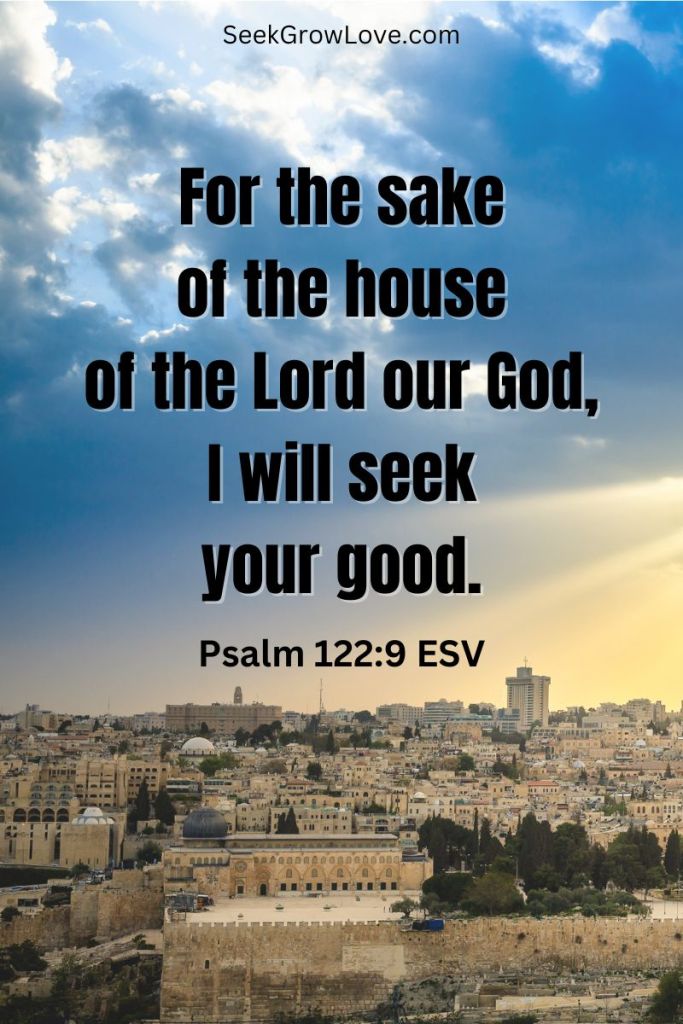
For the sake of the house of the Lord our God, I will seek your prosperity.
This Psalm is a prayer for peace in Jerusalem. It is a prayer that God’s people will live in security and protection. Today we pray for the Peace of Jerusalem. True and lasting peace will not come to Jerusalem until the Messiah, God’s anointed King, our savior Jesus Christ returns. When Jesus returns there will be Peace in Jerusalem and eventually Peace on earth in God’s Kingdom.
Let us continue to pray for the peace of Jerusalem. Let us pray for the release of those being held captive.
Pastor Jeff Fletcher
Reflection Questions
Compare and contrast Jerusalem, including it’s history and current situation, to that of the New Jerusalem we recently read about in the final chapters of Revelation. What causes the differences and the similarities?
How often do you pray for the peace of Jerusalem? Would adding a visual reminder to your home or device help you remember?
How might you be able to seek the good and prosperity of Jerusalem?
How often do you pray for the coming of the New Jerusalem and pray for its occupants, that those you know will be ready – recognized as the people of God, wearing white and not left outside?
(As we are pulling up past devotions this week, I wanted to choose a devotion on the end of Revelation – but didn’t want to ignore the Psalm we have been reading all week either. So, today we are including 2 devotions from Jeff Fletcher, one on the end of Revelation, and one on Psalm 121.)
The Bible begins in the book of Genesis with God and his children named Adam and Eve living in a perfect garden where his children have immediate access to the presence of God and can interact with God face to face. The act of rebellion against God caused them to be separated from God. They initiated this process by hiding from God and by their failed attempts to cover over their guilt and shame. The consequence of their rebellion against God was that they were cut off from immediate fellowship with God, they were cut off from the garden which, along with all of the earth and the inhabitants of the earth including animals and humans fell under the curse of death.
Within God’s ruling of the consequences of sin and the resulting curse came a kernel of good news in Genesis 3:15. One would come who was a “seed of the woman” meaning a child, a human child, who would ultimately defeat the serpent, which represents evil. In the process of destroying the evil serpent, that human would also suffer a wound (a bruised heel).
The rest of the Bible is the story of how God’s plan to rescue the earth from the curse and restore and redeem humanity that was cut off from God is fulfilled ultimately by Jesus Christ, the human being, he was a seed of the woman, who was also the perfect and sinless son of God. In going to the cross and dying for the sins of all humanity, and being raised up by God to everlasting life, Jesus defeated the serpent.
Revelation 20-22 provides a vision of the ultimate victory of how this is ultimately realized. The serpent/dragon/devil/satan(adversary) is permitted to influence the world only so long, and then it will finally meet it’s end. Evil will be defeated by Jesus Christ. Christ will return, the dead will be raised, there will be a final judgment based upon what we have done. Some will be resurrected to everlasting life with God on a renewed earth in the city of New Jerusalem. Some will be judged and condemned by God and cast into the lake of fire, which the Bible calls the second death. (Note that it does not teach that they will be tortured for eternity, but that they will die a second and final time in a type of mass cremation). Death has to be destroyed. Those who reject God’s love and gracious gift of salvation will not have it forced upon. God allows us the freedom to accept his love and the offer of salvation, but he also gives us the freedom to reject it. Just as a bride must consent to marrying the groom in order for a marriage to be valid, we, God’s people must consent to God’s love before our covenant relationship will be valid.
For those who reject God’s love, they will finally and mercifully be brought to everlasting destruction. Those who accept God’s love through Christ, will be granted everlasting life. The Bible ends with the reversals of Genesis 2-3. God will again make his presence here upon the earth. The image John gives in Revelation is of a New Jerusalem coming down from God to take up occupancy on the earth. This new Jerusalem, interesting, is built on the same scale as the Temple in Jerusalem was… only so much larger. The new temple occupies a territory that rivals the ancient Roman empire.
For Christians living in the first century suffering under Roman oppression, this must have given them hope. Rome/ or Babylon or whatever earthly power that was anti-God would be brought to an end, and God’s Kingdom, God’s government would cover all the earth, with Jerusalem acting as a giant temple where God and his people would dwell for all eternity. Within the temple, emanating from the throne of God is a river of life surrounded by the tree of life. The tree of life was the very reason why Adam and Eve were banished from Eden, so that they would not partake of the tree of life/immortality in their sinful and broken condition. Sin had to be defeated once and for all before immortality could be enjoyed. But now, in Revelation, we are free to partake of the tree of life, we are free to embrace immortality, and we will live forever with God in His Kingdom on this renewed earth. We have, in a sense, come full circle, we are back home with God’s presence in the new Eden, and we are forever blessed. Even those who have suffered martyrdom for their faith, will enjoy the benefits and blessings of the New Jerusalem the New Eden and the New Earth.
If you’ve never said yes to God’s love, I don’t want you to miss out on this greatest of all blessings. Say yes to God, you can do it right now. And then solidify that “Yes” by entering into a covenant relationship with God through Baptism. And then live as a child of God and share this good news with as many as you can, until the day all is fulfilled and Christ returns, or the day that you draw your last breath.
-Jeff Fletcher
(originally posted on July 21, 2017 for SeekGrowLove)
We’re discussing seven different types of psalms and how to make them a regular part of our worship. Today we consider pilgrimage psalms. A pilgrimage is a journey to a place that holds special spiritual value to the person making the pilgrimage. In ancient Israel those who lived outside of Jerusalem would make several pilgrimages each year to come to Jerusalem to worship at the temple and celebrate various feasts which commemorated important elements of Israel’s sacred story. We know that Jesus was arrested and crucified at the beginning of the Passover celebration.
As people made their pilgrimage to Jerusalem they would sing joyful and festive psalms that would help them recall God’s goodness. If you’ve ever travelled to a special place and event like Fuel, or General Conference, Christian Worker’s Seminar, or summer youth camp, you know that the excitement builds as you journey and get closer to the event. Sometimes people sing some of the songs that gave meaning and joy to their previous times at those places.
Imagine as the pilgrims get closer to Jerusalem. As Jerusalem is on a mountain they can see it from a distance. As they climb Mt. Zion to get closer to the city and the temple of God their excitement grows and they begin enjoying an attitude of worship by singing and recalling God’s blessings.
Psalm 121 is a great example of a pilgrimage psalm:
Psalm 121
A song of ascents.
1 I lift up my eyes to the mountains— where does my help come from? 2 My help comes from the Lord, the Maker of heaven and earth.
3 He will not let your foot slip— he who watches over you will not slumber; 4 indeed, he who watches over Israel will neither slumber nor sleep.
5 The Lord watches over you— the Lord is your shade at your right hand; 6 the sun will not harm you by day, nor the moon by night.
7 The Lord will keep you from all harm— he will watch over your life; 8 the Lord will watch over your coming and going both now and forevermore.
This serves as a reminder that as you journey on your way, God is with you. God is your helper who watches over you wherever you go. How comforting and assuring to know that God is with you on your journey through life. Even during those times where you might not know what’s waiting for you around the next corner or over the next hill, God is there, and he doesn’t go to sleep on the job.
-Jeff Fletcher
(originally posted June 7, 2019 for SeekGrowLove)
Reflection Questions
How is your journey towards the presence of God going today?
What encouragement do you find in today’s passages? What motivation do you find in today’s passages?
Who do you know who needs to know what the Bible shares and reveals?
Life is so busy and complicated that I have to create lots of reminders for myself. Fortunately, my phone and computer and watch all have features where I can set reminders for myself. “Doctors appointment Tuesday at 3:00. Take the garbage to the dump on the way to work in the morning. Stop by the store after work and pick up some milk and bread.” I can even set reminders months or years in advance. I can set alarms to remind me that in 2 hours I have a meeting. In 1 hour I have a meeting. In 15 minutes I have a meeting. The Meeting is now starting. Maybe I’m too busy or maybe I’m getting old, but I find myself more and more needing reminders.
Do you ever need reminders? Little kids need to be reminded to brush their teeth, make their bed, do their homework. What do you need reminders for?
The Apostle Paul thought reminders were important for Christians. I guess he understood how easy it can be to forget what’s important when we are busy living life and doing what’s necessary or urgent. Do Christians ever forget important things about God, about Jesus, about how we are supposed to live? Yep, we sure do.
In Titus 3 Paul tells Titus to remind the believers of some important things.
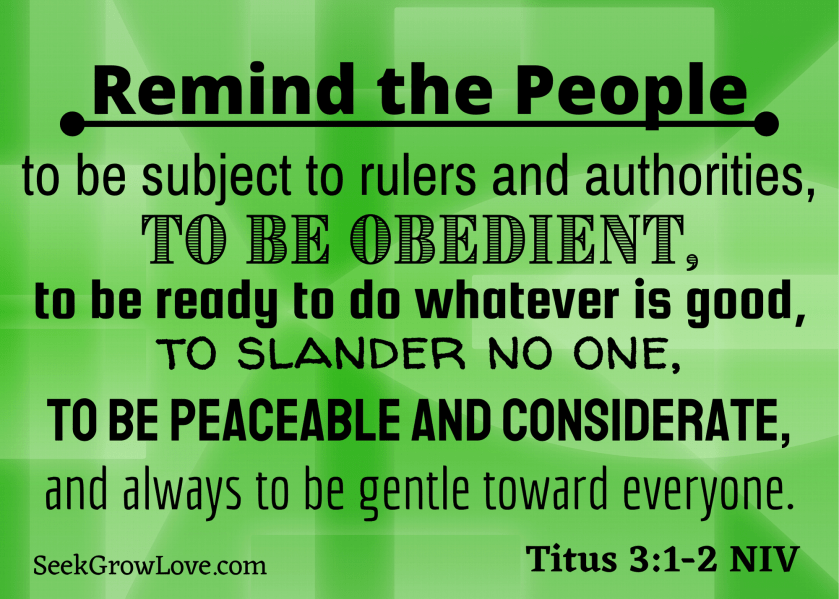
“Remind the people to be subject to rulers and authorities, to be obedient, to be ready to do whatever is good, to slander no one, to be peaceable and considerate, and always to be gentle toward everyone.” -Titus 3:1-2
Those reminders were important in the first century when Christianity was brand new and people were still learning the basics, but it’s been 2000 years. We’ve certainly got being a Christian all figured out by now, don’t we? Do we really need to be reminded to obey people in authority? Do we need to be reminded to always be ready to do good? Don’t all Christians always do what is good? Certainly we never slander or falsely accuse someone of wrong doing. I’m always peaceable and considerate and gentle toward everyone, aren’t you? (My tongue is in my cheek- that means I’m kidding).
To tell the truth, I still need to be reminded of all of those things. Just because I’ve been reading the Bible for over 50 years doesn’t mean I always remember to do good. I still need to be reminded to be considerate and gentle, and so do you. That’s why Christianity was never designed to be lived in isolation, but in community. We need each other. There’s a passage in Hebrews (a different book from today’s reading, but important) Hebrews 10:24-25 says that Christians shouldn’t get out of the habit of meeting together, because we need to encourage (I think Hebrews says “spur one another on”, like a rider spurs on a horse) each other.
Following Jesus is hard some times. Being obedient to God is hard some times. Remembering to do good and be gentle is hard sometimes. I need help, I need encouragement to keep on doing what is right. I need you, and you need me, we need each other.
I’ve read the Bible many times in my life and I need to keep on reading it to help me remember all the important things I need to remember. Today’s readings in Isaiah 63-64 and Titus 3 remind us both about God’s wrath and about God’s mercy. God has both. God hates sin, he hates it when his children are brutal to each other. He hates it when his children fight and argue. He hates sin because he loves us and he knows that sin hurts us. We hurt each other when we sin. No parent likes to see their children hurt each other. We learned that from our Father, God.
So keep reading your Bible and keep coming to Church and meeting with other believers so that you can remind them and they can remind you to keep on following Jesus.
“Hey Siri set a reminder for 7 a.m. tomorrow: be considerate and gentle to everyone.”
“Alexa, remind me to get up for Church Sunday at 8:00.”
-Jeff Fletcher
(Originally posted here on October 4, 2021 – when we were reading Titus and Isaiah together. This year, we get to start Isaiah tomorrow.)
Reflection Questions
What do you need reminders for?
Look at the list of things Paul told Titus to remind the people to do. For each one ask yourself why is this important and how well am I doing this? If you were to choose one to focus on reminding yourself to do for the next 14 days, which one needs your most attention right now?
What is your attitude toward those who give you reminders?
Today is our final look at Proverbs for the week. We have looked at these Proverbs as wisdom that leads to greater flourishing. In today’s Proverb there is a strong theme around our attitudes to the poor. If you know anything about King Solomon, he was the wealthiest man in all of Israel. He lived in a palace, had armies and servants in abundance and was the envy of other world leaders. There’s even a story in the Bible about the Queen of a place called Sheba who traveled to Israel just to see for herself how magnificent Solomon’s Kingdom was.
As wealthy as Solomon was, he also recognized that wealth could be dangerous and lead to pride which can do great spiritual damage to a person. Solomon cautiously warns his readers not to look down on people who are poor or to take advantage of the poor.
The rich and the poor meet together; the Lord is the Maker of them all. (Proverbs 22:2).
Whoever has a bountiful eye will be blessed, for he shares his bread with the poor. (22:9).
Whoever oppresses the poor to increase his own wealth, or gives to the rich, will only come to poverty. (22:18).
Do not rob the poor, because he is poor, or crush the afflicted at the gate for the Lord will plead their cause and rob of life those who rob them. (22-23).
Solomon gives some heavy-duty warning here. Many cultures throughout human history have looked down on the poor or otherwise economically challenged. In some cultures, the Hindu culture of India, they believe that poverty is simply Karma, the poor person is being punished for sins committed in a previous life (they believe in reincarnation of the dead, rather than sleeping till resurrection as the Bible consistently teaches). So that poor person is poor because they are bad. You can see how this attitude might breed a certain attitude of superiority. They are poor because they deserve it. On the other side, many think, I am rich because I am being rewarded for being a good person. In actual fact, more often than not the reverse is true. Many very poor people are actually very caring and loving people. Their poverty has nothing to do with their character or their sins. Poverty has many causes. There are all kinds of factors in society that can affect a person’s ability to acquire wealth or even a subsistence level of economic resources.
Consider a community where most laborers work in a factory. In some cases, several generations of their family worked in that same factory. What happens when suddenly the new CEO of the company decides that the shareholders will make more money if they can cut manufacturing costs by outsourcing production to a country with much lower labor costs. They can produce the same goods at lower production costs and sell them for the same amount resulting in greater profits and more dividends for the shareholders, and a nice healthy bonus for the CEO. Everybody wins, right? Wrong. The people who worked at the factory for 30 years suddenly find themselves unemployed. How will they feed their families? What happens to the town when suddenly a large part of the population are unemployed? I think you get my point. Suddenly you have poor people who are now poor through no fault of their own. They are victims of the wealthy people who are now even wealthier at their expense.
In our society, it is tempting to look at those kinds of situations as the result of our system but trusting that the system will balance itself out. But does it really? Now, don’t misunderstand me, I’m not advocating for communism or socialism as a better alternative to capitalism, but we must acknowledge that there is a moral component to wealth and we should not blind ourselves to the reality that there are systemic elements in society that do contribute to poverty and we need to be aware and mindful of ways that we contribute to that.
It is easy to look at poor people and blame them for ‘being too lazy’ or ‘on drugs.’ Sometimes that is no doubt true. But we don’t necessarily know that. We don’t know how lack of educational opportunities, racial inequalities, generational poverty and many other factors may be contributing to their situation. Sometimes substance abuse is the cause of poverty, but other times it is a symptom of one who has lost all hope for economic success and has given in to apathy and hopelessness and now is self-medicating. Poverty can also come as a result of mental illness. Many unhoused persons suffer from severe mental illness and most states lack sufficient resources to treat and support them, so they end up living lives of unmitigated poverty and misery.
Mindlessly throwing money at problems is not the solution, but neither is blame or even worse, intentionally taking advantage of the poor to make ourselves richer. Every day I get spam calls and texts from people who are phishing for my data so that they can access my bank account and take my money. They often target elderly people, try to scare them, or confuse them into sharing their personal information, so they can steal from them. In the same way, a predatory lion will look for the weakest gazelle in the herd to take down, predatory people often do the same. Solomon knew back then how the poor were often victimized by the predatory rich and he warned against it. Not much has changed.
When Jesus says that we are to love our neighbors as ourselves, he includes the poor. The person who wants to flourish spiritually will be intentional in how they treat everyone, especially those who are economically challenged and most vulnerable.
~ Jeff Fletcher
QUESTIONS:
What is your attitude to the poor? How does this translate into action?
Why does God care about the poor?
How does taking care of the poor relate to justice? How does it relate to wisdom?
Vs. 23. Whoever guards his mouth and his tongue keeps himself out of trouble.
At the beginning of the movie, Blindside, the narrator explains the role of the offensive line and one position in particular, the left guard. Her explanation goes something like this: “When a woman is paying the household bills, the first check she writes is to pay the mortgage, the second check is to pay the insurance.” The meaning: you want to ensure you have your greatest financial asset, your house so you pay the mortgage, and you want to make sure that your asset is protected, so you make sure your insurance premium is up to date. That all makes logical sense. As it is applied to football, you first make sure that you have a great quarterback to run the offense, and second, you want to make sure that your quarterback is well-protected, so you invest in a very good left guard to watch and guard the quarterback’s blindside.
Solomon, of course, knows nothing of football. In his world, as king of Israel most of the work that he accomplishes is with his mouth. When he as King utters a decree, it becomes law. As King, his words matter. The King’s words have the power of life and death. In some ways, the King’s authority is exercised by his words, they are powerful and effective. In some ways, they are very similar to God’s Word, which the Bible also says is powerful and effective. In Genesis 1 God speaks His word and the heavens and earth are formed.
So Solomon understands the power of our words. In Proverbs, he emphasizes the importance of protecting the source of our words, our tongue. “Whoever guards his mouth and his tongue keeps himself out of trouble.” (Proverbs 21:23). If your tongue is the quarterback, you need to invest in good protection, a good guard. That is putting knowledge into practice, that is wisdom.
Practically speaking, think of all the ways that an unguarded tongue can get a person into trouble: lying, gossip, slander, and cursing are just a few examples of trouble that comes courtesy of an unwisely guarded tongue. Lying can get you in trouble with your parents, with your husband or wife if married, with your boss, with your friends and with God. That’s a lot of trouble. People usually tell lies to try to keep out of trouble, but often it backfires and they get into more trouble. Lie to a police officer and you won’t only get into trouble for whatever you did, but then you’ll have extra trouble for lying about it. There’s a reason that when arrested they say “You have the right to remain silent, anything you say will be used against you.” What that means is, you’re better off just keeping your mouth shut then to tell a lie to try to cover up. Even if you are innocent of the charge, you can still get yourself into trouble by what you say. Please not, I’m not advocating for you to commit crimes and tell you how to avoid jail, but simply showing the wisdom of guarding your tongue. Think before you speak.
In this age of social media, guarding your tongue takes on greater meaning. With social media, our words can go farther faster and last longer. I have heard of incidents of people not being hired for a job they were otherwise qualified for because the prospective employer looked at their social media feed and saw objectionable content from years earlier. I’ve heard of people losing jobs because of their words. Unguarded words can be very costly. They can cost not only jobs; they can cost relationships.
Solomon wisely counsels that in many situations it is far wiser to say nothing at all. Proverbs 17:28 says: “Even a fool who keeps silent is considered wise; when he closes his lips, he is deemed intelligent.” An old adage attributed to Mark Twain or Abraham Lincoln (but probably someone different) says “It is better to be silent and be thought a fool than to open your mouth and remove all doubt.”
Words have heavy spiritual consequences as well. Ecclesiastes 5:2 says: “Do not be quick with your mouth, do not be hasty in your heart to utter anything before God. God is in heaven and you are on earth, so let your words be few.” Think about the promises that you make to other people, and think harder about the promises you make to God. For instance, when you are baptized, you promise to make Jesus Christ your Lord and Savior be faithful to him and follow him. That’s a very strong promise. A disturbingly large number of people who used to go to church faithfully are dropping out of the church, and many no longer identify as Christian, they are joining the swelling ranks of so-called “nones” or people with no religious affiliation. That’s a lot of people who made promises to God who are no longer keeping those promises. But good news: God is very forgiving and welcoming to those who repent, turn back to Him. Still, think about any promises you make with your mouth before God. Whether it’s to faithfully follow Jesus Christ, be faithful to a wife or husband, commit to serve in a ministry, don’t be quick to make a promise that you don’t really intend to keep.
In short, your words really do matter, so a spiritually wise person needs to “think before you speak.” So be sure to guard your tongue the way a left guard protects his quarterback. That’s a key to spiritual victory in life, that is a way towards true flourishing.
~ Jeff Fletcher
QUESTIONS:
What power do words have? Have you ever been greatly hurt by words? What about greatly encouraged?
Why is it always better to tell the truth rather than lies?
How can you cultivate your ‘word filter’? How can you practice thinking before you speak?
I have had a few different titles and roles in my life, pastor, reverend, spiritual director, chaplain, doctor. Of all of them, the one that I am most proud is Dad/Papa/Grandpa. If you do not know me from Adam, I have eleven children, six sons/daughters in law, and fifteen, soon to be sixteen grandchildren. Along with my wife Karen who I talked about earlier this week, these are my greatest loves and joys on this whole earth. One of Proverbs we looked at earlier this week included the following: “Grandchildren are the crown of the aged, and the glory of children is their fathers.” (Proverbs 17:6). This speaks of the importance of our families to our lives.
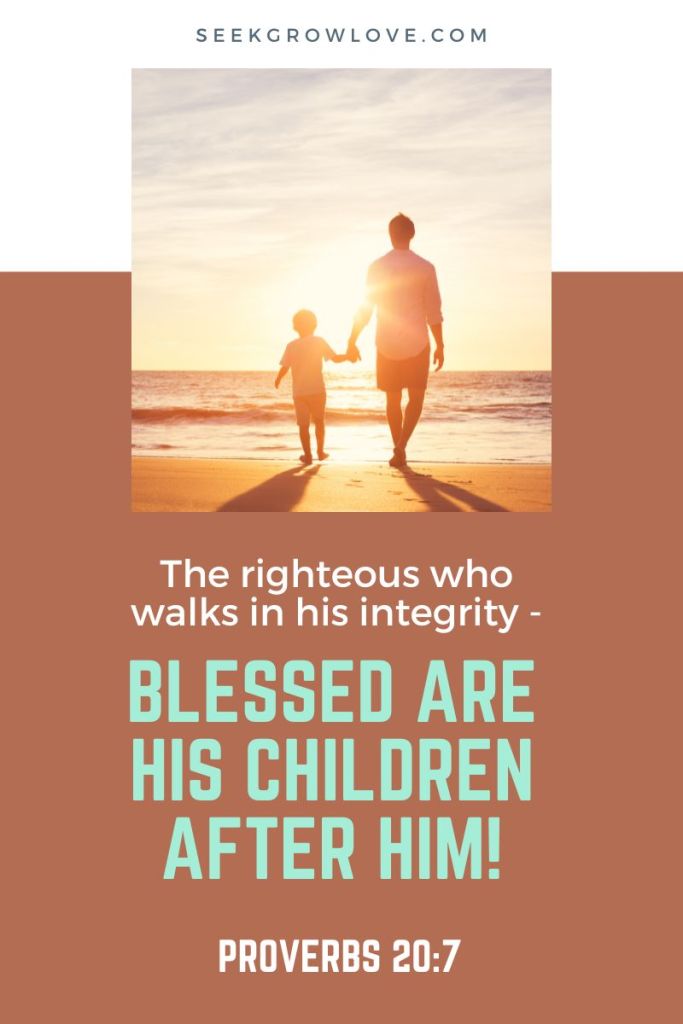
In today’s Proverb, I want to look at verse 7, which also speaks of the importance of family: “The righteous who walks in his integrity—blessed are his children after him!” (Proverbs 20:7). Growing up in the United States I have been exposed to important words like freedom. As a person who has spent the majority of my life in more conservative institutions I have been surrounded by ideas of “rugged individualism.” Since the emergence of neoliberalism in the 1970’s there has been this ongoing emphasis of personal responsibility. I grew up when the threat of Communist expansion was at a high point. Being surrounded by that cultural mindset it is easy to drift over into hyper-individualism. But is this what the Bible teaches?
There is a sense in which ultimately we are all responsible for the decisions that we make in life. If I make the decision to sin, I am the one who is answerable to God for my sin. I can’t say “it was my parents’ fault” or “it was my wife’s fault”. If you go back to the beginning of the Bible and the story of Adam and Eve in the garden, you can see how quick everyone was to try to shift the blame onto someone else. Adam famously tried to blame Eve, (or was he really blaming God?) “This woman that you made, she gave me the fruit”. The woman in turn blamed the serpent. God was having none of it.
A clear spiritual principle of the Bible is- each individual is accountable for their sins. Ezekiel 18:19-20 spells it out in very clear terms: “Yet you say, ‘Why should not the son suffer for the iniquity of the father?’ When the son has done what is just and right, and has been careful to observe all my statutes, he shall surely live. The soul who sins shall die. The son shall not suffer for the iniquity of the father, nor the father suffer for the iniquity of the son. The righteousness of the righteous shall be upon himself, and the wickedness of the wicked shall be upon himself.”
You could have the most wonderful, godly, spiritual parents in the world, but you do not automatically get to ride their coattails into the Kingdom of God. Once you reach a place of accountability, you alone are responsible for your commitment to follow Jesus Christ, or not. There are no legacy Christians. At the opposite extreme, you might have had the worst parents in all the world and suffered abuse or deprivation, maybe they never taught you about God or brought you to Sunday School or Vacation Bible School. You are still responsible when you grow to maturity. There are many people who came from terrible childhoods with not good parental spiritual support who meet Jesus Christ and allow him to transform their lives. From a spiritual/legal accountability standpoint, you are ultimately responsible for your sins and accepting Jesus Christ and following him.
Having said all of that, let me also say that we do NOT live only for ourselves. All of my children are now adults and they are accountable to God, but as a parent, I am accountable to God for how I parent my children. This was a clear principle give to God’s people, Israel from a very early time. Deuteronomy 6:6-7 says: “And these words that I command you today shall be on your heart. You shall teach them diligently to your children, and shall talk of them when you sit in your house, and when you walk by the way, and when you lie down, and when you rise.” Parents are instructed by God to diligently instruct their children in the teachings of God.
It became fashionable in the 1960’s in America for parents to say “I’m not going to impose my religious faith and values on my children. I’ll let them decide for themselves.” That is one of the stupidest ideas in the history of ideas. The world is constantly trying to impose its values on children. It begins with some of the baby books designed to be read to babies and toddlers, children’s television shows, childhood education in schools, social media, the music and entertainment industry, advertising, their peers etc…Everyone tries to impose their values on children, especially those who try to tell parents not to impose their values on children. God says to parents, you have got to start indoctrinating (aka teaching good doctrine to) your children with God’s teaching from the time they are small. Talk about God and God’s teachings to your children all day long.
I’m writing to some of you who are now or soon expect to be parents, and even for you younger ones, file this away so that if you do become a parent you will remember it. How you live your life and how faithfully you teach your children will have a major influence on them. Proverbs 22:6 says that we should “train up a child in the way he (she) should go”. Should is a word that contains judgment. You need to decide what is right and wrong in God’s word and you need to train your child to adopt those same values. There is no 100% guarantee that you will be successful and that your children will choose to follow your training and God’s Word when they grow up, but you can do all that is in your power to set them up for success.
I was blessed with a mother and father who loved God, brought me to Church throughout my childhood, practiced prayer in the home and demonstrated their faith in God and taught me to do the same. Were they perfect? No, no parent is. But they helped to prepare me to choose to live a life of faith as an adult. Did I have failures and setbacks in living as a follower of Jesus. Absolutely. I am 100% responsible for my sinful choices both as a teenager and now as a 60-year-old man. But I have been the blessed recipient of having had parents of faith. I have tried to pass along those benefits to my children. Was I a perfect Dad? Are you kidding? I have eleven eyewitnesses who could tell you stories about some of the stupid and sinful stuff that their dad has done. (Good thing they have a really good mom). And yet, I hope that I was able to teach and model faith to my children diligently, and continue to try to live out my faith today (I think I’ve gotten a little better at figuring out how to be a good dad as I’ve gotten older). Now, some of them are parents and having to navigate the same thing in their lives. Now they are responsible for how they parent their children.
Sorry, but when you stand before the Lord, you can’t blame your parents for your sinful choices, you are responsible. You are also responsible for how you parent any children God gives you, and you can help to better set them up for spiritual success by teaching them diligently God’s Word, until the time that they themselves are accountable to God. Faith is learned and lived in a community. We are responsible for how we live it in our families, in our churches, and in our world.
~ Jeff Fletcher
QUESTIONS:
How have your parents influenced you to follow (or not follow) God?
What values do you want to pass on to your current or future children?
What responsibility do parents have to pass on their faith to their children?
How can you prepare yourself to pass on this faith well to the next generation?
Have you ever seen a sloth in the zoo or on tv? Baby sloths are so cute. Sloths live in Central and South America and spend their lives “hanging around” in trees. About once a week they climb down from the tree and go to the bathroom, then they slowly climb back up again. Sloths name means literally “lazy”. This is because they are some of the slowest creatures on earth. The avg. land speed of a sloth is 9 feet per minute. That is roughly .1 mph. I mean, I am a slow old man, but even I could win a foot race with a sloth.
The word, sloth or slothful means lazy or indolent. The slothful person fails to engage life in a meaningful way. They are essentially withholding energy or effort to do the things that need to be done. Proverbs 19:15 points out this truth about the danger of sloth: “Slothfulness casts into a deep sleep, and an idle person will suffer hunger.” Slothfulness is essentially falling asleep to life. The consequences of sloth or laziness can be life-limiting. So, Solomon warns the reader that the wise person who wants to live a flourishing life as God has designed will pay careful attention to the times when laziness gains control of their lives.
Now, let us pause for a moment. Human beings were not created to work non-stop. Workaholism is not health to our bodies, our minds, or our relationships with others and with God. We all know people who seem like they are never able to stop working, relax, enjoy time with family and friends. We know people who are too “busy” to God to Church, pray, read their Bibles, visit a friend who needs support or just appreciate all the gifts of life.
God created us to be human beings, not human doings. God built into creation a certain rhythm and flow to life. Human beings need sleep. It is a biological imperative. You “have” to sleep in order to live. In the same way, God built into creation the need to not only sleep, but to cease productive activities, to rest from work. God said it is necessary to take one day of the week to “cease” working. He called this Shabbat/Sabbath which means literally, to cease. Solomon is not here prescribing workaholism. In fact elsewhere in the Bible it says: “It is in vain that you rise up early and go late to rest, eating the bread of anxious toil; for he gives to his beloved sleep.” (Psalm 127:2).
But just as it is bad to work all the time and never get rest, it is equally bad to be perpetually slothful and not do the work you need to do. Back to Proverbs 19 Solomon says: “The sluggard buries his hand in the dish and will not even bring it back to his mouth.” Here Solomon introduces another term “sluggard”. A slug is a tiny shellless gastropod. It is a snail without a shell. They hang around your garden all day munching on your vegetables. Like the sloth, they also do not move very much. A sluggard is essentially a person who is habitually lazy. In Solomon’s example this person is so lazy that they can’t even do the simple task or moving their food from their dish to their mouth so they can eat… and live.
In short, Solomon wants us to understand that the wise person who will flourish in life as God designed will not be perpetually lazy. You have things that you need to do to live a good and flourishing life. If you want to reap a harvest in the Fall you must first do the work of planting the seeds in the Spring. If you are too lazy to plant, to weed, to harvest, then you won’t have a flourishing garden, and you personally won’t flourish.
Important note: you can be busy and active doing stuff and still be slothful about what is truly important. If you have ever sat down with your laptop to work, and three hours later realized that you have been on your computer for three hours and haven’t gotten any work done, but you’re all caught up on your social media and binge watched several episodes of your favorite show on Netflix, you know that you can be doing activities when you planned to do work. The world is full of distractions. And human beings are easily bored.
Part of sloth is not being able to focus on what you really need to be doing in the moment. Many times in my life I have found myself procrastinating on a task that I needed to do, but instead reorganized my sock drawer, rearranged my shirts by color and researched and planned my next vacation. It is easy to get distracted away from important but unpleasant or difficult tasks by the low hanging fruit of something easy. Do not get me wrong, we all do this once in a while and It is certainly okay at times to say, “I Do not have the mental energy at this moment to tackle that task.” It is when it becomes habitual, when we become habitually slothful about important things that the real danger becomes apparent.
Now, finally, I must say that sometimes people have underlying health issues that reduce their energy. For some people, sloth can be a response to trauma, a sign of clinical depression or other mental health concerns. If you detect lethargy in your life, it might not be a character flaw, it might be a sign of a health concern, so get health. Do not ignore sloth. It could be a sign of a spiritual problem. The ancient Church used the term “acedia” as a kind of substitute for sloth. Acedia means literally, without care. Acedia is a kind of apathy, you just do not care any more- which can be a kind of spiritual depression and it can impact our relationship with God. Do not ignore sloth: it could be a sign of a physical problem. See a doctor and get it checked out. Do not ignore sloth: it could be a sign of an undiagnosed mental health issue, get it checked out. Do not ignore sloth: it could be a bad habit that you have fallen into, and if it becomes a perpetual habit it will change your character and keep you from flourishing. If this is a problem for you, talk to God about it in prayer, talk to your pastor, your parent, a trusted friend, a counselor, but do not ignore it.
~ Jeff Fletcher
QUESTIONS:
In what areas of your life are you slothful? What areas are you more of a workaholic?
Why can slothfulness (or acedia) be damaging to your relationships with God and others? Have you experienced some of that damage yourself?
Make a list of actions or habits that you could begin to practice to fight against slothfulness in your life.
I have spent the last 3 years of my life and academic studies focusing on the subject of human flourishing. Let me ask you a question this morning…Are you flourishing in your life? Would you like to? To flourish is to grow healthy, to thrive. I believe it is God’s ultimate goal for us to flourish. If you look at the Bible from beginning to end, it is all about flourishing. In Genesis God creates the heavens and the earth. He fills the earth with abundant plant and animal life and that places humans on the earth to act as his stewards. Humanities first job was to cultivate and enjoy a flourishing garden. God’s first command to humans was “be fruitful and multiply.” That is all flourishing language. At the end of the Bible, in Revelation 22 it shows the culmination of God’s plan to live with humans on a restores and renewed earth where there is flourishing. There is a picture of a river flowing from God’s throne and along the banks of the river are the tree of life that bears fruit all year long and whose leaves bring healing. This is, once again, flourishing language.
Throughout his ministry, Jesus uses the language of flourishing as well. He says things like “I have come that they might have abundant life.” (John 10:10). That is the language of flourishing. In John 15 he says that he is the vine and we are the branches. We must remain connected to him to bear fruit. This is flourishing language. Later, the Apostle Paul picks up this same language of flourishing. In Galatians 5:22-23 he speaks of the “fruit of the spirit” as love, joy, peace, patience, etc… This is most definitely flourishing language.
God wants His children to flourish. As we know, in order for a plant to flourish it needs certain conditions. It needs good soil with good nutrients, it needs the right amounts of sunlight and rain, it needs to be nurtured, weeds to be pulled, pruning, pests and parasites need to be kept away. In the same way, God’s children need to have conditions that are favorable to our flourishing. God lays these out throughout the Bible.
The week we are going to focus on Proverbs. I think it is helpful for us to think of the Proverbs as very simple and clear instructions on how to spiritually, emotionally, relationally and even physically flourish. To learn how to grow a flourishing garden you might want to talk to a wise and seasoned gardener who can give you insights into how to get the most flourishing. How to prepare the soil, when to plan the seeds of plants, how deep to plant, how far apart to space them, how much watering is needed, do they need more sun or more shade, when and how to prune. Proverbs give these kinds of practical wisdom instructions to help God’s people flourish.
Consider one of the short Proverbs in today’s reading: “Gracious words are like a honeycomb, sweetness to the soul and health to the body.” (Proverbs 16:24). Raw honey has health benefits, it contains antioxidants and other good things, and it tastes sweet. I remember as a child seeing my very English grandfather put a giant teaspoon of honey into his cup of tea which he drank several times a day. He lived to be almost 100 (hey maybe I need to start putting honey in my tea?). So honey tastes good and is good for you, win-win, right? In that same way, in our spiritual, emotional and relational life, speaking gracious words or words that are full of grace also taste good and are good for you. Jesus is the ultimate example of what a flourishing human life looks like and it was said of Jesus that he was “full of grace and truth.” (John 1:14). Colossians 4:6 says: “Let your speech always be gracious, seasoned with salt, so that you may know how you ought to answer each person.”
Maybe I am just getting old, but it seems to me that people are often not very gracious in the ways they speak to each other. In many ways, social media makes it easier to speak very ungracious words to others behind the safety of anonymity or the filter of a phone or computer screen. Now, when I hear someone speaking graciously in public or on social media, I am like, “Wow, that was nice to hear for a change.”
God wants us, His children, to experience flourishing lives. One way toward flourishing is to monitor how we speak and intentionally choose to speak words that convey grace to others. We do not always have to agree with others and even Jesus spoke truth to his opponents, but even hard truth can be spoken with grace. That is part of being wise in our speaking and that is one-step towards a fruitful, productive and flourishing life.
~ Jeff Fletcher
Jeff is a pastor and chaplain who lives in the beautiful mountains of Virginia. He has spent his life in ministry and recently earned his doctorate from Vanderbilt University. He has a large, loving family and is very active in all the COG events and ministries.
Questions:
In what ways are you flourishing in your life? Where do you feel like you are not flourishing?
Have you noticed flourishing language in the Bible before? How does the Bible speak about flourishing? What is flourishing according to the Bible?
How does the wisdom of Proverbs help you to flourish in your life?
When we began this week on Sunday we read about Spiritual gifts in chapter 12. We saw that there is no “I” in “team” and that everyone in the church has gifts and needs to be using their gifts to help the church grow and carry out its mission.
There is one key transitional sentence at the end of chapter 12 leading into chapter 13: “And I will show you a still more excellent way.” The more excellent way is the way of love. From Monday to Friday, we have looked at love, not as an abstract idea but as a concrete set of actions. Love is made up of behaviors that are patterned after God. When we love we show people who God is and what God does.
Today, we look at how Paul closes out this “Love chapter” in verses 8-13:
Love never ends. As for prophecies, they will pass away; as for tongues, they will cease; as for knowledge, it will pass away. For we know in part and we prophesy in part, but when the perfect comes, the partial will pass away. When I was a child, I spoke like a child, I thought like a child, I reasoned like a child. When I became a man, I gave up childish ways. For now we see in a mirror dimly, but then face to face. Now I know in part; then I shall know fully, even as I have been fully known.
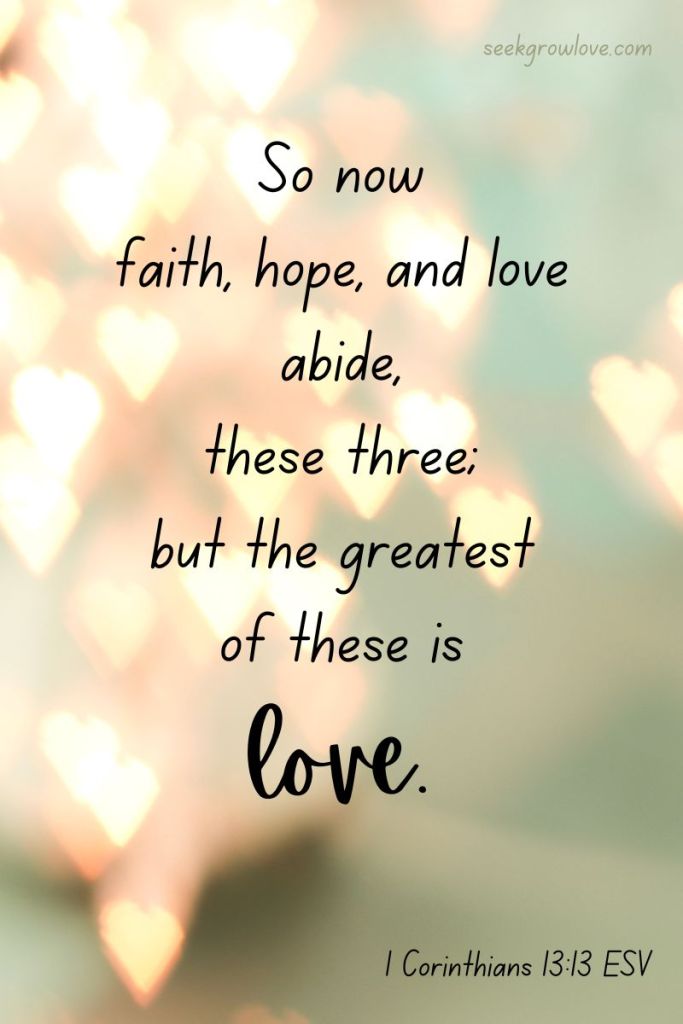
So now faith, hope, and love abide, these three; but the greatest of these is love.
Here as Paul brings this section to completion he brings home the point. It’s important to be gifted, to use your gifts and talents to serve in the Church and to serve God in the world, but as important as those gifts are, they are not the ultimate or final good, they are penultimate or next to last good. To speak a prophetic word to exhort a congregation is important, to exercise the gift of speaking to the world in ways that are understood by people of different languages is valuable, and knowledge is a necessary good to a flourishing life and church, but all of these are penultimate good, not ultimate. They will give way to the eternal, but love will outlast everything. At the end of all things love for God is love.
I’m getting older and I have some serious health challenges which remind me that I am a mortal person. Unless Jesus Christ returns very soon I will one day join those who have gone to “sleep in the dust of the earth” (Daniel 12:2) awaiting the resurrection. As I get closer to my personal end, I am more aware of that which is truly most important in life. It’s not my accomplishments, it’s not how much money I’ve earned, at the end of the day what matters most is “Did I love?” Jesus summed up the entire teaching of God with 2 things: “Love God and Love others”. Paul is adding more depth and clarity to what love looks like and what we all should aspire to be. Every morning we should ask, “God, how can I love well today?” And at the end of the day ask “God, how well did I love today?”
Reflection Questions
When you hear the words “Love never ends” what comes to your mind?
Why do you think Paul says that being loving is even more important than being gifted?
When will you start to begin your days asking “God, how can I love well today?” And at the end of the day ask “God, how well did I love today?”
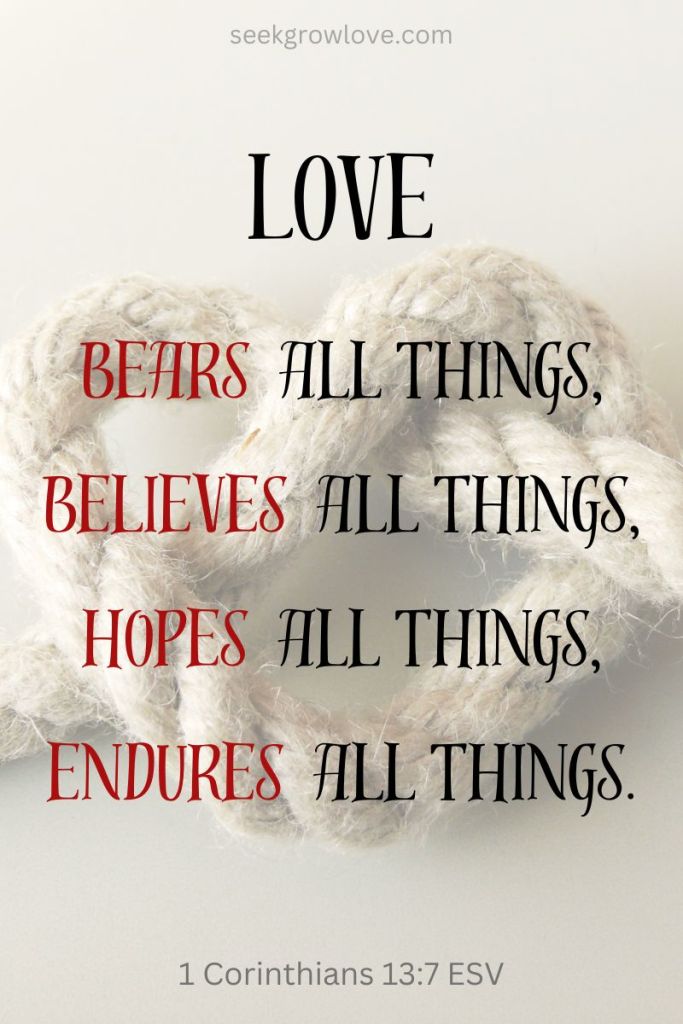
Love bears all things, believes all things, hopes all things, endures all things.
Through this week of reading through 1 Corinthians 13 Paul is giving us concrete examples of what It means to love. He’s building this message into a kind of crescendo. Like a great symphony or chorale masterwork, the various themes of the story build on themselves. Here he is moving toward the peak of this love song with 4 things that love does: love bears, love believes, love hopes and love endures. That would be a lot. But he adds “all things.”
I could take time and give you a detailed exegesis of what each of these words means in the original Greek and how they are used in Corinthians and throughout Paul’s writings and the Bible as a way to arrive at their precise meanings, but I’m not going to do that. Instead, I’m going to tell you a story.
I grew up in a loving family. My father was a pastor and also a school teacher. My mom was a pastor’s wife and drove a school bus and took care of our family, keeping us fed every day precisely at 6 p.m., our clothes washed and our house neat. I felt loved and supported along with my 2 older sisters Cheryl and Debbie. I was the baby, younger than my two older siblings by 7 and 10 years. My parents were in their early 40’s, our family was settled and my oldest sister had already left the nest and gotten married. I was an active boy, a happy ‘tween who played baseball and basketball and hadn’t started noticing girls yet at eleven, but life was sweet. We went to Church every Sunday and learned about God and his love for us.
Then the world changed. My Mom found out that she was going to have another baby. Surprise! Jeff, you’re not going to be the youngest child anymore, you get to be a big brother. I couldn’t wait, after years of being the only boy, the little brother who had to listen to his older sisters who both loved me but could also be a bit bossy. Sometimes it felt like I had a Dad and 3 Moms telling me what to do. Now I would have a little brother to boss around and to show how to hit a baseball and shoot a free throw. I even had a name picked out for my little brother, Scott. I don’t know why I picked that name, but that was the name I picked for my little brother.
As it turned out, “Scott” was born a little girl, whom my parents named Christine Noelle (she was born right after Christmas so she got a very Christmasy-sounding name). Before I got to meet my little sister (I got over the fact that she was not my little brother Scott) my parents shared that she was a special child. She was born with some differences in her little body that made her look different from other babies that I had known and she would not be able to do all the things that other children did in the way that they did them. The name for my sister’s condition was called Down’s Syndrome. I didn’t fully understand what that meant, but I was glad when my parents got to bring her home and we all loved her very much.
For the next 50 years my Father and Mother, and after my father died my mother alone, provided love and care for Christine. She received cutting-edge health care. She had multiple surgeries to repair things that normally didn’t function well in children with Down’s Syndrome that would help extend her life. She started getting therapy and schooling and grew to be a happy and loving young woman.
I found out many years later, as an adult, that when she was born her doctor advised my parents to have her institutionalized. He said she would never live with a good quality of life and would be a burden to them. It would be best for them, for the family, and everyone else to let her be put away. I am so glad that my parents did not listen to the advice of their physician but to the love of God in their hearts.
My mother, who is now 90 has spent the last 50 years loving my sister Christine. Christine has spent the last 50 years loving my mom. My mom has spent 50 years bearing, believing, hoping, and enduring many trials and challenges while caring for my sister. She has been for me, a model of what Paul talks about when he describes what true love is all about.
At 90, my Mom has come to recognize her limits, she will not be around forever to care for Christine, but even now she is acting in love to help prepare my sister to live a good and flourishing life after my Mom is no longer here.
I could tell many other stories about love that I have seen and experienced in my life.
When we love in selfless ways we bear God’s image to the world.
Pastor Jeff Fletcher
Reflection Questions
Think of a person in your life who modeled a selfless love for others. What does their life teach you about God’s love?
Why does Paul connect bearing, believing, hoping and enduring all things with concrete examples of love?
What is something you can do today to show selfless love for another?






 Seek Grow Love