
Good Works

*Nehemiah 9-10

Psalm 90

*Titus 3

-Devotion by Jeremy Martin (TN)

            The restoration of a people is a beautiful thing.  When the (1st) temple was destroyed in @587/586 BC and the people were taken captive and led off to Babylonia as a result of their sins, they languished there for 70 years.  The return happened in waves: Zerubbabel went to start rebuilding the Temple (@538BC), Ezra went later and restored the law (@458BC), and then Nehemiah returned (@445BC) and rebuilt the wall, the infrastructure, and finished restoring the law to Israel (with Ezra).  Tying prophecy to history is sometimes confusing and can be very subjective depending on your interpretation and understanding.  One of the things that confused me initially is that the Jewish year has 360 days in it, our calendars today have 365 days in it.  Over time that can skew calculations, but keep in mind that the OT prophecies (as most scriptures) were written for ancient Jews.   That’s important to keep in mind, particularly to keep a correct context and exegesis when interpreting scripture: the target audience was (at least initially) the Hebrews, God’s chosen people.

            The ancient Jewish understanding of God is very clear in this exceptionally beautiful prayer of repentance by the people in Nehemiah 9.  To help give yourself that same understanding, I highly recommend that if you have a bible that translates the name of God as “THE LORD” (all capital letters), highlight that every time you come across it.  Then, somewhere on that same page write a note “YHVH”, the sacred and holy personal name of God, and highlight that.  Note that this will not be a quick task, because the personal given name of God occurs about 7000 times in the Old Testament, more if you count the abbreviated “Yah” or compound titles like “YHVH Tzevaot”.  The correct pronunciation of this is debated (The V is thought to be pronounced like a W in ancient Hebrew), but the important thing to remind yourself every time you come across it is that this is a personal name, not a title, and it’s the name God asked to be identified by (in Ex 3:15) “forever”.

            Chapter 9, v1-3 gives a very, very important description of how the people approached God, one that we should take to heart when we’ve transgressed and are seeking to return to His favor: humble yourself .  These folks fasted, humbled themselves, and confessed their sins.  They called upon God by name (v5) and blessed the name of God.  Then they pronounced this critical statement of faith that was central to the entire faith of all Jews: “You alone are Yahweh“, and followed with a list of accomplishments and deeds that God had done (v6-15).  They continue on and confess their sins (v16-31), and then while acknowledging their own guilt and the righteousness of God in punishing them for it, they ask for mercy (v32-37), and ask to enter again into a covenant with God (v 38, and then all of the specifics of the covenant are listed in Chapter 10 in it’s entirety).

            In Nehemiah c9v27 about 3/4 down the verse it says: “You gave them saviors, and they (the saviors) saved them (the Israelites).” (LSB translation).  So, who sent them saviors?  God did, we see throughout scriptures that God interacts with His creation through agents, but that even though the agent may have physically performed the task, it was God who caused it.  So who saved them? God did, again, because He sent the saviors (the judges, in this instance).  Even today, we understand that if a subordinate performs an action on behalf of their superior’s direct orders, it was actually the superior that caused the action to occur.  The Jewish folks have a legal term for this, called “shaliah” (see 1/27/26 devotion).  It’s critical to understand this concept in order not to misinterpret or misunderstand scripture.

            Here’s a good example of why: in Titus 3:4 it says “4 But when the kindness and benevolence of God our Savior appeared,” (REV) , and then down a little bit further in Titus 3:5-6 it says, “5 he saved us, not because of righteous works that we ourselves did, but on the basis of his mercy, through the washing of a new beginning and renewal by the holy spirit, 6 which he richly poured out on us through Jesus Christ our Savior” (**Note that I’d originally had the LSB pulled up, but switched to the REV for this quote because the LSB evangelical bias was showing pretty strongly: holy spirit had been capitalized, and “which” had been incorrectly translated as “whom”, attempting to nudge the readers in a specific direction of interpretation.).  In the above comparison, we see that God is stated as being our savior, and then Jesus is stated as being our savior.  Does that point to a hidden “complex” understanding of God then? 

            Certainly not.  We understand that when God sends an agent, the credit for the actions of that agent are reflected to God, since God sent them.  While we can absolutely say that Jesus (the) Christ is our Savior due to his obedient submission and sacrifice, we can also absolutely say that God is our Savior because He sent Jesus.  God initiated the action, Jesus performed the action.  Jesus himself explains this to us, saying that God sent him about 30 times in the book of John alone.  This is very clearly explained throughout scripture.  I sometimes find myself getting a bit passionate about this very simple scriptural understanding, particularly when later traditions are presented to me as biblical truths, and particularly in a “church” environment.  That can be dangerous, though.

            That same passion is probably exactly what allowed men’s hearts to be corrupted, and to torture and murder fellow believers, when they believed differently.  We see in Titus 3:8 that: “those who have put their trust in God will apply themselves to good works” and in Titus 3:9 that we should “avoid foolish speculations and genealogies and strife and fighting about the law, because they are unprofitable and pointless.”.  Our focus should be on doing good works.  We’re just humans.  Regardless of what you believe, how are you acting on that belief?  This scripture tells us that we should be more concerned about performing good works in God’s name.  I absolutely believe that scriptural truths are important, but I also don’t want to be the most correct theologically understanding guy that didn’t make it into the kingdom because I didn’t act with love towards my fellow creation.                      

            So what is the perfect balance?  It’s tricky.  We see from scripture that our priority should be to trust in God, and to focus on performing good deeds to the glory of God.  That being said, it’s also important to understand scripture properly, because “God seeks those who worship Him in spirit and truth” (John 4:23-24), and I believe it’s a very good thing to share our understanding: provided we can do it in love.  Humbly, gently, with overwhelming concern and patience, and considering others to be greater than ourselves: but also firmly, and unwaveringly, using the scripture as our foundation.  Pray to God, and He will grant you wisdom.  In the meantime, if you’re not sure on how to proceed, focusing on good works will show where your heart is to those around you.  It will take time, patience, love, and God’s wisdom to affect any changes in understanding that are deep and meaningful.  Be a light to the world around you, don’t beat up the world around you with your light, but let it shine.

REFLECTION QUESTIONS:

  1. Have you put your trust in God, or are you still trying to run things your way?
  2. What good works have you done this week?
  3. Do you plan your good works, or just wait for opportunities? Why?
  4. Which is more important to you: a correct understanding of scripture, or the correct implementation of the scriptures you understand?  Why?

PRAYER

Father God, grant me the heart to do Your will here on the earth, in a manner that pleases You.  Help me to love as deeply as You’ve loved us, and to share my faith in a manner which honors and pleases You.  Help me to be humble, and to follow Jesus’ example.  In Jesus name, Amen.
Remind the People

Old Testament: 2 Chronicles 31-32

Poetry: Psalm 105

New Testament: Titus 3

Life is so busy and complicated that I have to create lots of reminders for myself.  Fortunately, my phone and computer and watch all have features where I can set reminders for myself.  “Doctors appointment Tuesday at 3:00.  Take the garbage to the dump on the way to work in the morning.  Stop by the store after work and pick up some milk and bread.” I can even set reminders months or years in advance.  I can set alarms to remind me that in 2 hours I have a meeting.  In 1 hour I have a meeting.  In 15 minutes I have a meeting.  The Meeting is now starting.  Maybe I’m too busy or maybe I’m getting old, but I find myself more and more needing reminders.

Do you ever need reminders?  Little kids need to be reminded to brush their teeth, make their bed, do their homework.  What do you need reminders for?

The Apostle Paul thought reminders were important for Christians.  I guess he understood how easy it can be to forget what’s important when we are busy living life and doing  what’s necessary or urgent.  Do Christians ever forget important things about God, about Jesus, about how we are supposed to live?  Yep, we sure do.

In Titus 3 Paul tells Titus to remind the believers of some important things.

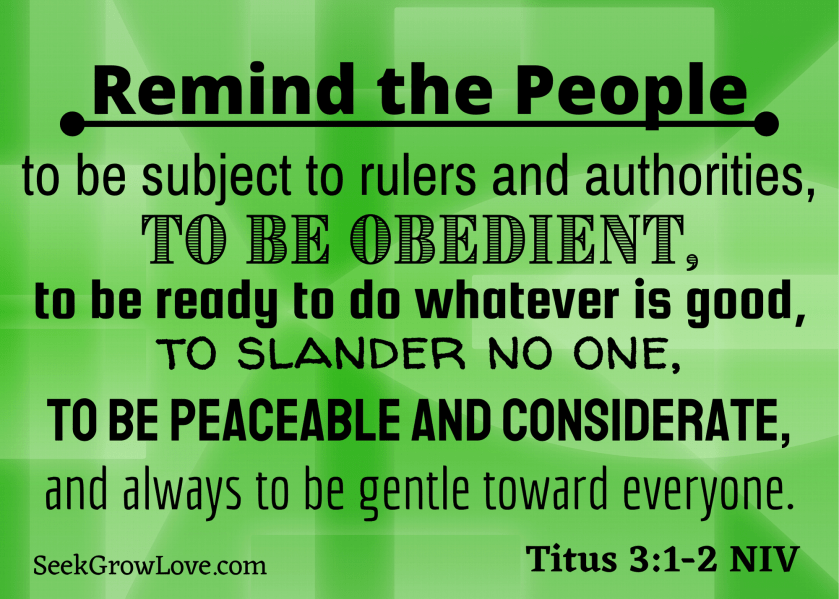
“Remind the people to be subject to rulers and authorities, to be obedient, to be ready to do whatever is good, to slander no one, to be peaceable and considerate, and always to be gentle toward everyone.” -Titus 3:1-2

Those reminders were important in the first century when Christianity was brand new and people were still learning the basics, but it’s been 2000 years.  We’ve certainly got being a Christian all figured out by now, don’t we?  Do we really need to be reminded to obey people in authority?  Do we need to be reminded to always be ready to do good?  Don’t all Christians always do what is good?   Certainly we never  slander or falsely accuse someone of wrong doing.  I’m always peaceable and considerate and gentle toward everyone, aren’t you? (My tongue is in my cheek- that means I’m kidding).

To tell the truth, I still need to be reminded of all of those things.  Just because I’ve been reading the Bible for over 50 years doesn’t mean I always remember to do good.  I still need to be reminded to be considerate and gentle, and so do you.  That’s why Christianity was never designed to be lived in isolation, but in community.  We need each other.  There’s a passage in Hebrews (a different book from today’s reading,  but important) Hebrews 10:24-25 says that Christians shouldn’t get out of the habit of meeting together, because we need to encourage (I think Hebrews says “spur one another on”, like a rider spurs on a horse) each other.  

Following Jesus is hard some times.  Being obedient to God is hard some times.  Remembering to do good and be gentle is hard sometimes.  I need help, I need encouragement to keep on doing what is right.  I need you, and you need me, we need each other.

I’ve read the Bible many times in my life and I need to keep on reading it to help me remember all the important things I need to remember.  Today’s readings in Isaiah 63-64 and Titus 3 remind us both about God’s wrath and about God’s mercy.  God has both.  God hates sin, he hates it when his children are brutal to each other.  He hates it when his children fight and argue.  He hates sin because he loves us and he knows that sin hurts us.  We hurt each other when we sin.  No parent likes to see their children hurt each other.  We learned that from our Father, God.

So keep reading your Bible and keep coming to Church and meeting with other believers so that you can remind them and they can remind you to keep on following Jesus.

“Hey Siri  set a reminder for 7 a.m. tomorrow:  be considerate and gentle to everyone.”

“Alexa, remind me to get up for Church Sunday at 8:00.”

-Jeff Fletcher

(Originally posted here on October 4, 2021 – when we were reading Titus and Isaiah together. This year, we get to start Isaiah tomorrow.)

Reflection Questions

  1. What do you need reminders for?
  2. Look at the list of things Paul told Titus to remind the people to do. For each one ask yourself why is this important and how well am I doing this? If you were to choose one to focus on reminding yourself to do for the next 14 days, which one needs your most attention right now?
  3. What is your attitude toward those who give you reminders?
  4. How can you encourage others to do what is right?

Before-and-After Transformation

Titus 3

Saturday, September 17, 2022

Though I had never met the woman in person, I was pretty certain it was her. I’d seen many photos of this wellness coach, and I had always been stunned at her story: she lost nearly 200 pounds by following the Trim Healthy Mama (THM) plan, which I try to also follow for health reasons, and was now a weightlifter as well. Something about her smile was distinctive and very recognizable. I knew she lived in this general area, so it wasn’t too far-fetched to think it could be her. As we got off the hotel elevator together, I summoned up the courage to ask: “Excuse me, are you a THM coach?” She looked stunned, but kindly replied, “Yes, I am…” I explained that I recognized her from the social media pages and was awed by her story. She gave all the glory to God for helping her become healthy. We said a few more words and then parted ways. Later that night, she posted humorously on the group page that she was now a B-List celebrity because she had been recognized in public looking a bit disheveled on her way back from the hotel waterpark, and then I formally introduced myself on social media as well. 

“Before-and-after” posts almost always entice me to stop scrolling and read into the story. Whether it is a weight loss, home makeover, cake decorating challenge, hairstyle tutorial, or hoarder-to-minimalist success story, I feel so thrilled watching a transformation take place. I think we all love a good change for the better, yes? Perhaps that’s why I’m fascinated with the metamorphosis of butterflies too! 

Paul tells us how our “before-and-after” should look, beginning in Titus 3:3: “At one time we too were foolish, disobedient, deceived and enslaved by all kinds of passions and pleasures. We lived in malice and envy, being hated and hating one another.” That is who we used to be, but that is not who we are now! He continues, “But when the kindness and love of God our Savior appeared, he saved us, not because of righteous things we had done, but because of his mercy. He saved us through the washing of rebirth and renewal by the Holy Spirit, whom he poured out on us generously through Jesus Christ our Savior, so that, having been justified by his grace, we might become heirs having the hope of eternal life.” So, what do we do now instead of all those behaviors we used to do before we were saved? Paul says, “I want you to stress these things, so that those who have trusted in God may be careful to devote themselves to doing what is good.” 

Before God saved us, we were overcome by all sorts of sinful behaviors. But now that  we have experienced the kindness and love and mercy and grace of God that we did not deserve, we need to devote ourselves to doing what is good. 

We have known since we were children sitting on Santa’s lap that we were supposed to be good! But what exactly does that mean in a biblical kind of way? Hop back up to verse 1 to find a bit more guidance. “Remind the people to be subject to rulers and authorities, to be obedient, to be ready to do whatever is good, to slander no one, to be peaceable and considerate, and always to be gentle toward everyone.” This list seems to be at least a partial, but still challenging, description of “doing what is good”, don’t you think? 

Paul urges yet again – it must have been such a problem in their society as it is in ours! – to avoid foolish talk (verse 9). I’ve noticed this theme throughout 2 Timothy and Titus; it is a good reminder that we need to pay careful attention to watch what we say, making sure our words are edifying. We are called to be representatives of Jesus in everything we say and do. 

-Rachel Cain

Reflection Questions: 

What does your “before-and-after” look like? Maybe, like me, you were raised a Christian and don’t have a dramatic story to tell. But God has still saved you by his grace! Write out your salvation story and testimony, so that you will always be ready to give an answer for the hope that you have. (I Peter 3:15)

In this scripture, Paul calls believers to “do what is good”. What are some specific good things you think God is calling you to do in this season?