HOPE

Isaiah 51-53

isaiah-51v6

Tuesday, February 21

These three chapters go together much better than some of the other chapters, in my opinion, so they are easier to write about all together, instead of chapter by chapter. Again there is SO much hope in these chapters, you just have to know where to find it. Throughout these chapters, God is comforting his people, and reminding them that he is always there for them, that he always knows what is best for them, and that he always comes through on his promises. He reminded them, and is reminding through these words that we can look to our ancestors and the promises that he made to them. He reminds his people of what he did for Abraham and Sarah, by giving them children and promising Abraham many children-we are all known as children of Abraham. How super cool is that promise! God is still fulfilling the promise that he made to Abraham even though Abraham has been gone for many many many years. He later in 51 says that the heavens will vanish and the earth will diminish and the people will die, but there is more in store for us as believers. God’s salvation will last forever and his righteousness will never fail. This is an amazing promise that talks of the promise of the coming kingdom. 52 talks about the history of the people of Jerusalem. He talks about how his people were forced into Egypt as slaves-they were bought with no money, and with no money they will be freed, because God has always known what would happen and had a plan to get them to freedom, God knows our hearts, and he knew that we would all go down a path of destruction, just like Adam and Eve-this is in human nature. This is why God sent his one and only begotten son into the world- that we might live. God knows everything; he knows your heart and mine, and he put a plan in place thousands of years ago for us to be saved. We need to heed all of the warnings in Isaiah, but we also need to rejoice in the good news this book carries as well.

A song for today:

“This Is Love” by Aaron Winner

https://www.youtube.com/watch?v=rQbjSTo3lYc&list=PL0v5rBOVXt3yiPNooFzmz_JxdInamLeIK

-Devotion by Jana Swanson
(photo credit: http://hiswordinpictures.blogspot.com/2011/08/isaiah-516.html)

Hallelujah – Praise God – Amen

Nehemiah 11-13

picture1

picture2

Sunday, December 11, 2016              

Today’s Bible reading wraps up some of the bleakest days in Israel’s Old Testament history due to the exile of God’s chosen people. Nehemiah’s courageous leadership prompted walls being restored and repaired to fortify Jerusalem. The precious contents of the temple could now be protected and temple service could begin again. A re-population of the Holy City was beginning to take place and the ancient promises of Yahweh were again being demonstrated to His people when they worshiped Him only.

The bulk of chapters 11 & 12 basically read as a holy “roll call.” While the inclusion of the long list of names do not make for much intriguing reading, (comparable to phone book reading for pleasure perhaps), it should prompt the reader to understand how a God of detail fondly remembers those who have been faithful to the cause, working to restore and revive His name.  These were brave families returning to a city in ruins, desperate to see God’s glory shine again in their land.

The end of chapter 12 sets the scene for one of the greatest days in the history of this holy community – a party of all parties! Imagine the pageantry of a redeemed people taking back their rightful place as they occupied the strategic places of Jerusalem and dedicated the walls. The atmosphere must have been electric and how the people must have rejoiced.

In chapter 13 it is apparent that Nehemiah returned to the king of Babylon for an undisclosed amount of time. Upon return to Jerusalem he finds that some of Israel’s enemies are residing and thriving within the city once again. He is outraged and leads a purging once again of foreign worship and mixed marriages. He institutes financial support of the temple and demands observance of the Sabbath.

He concludes the chapter and book by asking God to fondly remember him with favor for the work he has done there.

Reflecting over today’s reading this entire account reminds me of an upcoming event where new residents will move in, dedication and reforms will begin to unfold, and great service will be remembered in celebration. A “changing of the guard” of our own Church of God of the Abrahamic Faith headquarters will soon be taking place. Slated for the second week of January 2017, a new CEO, Chief Executive Officer, will begin to learn and assume duties as the leader of our General Conference and Bible College in Atlanta, Georgia. I am diligently praying for Seth Ross as he takes the baton from Dr. Joe Martin to lead our organization. I hope you are too.

The Book of Nehemiah provides a great illustration of how prayer and hard work can accomplish seemingly impossible things when a person determines to trust and obey God. Nehemiah was a man of responsibility, vision, prayer, action, cooperation, and compassion. Thank you, Dr. Joe, for displaying those same qualities over the years. We are excited about the future as Seth Ross, another dedicated leader, takes the reins to rightly divide the Word of Truth and the work of God in our conference. May it be our prayer that just as in Nehemiah’s day, many will hear and answer the call to follow as well. May you remember us all with favor, O God, as we long for your Son’s return and work for Your renown!

Julie Driskill


Julie Driskill is an encourager who celebrates the process of Divine pilgrimage wide open.  She’s never met a stranger and her distinguishable laugh is a dead give away in a crowded room.   

Receiving a B.A. in Education from the Clayton State University, Morrow, GA, she jointly attended Atlanta Bible College where she studied and worked for several years.  Julie’s philosophy of life revolves around service.  One of her favorite life quotes is “Service is the rent we pay to be living.  It is the very purpose of life….and not something you do in your spare time.” – Edelman

With the steadfast support of friends and family over the past twenty years she has pursued this goal of service by developing and implementing the work of Higher Ground Camp, an Ohio based 501 (c) (3).    

For the past two years Julie has expanded her duties to collaborate with Family & Youth Initiatives, of New Carlisle, Ohio, as an in-school educator for the Real Life Teen Choices Program. She teaches sexual risk avoidance curriculum to students in grades 6-12 in public and private schools in eight counties. Developing after-school leadership programs and peer to peer mentoring networks for at-risk youth has become her specialty.


Hand Me A Hammer, And Maybe A Sword Too

Nehemiah 1-4

nehemiah_rust_door-1024x682

Thursday, December 8

If you have a toolbox, then Nehemiah is the book you should read.  Nehemiah is the story of Nehemiah who was the cupbearer to King Artexerxes.  He had been wondering how the city of Jerusalem was progressing since the captivity of himself and others.   When he heard that the city wall was in ruins and the gates were burned he was greatly distressed.  He was so distressed, and so favored by King Artaxerxes that Artaxerxes  allowed Nehemiah to return to Jerusalem.  With letters of the King’s blessing with Nehemiah he travels to Jerusalem where he does a midnight tour of the damaged gates and places of the city.  Then in the day he proposes to the people of Jerusalem that they rebuild the city gates and walls.  This suggestion is opposed by two men who prove to be enemies of the work named Sanballat and Tobiah.

Work is begun on the wall and each branch of the Jewish families takes on a portion of the wall to rebuild or gate to be hung.  Some families even take on more parts of the wall or structures to repair and rebuild.  The work is going well and is being blessed by God in that all are working toward a common goal – to rebuild the protective wall around Jerusalem.

Sanballat was extremely displeased with the progress of the city wall and plotted against the people of Jerusalem.  He gathered an army of men to come and attack the people who were restoring the wall but the plot was uncovered and Nehemiah devised a plan of his own.  He stationed families with swords, spears, and bows by the wall so that they would be able to defend the city should they be attacked.  He also had all the workers who were working on the wall carry a spear with them from dawn until dark and set night guards around the city as well.  The enemies were discouraged by Nehemiah’s quick  protective thinking, and work on the wall continued uninterrupted by any enemies.

The people were able to accomplish a lot because they worked together.  Nehemiah comments that the people had a mind to work.  Isn’t it a great feeling when people are working together in harmony?  It makes the work seem easier and makes it go faster.  Even when the people had to hold a spear in their hand and continue working they still kept a common goal and interest in mind – the completion of the wall.  How often do we find ourselves working with a group of people with the same goal.  The people in Nehemiah all came from different family backgrounds and professions yet they were able to collectively focus to work on a huge task.  How important do you think it is to be able to work with others ?  Are you able to work towards a common goal with people who have different backgrounds or ideas of what is best than you do?  God wants us to be able to work together with people who are different than ourselves.  When we work together for God’s purposes in life He is pleased with us and will bless our work, just as he blessed the people of Jerusalem who worked together.  Key Thought :  How can I work with others to accomplish God’s purposes.

-Merry Peterson


Camping in Enemy Territory

Ezra 8-10

ezra822

Wednesday, December 7

Who would have thought that there would be a story about camping in the Bible.  The book of Ezra goes on to tell about how Ezra went with a company of people and those of Levitical heritage on a journey to the city of Jerusalem and the surrounding area.  They had a long, dangerous trek ahead of them sometimes even camping  in enemy territory.  They did not ask for soldiers or guards to protect them for their journey because they had said to the king that their God would protect them.  They were placing their trust in God to see them through the rough territory and prayed specifically for Him to protect them, their  children, and their possessions.  God honored their trust in Him and protected them.  When they arrived at Jerusalem they were able to give the gifts that King Artexerxes had sent, and able to offer the appropriate sacrifices.  They were also able to deliver the king’s edicts to the governors in the provinces beyond the river, and so Jerusalem’s neighbors began to show support for Jerusalem and the people who inhabited it, and the temple of God.

Then it is brought to Ezra’s attention that God’s people have been intermarrying with the idol worshipping people of the area around Jerusalem.  God had specified that the people should not intermarry as not to become entangled in the worship of other false gods within their homes, and the pagan influence that would be brought upon their children.  God wanted to keep his people from being drawn into pagan idol worship as they were so prone to being drawn into.  Ezra went into a time of mourning for the situation of God’s people.   He pleads with God for forgiveness for the people’s sins of disobedience.   A time of group repentance was held and sacrifices made to pay for the sins of disobedience to God in marrying foreign women who did not worship God thus concluding the book of Ezra.

What caught my eye was that Ezra and his company of people camping along the way decided to ask God for His protection instead of asking the King for a human army of protection.  They could have been attacked at any time by enemy forces, but because they chose to ask God for protection and trust Him – God protected them.  Have you ever asked God for his protection?  Are there times that you have felt God protecting you?  God is faithful to his promise that when we place our trust in Him, He will bring us through whatever situation we find ourselves in.    Key thought:  Place your trust in God because he is faithful to his promises.

-Merry Peterson


Some People Lift You Up – Others Bring You Down

Ezra 5-7

ezra-5-450x380

Tuesday, December 6

Some people really make your day, others – well they can really make your day worse.  With so much discouragement for the Jews in rebuilding the city of Jerusalem God decided to send several prophets to encourage the people in finishing work on the temple.  The prophets  Haggai and Zechariah were especially influential in bringing God’s encouragement to the workers rebuilding the temple.  A governor named Tattenai from beyond the river tried to put a stop to the rebuilding process by asking who had given them permission to rebuild the temple.    He wanted a detailed, official report from King Darius of who had truly funded this rebuilding project,  why this temple was being rebuilt and any details that might cast a negative light on the Jews rebuilding of their city.  King Darius looked into the matter and discovered that king Cyrus had indeed been moved by God to let the Jews rebuild the temple and their city with part of the bill being paid by the Babylonian empire.  Darius was so moved by the reading of the documents that he decreed that anyone who opposed the rebuilding project should be put to death and their home destroyed.  So the Jews were able to complete the rebuilding of God’s temple in Jerusalem with the encouragement of Haggai and Zechariah.

The city was beginning to take shape, and this is where Ezra whom the book is named after  comes onto the scene.  He was a priest and scribe in Babylon who had favor with the Babylonian king after Darius which was king Artaxerxes.  Ezra was decreed by the King to go to Jerusalem and select men who would be rulers over the city and set up the civil government of the city, appointing magistrates and judges for the people.  But King Artaxerxes didn’t send them empty handed.  He sent them with many gifts to embellish the temple and many measures of wheat, wine, oil, and salt that would be needed.  He even gave authorization to use the royal treasury money for whatever else they needed to ensure that proper temple worship could be accomplished.  This greatly encouraged Ezra and the people of God in Jerusalem.

Thinking about the many players in this account of the rebuilding of the temple it seems to me that there are those who are determined to bring the people encouragement and those who are determined to bring the people discouragement.  Are there people like that in your life too?  You may have noticed that there are some people who lift up your spirit, and some people who bring your spirit low.  Notice how God knew the discouraging people who brought the people down, and would send someone like Haggai or Ezra along to lift the people’s spirits up again?  Does God do this for us too?  Has he ever sent someone to encourage you and lift up your spirit when you were discouraged?  Maybe He has used you to help lift up the spirits of someone else just like he used Zechariah,  Haggai and Ezra.  They brought an encouraging word to the people.  Will you let God help you to be an encourager to someone else this week?   Key thought:  Ask God to help you be a person who lifts others up rather than a person who brings others down.

-Merry Peterson

The Day God Needed a U-Haul Truck!

Ezra 1-4

ezra

Monday, November 5

God could have used a U-Haul truck when His people were allowed to go back to Jerusalem after being taken captive into Babylon for 70 years.  God moved King Cyrus of Persia to allow the repatriation of the Jews back to their home in Jerusalem.  There were a lot of people who went , especially those who were from priestly lineage.  To find out just how many people went on this journey back to Jerusalem take a calculator and add up the number of people listed in chapter 2 verses 2-65!  They also had to pack up all the dishes that were to be used in the house of God that had been previously ransacked from God’s temple in Jerusalem some 70 years before.  That’s a lot of people, and things, to move all at once.

When the Jews did return to Jerusalem they began to re-instate the priestly duties of sacrifices even though the foundation of the new temple had not yet been poured.   They also began to celebrate their festivals as was their religious custom.  Cyrus had agreed to help them build the temple so orders for the cedar wood from Lebanon which was to be used, were issued.  The main contractor of this building project was a man by the name of Zerubbabel.  His job was to take this pile of rubble and figure out how to help make it into a beautiful place for God’s temple once again.  The people were overjoyed when the foundation of the new temple was laid and a celebration was held.  Things seemed to be looking up for God’s people but then some of their jealous neighbors in the land began to complain.  They sent complaints to Cyrus and the following kings of Persia making up all sorts of claims about the Jews who had returned which were not necessarily true.  So, with the distractions of unhappy neighbors in the land, and many hassles and arguments about the rebuilding that the Jews were doing, soon they became discouraged and left the project of rebuilding God’s house undone.  Not until the second year of the reign of King Darius of Persia did the completion of the temple happen.

Having been through a recent cross country move myself what caught my eye was all those dishes that were to be used in God’s temple that had to be transported.  5,400 to be exact!  They were made of gold and silver so they would have to be packed very carefully as not to be scratched or broken.  This gives dish duty a whole new meaning.  In my move a few of my dishes broke.  Thinking about this it makes me think of how broken the city was and the temple of God was when the people returned to their beloved city.  They must have been excited at first at the prospect of going back, but once there I’m sure that seeing all the brokenness of the city must have been very discouraging.

Think about one of the greatest things God can do — He can fix what is broken.  Sometimes we may feel broken , or tossed about by the circumstances in our lives.  So did the Jews.  The good news is that God can fix what is broken.  He helped the Jews to rebuild the temple to Him, and their lives after being exiled for so long – He made them beautiful again.  He can help us too by fixing the broken parts of our lives and shaping it into something beautiful.  Key thought:  Think about how God has helped to fix the broken parts of your life and think about how He chooses to make it beautiful.

-Merry Peterson

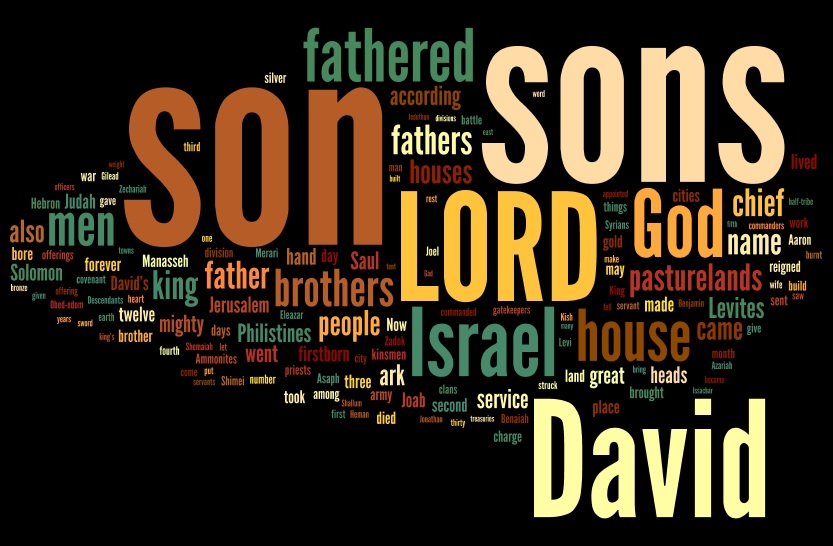
Faith of Our Fathers (1 Chronicles 11-13)

Friday, November 18

13-wordle-1-chronicles

As I mentioned in the devotion a few days ago for 1 Chronicles 1-2, tradition says that this book was probably written after the Israelites returned to Jerusalem following 70 years in exile.  This was probably during the time that Jerusalem was being rebuilt, a time with a lot of struggles and fear.   There were not walls around the city.  There were enemy nations around.  They had not had their own kingdom in the entire time most of the people had been alive.  This was all new for them.

These chapters start the retelling of the time when David was king, a prosperous time in their history.  In 1 Chronicles 11:4, it says:

David and all the Israelites marched to Jerusalem (that is, Jebus).  The Jebusites who lived there said to David, “You will not get in here.”  Nevertheless, David captured the fortress of Zion, the city of David.

Then in verse 8, it says about King David:

He built up the city around it, from the supporting terraces to the surrounding wall, while Joab restored the rest of the city.

This must have been very encouraging at this time to see that David had to conquer and then build up Jerusalem, including the walls, during his reign.  The nation was greatly blessed while David reigned, so why couldn’t they rebuild and be prosperous and be blessed again.  David had trusted God, and they were now trusting God, so they could look forward to blessings and protection just as the people in the time of David.

We can all look back to the people in the church before us, and see how they trusted God, and how the church has been blessed through them.  This may be people in our family, in our local church, or others that we know of.  Their examples and the things that they have done through faith should teach us that with faith, we can also have protection, peace, and blessings as we serve the LORD.

-Andrew Hamilton

God’s Grace Brings Release (2 Kings 24-25)

Sunday, November 13

jehoiachin

Chapter 23 ended with Jehoiakim becoming king and doing evil in the eyes of the Lord just as his fathers had.  Then moving into chapter 24, Nebuchadnezzar comes onto the scene.  He invaded Jerusalem, and made Jehoiakim his servant, to carry out his orders over Judah.  After 3 years Jehoiakim rebelled against Nebuchadnezzar.  The Lord sent armies against him for the evil he had done and he is killed.  His son Jehoiachin became king and continued doing evil in the eyes of the Lord as his fathers did.  The cycle is continuing.

After Jehoiachin had ruled only 3 months, Nebuchadnezzar laid siege to Jerusalem.  Jehoiachin surrendered and is taken prisoner.  All the treasures of the temple were taken, along with treasures from the king’s house.  All but the poorest people were exiled to Babylon.  Things were as low as they had ever been for Judah.  However, they kept getting worse, and Jerusalem was eventually destroyed.

This seems to just be a story of kings doing evil, and suffering consequences for it.  Fast forward 37 years and Nebuchadnezzar dies and Evil-Merodach becomes king of Babylon.  He releases Jehoiachin from prison and gave him a place of honor.  What a transformation overnight to go from prison to a place of honor with the king.

Have you ever felt that because of some mistake you made or some circumstances, that you can never get past it?  Have you felt that things are just going from bad to worse and you will never get past the problems you have?  I am guessing Jehoiachin felt that he was condemned to being in prison the rest of his life, and lacked hope at times.  However, his life turned around.  Doesn’t this sound like the grace of God?  There is nothing that shows Jehoiachin deserved this improved position, however he was granted it anyways.

Whether our problems are caused by our own mistakes or just circumstances we are in, we can have the hope of God’s grace, and have everything turned around.  We just need to accept God’s gift, along with repentance for our sins.

We can always have hope.

Andrew Hamilton