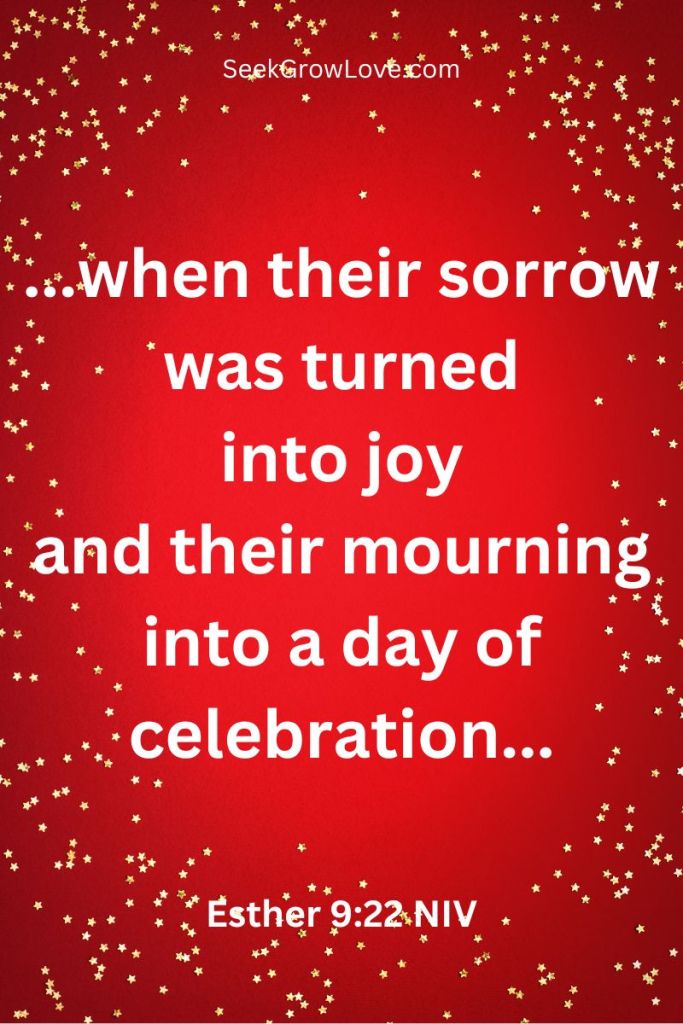
Esther 9:22 – “as the time when the Jews got relief from their enemies, and as the month when their sorrow was turned into joy and their mourning into a day of celebration. He wrote them to observe the days as days of feasting and joy and giving presents of food to one another and gifts to the poor.”
How often do you remember and celebrate the mercies God has shown you?
In this last section of the book of Esther we read about the establishment of the celebration of Purim which commemorates when the Jews saw their fear and sorrow turn into relief and joy as the edict of annihilation was overturned.
All throughout the Old Testament, God calls His people to set aside specific days to remember and celebrate all that was done on their behalf. From Passover to Purim and Rosh Hashanah to Chanukah, these Jewish holidays are full of traditions that have been passed down through the generations.
As New Testament believers we take time to celebrate Christmas and Easter. He is our Messiah, and our salvation and hope are only available to us because of his perfect life, atoning death, and miraculous resurrection.
Additionally, many of us regularly partake in communion, once again recognizing the sacrifice of Jesus on the cross and the promise of eternal life in the Kingdom of God.
But doesn’t God show us His grace and mercy daily? Shouldn’t we set aside time each day to pause, reflect, and give glory and honor for all that has been accomplished on our behalf? Like the Jews in the time of Esther, we too have been saved from the threat of annihilation from our enemies. We have been given the power of the Holy Spirit to do battle and conquer fear and so much more.
Every day we have reason to celebrate. Abundant living is ours today! God has given us so much. Let us never take it for granted.
-Bethany Ligon
Reflection Questions
Why do you think God gave directions for days of celebration? What benefits do they have?
What has God given you that He wants you to remember?
What was to be included in the celebration of Purim? What ingredients can you include in your holy days and in your every day?
The Gospel of John, chapters 7-12, have been happening in conjunction with our Old Testament readings these past two weeks. In the gospel of John, Jesus does not perform miracles per se. At least, John doesn’t call them miracles. Instead, John calls them signs. There are seven signs. These signs work with John’s overall mission. In John 20:31, we read “These are written so that you might believe that Jesus is the Christ, the Son of God, and by believing you may have life in his name.” “These things” that are written are the teachings of Jesus, but also the signs that show that he is the Messiah.
If you see the signs, you should recognize that Jesus is the Messiah.
That’s the point.
I really need to drive that home because I want to focus on a part of John 12 that has always bothered me deeply. It was not today’s reading but yesterday’s. Let’s look at verse 9-10 again: “The large crowd of the Jews then learned that He was there; and they came, not for Jesus’ sake only, but that they might also see Lazarus, whom He raised from the dead. But the chief priests planned to put Lazarus to death also; because on account of him many of the Jews were going away and were believing in Jesus.”
The seventh miraculous sign Jesus performed was the raising of Lazarus from the dead. It shows the power Jesus has been granted from the Father over the grave, and that Jesus himself is the resurrection and the life.
And the chief priests plan to kill Lazarus. They plan to take the one benefitted by the sign and put him down. They are so focused on preserving the comfortable way of life they have that they don’t realize they are destroying the good, the truth, the life of what is coming. A better way Jesus came to make. Maybe some of them knew Jesus really was the Messiah. It is even worse for them because they are knowingly attacking the resurrection and the life. The one who is the only way to the Father. They are doing so by denying his sign.
As you go through this advent, as you share the message of Jesus, the hope, peace, joy, and love he brings, don’t be surprised that there are those who cannot or do not want to hear the truth of that message; there were those in the time of Jesus who wanted to kill a man who Jesus raised from the dead. There will always be malcontents who cannot bear to experience joy and life.
What you are called to do is to love them, but never become like them.
May you be full of joy and life, this day and every day.
May you hear the voice of Jesus and jump for joy.
May you be raised by Jesus when he comes in his kingdom. Amen.
-Jake Ballard
Reflection Questions
In the account of the raising of Lazarus, where do you see yourself? Place yourself in the scene and imagine – what would be your thoughts, feelings, words, actions?
In what ways have you heard the voice of Jesus? What is your response to Jesus?
What is your response to those who reject the message and signs of Jesus that say he is the Messiah, the Christ, the Son of God?
Jake Ballard is pastor at Timberland Bible Church. If you’d like to hear more from him, you can find Timberland on Facebook (https://www.facebook.com/TimberlandBibleChurch/ ) and on Instagram (https://instagram.com/timberlandbiblechurch?igshid=t52xoq9esc7e ). The church streams the Worship Gathering every Sunday at 10:30. Besides studying and teaching God’s word, he is raising three beautiful children with the love of his life, plays board games and RPGs, and is currently learning how to speak Klingon. If you’d like to reach out to talk Bible, talk faith, or talk about whether Kirk or Picard were the better captains (though, of course, each were necessary in their own time), look Jacob Ballard up on Facebook (https://www.facebook.com/jacob.ballard.336) or email him at jakea.ballard@yahoo.com.
Jesus says, in the gospel of John, “God loved the world in this way: He gave his unique, one and only Son, that whoever believes in him should not perish but have everlasting life.” (3:16) Later, in the Revelation of Jesus, we read that anyone whose name is not written in the book of life shall be judged, but that those who conquer will never have their name blotted out of the book of life. (3:5)
As we come to a close in Daniel, we are struck with weird, disconsonant numbers. Yesterday, I gave you a giant history lesson; maybe today you are worried about a deep dive into math! Let me give you some hope, we aren’t doing math. (I can hear the sigh of relief from here.)
Instead, I am going to get very personal and very honest: eternity awaits you. This is not an “infinity-and-beyond” kind of aspiration. While the New Testament is very explicit in the book and verses we looked at above, it is what permeates the teaching and focus of Jesus. Eternity is coming. Whether at his return or at the end of our lives and our resurrection into the next, there is something coming. In Daniel 12 (and most places in the Bible) there is one resurrection at the end of the world. Daniel is full of metaphor and numbers, but here, the language is bolstered by the literal teachings of Jesus, and also other places in the New Testament. Daniel 12 tells us there will be a real, literal resurrection. Those who sleep will rise. But with one resurrection, there are two outcomes. One is everlasting life. One is shame and everlasting contempt. The gospel of John repeats as much: “Do not marvel at this, for an hour is coming when all who are in the tombs will hear his voice and come out, those who have done good to the resurrection of life, and those who have done evil to the resurrection of judgment.” (John 5:28-29 ESV) What does everlasting shame and contempt mean? Humans are not, in and of themselves, immortal. We die, the dead know nothing (Ecc. 9:5), the dead do not praise God (Psalm 115:17); instead the dead are, metaphorically, asleep, unaware of the passing of time. This matters because what is offered in Revelation is eternal life or the second death. Not torture forever, but the finality of hope, and the end of existence.
I am not a fire-and-brimstone kind of guy, and I won’t want to scare you. I want you to think through your options. Today, you have set before you life and death. More than that, you have eternal life or eternal death. I beg you, choose life! Jesus, the sacrifice for our sins, the ruler of God’s kingdom, the lamb slain from the foundation of the world, he desires to write your name down in his book of life. He, like his father, does not desire that any should perish, but all, whoever calls upon him, should live and live eternally.
My friends, may you call upon the name of the Lord Jesus.
May your name be found in the Lamb’s book of life.
May you spend eternity with all those who have called upon Jesus.
May you be blessed so that you may see God in his kingdom.
Remember, one day, we will all go on our way. We will all rest in death.
May we stand side by side in our allotted places at the end, covered in the grace of Jesus.
Amen.
-Jake Ballard
Questions:
It’s your turn to study! What are the connections between 1290, 1335, and “time, times and half a time”? Reading Revelation may make some of it clear, but you should ask your pastor. Be really specific and make your pastor think!
Some of our Christian brothers and sisters think that judgement means an eternity of pain and suffering. Can you understand why they might believe that? Can you see why it is wrong? List out some reasons in the Bible or in theology or philosophy that it might be wrong and explain them: “Human mortality” or “God’s love and justice” are good starting places, but think about going deeper.
Beyond numbers and judgement, I encourage you, during this time of Advent, to trust in what God has done in and through Jesus, our savior. I encourage you to trust him with your life and with your resurrection. I encourage you to talk to your pastor, youth pastor, or caregivers about becoming baptized, and finding forgiveness so that your name may never be blotted out of the book of life. God bless you as you seek him.
Today’s reading finishes up our time in the prophetic book of Ezekiel. A book that I’ve enjoyed studying a bit more- even if some days I’ve found myself with more questions than answers. Ultimately, it is nice to close in hope, and Ezekiel’s last chapters end with hope and a climax with God’s glory being restored to the temple. His words of prophecy were full of hope to those in exile even before the promised Messiah had surfaced. For us who have received the gift of the Messiah, and a personal relationship with God, the hope for a future restoration in the kingdom of God is something we still cling to in our days of exile.
The book of Ezekiel starts with a little less good news, and some warnings of destruction which certainly came to Jerusalem, but it ends with this detailed, beautiful prophetic description of a new temple yet to come. Historically, there has not yet been a temple meeting this description to fulfill this prophecy. And while some argue that this prophecy was solely fulfilled figuratively (in Jesus, in the church, etc.), others assert it is a future literal temple yet to come in the Millennium where believers reign with Christ. While I am certainly motivated to study it more after stumbling across the various ideas out there, because I am confident from scripture that there will be a literal return of Christ to earth, it appears to me these prophecies work well alongside that in describing a literal temple.
I appreciate the taste of restoration and return of God’s glory that Ezekiel gives us. In the United States, we have just finished another tiresome election cycle, and it seems like in these times we hear it all….. over and over again…..the self-proclaimed prophets, empty promises, whining and blaming, “pride, patriotism, and prejudice”…..the whole shebang. My hope and faith is not in America being great. Nor is it in world peace we know scripturally will not truly happen in this age- no matter who is president. My true identification or affiliation is not found in my national citizenship or any other political, demographic, or who-knows-what-now-label. My only sustaining hope is based in the promises given to Abraham and shared with me thousands of years later. I look forward to the world being great again, and pray Jesus will return soon, so that the meek will inherit it.
Ezekiel closes his prophecy telling us the name of the city he had described in such detail. It is called “The LORD is there”. In Hebrew, “YHWH sammah”. Two words that brought the most resonating image to my mind in all of the chapters in this book that I read. There will be a day when God and His son Jesus will dwell with us. Literally.
-Jennifer Hall
Questions:
What are your thoughts on how the prophecies from these chapters are/will be fulfilled?
What gives you hope in today’s reading?
How does the LORD “being there” impact a place? We know we’re invited!
I love petting zoos, seeing the animals at the 4H fair, and anytime I’ve been up close and personal with a sheep, I’ve been impressed! How soft and gentle, how amazing their wool coat really does feel, and for a non-farmer gal like me, how tricky it is to tell a sheep from a goat sometimes? How someone can tell a llama from an alpaca is also beyond me! I’ve never raised sheep or had a sheep of my own to care for. But, over the years, I’ve heard lots of sermons/teachings on sheep and shepherds, and a few takeaways I’ve learned are: sheep are mentioned a lot in the Bible!, sheep are reportedly dumb animals, and shepherds doing their dirty work were not considered the high class of society.
In today’s reading in Ezekiel 34 and 35, we encounter some Israelites being compared to shepherds though who perhaps thought they were the high class of society. And, they are being reproved harshly. In fact, even modern translations use a little “woe to” language in Ezekiel 34:2 ….”Woe to you shepherds of Israel who only take care of yourselves!
This verse caught my attention right away, making me think of a little phrase called “self care.” As an occupational therapist, these are words that for years were common in my “work language”, and it was a phrase referring to the self care tasks we need to do for basic daily living (dressing, toileting, hygiene, eating, etc.). Part of my job was to evaluate and work to help people with their self care tasks which can often be impacted by injuries, developmental disabilities, mental health challenges, etc. It wasn’t a phrase I heard out and about much in “non OT chit chat” for the first 10 years or so that I was working. And then it seemed to me that … kaboom….the phrase meant something new and was used all over social media, taught from preschool to college, and it was something emphasized as crucial for being able to function, be healthy, etc. But, it meant something different. It meant…..perhaps abstractly taking care of oneself…..but some of the examples I saw were more things like…..massages, vacations, get a degree, do a puzzle, prioritize “me time”, yoga, mindfulness breathing, and then maybe some camping weekends to “just relax” if your self care app found you lacking that week. I am kinda glad the term caught my attention because I became aware of some discrepancies that are out there on this subject.
Most definitely, it is beneficial for all aspects of our health to have adequate nutrition, sleep, cleanliness, time in nature, etc. And those of us who live in a free country, have a safe and comfortable place to sleep, the ability to look outside a window and see a tree and bird, the opportunity to be over-fed and clean should not take that for granted. But, it seems to me, these shepherds mentioned in Ezekiel would have loved the “self care” movement of today. A quick internet search regarding “self care” will lead you to terms emphasizing “self reliance”, “self defined”, “listening to you”, “self love”, “self esteem”, etc. Non of these terms are inherently bad if coupled with a Biblical world view, but combine them with some of the lists of things the internet tells me I should do daily for my self care , and my guard is up for a reason. I see some sneaky belief systems creeping in all over that I think are meant to destroy and not heal. The shepherds in Ezekiel were engaging in self care, but they were not doing anything for sheep care. Their job was to care for the sheep.
Should not shepherds take care of the flock? 3 You eat the curds, clothe yourselves with the wool and slaughter the choice animals, but you do not take care of the flock. 4 You have not strengthened the weak or healed the sick or bound up the injured. You have not brought back the strays or searched for the lost. (Ezekiel 34: 2-4)
In today’s world, there are so many pressing challenges negatively impacting every area of health, and the image Ezekiel 34 ends with provides a beautiful thought for both self care and sheep care. They are words revealing a hope beyond ourselves because my “self” isn’t going to get me through this alone. My mental health benefits from knowing that God cares for his sheep, that I am grafted into the vine through Jesus, and that as Christians, we are also heirs to the promises of Abraham.
They will no longer be plundered by the nations, nor will wild animals devour them. They will live in safety, and no one will make them afraid. 29 I will provide for them a land renowned for its crops, and they will no longer be victims of famine in the land or bear the scorn of the nations. 30 Then they will know that I, the Lord their God, am with them and that they, the Israelites, are my people, declares the Sovereign Lord. 31 You are my sheep, the sheep of my pasture, and I am your God, declares the Sovereign Lord.’” (Ezekiel 34: 28-31)
Interestingly, so many studies show that one of the best ways to improve mental health or physical health is by doing things to help others, so self care and sheep care really are aligned. On days we are struggling with our own baggage and carrying weights Jesus doesn’t want us to carry alone, one of the best ways to engage in true self care is by engaging in sheep care. Ironically, one of our therapy students at work recently told her supervising therapist that she couldn’t see the next patient yet because she had had a stressful day, could tell she needed some “me time”, and proceeded to sit down on a mat in the middle of a patient care area of the hospital and begin scrolling on her phone. I am not sure who needed a bubble bath or pursed lip breathing most at that moment, but I firmly believe asking for help from a shepherd and serving people instead of scrolling would have genuinely helped. However, the memory provides comical relief at work for the rest of us still, and we appreciate that.
Whatever we do to pursue physical, emotional, and spiritual health, let’s be careful it is rooted in scripture and the example we see in Jesus and his followers rather than the latest blog, book, or meme.
-Jennifer Hall
Questions:
Imagine you are home alone sick in bed. How can you participate in sheep care?
Imagine that you have been on a path too indulgent in self care and too lacking in sheep care. How could you improve things?
Imagine a restored earth under Jesus’ reign where all of God’s sheep are gathered in a perfect “pasture”. Take a few moments of prayer and reflection seeking first his kingdom.
In today’s John 4 reading, one of our main characters is a woman from Samaria. When I hear the term Samaria, two phrases jump into my mind. The “Good Samaritan” and the “Samaritan Woman”. Those who label Sunday school lessons or chapter headings don’t seem to toss in the adjective “good” for this one. Just woman. She’s not a man. She’s not a Jew. She’s not married. And she’s out fetching water at the old Jacob’s well (which was in Samaria at that time in history) when she runs across a weary Jesus.
We don’t know the exact reasons Jesus chose to travel through Samaria on his way from Judea to Galilee since he could have easily avoided the area the way “Samaritan-avoiding-Jews” were often known to do. We just know he did travel right through it, and when he asked a woman for a drink at the well, he was recognized as a Jew who would not be expected to interact with her socially. There seems to be some differing opinions among historians and commentators regarding the time of day for this drink, but that detail is not what matters. Whether on Roman time (around 6pm) or Jewish time (noon), we know that Jesus was intentionally interacting with a Samarian woman with a bit of a reputation in a public area, and we are given an account of that meaningful conversation. His words are what sparked the things she learned, what she said of him in the moment, and what she told Samaria about after he was gone. Not what time the old sun dial said when she was at the well.
Jesus allowed himself to be served by this woman, and in turn, by telling her about living water, by showing her he was willing to minister to her even with awareness of the past and present sins in her life, and by revealing himself as the Messiah to her, “many more believed (verse 41).”
This woman (I wish I knew her name just because I’m tired of typing woman, but that detail doesn’t matter either I guess, and Jesus himself calls her “woman”!) uses a number of terms for Jesus which evidence who he is and seem to increase a bit in honor:
Verse 11: Sir
Verse 19: Prophet
Verse 25: Messiah, Christ
And in verse 32 we see that the people she told about him call him “the Savior of the world.”
Jesus acknowledges being the Messiah, the one prophesied about for generations. When he answers in John 4:26 he said “I am he.” In Greek, the words “ego eimi”. The same words the blind man uses of himself a few chapters later in John 9. Jesus essentially said, “Yup, I’m that guy.” Not I am…..anything else. Not I AM YHWH. Not the Creator. Not …I am a coequal part of this mysterious triune deity thing. He said “I am he” referencing being: the Messiah. If Jesus speaks, I think his words deserve our critical attention in a world, even a Christian world, that is often careless with them.
The Samaritan woman knew he was the Messiah and proclaimed him to be who he was. In addition to the personal level of interaction and forgiveness we see in this story giving a beautiful taste of the personal aspect of salvation, our Messiah also referenced the gospel he came to teach, “. . .fruit for eternal life (v. 36)” . . .our inheritance in the coming kingdom of God! The hope for an imperfect Samaritan woman remains my hope as an imperfect American woman.
-Jennifer Hall
Reflection Questions:
Consider if there are any people or groups of people you could treat more like Jesus treated the Samaritan woman even if it goes against norms in your social group.
How can you better draw from Jesus’ living water in your life when you find yourself spiritually and emotionally “thirsty”?
Is there anything you need to share with God or others about what Jesus has done in your life the same way the Samaritan woman did?
Blessed are all who fear the Lord, who walk in obedience to him.
2
You will eat the fruit of your labor; blessings and prosperity will be yours.
3
Your wife will be like a fruitful vine within your house; your children will be like olive shoots around your table.
4
Yes, this will be the blessing for the man who fears the Lord.
5
May the Lord bless you from Zion; may you see the prosperity of Jerusalem all the days of your life.
6
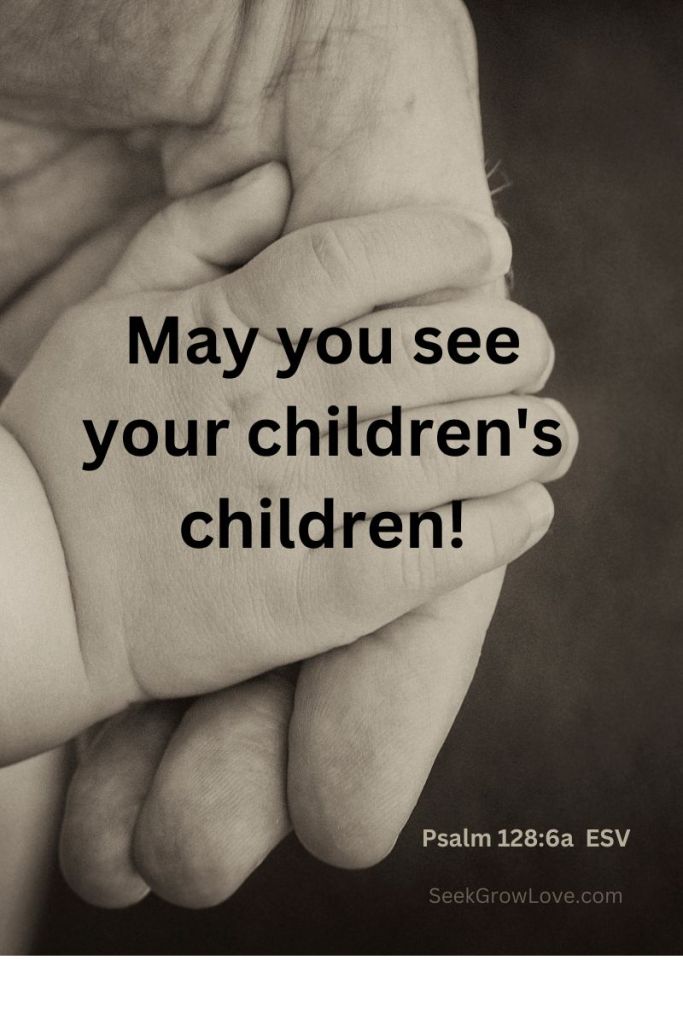
May you live to see your children’s children— peace be on Israel.
Today is a special day. It’s the birthday of my oldest grandchild, Scarlett. All of my grandchildren are precious and I love them all dearly. I can’t believe how blessed I am to have so many who call me Grandpa or Poppa or Poppy. Scarlett is the first to make me a grandparent. Psalm 128 names being able to see your children’s children a special blessing.
Reading this Psalm again touches me deeply and reminds me not to take things for granted like enjoying the fruit of your labor. Not everyone does enjoy the fruit of their labor due to war, disaster, or disease. We should not take the blessings we receive in life for granted. Life does not always go how we planned or wished. Not every man is blessed with a fruitful vine with a table surrounded by olive shoots. Not every parent is blessed to live long enough to enjoy their grandchildren. I’m currently battling some pretty serious diseases. One of my motivators to be healed is to enjoy my family… and honestly, I’d like to meet not only my grandchildren but also my great grandchildren in a few years.
I also want to see the prosperity of Jerusalem and peace in Jerusalem. That will happen when King Jesus returns. I’d like to be around to see that too. But if I should close my eyes in the sleep of death, I will see Jesus, and I hope my family, my church, and my friends at the first resurrection.
The blessings that await us at the coming of Jesus will be awesome. I want to see you there too. Don’t overlook both the promises or warnings in John 3:36 “Whoever believes in the Son has eternal life, but whoever rejects the Son will not see life, for God’s wrath remains on them.” Don’t miss out on the blessings that come through Jesus. May God bless you.
Pastor Jeff Fletcher
Reflection Questions
What are the blessings you have already seen? Thank God for them
What are the blessings you still hope to see before Jesus returns or you sleep in death?
What does Jesus’ return mean to you?
What is your greatest hope for the future? What do you need to do today to increase your chances of taking part in that future?
Weddings are a lot of fun. I’ve been blessed to lead wedding ceremonies for 6 of my own children and over 100 other weddings over the last 40 years of ministry. Of all the weddings I’ve been involved in, the one that affected me most was the wedding of my wife Karen and me. In 11 days we will celebrate our 40th wedding anniversary- November 24, 1984.
Weddings hold a lot of meaning in the Bible. Abraham and Sarah’s son Isaac had a special wedding when he married Rebekah. Their son Jacob had a huge wedding surprise when he thought he was marrying Rachel but her father tricked him into marrying his older daughter Leah.
Jesus’ first miracle came at a wedding when Jesus turned water into wine at a wedding.
John 2:1-11
2 On the third day a wedding took place at Cana in Galilee. Jesus’ mother was there, 2 and Jesus and his disciples had also been invited to the wedding. 3 When the wine was gone, Jesus’ mother said to him, “They have no more wine.”
4 “Woman, why do you involve me?” Jesus replied. “My hour has not yet come.”
5 His mother said to the servants, “Do whatever he tells you.”
6 Nearby stood six stone water jars, the kind used by the Jews for ceremonial washing, each holding from twenty to thirty gallons.
7 Jesus said to the servants, “Fill the jars with water”; so they filled them to the brim.
8 Then he told them, “Now draw some out and take it to the master of the banquet.”
They did so, 9 and the master of the banquet tasted the water that had been turned into wine. He did not realize where it had come from, though the servants who had drawn the water knew. Then he called the bridegroom aside 10 and said, “Everyone brings out the choice wine first and then the cheaper wine after the guests have had too much to drink; but you have saved the best till now.”
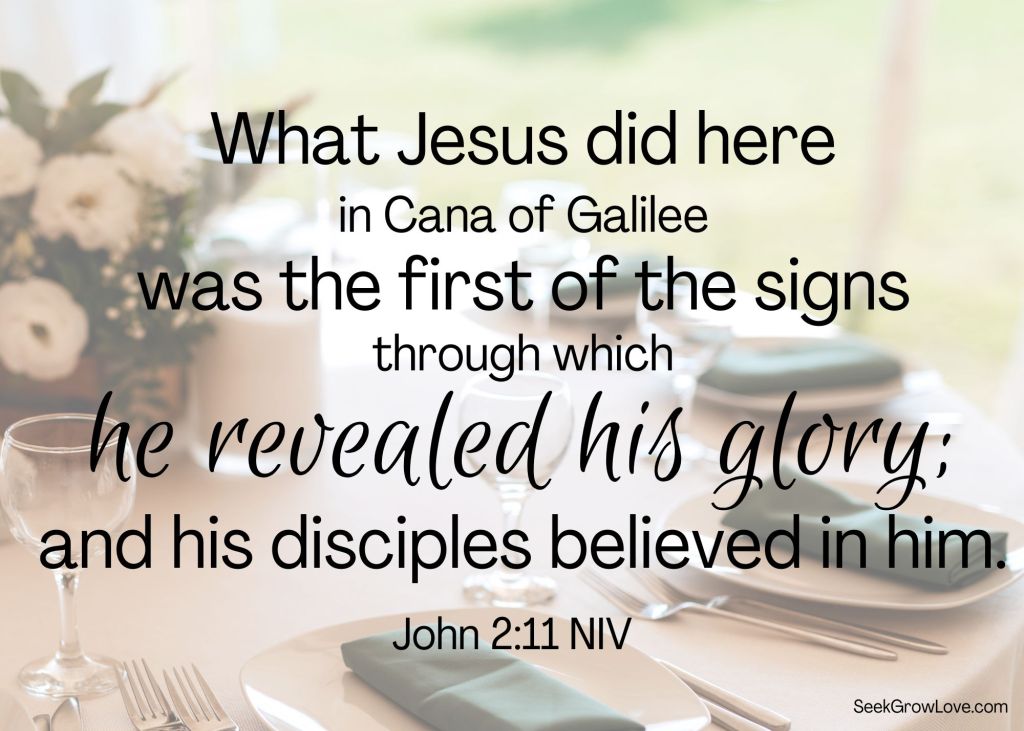
11 What Jesus did here in Cana of Galilee was the first of the signs through which he revealed his glory; and his disciples believed in him.
The symbolism of marriage can be seen throughout the New Testament. It begins in John 2 and makes an appearance in Matthew 22 with a parable of a King who has a wedding banquet for his son. He hosts a great banquet, but his invited guests refuse to come to the banquet. Instead, they mistreated and killed the king’s servants. So the king brings his judgment and wrath against the wicked.
Jesus tells a parable about the bridegroom coming to meet his bride for their wedding, but her wedding attendants were not ready and miss out on the wedding banquet (See Matthew 25).
Finally, the book of Revelation reveals the marriage supper of the lamb of God, when Jesus returns to claim his bride and celebrate his own wedding feast.
Revelation 19:6-9:
“6 Then I heard what seemed to be the voice of a great multitude, like the roar of many waters and like the sound of mighty peals of thunder, crying out,
“Hallelujah! For the Lord our God the Almighty reigns.
7
Let us rejoice and exult and give him the glory, for the marriage of the Lamb has come, and his Bride has made herself ready;
8
it was granted her to clothe herself with fine linen, bright and pure”—
for the fine linen is the righteous deeds of the saints.
9 And the angel said to me, “Write this: Blessed are those who are invited to the marriage supper of the Lamb.” And he said to me, “These are the true words of God.”
Who is the bride of Messiah Jesus? It is his Church. We are the bride of Christ and when Christ comes we will celebrate our union with our savior and king Jesus. So let us be prepared for this grand and glorious celebration with Jesus.
Jesus begins his ministry with a miracle at a wedding, and when he returns to earth there will be a great and final wedding feast. Don’t miss your great celebration. The greatest banquet in human history.
Pastor Jeff Fletcher
Reflection Questions
What are some of your favorite wedding memories? What makes them so precious?
Imagine what each of the characters at the wedding in Cana were thinking and feeling. Jesus and Mary were disagreeing as to if this was the right time for a first miracle. What do you think God thought?
Why do you think God chose a wedding banquet to compare with the church meeting Jesus at his return? How does a bride prepare for her wedding? How ought the church to be preparing to meet Jesus? Are there any details (or larger issues) that you may have overlooked in your preparations thus far?
Last week in the United States we had our election for President. For months people campaigned on behalf of the candidates. There were debates, speeches, and interviews.
2000 years ago in Israel, there were questions surrounding potential leaders. One man who had developed a large following drew interest in from the leaders who sent religious leaders to question who he was. He made it clear who he was not.
John 1:19-34
19 Now this was John’s testimony when the Jewish leaders in Jerusalem sent priests and Levites to ask him who he was. 20 He did not fail to confess, but confessed freely, “I am not the Messiah.”
21 They asked him, “Then who are you? Are you Elijah?”
He said, “I am not.”
“Are you the Prophet?”
He answered, “No.”
22 Finally they said, “Who are you? Give us an answer to take back to those who sent us. What do you say about yourself?”
23 John replied in the words of Isaiah the prophet, “I am the voice of one calling in the wilderness, ‘Make straight the way for the Lord.’”
24 Now the Pharisees who had been sent 25 questioned him, “Why then do you baptize if you are not the Messiah, nor Elijah, nor the Prophet?”
26 “I baptize with water,” John replied, “but among you stands one you do not know. 27 He is the one who comes after me, the straps of whose sandals I am not worthy to untie.”
28 This all happened at Bethany on the other side of the Jordan, where John was baptizing.
John Testifies About Jesus
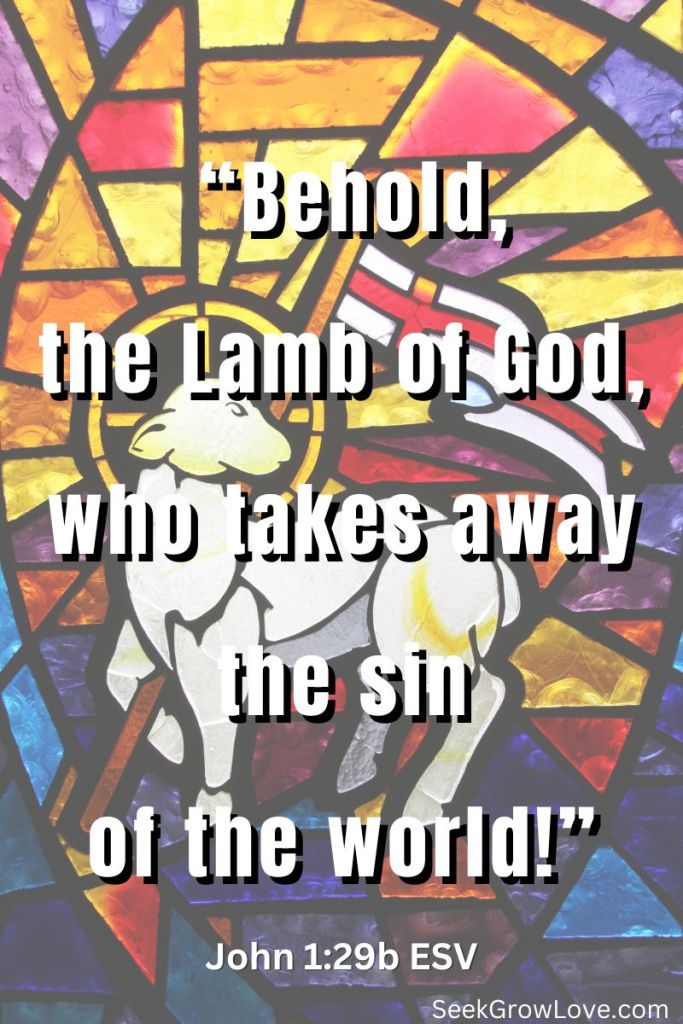
29 The next day John saw Jesus coming toward him and said, “Look, the Lamb of God, who takes away the sin of the world! 30 This is the one I meant when I said, ‘A man who comes after me has surpassed me because he was before me.’ 31 I myself did not know him, but the reason I came baptizing with water was that he might be revealed to Israel.”
32 Then John gave this testimony: “I saw the Spirit come down from heaven as a dove and remain on him. 33 And I myself did not know him, but the one who sent me to baptize with water told me, ‘The man on whom you see the Spirit come down and remain is the one who will baptize with the Holy Spirit.’ 34 I have seen and I testify that this is God’s Chosen One.”
John made clear that he was not the one, he was not the Messiah, the King. John made it clear that Jesus was the true King. God himself declared that Jesus was revealed to be the savior of the world. Jesus was God’s chosen. He was God’s sacrificial lamb who would take away the sins of the world.
John was a man of great humility. He did not pursue power and glory. His call was to witness the truth about God’s true savior.
Presidents come and go, but Jesus is the true Messiah and Savior. Just as John in all humility pointed people to Jesus, let us all point to Jesus as our savior and king.
Pastor Jeff Fletcher
Reflection Questions
What characteristics of John do you admire? What makes a good Christian leader?
What evidence did John have that Jesus was God’s Chosen One – God’s Messiah?
Like John, how can you prepare people to meet Jesus? How can you introduce Jesus to your friends/co-workers/neighbors?
As the year comes to an end, and the days are short and draw to a close so quickly, so we turn to the last chapter of God’s word. The last vision we are given is a river flowing from the throne of God and of the lamb, with trees lining the banks. The people of God, living forever, dwell in a paradisal city that the Garden of Eden was always supposed to grow to. In fact, a theologian once said “What is a city, but a collection of ordered gardens?” Maybe the “concrete jungles” we are familiar with don’t seem that way, but in some sense, cities are places where life is put in order, in order to grow.
It starts with a garden. It ends with a garden.
With a man in a garden in between.
“Let not what I desire, but you, God, desire, let that be done.”
The man who said those words also tells us here:
“I am coming soon! My reward is with me.”
In looking at the end, we take a look back at the beginning. God’s desires are made final, and he will be among us. God’s intentions from the beginning are made real at the end.
He has done this through the one who calls himself “the Beginning and the End.”
As this year draws to a close : may you look to the one who has written the story of your salvation in his blood as you write A to Z. May you think of the one who goes on before you into your day and follows you up at night to bring it to a close. May you honor the Lamb who was planned before the first garden was planted, who will bring about the planting of the last garden, who for our sake submitted his will in a garden, and who for God’s glory was resurrected in a garden.
The page closes. In a novel, this would be the end.
For those in Christ this is only
The beginning…
-Jake Ballard
(originally posted Dec 7, 2022 for SeekGrowLove)
Reflection Questions
Verse 7 says, “Blessed is the one who keeps the words of the prophecy written in this scroll.” If you desire this blessing – how would you keep the words of this prophecy?
Verse 12 says, “Look, I am coming soon! My reward is with me, and I will give to each person according to what they have done. ” What have you done? What do you think Jesus wants you to still do?
What thoughts and feelings do you have about “the end” which is really the beginning for those in Christ?






 Seek Grow Love