The Boy who Changed – and Is Still Changing – the World

Luke 2

Luke 2 final

“Do not be afraid, for look, I proclaim to you good news of great joy that will be for all the people: today a savior, who is Messiah the Lord, was born for you in the city of David. This will be the sign for you: you will find a baby wrapped snugly in cloth and lying in a feeding trough.” Luke 2:10-12


Today, we are reading through Luke chapter 2 which contains one of the most popular accounts written in the Bible—which is the birth of the only begotten Son of God, Jesus Christ. Regardless of our religious affiliation or background, we are familiar with the story line. Mary and Joseph travel to Bethlehem to be registered under Caesar Augustus’s decree. While there, it comes time for Mary to give birth. Because there is no room in any inn, she must give birth in a stable.


For us, this narrative is important because it is the beginning of the story of a man who turned (and is still turning) the world upside down. We can skip forward and see how much of an impact Jesus had on so many, and we can also see how he works in our lives today.


But imagine being in the shoes of Mary, Joseph, and even the shepherds. They weren’t able to skip ahead, they had to live it out. For Mary and Joseph, they had to trust in God that he would see them through. They had to have strong enough faith that God would do what he said he would do. For the shepherds, imagine going from a normal day to having an angel tell you that the Son of God has been born. The Messiah is here! It is even written that they were terrified (Luke 2:9).


Why does this matter? I just think it’s important for us to realize that these heroes we read about in the Bible were more than just characters. They were real people. They didn’t get the luxury of knowing what was written on the next page. They had fears, and they weren’t perfect. They had to trust in God and his purpose. They had to believe that God was going to hold their hand through everything. Imagine the trust! Imagine the faith!


So as you read today, place yourself in their shoes. Because if we can understand what Mary and Joseph went through, maybe we can learn to emulate their faith in our own lives.


-Leslie Jones


What Is In You?

SATURDAY

1 Thessalonians 4_7

1Thessalonians 4:7 For God did not call us to impurity but in holiness. 8 Therefore whoever rejects this rejects not human authority but God, who also gives his Holy Spirit to you.


In looking at how to live a holy life, how to make moral decisions, we have looked at three things. Two are external to us — what have we been taught and how are we treating another person. The second was internal, i.e., what is best for me? The last is also internal, and perhaps the most amazing: what is the Spirit of God saying within me?


The most amazing teaching about our new life in Christ is that the Spirit of God is actually within us. Jesus is within us through the presence of the Spirit. As Paul writes, “Christ in you, the hope of glory” (Colossians 1:27). It’s staggering to think that we bring Jesus into our immoral actions, but can it give us hope that he is present in us and will give us the strength to do his will?


How do we live a holy life? Are we willing to ask, what does Jesus, who lives within me through the Holy Spirit, say to me?


-Greg Demmitt

Not with Lustful Passion

THURSDAY

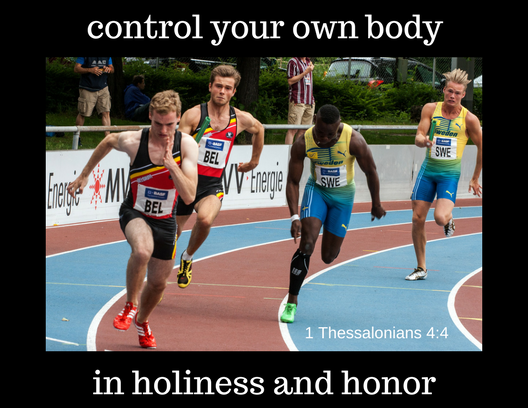
1 Thessalonians 4 4

1Th. 4:4 that each one of you know how to control your own body in holiness and honor, 5 not with lustful passion, like the Gentiles who do not know God;


We wrote yesterday that the most important thing in making moral decisions is to know what God has said. The second most important is to exercise self-control. The first has an external source — what has God said? The second is internal — What does it mean to have self control?


Not everyone agrees with me, but I believe that in life, after being true to God, we must be true to self. That’s more important than anything else. That doesn’t mean, “if it feels good, do it.” the mantra of my generation, but rather, what is best for me as a one of God’s creation. Paul writes about moral decisions in these terms in 1 Corinthians:


1Cor. 10:23   “All things are lawful,” but not all things are beneficial. “All things are lawful,” but not all things build up.


This world says that we can do anything. Can we stop and ask, “What is actually good for me?”


I have worked with many people who have practiced the world’s view of sexuality, i.e., “I can do anything I want to do.” I truly love people who have been caught up in sexual sin, still see them as people for whom Jesus died, but I cannot say that their life choices have been good for them. Their choices have made them miserable, sometimes have even shortened their lives.


Making good moral decisions includes respecting ourselves and not hurting ourselves through bad choices.


-Greg Demmitt

Right from Wrong

WEDNESDAY

In understanding right from wrong, the most important thing is to know what God has said.

1Th. 4:1   Finally, brothers and sisters, we ask and urge you in the Lord Jesus that, as you learned from us how you ought to live and to please God (as, in fact, you are doing), you should do so more and more. 2 For you know what instructions we gave you through the Lord Jesus. 3 For this is the will of God, your sanctification: that you abstain from fornication;


The church at Thessaloniki was made up of mostly non-Jews, so Paul knew that it was important to teach them about sexual purity, because that was not something that was expected in their society. As Demosthenes wrote:


“We keep mistresses for pleasure, concubines for our day-to-day bodily needs, but we have wives to produce legitimate children and serve as trustworthy guardians of our homes.”

This attitude was not acceptable to God’s people. In Acts 15, when the leaders of the Jerusalem church welcomed the Gentile Christians into the body, they thought it important to remind them to abstain from fornication (Acts 15:29).


We live in such a world today. How do we make moral decisions? As we continue in this chapter we will see three more important points, but Paul begins with what we have been taught. In understanding right from wrong, the most important thing is to know what God has said. Paul writes that they have been taught to abstain from fornication, meaning every type of sexual sin.


-Greg Demmitt

Paul’s Prayer: Strong Holy Hearts

TUESDAY

1 Thessalonians 3-13a

I Thessalonians 3

1Th. 3:1   Therefore when we could bear it no longer, we decided to be left alone in Athens; 2 and we sent Timothy, our brother and co-worker for God in proclaiming the gospel of Christ, to strengthen and encourage you for the sake of your faith, 3 so that no one would be shaken by these persecutions. Indeed, you yourselves know that this is what we are destined for. 4 In fact, when we were with you, we told you beforehand that we were to suffer persecution; so it turned out, as you know. 5 For this reason, when I could bear it no longer, I sent to find out about your faith; I was afraid that somehow the tempter had tempted you and that our labor had been in vain.


1Th. 3:6   But Timothy has just now come to us from you, and has brought us the good news of your faith and love. He has told us also that you always remember us kindly and long to see us—just as we long to see you. 7 For this reason, brothers and sisters, during all our distress and persecution we have been encouraged about you through your faith. 8 For we now live, if you continue to stand firm in the Lord. 9 How can we thank God enough for you in return for all the joy that we feel before our God because of you? 10 Night and day we pray most earnestly that we may see you face to face and restore whatever is lacking in your faith.


1Th. 3:11   Now may our God and Father himself and our Lord Jesus direct our way to you. 12 And may the Lord make you increase and abound in love for one another and for all, just as we abound in love for you. 13 And may he so strengthen your hearts in holiness that you may be blameless before our God and Father at the coming of our Lord Jesus with all his saints.


I highlighted Paul’s prayer at the end of this chapter. In several of Paul’s letters, he offers a prayer in the middle. In these prayers, he often prays about the things which he is about to write. In this prayer, after praying that God will make it possible for him to return to Thessaloniki, he prays three things for the Thessalonians:


  1. May they increase and abound in love for one another,
  2. May God strengthen their hearts in holiness.
  3. May they be blameless before God at the coming of our Lord Jesus.


Paul gives practical teaching on these three things in chapter 4 and we will be looking at his teachings on holiness in the remainder of these devotions this week.

-Greg Demmitt


Let Me Introduce You to the Thessalonians

SUNDAY

1 Thessalonians 1-2,3

Acts 17:11  These were more noble than those in Thessalonica, in that they received the word with all readiness of mind, and searched the scriptures daily, whether those things were so.

This was one of my earliest memory verses. Back in that day, we called our youth group the Bereans because we searched the scriptures daily. That’s certainly a good idea, but the verse gives the Thessaloniki (this is the modern name of the still-existing city) church a bad rap. The preceding verses in Acts show that some exciting things happened during the three weeks Paul and company ministered in this ancient city.


Acts 17:1   After Paul and Silas had passed through Amphipolis and Apollonia, they came to Thessalonica, where there was a synagogue of the Jews. 2 And Paul went in, as was his custom, and on three sabbath days argued with them from the scriptures, 3 explaining and proving that it was necessary for the Messiah to suffer and to rise from the dead, and saying, “This is the Messiah, Jesus whom I am proclaiming to you.” 4 Some of them were persuaded and joined Paul and Silas, as did a great many of the devout Greeks and not a few of the leading women. 5 But the Jews became jealous, and with the help of some ruffians in the marketplaces they formed a mob and set the city in an uproar. While they were searching for Paul and Silas to bring them out to the assembly, they attacked Jason’s house. 6 When they could not find them, they dragged Jason and some believers before the city authorities, shouting, “These people who have been turning the world upside down have come here also, 7 and Jason has entertained them as guests. They are all acting contrary to the decrees of the emperor, saying that there is another king named Jesus.” 8 The people and the city officials were disturbed when they heard this, 9 and after they had taken bail from Jason and the others, they let them go.


So, while the Jews in Thessaloniki did not receive the good news about Jesus, the non-Jews did. Something very exciting happened there in a very short time, so exciting that Paul wrote this in what was his very first letter:


1Th. 1:1   Paul, Silvanus, and Timothy,  to the church of the Thessalonians in God the Father and the Lord Jesus Christ:  Grace to you and peace. 2   We always give thanks to God for all of you and mention you in our prayers, constantly 3 remembering before our God and Father your work of faith and labor of love and steadfastness of hope in our Lord Jesus Christ. 4 For we know, brothers and sisters beloved by God, that he has chosen you, 5 because our message of the gospel came to you not in word only, but also in power and in the Holy Spirit and with full conviction; just as you know what kind of persons we proved to be among you for your sake. 6 And you became imitators of us and of the Lord, for in spite of persecution you received the word with joy inspired by the Holy Spirit, 7 so that you became an example to all the believers in Macedonia and in Achaia. 8 For the word of the Lord has sounded forth from you not only in Macedonia and Achaia, but in every place your faith in God has become known, so that we have no need to speak about it. 9 For the people of those regions report about us what kind of welcome we had among you, and how you turned to God from idols, to serve a living and true God, 10 and to wait for his Son from heaven, whom he raised from the dead—Jesus, who rescues us from the wrath that is coming.


This week we will look at this letter to a very young church in which the word of God exploded in a life-changing way.


-Greg Demmitt

Reflect His Goodness

psalm 107-22

It’s been a week of thankfulness – recognizing God as the Giver of All Good Gifts, getting to know Him more and more through the gift of His Word, gratefully accepting the gift of His Son, Jesus, and being thankful even in the midst of a difficult time.

Now for the great yearly challenge – how do we continue the thankful thinking all year?

Perhaps the following quote from J.F. Kennedy will provide some help.  “As we express our gratitude, we must never forget that the highest appreciation is not to utter words, but to live by them.”  Show your gratitude, not just by saying, “Thank You” to God and to others, but by living a thankful lifestyle.  If we are deeply thankful for the blessings that have been given we will naturally want to share those blessings with others.  Opening our home to others, tithing to our church, caring for those experiencing difficult trials, and sharing with those who have less material blessings are all ways we can express our gratitude for what has been given.  We can reflect His goodness.  He has given to us.  We will give to others.

And, most importantly, when we are truly grateful for what God has done, for who He is and for His plan of salvation, for the gift of His Son and the forgiveness given, for the Kingdom hope – we will want to share it with others.  Inviting a friend to church, sharing a devotion with the family, praying with someone struggling, telling what God has done for you, giving a Bible, donating to missions (*), posting Scripture on your social media, home, office and locker walls, and the list goes on.

Read over Romans 10.  The world is full of people who do not know the gifts they could be receiving right now – who have not heard the message.  It is our job to, “Sacrifice thank offerings and tell of His works with songs of joy.” (Psalm 107:22).  What thank offerings will you present?  How will you tell of His works?  We are not responsible for other’s reaction to the saving message.  Just as Moses and Isaiah met up with resistance and obstinate people – so will we when we exercise our beautiful feet (Romans 10:15).

Look over your thankful list (go ahead and write it down if you haven’t already this week).  Prayerfully consider how you can show your appreciation for each gift.  How can you pass along the joy you’ve received?  How will you reflect His goodness?

-Marcia Railton


(*) Be watching for the soon-to-be released Lord’s Harvest International Gift Catalog for some great ideas on how to help provide for needs on our missionary fronts (Bibles, church buildings or rent, a pastor’s transportation, an orphan’s or widow’s care, seed & fertilizer, etc….) 

Forget Not All His Benefits

Psalm 103

psalm 103 2 b

Yesterday we practiced seeing God revealed in Psalm 100.  Today you can try it again with another great Psalm – 103.  Read through the Psalm and search for what you can learn (or be reminded) about God.

What characteristics of God are you especially thankful for?  His omniscience (all-knowing)?  His omnipotence (all-powerful)?  His faithfulness?  His forgiveness?  His compassion?

Verse 12 gives a little teaser of what was yet to come in God’s perfect plan of salvation. “As far as the east is from the west, so far has he removed our transgressions from us.”  At the time this was written God’s people were still living under the Old Testament law with it’s system of sacrifices and priests.  There was a plan in place for forgiveness but it required strict adherence to a detailed list of sacrifices and who could perform them for what sins.

Sin was – and still is – a big deal because it causes separation from God who can not be in the presence of sin.

And so, in the New Testament a new gift from God was given!  A new path to forgiveness – one not just for the Jews, but for all who would believe on the name of the Lord Jesus Christ – the Son of God!  The giver of all good gifts gave us His one and only Son – first to teach us how to live and to point us to his Father – and then to die so that we can be saved from our sins.  But God still wasn’t done gifting.  He raised Jesus from the dead.  And today he is in heaven at God’s right hand, interceding on our behalf and serving as the mediator between God and man.

Let us forget not all his benefits…and thank Him for His Son.

-Marcia Railton

Bold

Peter

When being bold can be a flaw

Matt. 14:22-31, Matt. 16:21-23, Luke 22:31-34

I think we all know someone, it may even be the person in the mirror, who seems to have the Frank Sinatra song, “I Did It My Way” playing as their anthem. I believe one such person in the Bible is Peter. Peter seemed to try to be the exception to every rule and push boundaries that the other apostles didn’t dream of.

Remember when Peter walked out on the water to meet Jesus? It doesn’t mention anyone else volunteering but Peter in faith and boldness offered to meet Jesus on the water. This is just one of many stories of Peter stepping up and speaking out. While many times his boldness was a good thing there are times the contrary was true.

In Matt 16 Jesus explained that he would suffer and be killed but Peter rebuked him! Can you imagine taking Jesus to the side and telling him that he was wrong? Jesus set Peter straight on the matter but Peter still didn’t seem to understand.

In Luke 22:31-34 Jesus tells them again that he must suffer and that they cannot go where he is going. Peter boldly proclaims that he would follow Jesus even to death. Later in the chapter (vs54-62) Peter boldly denied Christ three times just as Christ told him he would. I can’t imagine the sorrow in Peter’s heart as he looked into his Savior’s eyes knowing that he had denied that he even knew him.

Peter’s boldness when not thought through was a flaw but Jesus knew there was potential in Peter and even prayed that his faith would be strengthened so he could also help strengthen his brothers (Matt. 16:32). After Jesus’ resurrection Peter boldly spoke about the death and resurrection of Christ and proclaimed the gospel message.

God answered Christ’s prayer and helped shape Peter into an evangelist. If Peter, Jesus and God chose not to focus on Peter’s flaws that tells us that we should also choose grace and not focus on our own flaws or the flaws of others.

-Lacey Dunn

Hearts of Flesh

Empathy

This week, we have explored the ways in which empathy informs and shapes our call as Christians to love one another.  We’ve learned how empathy is sitting with and understanding another’s perspective.  We’ve looked at how empathy allows us to love others in ways that uniquely speak to their circumstances.  We’ve even seen how we have a high priest in Christ who’s empathy has brought us salvation.


Today, I would like to end our time together by encouraging each one of us to live our lives more empathetically in light of our readings.  In a society that often seems more and more connected, we can increasingly find ourselves alone.  At its very root, empathy stands against such isolation by opening our own hearts to those around us.


This is hard.  This is dangerous.  It’s a path that has even led to the cross.  But when we refuse or close our eyes to the full humanity of those around us, we begin to break the very ties that make us human.  Because out of everything that God has made, only loneliness was not good.


To be human – the way that humanity is meant to be – is to be in community, relationship, and connection with all those around us.  Who is our neighbor? Everyone.  Am I my brother’s keeper? Yes.  Who should I love? Even my enemies.


The work of God, from the emancipation of the Israelites to the salvation of the resurrection, is a story of an ever widening circle of people that are called to love and care for one another in the glory of God.  That cause has not changed even today.


We are called to love and care and expand the boundaries of our own comfort so that the unlovable will be cared for and the lonely will no longer be alone.


Empathy is the tool that protects our hearts from becoming stone.


As we part ways today, my prayer for each of us is that we are transformed and empowered to carry hearts of flesh that can love beyond human comprehension.

-Graysen Pack