God’s Watchman to A Generation

Ezekiel 1-4

ezekiel 1

Sunday, March 19

Ezekiel was a priest in Israel during a tumultuous time in their history.  The Northern kingdom had been decimated by the Assyrian empire and its people scattered and assimilated resulting in a complete loss in their identity as a distinctive people of God.  The Southern Kingdom of Judah was now being systematically taken apart by the Babylonians.  Ezekiel was among the early members of Judah’s elite leaders who were taken captive to Babylon.  Ezekiel was now a priest living in a foreign land where he had no access to the temple of Jerusalem and the religious symbols that helped shape his life and give him meaning and purpose.

In today’s readings God comes to Ezekiel in a series of visions.  These visions  are recorded as a type of scripture known as apocalyptic- where something is revealed or unveiled.  In addition to portions of  Ezekiel there are apocalyptic passages in the books of Daniel, Isaiah and Joel.  God reveals what is going to happen as He brings an end to the present age preparing the way for the age to come or coming Kingdom of God.  You will notice some similarities between Ezekiel 1 and Revelation 1 and 4.

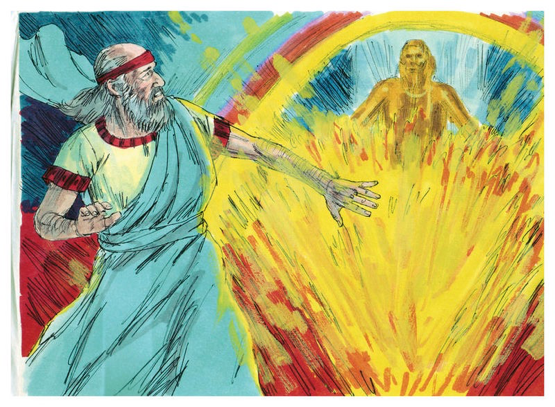
Ezekiel’s description sounds like something in a science fiction movie- 1:27-28 says: “ I saw that from what appeared to be his waist up he looked like glowing metal, as if full of fire, and that from there down he looked like fire; and brilliant light surrounded him.  Like the appearance of a rainbow in the clouds on a rainy day, so was the radiance around him.  This was the appearance of the likeness of the glory of the Lord. When I saw it, I fell facedown, and I heard the voice of one speaking.”

Imagine if, for a brief instant, God permitted you to have a vision of himself in all of His glory.  You would probably struggle to find the right words to communicate what you saw.  So it is with Ezekiel.  He is overcome by the glory of God and he falls on his face.

The whole of Ezekiel is surrounded by the image of a holy God.  But God’s people, Israel, have been disobedient to God.  Ezekiel is appointed by God to serve as his “watchman” (3:17) for the people Israel in captivity.  His mission is to warn God’s people of their sins and to call them to repentance.  Ezekiel 2:7-8: “You must speak my words to them, whether they listen or fail to listen, for they are rebellious.   But you, son of man, listen to what I say to you.”

The job of a watchman is to stay awake, keep one’s eyes open, and warn if anything dangerous or illegal is taking place.  It might also include a warning to those who are tempted to trespass.  Ezekiel’s job was to warn God’s people about the consequences of their sins and the coming judgment of God.  God tells Ezekiel essentially: “you need to warn the people about my coming judgment.  If they don’t listen to your warning, then they will suffer the consequences, but if you fail to warn them, then I’ll hold you responsible for their sins.”  God was letting Ezekiel know that he had a mission, to share God’s word with people.  If the people didn’t listen or heed the warning, it was on them, but if he refused to give the warning it was on him.

As followers of Jesus Christ today, we are called to be priests in this world.  Like Ezekiel,  we are living in an age where much of Christianity has been decimated by a massive turning away from God and people are scattered and assimilated into the world resulting in a complete loss in their identity as a distinctive people of God.  And like Ezekiel, we are to keep watch and issue warnings to the people of the world.  As with Ezekiel, sometimes we will warn people and they won’t listen.  If that’s the case, it’s on them.  But if we fail to do our job and give the warning, then it’s on us.  People won’t always like what we have to say- prophets and priests are sometimes labelled as intolerant and not very popular, but that should not prevent us from doing the work God has given us to be His watchmen to our generation.  (Note: our job is not to be the judge, it’s not our place to condemn the world, but to tell them what God tells us to tell them, which is the Gospel.)

-Pastor Jeff Fletcher

My name is Pastor Jeff Fletcher.  I’m one of the old guys.  I first attended what is now FUEL (then it was called National Camp) back in 1977 and I’ve been a camper or on the staff for most of the past 40 years.  I’m a graduate of Oregon Bible College, (Now ABC) and I’m completing a Master’s Degree from Eastern Mennonite Seminary.  I’ve pastored Churches in Illinois, England, Louisiana, South Carolina and now Virginia.  My wife Karen and I have eleven children and 4 grandchildren and my daughter, Karee Anne is getting married this Saturday, March 25.  In addition to pastoring a Church I also work as a hospital chaplain.  I am passionate about bringing the message of God’s loving presence to people who are hurting and in need of hope and purpose in life.

Death Swallowed Up

Isaiah 22-25

isaiah-25v8-e1480432832403-940x688

Saturday, February 11

I am writing to you guys now, after I took a 6 hour class with Sir Anthony Buzzard on the Kingdom of God as the Gospel.  Therefore, I can’t help but write about the Kingdom today.  One thing that has really shed light for me is that the gospel of the Kingdom is throughout the whole Bible.  It is not just a New Testament idea.  In fact, the gospel was even preached to Abraham from God (Gal 3:8).  It is evident that the gospel of the Kingdom was important to Jesus as he preached about the Kingdom his whole ministry (Matt 4:17).  I knew that Jesus did not come up with the idea of the Kingdom on his own, but I was not aware of how prevalent it was in the Old Testament.  The Kingdom is found all throughout the Old and New Testament.  In our reading today in Isaiah, there indeed is scripture on the coming Kingdom.

Isaiah 24:23 is prophecy about the Kingdom.  The talk about the moon and the sun is similar to the passage in Matthew 24:29 when it talks about signs of the second coming.  Then actually in the Kingdom, the LORD along with Jesus will reign.  There is some dispute as to whether this verse is referring to God reigning on Mount Zion or Jesus.  In my opinion, it does not matter too much.  What matters is that God through Jesus will reign.

Isaiah 25:6-12 is then a beautiful passage on the Kingdom.  One of my favorite verses in the whole Bible is Revelation 21:4.  Isaiah 25:8 is very similar to that verse in Revelation.  In the Kingdom, there will be no more death or tears.  What a comfort that is.  This idea helped comfort me through the loss of my grandpa.  I was devastated to lose him as he was my biggest role model in my life.  I greatly looked up to him.  He inspired (and continues to inspire) me to pursue pastoral ministry like him.  We all experience similar losses to this.  Let Isaiah 25:8 and Revelation 21:4 be a comfort to you.

The Kingdom should be the focus of our lives.  It was surely the focus of our Savior Jesus Christ.  Most people perceive the gospel to be the death and resurrection of Christ.  That is only a part of it.  Christ didn’t even speak of his death and resurrection until Matthew 16:21.  That is about two thirds of his way through his ministry.  What was Jesus preaching before then?  That answer is found in Matthew 4:17, the Kingdom.

-Kyle McClain

(photo credit: http://www.spiritradio.ie/word-for-advent-isaiah-258/)


What’s Your Motivator?

Isaiah 10-13

isaiah11_9

Wednesday, February 8

As we continue on with Isaiah, we also continue on with scripture about judgement.  The book of Isaiah as a whole can be split into two sections: judgement (1-39) and restoration (40-66).  Therefore, if you aren’t a fan of this judgement variety, then just stick with it and the restoration will come at the close of Isaiah.  However, even if you aren’t a fan of the judgement material, valuable lessons can still be learned from it.

When reading the judgement material throughout Isaiah, I get a bit tense.  I get tense because the judgement that is coming for so many is severe.  We see the sin of Israel and the surrounding nations causing God to become angry with people, and in reading Isaiah, we are assured that God’s wrath will come out sometime.  The following snip-it’s from this reading give a sense of the kind of judgement coming: “the LORD will utterly destroy,” “shall be cut off,” “destroy both soul and body,” “anger will be directed to their destruction,” “kill the wicked,” “destroy its sinners,” “destruction from the Almighty,” and “fierce anger”.  This is what is coming for those who do not turn their lives over to God.  Furthermore, from Isaiah 13: 6, 9, and 22 we know this day is coming soon.  Although turning our lives over to God to escape this punishment should not be our main focus or motivator, it is still a motivator nonetheless.  I know personally, I do not want this punishment that many will receive.  We know many will receive this destruction as God says, “I will make people more rare than fine gold,” (Isaiah 13:12).  Last time I checked, there wasn’t just a bunch of fine gold laying around.

Yes, escaping a severe punishment that many will receive is motivation to give our lives to God.  However, the greatest motivation of all is found in chapter 11, and that motivation is the Kingdom of God.  One thing the Church of God as a whole is great at is keeping the focus on the Kingdom of God.  One of the great Kingdom prophecies is found in Isaiah 11:6-9.  This passage describes the peace that will take place in the Kingdom.  It describes that a nursing child will play over the hole of the cobra.  Last I checked, no parent in this present age won any parenting awards for leaving their babies next to cobra holes.  However, in this future Kingdom, there will be no death, mourning, crying, nor pain in the coming Kingdom.  The earth will be full of the knowledge of the LORD.  The Kingdom is a never ending celebration.  I know that I want a part in this.  To do this, we must turn our lives over to God.  Let the hope of the coming Kingdom drive you in growing closer to God every day of your life.  The reward for living a life for God is beyond imagination.

-Kyle McClain

(Photo credit: http://www.verseoftheday.com/en/11092012/)

“Here I Am! Send Me!”

Isaiah 4-6

is6

Monday, February 6

Today, we continue on to Isaiah 4-6.   In this section, there is one of the most well-known passages in the whole Bible, Isaiah’s vision of the LORD in chapter 6.  Before we get there though, we will talk briefly about chapters 4 and 5.

There are essentially two main purposes to the book of Isaiah: “to assure Judah that God would surely judge them for their sins… [And] to assure God’s people of God’s wonderful plan for their future,” (The 5Ws and 1H of Genesis Through Malachi, Robert Jones).  In the first three chapters, we got a sense of the first purpose, to assure Judah/Israel that God does not leave the guilty unpunished.  However, starting in chapter 4, we get a sense of God’s wonderful plan for their future.  After ridding the place of evil, God will establish a place (The Kingdom of God) that shall be “beautiful and glorious.”

Chapter 5 deals with the wicked, once again.  Verse 24 and 25 sums it up fairly well: “for they have rejected the law of the LORD of hosts, and have despised the word of the Holy One of Israel.  Therefore, the anger of the LORD was kindled against his people.”  We have two things happening here.  One, the people are rejecting the LORD and despising Him.  On the other hand, we see that the anger of the LORD is put against his own chosen people.  The people sin, and God responds by getting angry.  However, we know that God is slow to anger as he describes himself in Exodus 34:6, 7.  God’s chosen people kept sinning with no signs of repentance.  What Isaiah is describing is not a sin here or there.  Rather, Isaiah is describing a people, whom God loves very much, living a life of sin.  God’s chosen people of Israel, the same people He has performed many miracles for, were forsaking the LORD.  God does not leave the guilty unpunished, also found in Exodus 34:6, 7.

The beginning of chapter 6 sets the scene of when this was going on.  Isaiah 6:1 states, “In the year that King Uzziah died.”  King Uzziah was one of the Kings of Judah after the split of Israel, and he died in the year 740 BC.  This is not long after the Golden Age of Israel when it was a unified nation under kings Saul, David, and Solomon.  It is also before the Israelites were exiled into the Babylonian land.  Therefore, the ministry and writing of Isaiah took place before books such as Ezra and Nehemiah.  Isaiah’s ministry is taking place at the same time many of the events in 1st and 2nd Kings and Chronicles are taking place.

As mentioned before, Isaiah 6 is one of the most well-known passages in the whole Bible.  It paints a beautiful picture as to what the Throne of God looks like. You can compare this picture to the description of God’s Throne in Revelation 4.  In Isaiah’s vision, as he approaches the throne of God, he humbles himself by basically saying he was not worthy to be seeing what he was seeing.  Then, God asks Isaiah whom He shall send.  Isaiah then wonderfully replied by stating, “Here I am! Send me.”  We can learn a lot from this simple statement.  The attitude that Isaiah displayed here should be the same attitude we express in our lives.  The harvest indeed is plenty and the workers few.  The LORD is seeing who he can send to do His work.  Are you willing to do his work?

-Kyle McClain

My name is Kyle McClain, and I am currently attending the Atlanta Bible College.  It is my second year at the Bible college and I will receive my bachelor’s degree in pastoral ministry next year.  I am excited to be able to go through the first third of the book of Isaiah with you all (or y’all as they say down here in Georgia).


Our Boundary Lines

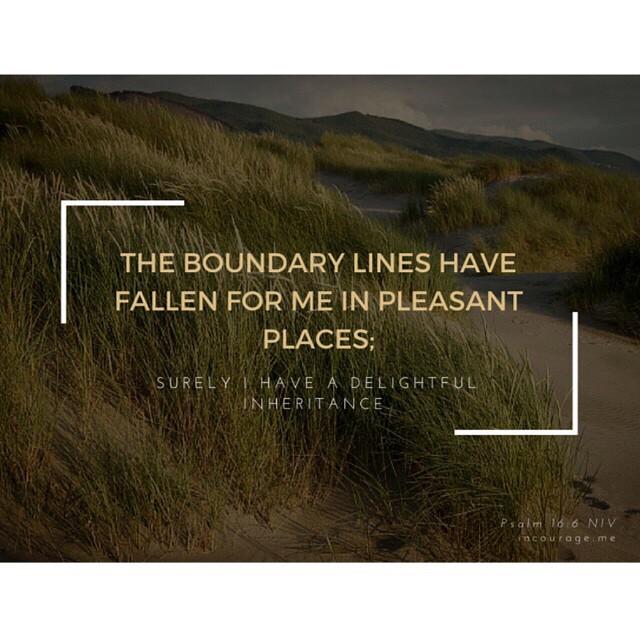
boundarylinesWhen the Israelites finally entered the Promised Land after wandering for forty years, they had a big job to do. After taking possession of the land, they had to divide the land between the twelve tribes. Joshua was given this job, and you can find the boundary lines of each tribe in Joshua 16-21. These boundary lines were designed by God so that each tribe would have access to enough good land to survive. They were a provision from God as the Israelites settled into their new home.

Hundreds of years later, David talks about boundary lines in Psalm 16. He says,

“LORD, you are my portion

and my cup of blessing;

You hold my future.

The boundary lines

have fallen for me

In pleasant places;

Indeed, I have

A beautiful inheritance.” –vv. 5-6

The boundary lines David was talking about were not only boundary markers on the ground dictating the land he would inherit. These boundary lines concerned something far more important. These boundaries established a spiritual inheritance that we also receive, the Kingdom of God.

Hebrews 9:15 says, “Therefore, He is the mediator of a new covenant, so that those who are called might receive the promise of the eternal inheritance.” Jesus is our mediator, so that we can receive our promised inheritance. The portion that we receive, our future and our inheritance, is the Kingdom of God. Indeed, our boundary lines have fallen in pleasant places!

Like many of David’s psalms, his celebration of God does not end with a praise. David always includes action. If we continue to read through the rest of Psalm 16, we see the reflection of a heart change in David’s life. He praises God, because God counsels Him- through his meditation on God’s word, he reflects on how he can better live for God. Through David’s purposeful study of God’s word, he walks on the path of life, which leads to the Kingdom.

Often, we think about boundaries as hemming and restricting us. David rejoices because, though the law does give him restrictions on how to live, he sees that life with the law is pleasant. Our boundary lines are great not only in the future to come, but also this world now.

Let’s rejoice in our inheritance and follow David’s example of walking and reveling in God’s word and presence.

-Cayce Ballard


Photo Credit: https://pbs.twimg.com/media/B8CzfQUIcAAi1yT.jpg

Enduring Faithfulness

Job 27-30

job-28-28-ww-notrace-9x

Tuesday, December 20

Yesterday, we tackled Bildad’s question to Job about the righteousness of man before a Holy God.   With a new frame of mind, we can answer and confidently place these words of Job in our heart:

“I will maintain my innocence and never let go of it;  my conscience will not reproach me as long as I live.” – Job 27:6

Our conscience, our friends, and our family are not our judge, only the Lord God Almighty.  If he has made us new through repentance, then that we are indeed.  Do we continue in sin? NO! (Rom 6:1).  Do we walk around saying, “You are not my judge!” NO! (Heb 10:24) We become part of the church, pray, study, do good works, give cheerfully, share His good news, not to earn merit badges for the Kingdom of God but as loving and faithful acts of a pardoned people.  No matter our past or present circumstance we must not conceal what God is/can do in us.  Today, you can move forward declare and renew your innocence through Him.

“I will teach you about the power of God;   the ways of the Almighty I will not conceal” – Job 27:11

Along the same vein, another reflection for today comes from the second half of today’s reading (Job 29 – 30).  Job essentially is contemplating the “good ole days”, before his fortunes turned south.  The power, the respect, the friends, and the wealth he once enjoyed all are gone.  While our fall might not equal Job’s, far too often when things take a turn for the worse, we quickly forget about the faithfulness of God.  We become as the children of Israel, longing to return to slavery so our belly can be momentarily filled. (Ex 14:20) We cry out, “God, why have you taken this from me?” yet we forget who gave it to us in the first place.

Your present life may not include the finite features of your past.  Death, debt, despair, and destruction may have become more commonplace; however, there is one infinite feature that is constant: the love and faithfulness of an unchanging God.  Look upon the past not to remind you of the “good ole days,” but of his enduring faithfulness; use the lamp unto your feet to know that your future is secure, no matter what life’s storms may bring.

-Aaron Winner