The Root of Learning

Proverbs 1-3

I’m a homeschooling mom. I never meant to be one, it just kind of happened. It happened in such a weird way, actually, that I know it was God speaking into our lives. That being said, we follow what is known as a classical model of learning. I won’t go into details about it, but when you dive into homeschooling, or if you’re an educator, you have probably become familiar with pedagogy – the study of learning. Or, as most people think of it, the study of how to instruct. We’ve developed many different ways of learning over the years, trying to help people in various situations learn in different ways that speak to them more clearly. We require different methods because we are different people with a beautiful variety of brains. 

But the root of learning is not teaching. It’s not the brain, nor the instructor. It is knowledge and wisdom itself. And behind all knowledge and wisdom is God. 

God did an interesting thing when he created us and the world we live in. He placed a tree of the knowledge of good and evil and then told us not to eat from it. What a crazy thing, right? Why place the tree there at all? But to be completely free, he had to give us freedom of choice. And that means we have to have options to choose from. Humanity chose poorly. We continue to choose poorly. 

How do we choose wisely? Proverbs 1:7 tells us, “The fear of the LORD is the beginning of knowledge, but fools despise wisdom and instruction.” The fear of the LORD means showing God the respect and awe that he’s due so that we long to obey him in all things. When we obey the instructions of the loving Father who wants only the best for us, then we are led to knowledge and wisdom. 

As you start through the book of Proverbs, take note of how this wonderful book is not only trying to grant you wisdom and knowledge, but also moral guidance. Let these Proverbs speak to you in a way that helps you see how much God loves you and wants to guide you and protect you. I hope you start to see the benefits of wisdom, as they are beautifully outlined in chapter 2, show up in big ways in your life. 

-Jenn Haynes

Reflection Questions:

What are some of the ways that God’s guidance has kept you from trouble? In what moments of your life do you feel you would have avoided trouble if you HAD followed God’s instruction more closely?

Proverbs 2:10 says, “For wisdom will enter your heart, and knowledge will be pleasant to your soul.” What wisdom have you gleaned from scripture that has given you that sense of pleasantness in your soul? 

My prayer for you today is that you will experience the truth in Proverbs 3:5-6. Trust in the LORD with all your heart and lean not on your own understanding; in all your ways submit to him, and he will make your paths straight. 
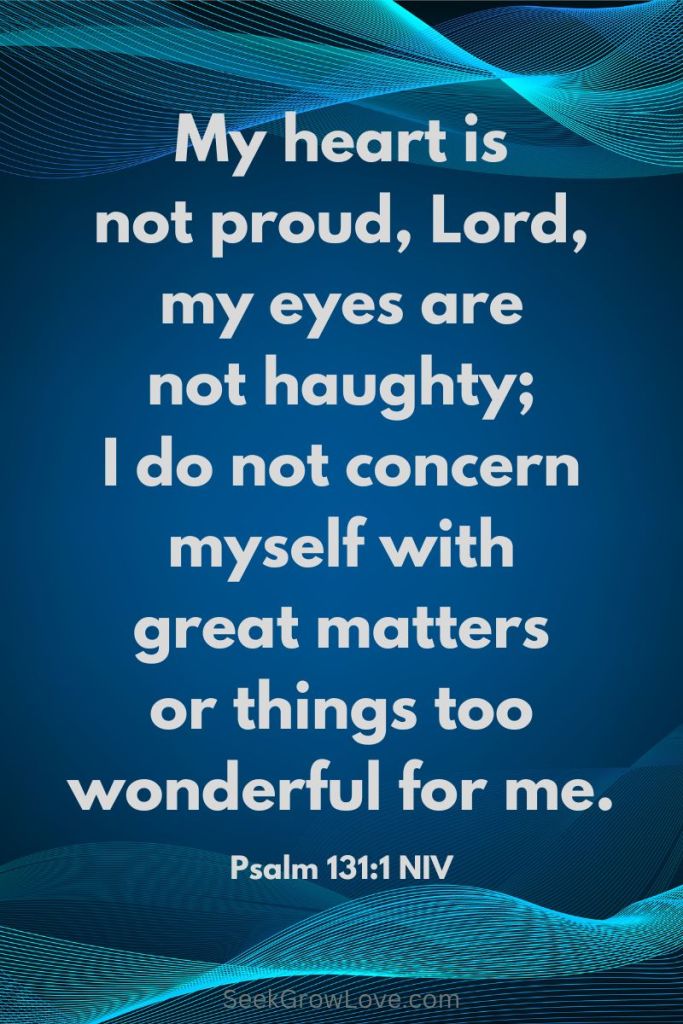
The Search for Knowledge?

Old Testament: Amos 7-9

Poetry: Psalm 131

New Testament: Matthew 17

Our Psalm reading starts today with this verse:

My heart is not proud, Lord,
    my eyes are not haughty;
I do not concern myself with great matters
    or things too wonderful for me.

When reading through this, I had two thoughts on this first verse from different perspectives.

  1. Do we sometimes try to understand things that we just really can’t understand?  There are some people who want to know the answer to everything.  And searching for knowledge isn’t inherently bad.  But does it become so much of a priority that it is leading you toward pride?
  2. On the other hand, do we let this become an excuse to just say “well, I guess we can’t know” and give up on the pursuit of truth and knowledge?

I think there probably has to be a balance between these two things.  When I don’t know the answer to something (that I believe to be unanswerable – not like a math problem that has a clear answer), it just doesn’t bug me.  I know other people who just have to know and they spend so much time searching and studying and still not finding answers which frustrates them.  But I do let that be an excuse at times to not search for an answer and give up on something that I could know more about.

The passage goes on to say, “But I have stilled and quieted my soul […] O Israel, put your hope in the LORD both now and forevermore.”

That’s the key.  Our hope shouldn’t be found in knowledge.  Our hope should be in the LORD.  We should be at peace with the things that are above our understanding.  But I also think we should try to know the LORD as best as we can with our human minds.  In John 17:3, it says, “Now this is eternal life: that they know you, the only true God, and Jesus Christ, whom you have sent.”  Eternal life is to know God and His Son Jesus.  And we can’t know Him if we don’t spend time pursuing Him even if we can’t have all the answers.

So we should be doing what we can to know and understand God, but also let go of our desire to have the answer to everything, humble ourselves, and live in peace knowing that God’s ways are greater than our own.

~Stephanie Fletcher

Reflection Questions

  1. Is there some information you are content not knowing? Like what?
  2. Have you ever found yourself struggling with pride because of what you do know? How can you practice humility instead?
  3. What do you think God wants us to know about Him and His Son?
  4. Do you ever misplace your hope and put it in yourself and all you know and can do – instead of in God? What is the remedy?

With Great Power Comes Great Responsibility

1 Corinthians 8

June 9

While we now live in an era where information is at the tips of our fingers, just a few swipes and searches away, knowledge still holds as much power as ever. At the beginning of this chapter, Paul reminds us of this crucial fact when he says, “… But knowledge puffs up while love builds up. Those who think they know something do not yet know as they ought to know. But whoever loves God is known by God.” (1 Corinthians 8:1b-3) Here, Paul highlights how gaining knowledge can lead to becoming arrogant and result in divisions between people. He then explains the flip side of this coin: love. By using what we do know for the benefit of others, we can become better leaders in the church and set an example for how to live a life like Christ. To better elaborate on this concept, Paul addresses a question the people of Corinth had for him concerning eating food sacrificed to idols.

Later in the chapter, Paul states, “… yet for us there is but one God, the Father, from whom all things came and for whom we live; and there is but one Lord, Jesus Christ, through whom all things came and through whom we live But not everyone possesses this knowledge…” (1 Corinthians 8:6-7a) Since Christians are aware that all things come from God, it was clear at the time that the meat in the markets was just meat, despite its old use in rituals to idols past. As more experienced Christians were aware of this fact, they would eat the meat casually as they should; however, as Paul states, not everyone knows this information. To the average individual, seeing the meat could still serve as a reminder of the idols of the past, and witnessing Christians eating this same meat could cause confusion and make one deviate in their faith. It’s here where Paul warns us, “Be careful, however, that the exercise of your rights does not become a stumbling block to the weak.” (1 Corinthians 8:9)

The rest of the chapter really speaks for itself as Paul describes how wounding someone with knowledge by being that stumbling block also hurts yourself. In verses 11-13, Paul writes, “So this weak brother or sister, for whom Christ died, is destroyed by your knowledge. When you sin against them in this way and wound their weak conscience, you sin against Christ. Therefore, if what I eat causes my brother or sister to fall into sin, I will never eat meat again, so that I will not cause them to fall.” The result of not being responsible with our knowledge is devastating because not only do we sin against the individuals concerned, but we also sin against Christ. However, as mentioned previously, there is a flip side to all of this. If we are responsible with this powerful knowledge and use it lovingly, then we can build upon one another. It’s no easy feat of course—like giving up meat for good, as Paul describes—but by preventing the fall of those around us, we can continue to raise our commitment to Christ together.

— Austin Kizer

Questions for Reflection and Discussion

  1. How do you use your knowledge to grow closer to Christ? Do your actions and applications of this knowledge show other people your firmness in faith, or are you sending mixed signals? 
  2. A unique phrase in this chapter was “stumbling block for the weak”. What are different stumbling blocks that the world throws at us, and how can we combat them to stay firm in our faith?
  3. With knowledge about Christianity becoming more accessible to people worldwide, it’s important to hone in on the areas that we can directly impact. Discuss how Christians in this modern day can share their knowledge and build relationships with people in their community.

Imbedded Wisdom – Proverbs 6

The Memory verse for this week is Proverbs 9:10:

 “The fear of the LORD is the beginning of wisdom and knowledge of the Holy One is understanding.”

The book of Proverbs is a genre of literature known as wisdom literature.  Along with Job and Ecclesiastes, Proverbs looks at the world in a slightly different way than the historical books of the Bible or the prophetic books.  In the wisdom books, the sages find information about God throughout the world of nature.  Where God reveals himself directly to Moses and Israel in Exodus and he reveals himself in visions to the prophets Ezekiel and Daniel, to the sages who write in Proverbs God often reveals himself in the created world and by observation of human behavior.

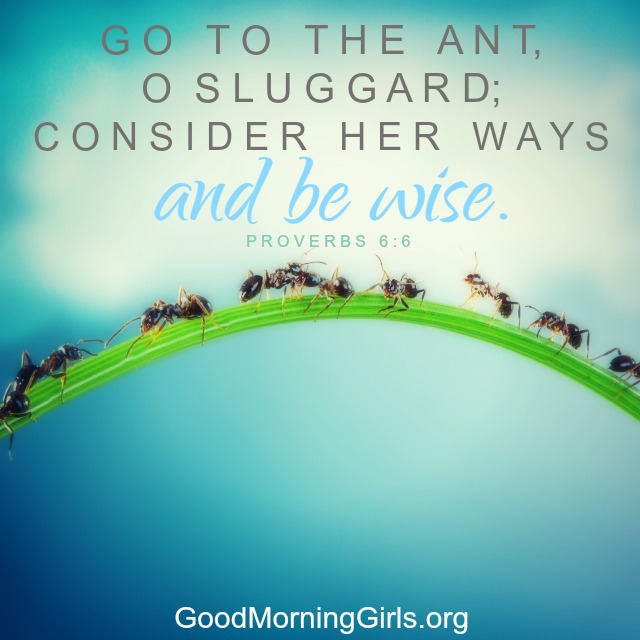
Ant Image

In Proverbs 6:6 he writes: “go to the ant, you sluggard; consider its ways and be wise!”  An ant is a comparatively small and very weak creature when set alongside a human being, and yet, ants are industrious and hard working.  They plan and prepare for the winter by working hard and gathering up their provisions in the summer time.  There is wisdom in hard work and preparation.  The wisdom writer uses this as a way to admonish the person who is lazy and refuses to do the hard work of preparing for winter.  So the wisdom lesson here is “don’t be lazy, work hard to prepare in advance and you will be much less likely to suffer adversity.”

We could then apply this to other areas of life.  For students this means, don’t wait until the night before your test to begin “cramming” for the test.  Work hard at your studies each day in your preparation.  Read your assignments, do your research.  Then, when the harvest comes (the test) you will be successful because you worked hard and prepared.  That’s wisdom applied to life and that’s the value of Proverbs.

Later in Proverbs 6 wisdom is applied to relationships and to marital faithfulness.  He gives a stern warning against the sin of adultery.  He compares adultery to scooping a fire into your lap and expecting not to get burned or trying to walk across hot coals without burning your feet.  As Forrest Gump would say “sometimes things just don’t make no sense.”  Thinking that you can play around with fire and not get burned is foolish… and thinking that you can cheat on your spouse or with someone else’s spouse and not get burned is just plain foolish.  “A man who commits adultery has no sense.”  Instead of the ant, the author uses the jealous husband as the example from nature “he will show no mercy when he takes revenge.”

One doesn’t have to look far to find wisdom.  God has imbedded it in all of his creation and we just need to pay attention- whether it’s the wisdom of the ant in working hard to prepare for Winter, or the wisdom of not fooling around with someone else’s wife or husband, we need to pay attention to God’s wisdom that’s revealed all around us.

prov 9 10

~ Jeff Fletcher

The Key to the Treasure!

Isaiah 32-34

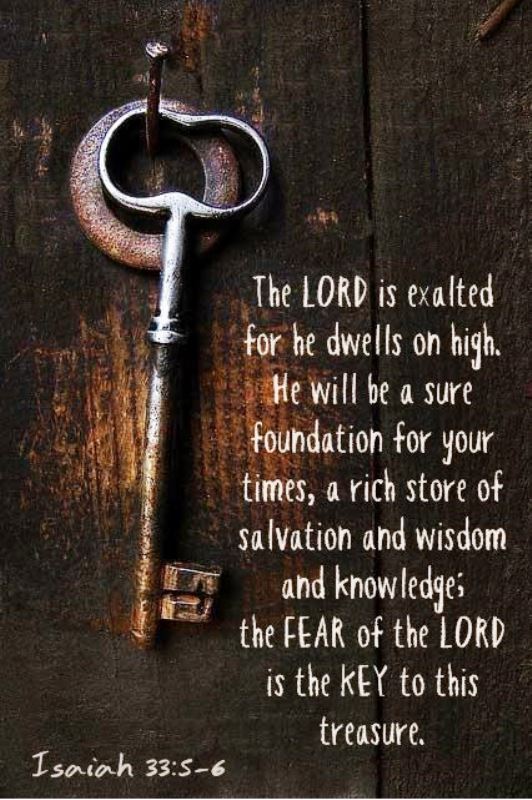
isaiah-33

Tuesday, February 14

Today we are pirates. Isaiah gave us a treasure map! What’s the treasure you ask? Well, look no further than Isaiah 33:5-6. Locked up somewhere is a sure foundation for our times, a rich store of salvation and wisdom and knowledge. Huh? No cash? If none other than the creator of the heavens and the earth holds the key to this treasure, then I think it’s safe to assume that these things are better than anything that you could find in a pirates treasure chest. The most valuable things you can ever obtain in this life are listed right here: a sure foundation, wisdom, knowledge and salvation. Thankfully we know exactly how to get the key to those treasures. Fear the Lord. After all the things we’ve read in Isaiah, it’s easy to see the power that God holds. But don’t just fear God with your mouth, fear him in your heart. Then, you will get the key to these treasures.

-Nathaniel Johnson

(photo credit: http://wiirocku.tumblr.com/post/139549150857/isaiah-335-6-niv-the-lord-is-exalted-for-he)