We all like sheep have gone astray

OLD TESTAMENT: EXODUS 1

POETRY: PSALM 23

NEW TESTAMENT: MATTHEW 18:1-20

Earlier this year, my husband and I went to visit a sheep dairy farm (yes – that’s a thing!) near our house. We spun wool, petted the sheep, and ate some cheese. One of my son’s favorite parts was watching the sheep dogs herd the sheep, seeing all the twists and turns they took into the corral. 

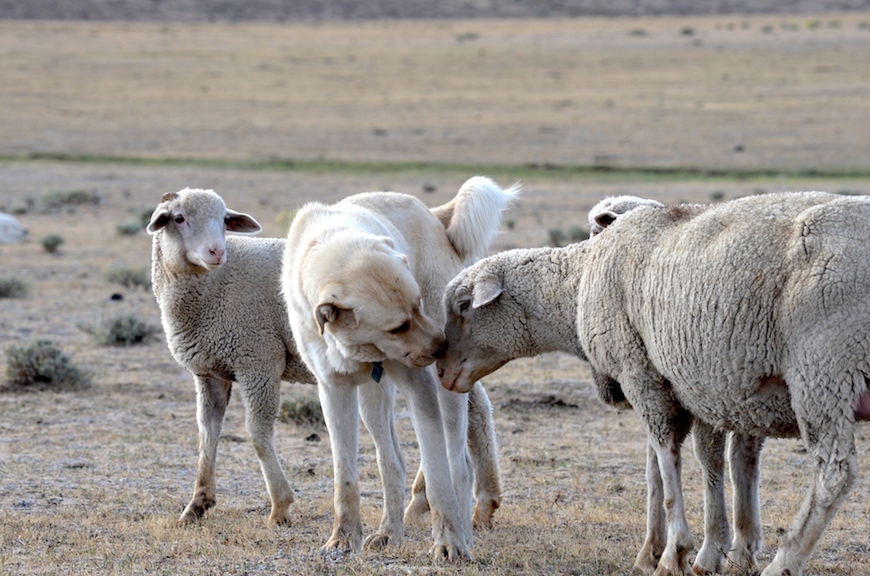
What I didn’t realize is that when you want to get sheep, you really need two different types of dogs. You need a herding dog, like a Border Collie, Corgi, or Australian Shepherd, and you need a guardian dog, like a Great Pyrenees. The herding dog lives with the owner of the sheep and learns how to work the sheep. The guardian dog lives with the sheep. The sheep become part of its pack and for good reason. Sheep are easily hunted down by coyotes, (sometimes) bears, and even stray dogs. 

guardian dog
Guardian dog with his ‘pack’

Growing up, my grandfather had a herd of goats – similar in temperament to sheep – that were attacked by a pack of stray dogs. Out of the 40 in his pack, there were only a few left, who dealt with shock (a sometimes fatal aftereffect). The common saying in circles of sheep owners is that sheep are always looking for a reason to die. Whether that’s escaping from a fence, getting sick from their food, or predators, it takes a watchful eye – from a guardian dog or a shepherd – to care for these wooly beasts. 

This week, we will dwell on Psalm 23, a beautiful passage that describes how the Lord is our shepherd. The undercurrent of the passage is the resounding hope that we have in the good that God has in store for us despite the dangers that we face in our everyday lives. Some of the dangers, the dark places of the valley, are made up of sickness and the brokenness of the world. But, some of the dangers are caused by our own tendencies to wander off the path that God has laid for us. 

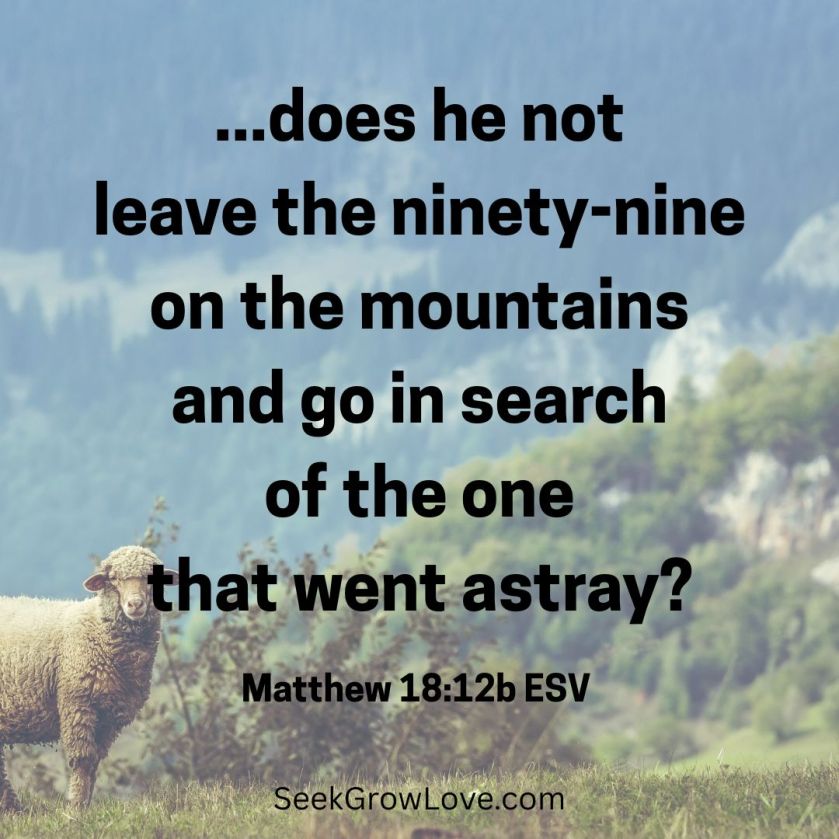
Our passage in Matthew contains the parable of the Lost Sheep. In this parable, Jesus emphasizes how there is much rejoicing in heaven when one lost sheep is found. The sheep had wandered away, looking for some way to die out of the watchful eye of the shepherd, but the shepherd wandered through that valley of the shadow of death and brought the sheep back to the flock. 

We are that sheep who wanders. And God, in his grace, has brought us back. How has this happened? Isaiah 53:8 says, “We all, like sheep, have gone astray, each of us has turned to our own way; and the LORD has laid on him the iniquity of us all.” This prophecy speaks to the role Christ would play in our salvation because God has saved us by placing our sins onto Christ. 

God is the Redeemer. He brings salvation to his people. We will see this ring true in our reading from Exodus this week. You may feel like your life is bitter and full of groaning under the weight of your sin, but God is a good shepherd. He will rescue you if you trust in him. 

~ Cayce Fletcher

Cayce writes about discipleship, productivity, and homemaking at her blog https://amorebeautifullifecollective. You can find her latest post on celebrating the Christian year here. You can also listen to A More Beautiful Life Collective Podcast on Apple Podcasts, Spotify, YouTube, or wherever you listen to podcasts. 

REFLECTION QUESTIONS

  1. What are some similarities between ourselves and sheep?  
  2. What is the point of the parable of the lost sheep? Do you rejoice when another one who was ‘lost’ is found again? 
  3. Can you think of a time when you felt bitter over your life circumstances? Did you handle that season with faith or doubt? 

SGLCalendar2024DOWNLOAD

ON PURPOSE – Evangelism

Luke 15 6b

The past five days we have been looking at how to live our lives on purpose.  We don’t want to drift through life not accomplishing what God has prepared for us to do.  We don’t want worldly goals that pull us away from what really matters.

First, we looked at the Greatest Commandment and said that to love God is to worship God.  Next, we discussed the importance of following Christ by being a devoted disciple: the on-going process of becoming mature in Christ (discipleship) which begins with time in God’s Word – and will include other godly habits as well.  And, a disciple remembers they are not alone but are connected to other disciples as the body of Christ so they are eager to fellowship with and encourage one another.  Life in the encouraging body leads to seeing other’s needs and being willing to use our God-given gifts in ministry to others.

So far, we have created an individual who deeply loves God, is growing in their walk with God’s Son, has healthy connections to the church family and seeks to serve others.  That is a GREAT and beautiful start!  But, too often, we are content to stop right there and remain committed to just these 4 purposes – and stay inside our safe little church bubble (myself included).

When church members were surveyed, 89% said, “The church’s purpose is to take care of my family’s and my needs… Only 11% said the purpose of the church is to win the world for Jesus Christ.” (Purpose Driven Church – Rick Warren – p 82).  And we wonder why the church isn’t growing.  This selfish, inward focus is not healthy, and is not what God intended for us as individuals, or as the church.

The Great Commission did not tell us to just go and BE a good disciple – it commands us, “Go and MAKE disciples of all nations.”  It is not enough to only be concerned for my own salvation.  To truly love God and others includes a desire to share a great and glorious God with those who are lost and hurting and oblivious without Him.  God wants His lost sheep found and most often he chooses to use people to do that.  Only God can save the lost, but He relies on us to share the good news.  Read Luke 15 to see God’s heart for the lost – and pray that becomes your heart, too.

When Jesus said, “Come, follow me” he wasn’t just inviting you to his church pew on Sunday morning.  He said, “Come, follow me, and I will make you fishers of men.” (Matthew 4:19.).  He is asking you to invite others to your church pew.

Who do you know who needs to know God’s saving power and plan?  Who do you know who is not ready for Christ’s return and the Kingdom of God?  Start by naming them and then praying for them and watching for God-given opportunities to speak and act with God’s love and truth.  Then, jump in there and do it.

For Him,

Marcia Railton


The Parable of the Lost Ring

Luke 15

Luke 15_10

It was the beginning of a Louisiana winter when I lost my wedding ring just a couple years into my marriage.  It was a beautiful white gold ring with an inscription of our anniversary on the inside of the band.  It was a perfect reminder of my covenant in every way; however, its faults were it was a little loose when my hands were cold, and of course, it had me for an owner.  My friends and I were readying to play a football game on a Sunday afternoon and I was warming up by tossing the ball with a friend.  In a bit of foreshadowing for the events of the day, my ring slipped off as I caught the ball.  I picked it up off the ground, remarked how cold it was that afternoon, thought about placing my ring inside my pocket but thought it might fall out if it was there.  I put the ring back on my finger, only to lose it at some point in the next couple of hours of our pick-up game.

As we finished playing, my heart immediately sank when I realized it was gone.  I felt a cold sweat build on my forehead, my gut churned, and I held back tears, disappointed that I had lost something so precious.  My friends helped me look for almost an hour without success.  In the muddy, mushy, marshy Louisiana ground, I could see the imprints of our shoes and feet, I could see heaps of crawdad holes, but none of us saw the silvery reflection of my ring buried within the mire and muck.

In Luke Chapter 15, Jesus tells a series of three parables with a similar subject of a possession that has gone missing. In “The Parable of the Lost Sheep”, the master realizes that one of his flock is missing, and leaves behind 99 others to search for the lost one.  In the “Parable of the Lost Coin”, a woman takes account (to tie to our theme from yesterday) to realize she has misplaced a day’s earnings and does the equivalent of turning up couch cushion, investigating under the bed, and sweeping every nook and cranny to uncover it.  In “The Parable of the Lost Son” a father turns his son loose with an inheritance, but is actively looking for his return.  In addition to the same topic, each story ends in a similar resolution: what has been lost has become found and there is great rejoicing.

For me, there are two great takeaways as I ponder the collective meaning of these parables.  The first: to be lost, you have already belonged.  It is true that we each must find the Master in order to be saved, but He is the one who never stops searching.  Our Lord desires that not even a single sheep goes astray and is left without the safety of the shepherd (2 Peter 3:9).  Additionally, my thoughts turn to the Book of Life.  In Revelation 3, we are presented an image that our names are not written into the Book at the transition from “lost” to “saved”, but have already received a place there and are blotted out at the end of a life that is not found in Christ.  We are always His, but like the lost son, we make the decision to be found.

The second takeaway is the wonderful rejoicing that occurs when we turn our lives over and are indeed found.  There is a literal fiesta in the firmament to celebrate our Savior’s joy that we are alive again. No longer do we share the fleeting moments of a mortal life with our Father, but have the hope of an eternity of His presence, living with Him in His kingdom, our intended inheritance instead of passing pleasures. We, too, should echo the heavens and revel in each return.

Unfortunately, the resolution to my own parable of the ring isn’t as joyous as our Jesus’.  I searched for the ring for weeks, beseeched friends I know with metal detectors, offered rewards, but none of these measures ensured the retrieval of my wedding band.  I resigned my search, and my ring is forever lost in the loose Louisiana earth.  Maybe, as I like to imagine, it is the crowning jewel at the bottom at some crawdad family’s hole. With this being said, I can’t help but be thankful that my God has called me his treasure and that he never stops searching for me.  He finds me in my wandering, revealing and moving His will and His way through His words, waiting for my silhouette to again darken the horizon when I have gone astray – a Father who never fails finding those who desire to be found in Him.

-Aaron Winner