Knock and It Will be Opened to You

Genesis 33-34

Proverbs 17

*Matthew 7

Devotion by Tom Siderius (MI)


Matthew 7:7-12(NKJV) Ask, and it will be given to you; seek, and you will find; knock, and it will be opened to you. 8 For everyone who asks receives, and he who seeks finds, and to him who knocks it will be opened. 9 Or what man is there among you who, if his son asks for bread, will give him a stone? 10 Or if he asks for a fish, will he give him a serpent? 11 If you then, being evil, know how to give good gifts to your children, how much more will your Father who is in heaven give good things to those who ask Him! 12 Therefore, whatever you want men to do to you, do also to them, for this is the Law and the Prophets.

It is so humbling to read the words of Jesus and see how he so quickly and precisely condenses the issues of life into a perfect understanding for us. Here in Matthew 7 Jesus tells many truths that illustrate God’s true desire for mankind and gives us the hope that is evident in the statements and wisdom he teaches. 

Ask, Knock, Seek. All these actions come from a believing heart which hears the Word and desires to have the wisdom that God gives to us when we seek Him. The life of Jesus is the way that we can see the true heart of God in Jesus’ actions and speech. Marcia Railton recently taught us in the lessons on Matthew 5 that it is not by following the rules we are made wise and righteous, but by changing our hearts to be like our Father God who loves us. Our minds and hearts need to become changed from our human nature and sin and grow into the attitude and actions of being Christ-like. We must earnestly desire and pursue the truth of God’s Word for our lives in order for them to be changed into what God would have us be. 

Jesus appeals to our human understanding by asking us a question:  Which of you that is a father to children would not be true to their desire for food. Jesus asks, “when the son asks for bread would you give him a stone?”  Their bread was baked in a sort of furnace that had great flat stones for the bread loaves to set on and bake. After an extended period of use the stones in their ovens would look exactly like the loaves of bread being baked on them. Jesus is challenging us to be honest and true in how we deal with people by not giving wisdom or judgement to them which is false or counterfeit. 

The next question is “what father when asked for fish would give his son a snake?”  There were fish that came from the sea of Galilee and other waters that looked like a snake, long and slender. But they were good to eat and nutritious. The counterfeit action here would be to give the child a snake which could be dangerous and certainly not what should be given to them. Luke expands this teaching with “when asked for an egg would give the child a scorpion?”  Here again the counterfeit is the scorpion which when drawn tight together looks like a hen’s egg cooked and ready to eat. But the counterfeit egg is dangerous and even deadly.

Then Jesus asks the question  if we have at least this honesty and integrity with our own children to bless them how much more our God and Father in heaven desires to bless us and give us His care and love? I think this a fitting example of a rhetorical question as it causes us to examine the motives and desires of our hearts. We can live good lives by the rules, I haven’t stolen today, I haven’t murdered today, I haven’t committed adultery today. But the day is early as I write this so how can I be sure I will follow every rule making myself righteous in God’s sight? What great reward does He have for me today for being good and doing all the rules? 

Then we are convicted by just doing what our human nature would probably consider good, giving the real fish, bread, and egg to those that ask. But how much more does God require of us to become like Jesus with his heart of compassion and true love for those we meet and interact with.

Look at Proverbs 17:3 for more wisdom on these questions.

Proverbs 17:3(NKJV) The refining pot is for silver and the furnace for gold,
But the LORD tests the hearts.

Yahweh God our Father is most concerned with our hearts and the test is what is really there. True wisdom comes from above and the words and life of Jesus give us such convicting records of how we are t0 believe and live.

Reflection Questions

  1. What good gifts have you received from God?
  2. Truthfully consider, what does God see in your heart today? What is He pleased to see? What doo you wish He did not see?
  3. What do you want others to do to you? How can you do, or give, that to others?

PRAYER:


Father God today we pray that You change our hearts from the hearts of stone we have to hearts filled with Your love and compassion. We seek you today and ask for Your help in all of life. We knock on the door of understanding and ask for You to give it to us. Father refine our hearts and motives so that we become like Christ. In the name of Jesus Christ we pray this today.

Looking Again and Again at the Sermon on the Mount

Genesis 31-32

Proverbs 16

*Matthew 7

-Marcia Railton (IN)

For the last couple of years January often has me writing something on the Sermon on the Mount. I admit, at first it can seem like a chore to do. But, I have been thankful for the opportunity to take a deeper look into these passages, often seeing ways I need to “Think Again” to change my opinions, thoughts and ultimately my actions to become more like Jesus. It is a great way to start the year. But, how would I be different, inside and out, if I read, thought about, lived out the Sermon on the Mount every day?

So today, I will start with a few of the thoughts I have previously shared on Matthew 7 (with a few revisions, that’s part of the beauty of reading the Sermon on the Mount again and again and thinking again). You can read them – or just read Matthew 7 again. And then, in our longer than normal reflection section let’s talk about how we can be more intentional about keeping this spectacular sermon in our minds, mouths, heart and hands everyday.

Adapted from parts of The Rest of “Do Not Judge” – (from January 10, 2024 for SGL)

Unfortunately, the world has heard just the first three words, “Do Not Judge” and has twisted Jesus’ words into permission to sin and accept sin. But that is not the case! Jesus tells us over and over again (and even multiple times in this same chapter) to look carefully and judge whether people and actions and ideas are good or bad, righteous or wicked, wise or foolish, innocent or dangerous, taking us closer to God or further from Him. He warns you and I about the wolf in sheep’s clothing who wants to deceive you and figurative dogs and pigs that will tear you to pieces. And if you have already decided that it is not your place to judge if they are good or evil or to discern if they want what is good and godly for you or what will destroy you, then I fear you are already sitting in a very dangerous spot. 

So, what did Jesus mean when he started out with the words, “Do not Judge…or you too will be judged” and then gave the excellent illustration of the speck and the plank? Make sure you read it for yourself from Matthew 7. I think he was saying judge yourself first in order to be helpful in then spotting sin in others. Specks are hard to see clearly when we have a plank lodged in our eye socket. And our restored sight is crucial in then being able to delicately help our neighbor remove the irritating speck in their eye. When we judge rightly we can start out by putting every single one of us in the same sorry sinking boat of sinners in need of a Savior – just make sure you jump into that boat first. Stop bad talking and blaming the neighbors and church members and family and see yourself for what you are and what you do. Don’t sugar-coat the truth trying to make yourself look better than the rest. 

Sin causes vision problems – those dangerous specks and planks in the eye are not conducive to seeing the world or yourself clearly. It can be all too easy to completely overlook seeing our own sins and instead attack others for not measuring up to Jesus’ standard. I have been quick to blame my husband and my kids and my friends, when the fault was also with me. I have mistreated people, sometimes to their face, sometimes behind their back. And I have tried to ‘fix’ things my way rather than patiently trusting God for what He said He would do in His time. I can be very selfish and prideful and rude. And the list goes on. And if I don’t accept and work to correct these problems and sins in myself FIRST then I will be hypocritical and ineffective when I, with that plank still stuck in my eye, turn to help my neighbor who has a speck in her eye.

Jesus was not saying specks and planks in the eye are okay and we should leave them be. Sin is not okay. He was telling us the order in which to correct things – self first SO THAT you can actually be useful in helping others recognize and remove the sins that are affecting their sight and health and well-being. Sin surgery for yourself first. Recognize it for what it is and get it out! Then look with compassion not contempt on the neighbors of the world, some of whom do not even know God’s law and have no idea they are stuck in sin because they only heard “Do Not Judge” and never heard the rest.

Adapted from parts of Will it Stand or Fall – (from January 12, 2024 for SGL)

Jesus too, warns of storms with such driving rains and rising waters which have the power to totally destroy and wipe out homes if we don’t take the proper actions beforehand. Storms are coming – and in some cases they have already begun. Jesus tells us, some houses will stand, some will not. It depends on their foundation. Is the house built on rock - or on sand – which is determined by how wise – or how foolish – the builder is. Both builders listen to the words of Jesus – good first step. The wise builder proceeds to “put it into practice” – and his house endures the storm. The foolish builder with his house built on sand has heard the words of Jesus but does not put them into practice. And when the storm comes, his house is destroyed.

Hear the words of Jesus. And then, put it into practice. It is not enough to sit at his feet listening every week or even every morning – if you don’t then spend your days DOING what he says. We have just spent the last several days reading and looking at Jesus’ Sermon on the Mount (Matthew 5-7). Now, what will we do with it? What will it look like to put it into practice today and tomorrow and every day of 2024 (and now 2026) and the rest of our lives – however long or short that may be? Both houses will experience the winds and the rain. Will your house stand?

Reflection Questions

  1. Judge yourself first – what sins are on the plank in your eye? How has sin (the plank in your eye) affected your vision? Do you want it gone? What are the benefits to having it removed? What is needed to remove it?
  2. Looking through Matthew 7, what thought or call to action strikes you as one God wants to see you really working on this month?
  3. It is not enough to be considering these words of Jesus just every January when our Bible reading plan has us reading through the book of Matthew. We need to be tending to our foundation regularly to ensure our homes will withstand the storms. How can we get these words into our hearts so we make them a part of our daily thought/judging/discerning process and then put it into practice so we don’t find ourselves (and our loved ones) surprised at the end of the wide path that leads to destruction? Every day this year I want to read something from the Sermon on the Mount. How about even multiple times a day? I printed a simple Matthew 5-7 document to hang throughout my house – one page in the laundry room, one page on the inside of the medicine cabinet, another in the front of my Bible, etc…. Through the year I can rotate them around if one is more neglected. Feel free to make yours pretty and colorful and/or underlined and marked up. I am excited about learning this familiar sermon better. But not just learning it – living it, more and more. Will you join me? Here’s one to print for you:

Prayer

Dear God Almighty, we praise You because you are perfect in all Your ways. Thank you for the gift of Your Son who not only tells us but also shows us how to live different from the world, and also different from the “religious leaders” of his day, on the narrow path, a light for the world, with a heart devoted to pleasing You, with our foundation on the rock, putting into action every day the words and wisdom in this spectacular Sermon on the Mount. Lord, I confess the plank in my eye. Help me see it. I don’t want it to stay. I want to see clearly and I know this requires sin surgery in my own life, thoughts, attitudes and actions. Help me remove it, realizing it might be a painful process – but with such marvelous benefits in this life and the one to come. Thank you for Your forgiveness, Your wisdom shared through Your Son, Your guidance and proddings through Your Holy Spirit. Help me to listen well this whole year to this Sermon on the Mount, that I might become more and more like Your Son Jesus who preached and lived and died these words for me, and is coming again to live eternally with those who choose to hear and DO your words. In his precious name I pray, Amen.

Will it Stand or Fall?

Old Testament: GENESIS 19 & 20

Poetry: Psalm 7

New Testament: Matthew 7:24-29

There has been a lot of talk and anticipation over widespread storms this week. Much of the United States has been impacted in one way or another and depending on where you live that could mean changing travel plans or school closings due to snow, ice, wind, limited visibility, heavy rains, and flooding or even tornadoes. And sometimes, like today in parts of lower Michigan, just the threat of poor conditions which could produce dangerous situations is enough to alter course for many. 

Jesus too, warns of storms with such driving rains and rising waters which have the power to totally destroy and wipe out homes if we don’t take the proper actions beforehand. Storms are coming – and in some cases they have already begun. Jesus tells us, some houses will stand, some will not. It depends on their foundation. Is the house built on rock - or on sand – which is determined by how wise – or how foolish – the builder is. Both builders listen to the words of Jesus – good first step. The wise builder proceeds to “put it into practice” – and his house endures the storm. The foolish builder with his house built on sand has heard the words of Jesus but does not put them into practice. And when the storm comes, his house is destroyed.

Hear the words of Jesus. And then, put it into practice. It is not enough to sit at his feet listening every week or even every morning – if you don’t then spend your days DOING what he says. We have just spent the last seven days reading and looking at Jesus’ Sermon on the Mount (Matthew 5-7). Now, what will we do with oit? What will it look like to put it into practice today and tomorrow and every day of 2024 and the rest of our lives – however long or short that may be?Both houses will experience the winds and the rain. Will your house stand?

-Marcia Railton

Reflection Questions

  1. What shape is the foundation of your life/house in right now? Have you built on rock or on sand? Are there some cracks to be filled in before the storms start or worsen or are you in need of a totally new foundation re-do?
  2. What are some reasons people who have heard what Jesus said then don’t put it into practice? Which of these have been the biggest issues in your own life? 
  3. Look back over the Sermon on the Mount (Matthew 5-7). How can you put these words of Jesus into practice? What would he like to see you do today? What steps will you do to put it into action?

Two Gates, Two Roads and One Big Surprise

Old Testament: Genesis 17 & 18

Poetry: Psalm 6

New Testament: Matthew 7: 13-23

Many surprises are really good surprises: birthday parties, just because flowers or gifts, snow days, finding bacon in the fridge (said my husband), a check in the mail, your daughter coming home from college 4 days early. But, the surprise in our short New Testament passage today would have to be one of, if not the total WORST surprise ever. But, that’s no place to start a good devotion – let’s save that surprise for the (fitting) end and start with the two gates. 

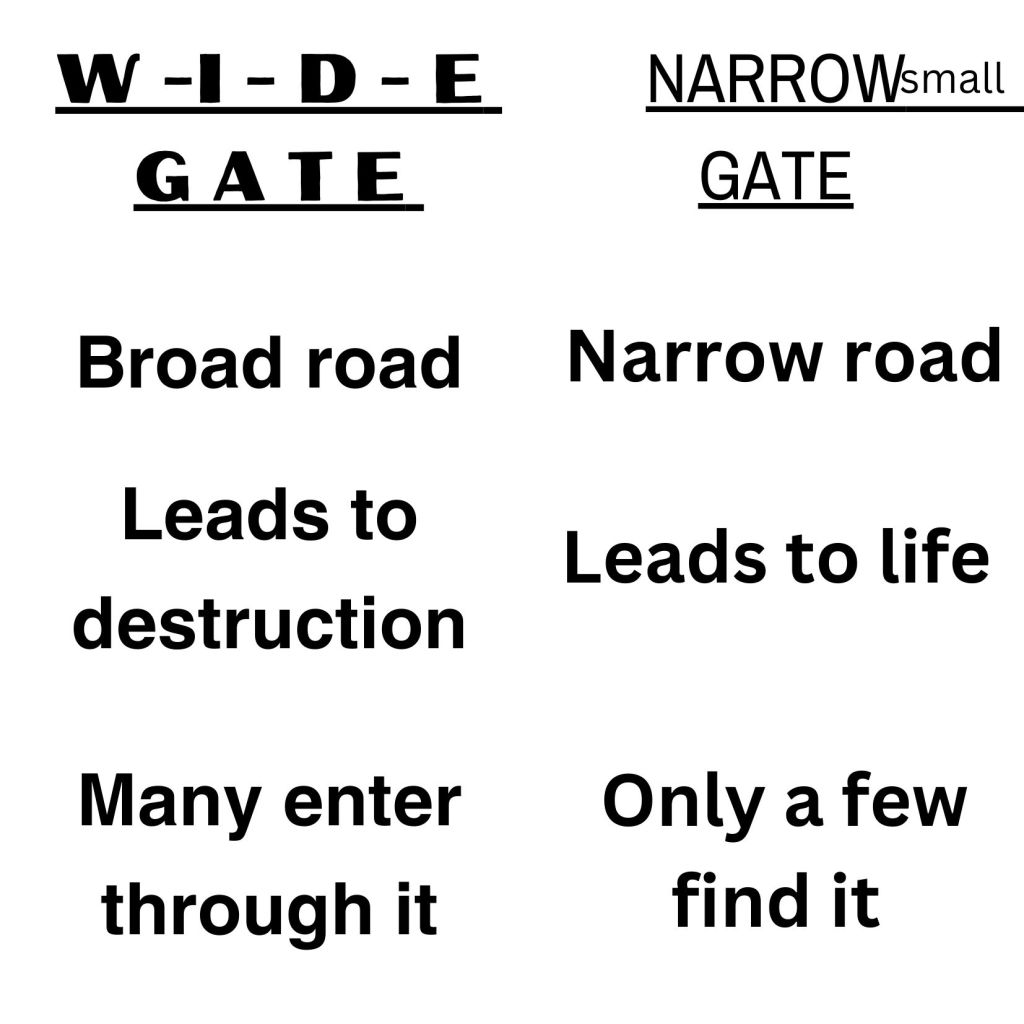
I am a visual learner (though not too artistic) so I made a simple little chart in my journal of the two gates in Matthew 7:13 & 14- two simple little verses with a very big lesson.

It brings to mind the repeated refrain of the desperate teenager arguing with his or her parents to be allowed to ___ (fill-in-the-blank with whatever popular but not always wise pursuit kids are into at the time), “But, everyone else is doing it!” Unfortunately, even as adults we too often strive to fit in with what everyone else is doing, saying, watching, thinking, and even being. When will we learn that “what everyone else is doing” is not a good argument for joining in but actually should raise giant red flags and make one consider reversing course immediately. MANY are on the road leading to destruction. It is popular, easy, fun, attractive, politically correct and what everyone else is doing. It is where your friends and neighbors and co-workers are and likely some family and church members, too. It is where the majority live and work and play, where entertainment and media, social and otherwise, hang out, and where influencers thrive. Why wouldn’t anyone want to join in? Just one reason. It. Leads. To.

Destruction.

Not just a bad day, not just a mistake, not just a lesson learned, but destruction, final and ultimate and forever destruction. Many are headed there now. Many are on that road. And you know them. You might be them. This popular road is also the road with the teenager (and now even younger) tragically contemplating and committing suicide. This is the road with the pregnant hopeless woman planning an abortion. This is the road that is raising way too many of our world’s children and youth. This is the road with ferocious wolves dressed up as harmless sheep. This is the road with hatred and despair and deception grotesquely mixed in amongst the glittery fun popularity. This is the overflowing road that leads to destruction.

Who will find the way out? Just. A. Few. Will I? Will you?

Remember that surprise we were saving for the end? The WORST surprise ever? Jesus said that MANY (where did we see that word recently?) who appear to know Jesus and speak in his name – who even drive out demons and perform miracles in his name – will be told by Jesus, “Away from me, you evildoers!” as he denies them entrance into the kingdom. And if you aren’t going into the kingdom the only other option is that wide slippery slope of a road that drops you straight into destruction. 

This is one of those many times in the Scriptures where I want more information to answer all my burning questions starting with, who are these (many) people? Yeah, I want names, Jesus, but if you can’t give me that, at least some more details… What denomination(s) are they? What hidden sins? Who do they believe Jesus is? Are they wrong? Is that why they are denied? What role does pride play? Are these different from the wolves in sheep clothing? They kind of seem to be “better” good and effective “Christians”- are they? Do they think they are? It seems they look really good on the outside, could something be wrong on the inside? Have they fooled even themselves? 

But the most important question is: How can I make sure I, and the ones I love and care for, are not in this group? And Jesus does give us that answer. Do the will of His Father in heaven. ONLY the people who DO the WILL of GOD will be allowed into eternal life anew in the Kingdom of God. Just wearing the Christian name is not the ticket. Merely calling Jesus Lord is not enough. Even driving out demons and performing miracles – which do appear to be convincing signs of doing the will of God – is not enough to prove one is actually doing God’s will. GOD always knows who is and who isn’t doing His Will. And Jesus isn’t fooled either. It is indeed much harder for us to see and always know who Is and who Isn’t doing the will and work of God. We are told that false Christs and false prophets and even a powerful beast of the earth will come with great signs and wonders in order to deceive. (Matthew 24 and Revelation 14).

Don’t be deceived. Don’t deceive yourself. Don’t set yourself up to receive the worst surprise in the world. Don’t join them on that wide road. Don’t let your last words be, “But everyone else was doing it.” Don’t be tricked into believing you have to stay on that wide road if that is where you are now. Get off. Change your course. Change your destiny. Fight against that loud crowd and find your way to the unpopular narrow road.  Do His Will. And in order to DO that – you need to study to know Who God is and what His Will actually is so you won’t be tricked into thinking you are good and safe and got your ticket in. Be one of the few heading toward the narrow gate doing God’s will. It is the only way to life. 

-Marcia Railton

Reflection Questions

  1. What do you think makes the wide road so popular? 
  2. Do you find the narrow road appealing? Why or why not? 
  3. Which road do you think you are on now? What evidence do you have? Is this where you want to stay? Why or why not?
  4. With the information you have right now, what do you think doing God’s will would look like for you today? Are you doing it? How can you learn more about what God’s will is for you? What’s the danger in not learning more about God’s will?


The Rest of “Do Not Judge”

Old Testament: Genesis 15 & 16

Poetry: Psalm 5

New Testament: Matthew 7:1-12

If Sarai of Genesis 16 was my neighbor or Bible study partner or worse, my daughter-in-law, I’m not sure I would like her much. There is the big problem of Sarai sending her maidservant Hagar to sleep with her husband Abram. Perhaps, with a bit of study I could accept this as a cultural Canaanite tradition which was indeed an effective way of fulfilling God’s first command to Adam and Eve: Be fruitful and increase in number (Genesis 1:27). It gets trickier to do this God’s way when there are more than two people on earth, but still no law. In fairness to Sarai, she did not have the benefit of God’s law yet as she was born hundreds of years before Moses. But, even if I were to give her grace and excuse her from that act, there is the whole problem with her attitude and overall mean spirit. Even when her plan works out as she had orchestrated, she quickly casts blame on her husband and mistreats/abuses Hagar. Not a pretty picture, Sarai. 

I am glad I am so much better. I would never impatiently try to help God give me blessings in my own way not His. You would never find me blaming my husband. And I have certainly never ever mistreated – anyone. Well, probably not enough to make them run away into the desert. 

Maybe, I am exactly what Jesus was talking about in Matthew 7 when he begins, “Do not judge, or you too will be judged.  For in the same way you judge others, you will be judged, and with the measure you use, it will be measured to you” (vs 1-2). Unfortunately, the world has heard just the first three words, “Do Not Judge” and has twisted Jesus’ words into permission to sin and accept sin. But that is not the case! Jesus tells us over and over again (and even multiple times in this same chapter) to look carefully and judge whether people and actions and ideas are good or bad, righteous or wicked, wise or foolish, innocent or dangerous, taking us closer to God or further from Him. He warns you and I about the wolf in sheep’s clothing who wants to deceive you and figurative dogs and pigs that will tear you to pieces. And if you have already decided that it is not your place to judge if they are good or evil or to discern if they want what is good and godly for you or what will destroy you, then I fear you are already sitting in a very dangerous spot. 

So, what did Jesus mean when he started out with the words, “Do not Judge…or you too will be judged” and then gave the excellent illustration of the speck and the plank? Make sure you read it for yourself from Matthew 7. I think he was saying judge yourself first in order to be helpful in then spotting sin in others. Specks are hard to see clearly when we have a plank lodged in our eye socket. And our restored sight is crucial in then being able to delicately help our neighbor remove the irritating speck in their eye. When we judge rightly we can start out by putting every single one of us in the sorry sinking boat of sinners in need of a Savior – and make sure you jump into that boat first. Stop bad talking and blaming the neighbors and church members and see yourself for what you are and what you do. Don’t sugar-coat the truth trying to make yourself look better than the rest. 

I am no better than Sarai. I have been quick to blame my husband and my kids and my friends, when the fault was more with me. I have mistreated people, sometimes to their face, sometimes behind their back. And I have tried to ‘fix’ things my way rather than patiently trusting God for what He said He would do in His time. I can be very selfish and prideful and rude. And the list goes on. And if I don’t accept and work to correct these problems and sins in myself FIRST then I will be hypocritical and ineffective when I, with that plank still stuck in my eye, turn to help my neighbor who has a speck in her eye.

Jesus was not saying specks and planks are okay and we should leave them be. Sin is not okay. He was telling us the order in which to judge and correct – self first SO THAT you can actually be useful in helping others recognize and remove the sins that are affecting their sight and health and well-being. Sin surgery for yourself first. Recognize it for what it is and get it out! Then look with compassion not contempt on the Sarais and Hagars and neighbors of the world, some of whom do not even know God’s law and have no idea they are stuck in evil because they only heard “Do Not Judge” and never heard the rest.

-Marcia Railton

Reflection Questions

  1. When you honestly look at yourself what sins do you find? How can you work at removing them? What roles do Jesus and God’s word play in surgery to remove sin?
  2. When you encounter sinful stories how can you respond less like a hypocrite and more like “The God who sees me” that Hagar experienced in the desert in Genesis 16?
  3. What is the problem with not judging what you see around you? 
  4. How does Matthew 7:12 relate to the “Do not Judge” part of Matthew 7? In what other situations is it wise to live by Matthew 7:12?

Mistaken Identity

Old Testament Reading: Genesis 11 & 12

Psalm Reading: Psalm 8

New Testament Reading: Matthew 7

Mistaken identity. Incorrectly thinking you found or recognize someone. It makes for a funny sitcom, dramatic court scene or suspenseful spy thriller. But in real life – and specifically when dealing with eternal life – it’s not the best time to realize – you don’t really know who you are dealing with. There is a lot of that going on in Matthew 7:15-23. Now’s a good time to go click the Matthew 7 link above and give it a read if you haven’t yet. Don’t trust my words – I might not be who I say I am, but the words of God are always true and here in Matthew His Son, Jesus, speaks words that are trustworthy and accurate and when acted upon can even save your life/house from destruction in the storm (Matthew 7:24-27). Give it a read.

Its a great chapter with a lot of wisdom – too much for one devotion. Last year I happened to be writing about this chapter in January as well and I was drawn first to “Do not judge…” This week the picture that sticks in my brain is Jesus on THAT day (THE day of judgment) when all will be seen clearly and Jesus effectively sorts out all cases of mistaken identity. Jesus gives the example of those who call him, “Lord, Lord” – but are NOT allowed to enter the kingdom. He even says there will be MANY who call him Lord AND who prophesy (speak) in the name of Jesus, drive out demons and perform miracles – who will NOT be given access to the kingdom. These are not “name only Christians” who only come to church on Easter. These are the ones leading the service! It seems everyone would be quick to call them Christians. But what everyone thinks about these “Christians” won’t matter on judgment day. Jesus sees. Jesus knows. He isn’t fooled by a sheep costume.

How can we tell we aren’t being mistaken about their identity? Is that a sheep? Or is that a wolf? Sometimes it is hard to know. It appears to me that perhaps many of them don’t even know! Did those wolves really think they were the sheep, doing all the right sheeply things? Will they be totally surprised when Jesus denies them entrance to the kingdom? I am guessing the answer is yes for many.

What about me? If I could be wrong about them, and they could be wrong about themselves, could I be wrong about myself? How deep does this mistaken identity problem go? How can I tell? I don’t want to wait until THAT day to find out I was wrong! I don’t want Jesus to block my entrance to eternal life. I don’t want Jesus to call me an evildoer and say that he never knew me. I want to be known by Jesus on that day. So what do I do today?

Jesus tells us. He says it’s not enough to call him Lord and brag about an impressive ministry checklist. Instead, we must be doing the will of His Father in heaven. Am I doing God’s will? How will I know? He’s not just looking for a lot of boxes checked off – that didn’t work. What does He really want from me? What is His will?

Anytime you are sincerely trying to give someone what they want – a birthday present for a family member, a job well done for a boss, or a surprise for a friend – the more you know about the recipient the easier it is to know what they want. Similarly, the more we know God the easier it is to know what He wants, what His will is, and what He doesn’t want. And the best way to get to know God is spending time with Him – seeking Him in His Scriptures, reading His words, speaking to Him in prayer, building a relationship that goes far beyond a checklist.

Don’t be wrong about who God is and what He wills. Seek Him today. Seek Him today and every day from now until THAT day.

Dear God, I pray, reveal yourself to me. Please show me who you are and what you want. I don’t want to be wrong about You and Your Son and Your Kingdom and Your Will. Help me to know your will and do it. I want to be known by Your Son, today and on that day. Help me be pleasing to You.

-Marcia Railton

Reflection Questions

  1. What is your favorite part of Matthew 7 today? Why? How can you act upon it (hear these words and put it into practice – vs 24)?
  2. How can you guard against cases of mistaken identity? What should we look for in determining if one is a true sheep?
  3. What do you learn about God in your reading today? How can you use this information wisely?