What Fills YOUR Heart?

Matthew 12

matthew 12 34 b

We find in Matthew 12 that Jesus hasn’t slowed down. In fact, all the surrounding naysayers,  the Pharisees, are turning the criticism up. They were obviously feeling threatened. What I find most interesting though in these 50 verses is how familiar it all sounds. Just like then, the Pharisee in many of us now is also killing the mission and effectiveness of the church too.


Not uncommon in today’s age is to view a Pharisee as bad, yet the Pharisees were, to some extent, well-meaning people. They studied the law and knew it as well as anyone. Some were sincerely seeking God. After all, Nicodemus and Joseph of Arimathea, both Pharisees, arranged for Jesus’ burial. They were sympathetic to Christ and, from what I can tell, ultimately ended up following him. The mission of the early church was radically advanced by a converted Pharisee – Paul. The irony is the people who declared to love God the MOST ultimately killed his offspring when he showed up to heal and teach the nation.


Rightfully, Jesus condemned the Pharisees for their pride, lack of compassion and hypocrisy. Observe some of their exchanges in this one chapter alone and you might find it leaving a bad taste in your mouth, too. They were always trying to trip him up and I can’t recall one time where he was praised for his tireless work.  In verse 34 Jesus compares the Pharisees to a cluster of snakes and remarks “for the mouth speaks what the heart is full of.” How all too often do I find myself under pressure or stressful situations looking to my own self-justification and self-importance, just like the Pharisees. Denying God is exactly what I do when my attitude justifies me more than reflecting the heart and love of Christ.  


The religious leaders of the time were obsessed by their rules and detailed interpretations of the Old Testament law but they had largely ignored the key points of it – justice, mercy and faith. Oh that we learn this lesson in our congregations today opening wide the doors to welcome in the broken, bruised and hurting. Jesus is interested with reality. It is easy to pretend that everything is okay and that we have everything together. If we want to pretend that everything is fine when it isn’t that is up to us, but we shouldn’t expect other people to live up to the standards that we are pretending to live by.


The gig is up for me. I won’t do it anymore. My heart is full and declaring just like Paul that “but for the grace of God go I.” (1 Corinthians 15:9) I am imperfect and Jesus is restoring me everyday. Use me, Lord, as you will to build your church.


-Julie Driskill

Justice vs. Mercy

Matthew 25-26

mercy vs justice

Saturday, May 6

Which is more important in God’s eyes, justice or mercy?  That might be a difficult question to answer, but let me give it a try.

First let’s talk about justice.  There are many examples of God’s justice in today’s reading.  In the parable of the ten virgins, those who were not ready for the return of Christ were told by Jesus that he did not know them.  They were receiving justice for the lives they lived.  In the parable of the talents, the man who did not use the talents that were given to him was sent to the place where there shall be weeping and gnashing of teeth.  Justice was on display again.  In Matthew 25:31-46, those that did not help the needy were sentenced to eternal punishment.  Justice served.  Judas betrayed Jesus and Jesus said it would have been better for Judas if he had not been born.  That was a warning that justice was on its way.  There was no mercy shown in any of these instances, only justice.

In Matthew 26, Jesus is arrested and his death on the cross is imminent.  We know why Jesus needed to die – to pay the debt for our sins.  The wages of sin is death so we all deserve to die since we have all sinned.  But think about this for a minute.  Couldn’t there have been a different way to make it right?  Jesus even prayed that prayer three times.  He didn’t want to die and he was hoping there was a different way to handle this.  God is in charge of everything so certainly he could have come up with an alternative solution to this problem.  Maybe if we sincerely repented for our sins, God could have shown us mercy and wiped our slates clean without anyone having to die.  Or maybe if we showed Him that we loved Him he could have overlooked our sins.  There had to be a different way.  Why did someone have to die?  The reason someone had to die is because of justice.  God is such a just God that He could not ignore justice.  It is very clear to me that God believes justice must always occur.

So where does that leave mercy?  Let’s go back to the death of Jesus.  Jesus was God’s own son.  He was also without sin.  There has only been one person on this earth in the history of mankind that did not deserve death, and that was Jesus.  God watched his only son be tortured and killed on the cross for something he did not do.  I can’t even imagine how painful it would be to watch one of my children suffer and die for something they did not do.  Yet God allowed it to happen, even though He could have stepped in and rescued him at any time.  Why would He just watch and do nothing?  It was because of His immense love for each of us.  He let His own son die for our sins so that we would not have to.  I believe that is the greatest act of mercy that has ever taken place.

So the answer to justice vs. mercy is “both”.  God will make sure justice occurs 100% of the time and He is on record as committing the most merciful act in history.

-Rick McClain

(Photo Credit http://www.breslev.co.il/articles/breslev/rebbe_nachmans_wisdom/mercy_vs__justice.aspx?id=26842&language=english)

To Fast or Not to Fast?

Zechariah 7-10

zechariah-7-9-10

Monday, April 24

Do you fast? I’ve done it once, a 30 hour famine…it was rough…of course the promise of pancakes afterward helped! 😉

Zechariah Chapter 7 dives into the question, to fast or not to fast?. “Shall I weep in the fifth month and abstain, as I have done these many years?” The Israelites question whether or not they should continue to fast and grieve over the destruction of Solomon’s temple since the new temple was being built. God makes it clear that in this case fasting is essentially pointless. The Israelites chose to fast out of their own grief and sadness, they created that tradition not God. God quickly reminds them that there are more important, better ways to honor God than continuing their fasting.

The Israelites were following the tradition and rules of fasting that they created,  but not really doing anything for their relationship with God. In the next couple verses God lays out some simple truths: “Thus says the Lord of hosts: ‘Execute true justice, show mercy and compassion everyone to his brother. Do not oppress the widow or the fatherless, the alien or the poor. Let none of you plan evil in his heart against his brother.” Zechariah 7:9-10


Plain and simple. These are things God desires for us to do, to be. This reminds me of when Jesus was questioned about what the greatest commandments in the Bible are. Matthew 22:37 Jesus answers, ”Jesus declares, ‘Love the Lord your God with all your heart and with all your soul and with all your mind.’ 38 This is the first and greatest commandment. 39 And the second is like it: ‘Love your neighbor as yourself.’ 40 All the Law and the Prophets depend on these two commandments.”


How great it is to have a God that desires more from us than our earthly traditions. He is a God that wants us to love and serve him by loving and serving others. Jesus’ very message.


To Fast or Not to Fast… do you have the answer?
Elleigh Dylewski


(Photo Credit: https://dailyverses.net/zechariah/7/9-10)

Broken Down

Jeremiah 3-4

jer-3-22-ww-splitshire-9x

Monday, February 27

In Chapters 3-4  Jeremiah wanted a spiritual turnaround for sinful, wasteful lives.  He pictured this as a plowing of ground, formerly hard and unproductive because of weeds, in order to make it useful for sowing.


Chapters 3-4 are a description of God sending enemies to break up and punish the sinful people who are not seeing their sin.

God sent armies that were powerful like lions and took away blessings that they no longer recognized from God.

This is actually mercy from God so that these people will not die in their sin but recognize how far they have turned from God.


Do you recognize when God is trying to bring you back?

Are their things that you see as hardships that maybe can be useful to your spiritual life?

– Andy Cisneros

(Photo Credit: http://www.alittleperspective.com/jeremiah-3-and-4/)

Mercy and Compassion

Isaiah 14-16

isa-14-1-ww-cc-9x

Thursday, February 9

If someone were to look at news regarding the Middle East, there is a good chance it would have something to do with the people of Israel fighting against the surrounding nations.  Israel always seems to have problems with its neighbors.  These problems go all the way back to Abraham!  In today’s section of reading, there were several passages about neighboring nations of Israel.

At the beginning of our reading in Isaiah 14:1, it states that “the LORD will have compassion on Jacob and will again choose Israel, and will set them in their own land.”  Even though the people of Israel were a wicked nation at this time, God was still going to have compassion on them.  This is an example of the grace and mercy of God, as He was still going to work with them and give them their own land.  Similar to God having mercy on the people of Israel, God is willing to have mercy on us.  God’s will is that no one should perish; He wants us to seek Him.  If we do, then God will have mercy on us and grant us a spot in the coming Kingdom.

The rest of our reading for the day had to deal with the oracles of the surrounding nations.  Although God was merciful towards his own people, the other nations don’t necessarily receive that same mercy.  These other nations were opposing the people of Israel, and God was not too fond of that.  He was going to redeem His people.  God has the back of the Israelites, even when they were at their worst.

Nowadays, according to Paul, “There is neither Jew nor Greek,” (Galatians 3:28).  Anyone who devotes their life to God, is seen as a chosen people from our Heavenly Father.  The chosen people in the Old Testament were pretty much the Israelites.  The chosen people nowadays are followers of Christ.  Therefore, just as God had the backs of the Israelites, God has our back.

-Kyle McClain

(photo credit: http://www.alittleperspective.com/isaiah-14-through-16/)    

Sacrifice that is Pleasing to God (I Chronicles 21-23)

Monday, November 21

1-chron-21-24

Chronicles 21-23 continue with various exploits of David and opportunities to see the need for a savior to stand between sinful man and Yahweh. David had earlier gotten into trouble numbering the “strong men” of Israel who were ready for battle. He doesn’t seem to learn the lesson to trust in God and follow His plan. At times David seems ready to be God’s servant and listen before acting, but he can’t let go of the idea that he needs to be in control.

David decides to order a census. On the surface there is no problem, but God required a tax to be paid to the tabernacle or be plagued each time they were counted in order to take time and count their blessings before God. (Ex. 30:12-15) Joab reasoned the people would not want to pay another tax and would be plagued. In chapter 20:3 Joab asks David, “my lord the king are not they all God’s servants? Why become the cause of guilt for Israel?”

Joab did his best to intercede on behalf of Israel, but David would not relent and Israel was plagued. God keeps His word even when it hurts. When David realized what was happening to the people he asked God to forgive him and if you have heard the story before you know God offered David three choices. Three years of famine. Three months under the control of enemies. Or he could choose three days under the sword of Yahweh.

David asks that he fall into the hands of God because he had witnessed that the mercies of God were great. As God’s angel was ready to strike Jerusalem, God relented after hearing all the cries for mercy and ordered David to build an alter at the spot the angel stood. The story that follows is one of my favorites. Ornan and his four sons have seen the angel and are hiding, like that would help. David approaches to ask to buy the land where the threshing floor stands to build an alter for God and Ornan tells David to take the land and oxen for an offering and suggests David use his tools for the wood to start the fire and to use the wheat he has milled for a meal offering. Ornan says, “I give it all.” Talk about being “All In”!

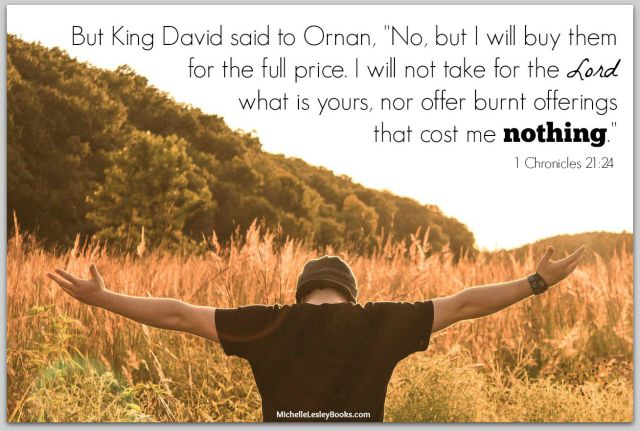
David could have done just that, but he has had an epiphany. He understands that the sin belongs on his shoulder and he wants to pay the price. He tells Ornan in v. 24, “No; but I will certainly buy it for full price. I will not take that which is yours for Yahweh, nor offer a burnt offering without cost.” Forgiveness comes with a cost. Ornan was willing to give it all to protect his sons. David asked that Israel’s sin be counted to him and his family. He trusted God to love and show mercy and always provide a covering for the sins of men. David was so messed up when he acted on his own impulses. When he came face to face with God, I believe he realized he was a type of Christ to come to mediate for all mankind.

God asks so little of us when you really stop and think about it. Basically God said; if you want to be counted in your own strength, pay a tax to the treasury of God so you are reminded that all you have is mine, all you are is mine and we are in this together.” A sacrifice has to have a cost, otherwise what is the purpose of going through the motions.

Just as David came to realize how he set Israel up for failure and the need for a sacrifice to cover the sins of Israel; let us examine our behavior in light of God’s word and determine each day to be a guide rather than a stumbling block as we interact with our friends and family. And thank the Good Lord above He didn’t hide His son from us, but offered HIM as the perfect sacrifice and the light to a darkened world.

Glennis Walters