
Big and Bold

OLD TESTAMENT: Ezekiel 10 & 11

POETRY: Psalm 121

NEW TESTAMENT: Revelation 21 – again

    In Revelation 21 we have come to the climax of events. In the Garden of Eden God set out to undo the separation between Himself and us, and that goal is at last complete. Humans may have been short sighted during history and at times tied themselves in knots over other issues, but God wanted to return to our sides. With “the first things” passed away there will be no more pain. Evil is removed from the scene and God is changing the universe, making everything new. He intends to freely give the water of life to those who overcome (John 4:14).

     God lists some of those who will not receive what He offers, addressing several issues that were raised in the book, murder, sorcery, idolatry – but it begins with the cowardly (v. 8). I wonder if that is directed at early readers, facing persecution in the Roman Empire and possibly hesitant to commit. But it extends to later readers, who might question if they wish to stand up for Jesus’ name and his authority and risk conflict, or if it would be simpler and safer not to, even to appear to be unsaved. Some of God’s servants, like Gideon, were called to serve while not eager to act on their own. That may seem to give a basis for seeing hiding as credible. But I think God chose from the reluctant to make a point, and to stir the hearts of others. And those were not Christ’s disciples, already gifted with the Spirit. He expects something else from us. Not that I am saying we are to be abrasive and offensive in an eagerness to act, there are proper and wise moments and ways to stand up, and we are not always the right people to do so in a situation. Like I said, the appearance of that word first in the list strikes me. It convicts me, all too often, of taking an easier route. But I work for Jesus, and I’ve never heard of anyone braver than him. I leave it to you how it makes you feel. 

     John is taken to a tall mountain by an angel to see “the bride, the wife of the Lamb” and arrives at “the holy city, Jerusalem” (v. 9, 10). It is reminiscent of Ezekiel being shown the new temple, which was on a mountain (Ezekiel 40). I have taught about Revelation 21 numerous times. I have considered taping a cardboard mockup on a globe of the world to show the size of New Jerusalem. I didn’t end up attaching it, and I wasn’t sure if it should be a cube or a ziggurat, or a pyramid (we are told its base is square, and the height). Just describing my idea to the students got the gist across. New Jerusalem is large.

     Earth’s breathable atmosphere extends out for about eleven miles at the equator. Perhaps you have heard the idea about being able to see the Great Wall of China from orbit. You can’t. You could bump into New Jerusalem in orbit. We aren’t totally sure of the size of the city, it depends on how you understand twelve thousand stadia, the 1995 NASB says 1,380 miles and some other versions say 1,500 miles. The International Space Station orbits about 250 miles from Earth. The Hubble telescope is 340 miles out. The upper range of what are known as “low Earth orbit” satellites is 1,243 miles, so the city would tower above all of them, if they were still around. (Which they won’t be.) But the geostationary satellites are much further out, at 22,236 miles. And the Moon is 238,900 miles away, which is nowhere near it. Speaking of the Moon, it has a diameter of 2,159 miles. Earth is 7,917.5 miles in diameter. Under the smaller estimate for the city (1,380 miles) it is 15.69% of the width of Earth, and my cardboard mockup needed to be 1.88 inches wide for a standard 12-inch globe.

     We are told that with God’s new heaven and new Earth there is no longer a sea (v. 1). If that refers to the Mediterranean Sea it seems like a necessary removal, to give New Jerusalem ground space to fit. If it was centered on the location of Jerusalem it would extend about halfway through Greece, assuming it was aligned square with the equator. It also couldn’t be flat on the bottom since the Earth curves, which matters at this size.

     I think this raises some questions. When God replaces the Earth, will it be the same size as the old one? What is being described here sounds like God planned on expansion. The millennium just took place, a thousand years without plagues, famine, and war. It didn’t start off with very many mortal people, but I think the population had a good opportunity for growth. It may be that the number saved during human history leading up to Christ’s return will be just a fraction of those who will ultimately be saved, guided in part by the priests we are being prepared to be. Oh, may it be so.

     My questions are skipping over a rather obvious point. The angel who volunteers to show New Jerusalem to John does so under the description of “the bride, the wife of the Lamb” (v. 9). It isn’t clear to me whether that is because the bride (the population) is inside the city, or because the city is simply a symbol of those who have been accepted as Christ’s bride. The names inscribed on it, of the twelve tribes and the twelve apostles, may not simply be honoring those figures but symbolizing all who came from the lineage of those figures. Consider the description of its size and splendor, and the statements that none with bad character will enter. It says that God and the Lamb provide it with temple and light and lamp. All of this fits the idea that New Jerusalem is the people of God. Now, perhaps the language here presents people and city in another of the Bible’s double fulfillments and both cases are true. Whatever God intends it will be wonderful, and the beautiful description given in this chapter leaves me in awe and anticipation. I say, rejoice in your Lord!

     Thank you, Father, for giving us this glimpse of the glory that lies ahead. Thank you for your commitment to us, that you did not give up on the work of Your hands, but took such care and effort to restore what had been damaged. Please help us to value what you value, to seek what you desire. There are so many lost sheep, so many hurting hearts, that you desire to be blessed by the love of your son. Please shape me into who you desire me to be, until I am complete. Thank you, in the name of Jesus, Amen.

-Daniel Smead

(originally posted November 17, 2023 for SeekGrowLove)

Reflection Questions

  1. What does God’s commitment to fixing what was broken tell you about Him? What does it say about how God sees us?
  2. What are some of the “first things” that will have passed away when the events of Revelation 21 have come to be?
  3. Might God count you among the cowardly? When have you taken a courageous stand for Him? If (when) you are tempted to hide, what helps you overcome that temptation and stand up?

New!

Sunday, December 31, 2023, New Years Eve

Theme Week – Celebrating Jesus: Revelation 21

Old Testament: Malachi 3 & 4

Poetry: Psalm 150

            Here we are, the last day of 2023.  We’ve come to the end of the year.  We’ve also come to the end of this eight day focus on the life of Jesus.  We started with the announcement that he was to be born, then his birth announcement, his escape to Egypt, his new beginning in Nazareth, his baptism and testing, his ministry, his death, this resurrection, his ascension to heaven and now we’ve reached the end.  Revelation 21 is a picture of what the future will be after all of the other prophecies surrounding the end of this age and the return of Jesus to reign are completed.    I’m going to insert one passage from 1 Corinthians 15 to help transition us to Revelation 21.

“But Christ has indeed been raised from the dead, the firstfruits of those who have fallen asleep. For since death came through a man, the resurrection of the dead comes also through a man. For as in Adam all die, so in Christ all will be made alive. But each in turn: Christ, the firstfruits; then, when he comes, those who belong to him. Then the end will come, when he hands over the kingdom to God the Father after he has destroyed all dominion, authority and power.” (1 Corinthians 15:20-24).

Paul here gives the basic outline: Christ died and became alive again.  When he comes again those who belong to Christ will, in the same way become alive again, never more to die.  Jesus will reign for a time, Revelation 20 says it will be 1000 year or a millennium, and at the end of that time there will be a final judgment and all of the powers which opposed God since the beginning will finally be destroyed, at which time Jesus will hand over the kingdom to God himself who will come and reign over us in person.

Today’s reading in Revelation 21 shows what will happen after Jesus hands over the kingdom to God.  God sets up his kingdom on earth, in what Revelation calls the New Jerusalem (it’s much larger than the present city of Jerusalem).

This brings the Bible full circle.  In Genesis 1-3 when God first created the earth, he came to the Garden of Eden to visit with Adam and Eve in person.  After they sinned and were cast out of the garden, they were separated from God.  They could no longer dwell in the presence of God.  God made provision for his people through various tabernacles and temples that would have a very holy place where the glory of God would come and where a representative of the people, the high priest would come once a year.  But God’s presence was always mediated by other forms- a burning bush, an angel, pillar of fire or pillar of cloud.  Now, in Revelation 21, God is back fully on earth with his people, in an unmediated direct way.  There’s no need for a temple now, for everyone who is there has been made holy by the blood of Jesus which has cleansed them from their sins.  They are immortal and sinless.  There will be no more death or pain or brokenness.  The Lord God announces, “I am making everything new.”

Tomorrow begins a new year, 2024.  My best guess is, not much will change in the world. Yes, you’ll need a new calendar.  People might have a new insurance plan.  But there will still be sickness, there will still be wars, people will still be snarky on social media and the Democrats and Republicans will continue to fight.  And people will still die.  That’s not going to change until Jesus returns and puts a final nail in the coffin of evil in this world.  This passage gives us a hopeful picture of what the world will be like after that happens, when God comes to live with us, when the final enemy of death will be destroyed and God makes all things new.

The world will be the same tomorrow, but you can be made new.  If you put your full faith and trust in Jesus and follow him, he will make you new.    2 Corinthians 5:17 says: “Therefore, if anyone is in Christ, he is a new creation; the old has gone, the new has come!”.  Will you choose to be in Christ, will you be made new?  Happy new year and happy new you!

-Jeff Fletcher

Reflection Questions

  1. How would you describe Revelation 21 to someone who has never read it before? What do you find most exciting about the New Heaven and the New Earth and New Jerusalem? 
  2. Have you chosen to be in Christ? How does life in Christ create a new creation?
  3. Through your Bible reading what have you learned about God and His Son Jesus in 2023? How can what you learned change you? How can you put this knowledge to use in 2024? Who needs to know what you know? Thank God for revealing Himself to you through His holy Scriptures. 

Watch for the NEW 2024 SeekGrowLove Bible reading plan to be revealed later today! 

Paradise

Old Testament: Ezekiel 37 & 38

Poetry: Psalm 107

New Testament: Revelation 22

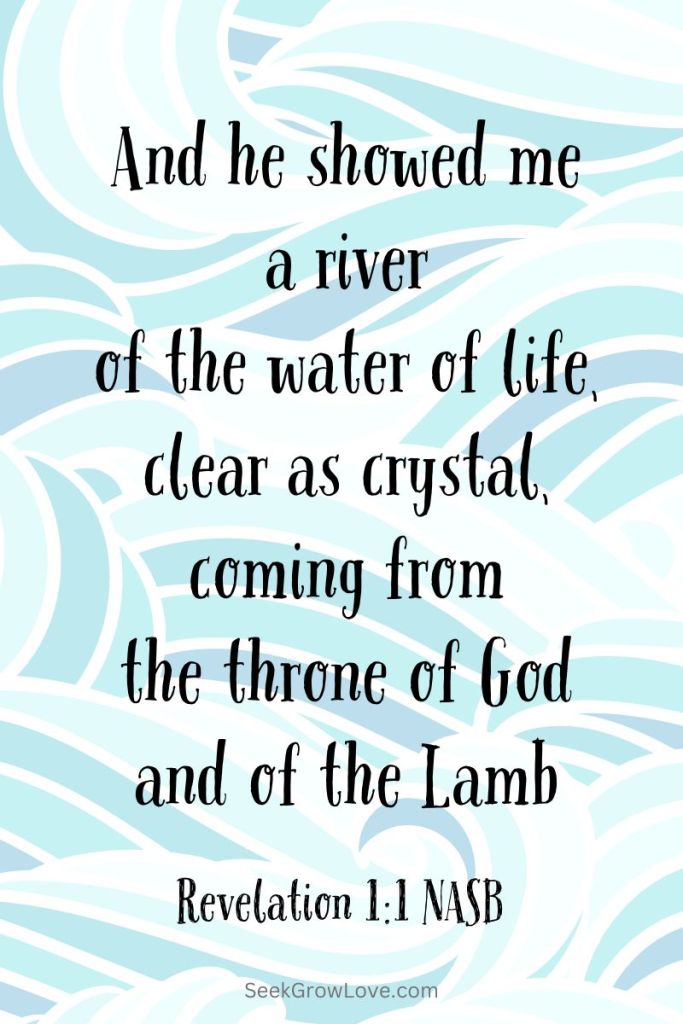
     Revelation 22 begins with a few more verses describing New Jerusalem, a topic which began in chapter 21. It is full of life. I go back and forth on how to visualize this from the details we have. The city is described with one street, paved in gold like glass. The street leads to the throne of God and Christ – it is the most important destination. Perhaps the street spirals up to them, and the clarity of the gold helps the light from the throne reach everywhere. The river of the water of life passes down the center of the street, and the tree of life is on either side (v. 2). So perhaps the water goes through a tunnel carved in the thick trunk of the tree of life, which has grown quite large since being transplanted from the Garden of Eden. The design does not concern me greatly, the key is the offer of life and blessings. This is a place of contentment and worship – it has no temple because it needs none, all within it are constantly in the presence of God and Christ, bathed in their glory.

     Rather than design, I am interested in the idea that things have, at last, moved beyond the stage where God considers them “very good” (Genesis 1:31). After each of the first five days of creation God declared the work “good”; after day six it was “very good” – notably with the addition of humans. It may be that things didn’t remain at “very good” for long before they slid into distress and pain due to the addition of sin, but that isn’t the point in this chapter. God has restored matters. The curse is gone! But I think God more than restored things and passed “very good” to “perfect.” I suspect the needed element for that to take place involves free will – God would not force Adam and Eve to love and accept Him, it was to be our choice if we would seek companionship with Him.

     Well, talking about this sort of thing with God can wait, and by the time we enter those kinds of conversations with God we will be better equipped to do so. For now, we know the challenges we face, and the Spirit we have been entrusted with to face them. Let us continue toward the paradise God has planned for us.

     The Greek word for “paradise,” by the way (Luke 23:43; Revelation 2:7), from which we get our English word “paradise,” comes from a Persian word for a pleasure garden. It seems like we are striving to get back to a garden, where we could eat from the tree of life and perhaps even walk with God.

     With understanding and acceptance of each other.

     Loving and loved.

     Forever.

     These are goals worth having.

     Lord, the book says a blessing is on those who read and hear the words of this prophecy and heed the things written in it, for the time is near. Help us be attentive to these words, and all that you direct for our lives. Thank you for the gift of your words. Do not let us be drawn astray from you, your message, or your work. You are a gracious God. In Jesus’ name I pray to you, Amen.

-Daniel Smead

Reflection Questions

  1. We are repeatedly told there will be no night in the time of the New Jerusalem – what do you associate with night that you will be pleased to have end?
  2. How do you find the curse affecting your life this week? How is knowing Jesus, and believers, helping you to deal with the curse now?
  3. Looking back over Revelation, what directions stand out to you for your life? How is it going? Do you think you should call on someone to help you be accountable for what you feel called to do?

A Glimpse of Coming Glory

Old Testament: Ezekiel 35 & 36

Poetry: Psalm 106

New Testament: Revelation 21

     In Revelation 21 we have come to the climax of events. In the Garden of Eden God set out to undo the separation between Himself and us, and that goal is at last complete. Humans may have been short sighted during history and at times tied themselves in knots over other issues, but God wanted to return to our sides. With “the first things” passed away there will be no more pain. Evil is removed from the scene and God is changing the universe, making everything new. He intends to freely give the water of life to those who overcome (John 4:14).

     God lists some of those who will not receive what He offers, addressing several issues that were raised in the book, murder, sorcery, idolatry – but it begins with the cowardly (v. 8). I wonder if that is directed at early readers, facing persecution in the Roman Empire and possibly hesitant to commit. But it extends to later readers, who might question if they wish to stand up for Jesus’ name and his authority and risk conflict, or if it would be simpler and safer not to, even to appear to be unsaved. Some of God’s servants, like Gideon, were called to serve while not eager to act on their own. That may seem to give a basis for seeing hiding as credible. But I think God chose from the reluctant to make a point, and to stir the hearts of others. And those were not Christ’s disciples, already gifted with the Spirit. He expects something else from us. Not that I am saying we are to be abrasive and offensive in an eagerness to act, there are proper and wise moments and ways to stand up, and we are not always the right people to do so in a situation. Like I said, the appearance of that word first in the list strikes me. It convicts me, all too often, of taking an easier route. But I work for Jesus, and I’ve never heard of anyone braver than him. I leave it to you how it makes you feel. 

     John is taken to a tall mountain by an angel to see “the bride, the wife of the Lamb” and arrives at “the holy city, Jerusalem” (v. 9, 10). It is reminiscent of Ezekiel being shown the new temple, which was on a mountain (Ezekiel 40). I have taught about Revelation 21 numerous times. I have considered taping a cardboard mockup on a globe of the world to show the size of New Jerusalem. I didn’t end up attaching it, and I wasn’t sure if it should be a cube or a ziggurat, or a pyramid (we are told its base is square, and the height). Just describing my idea to the students got the gist across. New Jerusalem is large.

     Earth’s breathable atmosphere extends out for about eleven miles at the equator. Perhaps you have heard the idea about being able to see the Great Wall of China from orbit. You can’t. You could bump into New Jerusalem in orbit. We aren’t totally sure of the size of the city, it depends on how you understand twelve thousand stadia, the 1995 NASB says 1,380 miles and some other versions say 1,500 miles. The International Space Station orbits about 250 miles from Earth. The Hubble telescope is 340 miles out. The upper range of what are known as “low Earth orbit” satellites is 1,243 miles, so the city would tower above all of them, if they were still around. (Which they won’t be.) But the geostationary satellites are much further out, at 22,236 miles. And the Moon is 238,900 miles away, which is nowhere near it. Speaking of the Moon, it has a diameter of 2,159 miles. Earth is 7,917.5 miles in diameter. Under the smaller estimate for the city (1,380 miles) it is 15.69% of the width of Earth, and my cardboard mockup needed to be 1.88 inches wide for a standard 12-inch globe.

     We are told that with God’s new heaven and new Earth there is no longer a sea (v. 1). If that refers to the Mediterranean Sea it seems like a necessary removal, to give New Jerusalem ground space to fit. If it was centered on the location of Jerusalem it would extend about halfway through Greece, assuming it was aligned square with the equator. It also couldn’t be flat on the bottom since the Earth curves, which matters at this size.

     I think this raises some questions. When God replaces the Earth, will it be the same size as the old one? What is being described here sounds like God planned on expansion. The millennium just took place, a thousand years without plagues, famine, and war. It didn’t start off with very many mortal people, but I think the population had a good opportunity for growth. It may be that the number saved during human history leading up to Christ’s return will be just a fraction of those who will ultimately be saved, guided in part by the priests we are being prepared to be. Oh, may it be so.

     My questions are skipping over a rather obvious point. The angel who volunteers to show New Jerusalem to John does so under the description of “the bride, the wife of the Lamb” (v. 9). It isn’t clear to me whether that is because the bride (the population) is inside the city, or because the city is simply a symbol of those who have been accepted as Christ’s bride. The names inscribed on it, of the twelve tribes and the twelve apostles, may not simply be honoring those figures but symbolizing all who came from the lineage of those figures. Consider the description of its size and splendor, and the statements that none with bad character will enter. It says that God and the Lamb provide it with temple and light and lamp. All of this fits the idea that New Jerusalem is the people of God. Now, perhaps the language here presents people and city in another of the Bible’s double fulfillments and both cases are true. Whatever God intends it will be wonderful, and the beautiful description given in this chapter leaves me in awe and anticipation. I say, rejoice in your Lord!

     Thank you, Father, for giving us this glimpse of the glory that lies ahead. Thank you for your commitment to us, that you did not give up on the work of Your hands, but took such care and effort to restore what had been damaged. Please help us to value what you value, to seek what you desire. There are so many lost sheep, so many hurting hearts, that you desire to be blessed by the love of your son. Please shape me into who you desire me to be, until I am complete. Thank you, in the name of Jesus, Amen.

-Daniel Smead

Reflection Questions

  1. What does God’s commitment to fixing what was broken tell you about Him? What does it say about how God sees us?
  2. What are some of the “first things” that will have passed away when the events of Revelation 21 have come to be?
  3. If (when) you are tempted to hide, what helps you overcome that temptation and stand up?
Patience while Preparing

2nd Samuel 5:1-10 & 1st Chronicles 11-12

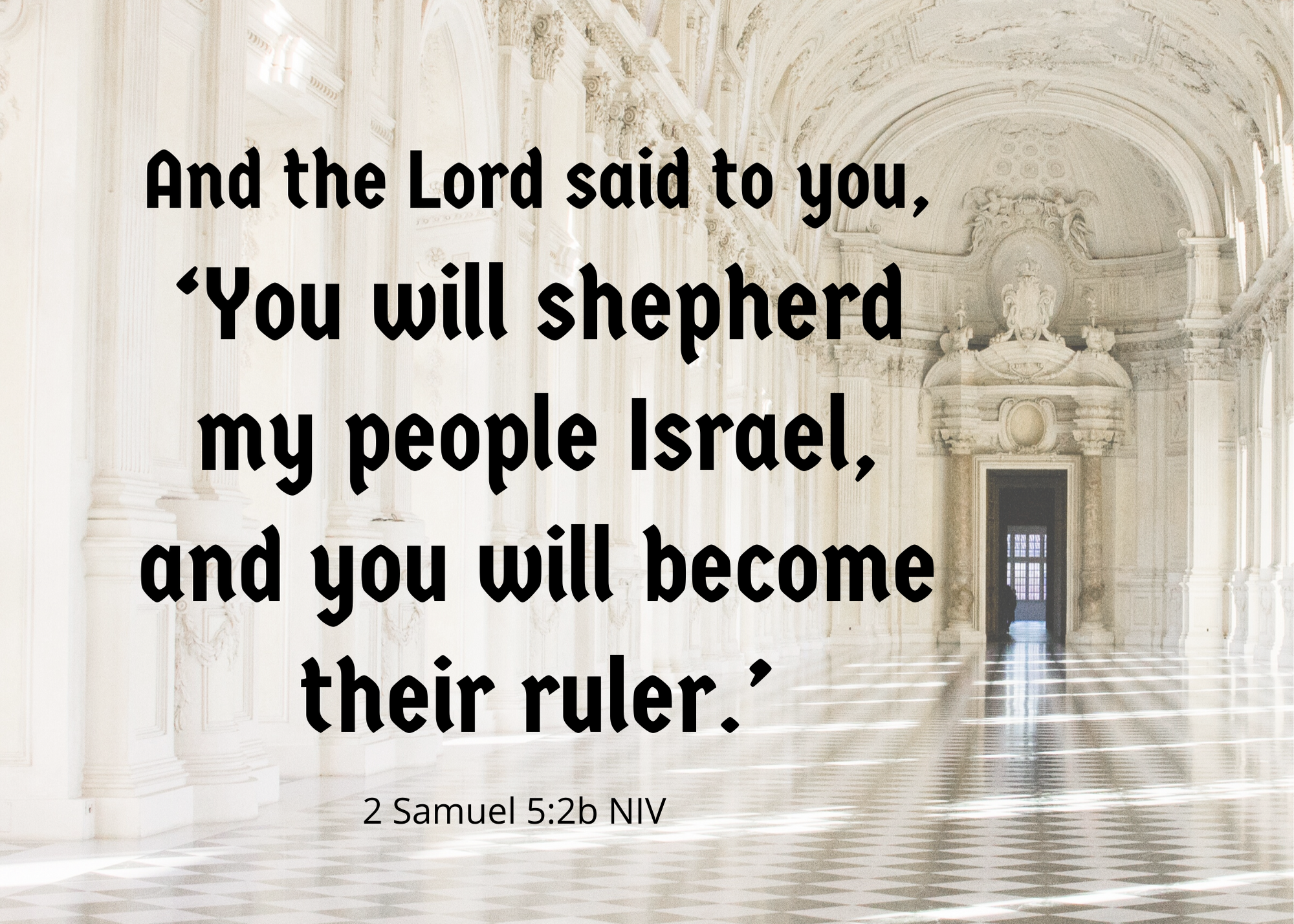
2 Samuel 5 2b NIV

We return to the people, places and events of King David’s life in our reading today.  The last we read of David, he had been named king of his tribe of Judah following the death of King Saul and he was ruling in Hebron.  It is now 7 years and 6 months later, David is 30 years old and he will finally be anointed king of all 12 tribes of Israel. And he will conquer the town of Jerusalem to convert into his capital city: The City of David.

He has waited a long time for this moment.  Remember the day long ago when the prophet Samuel was sent by God to the town of Bethlehem to visit the family of Jesse.   God had revealed to Samuel that one of Jesse’s sons would be chosen to rule over Israel.  And how surprised everyone was when it was the youngest son, David, a little shepherd-boy, whom God led Samuel to anoint.

Much has happened to David since then.  His life has been full of many twists and turns.  It was not an easy or clearly illuminated path to the throne.  There had been days with great news where it seemed the kingship might not be too far off: invited into the king’s court as a musician, killed the giant, the king offers his daughter to David in marriage, and the king’s son says he wants to see David become king. But, it wasn’t to be – yet.  There would be many difficult years of hiding in exile from jealous King Saul who wanted nothing more than to see David dead.  But, Saul’s plans were nothing compared to God’s.  God would protect David, and use this time to refine David and prepare him to be king of His people.

You may be questioning God’s plans for your life.  Remember David.  You may be wondering how long you will need to be patient.  Remember David.  Even when you aren’t sure what the next step will be – rest in knowing God’s plans and design is greater than man’s.  His promises come true.  Use this time to work on refining yourself  in preparation for whatever God is preparing for you.

Don’t miss the many striking similarities between David and Jesus.  From the town of Bethlehem.  To Jerusalem.  30 years old.  King of the Jews.

Never doubt that God’s plan continues through the ages – including David, and Jesus, and YOU!  And God has so much more planned – including the return of Jesus as King and a New Jerusalem and reigning with Christ!   How are you preparing for what comes next?

Marcia Railton


Today’s Bible reading can be read or listened to at https://www.biblegateway.com/passage/?search=2+Samuel+5%3A1-10%2C+1Chronicles+11-12&version=NIV

Tomorrow’s Bible reading will be Psalm 133 as we continue on the 2020 Chronological Bible Reading Plan

Pillars

Revelation 3

Revelation 3 12 .png

I live and work in Louisiana and the land down here is often very wet and soggy. Most of it in fact, is considered to be swamp land.  But nevertheless, people build on this land close to rivers and lakes. For my day job I work on building shorefront and boat houses. In order to do so we must use “piles” or otherwise known as oversized telephone poles and we drive them with a machine into the ground. When we drive 4 to 8 of them for a boat house, they create a pillar like effect which can support up to and if designed well over 15,000-pound boats. Each pile is driven with the machine with over 20,000+ pounds of force. That is really strong.

One of the most encouraging verses I can think of in the Bible is located in Revelation 3:12

“’He who overcomes, I will make him a pillar in the temple of My God, and he will not go out from it anymore; and I will write on him the name of My God; and the name of the city of My God, the new Jerusalem, which comes down out of heaven from My God, and My new name.”

The one who overcomes this world and all of its false hopes and temptations and focuses on Jesus will be like a pillar of faith in the temple and in the New Jerusalem. They will have written on them his own name YHWH. This is something I strive to have every day –  to allow myself to represent the LORD almighty everyday by carrying his name through my actions. Although I fail sometimes with this, I learn a little bit everyday how I can overcome my shortcomings.

Today I want you to focus on how you can be a pillar of faith in your communities and how you can carry the name of God with your actions. Also don’t forget to keep looking up phrases you see and don’t understand!

Jesse Allen

Reflecting His Glory

rebecca 7

I was teaching a junior youth class last week. We were learning about the Lord’s Prayer. At the end of our lesson, we were going over the phrase “for Thine is the Kingdom, the power and the glory forever.”  I asked the children what does glory mean? None of the students knew and it was time for our class to end so I suggested that they ask someone what God’s glory means. I told them that they could bring the answer back for next time. A four year old said, “I’ll ask Siri.” He took his tablet out of his backpack and asked, “Siri, what is God’s glory?” She verbally gave us a definition. That was a first. I wonder how Siri would be as a Sunday School teacher?

Here is a partial definition of glory:

Great praise, splendor, or honor. High renown or honor won by notable achievements.

fame, prestige, distinction, kudos, eminence, acclaim, celebrity, recognition, reputation


While glory is a vast subject, it might help us understand it more by reading Psalm 96:2-10a. Sing to the Lord, praise his name; proclaim his salvation day after day. Declare his glory among the nations, his marvelous deeds among all peoples. For great is the Lord and most worthy of praise; he is to be feared above all gods. For all the gods of the nations are idols, but the Lord made the heavens. Splendor and majesty are before him; strength and glory are in his sanctuary. Ascribe to the Lord, all you families of nations, ascribe to the Lord glory and strength. Ascribe to the Lord the glory due his name; bring an offering and come into his courts. Worship the Lord in the splendor of his holiness; tremble before him, all the earth. Say among the nations, “The Lord reigns.”

Of course, God possesses glory, but the scriptures describe man as having the ability to possess glory, too. Psalm 21:5 describes David in this way, “Through the victories you gave, his glory is great; you have bestowed on him splendor and majesty. God also presents Christ with this glory.

“In my vision at night I looked, and there before me was one like a son of man, coming with the clouds of heaven. He approached the Ancient of Days and was led into his presence. He was given authority, glory and sovereign power; all nations and peoples of every language worshiped him. His dominion is an everlasting dominion that will not pass away, and his kingdom is one that will never be destroyed.” Then the sovereignty, power and greatness of all the kingdoms under heaven will be handed over to the holy people of the Most High. His kingdom will be an everlasting kingdom, and all rulers will worship and obey him. (Dan. 7:13,14 &27) We will be rewarded in so many ways including living in our kingdom home of New Jerusalem that will shine with the glory of God. The city does not need the sun or the moon to shine on it for the glory of God gives it light.

So what should our response be to gaining understanding of the glory of God. Jesus tells us that we should seek the glory of the one who sent us.  And Paul reminds us to turn to the Lord. “And we all, who with unveiled faces reflect the Lord’s glory, are being transformed into his image with ever-increasing glory, which comes from the Lord, who is the Spirit.” (2 Cor. 3:18)  Lets remember to keep our focus on God through Christ so we can reflect the Lord’s glory!

-Rebecca Dauksas


Say Yes

Revelation 20-22Revelation_22-12

Saturday, July 22

The Bible begins in the book of Genesis with God and his children named Adam and Eve living in a perfect garden where his children have immediate access to the presence of God and can interact with God face to face.  The act of rebellion against God caused them to be separated from God.  They initiated this process by hiding from God and by their failed attempts to cover over their guilt and shame.  The consequence of their rebellion against God was that they were cut off from immediate fellowship with God, they were cut off from the garden which, along with all of the earth and the inhabitants of the earth including animals and humans fell under the curse of death.

Within God’s ruling of the consequences of sin and the resulting curse came a kernel of good news in Genesis 3:15.  One would come who was a “seed of the woman” meaning a child, a human child, who would ultimately defeat the serpent, which represents evil.  In the process of destroying the evil serpent, that human would also suffer a wound (a bruised heel).

The rest of the Bible is the story of how God’s plan to rescue the earth from the curse and restore  and redeem humanity that was cut off from God is fulfilled ultimately by Jesus Christ, the human being, he was a seed of the woman, who was also the perfect and sinless son of God.  In going to the cross and dying for the sins of all humanity, and being raised up by God to everlasting life, Jesus defeated the serpent.

Revelation 20-22 provides a vision of the ultimate victory of how this is ultimately realized.  The serpent/dragon/devil/satan(adversary) is permitted to influence the world only so long, and then it will finally meet it’s end.   Evil will be defeated by Jesus Christ.  Christ will return, the dead will be raised, there will be a final judgment based upon what we have done.  Some will be resurrected to everlasting life with God on a renewed earth in the city of New Jerusalem.  Some will be judged and condemned by God and cast into the lake of fire, which the Bible calls the second death.  (Note that it does not teach that they will be tortured for eternity, but that they will die a second and final time in a type of mass cremation).  Death has to be destroyed.  Those who reject God’s love and gracious gift of salvation will not have it forced upon.  God allows us the freedom to accept his love and the offer of salvation, but he also gives us the freedom to reject it.  Just as a bride must consent to marrying the groom in order for a marriage to be valid, we, God’s people must consent to God’s love before our covenant relationship will be valid.

For those who reject God’s love, they will finally and mercifully be brought to everlasting destruction.  Those who accept God’s love through Christ, will be granted everlasting life.  The Bible ends with the reversals of Genesis 2-3.  God will again make his presence here upon the earth.  The image John gives in Revelation is of a New Jerusalem coming down from God to take up occupancy on the earth.  This new Jerusalem, interesting, is built on the same scale as the Temple in Jerusalem was… only so much larger.  The new temple occupies a territory that rivals the ancient Roman empire.

For Christians living in the first century suffering under Roman oppression, this must have given them hope.  Rome/ or Babylon or whatever earthly power that was anti-God would be brought to an end, and God’s Kingdom, God’s government would cover all the earth, with Jerusalem acting as a giant temple where God and his people would dwell for all eternity.  Within the temple, emanating from the throne of God is a river of life surrounded by the tree of life.  The tree of life was the very reason why Adam and Eve were banished from Eden, so that they would not partake of the tree of life/immortality in their sinful and broken condition.  Sin had to be defeated once and for all before immortality could be enjoyed.  But now, in Revelation, we are free to partake of the tree of life, we are free to embrace immortality, and we will live forever with God in His Kingdom on this renewed earth.  We have, in a sense, come full circle, we are back home with God’s presence in the new Eden, and we are forever blessed.  Even those who have suffered martyrdom for their faith, will enjoy the benefits and blessings of the New Jerusalem the New Eden and the New Earth.

If you’ve never said yes to God’s love, I don’t want you to miss out on this greatest of all blessings.  Say yes to God, you can do it right now.  And then solidify that “Yes” by entering into a covenant relationship with God through Baptism.  And then live as a child of God and share this good news with as many as you can, until the day all is fulfilled and Christ returns, or the day that you draw your last breath.

-Jeff Fletcher

(https://www.kingjamesbibleonline.org/Revelation-22-12_Inspirational_Image/)