A First Fruit Sacrifice

Deuteronomy 24-27

And behold, now I bring the first of the fruit of the ground, which you, O LORD, have given me.’ And you shall set it down before the LORD your God and worship before the LORD your God. Deuteronomy 26:10 (ESV)

It is Sunday morning. What are you going to do this morning (or, depending on when you read this, what did you do this morning)? It is the first day of the week; did you spend it on yourself, or did you give some of your time in worship of Yahweh our God and in remembrance of his son, Jesus, our savior? Most of those reading this likely attended a local church this morning, but some of you may have needed to work, or perhaps there was another reason for not being in church today.

Why am I asking these questions? Deuteronomy 26 speaks of the act of giving the first fruits of the harvest as an offering to God. Looking forward to the entrance into the land of milk and honey, the promised land, the Israelites are instructed to take a portion of their first fruits and bring it to the priest to set before the altar. Taking a portion of what God has blessed them with and giving it back as a sacrifice or offering. Things are different now. We are not under the ceremonial law, but are we exempt from sacrifices?

Through him then, let us offer up a sacrifice of praise to God continually, that is, the fruit of lips that make confession to his name. Do not neglect to do good and to share what you have, for such sacrifices are pleasing to God. Hebrews 13:15-16 (REV)

Worship is something God desires of us, and while it is not for us, it does us good, for it puts God into our focus and puts him in his exalted place. Jesus told his disciples to break bread and partake of the cup whenever they got together “in remembrance of me”. We need to remember Jesus’ sacrifice as we try to live sacrificial lives.

Gathering for worship and fellowship is important, but it is a sacrifice. Many people don’t work on Sunday, a day to sleep in and relax! We may see the value of setting this time aside for worship, but sometimes we may struggle with it. Churches are filled with imperfect people (sorry if this comes as a surprise to you), and sometimes those people are a source of pain in our lives. We hurt one another and sometimes struggle to confess our sins against one another, and sometimes we fail to forgive those who sin against us (that seems backwards from how Jesus instructed us to pray). Maybe we see this sacrifice of our time as a duty, and we lose some of the wonder that we experienced toward Christ’s church.

There can be reconciliation through our sacrifices of praise and obedience, just as Christ’s sacrifice reconciles us to God, as we spend time in community and in fellowship through the spirit of God, we should be transformed to be like Jesus, who was able to forgive the betrayal and brutality that was directed to him. Jesus had to slog through difficulties and disappointments like we do; he had his times of questioning, and maybe he even struggled at seeing the wonder of it all at times. Through obedience, sacrifice, and confession, we can be conformed to his image of Jesus and also glorify God as we recognize him as our provider and source of our hope.

-J.J. Fletcher

Reflection Questions:

  1. What do we have for first fruits that can be brought before God?
  2. I see time as being our most valuable resource. When we give time to God, what does this do to and for us?
  3. Do you give money to your church or other ministries? How does financial offering correlate to first fruits?
  4. When you give the first fruits of your day or week to God in devotion or worship, does it differ from giving him whatever you have left at the end of a long day or week?

Make a Sanctuary

Exodus 25-27

               Places of worship come in all different shapes and sizes.  I have worshipped God in huge cathedrals with impressive pipe organs and altars overlaid with gold and stained glass windows.  I have also worshipped God in open-air tabernacles with sawdust floors.  I have worshipped God in a deer stand, at the beach, on a mountaintop and on a table undergoing radiation.  I have worshipped God in loud and energetic services with guitars, drums, and electronic keyboards and I have worshipped him in places with no sound at all except the flickering flame of a single candle.

                I believe God loves to be worshipped in lots of ways and in lots of places.  Even in the Biblical stories God was worshipped on simple stone altars, in burning bushes, on mountain tops and down in valleys.

                Israel was at a critical time in their formation and it was important for them to have a steady reminder of God’s presence.  God made his presence visible to them as they journeyed with both a pillar of cloud in the day and a pillar of fire at night.  As they continued their journey across the wilderness, God chose to make his visible presence known to them in a portable house of worship.  This place would provide structure in the midst of their community wherever they stopped to make camp.  The tent of meeting or tabernacle would be an ongoing visible sign that God’s glory was in their midst.  And God taught them how to be a holy nation. He used various symbols and rituals of sacrifice and worship as a way to drill home to them his holiness and the consequences of sin.

                How God chose to do this is quite interesting.  He could have simply built a temple Himself in the heavens and dropped it down fully formed on earth.  However, God chose instead to invite His people to become active participants in creating this place of worship.

                First, God began with their willing desire to give.  “Tell the Israelites to bring me an offering. You are to receive the offering for me from everyone whose heart prompts them to give. These are the offerings you are to receive from them: gold, silver and bronze;  blue, purple and scarlet yarn and fine linen; goat hair;  ram skins dyed red and another type of durable leather acacia wood;  olive oil for the light; spices for the anointing oil and for the fragrant incense; and onyx stones and other gems to be mounted on the ephod and breast piece” (Exodus 25:2-7).   This was not a mandatory tithe that was required; this was an offering to be willingly given and received.

                Where did the people get all of these valuable commodities?  If you will recall, as they were leaving Egypt they were given many valuable items by the Egyptian peoples – one might say this was payment to help compensate for years of slavery.  They had these items in their possession already.  Those who were willing could give them to help create the tent of meeting and the prescribed worship items inside of the temple, which included the Ark of the Covenant, the table, the lampstand as well as the material for the tabernacle itself, and the altar, courtyard and the oil to keep the lamps burning.  All of the materials were freely donated.  The people of God used their own skill to build the items from these donated materials – carpenters, weavers, stonemasons, goldsmiths and others each made their own contributions to the creation of this place of worship.  In this way, everyone in the community that wished to participate had buy in to the tabernacle.  It truly was a communal place of worship.

                Once the nation finished their journey through the wilderness and took possession of the Promised Land, they would eventually transition from a portable tent of meeting to a permanent temple under the leadership of King Solomon.  However, this tent of meeting served them well for 40 years in the wilderness and many more during the times of the judges, and kings Saul and David.

                For Christians, we do not worship God in a tabernacle or physical temple and we do not bring sacrifices of sheep or goats or bulls for an offering to God.  For us, the Church itself is the temple of God.  I am not talking about the building where the Church gathers to worship, I am talking about the actual people who gather to worship, and we are the Church.  Jesus said whenever 2-3 gather in his name that he is there in their midst.  There is no one single right way or place to worship God.  It is wherever God’s people come together.  Christian Worship does not have to follow a strict pattern.  Worship is where we gather to read the word of God, pray, worship, encourage each other and exhort one another to good works, break bread and proclaim the resurrection of Jesus.  Blood sacrifices are not necessary because Jesus is the Lamb of God who takes away the sins of the world and he entered into the holy of holies once and for all and gave his own body as the final sacrifice for all of our sins.

                One thing remains unchanged from the time of Israel in the wilderness tent of meeting and the Church today.  God still welcomes us to bring our offerings from the heart as a way to say thank you.  We can still bring tangible offerings, and we can still offer our gifts and talents as ways of showing God our deep gratitude for all of his blessings to us.  It is not all that important how we worship or where we worship, but it is very important that we worship and we bring our offerings freely to worship God.

Jeff Fletcher

(originally posted February 7, 2020 for SeekGrowLove)

Reflection Questions

  1. Why do you think God wanted the Israelites to have a tabernacle? What are some benefits today to having a place to go to worship God together with God’s people? What are the additional benefits to being able to worship God anywhere?
  2. Why do you think God gave Moses so many details for how to make the tabernacle and its furnishings?
  3. Where do you find a sanctuary where God dwells with you? What offerings do you freely bring to God as part of your worship?

Gold and Goat Hair

Exodus 35:5a NIV

Old Testament: Exodus 35 & 36

Poetry: Psalm 34

New Testament: Acts 1

Gold and goat hair. Silver and sea cow hides. Bronze metal and blue yarn. Onyx stones and olive oil. These all were great offerings to do the work of God. These were just some of the precious, as well as the more common, everyday items that were brought as offerings to create the very first tabernacle.

God had given Moses some very specific plans for what He wanted for His tabernacle including the furnishings and priestly garments. The creative Creator who designed heaven and earth and fashioned all sorts of lands, plants, fish, birds, animals and unique human beings was now showing His flair for architecture (albeit tent-like architecture that would travel well), interior decorating (including specific dimensions, materials and details for the furnishings and surfaces), and even fashion designing (of the stunning priestly wardrobe).

God gave the precise plans – and He also gave His Spirit. God gave His Spirit to fill these craftsmen (Bezalel, Oholiab and other skilled persons) with skill, ability and knowledge so they would know how to create His masterpieces in gold, silver, bronze, stones, wood and “all kinds of artistic craftsmanship” (Exodus 35:33). And the Bible records that God also gave both Bezalel and Oholiab the ability to teach others these skills. What a creative and masterful and wise Spirit of God, which God still gives today! Have you received any of His crafty, skilled Spirit? If so, how are you using it to do His work? Are you able to teach others what God has given you? How can teaching others your skills and abilities further God’s work?

God gave the plans and His Spirit with the skills, it was up to the people to give the resources. ”All the Israelite men and women who were willing brought to the LORD freewill offerings for all the work the LORD through Moses had commanded them to do.”  (Exodus 35:29) These offerings were not required (as other offerings were), but these were voluntary offerings. ”Everyone who was willing and whose heart moved him came and brought an offering to the Lord for the work.” (Exodus 35:21) And they did give! They donated their gold jewelry to the cause. Those who had acacia wood, bronze, spices and oil gave what they had. The skilled willing women got to work spinning the colorful yarn, linen and goat hair. There was no gift too large and no gift too small. It was all given with a willing heart and would be used for the Lord’s work. They even gave and gave until they were told to stop because they had given more than enough to complete the sanctuary. 

I am not sure your church would find a good use for your donated goat hair today…um, wait, correction, my quick internet search just now revealed several common uses for goat hair including paintbrushes, rugs, carpet, and even Mohair or cashmere (different from rabbit cashmere) to be used in making sweaters or even fine pants for your pastor. So, go ahead keep collecting your goat hair for God, if that is what you have and your willing heart is telling you to give it to Lord’s work. 

And also consider, what do you have, or could you acquire with what you have, to provide for God’s work today. I’m guessing God’s not planning on building a tabernacle in your backyard, but do not doubt He has many, many plans that you can be an exciting part of with your participation and your offerings. What is your church doing that you can be a part of, contributing your time, talents and what you have to a larger extent than ever before? Could the children’s ministry use new crayons or is the kitchen running out of coffee cups? Would a tray of cookies be useful after church or could you help provide a spring cleaning spruce-up? What needs can you provide? Do you have a crafty skill to create a piece of artwork or functional thing of beauty (furniture or banner or blanket) for God’s church or even for His work outside of the church (perhaps a donation for a non-profit organization). Where is God’s work around the world in need of what you have? Sometimes the need is as simple as highlighters, glasses, or flat frisbees. Sometimes it’s Bibles, bikes and fertilizer. Sometimes it’s larger, like a church building – a new tabernacle. What do you have (given to you by God), that He would love to see you use to further His work with one of your neighbors in need – your means of transportation, your coffeepot, you sharing a skill? 

What is your heart moving you to offer to God’s work? Consider both your valuable and precious resources as well as your common and everyday items? What gold and goat hair will you offer to God with a willing heart? 

-Marcia Railton

Reflection & APplication

  1. What do you have (or have the means to acquire) that could be used to do the work of the Lord? How is your heart moving you to give offerings to the Lord’s work? 
  2. Pray about it and do it.

Sour Gummy Worms & Copper Coins

Luke 21

My young cousin got a bag of sour gummy worms for Christmas this past year. The following week, he carried the bag along everywhere he went, proudly savoring each lick. He loved those sour gummy worms! At the end of the week, he tried to give me his precious worms; of course, I declined because I don’t delight in stealing candy from children. As he was leaving my house, he hid the candy in my bedroom because he wanted me to have them. He didn’t have much to give, but he gave all he had and did so sincerely. 

Luke describes a similar encounter Jesus had with a poor widow at the temple: 

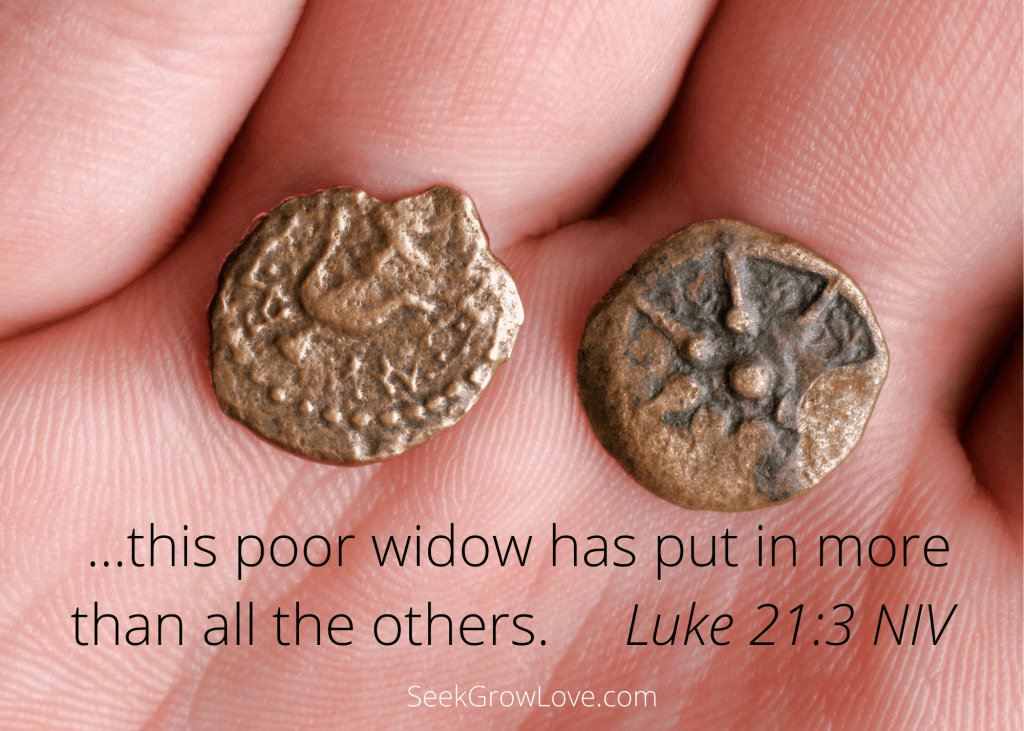
As Jesus looked up, he saw the rich putting their gifts into the temple treasury. He also saw a poor widow put in two very small copper coins. “Truly I tell you,” he said, “this poor widow has put in more than all the others. All these people gave their gifts out of their wealth; but she out of her poverty put in all she had to live on.” (Luke 21:1-4)

We know three things about the woman mentioned: she was poor, she was a widow, and she gave a small amount of money to the church. Her story isn’t flashy and her name isn’t even mentioned. Yet, she honored God by giving the little she had. And you know what? Jesus said her gift was greater than all the others. 

Jesus had spent the past day discussing the intricate details of religious rules and hypothetical situations. They were concerned with religion, but perhaps not the conditions of their hearts. Their attitudes are juxtaposed by the poor widow whose heart was generous and faithful. By the world’s standards, the poor widow’s actions were foolish. She should have used the money to feed her family and allowed the Jews with more money to support the church. In God’s eyes, her giving was a reflection of her faith, and I am sure her family didn’t go hungry that night.

To be clear, God doesn’t need your money—neither your time nor gifts. 

I could have bought my own bag of sour gummy worms at the gas station down the street. In the same way, God can accomplish anything and everything by his own accord. However, He still wants your sour gummy worms, copper coins, and anything you have to give. 

God wants your trust.

God wants you to participate in the mission of the Church. 

God wants to bless you. 

-Mackenzie McClain

Today’s Bible reading passages can be read or listened to at BibleGateway here – Deuteronomy 25-26 and Luke 21

More Than Enough

Exodus 36-38

Exodus 36 3b NIV

We see the builders start working on the sanctuary. They are getting the resources to build from gift offerings from the Israelites. They run into a problem. Although a good problem, still a problem. They have been given too much – and the workers cannot keep up. So Moses has to make an announcement.

After 15 years of preaching – this is an announcement that I have yet to make but would absolutely love making.

Moses tells the Israelites:  We have too much from the offering – we cannot outwork the generosity – stop giving so the work can catch up.

The whole nation of Israel is working together – everyone is doing their part. When the whole body works together there is more than enough.

Unfortunately, in the modern church, not everyone is pulling their weight. I know it sounds harsh and I may be preaching to the choir. But the statistics show that 20% percent of the church is carrying 80% of the workload. It roughly translates to participation, work and giving.

It follows along with the Pareto principle – which simply defined is: roughly 80% of the effects come from roughly 20% of the causes.

So if the church is functioning with only 20% of the people active and giving, think what it could do if everyone did their part? If everyone carried their weight, could the workers not keep up with generosity of the church again?

My challenge to you: get involved, help out, give generously and recruit others to do the same.


John Wincapaw


Today’s Bible reading can be read or listened to at https://www.biblegateway.com/passage/?search=exodus+36-38&version=NIV

Tomorrow’s reading will be Exodus 39-40 as we continue the 2020 Chronological Bible Reading Plan

5 Point Checklist

1 Corinthians 16

1 Corinthians 16 13 14


At first this chapter seems to be a hodge-podge mixture of final instructions and greetings regarding several people we don’t know in a church we’ve never been to.  And yet, could Paul really just as well have been writing to us regarding our church?  Where would he insert your name today?  Let’s see what we find…


Paul begins by instructing the Corinthians to each be setting aside a weekly gift offering (in accordance with their income) on the first day of the week (not just giving some left-overs at the end of the week – if there was anything left).  This money would then be collected when Paul arrived and sent with responsible men to the church in Jerusalem which was experiencing great poverty and famine as well as persecution.  Generous, scheduled/weekly, repeated giving to help the Christian brothers and sisters in need.  Are we called to do any less?   How are you and your Christian community giving to support a church in need?  I think immediately of the needs in Malawi and Mozambique which have been hit so hard with recent cyclones and flooding resulting in the loss of crops, homes, churches and lives.  http://www.lhicog.com/images/Africa_Disaster_Relief.pdf.


I was struck with the reason Paul said he was going to stay in Ephesus until Pentecost: “For a wide door for effective service has opened for me, and there are many adversaries.” (1 Corinthians 16:9).  How exciting to have a WIDE door for EFFECTIVE service OPENED for ME!  Have you been testing doors to see which ones will open – even a crack?  I am quite sure Paul hadn’t been sitting on his couch watching Netflix when suddenly a door opened wide for him.  It often takes time, sacrifice, trials, perseverance, and ordering priorities to seek and find the open doors.  And when that door did open wide – it was still far from easy – in fact he found he had many adversaries!  But, rather than high-tailing it out of there and looking for an easier way – he was scheduling his priorities to stay where he was for that time because he saw how he could be used by God for effective service.  Would I recognize the open door?  Am I testing doors?  Am I not scared away at the possibility of gaining a few adversaries?  Let’s pray today (and daily) for “wide doors for effective service” to be opened for each of us – even if it comes with some adversaries.  And then – for the courage and wisdom to advance through the door.


Paul leaves a concise 5 point checklist for the church – of any century (vs. 13 & 14).

  1. Be on your guard

Watch for spiritual dangers – they are sneaky, real, powerful and deadly.  Apathy, busy-ness, worldliness, sin, a different gospel, and pride (to name just a few) can easily creep in when you aren’t standing guard against them.

  1. Stand firm in the faith

Remain steadfast in what matters most – your faith will be attacked (by others, by the enemy, by trials).  Keep it the priority.  Don’t be swayed.  Believe in God and the truth He gives.

  1. Be courageous

Troubles will come – be courageous – keep following God into the battle.  Gain courage knowing you are dressed for success with the Armor of God.

  1. Be strong

It will be hard– be disciplined in your spiritual training which will grow your spiritual muscle power.  Rely on His strength knowing you can’t do it alone. Stay connected to your church – there is strength in numbers.

  1. Do everything in love

In the midst of the spiritual battle, don’t grow cold-hearted – love, every time.  What does real love look like?  Self-sacrifice, giving, do onto others, sharing truth and the saving message of salvation, and love even when they haven’t earned it. (Refresh your love checklist with 1 Corinthians 13 again.)


These two short verses (Be on your guard; stand firm in the faith; be courageous; be strong. Do everything in love – 1 Corinthians 16:13,14) would be great to post on your bathroom mirror to see every morning as you prepare for the day.  Examine yourself daily – not just your hair, teeth and physical appearance.  How are you looking spiritually?  What do others see when they look at you?  What grades would you earn for your watchfulness, steadfastness, courage, strength and love of the day before?    What will courage look like today?  What spiritual dangers are lurking around the corner?   Who is God putting in your life to love in a special way?  Pray for these qualities in yourself and others, surround yourself with those developing and demonstrating these attributes so you can mutually encourage (and sometimes even admonish) one another.


Be the church Paul longed to see.


It’s not easy – but it’s always worth it.  (Refresh your resurrection recall with 1 Corinthians 15).


There are so many other great nuggets in this chapter.  Take the time to read it today and see where Paul would have put your name.


Praying for God’s Church,

Marcia Railton


How Generous Are You?

2 Corinthians 8-10

2corinthians-9-15-asv-preview

Saturday, June 24


The point is this: whoever sows sparingly will also reap sparingly, and whoever sows bountifully will also reap bountifully.           2 Corinthians 9:6


Paul has been talking about a collection of money that the Corinthians had promised to gather and prepare for the poor believers in Jerusalem, and he has sent certain brothers to come retrieve it and bring it to Judea (9:3-5). The collection was to be a free-will offering of monetary gifts for a relief aid to subsidize the needs of the saints in Jerusalem who were suffering.


To put his point bluntly, Paul uses an agricultural metaphor to convey the principle he desires his readers to understand. If little is sown, little will be reaped. If much is sown, much will be reaped. Now what is Paul teaching here. Is it that giving away a little money will result in you getting little money in life. Or giving away much money will result in receiving much money. Not at all. While Paul is openly encouraging the Corinthians to give of their abundance to help the needy believers in Jerusalem, his axiomatic metaphor is intended to set the premise that whoever does not want to give should not expect to receive, but whoever is generous should expect to receive generously. It is a simply matter of reciprocity that Paul is getting at.


According to the wisdom of Proverbs, the person who is willing to give will prosper and do well, and the person who is stingy and selfish will end up falling into poverty.


Proverbs 11:24

One gives freely, yet grows all the richer; another withholds what he should give, and only suffers want.


Proverbial wisdom is designed to demonstrate a general principle or prescribed attitude that its readers would do well to adopt. It should not be viewed as enforcing a formulaic approach to life. Even Jesus taught that “it is more blessed to give than to receive” (Acts 20:35). The choice for the free-will act of financial giving will result in blessings and provisions in your life. James also employs this principle of sowing and reaping when he says, “And a harvest of righteousness is sown in peace by those who make peace” (Jas. 3:18).


If we think that our giving of time, energy, or money is simply that—time, energy, and money—we will miss the way that God will turn that generosity back upon in like measure but perhaps in a different form than we think it might look. And also, often times in even exceeding degrees than the level of our demonstration of love in giving.


Be generous and give willingly and cheerfully, and trust that God will continue to provide your needs and bless you for your generous heart.


Proverbs 22:9

Whoever has a generous eye will be blessed, for he shares his bread with the poor.


-Jerry Wierwille


(Photo Credit: http://www.biblepub.com/downloads/wallpapers/preview?w=2corinthians-9-15-asv)

Oxen in the Offering Plate (Numbers 7-8)

Friday, September 2

Rebecca Fri

By Rebecca Dauksas

We have a time in our Worship Service when we receive tithes and offerings.  Of course, for most of us that means writing a check or placing cash in the offering plate.  It is not the objects themselves that are of value, but the time and energy we exerted to create the money for our gifts to the LORD. In Numbers 7 the leaders of Israel brought their offerings of Dedication for the Tabernacle. They presented twelve oxen and six carts to the LORD in front of the Tabernacle.  The LORD told Moses to let each leader bring his gifts on a different day for the dedication of the altar. They placed them before the altar. The offering of each leader included a silver plate, a silver sprinkling bowl filled with the finest flour mixed with olive oil, a gold dish filled with incense, a young bull, a ram, a male lamb, a male goat, two oxen, five rams, five male goats and five male lambs. Can you imagine bringing in these gifts?  But these offerings had value. The people crafted the carts, formed the precious metal dishes, raised the animals, …these offerings cost the people something.  They wanted to donate these items to the LORD.  They wanted to show their thankfulness, they wanted to be a part of their Tabernacle.  What are we offering the LORD this week?  Maybe it is from our checkbook or wallet and maybe it is our time.  Time invested in Bible Study. Time devoted to serving the needs of others.  Time spent with God in prayer.  Time showing others what the Love of God truly looks like.  Of course, we want to support the work of God financially – the LORD loves a cheerful giver.  But we want to offer the LORD more than just our financial gifts.  We want to offer ourselves.  Think about a God given ability or talent that you have. Could you use that in some way to serve God today?