A Farewell

ACTS 20

acts 20 26 27

In Acts 20 Paul travels around some more, and is heading towards Jerusalem, but on his way he meets with the Ephesus elders one last time to talk to them and encourage them.  He knows that God’s plan for him will not bring him back to Ephesus and that he would never see them again. He had spent three years with them and knew that they would be a strong pillar in the growing Church and he wanted to make sure that they would be okay.  The Church had come under attack from the Jewish communities and from the government many times during Paul’s ministry and he knew that would continue, so he wanted to prepare them. He knew that those who would come after and try to lead them astray would try to attack him personally in order to get the Christians at Ephesus to doubt him and his message, and therefore their own faith.  Paul reminds them that at all times when he was with them he took care of his own needs, and did not profit off of them in any way and only cared about their spiritual well being.


One of the biggest detractors in the Christian faith is hypocrites.  How many times do you hear about the pastor at a church somewhere being involved in a scandal and then the church folding or many of the people walking away from the faith.  As Christians we are held to a higher standard and when we do not live up to that standard it affects any who look up to us as a role model. Paul’s ministry was successful and had a deep impact on all of western culture because he preached boldly, and he backed it up with a righteous life.  This is also why you need to make your faith your own. People will invariably let you down at some point, but Jesus is a rock on which you can build your life. Of course it is good to have role models, but know that they are only human.

-Chris Mattison

A Profitable Business

ACTS 19

Acts 19 25 26

Acts 19 tells about Paul’s ministry in Ephesus.  While there he performs many miracles and heals many people and “The word of the Lord was growing mightily and prevailing”.  While there the silversmiths who made the shrines to Artemis conspired against him because the Christian converts stopped buying their profitable shrines and they were losing their livelihood.  So of course they formed a mob and tried to get Paul and the Christians in trouble with the law and they tried to drum up religious fervor to protect their business. In the end it was ok for Paul, but this had to be a hindrance to his mission.

In this story the followers of Artemis were not just rioting against Paul and the other missionaries, but against their friends, neighbors, and family who had converted to Christianity.

If you are a Christian and have non-Christian friends then they will often try to bring you down to their level.  They see that you are changing and they do not want to change, just like the silversmiths, so they will try to do anything they can to go back to the “good o’l days” when you were living in sin.  You have to watch out because these people can have a strong influence on your life and will erode your faith if you let them. This type of thing happened to Paul several times, and in some instances he just had to leave that city and in others he was able to stick around and continue to minister in that city.  Maybe if you have given your life over to Christ you will need to leave some friendships, or maybe you can help that person to come to Christ themselves, it will take prayer to know what is needed in your situation.

-Chris Mattison

Keep At It

ACTS 18

Acts 18 9 10

Acts 18 details the cities that Paul visited on his way from Jerusalem to Greece and some of the highlights in those cities.  While in Corinth Paul again has issues with the Jewish community there and instead finds a Gentile man named Titius Justus who was a worshiper of God.  Paul also has a vision from God in which God says,

“Do not be afraid; keep on speaking, do not be silent.  For I am with you, and no one is going to attack and harm you, because I have many people in this city.” (Acts 18:9,10)

I understand why Paul would need this encouragement with the number of cities that he had been thrown out of after annoying the local Jewish population with his message.

What I find interesting is the fact that Paul is the first missionary to set foot on the continent of Europe and just recently we read about the first convert in the area, yet even in this “heathen” land filled with idols and false gods God is working in people’s lives and has people who worship him.  These people do not know the gospel and need to hear about Jesus desperately, but even without that knowledge they are seeking God and worshiping him. We see this today in many of the mission fields that we send people into. The people do not know about Christ, but it is obvious that God has been working in their community to prepare them to hear.  This is why it is so important that we get out there and evangelize. The harvest is plentiful but the workers are few.

Then while traveling in Ephesus in modern day Turkey, Paul runs into a man named Apollos who was a Jew that knew his scriptures (Old Testament) thoroughly and knew only the message of John the Baptist.  With only this information he was boldly speaking about Jesus and the fact that he was the son of God. He was off on some things, but he was on fire for God and was running with it.

These verses are encouraging because they show that you do not need to have everything figured out theologically in order to follow God.  You don’t need a master’s degree or years of training for him to be working in your life. Now I do think that seeking truth should be an important part of any believer’s life, but all that is needed to get started with God is faith in Jesus, and the Holy Spirit to work in your life.

-Chris Mattison

Be a Berean

ACTS 17

acts 17 11

In Acts 17 we see three very different cities and their different responses to the Gospel.

Thessalonica hears the word and some Jews and a lot of Greeks believed.  But other Jews did not like how Christianity changed their culture. They liked the status quo and therefore used their influence to stir up trouble for Paul and got him kicked out of the city.  Similar to the rich young ruler there are some people that are very happy with life as it is and just cannot accept the changes required to follow Christ and will fight it tooth and nail to hold on to their old lives.  We cannot hesitate and look back when we follow Christ.


Berea is very different.  The Jews there hesitated when they heard Paul’s message, but they studied the scriptures and saw that Jesus did indeed fulfill the prophecies and they believed.  It is very important that we seek out truth and question things that we hear and compare them to scripture. There are too many people in the world today that hold a certain belief just because their pastor or their denomination told them so.  Those people might be right and might have a lot of wisdom and knowledge to pass on, but at the end of the day I am the one that is responsible for my own salvation and I need to know that what I believe is the truth. Deep study is a great way to make your faith your own.


Lastly there was Athens, which had been a hub of culture and ideas for hundreds of years and had idols of many different gods from many different cultures.  The Athenians knew that God was out there, but they were searching for him in all the wrong places. There are many people around us today that similarly feel a need for something more in their lives, but instead of finding the one true God they fill that void with idols.  Those idols come in many different forms such as jobs, significant others, money, or belongings. Even though the Athenians were searching in all the wrong places at least they were searching and were therefore open to listening to Paul’s message. I think that Athenian culture is one of the most similar cultures from Bible times to our culture today, and I think that God is likely similarly unhappy at the number of idols that we have placed in our lives.


So, to conclude, I would encourage you to let go of your old life, study the scriptures and make them your own, and remove the idols from your life.  If we can do these things then we can consider ourselves to be of noble character like the Bereans.

-Chris Mattison

The Best Influence

acts 16 9

ACTS 16

As Paul and his group were traveling around what is modern day Turkey they kept having messages from the holy spirit telling them that they were not allowed to preach in that area, and that they need to go farther, and eventually led them to Greece.  With this the Gospel made its first direct contact with the “Western World” in the city of Philippi. It is here that Paul converts Lydia who is the first known convert in Europe. As they were going along and preaching Paul got in trouble with some of the local officials and they were thrown in prison because of a popular uprising against them.  It was in this prison that Paul and Silas were singing praises to God after being beaten, and an earthquake came and freed them, but they stayed and preached to the jailor instead of running away. Because of their unusual behavior and their powerful message the jailor believed and his whole family was baptized.


Throughout this story we see that the people that Paul spends the most time with and interacts with one on one are the ones that he has the most influence on.  Lydia and the jailor both spend time with Paul and invite him to their homes and listen to his message and believe. The leaders of the city who get mad at Paul only see how his message is disrupting their business and how their culture and religion is different from their own and throw them out of town.  In my experience this seems to hold true, that the people you spend time with are the ones that you are going to impact the most for Christ. Many people will post on social media about different parts of Christian culture or parts of their Christian life, but to unbelievers seeing that, all they see is that you are different, just like the city leaders in Paul’s day.  Without being deeply involved in your life they are never going to see the benefits of a life that is free from the bondage of sin. Everybody knows that everybody puts forth their best image online and we have all seen enough stuff online to be skeptical of most of it. The best way to spread the gospel is to be right there day to day with people and praising God even in the worst of times.  This is how they will know that you are truly different.

-Chris Mattison

Crutches and Stumbling Blocks

Acts 15

Acts 15 9

In Acts 15 we see a fundamental theological question that the early church had to answer, and how they went about handling the situation.  Jesus’ ministry, death, and resurrection represented a radical change in how mankind interacted with God. We no longer need to sacrifice for our sins because Jesus is the perfect sacrifice, and has fulfilled the law and the prophets.  The problem is that the Law of Moses was the very foundation of basically all of Jewish culture and when Jesus ascended it was not completely clear to the apostles as to what to do with the Law of Moses. Because Christianity started in Jerusalem and then spread out from there to the rest of the world the early Christian leaders all came from a Jewish background and some of them tried to force their culture and the Law of Moses onto the new Gentile believers.  To them this would seem natural because in their mind this is how you interact with God and what he expects from you, and has been for over a thousand years. They had not caught up completely with all of the changes that Jesus brought. The way I picture this is like a person who messed up their leg and needs to walk on crutches for a while, and then after the doctor performs a surgery that completely fixes their leg they decide to continue to use the crutches after that, and then also try to convince their friends that they should start to use crutches too even though that isn’t necessary at all and will only inhibit your friends.  This is basically the conclusion that the early church leaders come to and they tell the gentiles that they do not need to follow the Law of Moses because it would hinder the gentiles from coming to God. They also tell the gentile believers that they need to make sure that they are not participating in the aspects of their old gentile beliefs that might cause issues for them. Just as the early church leaders saw that the Law of Moses would be a stumbling block to other people, they saw that aspects of the idol worship in many gentile areas would be a stumbling block as well.


I think it is very important that we recognize that there are many aspects of our modern secular American culture that are going to be stumbling blocks for our spiritual walk, and that we need to leave many of those things behind if we are going to devote our lives to Christ.  This is not easy and was a very divisive issue in the early church, and has the potential to be divisive in our churches today. Some things as seemingly small as the use of drums and guitar in a church service can be very contentious in some churches. This passage also shows us how Paul dealt with the issue so as to not cause division.  He was one of the first people preaching to the gentiles and had not had a lot of contact with the early church leaders in Jerusalem. Instead of trying to handle this issue by himself and decree what he knew the Holy Spirit was telling him he went to Jerusalem and discussed with the church leaders and showed them that God was working in the gentiles and that was proof that they did not need to follow the Law.  Once they agreed this helped to legitimize Paul’s message and began the process of unifying the Church on this issue.

-Chris Mattison

Notes from Paul

Romans 13 12

In Romans, Paul is describing the sorrow he feels that the Jews he has been trying to teach have not accepted the good news of Jesus Christ.  Even though he recognizes it is in God’s plan, he is mourning their stubbornness and their hardened hearts.

It is important to God why we follow Him…what motivates us.  He wants us to pursue Him because our faith compels us to do so, not as a result of our obligation to the law.

Paul begins to bring his message around again to the idea that Christ came for all people.  Paul continues to hope that the Israelites will listen and allow their hearts to be opened to God’s message of love and mercy. (Romans 11:11-16)

I believe Paul is saying to the early believers who are not of Jewish descent that they are the branches which come from the foundation of the Israelites.  If the root is holy, then so are the branches. As a result they need to continue to live and work together in the hope that the Jews’ eyes and hearts will be opened to a new understanding of God and Jesus Christ as Savior.  Paul points to this idea more clearly by instructing them in Romans 12:9-17…

 Love must be sincere. Hate what is evil; cling to what is good. 10 Be devoted to one another in love. Honor one another above yourselves.11 Never be lacking in zeal, but keep your spiritual fervor, serving the Lord. 12 Be joyful in hope, patient in affliction, faithful in prayer. 13 Share with the Lord’s people who are in need. Practice hospitality.

14 Bless those who persecute you; bless and do not curse. 15 Rejoice with those who rejoice; mourn with those who mourn. 16 Live in harmony with one another. Do not be proud, but be willing to associate with people of low position.[c] Do not be conceited.

17 Do not repay anyone evil for evil. Be careful to do what is right in the eyes of everyone. 18 If it is possible, as far as it depends on you, live at peace with everyone.

As we do our best to live at peace with everyone, Paul gets into more controversial subjects next…it could be controversial yet today too.  In Chapter 13, Paul includes the authorities which govern the members of the early church in his statements about how to treat one another if we are followers of Christ.

Romans 13:6 & 7

This is also why you pay taxes, for the authorities are God’s servants, who give their full time to governing. Give to everyone what you owe them: If you owe taxes, pay taxes; if revenue, then revenue; if respect, then respect; if honor, then honor.

I am guilty of not appreciating those who are in authority over me.  I speak out against the actions, decisions and judgements those in civil service make sometimes.  There are many times that I don’t agree and wish the government didn’t appear so corrupt and hypocritical, but rather than allowing my anger to rise and my resentment to grow, I should be praying for those in power.  I should be blessing them…tough pill to swallow Paul, tough pill to swallow…sometimes it is bitter too.  Nevertheless, if I am to be obedient to God’s call on my life, this is one area I can improve…I think Paul was speaking the early believers about this subject because he knew they could do better too.

The next part is a little easier to accept, though not necessarily easier to accomplish:

Romans 13:8-10

Let no debt remain outstanding, except the continuing debt to love one another, for whoever loves others has fulfilled the law. The commandments, “You shall not commit adultery,” “You shall not murder,” “You shall not steal,” “You shall not covet,”[a] and whatever other command there may be, are summed up in this one command: “Love your neighbor as yourself.”[b] 10 Love does no harm to a neighbor. Therefore love is the fulfillment of the law.

Why do we do this? Why do we live this way?  Because the day is near…

Romans 13:11& 12

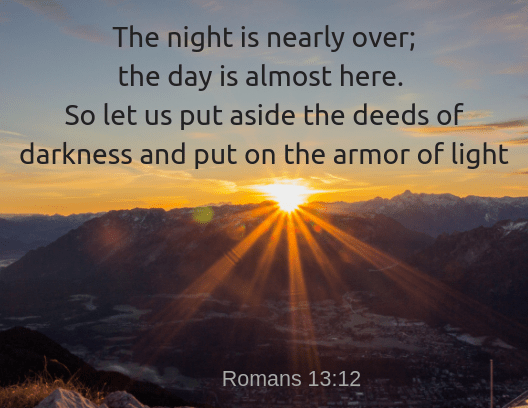
And do this, understanding the present time: The hour has already comefor you to wake up from your slumber, because our salvation is nearer now than when we first believed. 12 The night is nearly over; the day is almost here. So let us put aside the deeds of darkness and put on the armor of light

Let us also join that high calling, that of putting aside the deeds of darkness and putting on the armor of light…let us love one another in spirit and in truth, in action as well as in word…the day is near

Come, Lord Jesus, Come…

Joyanne Swanson

Paul’s Mess, God’s Message

acts 28 31 (1)
At the end of the book of Acts we are following Paul in his ministry as he shares his testimony and all he is learning from God with established groups of believers as well as with those who have not yet heard the good news of Jesus Christ. He is told through a prophet that he will be bound by the Jewish leaders and sent to the Gentiles to share his story.  He is accused by the Jewish leaders in Jerusalem, then arrested and imprisoned while the Roman authorities try to figure out which side of the story to believe.  Over the course of Paul’s imprisonment he is moved to various cities and meets with several governors as well as King Agrippa.  Then finally he is sent to Rome.  During each of these transitions, Paul has an opportunity to share the story of his conversion…who he was…who he is and who he will continue to be through God’s grace.  Every time he is questioned he says something like the following phrase from Acts 23:1 “My brothers, I have fulfilled my duty to God in all good conscience to this day.” 
Paul faced so much opposition during this period of time and yet he continued to stand firm in his belief that God had a purpose for him which would be fulfilled no matter what…arrest, false accusations, storms, shipwrecks, imprisonment, isolation, death threats, nothing was going to stop God’s message from being spread.
As the book of Acts closes we are given a chance to witness Paul as he teaches a group of Jewish leaders in Rome. 
Acts 28:23-30
They arranged to meet Paul on a certain day, and came in even larger numbers
to the place where he was staying. He witnessed to them from morning till evening,
explaining about the kingdom of God, and from the Law of Moses and from the Prophets
he tried to persuade them about Jesus. 24 Some were convinced by what he said,
but others would not believe. 25 They disagreed among themselves and
began to leave after Paul had made this final statement: “The Holy Spirit spoke the truth
to your ancestors when he said through Isaiah the prophet:
26
“‘Go to this people and say,
“You will be ever hearing but never understanding;
you will be ever seeing but never perceiving.”
27
For this people’s heart has become calloused;
they hardly hear with their ears,
and they have closed their eyes.
Otherwise they might see with their eyes,
hear with their ears,
understand with their hearts
and turn, and I would heal them.’[a]
28 “Therefore I want you to know that God’s salvation has been sent to the Gentiles,
and they will listen!” [29] [b]
30 For two whole years Paul stayed there in his own rented house and welcomed all
who came to see him. 31 He proclaimed the kingdom of God and taught about the Lord
Jesus Christ—with all boldness and without hindrance!
Some of those who were listening, heard Paul’s message and their lives were changed.  Others found that they couldn’t believe what Paul was preaching and left.  They heard but didn’t understand, they saw but didn’t allow comprehension. Paul kept right on teaching, preaching and sharing his mess so that God’s message could get through.
Oh to have Paul’s boldness and eloquence!  There are many times that we are provided the opportunity to share our own stories of faith with others and we often let them pass us by.  Are we afraid?  Maybe we don’t think they would be interested, or that we’ll be bothering them if we share.  Or maybe we don’t want to offend anyone…but if we are learning from Paul’s example, we need to be sharing our stories of faith regardless of the personal costs.  God’s message will be heard, don’t you want to be a part of that exciting adventure? I promise it’ll be a good one!
-Joyanne Swanson

Our Life is a Letter

2 Corinthians 3 2 (1)

1Are we beginning to commend ourselves again? Or do we need, like some people, letters of recommendation to you or from you? 2You yourselves are our letter, written on our hearts, known and read by everyone. 3 You show that you are a letter from Christ, the result of our ministry, written not with ink but with the Spirit of the living God, not on tablets of stone but on tablets of human hearts.”

2 Corinthians 3:1-3


Have you ever had to write a letter of recommendation for someone or had one written for you?


In this passage the Corinthians are requesting a letter of recommendation from higher up disciples to prove that Paul is doing the work of the Lord. Paul explains to the Corinthians that their life should be his recommendation letter, a confirmation of his teaching.

Imagine if your life was a letter, open to anyone to read, and when they read it they would know exactly who you are, what you stand for, your convictions, your beliefs, your faith or the lack of. Paul is saying our life is a letter written on our hearts through the Holy Spirit. How we live confirms the message of the gospel. It’s a way for others to see and understand why we dedicate our time, money, and energy into church, ministry, mission work, church camps and much more. When we face the king on judgment day we will not be getting a letter of recommendation from our pastors or parents saying why we should be in the kingdom. Instead Jesus will read the letter of our hearts and our life.

If our life is a letter open to the world to read what do you want people to read? What kind of letter are you going to allow the spirit to write upon your hearts? And will you choose to follow it?


-Elleigh

Acts – His Witnesses at Work

Acts 1 8 b.png

The book of Acts is one of the most exciting reads you will ever come across: action adventure, good guys, bad guys, left for dead, miracles, jail breaks, courtroom drama, angry mob, shipwreck, dramatic monologues, and some of the most fascinating characters of the early church.  The author, Luke, was the same Gentile doctor who wrote what is now the 3rd gospel – an account of Jesus’ life and ministry.  Here, in the book of Acts, his story continues with the Acts of the Apostles – the story of the early Christian church age.


Luke opens his account in Acts with the crucified and resurrected Jesus appearing to his disciples for 40 days, speaking about the kingdom of God (1:3) – obviously a topic near and dear to Jesus – so it should likewise be a topic we are passionate about.  Then, Jesus told his disciples, “You will be my witnesses in Jerusalem, and in all Judea and Samaria, and to the ends of the earth.” (1:8). And as he ascends into the clouds, two men in white reassure the disciples that Jesus will return the same way that he rose.  And, throughout the rest of Acts, we see what happens when Jesus’ witnesses are faithful.


The promised Holy Spirit came upon the disciples and they were able to do many miracles and wonders, even speaking in languages that men from all parts of the world would understand the good news of Jesus and the Kingdom of God.  Most of the first half of Acts follows the disciples, particularly Peter, as they teach and preach and grow the early church.  Even amongst strong opposition the church grows, with many new believers being baptized and committing their lives, homes, finances, and families to following Jesus.  Some, like Stephen, even gave their life – as he was stoned to death for speaking the truth about Jesus, the Son of God.


Most of the second half of Acts tells the incredible – and true – stories of Paul.  It starts with the conversion of Saul who was persecuting Christians.  BUT – he changed and became the great apostle who went on 3 missionary journeys and wrote much of what would become the New Testament (but more on that tomorrow when we cover the 3rd Division of the NT – Paul’s Letters).


There are so many great passages in the book of Acts you just have to read it for yourself!  Not only are there amazing action stories, but you also get some wonderful sermon snippets and see what is most important to the early church.  You see their teachings, courage and priorities.


We are still waiting for that day when the clouds will part and our Lord and Savior will come down to greet his followers.  What a day that will be!  If you have read the gospels to see Jesus in action – then you are his witness.  If you have felt Jesus’ peace in the storm – then you are his witness.  May we be faithful witnesses ready for his return.


-Marcia Railton