Notes from Paul

Romans 13 12

In Romans, Paul is describing the sorrow he feels that the Jews he has been trying to teach have not accepted the good news of Jesus Christ.  Even though he recognizes it is in God’s plan, he is mourning their stubbornness and their hardened hearts.

It is important to God why we follow Him…what motivates us.  He wants us to pursue Him because our faith compels us to do so, not as a result of our obligation to the law.

Paul begins to bring his message around again to the idea that Christ came for all people.  Paul continues to hope that the Israelites will listen and allow their hearts to be opened to God’s message of love and mercy. (Romans 11:11-16)

I believe Paul is saying to the early believers who are not of Jewish descent that they are the branches which come from the foundation of the Israelites.  If the root is holy, then so are the branches. As a result they need to continue to live and work together in the hope that the Jews’ eyes and hearts will be opened to a new understanding of God and Jesus Christ as Savior.  Paul points to this idea more clearly by instructing them in Romans 12:9-17…

 Love must be sincere. Hate what is evil; cling to what is good. 10 Be devoted to one another in love. Honor one another above yourselves.11 Never be lacking in zeal, but keep your spiritual fervor, serving the Lord. 12 Be joyful in hope, patient in affliction, faithful in prayer. 13 Share with the Lord’s people who are in need. Practice hospitality.

14 Bless those who persecute you; bless and do not curse. 15 Rejoice with those who rejoice; mourn with those who mourn. 16 Live in harmony with one another. Do not be proud, but be willing to associate with people of low position.[c] Do not be conceited.

17 Do not repay anyone evil for evil. Be careful to do what is right in the eyes of everyone. 18 If it is possible, as far as it depends on you, live at peace with everyone.

As we do our best to live at peace with everyone, Paul gets into more controversial subjects next…it could be controversial yet today too.  In Chapter 13, Paul includes the authorities which govern the members of the early church in his statements about how to treat one another if we are followers of Christ.

Romans 13:6 & 7

This is also why you pay taxes, for the authorities are God’s servants, who give their full time to governing. Give to everyone what you owe them: If you owe taxes, pay taxes; if revenue, then revenue; if respect, then respect; if honor, then honor.

I am guilty of not appreciating those who are in authority over me.  I speak out against the actions, decisions and judgements those in civil service make sometimes.  There are many times that I don’t agree and wish the government didn’t appear so corrupt and hypocritical, but rather than allowing my anger to rise and my resentment to grow, I should be praying for those in power.  I should be blessing them…tough pill to swallow Paul, tough pill to swallow…sometimes it is bitter too.  Nevertheless, if I am to be obedient to God’s call on my life, this is one area I can improve…I think Paul was speaking the early believers about this subject because he knew they could do better too.

The next part is a little easier to accept, though not necessarily easier to accomplish:

Romans 13:8-10

Let no debt remain outstanding, except the continuing debt to love one another, for whoever loves others has fulfilled the law. The commandments, “You shall not commit adultery,” “You shall not murder,” “You shall not steal,” “You shall not covet,”[a] and whatever other command there may be, are summed up in this one command: “Love your neighbor as yourself.”[b] 10 Love does no harm to a neighbor. Therefore love is the fulfillment of the law.

Why do we do this? Why do we live this way?  Because the day is near…

Romans 13:11& 12

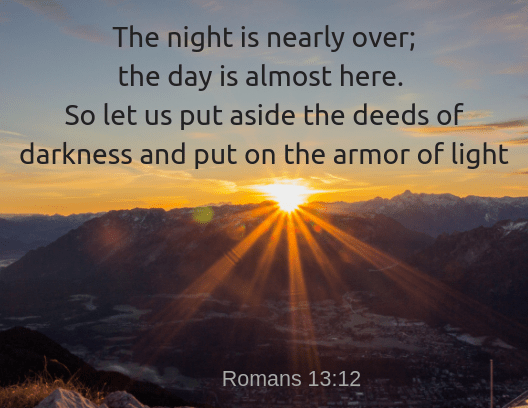
And do this, understanding the present time: The hour has already comefor you to wake up from your slumber, because our salvation is nearer now than when we first believed. 12 The night is nearly over; the day is almost here. So let us put aside the deeds of darkness and put on the armor of light

Let us also join that high calling, that of putting aside the deeds of darkness and putting on the armor of light…let us love one another in spirit and in truth, in action as well as in word…the day is near

Come, Lord Jesus, Come…

Joyanne Swanson
Paul’s Mess, God’s Message

acts 28 31 (1)
At the end of the book of Acts we are following Paul in his ministry as he shares his testimony and all he is learning from God with established groups of believers as well as with those who have not yet heard the good news of Jesus Christ. He is told through a prophet that he will be bound by the Jewish leaders and sent to the Gentiles to share his story.  He is accused by the Jewish leaders in Jerusalem, then arrested and imprisoned while the Roman authorities try to figure out which side of the story to believe.  Over the course of Paul’s imprisonment he is moved to various cities and meets with several governors as well as King Agrippa.  Then finally he is sent to Rome.  During each of these transitions, Paul has an opportunity to share the story of his conversion…who he was…who he is and who he will continue to be through God’s grace.  Every time he is questioned he says something like the following phrase from Acts 23:1 “My brothers, I have fulfilled my duty to God in all good conscience to this day.” 
Paul faced so much opposition during this period of time and yet he continued to stand firm in his belief that God had a purpose for him which would be fulfilled no matter what…arrest, false accusations, storms, shipwrecks, imprisonment, isolation, death threats, nothing was going to stop God’s message from being spread.
As the book of Acts closes we are given a chance to witness Paul as he teaches a group of Jewish leaders in Rome. 
Acts 28:23-30
They arranged to meet Paul on a certain day, and came in even larger numbers
to the place where he was staying. He witnessed to them from morning till evening,
explaining about the kingdom of God, and from the Law of Moses and from the Prophets
he tried to persuade them about Jesus. 24 Some were convinced by what he said,
but others would not believe. 25 They disagreed among themselves and
began to leave after Paul had made this final statement: “The Holy Spirit spoke the truth
to your ancestors when he said through Isaiah the prophet:
26
“‘Go to this people and say,
“You will be ever hearing but never understanding;
you will be ever seeing but never perceiving.”
27
For this people’s heart has become calloused;
they hardly hear with their ears,
and they have closed their eyes.
Otherwise they might see with their eyes,
hear with their ears,
understand with their hearts
and turn, and I would heal them.’[a]
28 “Therefore I want you to know that God’s salvation has been sent to the Gentiles,
and they will listen!” [29] [b]
30 For two whole years Paul stayed there in his own rented house and welcomed all
who came to see him. 31 He proclaimed the kingdom of God and taught about the Lord
Jesus Christ—with all boldness and without hindrance!
Some of those who were listening, heard Paul’s message and their lives were changed.  Others found that they couldn’t believe what Paul was preaching and left.  They heard but didn’t understand, they saw but didn’t allow comprehension. Paul kept right on teaching, preaching and sharing his mess so that God’s message could get through.
Oh to have Paul’s boldness and eloquence!  There are many times that we are provided the opportunity to share our own stories of faith with others and we often let them pass us by.  Are we afraid?  Maybe we don’t think they would be interested, or that we’ll be bothering them if we share.  Or maybe we don’t want to offend anyone…but if we are learning from Paul’s example, we need to be sharing our stories of faith regardless of the personal costs.  God’s message will be heard, don’t you want to be a part of that exciting adventure? I promise it’ll be a good one!
-Joyanne Swanson

Our Life is a Letter

2 Corinthians 3 2 (1)

1Are we beginning to commend ourselves again? Or do we need, like some people, letters of recommendation to you or from you? 2You yourselves are our letter, written on our hearts, known and read by everyone. 3 You show that you are a letter from Christ, the result of our ministry, written not with ink but with the Spirit of the living God, not on tablets of stone but on tablets of human hearts.”

2 Corinthians 3:1-3


Have you ever had to write a letter of recommendation for someone or had one written for you?


In this passage the Corinthians are requesting a letter of recommendation from higher up disciples to prove that Paul is doing the work of the Lord. Paul explains to the Corinthians that their life should be his recommendation letter, a confirmation of his teaching.

Imagine if your life was a letter, open to anyone to read, and when they read it they would know exactly who you are, what you stand for, your convictions, your beliefs, your faith or the lack of. Paul is saying our life is a letter written on our hearts through the Holy Spirit. How we live confirms the message of the gospel. It’s a way for others to see and understand why we dedicate our time, money, and energy into church, ministry, mission work, church camps and much more. When we face the king on judgment day we will not be getting a letter of recommendation from our pastors or parents saying why we should be in the kingdom. Instead Jesus will read the letter of our hearts and our life.

If our life is a letter open to the world to read what do you want people to read? What kind of letter are you going to allow the spirit to write upon your hearts? And will you choose to follow it?


-Elleigh

Acts – His Witnesses at Work

Acts 1 8 b.png

The book of Acts is one of the most exciting reads you will ever come across: action adventure, good guys, bad guys, left for dead, miracles, jail breaks, courtroom drama, angry mob, shipwreck, dramatic monologues, and some of the most fascinating characters of the early church.  The author, Luke, was the same Gentile doctor who wrote what is now the 3rd gospel – an account of Jesus’ life and ministry.  Here, in the book of Acts, his story continues with the Acts of the Apostles – the story of the early Christian church age.


Luke opens his account in Acts with the crucified and resurrected Jesus appearing to his disciples for 40 days, speaking about the kingdom of God (1:3) – obviously a topic near and dear to Jesus – so it should likewise be a topic we are passionate about.  Then, Jesus told his disciples, “You will be my witnesses in Jerusalem, and in all Judea and Samaria, and to the ends of the earth.” (1:8). And as he ascends into the clouds, two men in white reassure the disciples that Jesus will return the same way that he rose.  And, throughout the rest of Acts, we see what happens when Jesus’ witnesses are faithful.


The promised Holy Spirit came upon the disciples and they were able to do many miracles and wonders, even speaking in languages that men from all parts of the world would understand the good news of Jesus and the Kingdom of God.  Most of the first half of Acts follows the disciples, particularly Peter, as they teach and preach and grow the early church.  Even amongst strong opposition the church grows, with many new believers being baptized and committing their lives, homes, finances, and families to following Jesus.  Some, like Stephen, even gave their life – as he was stoned to death for speaking the truth about Jesus, the Son of God.


Most of the second half of Acts tells the incredible – and true – stories of Paul.  It starts with the conversion of Saul who was persecuting Christians.  BUT – he changed and became the great apostle who went on 3 missionary journeys and wrote much of what would become the New Testament (but more on that tomorrow when we cover the 3rd Division of the NT – Paul’s Letters).


There are so many great passages in the book of Acts you just have to read it for yourself!  Not only are there amazing action stories, but you also get some wonderful sermon snippets and see what is most important to the early church.  You see their teachings, courage and priorities.


We are still waiting for that day when the clouds will part and our Lord and Savior will come down to greet his followers.  What a day that will be!  If you have read the gospels to see Jesus in action – then you are his witness.  If you have felt Jesus’ peace in the storm – then you are his witness.  May we be faithful witnesses ready for his return.


-Marcia Railton

The Perfect Team

Acts 18 26

ACTS 18


Shoes and socks, salt and pepper, peanut butter and jelly.   Some things just go together, complement one another and make the perfect team.


Priscilla and Aquila are just such a pair.  They are spoken of at least three times in this chapter by Luke, and then Paul will speak highly of them in three of his letters – and each time they will be mentioned together – a team.  They were a team in marriage and a team in ministry.


They endured storms together – banished from their home in Italy when Emperor Claudius removed all Jews from Rome. Together they opened their home to others.  Paul would stay in their home, and later they would host a house church.  Together they risked their lives for the sake of Paul (Romans 16:3-4). They learned together and taught together. They traveled together. They mentored together. Together – they served God.


If you are married already – consider how you can work on your teamwork skills today (and all your tomorrows, too).  Neither you nor your spouse is perfect – that is true, of everybody else’s spouse too  – but together you CAN be a perfect team – complimenting each other’s skills and working together for God’s glory. What acts of service to God and others can you work on together?


If you are not married now – but might be in the market to be married at some point…consider wisely. Rather than seeking out the hottest athlete or the cutest nerd (or whatever characteristics are already on your to-find list), be intent upon finding one who will be a great mate to serve the Lord with you.


-Marcia Railton

Don’t Look Back

Acts 13 38

Acts 13 

Isn’t that what this is all about? The best gift – freedom and forgiveness through Jesus Christ. People had been waiting for him for years and now they were finally preaching about it, sharing the good news. Could you imagine being alive back then and reading the stories from the prophets and then finally hearing about Jesus? People had been talking, speculating, doubting, waiting, and anticipating him for YEARS. It is such a confirmation to our faith, it would be impossible not to talk about it!

In Acts 13, Saul, who is now called Paul, is on a mission to proclaim the gospel and he is not looking back. It’s crazy to think about the person he was just a few chapters ago. He is a great example of how we should approach our own missions. We die to ourselves, find our identity in Christ, and don’t look back. We have a lot to proclaim and not a lot of time, so worrying about who we once were will only hinder us!

-Grace Rodgers

Life in Light of Resurrection

1 Corinthians 15 33

In I Corinthians 15.29-34, Paul addresses some behaviors among the people in the Corinthian church that are not acceptable in light of the coming resurrection. Starting in verse 29, he speaks of some behavior that involved individuals being baptised possibly on behalf of those who have died? The behavior and practice described in this verse is unclear and shrouded in mystery and scholars are not entirely sure what to make of it. However, the principle is clear, whatever this practice was, was not acceptable in light of the resurrection. Verses 30-32 speak about the hardships and difficulties Paul has faced and that reality that if there is no resurrection then all of his labor and striving is in vain, a point he made earlier in this chapter (15.14). Then in verse 33 and 34 he exhorts them to correct their behavior. He warned them not to be deceived, that bad company corrupts good morals. The interesting point about this saying is that Paul is quoting a contemporary poet of his day and using it in his argument. In other words, watch who you hang around with because your behavior will be altered by those who are not a good influence. In this context, it could possibly be don’t be around people who deny the resurrection. Then he exhorts them to stop sinning and become sober minded. For some in the Corinthian church the reality of resurrection was being lost and it affected how they lived.

This passage does a great job of showing that what you believe about the future affects how you live today. My question to you is, in light of the resurrection of Jesus and the resurrection of the saints, are you living a life that is in step with that resurrection reality? Are you involved in activities that line up with someone awaiting resurrection? Are you involved in activities or with people that pull you away from a life of serving God? The awaiting resurrection serves as a reminder and something to set our eyes on to help aid us in pursuing a life that is pleasing to God.

-Jacob Rohrer

Resurrection and Loyalty


1 Corinthians 15 22

In today’s section we’ll look at verses 20-28 of I Corinthians 15. Did you know that you’re a king or a queen? So many blessings and riches are made available to us “in Christ” and in today’s section Paul speaks of another gift that comes with being “in Christ” – resurrection.

Paul begins by affirming that Jesus has indeed been raised from the dead, given the sad reality of if he hadn’t (v. 12-19). He then proceeds in verses 21-22 to compare Adam to Christ. Just as by a man came death, so to by a man came the resurrection of the dead. Paul clarifies this saying in the next verse by identifying the two men. In Adam all die but in Christ all live. This is a critical teaching of Paul about the dichotomy between Adam and Christ. By default all of us are in Adam, that is, we are identified and participate in the sphere of Adam which is rebellious and God hating. This inevitably results in death. But you and I can go from being “in Adam” to “in Christ”. When we are found “in Christ” that is our new identity (II Cor. 5.17) and this inevitably leads to life, specifically, resurrection and immortality (II Tim. 1.10). The way we can go from being “in Adam” to “in Christ” is by repentance, acceptance of the gospel, and obedience to Jesus as Lord. For more on the Adam-Christ teaching read Romans 5.12-21 and all of Romans 6 for what it means to be “in Christ” (“in Christ” is a technical term found often through Paul’s epistles that is rooted in his understanding of Adam and Christ). But Paul specifies that there is an order to the resurrection: Jesus first then those who are his at his coming.

Then Paul says literally “then the end”, when Jesus hands over the kingdom to his God and Father when he has abolished all rule and authority. In other words, when Jesus comes back he will dismantle and overthrow every human authority and government and establish his Father’s rule and reign with him as king. Then concluding, Paul says after this happens Jesus will hand over the newly established rule to his God and father, being subjected to him, so that God may be all in all forever and ever.

To be “in Christ” means so much more than just ‘I’m saved’ it’s larger meaning is that we get to participate in the sufferings and victories of Jesus. Specifically, because Jesus was raised from dead, we will be raised from the dead (I Cor. 15.20,23). Because Jesus ascended to God’s right hand and has been given all rule and authority, we too are seated with Christ and share in Jesus’ power and authority (Eph. 1.20-21, 2.4-7). You are a king and queen in the making whom God is making ready to rule and reign through our Lord Jesus Christ by means of the resurrection!

-Jacob Rohrer

No Resurrection?!

1 Corinthians 15_17


The next section of I Corinthians 15 we’ll look at are verses twelve through nineteen. In this section, Paul traces the implications of the claim that there is no resurrection. In verse twelve Paul asks “…how do some among you say that there is no resurrection from the dead?”. We’re not told anything about who these people are. They either could be outsiders that are influencing the church or it could be people part of the Corinthian church. Either way a group is claiming that resurrection is not a reality. This is not the first time Paul has interacted with the belief that resurrection does not exist. In Acts 17.32, the response to his preaching, that climaxed with the claim that God has made himself known through the risen Jesus, elicited a mixed response. Some believed and followed others sneered at the idea of resurrection.

Beginning in verse thirteen Paul sheds light on a world with no resurrection. To begin with first and foremost, if there is no resurrection then Christ himself has not been raised! And if Jesus hasn’t been raised then Paul’s preaching and the recipient’s faith is in vain! In other words, whether resurrection, specifically Jesus’ resurrection, is true or not, has a direct impact on how we live our lives and the manner in which we live them. Paul rebuilt his life around the risen Jesus and lived in such a manner, the recipients of Paul’s preaching reorganized their lives in light of the risen Lord. But if Jesus has not been raised, if resurrection is not possible, then we have to find something else to build our lives upon. This is why the resurrection of Jesus is the most important event in history. Everything hangs on it! It affects how we live and what we believe. He continues that if Christ has not been raised then it makes him a liar and God a liar because he falsely testifies that God raised him from the dead. In addition, our faith in Jesus is worthless and we still remain in our sins. Verse nineteen culminates with if we hope in Jesus in this life only, then we are the sorriest and most pitiful people there are. A hope in a non risen savior is no hope at all, it’s a delusion and a fraud.

The implications of no resurrection are bleak and grim, but Paul says in the next verse, “but now Christ has been raised from the dead…”. The reality described in verses 12-19 is not a reality because Jesus has been raised from the dead and resurrection is a reality. However, how can we have assurance or confidence that Jesus really did rise from the dead? This was an event that happened nearly two thousand years ago. I want to share some points that can help aid our belief in the resurrection. Our faith is not validated in what we can know intellectually alone but also we’re not supposed to check our brains at the door and just believe blindly or with no reason. Some reasons to have confidence in the resurrection are:

  1. The resurrection event is the best explanation for the rapid expanse of the early church. If someone wants to deny the resurrection then the burden of proof is on them to provide a more plausible explanation for the rapid growth of the early church.
  2. The resurrection is the best explanation for the change in the disciples. Again if the resurrection did not happen then a more plausible explanation needs to be provided to explain the disciples’ rapid change in attitude and disposition. The disciples transformed from cowards to men who preached boldly with confidence until their death, that God raised Jesus from the dead. Why?
  3. The resurrection event is attested in multiple independent sources.  When a historian tries to determine whether an event recorded happened or not they look for how many times the event is attested in sources. If an event is recorded in one source only then the likelihood of it actually happening decreases, however if the event is attested in multiple sources that are independent of each other (the sources have no knowledge of the others being written) then it is more likely that the event actually happened. The resurrection of Jesus is attested in five independent sources: Mark, Matthew, Luke, John, and Paul. These accounts of Jesus’ resurrection span over fifty years (Paul the earliest source and John the latest source) written by five different men independent of each other and they all record the same conclusion: God raised Jesus from the dead.

-Jacob Rohrer


What Do the Stars Tell You?

Psalm 19


I have always been amazed at God’s creation here on earth.  The beauty.  The creativity.  The grandeur. In fact, I have always wondered a little bit about the the new heaven and new earth that Revelation 21 records will herald the new Kingdom of God.  Could God really create something more majestic than what we have already seen?  Is there a chance that the new heaven and earth will be a little bit of a let-down?  I am after all a tad attached to what we have here and now.

And then, I saw pictures of Jupiter!  They are breathtaking!  NASA’s space probe Juno has been on a carefully routed 5 year trip to reach Jupiter – and in August 2017 Juno sent back to Earth stunning pictures of the planet it is now orbiting.  Here are just two pictures … many more can be found at https://www.nasa.gov/mission_pages/juno/images/index.html

jupiter swirling south pole            jupiter south pole from Juno


And all of a sudden, I am again in awe of Him and His creations.  And I know I can trust Him.  I can trust Him to create a spectacular new heaven and earth and I can trust Him today with my life.   There is so much He knows that I do not.  There is so much power that He has that I do not.  He is a great Big God and sometimes I forget how much I need Him because I think for just a few minutes that I have this world figured out.  And then my mind is once again blown away by how many stars there are and the new-found beauty of a planet we are just beginning to really discover.

David says it well in Psalm 19.  “The heavens declare the glory of God; the skies proclaim the work of his hands.  Day after day they pour forth speech; night after night they display knowledge.  There is no speech or language where their voice is not heard.  Their voice goes out into all the earth, their words to the ends of the world.” (Psalm 19:1-4).  God’s masterpiece speaks for Him.  His works of art tell us about the artist.

In the New Testament Paul writes similar words to the believers in Rome.  This city was proud of what they considered their superior culture, amazing architecture and roadways (some of which can still be seen today), and numerous temples to foreign gods (amongst them, Jupiter and Juno).   In many ways it was not too unlike our society today.  Paul writes to the church in Rome: “For since the creation of the world God’s invisible qualities—his eternal power and divine nature—have been clearly seen, being understood from what has been made, so that people are without excuse.” (Romans 1:20).  His artwork proves the power and majesty of the artist.

And yet, as we well know there are those who prefer to be blind and create their own explanations for the intricate and beautiful creation.  Interestingly, not one but two psalms begin with these words: “The fool says in his heart, ‘There is no God.'” (Psalm 14:1 and 53:1).   You get to decide which camp you will set your tent in, but there will be a day when everyone will acknowledge God (Romans 14:10-12).

This brings us back to the rest of Psalm 19 which you can read or listen to here –  (https://www.biblegateway.com/passage/?search=Psalm+19&version=NIV).

The first six verses of Psalm 19 speaks of God’s magnificent creation and how it points to God.  The next 5 verses give us a little foretaste of Psalm 119 which we talked about yesterday: the superiority and importance of God’s Word and commands.  “By them is your servant warned; in keeping them there is great reward.” (Psalm 19:11).  And the final three verses emphasize watching my own actions, attitudes, words, and thoughts to see that they are in line with God’s laws and desires for his children – and seeking forgiveness and change when they are not.  I love the final verse of the Psalm as much as the opening verse: “May the words of my mouth and the meditation of my heart be pleasing in your sight, O Lord, my Rock and my Redeemer.” (Psalm 19:14).

We serve an awesome Creator God who has provided a detailed guidebook for our lives and a brilliant plan for the future  – which will include everyone acknowledging him.  May we always strive to be pleasing in his sight.

Marcia Railton

(Stars photographed by Chris Mattison – thanks for sharing!)