Your Treasures

Old Testament: Minor Prophet Intro – found below

Poetry: Psalm 120

*New Testament: Matthew 6

“Where is my ALF? I can’t find him anywhere!” 

I was so distraught when I realized that my mom, who kept our small house under control by regularly donating unwelcomed items, had found a new home for my favorite ALF stuffed animal, my prized merchandise from the cheesy late-80s sitcom by the same name. Mom must not have realized how much I enjoyed that stuffy, and I never understood her constant need to purge… until I became a mom. 

Now that I am a mom too, I understand! A self-proclaimed reformed packrat, I have a permanent location for a Goodwill bag in my garage that is always ready to accept our rejects. No sooner is it sent to the donation center than another bag begins to fill in that vacant space. Stuff multiplies quicker than rabbits in my house! Some stuff is helpful, but too much of it becomes a burden. With a six-person family, I have to be careful – ruthless, even – about balancing what comes in with getting more out, or our home will be overflowing in no time. Though we were never anywhere near “hoarder status”, throughout the past two years, I have removed close to 50% of the items we owned, and I’m not finished yet. I am searching for simplicity. 

My recent mission towards minimalism has strengthened my faith as I learn more of what the Bible says about “stuff.”  I would even argue that Jesus was the ultimate minimalist – he had “no place to lay his head” (Matthew 8:20) and when he sent the disciples out in pairs to minister to communities, he instructed them to “take nothing for the journey—no staff, no bag, no bread, no money, no extra shirt” (Luke 9:3). 

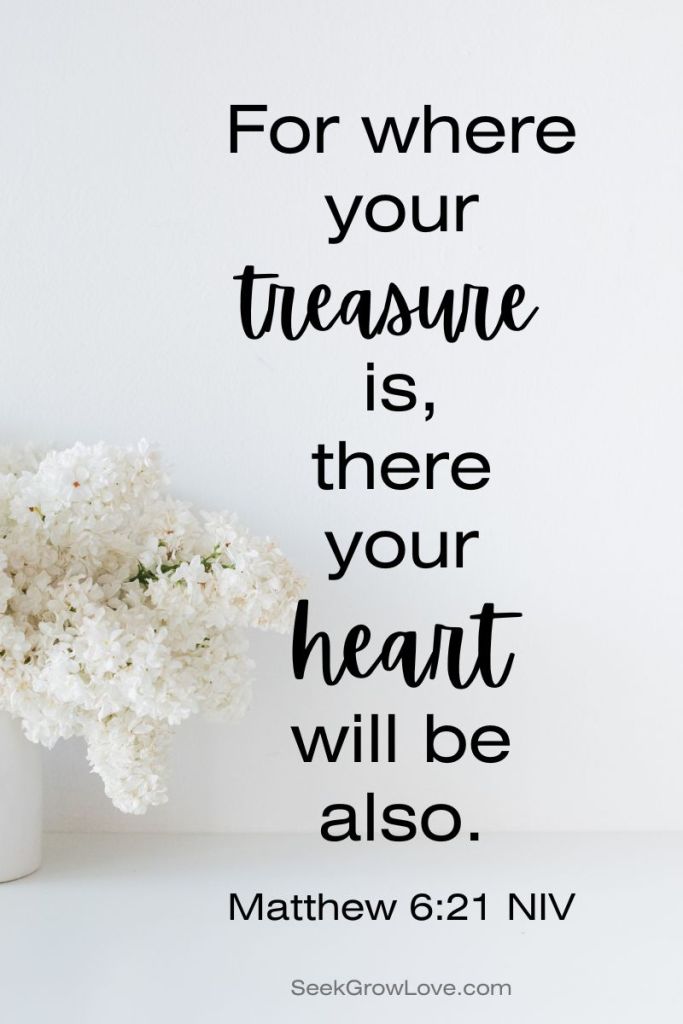
The text of Jesus’ Sermon on the Mount in Matthew 6 is full of great minimalist concepts. The simple yet powerful Lord’s Prayer, which begins in verse 9, reminds us to focus on God and trust in Him and His providence rather than ourselves. Then in verses 19-21 (NIV), Jesus steps on our toes by discussing our worldly treasures. “Do not store up for yourselves treasures on earth, where moths and vermin destroy, and where thieves break in and steal. But store up for yourselves treasures in heaven, where moths and vermin do not destroy, and where thieves do not break in and steal. For where your treasure is, there your heart will be also.” 

Nothing prepares you to consider your true treasures like a natural disaster. As a resident of the Midwest, I have been rudely awakened by sirens in the middle of the night announcing the threat of a tornado more times than I can count. Since I am a worst-case-scenario person, I’ve thought often of what I would want to save, if possible, in case of a disaster; if I know in advance that the weather is favorable for a funnel cloud, I will move our most precious belongings to the basement in case we don’t have time to grab them. It’s never easy to get the six of us to the basement in a jiffy (it can be challenging enough to bring 4 sleepy children to consciousness suddenly, not to mention a husband who sleeps soundly and disregards the urgency of a tornado warning, certain that it will never happen to us whilst forgetting about the EF-0 that caused roof damage when it spun right over our home a few years ago, but I digress). I grab the smallest child in my arms, yell at all the others to get out of bed while I rush said child to the basement, and then go back upstairs to loudly remind my sleepy stragglers of the critical nature of the situation, all while praying the tornado does not hit our house – at least until all of the humans are safe. If there is time, we may try to grab a few special things from the upper levels, but usually we choose to remain in the safety of the basement since none of the belongings in my home are worth the life of my family. 

We all have our terrestrial treasures, and that’s not necessarily wrong, as long as we realize that little of it is of eternal value and we keep our perspective in line with God’s values. Someday, it’s all gonna burn! But it won’t even matter when we dwell with our Savior in the Kingdom in perfect peace. 

Lastly, Jesus reminds us not to worry. To one prone to anxiety, this seems an impossible feat; however, it is important that he reminds us that nothing on earth is eternal and we must depend on him for all of our needs. Jesus reminds us that God takes care of the animals and the flowers, so how much more will He care for the humans made in His image? I could never hoard enough to outdo my need for God, and I could never prepare for every possible disaster in life! He challenges us to put our priorities in order by seeking God first, and then trusting that God will meet all of our needs. Jesus wants us to focus on Kingdom work more than our stuff, which can easily tie up our time, money, resources, and energy. 

Please note: I am NOT advocating for not taking care of our families and just expecting God to provide all that we need without doing anything. I think these verses are primarily about our attitude towards our stuff and our trust in our Heavenly Father. It is a good idea to try to save money for future needs, stash some food in case of emergency (and toilet paper, of course… remember the TP fiasco of 2020?!), and plan for some problems, because rainy days will come. Is it okay to have possessions? Of course; I enjoy resources just like anyone else. I have a home furnished with items our family uses and needs throughout all four seasons, plus some extras like a comprehensive collection of family board games, a nearly-complete set of Dr. Seuss books, and a handful of manatee souvenirs (hey, we all have our weaknesses!). Pursuing minimalism by getting rid of the excess clutter and unused items while still making sure the current needs of my family are met has helped to simplify my mind so I can be more present with my family, to evaluate wants versus needs so I spend less money, and to free up the mental and physical energy required to manage everything. 

Consider how you can simplify your life physically, mentally, and any “other-ly” you can think of, so that you can be more available to do the work God has entrusted to you. 

(Oh, and about that ALF stuffed animal… I must have made a big deal about missing it, because my mom replaced it that following Christmas. And yes, I still have it!!!)

Reflection questions: 

-Is your stuff weighing you down and taking your focus off the important things of God? How can you simplify?
-Why do you think we tend to overcomplicate prayer when Jesus gave us a simple but powerful template of how to pray? 

-If you want to learn more about simplifying your life, I recommend following The Minimal Mom on YouTube. She is a Christian and sometimes shares how her faith influences minimalism. If you want more fantastic faith-based (or just wholesome) resources about simplifying, feel free to contact me at rachel1213@gmail.com and I’ll be happy to share some! 

Rachel Cain

Minor Prophets Introduction

The minor prophets include the 12 final books in the Old Testament, including: Hosea, Joel, Amos, Obadiah, Jonah, Micah, Nahum, Habakkuk, Zephaniah, Haggai, Zachariah, and Malachi.  These books aren’t minor because they are unimportant, they are just shorter than (most of) the major prophets.  All of these prophets warned their respective audiences over a period of about 300 years to repent and return to God.  Many also contain prophecies of Jesus’ first or second coming, or both.

Hosea shows a parallel between Hosea’s adulterous wife and Israel’s spiritual unfaithfulness to God.

Joel talks about the “Day of the Lord” when God will pour out his judgment on wayward people.

Amos was written to prosperous Israel, whom he condemned because of their greed and forsaking justice.

Obadiah pronounced judgment against Edom for helping destroy Jerusalem.

Jonah is probably the most well-known of the minor prophets, telling the story of how Jonah himself initially rebelled against God, but eventually obeyed, and evangelized Nineveh – his mortal enemy.

Micah preached coming judgment for Jerusalem and Samaria because of the unfaithfulness of the people.  He also prophesied about the coming Messiah.

Nahum prophesied the doom of Nineveh about 150 years after Jonah, because the people had fallen back into their sinful ways.

Habakkuk contains the prophet’s frustrations that God would use a more wicked nation to punish a more righteous one; but ends with him still rejoicing in the Lord his God despite calamity.

Zephaniah prophesied the coming destruction of Jerusalem, and called the people to return to God.  He also prophesied that God would gather a remnant of His people even after He punished them.

Haggai preached after the return from Babylonian captivity, calling the people to rebuild God’s temple in Jerusalem.

Zechariah’s main focus was on the coming Messiah, and Jerusalem’s enemies to eventually be destroyed.

Malachi wrote about 100 years after the return from captivity, and was still encouraging the people to repent and return to God.

Even though these 12 books were written 2500+ years ago, and are fascinating from a historical and prophetic point of view, they are also still relevant today.  These prophets preached against hypocrisy, idolatry, and spiritual apathy – messages we need to hear again today.

I’ll close with Micah 6:8, “He has shown you, O mortal, what is good.  And what does the Lord require of you? To act justly and to love mercy and to walk humbly with your God.”

-Steve Mattison

Weird

Old Testament: Daniel 11, 12

Poetry: Psalm 119

* New Testament: Matthew 5

As a fifth-grade introvert who wanted nothing more to blend in with the small class in my little Christian school, “weird” was about the meanest name one could call me. Because I didn’t even want anyone to so much as notice me, remaining quiet and going with the flow was the most obvious way to camouflage among my peers. 

I’ve had a bit of a wake-up call since my private school elementary days. In my public secondary and post-secondary education, God called me to stand up for my faith on several occasions, even when it meant that I was standing alone – resulting in <gasp> people noticing me! More recently, ever since my husband and I felt God leading us to do things that go against the culture, such as home-birthing and home-educating all four of our children, I’ve had to learn to be confident in those decisions and keep my eyes focused on God, no matter if others think I am weird. (As fate would have it, since opposites attract, I married an extrovert who thinks “weird” is a compliment and loves nothing more than helping others laugh at his own expense, so he tries to do silly things when we are out in public – which then, of course, draws attention to me too! I’ve learned to loosen up and not care as much what others think, and he’s learned to rein in the silly antics a little bit when I am with him.)

Jesus was the epitome of weird, but not in a bad way; in fact, many people were drawn to him because they could sense his sincerity and wisdom. (Some even failed to recognize him as the Messiah for whom they were searching because he didn’t meet their expectations!) Most of Jesus’ teachings in Matthew 5 are quite counter-cultural; for example, the Beatitudes is a list of dichotomous concepts which indicate (in my simple summary) that bad things can be blessings in disguise.

Because God is love (I John 4:8) and Jesus is God’s Son and representative, one could deduce that the primary mission of Jesus’ ministry was to demonstrate the love of his Father to this broken world. That, I believe, is why the end of this chapter (Matthew 5:43-48 NIV) gives perhaps his most controversial nugget of wise advice yet: “You have heard that it was said, ‘Love your neighbor and hate your enemy.’ But I tell you, love your enemies and pray for those who persecute you, that you may be children of your Father in heaven. He causes his sun to rise on the evil and the good, and sends rain on the righteous and the unrighteous. If you love those who love you, what reward will you get? Are not even the tax collectors doing that? And if you greet only your own people, what are you doing more than others? Do not even pagans do that? Be perfect, therefore, as your heavenly Father is perfect.” Showing love to people who are not like me or who don’t deserve it can be hard enough, but to show love to my enemies and those people who have hurt me? Well, that just takes Jesus’ weird, radical love to a whole new level. Jesus demonstrated this love throughout his ministry, though, by dying for generations of sinners including you and me (see Romans 5:8) and even forgiving the people who brutally murdered him (see Luke 23:34). 

Romans 12:1-2 is one of my favorite passages; I especially love the down-to-earth wording of The Message paraphrase that reminds us why it is important to be weird: “So here’s what I want you to do, God helping you: Take your everyday, ordinary life—your sleeping, eating, going-to-work, and walking-around life—and place it before God as an offering. Embracing what God does for you is the best thing you can do for him. Don’t become so well-adjusted to your culture that you fit into it without even thinking. Instead, fix your attention on God. You’ll be changed from the inside out. Readily recognize what he wants from you, and quickly respond to it. Unlike the culture around you, always dragging you down to its level of immaturity, God brings the best out of you, develops well-formed maturity in you.” 

(This is a reminder to myself, but you can read it too if you like: Because I am following Jesus, I need to not be so afraid of being weird that no one around me even knows I am a Christian. I need to be weird in a Jesus kind of way so that people want to have the eternally-focused hope that I radiate, the kind of contagious joy that shows others there’s something different and gives me a reason to share my faith with them (see 1 Peter 3:15). In Matthew 5:14 & 16 (NIV) Jesus says, “you are the light of the world… let your light shine before others, that they may see your good deeds and glorify your Father in heaven.” Our light must have a source, and today’s Psalm 119 has a great bit of wisdom in verse 105: “Your word is a lamp to my feet and a light to my path.” Help me, Lord, to know you more through your Word and relationship with you. May I not be so afraid to be weird that I fail to shine your light in this dark world.)

Let’s take courage together to be weird in a countercultural, Jesus kind of way!

Reflection questions: 

-What are ways that you have blended in with the culture rather than standing out for Jesus? 

-Pray about the actions God wants you to take to be more “weird” in a Jesus kind of way. 

Rachel Cain

Still Giving Thanks

Old Testament: Daniel 9,10

Poetry: Psalm 118*

New Testament: Matthew 4

In our homeschool history lessons, my children and I have been learning about much of the world exploration that happened following the Reformation. Prior to this time period, two entire continents – North and South America – were largely unknown to the charted world. When there was religious persecution in England, the Puritans, who believed they should be able to worship God in their own way rather than under the thumb of the Church of England, decided to venture to the New World, where they could be truly free. Explorers had already paved the way for their travels; some colonies survived, but some did not. These Pilgrims were supposed to arrive at an existing Virginian village, but because a fierce storm blew The Mayflower off course, they ended up in Massachusetts instead. Their journey was wrought with difficulties, but they were careful to make note of God’s provision along the way, such as providing a kind Native American named Squanto who knew English (as a result of his own hardship of being sold into slavery in England for a time) and taught them how to grow food and survive the winter. Though half of the Pilgrims died that first year, they joined with their new Native American family after the first fall harvest to give thanks to God for his blessings. 

Psalm 118 begins and ends with praise; what a great reminder of how we should start and finish each day! It continues on to tell of difficulties and challenges, but immediately shares how YHWH God showed up each time, a reminder of His faithfulness and provision. 

Last week, many of us gathered to thank God for our blessings, remember the historical first Thanksgiving, and express gratitude for our religious freedom. Thanksgiving is perhaps my favorite holiday; it’s often a simple gathering with a mighty feast of both food and gratitude. My favorite part of the day is participating in the Cain family prayer song. Before we dig into our meal, thirty or more of us – original Cains, their spouses and families and extended families, and many friends – hold hands and sing “Give Thanks with a Grateful Heart” in a variety of harmonies. This sends shivers through my body as it reverberates through the large room that was once a church sanctuary and in which there have been countless prayers offered and innumerable songs sung. I always think of the bookend verses of Psalm 118 (verses 1 and 29, NIV) on Thanksgiving, but it is wise to remember at the beginning and end of every day of the year: “Give thanks to the LORD, for he is good! His faithful love endures forever.” 

Reflection:

-Commit to memory the first and final verses of Psalm 118. Then practice saying them as you wake up for the day and as you tuck yourself back into bed at night.

-Gratitude is an attitude! How can you cultivate more gratitude? 

Rachel Cain

God’s Pride and Joy

Old Testament: Daniel 7,8 

Poetry: Psalm 117 

*New Testament: Matthew 3

As a parent, there have been many times that I beamed with pride at the accomplishments of my children. Proud that my preschool-age son could write and was learning how to spell using the “oo” digraph, I was simultaneously embarrassed when he covered his church bulletin in the crooked letters “POOP” and gave it to our youth leader, Chris Lucas, with a big smile of accomplishment plastered across his face. Though slightly red-faced at the nature of my son’s first penmanship successes, I am always thrilled when I see my children building on their strengths and recognizing their potential! When they finally master the algorithm for double-digit multiplication, earn accolades at their very first session of gymnastics, build intricate LEGO creations, seamlessly play a song on their instrument, stand up for what is right, encourage a hurting friend, or create a fun craft independently in Sunday School, pride for my children fills my spirit. This year, my husband and I celebrated with tears of joy as our two oldest children were baptized on Easter and Christmas, respectively. Their decisions to follow Jesus were balm to my soul because “I have no greater joy than to hear that my children are walking in the truth.” (3 John 1:4).  

In our New Testament reading today, we learn about the beginnings of baptism and God’s pride in His Son, Jesus. John the Baptist was Jesus’ cousin – the baby who lept in the womb of his mother Elizabeth when Mary, mother of Jesus (who was still in utero, too), came to visit. We are familiar with Jesus’ virgin birth, but John came from a miraculous birth as well; his mother was well past child-bearing years when he was born as her first child. John had a public ministry to prepare the way for Jesus and was famous for introducing the concept of baptism (hence his nickname, “the Baptist”). John was a bit of an odd fellow: his attire was made from camel hair, and his most common sustenance while wandering in the desert was locusts smothered in honey. (Anyone else hungry for such a delicacy? Yum!) John was not fond of the Pharisees and made sure they knew it; you can read his reprimand to them in this passage. 

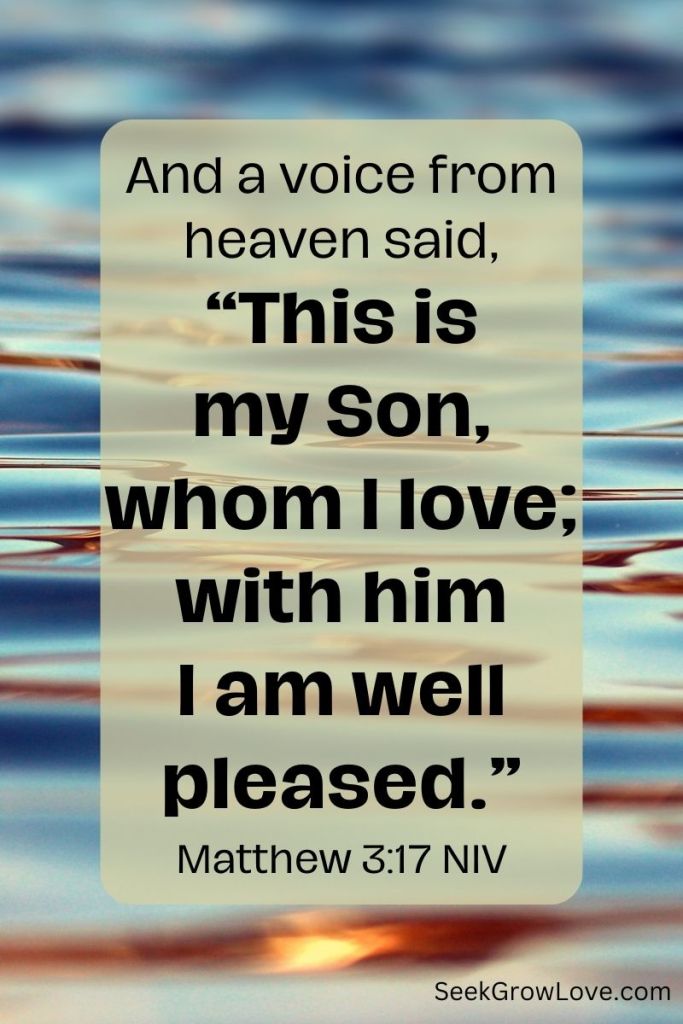
Aware that his cousin was the Son of God, John almost refused to baptize Jesus due to feelings of inadequacy but finally consented when Jesus explained the significance of the event. When Jesus rose out of the water, God’s Spirit descended like a dove and everyone in attendance could hear His voice from Heaven: “This is my Son, whom I love; with him I am well pleased.” (Matthew 3:17 NIV) 

God’s pride and joy literally shone down as the world prepared for Jesus’ public ministry. Jesus’ life, death, and resurrection would make a way for man to have a personal relationship with God again. I imagine God’s heart absolutely bubbling over with pride as he watched his Son fulfill his calling. To paraphrase a motif from Sally Lloyd Jones’ The Jesus Storybook Bible, Jesus was making the sad things come untrue; he was mending this broken world. 

All of us have, at one time or another, felt pride in our own accomplishments or for the successes of those around us; how much more pride must God have felt, finally seeing His great rescue plan begin to come to fruition!

While the wrong kind of pride can be a dangerous thing that leads to sin, we can have a humble pride – satisfaction that we have done a job well, confidence in a God-given talent, etc. – and use those opportunities of success to give glory and praise to God. 

Reflection questions:

-When have you felt pride in a confident, godly kind of way? 

-How can you use your gifts to minister to others and shine the light of Jesus? 

Rachel Cain

Remembering & Responding

*Old Testament: Daniel 5,6

Poetry: Psalm 116

New Testament: Matthew 2

Last Thursday, my fellow Americans and I demonstrated our gratitude for life’s blessings by stuffing our faces with stuffing, turkey, mashed potatoes, corn, and pie. Thanksgiving Day is a special time to remember not only our national heritage which includes the original Thanksgiving celebration of religious freedom and God’s providence of 400ish years ago, but also to reminisce about our own individual blessings. Sometimes we get so caught up with the ins and outs of life that we fail to remember how far we have come, the blessings that we have, the answered prayers and faithful love of our Father in Heaven. As we’ll see, we are not the first people in history to be so flaky and forgetful. 

In Daniel 5, we see King Nebby’s son, Belshazzar, ruling the kingdom. While drinking with his nobles out of goblets stolen from the Holy Temple, he notices a hand – just a hand – writing words on the wall. Flushed with terror, he promises a reward to whomever can interpret the cryptic message. Daniel, famous for having “power from the gods,” was summoned. Though his true interpretation of the text signified the imminent death and defeat of the current king, he was given a position of power, as promised. 


Daniel remained a leader for the new king, Darius. Because YHWH had blessed Daniel with wisdom and leadership qualities, it was widely assumed among the king’s men that Daniel would soon be given even more power than they had. Consumed with jealousy, they had to find a way to get rid of Daniel, but they could find no fault in him. 

…Except, there was that one thing: Daniel still prayed three times a day to the One True God. Maybe, if they could just get the king to sign a decree that everyone pray only to him, they could trap Daniel and get rid of him for good! 

Approaching the king with flattery to kindle the flame of his pride, the king’s leaders – minus Daniel, of course – recommended that the king enact a 30-day irrevocable law that people could pray only to King Darius. (Finally, a sure-fire way to trap their nemesis, Daniel!) The king signed the law, and the men immediately spied on Daniel. 

It didn’t take much spying, though. The men knew that Daniel always prayed at the window facing Jerusalem, and just as they suspected, his knowledge of the new law did not alter his commitment to this spiritual discipline and his allegiance to the True King. 

Giddy with pride at the simple success of their scheme, the men came back to the king, reminded him of the law, and tattled about Daniel’s offense. Darius, who considered Daniel a friend, was replete with regret. Aware that even he could not change his law, the king ordered Daniel thrust into the den of hungry lions, but offered one last hopeful prayer: “May your God, whom you serve continually, rescue you!” (6:16, NIV).  

Cue the children’s picture Bibles to show cute, cuddling lions purring on Daniel’s lap; maybe Daniel rubbed their bellies (a favorite pastime of my late cat, Maximus) or perhaps the lions just basked calmly in the ray of sunshine, as cats tend to do for the majority of their lives. However, that was not the case. The Bible states that an angel held shut the mouths of lions. Perhaps the angel was even wrestling with the powerful big kitties all night long to keep them from eating Daniel!  

Darius couldn’t sleep at all that night. As soon as dawn broke through, he scurried to the den to find out if Daniel’s God had miraculously saved his friend. The king was overjoyed when he heard Daniel’s voice and found him unharmed! Indignant at their trickery, Darius ordered the accusers to be thrown into the den, along with their families, who were mauled by lions before they even reached the bottom of the cell. Through this miracle, King Darius recognized YHWH as the One True God and decreed that his kingdom would follow YHWH, the God of Daniel. 

As a lover of all cats large and small, this story has always been a favorite of mine. I also noticed that the kings – and other characters – in the Bible have been as wishy-washy as a cat (“Pet me! Now stop or I’ll attack you! I’m hungry again! No, I want beef chunks in gravy, not beef pate!”) in the way they continue to forget or reject YHWH and then turn from their ways when they witness His power. Do they not remember? Did they learn nothing from the kings before them? Surely these events about hangry lions not eating a captive meal and three men (and an angel) walking around in a blazing furnace went down in history as turning points in their culture! It reminds me of the ridiculous cycle of the Israelites wandering in desert who would turn from the One True God, then come running back to Him when He allowed bad things to happen, then promised to always follow Him, and then forgot and worshiped other gods, and then He let their enemies attack them, and on and on and on… I feel no pity for the Israelites because they just keep on forgetting their One True God, but then I realize: how fickle am I sometimes, too. I am human; you are human; we all fail. We all forget to remember the faithfulness of our Father. We cease seeking Him when we need Him most. We, too, are like the amnesiac Israelites and the arrogant kings of the Old Testament. 

Thankfully, our reading from Psalms reminds us that “the LORD is gracious and righteous; our God is full of compassion…” (116:5, NIV). So as we depart today, let us not dwell on our offenses, but, with gratitude, ponder the question posed a few verses later (vs 12):  “What shall I return to the LORD for all His goodness to me?”

Reflection & Application: 

– Make a list of how you have seen the goodness of God, those recorded in the scriptures and in your own life, and pray about how He wants you to serve as a result of his faithfulness and grace, to share His love and joy with others. 

-Write out answered prayers and/or things for which you are grateful. Post it where you can see it. 

-Thank our Father in Heaven for His forgiveness and kindness when we forget and stray. How can you offer His grace to someone in your life today?

Rachel Cain

Even If

*Old Testament: Daniel 3 & 4

Poetry: Psalm 115

New Testament: Matthew 1

Millennials like myself will forever remember being engrossed in the dramatic animated retelling of Daniel chapter 3 in which our favorite anthropomorphic cucumber, tomato, and asparagus are punished for not bowing down to the giant chocolate bunny. While I appreciate the kid-friendly way in which Veggie Tales retold this story, the true account is quite dark and sad.

King Nebuchadnezzar, like many rulers in history, was very narcissistic. In the beginning of this book, we read how King Nebby (as we’ll call him for short) besieged Judah, claiming their strongest, handsomest, smartest young men as prisoners of war. It might sound nice that he ordered them to have the best food and education, but in reality, Nebby was trying to raise up men for his personal service who would be well-trained and informed about religions and philosophies that were contrary to the teachings of the God of Israel. Nebby even went so far as to try to remove their identities by changing their Hebrew names, which were rich with meaning and remembrance of the one true God, to Babylonian names referencing their false gods – Daniel to Belteshazzar, Hananiah to Shadrach, Mishael to Meshach, and Azariah to Abednego. (Fun fact: My oldest son, Azariah, is named after this character, whose name means “he who YHWH (God) helps”). I’ll refer to them with their Hebrew names during these readings. 

In chapter three, we observe Nebby announcing a law that whenever the ceremonial music begins, everyone must immediately bow to the obscenely large statue (idol) of himself. And if they don’t obey? They will be tossed into the furnace! Daniel and his friends had remained faithful to God, even in a foreign land with all kinds of pleasures, and they weren’t about to back down now. And so, when everyone else bowed, they stood. 

King Nebby, upon hearing of their disobedience, summoned Hananiah, Mishael, and Azariah to his presence. He gives them another chance to worship him and spare their lives. “But if you do not worship, you will immediately be cast into the furnace of blazing fire; and what god is there who can deliver you out of my hands?” 

King Nebby obviously didn’t know the One True God but was about to be overwhelmed by His power! The three men wisely replied, “Our God whom we serve is able to deliver us from the furnace of blazing fire; and He will deliver us out of your hand, O king.” (I imagine there was a dramatic pause here as the men looked into each other’s eyes, realized the potential implications of their choice, took a deep breath, and regained their courage.) “But even if He does not, let it be known to you, O king, that we are not going to serve your gods or worship the golden image you have set up.” (Daniel 3:17-18, NIV)

“Even if.” Two tiny words expressing such immense faith. 

“Even if.” Even IF God doesn’t come through in the way we hoped, we wouldn’t do anything differently. Even IF God doesn’t answer my prayers, I will not turn from Him. Even IF He seems absent, we can be confident that God is working behind the scenes. 

Well, if their confident, faith-filled response didn’t just burn the king’s biscuits! And he was about to burn theirs, quite literally! King Nebby, bubbling over with anger, ordered the already-scorching furnace to be made seven times hotter. When the guards threw in Hananiah, Mishael, and Azariah, the guards were consumed with fire and died. The king’s wrath turned to surprise when he noticed four men walking around in the fire. Awestruck, King Nebby ordered them to be removed from the fire. It is noted in the scripture that not a hair was singed, and they did not even smell like smoke. The King, beyond astonished by the miracle, declared their God to be the only one who is worshiped in his kingdom, and the three men prospered in Babylon. 

Even though the king had changed their names, he could NOT change their allegiance; the faithfulness of Hananiah, Mishael, and Azariah during a very fearful time allowed God to demonstrate His power. 

God didn’t save them FROM the fire; he saved them IN the fire. Even if He seems distant or you don’t understand your current struggle, continue being faithful. You might have to face some rain before you see a rainbow or go through the fire before you are refined? Continue seeking Him. He will show up, and your faithfulness will not go unnoticed. 

Reflection & APPLICATION:


-How has God saved you in the past?
-What did you learn from “going through the fire” that you would not have learned if he had saved you from the entire situation at the start?
-Give thanks for His provision! 

-Rachel Cain

Which are You?

Old Testament Reading: Leviticus 3 & 4
Psalms Reading: Psalm 48
New Testament Reading: 1 Corinthians 1

Let’s play a quick game together, shall we? I’m going to give you two separate lists to study, each with a dozen synonymic adjectives, and then ask you questions about them. 

List 1: idiotic, half-witted, brainless, imprudent, ill-advised, senseless, reckless, foolhardy, lunatic, absurd, unwise, nonsensical

List 2: sage, clever, informed, astute, sensible, prudent, judicious, discerning, insightful, perspicacious, sharp-witted, enlightened

Who is the first person to pop into your head when you see each respective list? 


Which list best describes you currently?

Which list would you rather have read about you at your funeral? 

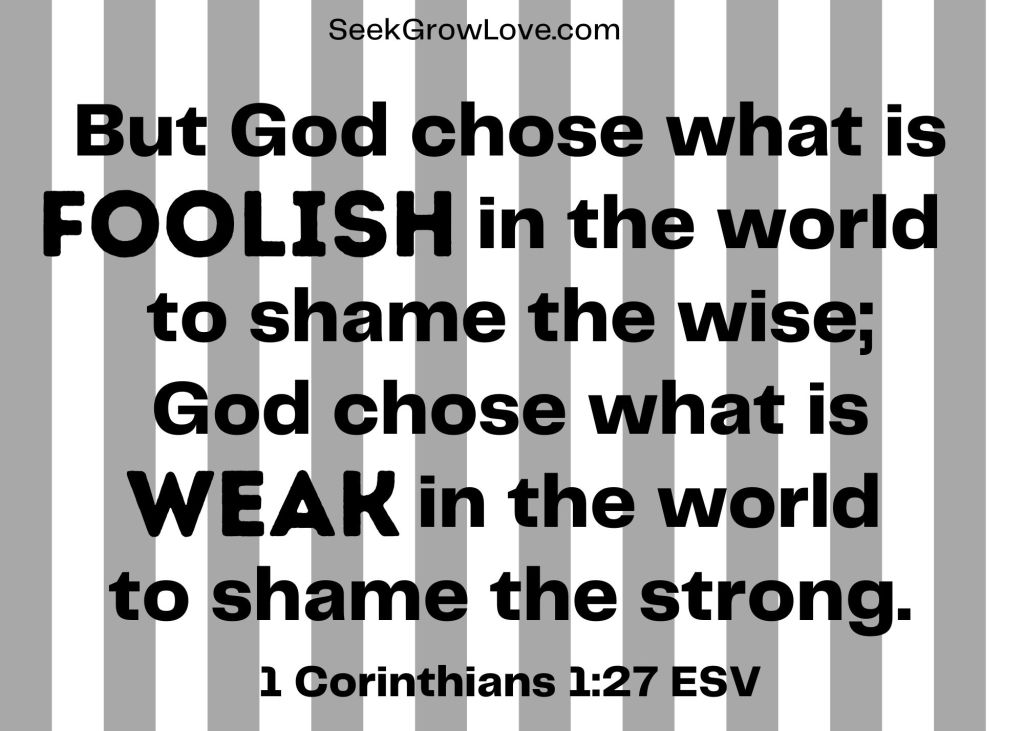
The first set of words contains synonyms for the word “foolish”, and the second one lists synonyms for “wise”. The end of I Corinthians 1 is contrasting foolishness and wisdom as it relates to God vs. man, and how God empowers us to do His work. Paul writes beginning in verse 25 (ESV), “For the foolishness of God is wiser than men, and the weakness of God is stronger than men. For consider your calling, brothers; not many of you were wise according to worldly standards, not many were powerful, not many were of noble birth. But God chose what is foolish in the world to shame the wise; God chose what is weak in the world to shame the strong; God chose what is low and despised in the world, even things that are not, to bring to nothing things that are, so that no human being might boast in the presence of God. And because of him you are in Christ Jesus, who became to us wisdom from God, righteousness and sanctification and redemption, so that, as it is written, ‘Let the one who boasts, boast in the Lord.'”

This verse causes me to bubble over with inspiration and gratitude every time I read it! I take great joy in reading accounts of the underdogs in the Bible whom God used to do great things, and in believing that He can do the same with me. Moses had a speech impediment, but God used him to speak with Pharoah and deliver the Isaelites from slavery. Rahab was a prostitute, but God designated her to save His spies and she was then in the lineage of Jesus. David was only a grungy, petite shepherd, but God used him to defeat Goliath. (David later served God as a great King of Israel, despite being a murderer and adulterer.) Gideon, who was the least important of his family (which was the weakest of his tribe), was hiding when an angel sent from God called him “Mighty Warrior”, but God led him to defeat the Midianite army with nothing but a miniscule army and God’s power. 

BUT GOD. 

BUT GOD. 

BUT GOD throughout history has called people to do great things through his power. Most of them were not already rich or famous or powerful, but when God gave them His power, He did mighty things through them! Even in the New Testament, we read in Acts 4:13 that people were amazed that Peter and John were “unschooled, ordinary men.” 

God is still active and working today. He wants us to strive for wisdom and seek Him. God wants to use you to do great things for Him! God is still using his people in big ways to impact their communities and the world. No matter your history, education level, age, job, or any other excuse you might share for why God can’t use you, remember… He loves to use imperfect people for His glory. 

-Rachel Cain

Reflection:

*What is your excuse for why God shouldn’t use you? Pray for Him to show you the way He sees you and give you His power. 

*What is God calling you to do that might be scary or out of your comfort zone? Pray about that situation and ask Him to fill you with His power! 

*What has God revealed about Himself today?

The Awesome Lord Most High

Old Testament Reading: Leviticus 1 & 2
* Psalms Reading: Psalm 47
New Testament: 1st & 2nd Chronicles Introduction – see below

Psalm 47 is all about praising God and realizing His power. In my Bible (ESV), it is titled, “God is King over All the Earth”. When the sons of Korah wrote this psalm/song, perhaps they had just completed a great military victory, or maybe there was some other big event that called for a celebration! 

It’s easy to praise God when things are going well, right? Or… do we even remember to praise Him in the good times? A lot of us probably come before God most often when we need something. Sometimes we treat him like a cosmic genie or Santa Claus, asking for the things we want. Sometimes, we simply get busy and forget Him during the good times, but when we need His intervention, then we remember to pray. 

It is so important to remember (and I am speaking to myself here too!) to praise God regularly, and talk with Him often. No one likes having that “friend” who only calls when they need something; however, if we have a dear friend in need, we want to help them! God is our Father who cares greatly for us, and He wants a relationship with us. So instead of just asking Him for what we need, we should remember to praise Him regularly and get to know Him better by reading His Word and listening for His still, small voice to speak to our souls. 

-Rachel Cain

Reflections:

  1. Rewrite Psalm 47 into your own words, using actual examples from your own life. Sing or pray the psalm to your Heavenly Father! 
  2. What picture do you get of God from your reading today?

In preparation for beginning 1st Chronicles tomorrow in our New Testament reading, here is our…

Introduction to 1st & 2nd Chronicles

Paul wrote the books of 1 and 2 Corinthians to the church in Corinth which he had personally founded.  The city of Corinth was rich and sinful, and the church was struggling to resist the ungodly influences of the pagan society.  Paul wrote 1 Corinthians to the church in Corinth specifically to address division and sin in the church.

The most well-known chapter is 1 Corinthians 13, also known as the love chapter.  This is sandwiched between two other chapters focusing on spiritual gifts and their use in the church.

The other well-known chapter is 1 Corinthians 15, also known as the resurrection chapter.

In 2 Corinthians, Paul defended the fact that he was an apostle.  He emphasized the suffering he had endured for the gospel.  He explained that he had not visited the church in Corinth again because he didn’t want to have to come down hard on them publicly.  He was happy they had addressed the sin in the church.  He emphasized the need to financially help other believers, and pointed out that “God loves a cheerful giver”.

Paul warned in 2 Corinthians 13:5, “Examine yourselves to see whether you are in the faith; test yourselves.  Do you not realize that Christ Jesus is in you – unless, of course, you fail the test?”

I suspect that if Paul were to write to Christians today, he would write something very nearly like 1 & 2 Corinthians, so pay attention as you read it.

-Steve Mattison

Be Still – Daddy’s Got You

Old Testament: Leviticus Introduction Below
*Psalms Reading: Psalm 46
New Testament Reading: Romans 16

I am a Daddy’s girl, through and through. As a child, you could usually find me hiking with my dad, reading books with him, snuggling up to him, or helping him with a building project. He was so strong, secure, safe. Now, as his terminal illness has progressed, I have much more of a parental role toward him than he does toward me, but I’ll still always consider myself a Daddy’s girl. 

Sometimes I like to sit back and just observe my daughters interacting with my husband too. They fawn over him! They want to attend all the Daddy-Daughter dances together. They draw him sweet pictures regularly. They beg him to scratch their backs to get them to sleep. When they are scared, they run to him for comfort and protection, knowing that he is strong and gentle.

Though in this flawed and sinful world many fathers don’t live up to God’s ideals, we all do have a Heavenly Father who wants to guide and protect us. 

“God is our refuge and strength, a very present help in trouble.” (Psalm 46:1, ESV)  I’ve always loved this verse. It has spoken to the depths of my soul during many tumultuous times in my life. Following these encouraging introductory verses, Psalm 46 proceeds to mention many catastrophic events – the earth gives way, mountains fall into the sea, waters roar, mountains tremble – and calls us to have no fear during these times. Verses 4 through 9 then remind us of the power and provision of our God. 

“Be still and know that I am God.” This verse I have both underlined in my Bible and written in the margins so I will be sure to notice it as I read. It is a good reminder that when all the chaotic events occur (both the ones mentioned in this Psalm as well as any others that happen in my own life), I am still called to find shelter in His stillness and remember that God is on the throne and He is in control. I don’t know about you, but “be still” is a tough command for me to follow; I like to always keep my hands and mind busy. My mind, actually, does not often settle down at all; anxiety has been my constant (uninvited) companion for as long as I can remember. However, when I purposefully choose to be still, basking in the presence of God, I can feel His peace wash over me like a spring rain. It takes a lot of effort, as I am not naturally driven to “be still”, but I’ve never been disappointed following a quiet moment with God; to the contrary, I find a renewed sense of purpose and strength when I remember – rather, KNOW within the depths of my soul! – that He is God.

“‘Be still, and know that I am God; I will be exalted among the nations. I will be exalted in the earth!’ The LORD of hosts with us; the God of Jacob is our fortress.” God is our protector, our fortress… our Daddy who loves us so much! 

-Rachel Cain

Reflections:

1. Pray this Psalm today. Think about it intently as you say each word. 

2. Choose a time this week that you can “be still and know that He is God” – bask in his presence for a while as you praise and pray. 

3. What in your reading today helps you KNOW that He is God? What are His qualities?

In our Old Testament reading, yesterday we finished reading Exodus, tomorrow we will begin Leviticus – here today is our

Introduction to Leviticus

Leviticus is the third book in the Old Testament, and the middle book in the Torah.  Moses wrote Leviticus, which is mostly a record of God dictating His rules to Moses – while the Israelites were camped in front of Mount Sinai.

The recurring theme in Leviticus is, “Be holy, because I [God] am holy”.  Leviticus 20:26 sums up the whole book pretty well, “You are to be holy to me because I, the Lord, am holy, and I have set you apart from the nations to be my own.”

God had rescued the Israelites from slavery to belong to God.  They had served the Egyptians, and now they must serve God.  And in order to do that, they needed to know what God required.

As you read, you’ll be struck repeatedly by the fact that God is holy, and people aren’t.  God gave all these rules because He wanted His people to be holy, and if they followed all these rules, they would be holy.  The story of Nadab and Abihu in Leviticus 10 is a stark reminder that misdirected zeal for God can result in death. 

You will see that reconciliation is possible for those who break God’s laws in ignorance, but only punishment awaits those who defiantly break God’s laws.

You will recognize that some rules were fulfilled in Jesus.  For example, Leviticus 23 describes the “Feasts of the Lord”, which have fulfillment in Jesus.  For example, Jesus fulfilled the 4 Spring feasts on the exact calendar day of the feast.  I suspect the 3 fall feasts will be ultimately fulfilled exactly when Jesus returns.

  • Passover – Jesus *was* the Passover lamb, and was killed on the date of Passover
  • Unleavened Bread – Just as yeast was to be removed from houses, Jesus removed sin to his grave on this date.
  • Firstfruits – Jesus was raised from the dead on the date of the feast of firstfruits.
  • Feast of Weeks (or Pentecost) – The Holy Spirit was poured out on the believers on this date in Acts 2.
  • Feast of Trumpets – I believe this will be the date the last trumpet sounds
  • Day of Atonement – I suspect this may be the date of the Great White Throne Judgement
  • Feast of Tabernacles – I suspect this may be the date of God’s dwelling with men.

Ultimately, I suspect what you’ll recognize is that God is holy, and no matter how hard we try, we just can’t follow all His rules to be holy.  You’ll acknowledge that we couldn’t please God on our own. And will appreciate all the more that God sent his one and only Son to reconcile us to Himself.

-Steve Mattison

A Guiding Presence

Old Testament Reading: Exodus 38, 39 & 40
Psalms Reading: Psalm 45
New Testament Reading: Romans 15

Last year, my kids and I studied history from Creation through Greek civilization in our homeschool, covering the entire Old Testament alongside simultaneously-occurring secular world history. This study included details about the Mosaic Tabernacle, God’s temporary dwelling place in the wilderness before His people reached their Promised Land. As a visual and kinesthetic learner, I love to bring our lessons to life in a tangible way, so you can imagine how excited I was to discover that a traveling life-size interactive Tabernacle replica would be near our stomping grounds last summer! 

The sun scorched down over the Tabernacle when we arrived, which I humored was very fitting since the real Tabernacle was built while the Israelites wandered in the desert. (However, keeping four young children calm in the heat was a bit of a challenge, and I had to make a pilgrimage from the Holy of Holies to the nearest well – I mean, my van – to get water to satisfy my parched children… but I digress). While we had already learned a lot about the Tabernacle before, it was fascinating to see it all with our own eyes and learn all about the symbolism of the Tabernacle to the Messiah and the coming Kingdom. 

In Exodus chapter 40, we see that the Tabernacle, after several chapters of minute details describing its construction, was finally erected, “and the glory of the LORD filled the tabernacle… throughout all their journeys, whenever the cloud was taken up from over the tabernacle, the people of Israel would set out… for the cloud of the LORD was on the tabernacle by day, and fire was upon it by night, in the sight of all the house of Israel throughout all their journeys.” (Exodus 40:34-38, ESV). 

The Tabernacle provided a way for God to live among His people again and guide them through the desert. I do wish that God’s direction was as clear to me as his presence in a cloud pillar leading me through this confusing life (wouldn’t that be nice?), but there is no longer a need for a Tabernacle like in those days, because Jesus is now our mediator and our Shepherd, and the Bible is our map and GPS. Because of Jesus, we have a direct line to God anytime, anywhere through prayer. Our ultimate hope is that someday, we will live together in the Kingdom with God, where there will not even need to be a sun because God will provide all the light we need! 

Our Psalm reading ties into this well. Check out verse 6: “Your throne, O God, is forever and ever. The scepter of your kingdom is a scepter of righteousness; you have loved righteousness and hated wickedness.” God is on the throne! Hallelujah! 

And I’ll leave you with this from our Romans passage (verse 13), as you journey through this life relying on God’s direction: “May the God of hope fill you with all joy and peace in believing, so that by the power of the Holy Spirit you may abound in hope.” Our hope is through Jesus in God the Father, who is preparing a Kingdom for us that will be permanent (not temporary like the Tabernacle), a place where we can one day dwell with Him. Go in that hope! 

-Rachel Cain

Reflection:

  1. Do some research about the symbolism of the Tabernacle to Jesus and the Kingdom. What speaks to your heart? 
  2. How is your prayer life, your connection with God? What could make it better? (Consider downloading a prayer app that pops up your prayer requests onto your phone throughout the day if, like me, having an uninterrupted prayer time is challenging). 
  3. What do you learn about God in our Bible reading today?