Has Christ Been Divided?

2 Samuel 13-14

Psalm 55

*1 Corinthians 1

-Devotion by Jeremy Martin (TN)

            Today’s reading in 1 Corinthians 1 hits me a little close to home, in a lot of ways.  I “self-identify” with a number of labels; and it makes me feel better, as if I am part of a larger whole, a part of “my team”.  We all do it to a point, and to a certain degree it is helpful in identifying like-minded folks.  I self identify, because of my scriptural beliefs as: a Biblical Unitarian, a Dynamic Monarchian, a Restorationist, a Biblical Monotheist, and a Primitive Christian.  I’m proud of all of those things, and believe that I’ve come to those labels by studying scripture, finding the truth in God’s spirit, and my labels keep me warm when I wrap myself up in them.  Our reading today, however, chastens me and lets me know that I should be cautious when labelling myself, and humbly acknowledge that what we really are is just servants of the Christ, who is himself the servant of God.

            In my time at the Bible College all of my teachers were amazing, and there were two professors there that I’m going to quote today as examples; Joe Martin (my dad, who is awesome even above my own personal bias) and Kent Ross (who gave the sermon at camp that caused me to get baptized).  Both of them believed in both grace and truth as critical aspects of religion, but each held a different view on which was predominant.  “GRACE!” my father would say, “but truth is important.”.  “TRUTH!” Kent would say, “but grace is also important.”.  Brother Kent has fallen asleep now, and my father’s eyes have been darkened (but not his mind nor his spirit).  I find myself agreeing with both of them, and sometimes it is difficult to find the perfect balance between these 2 critical aspects of the same coin.

            Today in the Christian world, there are an estimated 45000 denominations.  This is just Christians alone, but worldwide.  There are 4 to 10 sects of Judaism, with other sub-groups that make it harder to put an exact number to (although there are 3 sects that are predominant).  The Muslim faith has 2 primary branches, and numerous “schools of thought”, and is predicted to have division of 73 different sects.  Why have we divided ourselves, so much?  Aren’t we all children of the same God?  Each of these groups, each individual sect or subsect, believes that they have a critical aspect of truth that makes them unique.  I will absolutely agree that with so many different and sometimes opposing beliefs, some of them will be incorrect, but the most critical thing that I take away from today’s reading is: that’s not for me to decide for anybody else, but with fear and trembling to work out my own salvation (Phil 2:12).

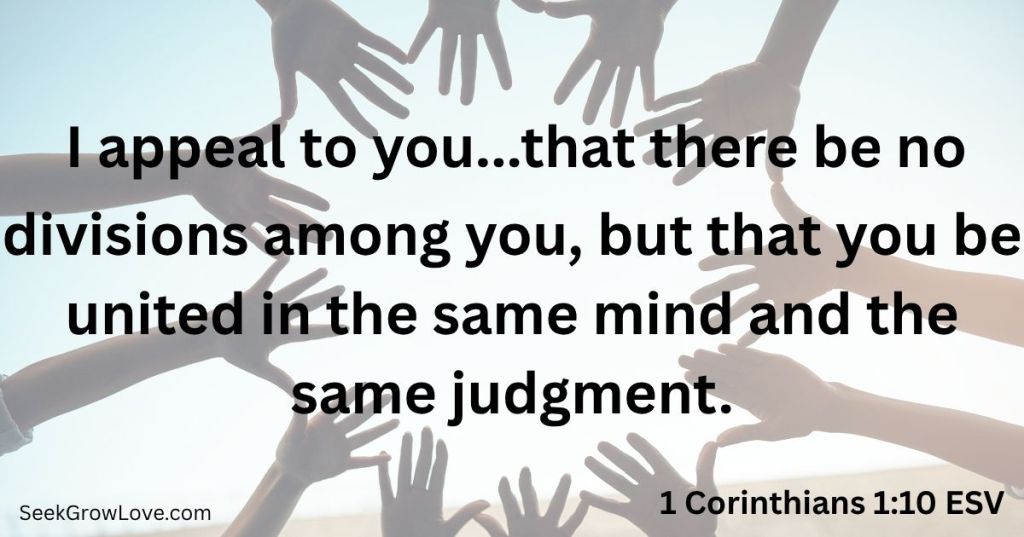
            In our 1 Corinthians 1 reading today, Paul calls us all back to unity.  In 1 Cor 1:10, he urges us to “all agree (or, “say the same thing”) and that there be no divisions among you…“(LSB).  In 1 Cor 1:11-12 he continues on to say that he knows of quarrels and divisions among the church, with some of the brothers claiming Paul, or Apollos, or Cephas as their “self-identifying” position.  With so many differing opinions it’s going to be difficult to “all say the same thing”, so how should we proceed?  The key and critical verse here is in 1 Cor 1:13, where he asks bluntly: “Has Christ been divided?“.  The answer is, clearly, no.  It is men who have become divided, and I will even venture to say that it is mostly because of pride.  “I’m right, and you’re wrong, so I win!” is a mentality that we must avoid at all costs, because that is just straight up pride speaking, and God mocks the proud.

            “But truth!” you may exclaim, and you are right.  We should all agree, and what we should agree on is specifically God’s word as it has been given to us in scripture: where scripture speaks loudly we should also speak loudly, and where scripture is silent, we should be silent.  I am in no way saying we should not speak truth, the Bereans fiercely sought truth by checking everything in scripture and were commended for it.  What I am saying is that when we speak the truth, it should be in love, spoken with patience and longsuffering mercy, not as to a combatant who is speaking lies but as to a brother or sister who may be mistaken, just as we could be mistaken.

            “Grace!” I say, but also, the truth is important.  Not so important that I want to jeopardize my entry into the kingdom of heaven by not showing you the love that God showed me, but I will patiently and lovingly, with great concern for your feelings and person, with overwhelming forgiveness and mercy (just like God had for me) discuss with you my understanding of scripture if you like, and hope that you find a relationship with my King as I have.  The God who made us, the same God who patiently reached down and pulled me to Him, will do the same for any who seek after Him. 

            Since my King who was innocent humbly took the offenses given to him quietly and without raising his voice, should I do differently?  The Christ has not been divided, he has been nailed to a cross for my transgression, so that our God could “cut a covenant” with us anew.  That does not place me in a position of authority, but of humility.  I’m not even a Jew, but a dog of a Gentile! (Matt 15:27).  What right do I have to get puffed up with pride?  I am just a man, I could be mistaken, I have changed the way I believed about certain things based on scripture, and these things are important to me but that in no way changes the fact that I am the tail and not the head: God is the head of Christ, and the Christ is the head of me (1 Cor 11:3).

            But God, our Creator and our Sustainer, who thought so highly of us that he sent us our king Yeshua (Jesus) to redeem us offers us a way.  Considering others to be greater than ourselves, we should entreat them with love to examine the scripture, and examine it ourselves even more deeply.  Then, not just reading the word, we should do our very best to reflect the amazing love and character of our God to all of our fellow creation, living in obedience to the best of our ability to God’s word, and remaining humble. 

            Our King didn’t say we had to have a perfect understanding to enter into the Kingdom, our King said that “Whoever then annuls one of the least of these commandments, and so teaches others, shall be called least in the kingdom of heaven…” (Matt 5:19, LSB).  This is super important, because it seeems to indicate that you can have an incorrect doctrine and still enter in to the kingdom (but it may impact your status there).  Is the truth important? Yes, of course it is, especially to you, but obeying God and showing others the grace that God showed you is, I would argue,  even more important (but I am just a man and I could be wrong).  Grace to you, and truth, and may God lead us.

REFLECTION QUESTIONS

  1. Have you ever changed the way you believed or thought about something based on scripture?
  2. When you discuss your faith with others who believe differently, do you always reflect God’s character?
  3. DO you ever discuss your faith with others who believe differently, and why or why not?
  4. Is there a perfect balance, a way to express truth while exhibiting God’s patient and compassionate grace?
  5. What are some ways we can reflect God’s love to our fellow creation?
  6. Are you able to, like Christ, take an offense given, both patiently and humbly?

PRAYER

Lord God, thank you for my life, and for the breath You have breathed into my lungs, for the fact that I woke up today.  Forgive me of my many iniquities and shortcomings, and instruct me in the way that I should go to be a servant who pleases You.  May the lips of all of Your creation offer you praise, and bow to the king that you have anointed, to Your glory.  Father, let me show Your love today.  In Jesus name, Amen.
Which are You?

Old Testament Reading: Leviticus 3 & 4
Psalms Reading: Psalm 48
New Testament Reading: 1 Corinthians 1

Let’s play a quick game together, shall we? I’m going to give you two separate lists to study, each with a dozen synonymic adjectives, and then ask you questions about them. 

List 1: idiotic, half-witted, brainless, imprudent, ill-advised, senseless, reckless, foolhardy, lunatic, absurd, unwise, nonsensical

List 2: sage, clever, informed, astute, sensible, prudent, judicious, discerning, insightful, perspicacious, sharp-witted, enlightened

Who is the first person to pop into your head when you see each respective list? 


Which list best describes you currently?

Which list would you rather have read about you at your funeral? 

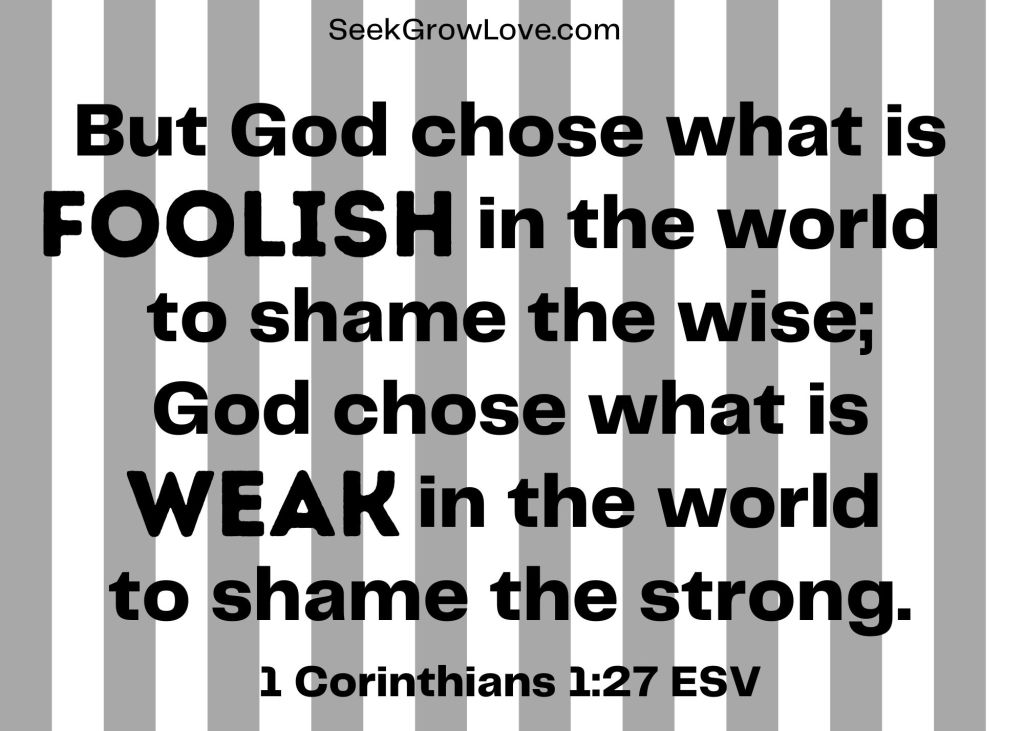
The first set of words contains synonyms for the word “foolish”, and the second one lists synonyms for “wise”. The end of I Corinthians 1 is contrasting foolishness and wisdom as it relates to God vs. man, and how God empowers us to do His work. Paul writes beginning in verse 25 (ESV), “For the foolishness of God is wiser than men, and the weakness of God is stronger than men. For consider your calling, brothers; not many of you were wise according to worldly standards, not many were powerful, not many were of noble birth. But God chose what is foolish in the world to shame the wise; God chose what is weak in the world to shame the strong; God chose what is low and despised in the world, even things that are not, to bring to nothing things that are, so that no human being might boast in the presence of God. And because of him you are in Christ Jesus, who became to us wisdom from God, righteousness and sanctification and redemption, so that, as it is written, ‘Let the one who boasts, boast in the Lord.'”

This verse causes me to bubble over with inspiration and gratitude every time I read it! I take great joy in reading accounts of the underdogs in the Bible whom God used to do great things, and in believing that He can do the same with me. Moses had a speech impediment, but God used him to speak with Pharoah and deliver the Isaelites from slavery. Rahab was a prostitute, but God designated her to save His spies and she was then in the lineage of Jesus. David was only a grungy, petite shepherd, but God used him to defeat Goliath. (David later served God as a great King of Israel, despite being a murderer and adulterer.) Gideon, who was the least important of his family (which was the weakest of his tribe), was hiding when an angel sent from God called him “Mighty Warrior”, but God led him to defeat the Midianite army with nothing but a miniscule army and God’s power. 

BUT GOD. 

BUT GOD. 

BUT GOD throughout history has called people to do great things through his power. Most of them were not already rich or famous or powerful, but when God gave them His power, He did mighty things through them! Even in the New Testament, we read in Acts 4:13 that people were amazed that Peter and John were “unschooled, ordinary men.” 

God is still active and working today. He wants us to strive for wisdom and seek Him. God wants to use you to do great things for Him! God is still using his people in big ways to impact their communities and the world. No matter your history, education level, age, job, or any other excuse you might share for why God can’t use you, remember… He loves to use imperfect people for His glory. 

-Rachel Cain

Reflection:

*What is your excuse for why God shouldn’t use you? Pray for Him to show you the way He sees you and give you His power. 

*What is God calling you to do that might be scary or out of your comfort zone? Pray about that situation and ask Him to fill you with His power! 

*What has God revealed about Himself today?

Foolishness – to Those Perishing

1 Corinthians 1

June 2

Wisdom is a concept that has been found in all cultures for all time. Wisdom in the ancient biblical sense is to reflect on God and obey Him with reverential awe. Wisdom in the 21st century western world stresses wise money investing in stocks with a look towards retirement. “Wise” thoughts have shifted from contemplating who God is, to “how can I make my life as comfortable as possible?” I’m not suggesting that wise investing is bad by any means, but there is a wisdom that goes beyond our capabilities to reason. True understanding and wisdom comes from God Himself, and is vastly superior to earthly human wisdom. This is a concept Paul explores in the first chapter of 1 Corinthians.


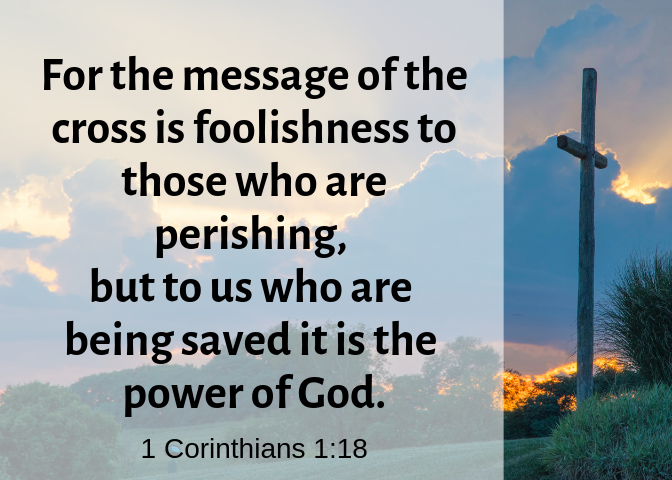
“For the word of the cross is folly to those who are perishing, but to us who are being saved it is the power of God” (1 Corinthians 1:18). There has never been a clearer distinction made in the Bible between wisdom and folly. The good news of Jesus Christ, his death and resurrection and the coming kingdom of God, is foolishness to a world that is dying. There’s a total lack of understanding of the meaning of the cross to a world that doesn’t receive it. When we don’t understand something, our general first reaction is to pass it off as foolish. I fell into this trap for many years of my life.

I was raised in church, but my family stopped regularly attending when I was nine. It eventually turned from a sporadic attendance to not attending at all. As I grew older I was informed of things that were happening at the church that I grew up in that shouldn’t have been happening: misconduct to say the least. I grew cold towards God because of actions that I wasn’t even aware of. Not being aware was somehow worse to me. I audibly said “if that’s how Christians are going to act, then I don’t want to be a part of the church”. I became lukewarm at best, and I was essentially an agnostic in all but name. The word of the cross became folly to me.


When I was a sophomore in High School, I met Josiah Cain. We became friends very quickly, but it didn’t take me long to find out that his dad was a pastor. I was skeptical, but I remained friends with him. For three years, God worked on me through Josiah, and after those three years I eventually agreed to attend a single service at his church: Lawrenceville. The service at Lawrenceville was a refreshing church experience. The message was relatable, the pastor was down to earth, the environment was relaxed. It felt right and I was thankful that I was there. It didn’t take me long to realize that I had based all of my assumptions on church and putting my faith in God on a bad experience that I had. That in and of itself branded me as foolish.


I began to attend Lawrenceville regularly. I came forward and accepted an altar call on Resurrection Sunday in 2013. The next month I was baptized. I was beginning to realize the word of the cross and what Jesus accomplished for me. With my original church experience I was only thinking of myself. I realized after being baptized that the good news of Jesus is not about what I feel and about what I can get out of it, but what God has accomplished through his son. The word of the cross ceased to be folly to me, and it became the power of God that was saving me. Nine years later, I’m a pastor (which is still wild to me) and it’s because of the faithfulness of God and the intentionality of Josiah. Folly was worked out of me and wisdom into me.


It is easy to lose patience with those that don’t understand the power of God through the cross. We must be patient, for the good news about Jesus is foolishness to a world that doesn’t understand. When something doesn’t make sense to us, we resent it and want nothing to do with it. When the patient understanding of a friend comes alongside us, there comes understanding. God is working through us to reach the lost around us. We must realize that God has the power to change a folly mind to a mind that gives Him reverential awe. Let’s be the people through whom God blesses the world through His wondrous working power.

-Nathan Massie


Application:

  1. God is working in and through us to reach the world. We as God’s people need to be ready to come alongside those who think the good news of Jesus is folly.
  2. Only God can change the minds and hearts of people, but God has chosen us to be His instruments. We must be ready to share the good news of Jesus with those around us. Who will you share the good news with?
  3. Reflect on God and be thankful for what He has accomplished through the cross of Jesus Christ for us. The word of the cross is the power unto salvation for all those who believe.

Who Deserves Our Faith & Following

1 Corinthians 1

1 Corinthians 1 18 (1)

Hey guys this is Chris and I’m excited to go through 1 Corinthians 1-7 with you this week.  I hope you enjoy this book as much as I do.


In 1 Corinthians 1:10-17 Paul chastises the people in the Church at Corinth for being divided based on the person they were baptized by or whose teachings they followed.  I think that this is a very good message for us today. Many Christians are drawn to a well spoken pastor, or an impassioned speaker, and these are good people to follow, but too often people place too much of their faith in that person.  I have seen it many times, these types of leaders will move away from their church or they will have a scandal, and the faith of the people will be shaken and many will stop going to that church. Hebrews 4:14 says “Therefore, since we have a great high priest who has ascended into heaven, Jesus the Son of God, let us hold firmly to the faith we profess.”  We need to follow Jesus as the head of the Church because he will not fail us, and he is the only one who deserves our faith. Also, in this age of social justice people can get caught up in a certain movement or behind a certain leader and let those ideas influence them, and we need to remember that Christ’s teachings come first. Those other movements may be good things, but we need to check what they are saying against what Christ teaches.


1 Corinthians 1:18-31 tells us that salvation is not attained through wisdom or knowledge that you can gain if you study long enough.  That was the teaching of the Greeks such as Plato and Aristotle, that seeking wisdom was the highest goal. Salvation comes through faith.  In the Church of God we can be very focused on the Word of God and the truth, which is a good thing, but we need to make sure that we do not take pride in our knowledge and somehow think that we are any better than other Christians. We are saved by our faith, not our knowledge or wisdom.  Knowledge and wisdom will come as we seek God and grow, but we should not have pride in our knowledge, only in Christ and his works.


Have a blessed day.

Chris Mattison