Joy to the World!

OLD TESTAMENT: Nehemiah 8

POETRY: Psalm 148

NEW TESTAMENT: John 19:38-42

Joy to the World! The Lord is come. Merry Christmas!

I never really considered Nehemiah as a Christmas devotional, but today’s reading actually fits in quite nicely! We read today about the Israelites finally being reintroduced to the Scriptures after completing the wall. They had forgotten who they were, and as the Torah was read to them, they cried – perhaps they were sad that they had not known this all of their lives? The Levites asked them to stop mourning and instead go celebrate by eating and drinking together. “Do not grieve, for the joy of the Lord is your strength!” (Neh. 8:10). 

As the people heard and understood more of the scriptures, they learned about the Feasts: God-ordained parties that had long been ignored or forgotten! Realizing that they were near the appointed time to celebrate the Feast of Tabernacles (also known as Sukkot or Feast of Booths) and eager to reconnect with their roots and their God, they quickly gathered branches to create temporary shelters. The booths/sukkahs that they created to remember their ancestors’ wilderness wanderings following their escape from Egyptian slavery were also a tangible reminder of their recent history living in a tumbledown city, which caused a renewed appreciation for their newly rebuilt Jerusalem. I can only imagine the overwhelming feeling of God’s faithfulness they experienced! The restoration of the wall led to a restoration of the Jewish people and their faith. 

A few months ago on a pleasant autumn evening, my family huddled with hearty bowls of soup under a makeshift tent (ok, so it was really just old bedsheets haphazardly pinned to the clothesline in the shape of an A by my Littles, but it’s the thought that counts!) in our backyard while we retold the story of Moses leading his people out of slavery only to wander in the desert and sleep in sukkahs – temporary dwellings – for 40 years until they were ready to enter the Promised Land. This God-ordained fall Feast of Tabernacles, which has been celebrated for centuries among the Jewish people, is a rich way to remember God’s faithfulness in the past (providing literal and metaphorical shelter for his people until they entered their Promised Land) and His promised hope for the future (the Kingdom). Through burps, unrelated laughter, and all the other chaos that occurs when doing almost anything with a small mob of children, we briefly discussed the parallels between Moses awaiting the Promised Land and Jesus awaiting the Kingdom through my best novice attempt to honor some of the traditional celebrations. (I encourage you to look more into the feasts and celebrate them, even at a basic level, with your family and friends!). 

Through my studies of this feast, I learned that Jesus was likely born around the time of Sukkot, which could be another reason why (in addition to the census) the area near Jerusalem was so full with travelers. As the Jewish nation celebrated their humble past, our Savior and King was born nearby in a humble dwelling, ushering in a new beginning. As many of us celebrate CHRISTmas today, we thank God for the gift of His son, Jesus. Merry CHRISTmas! 

Notes about the other passages:

In Psalm 148, the writer begs everyone and everything, large and small, to praise the LORD! The people of Jerusalem were definitely praising God for the completion of the wall and the restoration of their faith. 

John 19:38-42: Jesus was born around the time of the Feast of Tabernacles, but he died just before Passover, another important feast in which the Jewish people celebrate God’s provision when He led them out of slavery in Egypt. 

-Rachel Cain

Reflection:

  • Consider ways to renew your relationship with God and Jesus, such as celebrating the feasts, to help revive your joy and faith. 
  • During what times in your life has the joy of the LORD sustained you with supernatural strength? 

This is a music video of one of my favorite songs about JOY. How will you let God’s true joy be your strength in spite of whatever you’re facing

Knowing God

OLD TESTAMENT: Nehemiah 6-7

POETRY: Psalm 147

NEW TESTAMENT: John 19:28-37

What is one thing that you just adore, something that, when people see it, they think of you? For me, it’s manatees or anything cheery yellow (preferably not a yellow manatee!); when my kids draw a picture for me, their masterpieces regularly feature one or both of those things. When I see libraries, LEGO, monkey bars, and giraffes, I automatically think of my four children, respectively. And I can almost always predict what my husband will choose from a menu before I even hear his order: the most diverse combination of tastes ever imagined in one entree, or anything pumpkin – preferably together. 

My family is my tribe. We know each other so well that, when given choices to make for one another, we often don’t even need to ask the other which they would choose. 

Nehemiah knew God well. He was in such deep communion with God all day long for much of his life that sometimes he didn’t even need to take time to think about how to respond in tricky situations. Prayers are woven into the narrative of his book, nonchalantly immersed within the historical account; Nehemiah’s heart was so aligned with the heart of God that the next step was clear and he was able to answer quickly and confidently.

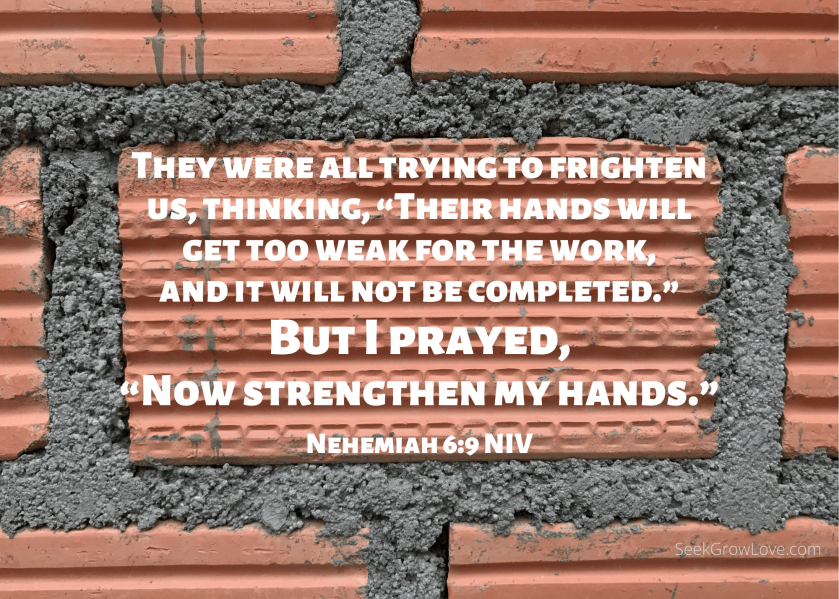
Sanballat and Tobiah, who had been conspiring to sabotage the wall-erecting project all along, attempted a new approach – requesting a “friendly” meeting in another town. Four times they invited Nehemiah to join them, and four times, suspecting a sinister scheme, Nehemiah replied, “I am doing a good work and I cannot come down!” (6:3) When that attempt failed, they made false accusations against him, threatening his reputation and leadership. Nehemiah prayed that God would strengthen his hands (verse 9). Then the antagonists hired a prophet – a spiritual leader – to give contrary advice to Nehemiah, but guess what? Nehemiah was so in tune with the One True God that he didn’t even need to pray about it or stew in confusion about this prophet’s words; he was so confident in God’s laws and the work God had called him to do that he already knew what God’s response would be. This potentially confusing situation did not derail him; he saw right through the deception and kept focused on God’s instruction. 

I want to be so in tune with God on a regular basis that I can confidently make the right choice when trials and confusion come my way! 

Here are correlations between our other passages and Nehemiah: 

Psalm 147:2  “The Lord loves the righteous, and sustains the fatherless and the widow, but he frustrates the ways of the wicked.” The plans of the wicked were definitely frustrated in today’s Nehemiah story! 

In the John reading today, Jesus died and was buried – a very sad day for his followers. But we now know that was the beginning of something much more wonderful: the fulfilling of a promise, the forgiving of sins, the saving of humanity! Likewise, the residents of Jerusalem who have experienced the death of their faith, dreams, and security, will be experiencing renewed joy, faith, and wonder with the rebuilding of their city.

-Rachel Cain

Reflection: 

  • How well do you know God? Do you know HIM, or know ABOUT Him? What steps can you take to know him better today? 

Fight Song

OLD TESTAMENT: Nehemiah 4 & 5

POETRY: Psalm 147

NEW TESTAMENT: John 19:17-27

I never grow tired of hearing my children belt out uplifting lyrics from the back of our van! I especially appreciate the passion in their voices reverberating throughout the vehicle every time we play Rachel Platten’s “Fight Song” :

This is my fight song

Take back my life song

Prove I’m alright song

My power’s turned on

Starting right now I’ll be strong

I’ll play my fight song

And I don’t really care if nobody else believes

‘Cause I’ve still got a lot of fight left in me

While I’m encouraged by the song’s positivity, I can’t help but think of how little fight I feel I have left in me some days. I doubt I’m the only one who is burdened under anxiety, societal pressures, responsibilities at work and home, fear of the future, difficult decisions, sickness and death of loved ones, mysterious health issues, spiritual warfare, and a plethora of other emotional and physical plagues. I often feel like I just. can’t. do. it. The fight requires too much of me sometimes, and there is little motivation or strength left with which to fight. Can you relate? 

Nehemiah’s construction team could relate! Sanballat and Tobiah were relentlessly hurling insults, threats, and discouragement at the builders. Not only was there oppression from outside their walls, but there was turmoil with them as well. The motley crew was trying to fix the wall – a monumental aspiration! – while also dealing with the other negative issues of daily life, which seemed to be compounding. And it was wearing on them. They already felt defeated, but the work was not yet complete. They were nearing the ends of their metaphorical ropes, anticipating the last symbolic straw that would break the camel’s back.

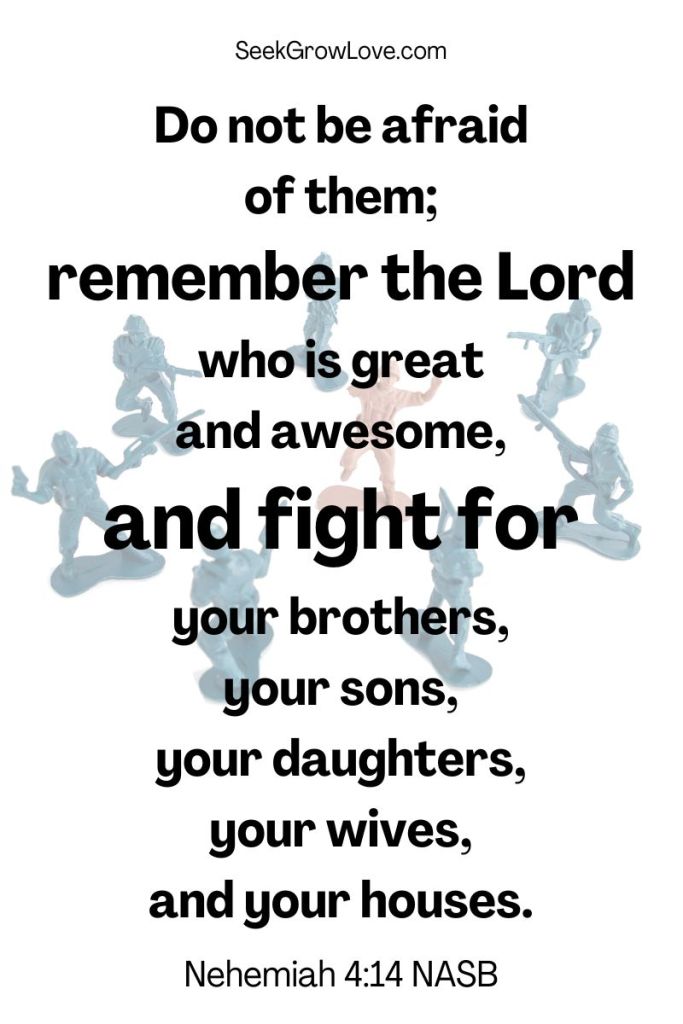
Nehemiah took action to provide defense for the workers, but most of all, he encouraged them to keep going! “… I stood up and said to the nobles, the officials and the rest of the people, “Don’t be afraid of them. Remember the Lord, who is great and awesome, and fight for your families, your sons and your daughters, your wives and your homes… Wherever you hear the sound of the trumpet, join us there. Our God will fight for us!” (4:14, 20)

Not only did Nehemiah help resolve some of the immediate burdens of the people and foil the plans of their enemies, he also helped them remember the reason for their work so they could be filled with the mettle needed to recommence this noble work . 

Not long after I prayed for God to revive the fighter’s soul within me, a new-to-me song by Rend Collective called “Shackles” rang through my speaker on autoplay. I paused in awe when I heard the chorus: 

You’re my deliverer

My anthem through it all 

When my strength and my fight is gone

I know You will come through 

As I soaked in the life-giving lyrics, I was humbled by God’s gentle reminders of His provision. When my strength and my fight are gone, God will be my strength. He will fight for me (see Exodus 14:14). He will give us the strength and courage to do what he has called us to do. Remember your God; He will fight for you. 

These verses from our poetry reading apply to the Nehemiah story:

Psalm 147:2-3, 10-11: 

The Lord builds up Jerusalem;

    He gathers the exiles of Israel.

He heals the brokenhearted

    and binds up their wounds…

His pleasure is not in the strength of the horse,

    nor his delight in the legs of the warrior;

the Lord delights in those who fear him,

    who put their hope in his unfailing love.

-Rachel Cain

Reflections:

  • Think back on some of the dark times in your life. How was God faithful to encourage you and bring you through it? 
  • Keep a journal of ways God has answered prayers and provided in big and small ways so you can look back on it during times of doubt.
  • Watch this powerful music video and remember that God is carrying you through your darkest times. 

Walls

OLD TESTAMENT: Nehemiah 1-3

POETRY: Psalm 147

NEW TESTAMENT: John 19:1-16

The Berlin Wall. 

The Wailing Wall. 

The Troy Wall (famous for the Trojan horse fiasco in Homer’s mythological “The Odyssey”)

The Wall of Jericho. 

The Great Wall of China. 

Seattle’s Gum Wall. 

These famous walls from history were built primarily to keep enemies out of the territory and protect the residents – with the exception of the touristy Gum Wall, of course. If you live in the USA or are in tune with any of our news, you have probably heard about our Wall, too. The Wall in recent American history refers to a literal wall that was planned to line the entirety of the USA’s southern border with Mexico, and it has been the topic of many a political rant from both political parties. 

Those of us who are far removed from the concept of once-prevalent city walls and who are not residing near country borders probably don’t comprehend the significance of a wall. Historically, though, city walls were gravely important to the safety of the residents, as they provided a barrier for defense against enemies. The state of the wall often reflected the state of the people who lived within it. In Nehemiah, we read about The Wall of Jerusalem being in shambles, and God’s people were quite broken as well. 

Nehemiah was the cupbearer to the King of Persia, a very important position; the king quite literally trusted Nehemiah with his life! After Nehemiah received word that the walls of Jerusalem were in major disrepair, he committed himself to prayer; still, the sadness was evident on his face as he went to work. Though Nehemiah was fearful that being sad in the presence of the king could cost his head, King Artaxerxes took pity on Nehemiah and allowed him to return to Jerusalem to rebuild the wall. Not only did the king send Nehemiah with his blessing, but he provided Nehemiah with many provisions for the journey.

(Interestingly, the text mentions the queen being with the king when he noticed Nehemiah’s unusually melancholy demeanor. Many scholars believe that this queen is none other than Queen Esther! The book of Esther occurred before the book of Nehemiah; the stories are not in chronological order in our Bible. While God definitely used Esther to save his people in the biblical book bearing her name, she was probably also instrumental in allowing Nehemiah to rebuild the wall.)

I can’t help but think of how comfortable Nehemiah likely had been in his position. He worked in the palace, which allowed for a lifestyle much more posh than the vast majority of the people in the territory of Persia and definitely more comfortable than his relatives in the rubble of Jerusalem. And yet, he was willing to give up everything in order to meet a deep need for God’s people. I just can’t help but wonder if I – if we – would be inclined to do the same? We have an abundance of possessions and time-saving resources: I’ll be the first to admit that I love how my house heats itself on chilly winter days, Walmart grocery pickup is my favorite modern convenience, and Amazon next-day delivery has saved the day on many occasions. Lights, indoor plumbing, DoorDash – we have so much more even than Nehemiah had. Would I be willing to forgo it for a long period of time so I could instead take on a very difficult and dangerous task? 

And yet Nehemiah ventured into the unknown to lead the charge to repair the wall, knowing that he was forgoing so much comfort, yet unable to settle his soul until he completed the assignment to which God had called him. Nehemiah chose to leave everything so he could rebuild the wall, embracing the burden that God had placed on his heart for his people. He accepted the sins of his people and asked God’s forgiveness on behalf of everyone. Nehemiah stayed focused and kept in touch with God despite adversaries trying to distract him and spoil his plans. 

Nehemiah focused on the bigger picture – helping his people for years to come. Similarly, we too must have an eternal perspective. One day, there will be a New Jerusalem which will have a wall with 12 gates that will never be shut. Praise God for the hope of the Kingdom! 

Interesting connections from Nehemiah to the other readings: 

Psalm 147:2, 13 – “The LORD builds up Jerusalem… He has strengthened the bars of your gates.” 

In the John passage, the leaders have turned Jesus over to be crucified, which would lead to the fulfillment of Jesus’ words from John 2:19 in which he called himself the temple. (The temple was in Jerusalem). 

-Rachel Cain

Reflections:

*What burdens has God placed on your heart that might require you to figuratively or literally leave your comfort zone? 

*Are there any “walls” (boundaries) you need to put into place to protect your family or yourself? 

*Pray this prayer (attributed to Sir Francis Drake) to ask God to help to venture out of your comfort zone and be ready to do the work he has called you to do. 

Your Longing

Old Testament: Malachi 4

Poetry: Psalm 84

New Testament: Luke 18:1-8

Close your eyes with me and replay in your mind the best day of your life so far. Try to recall all the vivid details – the sights, sounds, and smells, the intense feelings! (Then open your eyes so you can continue reading!)

Want to hear about one of the best days of my life? There are obvious ones not to be downplayed, such as my wedding day and holding each of my children outside the womb for the first time, but one of the most special days of my life was the day I swam with the manatees. 

Perhaps it sounds silly to you, but I adore manatees. I have spent copious amounts of time gazing at them through the massive glass aquariums at our two local zoos, both of which have manatee rehabilitation centers. So you can imagine my excitement a few years ago when my husband agreed that on our trip to Florida that year, we could splurge on an excursion to swim with the manatees in the Crystal River! I’ll never forget floating on the water while observing my beloved sea cows in a submerged, restful state ten feet away, surfacing every few minutes for air. It was an incredible experience to watch the momma manatee with her calf coasting through the shallow river beside us, the small herds interacting peacefully just under the surface, the chubby mermaids living their best (slow) life soaking in the warmth of the underwater spring. The tranquil experience was very healing for me, as one prone to anxiety who had to overcome many anxious thoughts to even pursue this swim-with-manatees dream. My mind still wanders in wishes… Why can’t life just be as peaceful for us as it is for our manatee friends? I’ve relived that day in my mind many times, and it always brings a smile to my face. 

“How lovely is your dwelling place, O LORD Almighty. I long, yes, I faint with longing, to enter the courts of the LORD. With my whole being, body and soul, I will shout joyfully to the living God… A single day in your courts is better than a thousand anywhere else! I would rather be a gatekeeper in the house of my God than live the good life in the homes of the wicked.” (Psalm 84:1-2,10, NLT). 

Psalm 84 is generally considered a song of pilgrimage, one that was recited or sung when God’s people would journey to the Temple to worship. The writer was longing to be in God’s presence again. Now that Jesus has made a way for us to connect to God again even without a temple, this song could apply to coming into His presence anytime, anywhere, describing our longing just to be near him. Though I am so grateful that we can come into His presence all the time now through prayer and worship, I have always thought of this Psalm as more of a hope of the coming Kingdom. Perhaps we take for granted that we can approach God at any time with our praise and concerns. (I know I do.) And perhaps we don’t really wholeheartedly perceive the amazing promise of the Kingdom. (I know I don’t.)  

This world claims to have it all: fame, fortune, fun. But it will never truly satisfy. C.S. Lewis once said, “It would seem that Our Lord finds our desires not too strong, but too weak. We are half-hearted creatures, fooling about with drink and sex and ambition when infinite joy is offered us, like an ignorant child who wants to go on making mud pies in a slum because he cannot imagine what is meant by the offer of a holiday at the sea. We are far too easily pleased.”

Sometimes I feel so overwhelmed with my never-ending to-do list and difficult, anxiety-provoking decisions that I lose focus of the eternal perspective. And other times, I think that everything is awesome and couldn’t possibly get better! For good or bad, it’s easy to get lost in the chaos of each day, isn’t it? It is important to focus on our purpose as followers of Christ and on the amazing hope of the Kingdom, which will be better than anything we can imagine. Even your best day in this life is nothing compared to the Kingdom experience, in which we will live with God and Jesus forever and where there will be no more sickness or crying or pain (see Revelation 21:4). 

Even just one day in God’s Kingdom will be better than a thousand of your best days in this lifetime. What a fantastic hope we have! 

-Rachel Cain

Reflections:

Close your eyes and imagine what the Kingdom will be like. Now, multiply that by a bazillion and you still won’t even be close to envisioning the peace and beauty of the Kingdom! 

Approach God in prayer and worship this week with a similar longing as expressed in this Psalm. Thank Him for the ability to enter His presence. Pray for a deepening desire to experience His presence during this life, as we await the coming Kingdom.

Astronomical Measures

Old Testament: Joshua 9-10

Poetry: Psalm 49

New Testament: 1 Corinthians 4

My inner science nerd was more excited than a kid in a free candy store last week as I donned my (un)fashionable cardboard glasses in preparation for a once-in-a-lifetime event: for the first time in over 200 years, my Midwest residence would be within the path of totality for a total solar eclipse – an alignment promised to not reoccur in this area for three quarters of a century. Seven years ago, we watched a partial eclipse (around 90% totality) from our home, which was very… underwhelming. However, after learning that there is a vast difference between even 99 and 100% totality, I bought into the hype and prepared for amazement. We hosted a watch party on our church property and our friends even flew in from Alaska to experience it with us! The weather was abnormally lovely for April. As the coverage increased, we detected a cool wind breaking through the warm air, and then street lights began to light up. Then, the millisecond that it reached total coverage, a wave of deep twilight blanketed the field and an evening chill washed over us; I could instantly sense the distinct change in my peripheral vision from behind the safety of my glasses. For about 3 minutes, we eschewed our disposable spectacles as we stared into the void of the sun, soaking in the uniqueness of a mid-afternoon that felt like a near-midnight. We were awed by the surreal experience and applauded the workmanship of our Creator! And then, as suddenly as it had been hidden, the sun again commenced its glorious shine, changing the temporary night back into day. 

Our reading in Joshua today tells of another rare astronomical event – “the sun stopped in the middle of the sky and delayed going down about a full day” while Joshua fought the Amorites. There are many theories about what actually went down on the day the sun didn’t, from an annular eclipse (which even secular scientists agree did occur in Canaan around that time) to a variation in rotation speed and everything in between (you can start your rabbit hole dive here), but what is most important is that God did something very miraculous to help Joshua win the battle. God was on Joshua’s side, and he took “astronomical” measures to help Joshua do what God had called him to do. Joshua and his men put forth the effort as wise and persistent soldiers, but they called on God for a miracle to help them win the battle – and He did, in an awesome display of His power. “There has never been a day like it before or since, a day when the LORD listened to a man. Surely the LORD was fighting for Israel!” (Joshua 10:14, NIV)

God fought for His people, and God fights for us. God is on our side, and He loves to show up in mighty ways. BUT… God usually expects us to be actively involved as well. Joshua had to go out and fight the battle – many of them, actually – and God showed up, often miraculously. This is a good reminder for our own lives. God has given us gifts and abilities, and He wants us to be engaged and active in this life. (For example, we don’t really have a legitimate reason to complain about not having a job if we’ve never submitted any applications, right?) Sometimes the best and only thing we can do is pray and let God work, but often, we will pray while we fight right there on the battlefield, trusting in God’s supernatural provision. He still performs miracles! 

In whatever battles you will face, remember that God is with you and still works in miraculous ways. Keep your eyes open to see His handwork in your life! 

-Rachel Cain

Reflection: 

– Watch for God moments in your day and thank him for them. It might be something as small as a daffodil field to bring a smile to your face as you drive to work, or as large as seeing God’s might during a solar eclipse. Either way, praise Him in all those moments! 

– How can you depend on God more to fight your battles? How might God be calling you to be more engaged in the battles yourself?

Underdogs Unite!

Old Testament: Joshua 7-8

Poetry: Psalm 48

New Testament: 1 Corinthians 3 

Kung Fu Panda 

Peter Parker (Spiderman)

Cinderella

Frodo Baggins

Luke Skywalker

King David

Jesus’ disciples

What an eclectic list of characters! Any guess on what they have in common? 

They were all underdogs, devalued by society, and yet through some combination of luck, magic, leadership, divine appointment, and/or wise counsel, they went on to do mighty things. Though some characters in that list are fictional, there are plenty more true accounts in the pages of your Bible and in ancient and recent history of people overcoming opposition and obstacles to become the Greats we know today.  

In I Corinthians 1, we read about how we were nothing special before we were saved by God’s grace and grafted into his family, that He often chooses the “underdogs” to do His work. In chapter 2, Paul reiterates that we need the wisdom and power of the Spirit in order to understand and speak the things of God; Paul clarifies that even he, who we now know as one of the greatest missionaries of all time, “did not come with eloquence or human wisdom as I proclaimed to you the testimony about God… My message and my preaching were not with wise and persuasive words, but with a demonstration of the Spirit’s power, so that your faith might not rest on human wisdom, but on God’s power” (verses 1, 4-5). Now, in the third chapter, while recapitulating to the Corinthians how we are all foolish without God, Paul is addressing quarrels and jealousy among the believers, reminding the Church how important it is to be united. 

I bet that a lot of the same words he wrote to the people back then would also be penned to us today; we humans can still tend to think we’re all that and a bag of potato chips with no need for God, and division still dominates our fleshly nature. As a mom, I’ve broken up more quarrels than I can count; it seems that my kids will find a reason to argue with each other about anything and everything! And as the wife of a pastor, I’ve seen division rear its ugly head in the church too many times. Churches have even split over petty things such as decor. It seems silly that we find trivial things to bicker about when there are bigger issues plaguing the world today such as war, poverty, and human trafficking. 

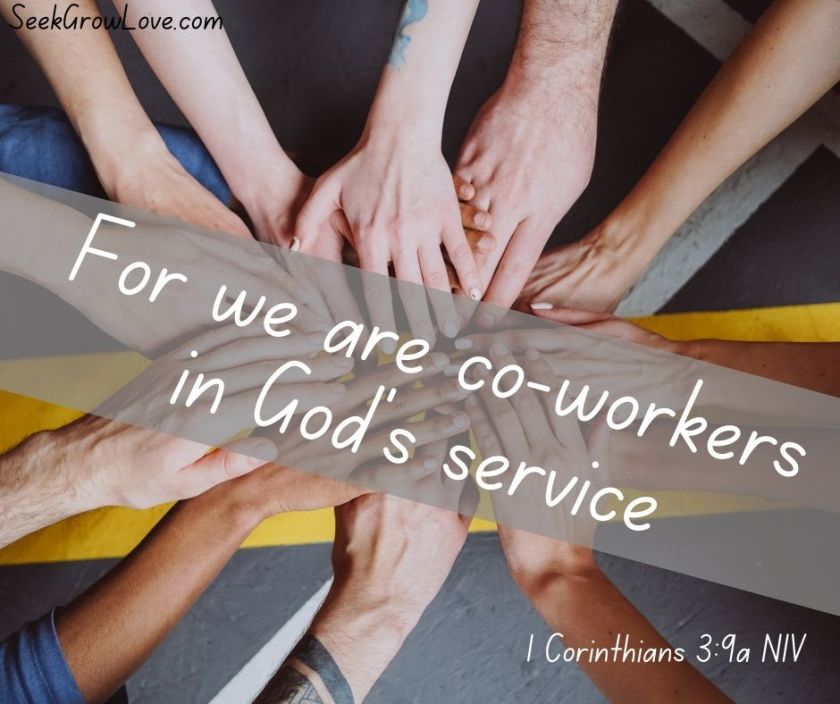
In this chapter, Paul emphasizes that we are all working together for God, but God is the real Force that makes anything happen. Paul reminds us that we are all on the same team, building on the foundation laid by Jesus Christ. In typical Paul fashion, he keeps us humble by reminding us of our foolishness; in modern-day terms, though we might have thick wallets or a string of letters behind our names indicating our importance in this world, we are all nothing without God. 

I’m always encouraged when I see Christians set aside their differences to work as one unit for a good cause, or when churches with very different doctrines join hands to reach their communities for Christ. We are meant to be one body: the body of Christ. It is crucial that we as believers unite hands and hearts for God’s eternal mission. 

-Rachel Cain

Reflection:

– Consider ways that you can help create unity and decrease division within your own church family. (A good place to start is to not participate in gossip). 

– Are there any local organizations with which your church or your own family could join to show the love of Jesus to your local community? State? The world? 

Keep Walking

OT – Joshua 5-6

Poetry – Psalm 47

NT – 1 Corinthians 2

Keep walking, but you won’t knock down our wall. 

Keep walking, but she isn’t gonna fall! 

It’s plain to see your brains are very small 

to think walking will be knocking down our wall.

– the Pea soldiers, from Veggie Tales “Josh and the Big Wall”

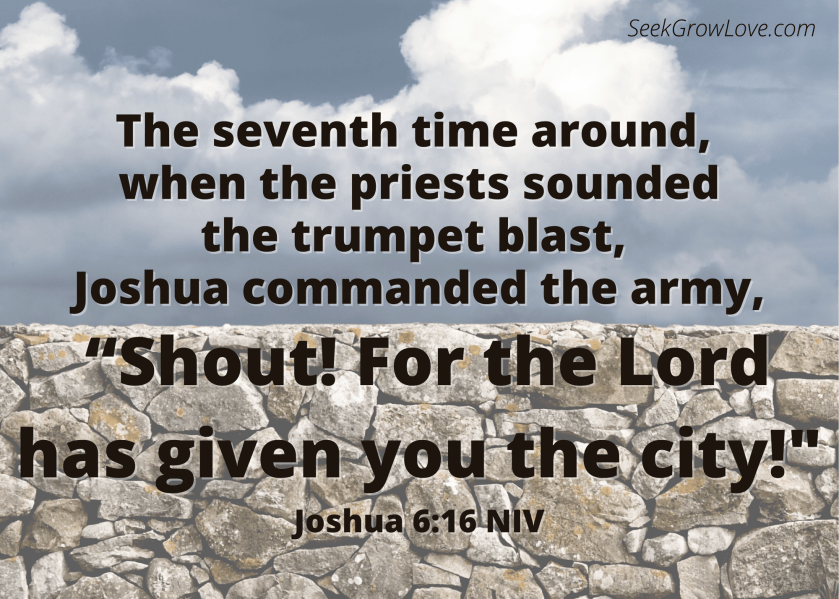
I’ve never been in the military (even preschool gymnastics was beyond my capabilities, and let’s just say I was usually a last pick in gym class), but even I can imagine that the mighty Israelite soldiers felt mighty silly walking around the city once a day for six days. Just walking behind the ark. And blowing some trumpets. Wow, fierce. I wonder if they wondered what God was thinking? Had they accidentally signed up for the (mostly-silent) marching band instead of the military? But on the seventh day – seven is the biblical number of completion – they marched around the city seven times, and then, a different kind of trumpet blast sounded, and Joshua ordered everyone to shout. And then, the wall collapsed. The mighty, impenetrable wall of the great city of Jericho, along with everything inside (save Rahab and her family), became a pile of rubble. Yet again, the people obeyed what seemed like ridiculous commands for an impossible task, and God worked through it all. I don’t know why God chose to take over Jericho in such a strange way, but I bet part of the reason was to display His awesome power and make sure everyone knew that He was the One True God. 

Psalm 47 even sounds like a song of praise that might have been shared after conquering Jericho: “He subdued the nations under us… He chose our inheritance for us… God has ascended amid shouts of joy, the LORD amid the sounding of trumpets…”

All of our lives should reflect back to the power of God. In our New Testament reading today, Paul also says, “My message and my preaching were not with wise and persuasive words, but with a demonstration of the Spirit’s power, so that your faith might rest not on men’s wisdom, but on God’s power” (I Cor 2:4-5) Just like when God made it clear that it was only by His power – not the marches and shouts – that the walls fell down, God likes to use ordinary, untrained people to do His biggest work, so His might is evident through their humility. 


God displays His power by working in big ways through us. He doesn’t NEED us; after all, God created the whole world without any input from mankind! But He wants to use us as part of HisStory, to help tell the world the greater message of His saving power. Will you join in the Greatest Mission of all time? 

-Rachel Cain

Reflection Questions

  1. How will you join in the Greatest Mission of all time?
  2. How/when have you seen God at work doing what seemed impossible in a way that you wouldn’t have expected? Who did He use in the mission?

Creating Memory-Sparkers

OT: Joshua 4

Poetry: Psalm 46

NT: I Corinthians 1

As a history buff, I love touring historical monuments. Even pre-digital-selfie days, I would try to capture a film-based image of myself at national memorials and important sites to remember the adventure. When we’ve studied certain landmarks and events in our homeschool, I’ve proudly shared my visual memories with my (thoroughly unimpressed) children. I’m hoping they will be more impressed when we take them on a historical tour of the East Coast next month, but I’m already preparing myself to accept their inevitable apathy (while I have enough fun for the whole lot of us!). 

In Joshua chapter 4, we find the throng of Israelites having just completed the journey across the Jordan River (no simple task, especially at flood stage). What do you think was of first priority? Moving on to their destination? Getting a snack? Setting up camp for the night?

No, God had bigger plans – plans that might seem trivial to us, but that were much more important in the eternal perspective. He told Joshua to select twelve men (one from each tribe) to select a large stone from the river and bring it to their campsite for the night. They would then stack the stones near the river to build a monument representing the twelve tribes of Israel. “In the future, your children will ask, ‘What do these stones mean?’ Then you can tell them, ‘This is where the Israelites crossed the Jordan on dry ground. For the Lord your God dried up the river right before your eyes, and he kept it dry until you were all across, just as he did at the Red Sea… so that all the nations of the earth might know the power of the LORD and that you might fear the LORD your God forever.’” (Joshua 4:21-24, NLT)

God knew that the Israelites had a tendency to worship other gods and forget His faithfulness. With more challenging battles ahead, God wanted them to have a visual reminder of how He had provided for them in miraculous ways. Not only that, but He wanted the other nations to know the power of God! This monument served as a memory-sparker to help the Israelites pass down the legacy of their God to their children. 

As a parent, I know firsthand how easy it is to get caught up in the day and forget to share about God’s faithfulness. But God, who created children, surely knows that two of the favorite activities of children are 1) playing with rocks and 2) asking a bazillion questions, so a large and unavoidable monument made of rocks was the perfect reminder for parents to share with their children about God’s provision! But God didn’t want them to remember him only when they passed the monument; he wanted his people to remember him all of the time! 

Deuteronomy 6:4-9:  Hear, O Israel: The Lord our God, the Lord is one. Love the Lord your God with all your heart and with all your soul and with all your strength. These commandments that I give you today are to be on your hearts. Impress them on your children. Talk about them when you sit at home and when you walk along the road, when you lie down and when you get up. Tie them as symbols on your hands and bind them on your foreheads. Write them on the doorframes of your houses and on your gates.

That section of scripture contains the Great Shema, a major tenet of our faith. Don’t overlook the part about remembering God’s faithfulness! We are called to talk about God constantly throughout our day, remembering Him together from the time we get up until we go to bed and all the time in between. This can even be as simple as praying when we hear an ambulance or thanking God for lovely nature. 

We might feel inadequate for such an important task as helping those around us to remember God throughout the day, but remember the words of Paul from our reading in I Corinthians 1:27-29: “God chose the foolish things of the world to shame the strong. He chose the lowly things of this world and the despised things and the things that are not – to nullify the things that are, so that no one may boast before him.” Even Moses, the man chosen to lead God’s people out of slavery, insisted that he could not do it because of a stutter, among other excuses. (We all like to give excuses, don’t we?) But God used Moses in mighty ways, and He has plans for us too – if we will choose to remember his ways and live for him. 

-Rachel Cain

Reflection:
-What are your excuses for not doing some of the things God has asked you to do? Debunk those excuses and pray to God to soften your heart. 

-How can you help pass along the message of God’s faithfulness? What memory-sparkers would God like to see you create? How can you remember and speak of God and His faithfulness more throughout the day?

Thankful for Their Legacy

OT: Joshua 3

Poetry: Psalm 45

NT: Romans 16

Last Friday marked one year since my father lost his battle with a terrible neurodegenerative illness. My sisters and I had helplessly watched him decline for over a decade, advocating intensely during that time to help him get the complex care he desperately needed while grieving the slow waning of our once-healthy father. Then, three days after Easter, our dad succumbed to his illness and was finally able to rest from this broken world. 

We sisters all shared a lot of our fond memories of our dad at his memorial service: his love for the color yellow, his affinity for hiking in nature, his proclivity to play practical jokes on unsuspecting coworkers and family members, his devotion to his daughters. As I remembered his life, I also considered what I would want written in my epitaph. What do I want people to say about me at my memorial service? What kind of legacy do I hope to leave? While considering my own funeral might sound a bit morbid, it is important to remember that we are mortal, our actions in this lifetime can have consequences (for the good or the bad), and we need to be focused on our mission for Christ. 

Perhaps, like me, you tend to skip over chapters like Romans 16, in which Paul is just thanking and saying hello to some random people with difficult-to-pronounce names, much like we might skip over the Acknowledgements section of a book. However, I encourage you to read it again, focusing on how all of these people were important to Paul and his work in some way. They all left a legacy, built a foundation for the early church. Paul didn’t complete his great missionary journeys alone; there were countless people supporting him in various ways the whole time. Some of the people were mentioned elsewhere in scripture; some of the others we have never heard of before, but they were all instrumental in the ministry work that Paul was doing, so he wanted to thank them publicly. (This is a good reminder to me that we need each other for help and encouragement, and we should offer gratitude to those people who have made a difference in our lives, especially those who encourage us in the ministry.) This chapter is a testament to the devotion of the early believers who helped spread the message of Jesus so we can all be believers today! And even though these are just names to us now, they were real people doing real work for the Kingdom, and their names are still being read thousands of years later. What a great legacy!

As followers of Jesus, we also have a hope beyond the grave. This life is not all that there is! We have a hope for resurrection and eternal life in the Kingdom with God and Jesus, and we are called to share that hope with others during our lives. Take another peek at the poetry reading for today. The explanation under the heading of Psalm 45 states that it was a wedding song, but many scholars also believe that it actually has some parallels to our Messiah and the hope of the coming Kingdom, the wedding feast of the Lamb (Jesus) with his Bride (the Church). What comparisons do you notice between the poem and the coming Kingdom? 

So, let’s keep living with an eternal perspective, focusing on the work God has called us to do, leaving a legacy for Him by contributing to the work of His Church. 

-Rachel Cain

Reflection questions:

-Who has been an encouragement and support to you as you seek out and pursue the work God has for you? How can you thank them?

-What do you hope is written in your epitaph? (What kind of legacy do you want to leave?)  What can you do this week to further develop or strengthen your legacy?