Be Careful that You Don’t Fall

2 Samuel 11

March 11

The story of David and Bathsheba is probably familiar to most of us.  King David, described elsewhere as a “man after God’s own heart”, had a little too much time on his hands while his army was away fighting.  One evening, he got up from his bed and walked around on the roof of his palace; and from his roof, he saw a beautiful woman taking a bath.  I’m reminded of 1 Corinthians 10:12, “So, if you think you are standing firm, be careful that you don’t fall!”

You might be tempted to stop right there and ask what this beautiful woman was doing taking a bath in public. Wasn’t she inviting unwanted attention? Presumably, she was in her own fenced backyard, and nobody could see her unless someone was on the roof of the palace next door – and who would be walking around on a roof?  Regardless, she isn’t the real topic of the story, David is.

The fact remains that David took a long look at her.  David lusted after her.  David violated one of the 10 commandments: “Don’t covet your neighbor’s wife…”.   Lust is a trap, especially for men – even for a “man after God’s own heart”.  David should have stopped right there, confessed, and asked God for forgiveness.  Instead, he asked one of his servants who she was.  He was definitely showing too much interest.

Once he found out that she was the wife of Uriah, one of his bodyguards, and the granddaughter of Ahithophel, his chief advisor, he certainly should have walked away.  But she was gorgeous, so instead, he invited her over and slept with her.  David violated another of the 10 commandments: “Don’t commit adultery” – and the punishment for this one was supposed to be death.

When David found out that Bathsheba was pregnant, he recalled her husband from the battle so he could go home – to try to hide the fact that David was the father.  But Uriah didn’t cooperate; he didn’t go home.  Ultimately, David then schemed to have Uriah put on the front line of the battle, and have everyone else withdraw, so Uriah was killed.  And so he violated another of the 10 commandments: “Don’t kill”.

David seemed to successfully hide all of this until after the son was born.  But God sent Nathan, the prophet, to confront David.  Nathan told David that God was going to discipline David, according to his sins.  

David wrote Psalm 51 after Nathan confronted him about his adultery with Bathsheba.  In this psalm, we find in verse 1, “Have mercy on me, O God, according to your unfailing love; according to your great compassion, blot out my transgressions.”  In verses 11-12, “Do not cast me from your presence or take your Holy Spirit from me.  Restore to me the joy of your Salvation…”  David’s heart was broken, he confessed, and was reconciled to God.

The discipline came a little later.  During Absalom’s rebellion, Absalom slept with 10 of David’s concubines in public;  David’s daughter Tamar was raped by her half brother Amnon; four of David’s sons died: this baby, Amnon, Absolam, and Adonijah; and David had problems for the rest of his life.  God forgave David’s sins, but David still had to live with the consequences of his sins.

God’s discipline isn’t punishment handed out by an angry God bent on vengeance, it’s difficulty allowed by a loving Father who wants to see his children develop godly character.  Otherwise, it would be too easy to just accept and live with sin, and God loves us too much to let that happen without a fight.

This brings us to our application for us today.

Do you consider yourself to be Godly?  If so, “If you think you are standing firm, be careful that you don’t fall!”  If you don’t consider yourself to be Godly, what do you think your long-term future (eternity) looks like?  Isn’t today the best time to solve that problem?

Look at the progression in David’s life.  A glance, lust, adultery, then murder.  Are there places in your own life where you are at that “glance” stage?  The “lust” stage?  Further down the path (to destruction)?  Wherever you find yourself, don’t continue down the path of sin.  Turn around.

Was David’s wild fling worth it?  Absolutely not!  Is the pleasure of your sins worth it?  It never is!  I’m reminded of Hebrews 11:25-26, where we’re told that Moses “chose to be mistreated along with the people of God rather than to enjoy the pleasures of sin for a short time… because he was looking ahead to his reward.”  Are you strong enough to forgo “the pleasures of sin for a short time” and instead look ahead to your reward?  If not, ask God to help you.

And when you do sin, don’t just try to hide it.  Remember 1 John 1:9, where God promises, “If we confess our sins, he [God] is faithful and just and will forgive us our sins and purify us from all unrighteousness.”  It was only after David’s confession that he was reconciled with God.  The same is true for us.

You may be tempted in similar ways as David, or you may be tempted in other ways, but you will be tempted.  1 Corinthians 10:13 reminds us, “No temptation has seized you except what is common to man.  And God is faithful; He will not let you be tempted beyond what you can bear.  But when you are tempted, He will also provide a way out so that you can stand up under it.”

-Steve Mattison

Questions for Reflection and Discussion

  1. In your own experience, have you ever observed (or are currently in) the downward spiral of sin where one sin leads to another? Where would have been the best place to stop? How? How do you turn around now – look at David’s example (Psalm 51 is a beautiful place to start).
  2. To avoid the painful and long lasting consequences of sin in your own life how can you build your resolve to forego the “pleasures of sin” which last a short time? What can you do now to help yourself stand strong when you are tempted? What can you do when you are right in the the middle of a strong temptation? How can you help others stand firm against their temptations?
  3. Like David, sometimes we need our sin pointed out to us before we reach a point of confession. Read 2 Samuel 12. Have you ever needed a Nathan to help you see your own sin? Pray to see your own sin clearly. Then confess it. Have you thanked those who have helped you see your sin. Then, as David said in Psalm 51 – with a pure heart he could, “Then…teach transgressors your ways, so that sinners will turn back to you.”

The Problem with Pride

2 Chronicles 32-33

2 Chronicles 32 25 NIV sgl

There are many lessons that we can learn from reading these chapters in the Bible. One of these lessons is that a proud heart can cause much trouble. For both Hezekiah and Manasseh this was an issue. Hezekiah did not want to credit the LORD, while Manasseh disregarded the LORD.

It is easy for us too to fall into this. There are times where we pray for guidance. However, once we receive the guidance we asked for, we neglect to go back to God and we just continue with our lives. We do not take the time to acknowledge the LORD’s hand in what was done and we do not do so until we feel we are again in need of him. It is easy for us to forget what he has done. The reality too, is that sometimes we like to think that we found the answers on our own. However, we would not have been capable of finding such answers without God. This situation is similar to Hezekiah when he allowed his heart to be proud and did not credit God with the successes of Jerusalem. He wanted to receive the glory that was owed to the LORD.

Other times, though, we may be able to better relate to Manasseh. During these times, we may be in outright rebellion toward God as Manasseh was. We want to do what we want. We may feel as though we do not need to listen to God because we are proud and think that we know best. We may say, “I know what I am doing.” That is until we receive a wake-up call and realize that we were not so wise in our thoughts and actions. We come to understand that we didn’t have a clue as to what we were doing. What a humbling experience this can be for our proud hearts!

This actually reminds me of a time when I was packing for a several month stent of studying abroad in Ireland. I had limited space, so I was trying to pack as lightly as possible. Because of this, I disregarded my mother’s advice to pack a small towel. I thought I was being smart. I will just get a towel when I get over there. “I know what I am doing”, I thought. This disregard for guidance offered to me by someone older and wiser than me resulted in me having to use a t-shirt as a towel for several days. Turns out that securing a towel in an unfamiliar country is not always so easy.

While this example is small in comparison, I think it shows how easily we can turn to ourselves rather than to others, and more specifically God. Even though the downfall of both Hezekiah and Manasseh were great, God forgave them when they repented. Because of the love our God has for us and the sacrifice of his son on the cross, we have the ability to be reconciled to him. That truly is something to be thankful for.

Hannah Deane


Today’s Bible reading can be read or listened to at https://www.biblegateway.com/passage/?search=2+Chronicles+32-33&version=NIV

Tomorrow’s reading will be Nahum 1-3 as we continue on the 2020 Chronological Bible Reading Plan

A Job to Do

2 Corinthians 5

2 Corinthians 5 19


I recently watched Finding Hope Now (also more recently titled Streets of Hope) based on the true story of the ministry of Roger Minassian and his book Gangs to Jobs: Faith-Based Gang Intervention for Your City.  At 53 Roger left his comfortable pastorate to create a ministry to gang members (something he knew nothing about at the time – except that they needed help – even though they often didn’t want it).  I won’t share too much about the movie because I hope you see it for yourself.  But at one point a gang member is before a judge who has the power to convict the young man for crimes he did commit and deliver him to a punishment he did deserve.  But, Roger was there at the teen’s side – even though this kid had personally caused Roger much personal pain, heartache and property damage.  Roger was speaking for the troubled teen.  Telling the judge of the change he saw – the old was gone, the new had come.  Roger was deep in the ministry of reconciliation – both to reconcile this young man with the court system and his community – as well as to reconcile him to God.  Now, you have to watch the movie to see what happened next.


Reconciliation is “the restoration of friendly relations”.  And, the world is much in need of it – particularly as it pertains to restoring a relationship with God.  Paul says it best here:


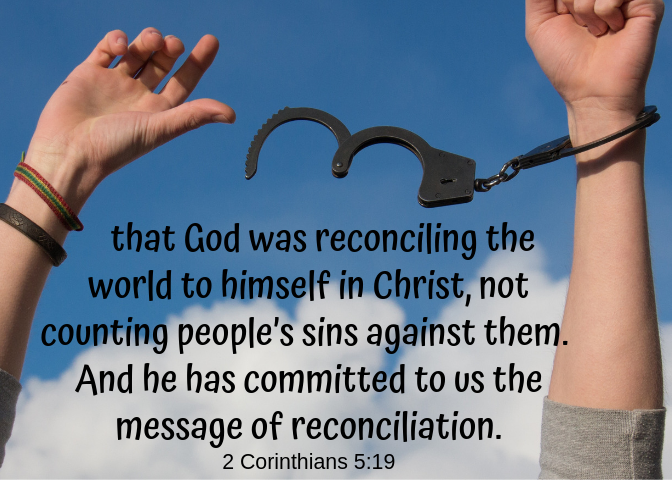
Therefore, if anyone is in Christ, the new creation has come: The old has gone, the new is here! 18 All this is from God, who reconciled us to himself through Christ and gave us the ministry of reconciliation: 19 that God was reconciling the world to himself in Christ, not counting people’s sins against them. And he has committed to us the message of reconciliation. 20 We are therefore Christ’s ambassadors, as though God were making his appeal through us. We implore you on Christ’s behalf: Be reconciled to God. 21 God made him who had no sin to be sin for us, so that in him we might become the righteousness of God.                   (2 Corinthians 5:17-21 . NIV)


God seeks restoration and “friendly relationships” with His creation.  So much so that He sent His sinless Son to carry our sins to the cross so we could become new, righteous creations who could draw near to God.  Previously our mountain of baggage and sins we were carrying was keeping us from embracing God.  But God made a way for us to set it all down – at the foot of the cross.  Because Jesus spoke for us God is not holding our sins against us – if we are in Christ – and have asked for forgiveness, accepted Jesus as Lord, been baptized to demonstrate the putting off of the old self, and are living a life of obedience.


If you aren’t there yet – in Christ – why not?  “We implore you on Christ’s behalf.  Be reconciled to God.” (vs. 20).  Please talk to your pastor or Sunday School teacher or youth group leader or Godly parents or me.  You don’t have to wait until you are perfect or you know the whole Bible – none of us Christians fall into either of those categories.  You just need to be ready to put the old behind.  Drop the junk you are holding onto, accept the sacrifice the Son made for you as he was speaking to his Dad for you and put on a new friendly relationship with God.  Be reconciled to God.


If you are there – in Christ – Congratulations!  Best choice ever!   Daily enjoy that friendly relationship with God that was opened for you by Christ.  And, get to work – you have a job to do!


“God has committed/given to us, the ministry/message of reconciliation.” (vs. 18 and 19).  Saying it once wasn’t enough for Paul.  So, I will repeat it, too.  “God has committed/given to us, the ministry/message of reconciliation. (vs. 18 and 19)”.  Do it!


If you’ve got the priceless gift of reconciliation with God through His Son – give it to others.  It won’t subtract what you have, but it will only multiply as you follow God’s command.   Maybe you will bring the message to gang members and in the process save a whole town!  Maybe you will boldly speak to a neighbor, family member, friend, co-worker, or church youth and be instrumental in that priceless person’s decision to be reconciled to God.  And all of heaven will rejoice with you.  Pray for God to show you where to start – and then start!


People are listening.  People are looking for hope in a hurting world.  Yesterday my heart hurt to hear of a girl in Malaysia who posted an Instagram poll – should she live or die?  Tears are falling as I type that she received a 69% response to die – and she took her own life.


The enemy is alive and well and we have a job to do!   Spread life and hope and reconciliation.  You won’t convince everyone.  Paul didn’t.  Roger didn’t.  But they did change lives because of their ministry of reconciliation.  And, we can, too.  People need reconciliation with God – even if they don’t know it yet.  How will you share it?


In Christ and Reconciled With a Job to Do,

Marcia Railton