
The One on the Throne

Isaiah 6-7

Psalm 109

Revelation 4

-Devotion by Daniel Smead (MN)

Revelation four shows John’s vision-state resuming. He sees an open door in the heavens, and hears the voice like a trumpet which marked the launch of his vision in chapter one. It says “Come up here,” which sounds like a summons. It doesn’t seem like this was meant to convince John to do anything, though, as he doesn’t get an opportunity to. Rather, John simply passes into the next scene, which he then describes. The impact of John seeing the open door, and hearing the words, is that he thinks of the new scene as positioned “above” where he had been, in heaven. Really John hasn’t moved, since all of this is in a vision. (Seeing something like that “open door” might be a somewhat normal part of visions about heavenly matters. They say things like “the heavens were opened,” I think we just don’t normally ask what that looked like; Ezekiel 1:1, Acts 10:11.)

The new scene John enters often is referred to as “God’s throne room,” but we aren’t even told if it has walls. We do know that it centers on a throne. We are sure it is God’s throne, but the vision refers to “the one on the throne.” Later the vision sometimes describes individuals and objects as “in front of God’s throne,” but it never says “God” is in “God’s throne.” (In 21:5-8, “the one on the throne” at last speaks and acknowledges being “God.”)

The scene introduced in chapter four is the dominant one for John’s vision. Much of the activity in Revelation takes place or begins near the throne, and many announcements also come from there. John doesn’t spend the whole vision in one spot, but when he does move it seems that often this central location remains in his view.

Everything else in the scene is positioned relative to the throne. Twenty-four elders and their thrones encircle it. Four creatures covered in eyes, with six wings each, are also around the throne (similar to ones described in Ezekiel 1 and 10, with faces like a man, an eagle, a lion, and a calf/cherub). Before the throne there is something like a sea of glass, clear as crystal (see 1 Kings 7:23ff, especially v. 38; the “sea” expanded on the bronze basin used when there were few priests, in the Tabernacle, Deuteronomy 30:17ff). Also before the throne are seven burning lamps which are “the seven spirits of God.” That is the only detail in the chapter John offers any explanation for, but it isn’t extensive (1:4; 3:1; 5:6).

I haven’t addressed the description for “the one on the throne,” but seeing that figure would certainly grab your attention (well, in a vision – in person that would kill you). God seems to be a glowing, jewel-toned figure, surrounded by a halo with rainbow qualities. Lightning, thunder, and rumbling roll out from the throne. And any question one might have about the significance of that figure is shoved aside by seeing the attention paid from all else present. Elements of the vision seem to mirror other scenes in the Bible, like Isaiah 6, Ezekiel 1 and 10 (including the crystal sea, 1:22ff), Daniel 7, and God’s manifestation at Sinai in Exodus 19:16-18. This scene intensely shows God’s majesty and power – John speaks of how everyone present repeatedly sings praise to God, most of them after falling on the ground. And we hear nothing about John’s response to the scene. Over the whole vision we learn that John fell to the ground three times (twice to angels, by mistake; 19:10, 22:8) and wept once. He was not a stoic; I think what he experienced in his vision brought many responses from John which he simply did not record for us.

Of great significance is something absent from this text. Jesus. Spoiler alert, if you have not yet read Revelation, Jesus will be on the scene soon, and his presence changes things. I’m not sure how long John watched before the events of chapter five began, perhaps it was only a few seconds. John wrote about the pattern of praise offered by the living creatures, but probably not based on watching them for days. It might be through the kind of dream-logic knowledge that lets people “just know” certain things. Chapter four does not portray a particular moment in history, it reflects the idea of God, enthroned in majesty, receiving praise. But my mind wants to balk at the idea of separating out the glory of God from God making plans to save the world through Christ.

The scene, cut off where it is, strikes me a bit like a practice problem in a physics text which, in order to simplify issues, tells you to ignore the effects of friction, and also place all the events at sea level, so that the calculations you work out can focus on just one rule. In this case – God is great. But trying to picture heavenly matters without Jesus’ involvement, in the Church age, feels like this scene wants to show God’s majesty unaffected by God’s merciful plans for humanity, not having them come into play until chapter five.

Well, in my personal physics God is the mass of the universe (God is even more than that, still, grant me my metaphor, please). And if God is the mass of my universe, Jesus is the gravity by which I relate to all that is around me. Pulling them apart simply will not do. (Although the further you go from a center of mass, the less you feel the influence of gravity.)

Prayer

Lord, please open my eyes to your glory. I say I respect and honor you, and sometimes my mind is set on you, but at times I veer off and take my own course. If I were to see you, once, how great a difference that might make (if I survived). Help me to commit myself more closely to you without that step. Open my eyes, and let me recognize more fully the true importance of things I have not seen, but someday will. Thank you for your son, who has been such a help to me, and allow me to be of better service to him, and to you. Amen

Reflection Questions

  1. The book of Revelation contains several passages of praise, from angels, creatures, saints – declaring how mighty and worthy they found God and Christ to be. Have you ever tried using these in your private worship?
  2. We should be careful about basing a deep discussion of the relationship of God and Christ on a metaphor (a fully accurate metaphor wouldn’t be a metaphor). But you might use the following texts to consider how close you think John viewed God’s relationship with Christ as being:

“Salvation belongs to our God who sits on the throne, and to the Lamb.” (Revelation 7:10b)

“The kingdom of the world has become the kingdom of our Lord and of His Christ; and He will reign forever and ever.” (Revelation 11:15)

“Then I looked, and behold, the Lamb was standing on Mount Zion, and with Him 144,000 who had His name and the name of His Father written on their foreheads. . . . These have been purchased from mankind as first fruits to God and to the Lamb.” (Revelation 14:1, 4b)

“I saw no temple in it, for the Lord God the Almighty and the Lamb are its temple. And the city has no need of the sun or of the moon to shine on it, for the glory of God has illuminated it, and its lamp is the Lamb.” (Revelation 21:22-23)

“And he showed me a river of the water of life, clear as crystal, coming from the throne of God and of the Lamb” (Revelation 22:1)

3. John was recording this vision while an exile, and relaying it to people in churches at risk of persecution – some at risk of death. Do you think they had a different view on the practice of offering worship to God than we normally do today?

A Glimpse of the Lord God’s Throne Room

Saturday, November 19th, 2022

Revelation 4

Revelation 4, although relatively short, is packed with symbological meaning and an introduction to new contexts in the Bible. Furthermore, this passage marks a transition from the opening in the first chapter of Revelation through the third chapter, where John was tasked with writing to the seven churches. Due to the shortness and density of this chapter, I think it is best to discuss on a verse-by-verse basis.

The first verse explains that John is no longer looking at things in an earthly perspective, rather, he is now in the spirit and is envisioning what is in heaven. This happens after a trumpet sounds, and John is told: “Come up here, and I will show you what must take place after these things.” The first thing that John is immediately fixated upon is what we can think of as the centerpiece of the vision: a throne, and what is on it. The throne itself is not described, but what is described is a brief description of the “One” who sits upon it. From this short detailing already, we can see the immense amount of humanism that is emanating from this image already, as there is a throne of supreme importance that is out of the reach of our realm of existence, and only “One” sits upon it. He who was sitting upon the throne was God, and His appearance could only be described with colors by John. His appearance was “like a jasper stone and a sardius in appearance…” Jasper is usually thought of to be an orange or green color, but this passage is usually interpreted with the emphasis on stone, which is more sensible when we know that to be a bright white color. This color signifies the purity that God embodies. Adding on sardius to the appearance also dictates that there is a red aura emanating from His presence, which is a sign of glory, and dominion over all things. The verse goes on to say: “… and there was a rainbow around the throne, like an emerald in appearance.” Before this portion, we have an image that shows that God is a pure and supreme being over all, which is true, but the context is especially enriched with the presence of the rainbow being around the throne. You see, a throne with One ruler may represent dominion, but the rainbow is a sign of covenants, promises, a connection with his creation, and most importantly for the purposes of the image so far: setting his own limitations for our sake. The rainbow being around the throne shows that God is dedicated to his creation, and is a kind and loving God who will make good on the promises that He makes. 

After the throne, John’s fixation shifts to what is around the throne: more thrones. Twenty-four of them to be exact. Seated on these twenty-four thrones were “elders” who were clothed in white garments and had gold crowns atop their heads. Now, the Bible does not make clear who these elders actually are, but we can use hints from before and after this chapter in Revelation to have a good guess. These twenty-four elders with white garments and gold crowns are a direct call-back to the two chapters beforehand, where we see that those who overcome and remain faithful will receive a gold crown and will be clothed in white garments. Automatically this makes me lean towards these elders on the thrones being human rather than any other sort of heavenly being. Furthermore, throughout the rest of the book they are seen worshiping and praising God, and even casting their crowns down. The motion of casting crowns signifies that these crowns were not from personal ownership, but rather they were inherited through God. These elders from my best guess then could represent the leaders of the Church. Other theories suggest that these twenty-four elders could represent a bridging between the twelve tribes of Israel and the twelve apostles. However, I believe that from the first verse emphasizing “what must take place after these things” that this is strictly a scene depicting the future, and at this point in history there are still apostles alive, and I also believe John would have in some sense recognized if he saw himself or eleven of his other friends upon the thrones. Furthermore, this theory would imply that Judas made it into the Kingdom, which is open for interpretation whether that could happen or not, and what the implications of that even are. Therefore, I believe a safe interpretation is that the elders represent leaders of the church. 

Now, there has been dense symbolization so far, but for what comes next I don’t believe I’m actually studied enough or if anyone in the world is studied enough for that matter to even fully explain this next scene. Out from the throne comes flashes of lightning and sounds of thunder, which is paralleled with the presence that God had on Mount Sinai in Exodus chapters 19-20. Revelation 4:5 continues to read: “And there were seven lamps of fire burning before the throne, which are the seven Spirits of God…” These lamps are not to be confused with the seven lampstands from the previous chapters which represented the churches. The lamps, on the other hand, could be representative of a physical presence of the Holy Spirit. Before then, in Acts we see that the Holy Spirit manifested as burning tongues on the Day of Pentecost. 

Below I will write the next few verses and briefly attempt to convey the value of it:

6 and before the throne there was something like a sea of glass, like crystal; and in the center and around the throne, four living creatures full of eyes in front and behind. 7 The first creature was like a lion, and the second creature like a calf, and the third creature had a face like that of a man, and the fourth creature was like a flying eagle. 8 And the four living creatures, each one of them having six wings, are full of eyes around and within; and day and night they do not cease to say, “Holy, holy, holy is the Lord God, the Almighty, who was and who is and who is to come.”

These four creatures are cherubim, which are angels which are, for our purposes in this short devotion, high on the hierarchy of angels. The eyes that cover them are representative of their deep insight and intelligence, which enforces the holy phrase they repeat over being that of given nature of gratitude rather than that of a mindless nature. The four creatures: the lion, the calf, a man, and the flying eagle can have a multitude of explanations, but for the purpose of this devotion I think it is important to detail what the importance of the characteristics of these creatures actually are. The lion is a creature that exudes might, and is also a wild beast on earth. Furthermore, the Lion is the symbol of Judah, and Jesus in the next chapter (Revelation 5:5) is called the “Lion of Judah.” The calf on the other hand is a strong but domesticated creature, which shows strength and prudence. The eagle is representative of the domains of the birds and the freedom that they have. Furthermore, eagles can be seen as a sort of “otherworldly” creature. No, it’s not because they are literally not from this world, but their domain and experience as a creature is extremely far from that which is human. Furthemore, Isaiah 40:31 relates the elevated heavenly connection that man will have as they will have “wings like eagles.” The last creature, man, represents intelligence and the highest order of creatures on the Earth. If you would like to dwell more on the importance of the appearance of these creatures, I would like to differ the readers to also look back over Genesis 1.

Here below is the last portion of the chapter:

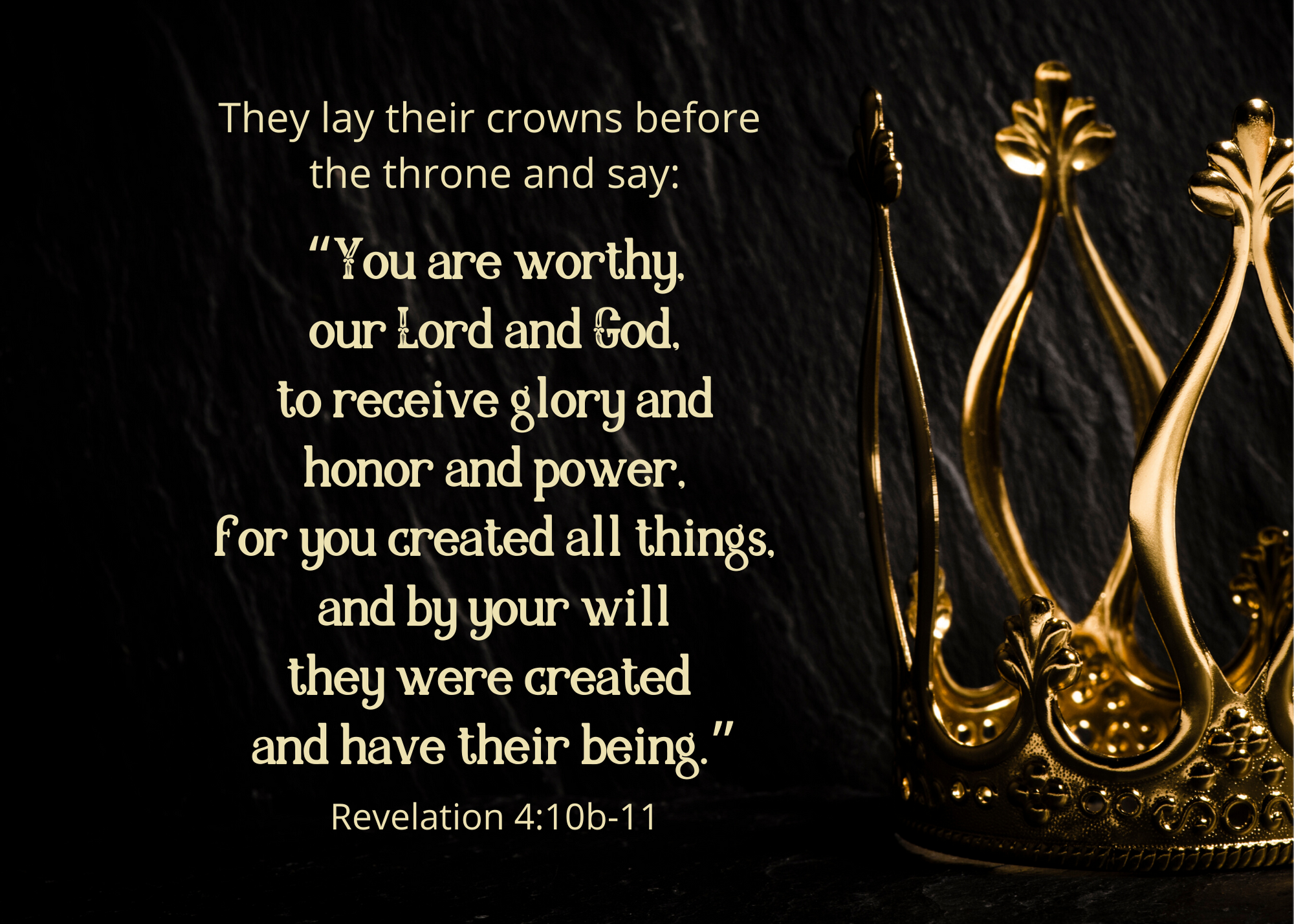
9 And when the living creatures give glory and honor and thanks to Him who sits on the throne, to Him who lives forever and ever, 10 the twenty-four elders will fall down before Him who sits on the throne, and will worship Him who lives forever and ever, and will cast their crowns before the throne, saying, 11 ‘Worthy are You, our Lord and our God, to receive glory and honor and power; for You created all things, and because of Your will they existed, and were created.’”

No matter the hierarchy or attached symbolism or inherited power, all things owe at least one thing: praise to the loving God who made them. This portion right here should be especially shocking for the time, as there are those in today’s world who will live their lives with knowledge of God, but will believe that their priorities and status in life put themselves above worship. The truth of the matter is that the entire Bible, and the undeniable creationist quality of the universe shows that we must always truly humble ourselves and worship God.

-Colby Leggitt

Reflection Questions:

  1. WOW that was a dense devotion for such a short chapter. What specific part was the most interesting to you?
  2. A lot of this can truly be left to interpretation and further studying. Do you have a different interpretation of the four cherubim or the twenty-four elders? What other parts of the scripture influence you?
  3. The rainbow around God’s throne shows a critical connection to mankind. If there was anything else at all to be had to the scene, what would you imagine would be important symbology?

Majestic

Revelation 4

Revelation 4 10b 11

Where are some places you have been that could be described with the word “majestic”? Maybe somewhere like Niagara Falls, the Grand Canyon, Appalachian Mountains, the beach, redwood forests, etc. There are many things about these areas and more that make them majestic; however, there is one thing that links them all together. That is, their creator. God is what makes these scenes and places majestic.

This is what comes to mind when I read the imagery in Revelation chapter 4. All of the thrones and elders with crowns and different animals and faces and a rainbow, four faces and eyes everywhere. Flashes of lightning and thunder going on in the background. It is all just majestic, and for what reason? On the surface of this chapter I would say it is safe to say it is to illustrate the importance and demonstration of worship. To worship our God in a holy way because He is holy. It says in verse 11 that, “He is to receive glory…. for You created all things”. So, we ought to worship God in a holy majestic way as all of creation does as well.

As far as the in-depth meaning of all the imagery in this chapter you must research what each animal represents in that time and worldview of Judaism as well as understanding the importance of the use of certain gems in reference to objects and people.

Jesse Allen