

Old Testament: Deuteronomy 21 & 22
Poetry: Job 38
New Testament: Romans 6
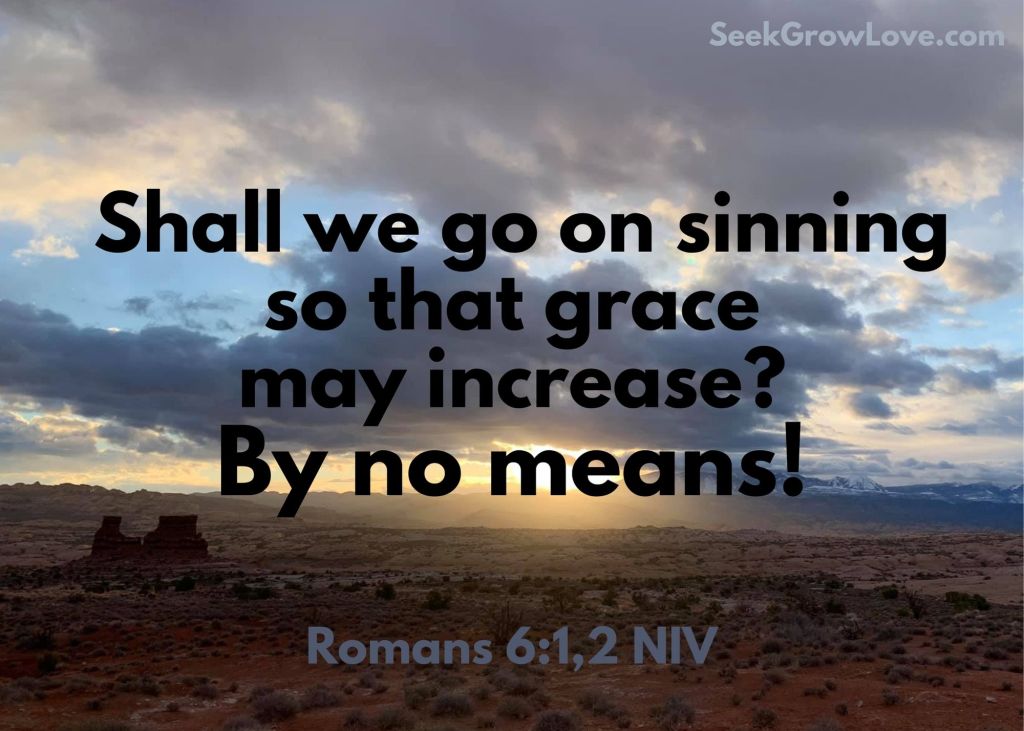
Today, we get to say hi to the same hypothetical objector that Paul seems to address in the first handful of chapters in the book of Romans. Paul opens up chapter six with the question, “Are we to continue in sin that grace may abound?” (Romans 6:1 ESV). He asks the same question in verse 15 as well. In chapter 5, Paul talked about the great work that God and Jesus were able to accomplish through the cross. The cross is only needed because of sin in the first place. If there was no sin, then there would be no need for Jesus to die on the cross. Therefore, in a sense, our sin led to the incredible, world-altering power that was experienced on the cross of Jesus. Should we continue in that sin then to show the incredible power and grace of God? Paul’s answer is quite clear both times this question is raised: “By no means!” (Romans 6:2,15).
Paul goes on to talk about the baptized believer being united with Christ Jesus in his death and resurrection. While being united with Jesus in his death, “our old self was crucified with him in order that the body of sin might be brought to nothing, so that we would no longer be enslaved to sin. For one who has died has been set free from sin… Let not sin therefore reign in your mortal body,” (Romans 6:6,7,12).
We live in a broken world that is cursed and broken by sin. It seems everywhere we turn we can see sin. Since we live in a world that is broken by sin, sin is to be expected in the life of a Christian, right? Well, that’s what many may expect, but that is not what Paul seems to indicate in chapter six. Paul states on multiple occasions in chapter six that we are both set free from sin and that we are dead to sin. This does not sound like someone who just expects a Christian to keep on with their sinful ways. Paul expects the Christ follower to no longer be enslaved to the great enemy of sin. Christ Jesus has set us free from that strong entanglement!
For too long, too many Christians have had a lax stance towards sin. When we expect a Christian to continue in sin, I believe that we are belittling the work that was accomplished on that cross. Before chapter 6, Paul has showed us that Christ’s death enabled us to experience forgiveness, justification, and reconciliation with God. From my personal experience, these seem to be the central focus of the church when discussing the salvation that is offered to us through the cross. However, it does not stop there. Christ didn’t die just so that we could be forgiven of our sins; it’s bigger than that. Christ didn’t die just so that we could be justified; it’s bigger than that. Christ didn’t die just so that we could be reconciled to God; it’s bigger than that.
I appreciate the work of Alva Huffer in his book Systematic Theology. In his book, he details the “Seven Doctrines of Salvation”. Huffer advocates for the fact that through Christ’s death, we have been saved seven-fold from the consequences of our sin. On top of forgiveness, justification, and reconciliation, we also experience sanctification, adoption, redemption, and newness of life. It is the newness of life that Paul describes here in chapter six. Because Christ died, we can experience new life as Christians – a life that is free from sin and dead to sin. As followers of Christ, let’s cherish this new life that we have access to. Let’s show the world what it looks like to live a new life that is free and dead to sin! That’s exactly what this world needs.
-Kyle McClain
Reflection Questions
- What does God’s grace mean to you?
- What is your stance on sin? And on sinners?
- Have you accepted the salvation God has made available through the death of His Son? If so, thank God for each of the seven doctrines of salvation! If not, what questions do you have?

 Seek Grow Love