
The Truth Will Set You Free

John 7-8

Devotion by JJ Fletcher (Minnesota)

Freedom. An idea. A goal. A buzzword? During election cycles, we hear candidates speak about freedoms that the other side of the political spectrum is trampling or encroaching on. Those of us who live in the United States enjoy many freedoms that are not experienced in other parts of the world. While there are some exceptions, we enjoy freedom of speech and expression. We enjoy the freedom of expressing our beliefs and following whichever faith tradition we choose (or we can choose not to believe in anything in particular). 

We have to follow the laws of the land, but we don’t typically have to worry about occupying forces that try to control our populace. On the flip side, the incarceration rate in the U.S. is the highest of any independent country with democratic ideals, and it has the most incarcerated people of any nation. While the U.S. has eliminated slavery, there is still an issue with human trafficking, and there are nations that still have forms of forced labor practices.

The Israelites had a history of slavery and occupation. They were in Egypt for over 400 years, around half of that being enslaved to the Egyptians. Throughout their history, there were other occupations, including the Roman occupation that existed at the time of Jesus’ ministry.

In John 8:32, Jesus said to those who believed in him, “You will know the truth, and the truth will set you free”.  Though they lived under occupation, the Jews were not enslaved, and this pronouncement from Jesus befuddled them. They didn’t know slavery, so how or why would they need to be set free?

Jesus is, of course, speaking of the enslaving forces of sin. Whoever practices sin is a slave to it. The Apostle Paul writes that the wages of sin are death. So, this enslavement that Jesus speaks of is that sin that leads to death. The Mosaic Law highlighted sin, made sin apparent in the lives of those under it, but the law did not eliminate sin. The law did not remove temptation and the desire to sin. Jesus, on the other hand, suggests that his teaching holds the keys to throwing off the shackles of sin and death. “If you abide in my word, you are truly my disciples and you will know the truth, and the truth will set you free”. In verse 36, Jesus says, “If the Son has set you free, then you are free indeed”. Jesus’ teachings were/are powerful and are important to follow, but we also need to remember his place as the lamb who was slain to liberate the captives of sin. Our ability to obey Jesus doesn’t free us from sin, but our allegiance to Jesus and his words can give us victory in our daily battles with sin. Jesus paid the price and gives us victory over sin through the New Covenant that is sealed by his blood. While we suffer and struggle with sin, we should not feel enslaved to it because Jesus has already liberated us from the penalty of sin. A great reminder from John later in chapter 14: Jesus is the way, the truth, and the life. 

Reflection Questions:

1.        Do you ever feel enslaved to sin? Do you question why you still feel inclined to sin, even though Jesus has brought forgiveness to you? 

2.        What can you do to deal with temptation? Do we sometimes set ourselves up to sin by not being careful about the situations we allow ourselves to be in? 

3.        Is it encouraging to know that Jesus has given liberation from sin and death, even if we are still experiencing the effects of them? How does this frame how you approach sin? We don’t need to defeat sin; we need to submit to the one who did. How can you take that approach day by day? 
No Longer a Slave

Thursday, August 11, 2022

 Galatians 4

            Parts of the Bible have been around for nearly 4,000 years.  Some parts are very clear and transcend time, place, language, and culture.  Instructions to not steal or to not murder generally don’t need a lot of contextual background to be understood.

            Other parts of the Bible come from contexts that are very different from our context and certain points can be confusing or easily lost in translation.  Galatians 4 uses words like slaves, heirs, and sons.  Paul wrote this against the backdrop of the Roman Empire so it is helpful to have a background understanding of civic and family life in ancient Rome to more easily understand Paul’s points in this part of his letter to the Christians in Galatia.

            Rome had different categories of persons.  To be a citizen of Rome was to be a person of privilege.  You had a lot of rights as a citizen: to vote, to run for public office, to get married, to make use of the legal system, to not be tortured or whipped.  This citizenship status and the accompanying rights were given to certain men.  Women had a lesser status as citizens and fewer rights- they could not vote nor run for public office.  Children had no rights, but they came under the protection of their fathers until the time when their fathers released them to become full citizens.

            There were other categories in the Roman Empire including Freedmen (former slaves, now free) who had some rights but were not automatically granted citizenship.  There were also Client States or allies who had some limited rights as citizens but not full citizenship.  Slaves had no rights and were not considered to be persons under Roman law.

            Because Paul was a Roman citizen and was writing to Christians who were in the Roman Empire, they would have had a basic understanding of these facts.  In addition to being a Roman Citizen, Paul was also a Jew and there were elements of the Jewish faith that would also have been well understood by these Galatian Christians, particularly those who themselves were Jews.  Paul also utilizes what is known as an allegorical interpretation of the Bible as he argues his case here.  An allegorical reading sees beyond the literal meaning of the story to the deeper symbolism found therein.

            With this as a background, Paul is showing these Christians that life in Christ is far superior to life under the Jewish Law.  Becoming a Christian is like going from being a slave to becoming a son.  To be a son is vastly better in terms of the rights given compared to being a slave.   Paul uses this to show the stark contrast between living under the law of Judaism vs. being redeemed by God and granted the spirit and the gift of sonship whereby we are now heirs of God’s coming Kingdom.  This should be a no-brainer.  And yet, Paul has been facing opposition from those who are teaching that Gentile converts to Christianity must live under the Jewish Law.  That is like telling an adopted son that he has to live under the rules of the slave.  It’s crazy.

            Today, it’s not terribly likely that you as a Christian are going to be bombarded by people trying to convince you to live under the Jewish law.  When was the last time someone insisted that you get circumcised (if you are an uncircumcised male), eat kosher foods, strictly observe the Jewish Sabbath, make pilgrimages 3 times a year to Jerusalem and offer sacrifices at the temple (when there is no temple anyway)?  We’re not likely to be enticed to enter into the “slavery” of law-keeping.  However, we very likely are being invited to enter into the slavery of lawlessness or sin.  Far more commonly, Paul talks about being a slave to sin and death.  As sons of God, we don’t have to become Jews and follow Jewish dietary and ceremonial laws, but we do have to follow Christ and live godly lives.  In Galatians 5 Paul will contrast living by the flesh vs. living by the spirit.  Paul wants Christians here to understand that in Christ we are not slaves but free.  We are not slaves we are sons (and daughters).  We should use that freedom wisely and not misuse it to be enslaved again whether it be to the law or to sin/the flesh.

-Jeff Fletcher

Questions for Discussion:

1.  How does seeing yourself as a son or daughter rather than as a slave change how you live?

2.  How have you misused your freedom?  What parts of slavery do you find most tempting?

Seek

Numbers14-15 cain

No matter how many times I read the story, it is hard for me to digest the betrayal of the Israelites in chapter 14. After they saw the land that He promised them, they wanted to return to being slaves in Egypt? What shocks me even more is that we do the same thing today. What do you think Jesus meant when he said this in Luke 9:62, “No one, after putting his hand to the plow and looking back, is fit for the kingdom of God”? This is alluding to a plow man tilling the ground to prepare it for planting. If the plow man were to look back behind him the rows would be crooked and off course. Jesus is saying that we are like plow men and if we look back and do a poor job then we aren’t fit for the kingdom. What does this have to do with Numbers 14? We can look back today the same way the Israelites did in Numbers 14. They were liberated from slavery in Egypt and given the promise of a new land that was “exceedingly good”. We were liberated from slavery under sin and given the promise of a perfect new earth. The Israelites looked back at their life in slavery and wanted its comforts once again, even knowing they would return to slavery. We can look back at our life of sin and wish we could go back to it, even if we know it will kill us in the end. Sometimes our desires can turn from God and pull us towards a life of sin.

The last two verses of chapter 15 tell us exactly what God desires from us. “Remember to do all My commandments and be holy to your God. I am the Lord your God who brought you out from the land of Egypt to be your God; I am the Lord your God.” Replace the phrase “land of Egypt” with “sin” and apply this to our lives today. Let’s not miss out on our promises because we want to look back to our old life of sin and return to slavery. Let’s keep our eyes on the goal of the kingdom and remember the God who saved us from sin and is bringing us to an “exceedingly good land.” I enjoy looking at the big picture in scripture and seeing how God works on a grand scale. Like how we see God working out the same goal for us and for the ancient Israelites.

Psalm 90 is a chapter that gives us a big picture view of the world and plainly relays potentially complex ideas into understandable language. When I read Psalm 90, a few things are clear to me. God is eternal. He views time differently than us. He sees our sin and He loves us despite our sin. Sometimes we need reminding of these big picture ideas because they help us understand the world and make us realize what is actually important. We can easily get lost in our everyday activities and bury our minds in worry, but in reality, God is still in control and willing to show us His favor.

Thank you for reading our devotions on Numbers this week. Hopefully we walked away with a renewed respect for God’s holiness, an awe for the awesome work He did in the people of Israel, and a reassurance that He is leading us towards a promise that is better than anything we can imagine. Numbers may sound like a boring math book, but in reality it is a rich record of God’s dealings with His people. As you continue to read through the book of Numbers, see how God deals with His people and make a connection to your life. Where God’s word and application meet, there is life change and understanding.

Josiah Cain


Today’s Bible reading can be read or listened to at https://www.biblegateway.com/passage/?search=Numbers+14-15%2C+Psalm+90&version=NIV

Tomorrow’s reading will be Numbers 16-17 as we continue the 2020 Chronological Bible Reading Plan

IF you Believe, THEN…

John 8

John 8 31 32

As we have read repeatedly in the last two chapters, we see again in John 8:30, 30 Even as he spoke, many believed in him.

Then Jesus shared this powerful truth:

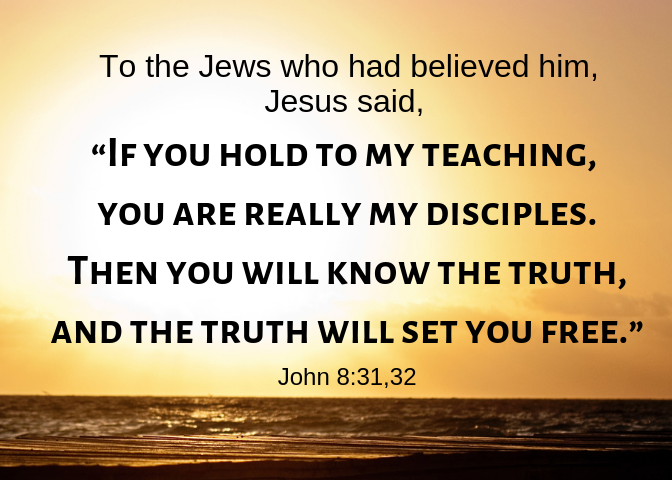
31 To the Jews who had believed him, Jesus said, “If you hold to my teaching, you are really my disciples. 32 Then you will know the truth, and the truth will set you free.”

This passage points out that while belief is important, belief alone is insufficient.  If I’m completely honest, I don’t like the implications of this passage.  I want to just believe and know I’m ok.  Unfortunately, I see a similar warning in James 2:19, where we’re told, “Even the demons believe – and shudder.”

Now Jesus has my attention.  If belief alone isn’t enough, what does He expect? I interpret these two verses as Jesus giving his followers a series of If .. Then conditions:

  1. If you hold to my teaching (which I interpret as meaning: you need to live your life like Jesus told you and demonstrated to you).
  2. Then you are really my disciples (meaning, you’re not really His follower unless you do what He told you to do.)
  3. If you are really my disciples, then you will know the truth. (This suggests to me that people can’t even understand the truth unless they are really Jesus’ disciples.)
  4. Finally, when one knows the truth, the truth will set them free.


The believers Jesus was talking to had the same reaction I tend to have.  Wait a minute, set me free?  I’m not a slave.


Jesus went on to say that anyone who sins is a slave to sin, and Jesus came to set people free from sin.


This is really interesting to me.  As members of a denomination that claims to have the faith of Abraham, we may tend to think we have a corner on the market for faith and truth.  But how focused are we on the holiness message Jesus is sharing in this passage?  This should challenge us.

Verses 35 and 36 go on to say, 35 Now a slave has no permanent place in the family, but a son belongs to it forever. 36 So if the Son sets you free, you will be free indeed.

I don’t know about you, but I want a permanent place in God’s family.  But to have that place, I need to be set free – first, from sin, and ultimately from death.


This requires adding to belief:

  1. Following Jesus’ teaching
  2. Becoming his disciple
  3. Knowing the truth
  4. Having Him set me free.

Sign me up!  How about you?

-Steve Mattison