Stand in Awe of God

Eccles 4 4 (1)

Ecclesiastes 4:1-5:7

Solomon, as cheerful as ever, writes about what he witnessed around him; the tears of the oppressed, power on the side of the oppressor, and no comfort for the oppressed. Who are the oppressed today, in our world, our country, our community? People are oppressed based on ethnicity, religious beliefs, economic status, gender, you name it. Some appear to less oppression than others but it is an illusion. We are all subjugated to one great oppressor, sin! Solomon rightfully says that we have no comforter … here on earth at least. He reminds us to look at what role we each play in the oppression of others for we cannot be a comfort if we are part of the problem, whether we realize it or not.

The dead! The dead are free from oppression … and happiness … and joy … and living. Peter wrote that it is only those who trust in God that may see the good that can come out of suffering. Thank you Peter for being a ray of sunshine! He says this though because we have a hope in Jesus of an eternity where sorrow and suffering will be no more. Peter was, as we are, on the other side of the cross so to speak so we have a better understanding of the impermanence of this life and its troubles and of the future promise of life in the coming kingdom.

But for today, greed and envy are tremendous motivators for oppression. When people strive for more wealth and power they rarely care for who gets pushed aside, trampled on or abused. It is a grabbing after that which will only give momentary happiness. Solomon suggests that it is better to have one handful with tranquility. … Yeah I read that and did not get it at first either. He is saying that we should not over reach or overextend ourselves. His wisdom guides us to be content with what we have, with what God has provided.

In chapter four Solomon gives two examples. The first is of a rich man whose insatiable thirst for more isolated him to the point that he had no partnership. He did not share with anyone and one day realized the immensity of that loneliness. In contrast, Solomon commends sharing in relationship. There are advantages in this as he points out. In companionship we find greater profit, a good return from our labor. We are able to help one another in difficult times when we are together. He pities those who have no one to help them when they fall. Together we can provide each other with comfort but there is no one to comfort the selfish and greedy. Companionship also affords greater protection when facing dangers. He goes further with that by saying that two is good but three is even better.

The second example is that of a poor but wise youth who succeeds the foolish king. He comes from nothing and it is implied that he was imprisoned at one point. But he rose to power and everyone followed him. He had it all! In time the people grew tired of him and he lost everything. All of his striving after money, power, and adoration was ultimately meaningless. It all comes and goes like the wind.

You might look at the opening verses of chapter five as advice or instruction on proper worship, the proper attitude, appropriate practice of prayer, and the respectful payment of vows. The reality though is Solomon is warning against straining our relationship with God. He warns against making rash vows. Rash vows become the “sacrifice of fools” and the “speech of a fool”. He advises us to be thoughtful before coming to God with an oath or vow. To consider our own limitations and our motivations. We ought to weigh all things against God’s word so that we know that it is good according to His perfect will. “What is the big deal about making vows?” A vow is a promise and for the God who always keeps His promises, breaking our promise is detestable to Him.

Whether facing oppression or battling against the sins of greed and envy, trying to stay humble enough to be content with what we have or avoiding quick words and rash vows, Solomon always returns to our Creator God. ”Therefore stand in awe of God”, trust in Him and His providence. In awe of Him rather than standing in awe of ourselves. Then we can face the troubles and strife with great endurance. Then we can rise above our baser nature. We can find contentment and dare I say … meaning!

To be continued …


Jeff Ransom


Under the Sun

Eccles 1_9

Ecclesiastes 1:1-2:16

Ecclesiastes does not exactly seem like the perfect book for uplifting and encouraging one another but let us take a look at it anyway.

We can assume from the titles the author gives himself and other clues that Solomon wrote this book. The wisest man, excluding Jesus, to walk the earth and he begins by saying that “everything is meaningless!” What is meaningless? From the third verse of chapter one and a number of arguments made throughout the book, we can understand Solomon to mean that all human endeavors are meaningless. With the number of times he repeats the word meaningless several translations/versions read as “utterly meaningless”. Our labors are totally and completely useless. So he asks the question, “What does man gain from all his labor?” It is almost like he is daring us to give a positive answer to that question.

He argues in broad strokes that our efforts can have no permanent value. “Generations come and generations go” speaks of how short life is and the insignificance of our efforts. He contrasts our efforts with the earth which will remain and yet even the things that happen on earth are without meaning. Solomon gives examples of the sun, wind, and water to illustrate his point. Each of these cycling around in ceaseless activity. But what does the sun, wind, or water gain from their activities? Nothing! It is all monotonous and wearisome without effecting any progress or reaching some goal.

“But there are so many advances every day. In technology, medicine, industry, you name it. With everything we have and what is coming, Solomon obviously had no idea what he was talking about when he said there is nothing new under the sun.”

Cell phones – just an update on old technology which in turn is just two people talking only over greater distances. The computer – just a dumbed down version of our own brains. If you know me you will find it difficult to believe that a computer is a dumbed down version of my brain but it is true. Computers only mimic the pathways and impulses of our brains. Space travel – it is still just traveling from one place to another, adventuring into the unknown. So Solomon is correct, there really is nothing new under the sun.

Let’s not forget either that Solomon was not only incredibly wise but he was insanely rich and powerful. With all of that he tried to discover something, anything that had not been done before. He even sunk into madness and folly. The conundrum to this endeavor however is that he did so under the guidance of wisdom. He did not indulge blindly or in uncontrolled excess. He denied himself nothing and undoubtedly gained some measure of satisfaction from his experiences but he discovered that it was all fleeting, gone in an instant. Nothing was truly gained from any of it.

Solomon’s verdict on all of this is that wisdom enabled him to enjoy both pleasure and the fruits of his labor sensibly, to cherish them rather than to pass numbly through them. So there is an advantage to wisdom over foolishness. Yet both the wise and foolish share the same fate. So what does wisdom gain us? What is the point?

Paraphrasing Proverbs 2:1-8, “my son, if you accept my words, turning your ear to wisdom, then you will understand the fear of the LORD and find the knowledge of God. For the LORD gives wisdom, He holds victory in store for the upright, He is a shield, He guards and protects the way of His faithful ones.”

There is a glorious purpose; Trust in Him and His plan, His power. We can gain knowledge and understanding from God’s Word but it only becomes wisdom when we apply it to our lives. When we live out what we have learned from Scripture we will be able to enjoy this life and all of our “meaningless” endeavors. Without God, everything is meaningless.

To be continued…

Jeff Ransom

The Wisdom of Solomon?

wisdom

When you read about the Kings of Israel or Judah, their life is always summed up in one sentence, as a kind of Eulogy: King ­___ did right/evil in the sight of the Lord. That’s really all it boils down to, if we do right or we do evil in the sight of the Lord. None of the other things that they did matter. Take King Solomon for example. The wisest man who ever lived, the Lord appeared to him twice. Once he told him, “Ask what you wish me to give you.” He asked for wisdom to be able to lead the Israelites. God was so pleased with his answer that he said he would give him wisdom, riches, and honor, and if he followed his commandments that he would prolong his days. Solomon went on to build the temple for the Lord in Jerusalem.

It sounds like he lived his life to bring God glory, but Solomon had one small problem.  Chapter 3:3 “Now Solomon loved the LORD, walking in the statutes of his father David, except he sacrificed and burned incense on the high places.” And in chapter 11 vs.1-6 it says (paraphrase), “King Solomon, however, loved many foreign women.  They were from nations about which the Lord had told the Israelites ‘You must not intermarry with them, because they will surely turn your hearts after their gods.’  As Solomon grew old, his wives turned his heart after other gods, and his heart was not fully devoted to the Lord his God, as the heart of David his father had been. So Solomon did evil in the eyes of the Lord….”  Contrast this to Ch.15:11&14 “And Asa did what was right in the sight of the Lord.” “The high places were not taken away, nevertheless the heart of Asa was wholly devoted to the Lord all his days.” You do not want your epithet to read:  He loved the Lord, EXCEPT….. We need to make sure that we keep our hearts wholly devoted to God. Solomon started out loving God, but then he put other people before him and his heart was pulled away.

Sherry Alcumbrack

2500 Years Later

Sunday Intro by Graysen Pack

God's Word RemainsLiving & Active

As we continue our readings in Proverbs (Chapters 22-26 this week), we are going to be leaving a collection of sayings by Solomon that contrast the wise and the foolish.  We’ll then move into a new section of Proverbs, the sayings of the Wise.  These proverbs, unlike previous ones, aren’t written down by Solomon directly but put down to paper by the servants of King Hezekiah years later.


This reveals one of the defining characteristics of Wisdom literature as it’s found in Scripture: it is a product of the dynamic tension that ancient people faced in their day to day lives.  These are sayings that were passed down for generations from the time of Solomon to the days of Hezekiah and then put to paper.  Unlike some portions of the Hebrew Bible, the Wisdom literature found in Psalms, Proverbs, Song of Solomon, Job, and Ecclesiastes are intrinsically shaped by the ways that the Jews of ancient Israel were trying to understand the role of faith in their daily actions.


This is what makes these scriptures deep, meaningful, and particularly relevant to the struggles we still face today.  So, as we explore the Proverbs this week, I encourage you to not see them as a detached set of sayings from a time long gone, but as markers laid out by individuals of faith who found themselves in older variations of the exact same challenges we encounter in our own lives some 2500 years later.

SOS

Song of Solomon 1-4

sos700

Friday, February 3

I hadn’t gotten around to registering for the “mom’s” conference, Hearts at Home, until a few days before and couldn’t find the class descriptions so I had to sign up for classes just based on the names.  I saw one called, “Passion Pursuit,” taught by Dr. Juli Slattery and Linda Dillow.  I’ve heard Dr. Slattery on Focus on the Family and at previous Hearts at Home conferences and really enjoyed learning from her. I also figured I’d like to figure out what I have a passion for, so I signed up for this class.
Pursuing one’s occupational or spiritual passion was NOT what this class was about!  It was about that one book your pastor rarely, if ever, speaks on, the book I personally have never done a jr. church series of lessons on, and as of yet, the one book we’ve never had the kids memorize verses from. That’s right! I’m talking about The Song of Solomon (SOS)!  (Signal collective blush from everyone’s cheeks.)
Over the years, there has been debate about what this book is about and why it is in the Bible.  I did a little bit of research and almost everyone agrees that this book is about God’s great love for His people and the intimacy He wants to have with both the Israelites and those of us who have chosen to become adopted seeds of Abraham.  Where debate and controversy lies is that other meaning.  As Bob Jones stated in his book, “ The 5W’s and 1H of Genesis Through Malachi,”  Song of Songs is to be seen as, “literally describing the sanctity and beauty of human physical love…Maybe God wants us to read this book so that we return marriage and sexuality to the holy place He has always intended them to occupy.” p. 70  The ladies teaching “Passion Pursuit” agree with Bob.  SOS is a book celebrating God’s love for us but it is also celebrating the gift God gives a couple upon their marriage. Those of us who have taken those vows are to embrace this gift to the fullest.( Dr. Slattery and Mrs. Dillow created an online ministry to help people do this called “Authentic Intimacy.”  I highly recommend checking this out. They have scriptural advice and instruction for anyone looking to have greater, true intimacy with God and their spouse or in preparation for marriage.)
Yes, there are a few problems with the actual book.  If Solomon was the author, which most consider as fact, he wasn’t exactly a one woman man.  My study Bible states he probably had 140 wives and concubines at the time and more throughout his life.  Not exactly a fact that would make a woman feel special!
This is also a very hard book to follow. They’re in a garden, she’s having a dream, they’re married….What is going on???? They are also talking in metaphors and similes…they’re in an actual garden, He’s in her “garden.”  And if it weren’t for the headings in my Bible, I would have no idea who is talking.  The Shulammite woman is talking, a whole bunch of women are talking (where did they come from?!) And even God speaks once.  This is a book you’ll benefit from reading along with a commentary.
So how do you use SOS to make a difference in your life?  How do you make this a part of your devotion?  A friend of mine told me that her pastor recently preached a sermon on it and encouraged husbands to tell their wives they are beautiful.  So there you go husbands!  God wants you to complement your wives!  Use lots of flowery words! (Check out youtube for examples on how to use King Solomon’s words to make your woman swoon!)  Ok, that was a little facetious. Seriously, most woman do want to know her man desires her (but maybe not in the words of chapter 4) and God has provided an example of this along with His blessings.
My friend thought of another take on SOS.  She thought that since her husband was being encouraged to tell her she’s beautiful, she should make more of an effort to be beautiful.  She looked at verse 1:6 when the Shulammite woman tries to hide from Solomon.  So my friend decided that in addition to not wearing sweats all day, she would close the door while using the powder room and not burp or otherwise display gross behaviors in front of her husband.  We all laughed when she told us that he didn’t notice but her point was that we shouldn’t take our husbands for granted and we should make an effort to be beautiful for our husbands. We also need to keep in mind verse 2:15, “ Catch for us the foxes, the little foxes that ruin the vineyards, our vineyards that are in bloom.  The chorus talking here, saying not to allow anything to spoil the man and woman’s relationship.  Good advice for all of us in any relationship.
The world may have cheapened the physical relationship between a man and a woman,  likening it to something as casual as a game of ping pong.  SOS reminds us that it is truly a wedding gift from God that is to be treasured, embraced, and protected.
So if you are married, read today’s reading with your spouse and have a great night! ; )
– Maria Knowlton

 (photo credit: cartoon by Andrew Fraser – found at http://www.cartoonsidrew.com/2014_10_01_archive.html)

DO it ANYWAY

Ecclesiastes 9-12

ecclesiastes-12814-37-638

Thursday, February 2

So you’ve read today’s reading and are thinking, “Maria, you said King Solomon was going to give us uplifting counsel!”  On the face of it, these last four chapters do not seem very uplifting.  But I read a couple of things along with these scriptures that made me realize that what he is saying is in fact, very uplifting, practical, and real.

The first thing I read, you may have read before.  It is a version of a poem that was originally written by Dr. Kent M. Keith but was rewritten as a spiritual poem, presumably by Mother Teresa.

Do It Anyway
People are often unreasonable, irrational, and self-centered.
Forgive them anyway.
If you are kind, people may accuse you of selfish, ulterior motives.
Be kind anyway.
If you are successful, you will win some unfaithful friends and genuine enemies.       Succeed anyway.
If you are honest and sincere, people may deceive you.
Be honest and sincere anyway.
What you spend years creating, others could destroy overnight.
Create anyway.
If you find serenity and happiness, some may be jealous.
Be happy anyway.
The good you do today, will often be forgotten.
Do good anyway.
Give the best you have, and it will never be enough.
Give your best anyway.
In the final analysis, it is between you and God.
It was never between you and them anyway.

This poem sums up exactly what King Solomon was saying! Verse 9:11 is a prime example of this idea that life isn’t fair.  You may work hard but not receive any rewards but verse 12: 13-14 says do it anyway!  God knows your works.
The second thing I read was the commentary in my study Bible, which I thought, wrapped up the book of Ecclesiastes quite well.

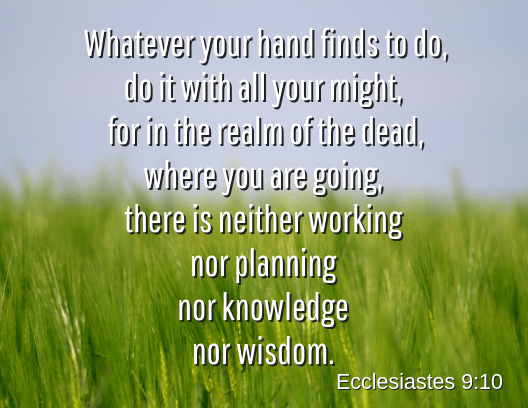
“God has not told man how to comprehend all the frustrating futilities of life, but He has instructed man to enjoy life as His gift (2:24), to make the most of every opportunity (9:10), and to live life with reverence toward God (12:13), accompanied by an awareness of future judgment (12:14), Solomon learned to live with life’s paradoxes by maintaining a proper attitude toward life and God.”

Solomon is saying life is rough and it doesn’t always go the way we think it should, but we need to do the best we can anyway and everything in this life is in God’s hands.
That sounds like pretty uplifting and practical counsel for all of us!
Tomorrow we will delve into Song of Songs, Song of Solomon, or Canticles. No matter what you call it, Solomon is clearly in a better mood in this book!
See you tomorrow!
Maria Knowlton

(Photo credit: http://www.slideshare.net/drrickgriffith/eccl-12v8-14-finishing-well62)

Wisdom from The Princess Bride – And Solomon, Of Course.

Ecclesiastes 5-8

ecclesiastes-5-10

Wednesday, February 1

I promise, King Solomon is going to offer us wise, uplifting counsel.  It’s just not going to be in today’s reading. Today’s themes are the futility of work ( we’ve heard that before), the wisdom of solemn considerations, the overall unfairness of life.
Chapter 5 opens with a warning to not pretend to please God with foolish words or hasty vows.  Solomon then warns against hoarding riches.  In verse 10 basically Solomon is saying, Mo’ money, Mo’ problems.
He does end the chapter with the positive observation that finding joy in one’s work and activities is a gift from God. If we are occupied with gladness of heart from God, we don’t have time to reflect, sadly I suspect, on the days of our lives.
Chapter 6 restates what Solomon said in chapter 4. In fact, in both he states that it would have been better to never have been born (verse 3 in chapter 4 and verse 3 in chapter 6) than to live a futile life.
I love verse 7:1.  We always celebrate the birth of a baby, in part, for all the hope the baby represents.  We celebrate not the death at the end of a person’s life, but rather the fulfillment of that hope.  Solomon is saying this celebration is better than the one at birth. In addition to celebrating that person, it reminds us of our own mortality and the need to make our time matter.  The following verses add to this thought.
When I was at Ball State for a whole semester, I was terribly homesick.  I found verse 7: 8, “The end of the matter is better than its beginning, and patience is better than pride.”  I wrote it on a piece of paper and pinned it to the wall.  It reminded me to be patient, the semester would end soon and it would certainly be better than the beginning. I would learn something from this awful experience.  I don’t remember where I thought the pride  part fit in, but it made sense to me at the time! This verse meant a lot to me and got me through that semester.
Most of Chapter 8 seems to suggest that King Solomon believed that if you do good, you will be rewarded.  But some of the verses (10 and 14) point to the fact that sometimes the wicked are rewarded and the good are punished.  I have several friends who go to tanning beds.  I have several friends who do not.  Would you believe two of my friends and I, who have never seen the inside of a tanning bed, are the ones who got skin cancer!!!! Talk about not fair! I am not saying tanning is wicked or that I want my tanning friends to get skin cancer, but it is frustrating to do all the “right” things and still suffer.  I think King Solomon understands my frustration. : )
I suspect Solomon would agree with the grandfather in The Princess Bride.  “Who says life is fair, where is that written?”  It certainly isn’t written in this chapter (or any scripture for that matter)!  God has never promised His children an easy or “fair” life.  Solomon knew that.  But he also knew that serving God is the only way to give meaning to life.  He will reassure us of this in tomorrow’s reading.
Until then, Maria Knowlton

When asked to give a short bio of herself Maria said, “I have one great husband, two wonderful kiddos, and will be a nurse in 12 months!”.  Those who know Maria would also add that she brings joy and life to every project she attacks (be it heading up the school science fair, providing first aid at Family Camp, being a spokesman for Indiana Donor Network, attending nursing school, or teaching at church in northern Indiana).  She is a model of faithfulness as she points others to her faithful God. 


(Photo credit: https://dailyverses.net/ecclesiastes/5/10/esv)

Nothing New Under the Sun

Chapters 1-4 of Ecclesiastes (eh/kle/see/as/tees; which might rhyme with “meh – see the nasties”)

ecclesiastes31

Tuesday, January 31

Many Bible books were named from a key word near the start of the book, which often means they are named after the author. That is sort-of the case with Ecclesiastes, but the author’s name isn’t used in the book so it picks up a title the author took. In Hebrew that title could mean “lecturer”: it comes from the word for “gatherer” and the idea is that he gathered information and then passed it along. When the book got translated into Greek this lecture-teaching was described as preaching, so its title now is a word for “preacher.” You might wish that the name of the book was translated to English when the book was. (By the way, “ecclesia” is the Greek word that normally is translated as “church” in the New Testament). We read the book of Proverbs, a collection of wise statements that often gives advice. We read the book of Psalms, a collection of poems which often call on God. You could get the impression that our current book is a collection of downer thoughts about life. That is how a lot of people have read this book, and it is understandable if some of what we read in Ecclesiastes seems sad to us, but there is more going on here than that.

In over 20 places the book says a thing is “meaningless”, but that doesn’t mean “don’t do it”, it is more about looking at things from a long perspective and saying that the “meaningless” event or action doesn’t really change things. Certainly that is true if we look at things from the perspective of generations (1:3). The verses keep returning to the idea of our work, our labors. In the short term they can bring us satisfaction, and we are meant to accept that, it is a gift from God (3:13). But we also should be careful how we view things, never totally forgetting the big picture.

If you haven’t heard the song that Pete Seeger made out of the lines in 3:1-8, check it out (“To Everything There is a Season”). Part of the point of the verses is that we can never emphasize one thing as “the point” for our actions, what is pushed in one direction will also be pushed in another. Nothing we change stays that way forever.

An obvious example for this is eating. You can feel really hungry, say right before a church potluck that has been delayed, and then a few minutes after you eat you have no interest in food at all. But a few hours later you will be hungry again. You can’t eat enough to end the cycle, and we can ask how much importance there is in any one meal we ever eat – but we certainly cannot skip all of them.

So, that cupcake you ate the other week may have tasted good, but does it still please you? That binge-session on Netflix of sit-com episodes? Almost certainly meaningless. The test you are studying for may make a big difference to your grades – but for how many years will it matter what grades you received? It is possible to poke holes in every form of human labor and success, but “wisdom is better than folly, just as light is better than darkness” (2:13). The wise person may recognize, like the Preacher, that success is temporary in this world, but it is still better to be wise.

The Preacher / Teacher is described as a king of Jerusalem, and many people tag him as Solomon late in life. It may require being a powerful king to test all the things the Preacher tested, to see what would make him happy. He could do what he wanted, and none of it was enough. But some of the simplest things, the inexpensive things, can bring happiness to us – we just know that none of it lasts. “Happily ever after” doesn’t have much sense behind it, because people are not immortal, and the struggles of this world don’t just get skipped over for the people who want to serve God.

In a way this book is an extended piece of wise-talk, like Proverbs has, but directed to just one issue – what the point of this life is. If this world were the one God was aiming for in the first place we could expect the Preacher to give us a more positive answer, but this world is what resulted from sin. God is in the process of fixing things.

This is the book about “meaningless” (temporary) things where there is “nothing new under the sun” (in this world) and both wise and foolish people “chase after the wind” but can’t catch it, and get nothing from the chase. But along with all the comments about our work not changing things, or being undone or forgotten, we get comments about the endless importance of what God does (3:14). Maybe that is a hint at the future. What God does lasts forever, and God sent Jesus to die for us and God raised Jesus from death as the first-fruits of many who will come to immortality and live with him forever.

If you find yourself getting dragged down by anything this book says, you could question if that is because it is telling you truth you didn’t want to know about something that you have considered to be more important than it should be. But don’t ever let yourself get brought to despair by this scripture or by anything at all – always remember that the story is not over

-Daniel Smead

Daniel grew up in Missouri, then attended Oregon Bible College, Atlanta Bible College, and Columbia Theological Seminary. He has pastored in Eden Valley, Minnesota, and now attends the Pine Grove Bible Church in Brooklyn Park, Minnesota. He has worked for many years editing adult Sunday School lessons, and also writes some (slowly). He is trying to create a card game about the first few centuries of Church history (very slowly). He also recognizes in himself a tendency to focus on a thing(s) more than he should, and the need to put things in God’s hands and leave them there – so if that describes you, you are not alone. God bless you.  : )

(photo credit: http://keywordsuggest.org/gallery/386871.html)

Even though Proverbs is Coming to a Close – Keep up with the Wisdom!

Proverbs 29-31

proverbs-30-5

Monday, January 30

Today’s reading will wrap up the book of Proverbs.  This book is one of what we refer to as the five book section of poetry.  You’ve probably noticed that neither Proverbs, nor the rest of this section has a lot of rhyme and rhythm which is often associated with poetry.  Here’s a little poem I remember from my school days.  “Roses are red, Violets are blue.  God made me pretty, what happened to you?”  The rhyme and rhythm are obvious.  The Biblical books of poetry are classified as such, because of the rhyme and rhythm of thought and reason.  This is often called parallelism, putting similar or contrasting thoughts side by side.  These five books are also often called Wisdom Literature.  The reason is obvious.  They are full of wisdom, every one of them, but particularly the Proverbs.


I liken the book of Proverbs to the New Testament book of James.  Both are very practical, and contain much wisdom for day to day living.  The Proverbs can be seen not so much as hard and fast promises or guarantees, but rather as counsel, guidance, directives to follow, with consequential blessings.


Solomon wrote many of the proverbs contained in this book, though not all of them.  He actually did write many, many other proverbs not contained in this book.  His wisdom was a gift from God, and we would do well to follow his counsel.


Read Proverbs 29 slowly and observe the many and varied topics.  You might recall Biblical examples that fit right into some of the proverbs.  You may even think of real life experiences that relate to or prove some of the counsel shared.


Proverbs 30 begins, “The sayings of Agur son of Jakeh – an oracle.”  An oracle is either the counsel or message of a person of trust and authority, or the person him or herself.  Again, I would suggest you read slowly through Proverbs 30.  Ponder the various topics addressed.  Agur likes the organization of numbers, two things he asked of the LORD, four things that are never satisfied, four things that are amazing, four things under which the earth trembles, four things that are small, yet extremely wise, and more.


Proverbs 31 comes in two parts.  The first nine verses are an oracle (again), this time from the mother of King Lemuel.  I’ll just comment a bit on verses 4-7, where she addresses the use of alcohol.  The use of alcohol is very much accepted these days within the church as well as without.  Lemuel’s mother cautioned him about its use, because of the risk of it affecting the king’s ability to properly perform his responsibilities.  The contrast then is given in verses 6 and 7, “Give beer to those who are perishing, wine to those who are in anguish; let them drink and forget their poverty and remember their misery no more.”  Alcohol so easily impairs people to the point where it’s an effective escape from the realities of life.  I can’t tell you the Bible condemns the use of alcohol, but I would caution those who use it freely that it often impairs the user of both wisdom and judgment.  I’ve seen all too often how the abuse of alcohol has been behind the ruining of marriages, families, careers, relationships, integrity; people have been killed, etc.  Most of the examples and stories I could cite have been within the church, people who should have known better, people who never set out to destroy their marriage, family, career, etc.  They just got caught up.  It isn’t worth it to me, to use my freedom to use alcohol, when the abuse of it is so easy and so costly.  I have enough of a challenge to somewhat control my food intake, and am not willing to risk what could happen if I were to use, and go on to abuse alcohol.  I’m confident that those who never take their first drink will never be an alcoholic.  I’ve never heard of an alcoholic who set out to become one.


The rest of Proverbs 31 is a wonderful passage describing a beautiful wife and mother.  It’s actually an acrostic, with each verse beginning with the next letter of the Hebrew alphabet.  Of course we lose all that in the translation into the English language.  It’s still a beautiful description.  This is as modern day as one could ask.  Read through it slowly.  If you’re in search of a wife, look for someone such as this.  If you are a wife, or may be some day, be one such as this.  If your wife or mother is one such as this, rise up and do as suggested in verses 28-31.


John A. Railton

-John Railton is a pastor in Northern Indiana at Family Bible Church.  He also uses his ministry talents working at a funeral home.  He would love to have a conversation with you about the Bible – and maybe play a round of ping-pong, too.

(photo credit: https://dailyverses.net/proverbs/30/5)

How to Be Stupid

Proverbs 11-13

prov-12-1

Tuesday, January 24


How have you used your “fountain of life” today (Proverbs 10:11)?  Did you know when to keep it shut?  Can you think of a time when you used it (your mouth) to nourish others?   In today’s readings there are several more excellent verses reminding us again of the power of our words.  And of course we know that “With Great Power Comes Great Responsibility”.  Some verses worthy of being great refrigerator verses are:

11:12 – A man who lacks judgment derides his neighbor, but a man of understanding holds his tongue.
12:18 – Reckless words pierce like a sword, but the tongue of the wise brings healing.
12:28 – An anxious heart weighs a man down, but a kind word cheers him up.
13:3 – He who guards his lips guards his life, but he who speaks rashly will come to ruin.

My guess is we can all quickly think of a time when someone’s words pierced us, and also a time when someone’s words healed us.  Can you also think of a recent time when your own words pierced another?  What about brought healing or cheered up someone?   How can we make a better plan for our mouth so we don’t just say the first thing that comes to mind, which can lead to ruin?

How about experimenting with ranking your mouth at the end of each day for the next week or two.  A big fat score of 0 would be for a day filled with piercing words spoken rashly: accusations, angry outbursts, rudeness, gossip, lies or twisted truths, put-downs (even in jest? It’s not really funny), boasting, manipulating, cursing and foul language, I’m sure you can think of more.  And of course our goal would be a shining 10 score for a day full of polite speech, genuine compliments, thankfulness, apologies, forgiveness extended, words of encouragement and sometimes sympathy, morsels of truth at just the right moment, Godly wisdom and Bible verses shared – and none of that nastiness that automatically pull your score down.  From day to day be looking for ways to grow your own score.  Be more mindful of how you use your words  – and sometimes more appropriately, your gift of silence – and the impact it has on those around you.   Hold yourself accountable for the proper use of your fountain of life.  For only then will you be called righteous.  (10:11)

There is so much more wisdom and lessons for the one seeking to live a righteous life!  Come to think of it – Proverbs also has great advice if you are aiming to be a stupid fool.   Solomon could have titled Proverbs, “How to Be STUPID”.  Proverbs 12:1 is a great start: “Whoever loves discipline loves knowledge, but he who hates correction is STUPID.”   And, since reading it once isn’t always enough . . .

13:1 – He who ignores discipline comes to poverty and shame, but whoever heeds correction is honored

13:10 – Pride only breeds quarrels, but wisdom is found in those who take advice

12:15 – The way of a fool seems right to him, but a wise man listens to advice

Raise your hand if you think you are right most of the time.  My hand goes up.  Guilty as charged.  No doubt it is my pride that makes me think I am right and they are wrong.  Sometimes, I AM right.  But, when I am WISE I will realize and accept that I am also sometimes wrong.  I have been, am and will be wrong, in need of correction and discipline and sorely in need of advice.  Why should I even LOVE discipline (12:1)  – because I want more and more to be as Godly as possible (Be holy, because I am holy – I Peter 1:16)– and right now there is still a pretty huge gap between God’s holiness and mine.   Dear God, help me grow a more humble spirit that accepts correction well.

So many great proverbs, so little time.  We sadly won’t go into detail about the sluggard, pig snout, chasing fantasies or husband’s crown or so many others.  But just one last nugget for those who want to be wise. “He who walks with the wise grows wise, but a companion of fools suffers harm” (13:20). If you desire to avoid harm (and I sure hope you do) – choose your companions carefully.  Don’t waste your time searching for perfect people to be friends with – that can be a real disappointment.  But choose to spend your time side by side with those who are seeking to grow closer and closer to the Father.
Keep Growing!
God Bless,
Marcia Railton