Committed Love

Song of Songs 7-8

Psalm 108

Revelation 1

-Devotion by Jerry Wierwille (NY) – today we cover Song of Songs 6-8

At the conclusion of chapter 5, which we looked at yesterday, the woman gave an elaborate description of her beloved and what she loves and admires about him to the daughters of Jerusalem (who are an unnamed group of women that are likely being used as a literary device in the poem). Now, chapter 6 opens with the daughters of Jerusalem asking where the woman’s beloved has gone. Whereas in chapter 5, she seems to not know where he went, now her answer is quite confident: “My beloved has gone down to his garden” (6:2). The tone of her response differs drastically from her frantic search in the previous chapter. And so, she apparently knows where he is now, and she knows where she stands in her relationship with him.

Verse 3 presents one of the most significant themes in the book, “I am my beloved’s, and my beloved is mine” (6:3). Back in chapter 2, the woman said, “My beloved is mine, and I am his” (2:16). Interestingly, now the order is reversed. The emphasis falls on the fact that she has given herself to him before she speaks of him belonging to her. Whether or not the change is intended to mark some growth in their relationship, or her perspective, it nonetheless expresses how she sees their mutual commitment to each other. This major theme of the book can help us see how healthy love is not built merely on asking, “What am I going to get?” but more importantly, “How can I give myself faithfully to the person I love?”

In response, the man begins praising her again, “You are beautiful, my darling, as Tirzah, lovely as Jerusalem, awesome as an army with banners.” (6:4). He compares her beauty to famous cities and a strong army proudly carrying banners. Something that we can note is that the man responds after the situation in chapter 5 when he went to see his beloved and was not greeted at the door with wonderful sentiments of praise and admiration.

It is important to remember, though, that healthy relationships are not free of problems, much less ignore problems. But it does remind us that conflict should not overwrite or erase our affection or desire. It is easy to reduce our opinion of someone to what has frustrated us about them most recently. But love resists that temptation and remembers the whole person and doesn’t neglect to speak what is true, beautiful, and worthy of gratitude, even when our present emotions may not drive us in that direction inherently.

In 6:10, the woman is described in this way: “Who is she who looks forth as the morning, beautiful as the moon, clear as the sun and awesome as an army with banners?” picking back up the militaristic imagery of verse 4. This imagery is striking. The woman is not presented as a fading light to the eyes of the man as something drifting into the background, but as someone whose presence is radiant, illuminating, and commands his full attention.

Lastly in chapter 6, the Hebrew in verse 13 is notoriously difficult, and it is hard to understand what the phrases are meant to conclude from preceding context. But what can be known is that they seem to bridge to chapter 7 where the man continues his elaborate description of his woman’s beauty.

Chapter 7 presents, yet again, several images and metaphors that may sound unusual to modern ears, but the point is as clear as it was previously: the man is delighted in his beloved and struggles to find the words to aptly describe the great love he has for her and how deep his affection is for her.

Then, in the middle of the chapter, the woman replies again with that familiar language from one of the main themes of the book, “I am my beloved’s, and his desire is for me.” (7:10). This statement conveys that her confidence in their relationship is one of strength and security: she knows both that she belongs to him and that she is desired by him. The woman perceives how much she is desired and her beloved’s attitude and affection toward her is not passive but firmly vocalized—she knows that she is wanted by him.

This brings out something important in healthy loving relationships: the ability to rest in another’s faithful and abiding love. The relationship that is filled with tension and conflict, instable, uncertain, and constantly hanging in the balances is one that asks, “Do they still want me? Am I enough? Has something changed? Has their love grown cold?” But a committed, loving relationship seeks to create an environment where those questions never surface. The reassurance, the verbal and non-verbal communication, and the unwillingness to entertain the destructive thoughts or patterns of interacting fortifies the relationship so that it is beyond assault from such nagging questions and self-doubts.

At the end of the chapter, the woman takes initiative by asking her lover, “Come, my beloved, let’s go out into the field. Let’s lodge in the villages” (7:11). Earlier, the man invited her to rise up and come away with him. Now she extends the invitation back to him. Their relationship is reciprocal. She is not simply waiting to be pursued by him; she also pursues him back. It is customary in many cultures for the man to initiate and make the “first move,” but love is not bound by cultural conventions. When two people love each other, it can be a beautiful combination of mutual pursuit where each knows that they are wanted by the other.

And finally, chapter 8 brings the book to a fitting conclusion by emphasizing the strength, exclusivity, and enduring nature of love. The woman says, “Set me as a seal on your heart, as a seal on your arm; for love is strong as death” (8:6). In the ancient world, a seal represented ownership, identity, and a pledge, and so the image of a seal in the context of a relationship communicates the woman’s belongingness, security in the relationship, and the enduring place that she will hold in the heart and life of the one she loves. 

She goes on to say that “Many waters cannot quench love, neither can floods drown it” (8:7). After all the longing, delight, distance, searching, reunion, and mutual desire that has been described throughout the book, Song of Songs ends by reminding us that genuine love is not fragile or disposable. It cannot be reduced to momentary emotion or physical attraction. Real love is powerful, persistent, and immeasurably valuable—so valuable that “If a man would give all the wealth of his house for love, he would be utterly scorned.” (8:7).

Perhaps that is the best way to bring the message of Song of Songs together. Throughout the book, we have seen love celebrated as something beautiful, passionate, patient, protective, sought after, vulnerable, and committed. The book is a love poem of two people delighting in each other, speaking words of affirmation, enduring moments of disappointment and distance, pursuing reconciliation, and continually reaffirming that they belong to one another. 

Although Song of Songs is primarily a celebration of human romantic love, its language can also remind us of the steadfast love God has shown us. His love is not something we earn or purchase, and it is not extinguished by changing circumstances or fluctuating emotions. We have a God of love who calls for us to respond to Him in love. He has committed Himself to us and is looking to see if we will commit ourselves to Him. Do we desire Him? And are we willing to show Him our true heart?

Reflection Questions

  1. Reread paragraph 4 in today’s devotion. Consider your beloved, or anyone you are close to, but sometimes find yourself in conflict with. What are his/her overall positive characteristics, personality, and actions that have drawn you to this person? It could be helpful to even write them down, print them out. How can you commit to remembering these, and speaking of them, in the next time of conflict.
  2. Particularly for the married: how well do you show committed love and desire to your spouse? What could you do to improve in this area? How might this concept apply (and not apply) to other relationships?
  3. “Do we desire God? And are we willing to show Him our true heart?”

Prayer

Dear God of love and faithfulness, I thank You for not seeing me and treating me as the product of all my failures and flaws. You know them, and You still love me. Help me to love others with the same committed love and mercy.


Healthy Love

Song of Songs 5-6

Psalm 107

Jude

-Devotion by Jerry Wierwille – today’s devotion will be over Song of Songs 4 & 5 since the first day we covered just chapter 1 we are working one chapter behind this week.

Chapters 4 and 5 of the Song of Songs deepen love by showing us the beauty of intimacy and the pain that can emerge when love feels distant. Chapter 4 is filled with admiration, while chapter 5 moves into hesitation, separation, searching, and longing. These chapters remind us that love thrives when it is expressed, protected, and pursued.

Chapter 4 of Song of Songs begins with the man speaking words of admiration and affirmation to the woman he loves (4:1-6). While we may not appreciate the imagery he uses to describe her eyes, hair, smile, lips, and appearance, they are nonetheless very romantic and poetic. And so, some comparisons may sound quite unusual to us, and perhaps even borderline insulting, but his purpose is unmistakable: he is captivated by her beauty and is not hesitant to tell her so in a multi-dimensional way. It seems as though he is drawing attention to every aspect of her that he finds lovely.

When the man concludes with, “You are all beautiful, my darling. There is no spot in you.” (4:7). To have a “spot” is the biblical expression for a flaw. Far from claiming that she is perfect, indeed, flawless in every regard, the man doesn’t see her flaws and dwell upon them or point them out to her; he loves her just the way she is.

There is an important lesson here regarding romantic relationships. Affection should not be presumed as though the other person certainly must understand how we feel. Rather, love must be verbalized and communicated. People need to hear words that build them up and remind them that they are valued. Over time, in any relationship, it can become easy to notice flaws and irritations more quickly than virtues, but healthy love intentionally looks for what is beautiful in the person and then is not ashamed or hesitant to say it out loud.

As the chapter continues, the imagery becomes more intimate. The woman is described as “a garden locked up,” “a locked up spring,” and “a sealed fountain” (4:12). These metaphors communicate that romantic relationships, and particularly sexuality, are something private, exclusive, and precious that is not available to everyone. The woman’s love and sexuality are portrayed as something carefully guarded and reserved, not common or shared with others openly.

As the chapter moves to the end, the imagery shifts to the woman inviting her beloved into the garden: “Let my beloved come into his garden and eat its delicious fruits.” (4:16). The locked garden now becomes an available garden, but by invitation only. They are committed to each other and the desire is mutual. And so, the imagery portrays how love must be welcomed, never forced or pressured.

At the beginning of chapter 5, the man responds to the woman’s invitation with great delight. The imagery points to the abundance of the garden with myrrh, spices, honey, wine, and milk. The poetry is certainly sensual and intimate. And as the chorus celebrates with the chant, “Eat, friends! Drink, yes, drink abundantly, beloved” (5:1b), the mood suddenly changes.

The woman says, “I was asleep, but my heart was awake. (5:2). Her beloved comes to the door and asks to be let in, but she hesitates. She has already taken off her robe and washed her feet. She is already in bed. Getting up would be inconvenient. Her response might sound mundane to our modern ears, but what the woman is conveying is what makes the scene so relatable. The idea being expressed is that love is sometimes interrupted not by betrayal or distrust, but by inconvenience, fatigue, hesitation, or reluctance.

By the time she changes her mind and opens the door, she finds him gone: “I opened to my beloved, but my beloved left and had gone away” (5:6). Suddenly, what seemed inconvenient becomes alarming. Immediately, realizing what she had done, she searches for him, but this time the search is filled with challenges and pain. The watchmen of the city find her, beat her, and take away her cloak (5:7).

Then the representative “daughters of Jerusalem” ask her, “How is your beloved better than another beloved”? What they want to know is what makes her beloved so special. Her answer tells us exactly how she feels. Instead of focusing on her situation, or her longing due to his absence, or her frustration with what has happened, she begins describing everything she admires about him (5:10-16a). And the ending captures her heart perfectly, when she says, “This is my beloved and this is my friend” (5:16).

That last utterance is especially powerful. The woman’s lover is not only the object of her romantic desire; he is also her friend. It entails the truth about deep love; it includes attraction and desire, but is also accompanied by companionship, admiration, and the joy they bring.

We can draw a spiritual lesson from this about our relationship with God. At times, God calls us to draw near, but life has a way of putting things in our way. We become distracted, tired, complacent, or simply slow to react. When we become aware of how we have been responding, we may realize how deeply we miss the nearness we once enjoyed. Yet rather than remaining stuck in regret, we can do what the woman did when she realized she had not responded the way she should have. She got up and began to seek him. And even if there are challenges, and even if there are pain and sacrifice, we must remember what is beautiful about the God we love and why He is worth pursuing.

So, let’s protect love (especially intimacy) as a sacred blessing that we have been entrusted with by God, guarding it and only giving it to the one who should be invited to enjoy it. And in our relationship with God, let’s not allow spiritual complacency to make us slow to answer His invitation to draw near and enjoy the blessing of His presence in our lives.

Reflection Questions

  1. How well do you communicate love and admiration with your words? How can you work towards improving in this area?
  2. How is the world’s view of and guidelines for intimacy different from God’s? What problems are caused by the world’s? How is God’s way best?
  3. What do you often do with regret in human relationships? Do you try to ignore it, letting it grow, or do you actively seek resolution and restoration? What do you often do with spiritual complacency? Do you try to ignore it, letting it grow, or do you actively seek God and His presence in your life? What does seeking God look like and what are the blessings from it?

Prayer

Dear God – I praise and thank You for being a God of love. Thank you for showing us how to love – in Your word, in Your Son’s example, and in Your own love. Help me to verbalize my love to You and to my spouse and others You have graciously put into my life. Help me to see opportunity to love rather than inconvenience. May I be moved by regret to pursue, resolve and restore. May I grow deeper and deeper in love with You and with my beloved and friend.

Protecting and Pursuing

Song of Songs 3-4

Psalm 107

3 John

-Devotion by Jerry Wierwille (NY) – today’s devotion will cover Song of Songs 2-3

Song of Songs chapters 2 and 3 continue the beautiful picture of mutual affection and love that was introduced in the first chapter. The woman and her beloved delight in one another, long for one another’s presence, and speak openly about the joy they find in being together. But these chapters also introduce another dimension of love: love must be protected, patiently received, and sometimes pursued through seasons when the one we desire feels distant.

Chapter 2 opens with the woman describing herself as a “lily of the valley” (2:1), which seems as though she is comparing herself to a rather ordinary flower that grows abundantly in the countryside in Israel. But that is exactly why the man’s response (i.e., her lover) is so meaningful. She may see herself as simply one flower among many, while he sees her as exquisite and incomparable. She is “a lily among the bramble” (2:2).

Moreover, she reciprocates with a description about the uniqueness and blessings of her lover by comparing him to “an apple tree among the trees of the forest” (2:3).  and affirms that she delights to sit “in his shade” (2:3). This imagery communicates how she feels safe and refreshed in his presence. And then comes one of the most memorable statements in the book: “His banner over me is love” (2:4). His love is not something she hopes for or tries to earn but is the atmosphere surrounding her and is what is made known to her—she knows herself to be loved.

A few verses later, the beloved calls to her: “Rise up, my darling, my beautiful one, and come away.” (2:10). Winter has passed, spring flowers are appearing, and the season of singing has arrived. The imagery in this section is full of vibrancy, freshness, and new life. His love invites her out of hiding and into shared joy for something wonderful is developing in their relationship—“our vineyards are in bloom” (2:15).

Yet right alongside this excitement comes a repeated warning: Do “not stir up nor awaken love until it so desires.” (2:7). Song of Songs celebrates romantic desire, but it does not treat this desire carelessly or purely sensually. Love is powerful, and because it is so powerful, we must take care not to be manipulated or rushed into it. There is a proper time for love to awaken and a proper way for it to be expressed. But too often we are caught up on love and fall prey to the adage, “Love is blind.”

There is an interesting and difficult passage in chapter 2 that uses a striking image to teach an important lesson: “Catch for us the foxes, the little foxes that spoil the vineyards” (2:15). The image suggests that a vineyard may be flourishing, but little creatures (like foxes) can quietly damage what is growing. Relationships are often harmed in the same way. It is not always one enormous betrayal that shatters a relationship and breaks trust. Sometimes it is the accumulation of a bunch of small actions, such as perhaps a few too many times of neglect, some residual resentment, foolish words repeatedly spoken, too much secrecy, the presence of selfishness, or unresolved hurts and wounds. Love is something to enjoy, but also something to carefully guard and protect.

At the climax of chapter 2 is the woman’s declaration, “My beloved is mine, and I am his.” (2:16). This language of being “someone’s” is not possessive or controlling but rather is the product of mutual commitment. Love creates a place where both people can say, in effect, “I give myself to you, and I receive you with joy.” The woman and her beloved are sharing this belongingness to each other as an expression of their true love.

When entering chapter 3, it is apparent that the mood has shifted. During the night, the woman searches for the one she loves and cannot find him. She gets up, walks through the city, asks the watchmen if they have seen him, and continues searching until at last she finds him, and she says, “I held him and would not let him go” (3:4).

There is something very relatable about what is described in this scene. When we love someone, their absence can feel like an enormous hole—a vacuum that nothing can fill. What once felt secure and steadfast can suddenly feel uncertain, and our longing can quickly turn into restlessness. But the woman does not respond to her anxious thoughts with fears and inner turmoil. Instead, she goes and searches diligently until she finds him.

Although Song of Songs is primarily celebrating human romantic love, this scene can also remind us of our relationship with God. There are times when God’s presence feels close and very perceivable, like the break from the sun when sitting in the shade of tree or spring blossoms and flower blooms in spring. But there are other times when our prayers may feel dry, less connected. Maybe reading Scripture feels less insightful, more rote and mechanical, and God seems strangely distant. Those experiences do not mean that He has abandoned us, but they can expose how deeply we desire His presence—the peace and comfort only He can give.

The woman’s intense searching can challenge us in those seasons. Instead of responding to a time of spiritual “dryness” with fear and worry, we can get up and seek Him. We can continue to pray even when prayer feels difficult; we can devote ourselves to Scripture even when reading seems to lack emotion and delight; we can keep meeting with God’s people and continue to serve; and we can refuse to let a temporary feeling of distance rewrite what God has already told us about His faithfulness and nearness to us.

Chapters 2 and 3 remind us that healthy love has elements of both delight and caution. It rejoices in the presence of the one we love, respects proper timing, protects what is precious, and continues to pursue even in times when we might feel disconnected or frustrated in moments of longing. Therefore, let’s receive the love God has given us with gratitude, protect the relationships He has entrusted to us, and keep seeking Him even when we do not immediately feel what we wish we did. His love is faithful, and so let’s be faithful in loving Him back.

Reflection Questions

  1. What specific “little foxes” (including those of your own making) have the power of sneaking in to spoil your love relationships (both with a spouse, and/or with God)? What can you do to protect your love relationship(s) from each of these “little foxes”?
  2. What do you think it means to, “not stir up or awaken love until it pleases” (or various other translations, as seen in 3:5)? How many times does Solomon repeat this phrase? What is the danger in not following this advice?
  3. What is your common response when your love (spouse and/or God) feels difficult or distant? What would seeking look like in your case? Have you been through a dry spell that then revived? What do you think helped?

Prayer

Dear God, You are a great lover of me. Thank You for faithfully loving me. I confess the times I have allowed little foxes to eat away at my devotion to You, and times when I am more distant from You, often due to distractions I have allowed. Help me protect and pursue our love – with time, desire, effort, and a full heart. Thank you, too, for the gift of loved ones You have given. Help me to protect and pursue those relationships – particularly that of my spouse (as it applies) – what a wonderful plan for marriage and family You have created for me to honor, enjoy, protect and pursue. Help me be the spouse You want me to be.

Insecurity and Love

Song of Songs 1-2

Psalm 106

2 John

-Devotion by Jerry Wierwille (NY)

The book Song of Songs (also known as the Song of Solomon) is one of the most beautiful and captivating books in the Bible. It is a collection of love poetry that celebrates affection, desire, beauty, commitment, and the joy of belonging to another person. Rather than treating romantic love as something embarrassing or unspiritual, Song of Songs presents it as something to be sought after, treasured, and protected.

Throughout Christian history, many believers have read Song of Songs as a figurative representation of the love between God and His people, or the love of Christ for His church. But that allegorization should not be the primary way to understand the book. Nevertheless, while we should read Song of Songs primarily as romantic poetry celebrating human love, the vivid imagery and language of longing, delight, pursuit, and belonging, though not romantic in nature, can also help us to understand the depth of affection found in our relationship with God—our love for Him and His love for us.

Song of Songs begins with a description about a deep longing. The unidentified woman figure desires the presence of the one she loves, and throughout the first chapter there is a strong sense of mutual delight between them. They speak about their admiration, affection, and tenderness toward each another. They take note of what they see as beautiful, and they are not afraid to express it.

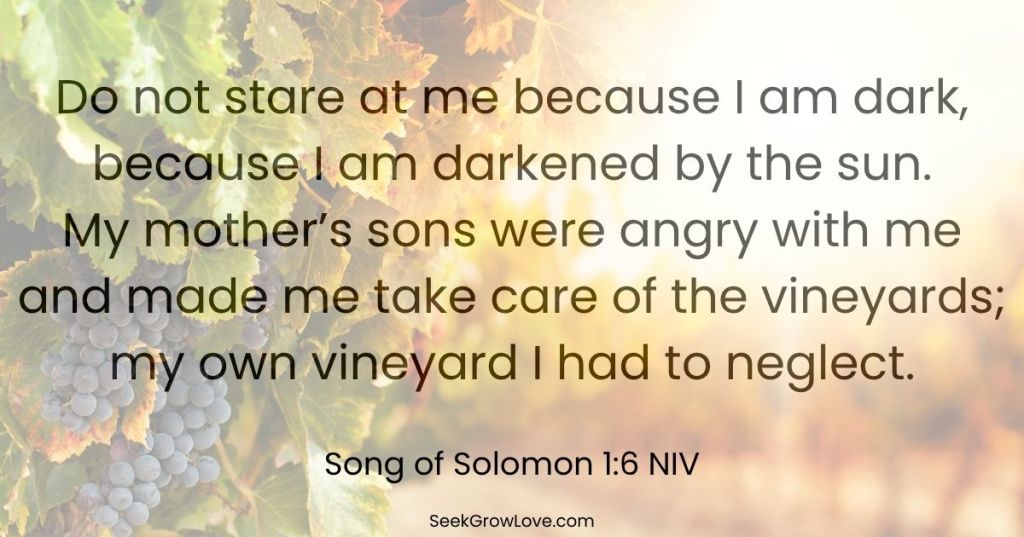
Yet right in the midst of this jubilee of love is a hint of the woman’s insecurity. She says, “Do not stare at me because I am dark, because the sun has looked upon me” (1:6). Apparently, she is quite self-conscious about how she appears to others. She says that she works in the sun and seems aware of the fact that she has become dark because of it, and that may not fit the standards of beauty in her culture.

I think this expresses something deeply human as we all know what it is like to feel exposed, inadequate, or less than what we think others expect of us. We compare ourselves to others; we think about our weaknesses or our failures; and we often wonder whether people would still accept us if they knew everything about us.

What comes next pierces through that chatter. The response of her beloved counteracts her insecurity: “O most beautiful among women,” (1:8), and “Behold, you are beautiful, my darling!” he says (1:15). He does not respond to her insecurity by pointing out her flaws but speaks words of love, affirmation, and delight. He seeks to overwrite her negative self-image with truth. In his affirmation of her, the lover does not trivialize her mistaken view, but simply paints an entirely different picture on the canvas of her mind so that she can begin to believe a different narrative than the one she has been telling herself.

This can remind us of the way God sees us. God sees us more clearly than anyone else ever could. He knows every weakness, every hidden thought, every regret, and every place where we have failed. Yet through Christ, we are not defined by shame, guilt, and unmet expectations. Instead, we are forgiven, accepted, and brought near.

In our insecurity, we might imagine that God merely puts up with us. But we know that He loves us dearly since Scripture tells us He does. But perhaps we struggle to believe that He actually delights in us. And so, if we think about that passion and eagerness of desire that the woman and her lover express in the first chapter of Song of Songs, even though it is a picture of human love, then it can challenge us to dismiss any fictional view of God’s love that is less than the truth.

Let’s have the truth God has told us in Scripture be the narrative we believe, and not the distorted story our fears, insecurities, failures, or past experiences try to write for us. So when insecurity, shame, comparison with others, or regret begin to creep into how we see ourselves, don’t let it! Instead, allow the truth of God’s love and grace overwrite that false portrait of who we are. We are God’s beloved. And He desires us!

Reflection Questions

  1. What lies about yourself do you tell yourself? What insecurities, shame, comparison with others, and/or regret have you allowed to distort your image?
  2. Have you accepted Jesus’s sacrifice to save you? What do you think God sees when He looks at and in you? Pray for God to show you.
  3. How can you help someone else see the truth and the beauty (inside and out) God has made them to be?

Prayer

Dear God, You are worthy of all my desire and love and it boggles my mind that You indeed desire a deep relationship with me. The lengths of Your great love for me, which Your Son then learned from You, are extraordinary. Help me to see clearly who You have made and saved me to be, removing all lies, attitudes and actions that interfere with me receiving Your love, returning love back to You, and spreading Your love.

Set Me as a Seal

Song of Solomon 5-8

While I was in college at Ohio Northern, I was a member of their touring choir. We sang many beautiful pieces, most of them filled with Christian content and stories. Our director chose them for their beauty or technical difficulty, as he was not a man of faith. But I loved the content. One piece from my years there stands out to me to this day because our director told us the story of its composition, and it has never left me.

René Clausen, an accomplished American composer and director, wrote Set Me As a Seal after the tragic death of his unborn child. After three miscarriages, he and his wife were six and a half months into pregnancy. Because his wife was 39, and their three previous children died before birth because of birth defects, the doctor wanted an amniocentesis done. Due to misplacement of the needle, the baby was killed instantly during the process. The Clausens still had to deliver their baby, who had no birth defects and was perfectly sound, in a delivery room to the sound of crying babies being born around them. 

I cannot imagine the agony. The senselessness of the loss is overwhelming to me. It was to Dr. Clausen and his wife as well. After the stillbirth of their fourth child, Clausen went home and composed Set Me As a Seal in 20 minutes. 

I remember singing this song with our choir, time and again as we went on tour. It was beautiful in its simplicity of words, and complexity of notes and harmonies. It sounded like a plea from a grieving heart. The lyrics were short but profound, and straight from Song of Solomon chapter 8, verses 6 and 7. 

“Set me as a seal upon your heart, as a seal upon your arm: for love is strong as death.

Many waters cannot quench love, neither can the floods drown it.”

While grieving the loss of another child, Clausen turned to scripture and faith and found his inspiration in a book of love songs written for a husband and wife. But these love songs aren’t just for husband and wife. They are to mirror the love that God has for each of us, and the love we should have for him. These lines represent complete ownership and belonging. They represent a love that is to last forever, that cannot be removed or washed away. 

God wants us to belong to him in such a way. He wants us to seek him first and always. And his love for us is also without end. How beautiful it is to know that a love this deep exists. When we are in our darkest hour, or in our greatest moment of joy, his love is the same. He is unwavering. 

As you read through the last half of these songs today, I hope you see the beauty of God’s love for you and the relationship he longs to have with you, and also the relationship Christ has with the church. You are beautiful to him, and worthy of love. You are so worthy, in fact, that Christ died for you. 

– Jenn Haynes

PS: If you would like to hear a lovely recording of Set Me As a Seal, this choir performs it beautifully: 

UNT A Cappella Choir: René Clausen – Set Me As a Seal Upon Your Heart (1989) 

I hope it helps you to reflect on his profound love for you

-Jenn Haynes

Reflection Questions: 

Do you see yourself as beautiful and worthy of the love God has for you? 

How do you think God sees you? 

Take a quiet moment to reflect on the fact that God’s love for you is so deep and passionate that he desires your love above all else. The God of the universe wants a relationship with you that is deeper than any other relationship you’ve ever had. He sees you as valuable and lovely. Hold that close to you. 

Chapters of Love

Song of Solomon 1-4

This collection of songs is something that, sadly, is frequently misunderstood and avoided today. At a wedding we celebrate love, yes, but certainly not like this. The beautiful imagery described in these chapters of love, desire and passion are everything we should want in a relationship with our spouse. Unfortunately, discussions of sexual desire and attraction like this are usually either twisted by an immoral society, or avoided by Christians. The world has thrown sex around until it’s dirty, misused, and undervalued. And Christian religion has gone in the complete opposite direction and has made it into something secret and almost shameful. We feel embarrassment.

But desire is not shameful at all when it is within its perfect time and place. Amidst all of this expression of love, there is one important phrase repeated again and again. 

“Do not arouse or awaken love until it so desires.”

There is no rushing here. When we want to be in a relationship or long to fill our sexual desires more than we long for God’s good and perfect plan, this is when everything falls apart. The imagery stops being intimate and beautiful. It becomes cheap and our relationship is no longer the reflection of God’s love for us that it should be. 

But when we acknowledge God first and seek him for our fulfillment, we restore the proper order of things. God created man and everything was good. Adam had God and relied on him completely. And in that complete reliance, God provided the perfect partner. 

God knows our needs far better than we do, and that includes our need for relationships and intimacy. When we seek him first before seeking fulfillment in others, God will provide in his own perfect timing. 

I hope you see the beauty reflected in these chapters! Love and desire within God’s plan is a treasure to be appreciated. 

-Jenn Haynes

Reflection Questions: 

For those who are unmarried: Do you find yourself growing impatient? Are you seeking fulfillment from people rather than God? How can you turn your focus more on your relationship with God and rely more fully on him? 

For those who married: Maybe you’re a newlywed, or you’ve been married for years, or you’re widowed. Take some time to reflect on your love. Read through the descriptions and think about your own beloved. What do you appreciate about your spouse? How did God provide for you by bringing you together? How does your relationship reflect the relationship God desires to have with you? 

My prayer for you today is that you see beauty in this passage. I pray you seek intimacy with God first, and that you rely on him fully. And for those who are/were married, I pray you are able to reflect and appreciate all of the wonderful qualities of your spouse. 

Not Just One, but Three

*Old Testament: Song of Songs 1-3

Poetry: Psalm 55

New Testament: Hebrews Intro – found below

Are you in for a special treat today! Not just because we are discussing Song of Songs (otherwise known as Song of Songs), but also because I looked into the SeekGrowLove archives and found not one, not two, but three great devotions on Song of Solomon (and then I stopped looking). So, today is a bit of a compilation with pieces from three previous devotions. The full devotions are linked below and are all worthy of a read/re-read.

From Rick McClain:

“The visuals painted in these chapters about a bride and groom are very sexual in nature, but is that what this book is about?  Some say it is an allegory of Jesus and his bride, the church.  I doubt this is true because Jesus wasn’t even around in the Old Testament when this was written.  I don’t think the concept of the church being the bride of Jesus was known back then so why would someone write an allegory about that?  It is also believed by some that it could be an allegory about God and the people of Israel.  There are no doubt similarities between the relationship of a bride and groom and the relationship between God and His people, but why would someone use such erotic sexual material to describe how God thinks about Israel and vice versa?

I believe it is love poetry and I am thrilled that the Bible has affirmed that the sexual desire I have for my wife is a good thing.  I know that will make some of you squirm a bit because we don’t usually talk about this stuff, especially in church.  However, I think one of the main points of this book is to show that the physical attraction between a bride and groom is a beautiful thing that God has created for them to enjoy.”

“But back to the song of all songs.  I am not going to go in great detail here about this book because you should read it for yourself.  I couldn’t stop thinking about how much in love these two seemed to be.  It reminded me of when you see two young people in love, and their love is just oozing all over each other so much so that they don’t even notice anyone else is around.  They can’t stop smiling at each other and they are on cloud nine.  We usually roll our eyes at them and think they are being ridiculous, but this is exactly the kind of love that was on display in these eight chapters.  Solomon gushed about her eyes, hair, neck, lips, and body parts that reminded him of fawns, but it didn’t stop there.  I knew this was a story about real, intense, true love when he mentioned her teeth.  He didn’t just say she had beautiful teeth, he said her teeth were like a flock of newly shorn ewes.  Don’t picture dirty ewes that have been rolling around in the dirt, Solomon said the ewes had just come up from their washing.  Moreover, all these ewes bore twins, and not one of them had lost their young.  He said all of that about her teeth!?!?  That dude was crazy in love!  And she was just as ridiculous as him, which can be seen when she says her beloved is like a cluster of henna blossoms from the vineyards of Engedi.”

From Steve Mattison:

SoS 2:2 says, “Like a lily among thorns is my darling among the maidens.”  Husbands and future husbands take note.  Highlight what you appreciate about your wife, and make sure she knows it well and often. But the praise must be sincere.  And if it’s appropriate and if she would appreciate it, make sure you extend this praise publicly.  But don’t just stop with praise.  Treat her like she is precious because she is.

SoS 2:4 contains part of the wife’s response, “His banner over me is love.”  All by itself, this sounds pretty weird.  I think this is saying that her husband is publicly proclaiming his love for her – sort of like writing it on a flag, and waving it around for everyone to see.  He is not ashamed to acknowledge her publicly.  Again, husbands take note.

In SoS 2:6, the wife goes on to say, “His left arm is under my head, and his right arm embraces me.”  I’ll leave it to your imagination to consider their position and presumed activity.  Husband’s again take note.  If you shower your wife with love.  If you make her a priority, and she knows it.  If she knows you’re never ashamed of having her at your side.  Things will go a lot better with your love life.

She goes on to say in SoS 2:7, “Do not arouse or awaken love until it so desires.”  I would say that differently.  I would say “save sex for marriage” – and then, it is a wonderful blessing from God for both husband and wife to enjoy to the fullest together.

In his reply, in SoS 2:15, the husband says, “Catch for us the foxes, the little foxes that ruin the vineyards, our vineyards that are in bloom”.  I think the idea here is that there are always little things that can attack the relationship, and these things need to be caught and stopped.  Some examples may include selfishness, pride, never admitting that you are wrong, finding fault, unforgiveness, mistrust, etc.  All of these have to be dealt with and removed in order for the love to blossom and flourish.

And you have to love that part in verse 17 where she says, “until the day breaks and the shadows flee…”.  It sounds like she is talking about being intimate all night long.  So, husbands, if you want verse 17, you have to have to practice verses 2 and 4 and 7 and 15.  In other words, if you want a great sex life in your marriage, adore your wife.  Let that show in everything you do and in every way you treat her, and you will see results.

Oh yeah, and do the same with your relationship with God, and you’ll see great results there too – both now and forever.”

From Maria Knowlton:

“So how do you use SOS to make a difference in your life?  How do you make this a part of your devotion?  A friend of mine told me that her pastor recently preached a sermon on it and encouraged husbands to tell their wives they are beautiful.  So there you go husbands!  God wants you to complement your wives!  Use lots of flowery words! (Check out youtube for examples on how to use King Solomon’s words to make your woman swoon!)  Ok, that was a little facetious. Seriously, most woman do want to know her man desires her (but maybe not in the words of chapter 4) and God has provided an example of this along with His blessings.
My friend thought of another take on SOS.  She thought that since her husband was being encouraged to tell her she’s beautiful, she should make more of an effort to be beautiful.  She looked at verse 1:6 when the Shulammite woman tries to hide from Solomon.  So my friend decided that in addition to not wearing sweats all day, she would close the door while using the powder room and not burp or otherwise display gross behaviors in front of her husband.  We all laughed when she told us that he didn’t notice but her point was that we shouldn’t take our husbands for granted and we should make an effort to be beautiful for our husbands. We also need to keep in mind verse 2:15, “ Catch for us the foxes, the little foxes that ruin the vineyards, our vineyards that are in bloom.  The chorus talking here, saying not to allow anything to spoil the man and woman’s relationship.  Good advice for all of us in any relationship.
The world may have cheapened the physical relationship between a man and a woman,  likening it to something as casual as a game of ping pong.  SOS reminds us that it is truly a wedding gift from God that is to be treasured, embraced, and protected.
So if you are married, read today’s reading with your spouse and have a great night! ; )”

God made sex. And He made it good. To be enjoyed by one man and one woman who are married – meaning they have committed their lives to one another til death do them part. There are a lot of verses in Song of Solomon that have never been made into refrigerator magnets or wedding invitations – but I do love 2:16a “My beloved is mine and I am his.” Such a beautiful declaration of a deep, mutual devotion to the love of your life. It is indeed perfect for a wedding invitation! But, how many couples can say the same thing 10, 20, 30, 50 or more years down the road. How do we keep the love from growing cold – which will happen when the fire isn’t tended? Marriage is complex and there is no one easy answer – but Song of Songs does have some useful tips for fanning that flame with your spouse.

-Marcia and Steve and Rick and Maria

Steve Mattison’s “A Love Poem” – posted by SeekGrowLove on July 22, 2022

Rick McClain’s “OohLaLa” – posted by SeekGrowLove on June 1, 2020

Maria Knowlton’s “SOS” – posted by SeekGrowLove on Feb 3, 2017

Reflection Questions

  1. If you aren’t married yet – what is the greatest take-away you found in Song of Solomon?
  2. If you are married – what is the greatest take-away you found in Song of Solomon?
  3. Why do you think God included Song of Solomon in the Bible?

Hebrews Introduction

The title of the book of Hebrews suggests it was written to Jewish Christians.  We don’t know who wrote the book.  Although some suggest the author may have been Paul, Hebrews 2:3 almost certainly refutes this.  Whoever it was knew their Old Testament very well, and wrote persuasive arguments showing that Jesus is greater than everyone and everything in the Old Testament, including angels, priests, the law, Moses, sacrifices, etc.

The book of Hebrews points out that the law was only a shadow of the good things that are coming (Hebrews 10:1). Colossians 2:16-17 goes on to say that the reality is found in Christ. And Jesus became the ultimate high priest, who offered himself as the ultimate sacrifice once and for all.

The two main points of Hebrews are to encourage Christians to endure, and to warn Christians to remain faithful in following Christ.  

Hebrews 11, the faith chapter, is probably the best well-known chapter in Hebrews.  One of the most well-known verses is 11:4, “And without faith, it is impossible to please God, because anyone who comes to him must believe that he exists and that he rewards those who earnestly seek him.”

-Steve Mattison, again 🙂

A Love Poem

Song of Solomon 2

Friday, July 22, 2022

Song of Solomon contains poetry written by Solomon.  Some people try to spiritualize it, suggesting it describes the relationship between God and a follower of God.  Those who think that have obviously not read it.  Song of Solomon describes the intimate relationship between a husband and a wife, sometimes a little graphically.  If you’ve never read the Bible before, the Song of Solomon just might pique your interest.  I’ll share a few verses from chapter 2.

SoS 2:2 says, “Like a lily among thorns is my darling among the maidens.”  Husbands and future husbands take note.  Highlight what you appreciate about your wife, and make sure she knows it well and often. But the praise must be sincere.  And if it’s appropriate and if she would appreciate it, make sure you extend this praise publicly.  But don’t just stop with praise.  Treat her like she is precious because she is.

SoS 2:4 contains part of the wife’s response, “His banner over me is love.”  All by itself, this sounds pretty weird.  I think this is saying that her husband is publicly proclaiming his love for her – sort of like writing it on a flag, and waving it around for everyone to see.  He is not ashamed to acknowledge her publicly.  Again, husbands take note.

In SoS 2:6, the wife goes on to say, “His left arm is under my head, and his right arm embraces me.”  I’ll leave it to your imagination to consider their position and presumed activity.  Husband’s again take note.  If you shower your wife with love.  If you make her a priority, and she knows it.  If she knows you’re never ashamed of having her at your side.  Things will go a lot better with your love life.

She goes on to say in SoS 2:7, “Do not arouse or awaken love until it so desires.”  I would say that differently.  I would say “save sex for marriage” – and then, it is a wonderful blessing from God for both husband and wife to enjoy to the fullest together.

In his reply, in SoS 2:15, the husband says, “Catch for us the foxes, the little foxes that ruin the vineyards, our vineyards that are in bloom”.  I think the idea here is that there are always little things that can attack the relationship, and these things need to be caught and stopped.  Some examples may include selfishness, pride, never admitting that you are wrong, finding fault, unforgiveness, mistrust, etc.  All of these have to be dealt with and removed in order for the love to blossom and flourish.

In SoS 2:16-17, the wife says, “My lover is mine and I am his; he browses among the lilies.  Until the day breaks and the shadows flee…”.  She is talking about how exclusive the marriage relationship must be.  (Unfortunately, Solomon didn’t do very well in this regard.  Maybe she should have said, “my lover is mine, and I am his and a thousand other women are his.”  Can you imagine how that would make your wife feel – if this wasn’t an exclusive relationship?  Husbands, again take note.

And you have to love that part in verse 17 where she says, “until the day breaks and the shadows flee…”.  It sounds like she is talking about being intimate all night long.  So, husbands, if you want verse 17, you have to have to practice verses 2 and 4 and 7 and 15.  In other words, if you want a great sex life in your marriage, adore your wife.  Let that show in everything you do and in every way you treat her, and you will see results.

Oh yeah, and do the same with your relationship with God, and you’ll see great results there too – both now and forever.

–Steve Mattison

Application Questions

  1. If you aren’t married yet – what is the greatest take-away you found in Song of Solomon 2?
  2. If you are married – what is the greatest take-away you found in Song of Solomon 2?
  3. Why do you think God included Song of Solomon in the Bible?

Smokin’ Hot Mama OR The End Of SOS – Which Title Do You Prefer?

Song of Solomon 5-8

song-of-solomon-8_6

Saturday, February 4

As I mentioned yesterday, there is quite a discrepancy of opinions among Biblical scholars about SOS (Song of Solomon).  Commentators such as Matthew Henry and James Durham believed SOS was solely allegorical.  Whereas, in the “Passion Pursuit” class, the ladies referred to the Shulammite woman as a “Smokin’ Hot Mama”.   In his commentary, Ray Stedman states that the Bible, especially here in SOS, handles physical passion frankly and forthrightly.  In my research, I found an excellent commentary that blends both lines of thought (it was also mentioned several times on the Authentic Intimacy website). How to Love God With All Your Heart by Keith Simons and Mark Kirkpatrick analyzes each verse in both its literal and allegorical interpretations.

I really appreciate being able to pull from both interpretations when it comes to real life applications.  If you are single, the literal application may not apply.  If you only take the allegorical application, you will miss the beauty of physical love and permission from God to be a “smokin’ hot mama” or “dude” in the marital realm.

It makes a lot of sense that SOS follows the other poetic books of the Bible not only because of its poetic nature but also because it offers wisdom for living as do the other books.  Ray Stedman refers to the 5 books of poetry as each containing a “cry.”  Job is the cry of the spirit. Psalms, Proverbs, and Ecclesiastes are the cry of the soul.  SOS is the cry of the body for love.  He goes on to say that because the devil pushed this beautiful gift to extreme evil, Victorianism pushed sex into prudishness, as if it were something to be ashamed of.  SOS represents “sex as God intended it to be, involving not just a physical activity, but the whole nature of man.”

When having “the talk” (one of many) with our son, we described the reproductive purpose of sex and the bonding purpose.  Husbands and wives need to “reenact SOS” to bond.  In fact, I learned in the “Passion Pursuit” class there are many studies that show that the same hormone that bonds a mother to her child, oxytocin, is released during sex and plays a role in bonding a man and woman together.  Of course, discussing the bonding purpose of sex with our son was a little harder than the reproductive purpose.  Both of our children were adopted so he knew that wasn’t an issue… was hoping he wasn’t going to put 2 and 2 together for the other purpose! But alas….

SOS is also a beautiful allegory for God’s love and want for intimacy with his people. The New Testament also compares Christ and the church as a groom and his bride. So clearly, God created marriage as an allegory for this relationship.  I cannot state all of this nearly as well as Simons and Kirkpatrick, so I really encourage you to read How To Love God With All Your Heart ( http://www.easyenglish.info ) or just Google it!

I didn’t recall signing up for writing a devotion on SOS at Family Camp.  I just wanted to do the devotions between school semesters.  But I’m really glad I did.  I got to use some of the stuff I learned in “Passion Pursuit” and I did research I probably wouldn’t have gotten around to doing if I didn’t have to write about it.  We all make jokes about King Solomon’s pick up lines, but in truth, SOS is a beautiful book to be read on several levels.  I think God included SOS in scriptures so that we know that “every good and perfect gift is from above.” (James 1:17)

God bless you and the reading of His Word!

Maria Knowlton

(Maria’s devotion shared this week were originally used as part of a year-long Bible reading plan following 2015 COG Family Camp at Camp Mack.  We thank her for permission to reprint them here).

 (photo credit: http://www.godswordimages.com/wallpaper/love/song-of-solomon-8-6/)

SOS

Song of Solomon 1-4

sos700

Friday, February 3

I hadn’t gotten around to registering for the “mom’s” conference, Hearts at Home, until a few days before and couldn’t find the class descriptions so I had to sign up for classes just based on the names.  I saw one called, “Passion Pursuit,” taught by Dr. Juli Slattery and Linda Dillow.  I’ve heard Dr. Slattery on Focus on the Family and at previous Hearts at Home conferences and really enjoyed learning from her. I also figured I’d like to figure out what I have a passion for, so I signed up for this class.
Pursuing one’s occupational or spiritual passion was NOT what this class was about!  It was about that one book your pastor rarely, if ever, speaks on, the book I personally have never done a jr. church series of lessons on, and as of yet, the one book we’ve never had the kids memorize verses from. That’s right! I’m talking about The Song of Solomon (SOS)!  (Signal collective blush from everyone’s cheeks.)
Over the years, there has been debate about what this book is about and why it is in the Bible.  I did a little bit of research and almost everyone agrees that this book is about God’s great love for His people and the intimacy He wants to have with both the Israelites and those of us who have chosen to become adopted seeds of Abraham.  Where debate and controversy lies is that other meaning.  As Bob Jones stated in his book, “ The 5W’s and 1H of Genesis Through Malachi,”  Song of Songs is to be seen as, “literally describing the sanctity and beauty of human physical love…Maybe God wants us to read this book so that we return marriage and sexuality to the holy place He has always intended them to occupy.” p. 70  The ladies teaching “Passion Pursuit” agree with Bob.  SOS is a book celebrating God’s love for us but it is also celebrating the gift God gives a couple upon their marriage. Those of us who have taken those vows are to embrace this gift to the fullest.( Dr. Slattery and Mrs. Dillow created an online ministry to help people do this called “Authentic Intimacy.”  I highly recommend checking this out. They have scriptural advice and instruction for anyone looking to have greater, true intimacy with God and their spouse or in preparation for marriage.)
Yes, there are a few problems with the actual book.  If Solomon was the author, which most consider as fact, he wasn’t exactly a one woman man.  My study Bible states he probably had 140 wives and concubines at the time and more throughout his life.  Not exactly a fact that would make a woman feel special!
This is also a very hard book to follow. They’re in a garden, she’s having a dream, they’re married….What is going on???? They are also talking in metaphors and similes…they’re in an actual garden, He’s in her “garden.”  And if it weren’t for the headings in my Bible, I would have no idea who is talking.  The Shulammite woman is talking, a whole bunch of women are talking (where did they come from?!) And even God speaks once.  This is a book you’ll benefit from reading along with a commentary.
So how do you use SOS to make a difference in your life?  How do you make this a part of your devotion?  A friend of mine told me that her pastor recently preached a sermon on it and encouraged husbands to tell their wives they are beautiful.  So there you go husbands!  God wants you to complement your wives!  Use lots of flowery words! (Check out youtube for examples on how to use King Solomon’s words to make your woman swoon!)  Ok, that was a little facetious. Seriously, most woman do want to know her man desires her (but maybe not in the words of chapter 4) and God has provided an example of this along with His blessings.
My friend thought of another take on SOS.  She thought that since her husband was being encouraged to tell her she’s beautiful, she should make more of an effort to be beautiful.  She looked at verse 1:6 when the Shulammite woman tries to hide from Solomon.  So my friend decided that in addition to not wearing sweats all day, she would close the door while using the powder room and not burp or otherwise display gross behaviors in front of her husband.  We all laughed when she told us that he didn’t notice but her point was that we shouldn’t take our husbands for granted and we should make an effort to be beautiful for our husbands. We also need to keep in mind verse 2:15, “ Catch for us the foxes, the little foxes that ruin the vineyards, our vineyards that are in bloom.  The chorus talking here, saying not to allow anything to spoil the man and woman’s relationship.  Good advice for all of us in any relationship.
The world may have cheapened the physical relationship between a man and a woman,  likening it to something as casual as a game of ping pong.  SOS reminds us that it is truly a wedding gift from God that is to be treasured, embraced, and protected.
So if you are married, read today’s reading with your spouse and have a great night! ; )
– Maria Knowlton

 (photo credit: cartoon by Andrew Fraser – found at http://www.cartoonsidrew.com/2014_10_01_archive.html)