How to Be Stupid

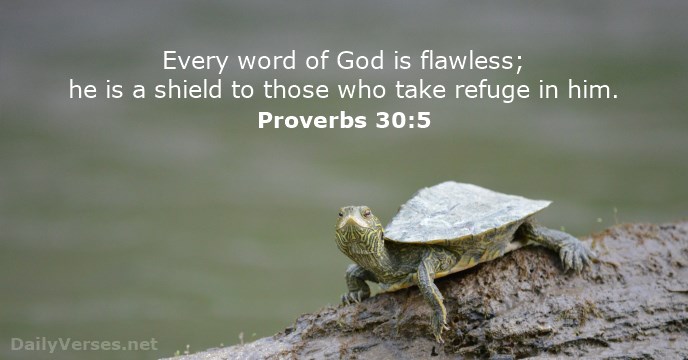
Proverbs 11-13

prov-12-1

Tuesday, January 24


How have you used your “fountain of life” today (Proverbs 10:11)?  Did you know when to keep it shut?  Can you think of a time when you used it (your mouth) to nourish others?   In today’s readings there are several more excellent verses reminding us again of the power of our words.  And of course we know that “With Great Power Comes Great Responsibility”.  Some verses worthy of being great refrigerator verses are:

11:12 – A man who lacks judgment derides his neighbor, but a man of understanding holds his tongue.
12:18 – Reckless words pierce like a sword, but the tongue of the wise brings healing.
12:28 – An anxious heart weighs a man down, but a kind word cheers him up.
13:3 – He who guards his lips guards his life, but he who speaks rashly will come to ruin.

My guess is we can all quickly think of a time when someone’s words pierced us, and also a time when someone’s words healed us.  Can you also think of a recent time when your own words pierced another?  What about brought healing or cheered up someone?   How can we make a better plan for our mouth so we don’t just say the first thing that comes to mind, which can lead to ruin?

How about experimenting with ranking your mouth at the end of each day for the next week or two.  A big fat score of 0 would be for a day filled with piercing words spoken rashly: accusations, angry outbursts, rudeness, gossip, lies or twisted truths, put-downs (even in jest? It’s not really funny), boasting, manipulating, cursing and foul language, I’m sure you can think of more.  And of course our goal would be a shining 10 score for a day full of polite speech, genuine compliments, thankfulness, apologies, forgiveness extended, words of encouragement and sometimes sympathy, morsels of truth at just the right moment, Godly wisdom and Bible verses shared – and none of that nastiness that automatically pull your score down.  From day to day be looking for ways to grow your own score.  Be more mindful of how you use your words  – and sometimes more appropriately, your gift of silence – and the impact it has on those around you.   Hold yourself accountable for the proper use of your fountain of life.  For only then will you be called righteous.  (10:11)

There is so much more wisdom and lessons for the one seeking to live a righteous life!  Come to think of it – Proverbs also has great advice if you are aiming to be a stupid fool.   Solomon could have titled Proverbs, “How to Be STUPID”.  Proverbs 12:1 is a great start: “Whoever loves discipline loves knowledge, but he who hates correction is STUPID.”   And, since reading it once isn’t always enough . . .

13:1 – He who ignores discipline comes to poverty and shame, but whoever heeds correction is honored

13:10 – Pride only breeds quarrels, but wisdom is found in those who take advice

12:15 – The way of a fool seems right to him, but a wise man listens to advice

Raise your hand if you think you are right most of the time.  My hand goes up.  Guilty as charged.  No doubt it is my pride that makes me think I am right and they are wrong.  Sometimes, I AM right.  But, when I am WISE I will realize and accept that I am also sometimes wrong.  I have been, am and will be wrong, in need of correction and discipline and sorely in need of advice.  Why should I even LOVE discipline (12:1)  – because I want more and more to be as Godly as possible (Be holy, because I am holy – I Peter 1:16)– and right now there is still a pretty huge gap between God’s holiness and mine.   Dear God, help me grow a more humble spirit that accepts correction well.

So many great proverbs, so little time.  We sadly won’t go into detail about the sluggard, pig snout, chasing fantasies or husband’s crown or so many others.  But just one last nugget for those who want to be wise. “He who walks with the wise grows wise, but a companion of fools suffers harm” (13:20). If you desire to avoid harm (and I sure hope you do) – choose your companions carefully.  Don’t waste your time searching for perfect people to be friends with – that can be a real disappointment.  But choose to spend your time side by side with those who are seeking to grow closer and closer to the Father.
Keep Growing!
God Bless,
Marcia Railton


My Mouth – Wise or Foolish?

Proverbs 8-10

proverbs10_9


Monday, January 23

In/Out, Hot/Cold, Wet/Dry, Over/Under, Near/Far.  Beginning at a very young age opposites are a great learning tool.  Toddlers learn what wet is because it is the absence of what dry is, and vice versa.  Wise Solomon similarly employed the power of opposites throughout the book of Proverbs.   Wise/Foolish is the ultimate lesson of contrasts.  But in teaching the multitude of differences between wise and foolish numerous pairs of opposing opposites are introduced: joy/grief, diligent/lazy, wealth/poor, love/hatred, nourish/die, choice silver/little value, length to life/years cut short, refuge/ruin, and righteous/wicked.  A very clear picture emerges of what is indeed wise and what is not.  And with the picture comes a strong desire to find myself more and more camped out on the side of the wise.  But how do I do that?

Mouth, lips, words, tongue – it becomes obvious that wisdom is not just for the mind and following God is not just for the heart.  Our mouths must play the part, too.  Some great verses in Chapter 10 are aimed at the use of the mouth.

10:11 – The mouth of the RIGHTEOUS is a fountain of life,  but violence overwhelms the mouth of the WICKED.
10:21 – The lips of the righteous nourish many, but fools die for lack of judgment.

10:31 – The mouth of the righteous brings forth wisdom, but a perverse tongue will be cut out.

10:32 – The lips of the righteous know what is fitting, but the mouth of the wicked only what is perverse.

And, we not only read of how to use our mouth – there is a helpful reminder when NOT to use it as well . . .

10:19 – When words are many, sin is not absent,
but he who holds his tongue is wise.

Dear God – May I use my mouth as a fountain of life that nourishes many – those in my house and in my church, neighborhood, school, social media and employment.   May the words I speak (as well as those I chose not to say) give life and point others to you.   Help me know when to keep my mouth shut – putting an end to useless arguments, pride, put-downs,  harmful dissension,  potty mouth, “little white lies”, and big black ones, too.  Help me be more intentional about how and when I use my words – that they might draw me closer to you and to becoming what you desire for me.
In Jesus Name, Amen.

God Bless Your Reading,
Marcia Railton
(Photo credit: http://www.verseoftheday.com/en/09102013/)


Where Wisdom Can Be Found

Proverbs 1-3

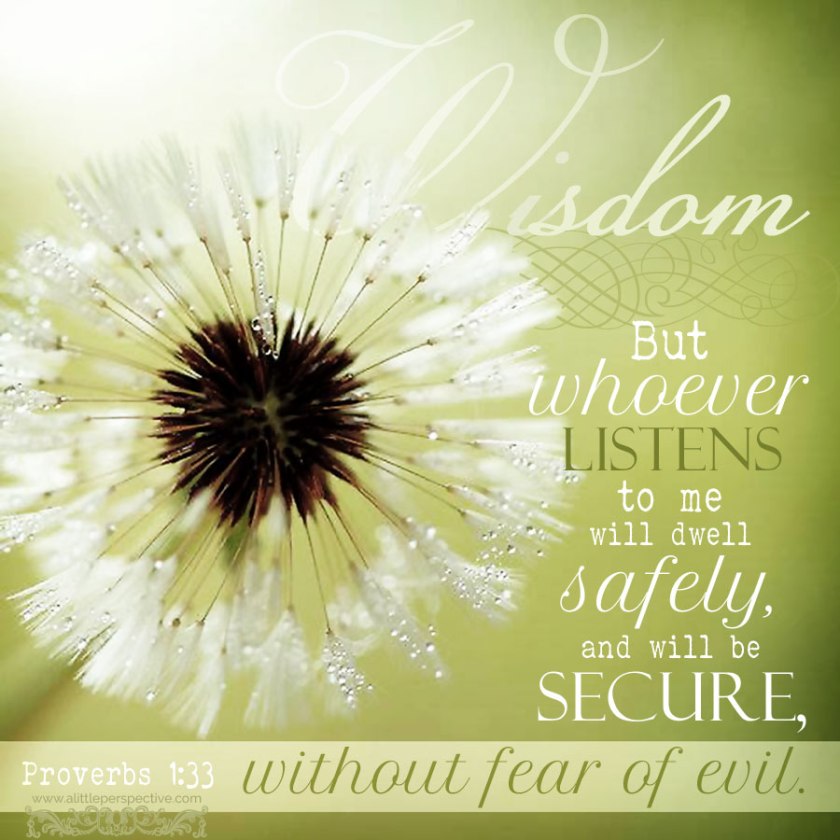
pro-1-33-ww-notrace-9x

Saturday, January 21

There is a great contradiction in today’s world. In a time when we are experiencing exponential expansions in knowledge, we are also suffering significant shortages in wisdom.   We had placed value so high on creation and discovery, that many have lost what is labeled as “common sense,” in the process.  There are plenty of planes, but no pilots, plenty of shells, but no yokes, plenty of bark but no bite? Wood? No matter.  I see it in adults and students alike.  They are missing a critical component in the navigation of life: wisdom.

.

Today, begins our reading in Proverbs, The Psalms’ more practical brother.  Much like an instruction manual, a lesson plan, or a mission briefing, Solomon, King of Israel and our author, lays out the purpose of this book in the opening verses:

“ <These Proverbs are> for gaining wisdom and instruction; for understanding words of insight; for receiving instruction in prudent behavior, doing what is right and just and fair for giving prudence to those who are simple, knowledge and discretion to the young” – Proverb 1: 2-4

The faith of Proverbs is not theoretical, hypothetical, or abstract. It is the pragmatic and clinical day-to-day application of faith.  It is the “how-to” or “for Dummies” book of those who are trying to live for Christ.  Even without true understanding of the meaning behind these words, one only needs to put them into practice, and they will immediately benefit. Solomon was granted special insight to God’s infinite knowledge and ultimate goodness. Through this, he had the ability to prioritize, see the sequence of events, discern the lasting outcomes of every decision, and sense the overriding nature of man  throughout his reign.  How did he obtain such a gift?  He asked (2 Chron 1:7-12).


“For the Lord grants wisdom!  From his mouth come knowledge and understanding.  He grants a treasure of common sense to the honest.  He is a shield to those who walk with integrity.  He guards the paths of the just and protects those who are faithful to him.” – Proverbs 2:6-8


“If you need wisdom, ask our generous God, and he will give it to you. He will not rebuke you for asking. But when you ask him, be sure that your faith is in God alone. Do not waver…” – James 1:5-6a


Thankfully, the wisdom of Solomon is available to us.  Yes, literally, here in the Proverbs, as we pour through a lifetime of wisdom in a handful of days, but also in a direct-to-us, handpicked for today’s questions and quandaries type of way.  The only condition is, like Solomon, we ask.  You don’t have to have a certain number of gray hairs, grow a long beard, or wear your glasses on a chain.  God has promised to give generously to all, without finding fault.


Let this time you spend in Proverbs begin or reignite your prayerful pursuit of God’s timeless wisdom.

-Aaron Winner

(photo credit: http://www.alittleperspective.com/proverbs-1-2016/)

Kings and Queens Make a Full House

II Chronicles 8-11

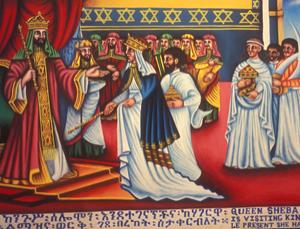
queen-of-sheba

Saturday, November 26

Solomon has completed building the Temple and his house and has moved on to building cities. Everything Solomon touched was lavished with beauty and excess. He built one entire city for the purpose of housing his many horses and chariots. That is one way to build a name and gain a reputation. As word of Solomon traveled outward to other nations, interest grew to understand what this king was all about. Solomon shows that his desire to build was for his own pleasure and he enjoyed the benefits that his talents garnered. He was a man on display. He worked hard to share how God had chosen him to bless the nation of Israel and show justice and righteousness to God’s children.

One thing that was lost on Solomon was that God was the creator of all and wanted Israel to be a light to the nations. Instead  he would not allow Israel to do certain jobs he felt beneath them and would take nations as slaves and indentured servants to do the ugly work.

When the Queen of Sheba heard of Solomon she traveled herself to see if what she was hearing was true. And indeed she found him to be a man full of wisdom and in control of vast lands and wealth. After swooning over all his fame and power, she tells King Solomon, “It was a true report that I heard in my own land of your acts and of your wisdom. However I didn’t believe their words until I came, and my eyes had seen it; and behold, the half of the greatness of your wisdom wasn’t told me: you exceed the fame that I heard.” II Chron. 9:5-6

Even though Queen Sheba had heard the truth, it did not resonate with her until she saw it for herself. Others bringing word to her was not enough. King Solomon sounded too good to be true. This is why it is so important to be living out the word of God in our lives so that the message of Christ rings true to those who observe His truth in action. I can write this out using the electronic medium at our disposal today and maybe be a witness to some on God’s behalf; but it is the personal relationships that we create that witness into people’s lives and situations at a much more powerful level.

Solomon understood about God. He even spent an incredible amount of time and resources devoted to sharing Yahweh with others. Solomon was wonderful at telling others what would be best in any given circumstance, but he was not so good at heeding his own lessons. He is like some we witness who gain power and begin to feel they are above the law.

Years ago Brother Billie Kennedy said in a message at Camp Mack (yes, I am going back that far in my memory bank!) “Some people will miss the kingdom of God by 18 inches because that is how far it takes to get from your head to your heart.” That last few feet is the hardest step of all at times, but when we reach that final destination I am hoping for a full house and do not want anyone to miss out by just a few inches.

If the Queen of Sheba thought putting in the effort to check out the truth of who King Solomon was, how much more should we seek out the truth of God’s love and mercy toward all of his children.

-Glennis Walters

Ask What I Shall Give You

The Second Book of Chronicles Chapters 1-4

Book of 2 Chronicles

Thursday, November 23

The life of King David comes to an end and ushers in the life and times of

King Solomon. II Chronicles opens with “Solomon the son of David was strengthened in his kingdom, and Yahweh his God was with him, and magnified him exceedingly.”  This verse would be a great way to end the story of his life, but these are the early years when he was still seeking after God.

Solomon decided since his kingdom was in order he was going to reward himself and prepare a feast for his friends and family and fans to attend. He also offered great sacrifices to God. It was a partay magnificent~ He was consumed with doing everything right and pleasing God, but his spirituality was more of a surface variety and didn’t hold up to future challenges.

After the great amount of feasting and great amount of offerings, God came to Solomon in a dream that night and tells him to “ask what I shall give you.” I had never noticed this before. I had always assumed that God told him to ask for whatever he wanted. God was ready to tell Solomon something important and instead Solomon reminds God how he had shown grace to David and explains to God how he needs wisdom and knowledge to be a leader and judge Gods people.

God gives Solomon what he asked for and then tells him that all he achieves will be additional gifts from God. His riches, wealth, honor unlike any before him or after him will be from the hand of God. Solomon goes on to do marvelous deeds. He builds the temple and his own personal home (Palace) and hanging gardens that were the envy of the world. Leaders came from far away, just as God promised to bow down and offer gifts. He is a man on the rise. Only he isn’t the messiah, and he is also ready for a fall.

David had prayed that Solomon would be the Messiah and at times Solomon seems to believe he was. David prayed specific prayers over Solomon (Psalms 72) and he seems to try and live up to his father’s desires, but he falls short. Solomon, for all his wisdom and attempts at trying to be the messiah fails and shows us once again the need for a true savior.

I think we all need to look at v.7 again and put our name in place of Solomon.  “In that night (after feasting and worshiping God and giving gifts to God for all his blessings) God appeared to _______ and said, Ask what I shall give you.

“Ask what I shall give you!”…. He is our reason for all our Thanksgiving. Find a way today to bridge a gap or help heal a hurt or simply remind someone how much God has given and stands ready to give.

Glennis Walters


A Second Chance Squandered (I Kings 13-15)

Tuesday, November 1

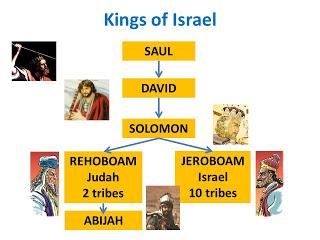
kings-of-israel-pic
written by: Melissa New
It is amazing how kind our Father is. Previously, we saw that Solomon deliberately disobeyed God and because of his sin, which in turn led many others to sin by worshipping idols, God did what He said He would do. He would “tear the kingdom away from you (Solomon) and give it to one of your servants.” (I Kings 11:11) He sent the prophet Ahijah to tell Jeroboam of some spectacular news for his future.  God was making a new covenant promise for Jeroboam! Solomon broke his covenant promise from God, and now Jeroboam is given the opportunity to enjoy a covenant promise. Could he learn from the mistakes he saw Solomon make? If he would be wholeheartedly devoted to God, as David was, then Jeroboam could have the benefits of a similar promise!
We find in these chapters that Jeroboam’s god was “power.”  He was unwilling to risk losing any of it. He didn’t trust the promise of God. He thought he could better rule the people of Israel without God. So he made golden calves for the Israelites to worship. He led the people into idolatry. But God gives Jeroboam a second chance! Just as he warned Solomon, he sent a man of God to tell of his demise.  Jeroboam’s life would come to a nasty end because of his sin.  He didn’t listen to the man of God even though he proved that what God says comes true. In chapter 13 we see that another prophet learns that what the “man of God” said was, indeed, true, but Jeroboam would not “turn from his evil ways.” In chapter 14 we see that Ahijah no longer has good news for Jeroboam. His prophecy for Jeroboam is dishonorable death and a future dispersing of the Israelites.
The legacy of Jeroboam is wickedness. Israel will have 20 kings until they are taken over by Assyria, and all of them will be BAD. Many times Christians think that a little sin in their lives only affects themselves. And it’s true that leaders, like Jeroboam, have a lot more influence, but sin has consequences for any who see or are around it. In some cases, it could have an impact on people not even born yet.

Incomparable Blessings Followed by Incomplete Obedience (I Kings 10-12)

Monday, October 31

1-kings-11_38
Melissa New
If ever there was a man that “had it all”, Solomon was that man. Precious things were flooding into Israel during his reign. Gold, silver, wood, horses, spices, weapons, mules, jewels…..and wives. 10:21 tells us the wealth was so immense that “silver was considered worthless in Solomon’s day!” There was just one thing that Solomon was lacking; complete obedience to God. His dad warned him before dying. Why didn’t he keep the sound advice of his father? God’s great covenant blessings only come with one condition. Solomon himself told everyone in his prayer at the dedication, “You keep your covenant and show unfailing love to all who walk before you in wholehearted devotion.” (I Kings 8:9) In I Kings 11:10 we see that the LORD “had warned Solomon specifically about worshiping other gods, but Solomon did not listen to the LORD’s command.” It was a case of deliberate disobedience, and as any parent knows, this means that there has to be consequences.
God is such a good father. He explained to Solomon what would happen because of his disobedience. It would seem that Solomon didn’t take correction as well as his father always did, though. David worshiped God after his first son with Bathsheba died, he accepted the abuse of Shimei because if it was from God he knew it was justified. David confessed to God his sin in taking the census, asked for forgiveness, and then was distraught, but willing to personally accept the consequence for his sin. It would seem that when adversaries came up against Solomon, he didn’t ask God for help. Did Solomon hear of Ahijah’s prophecy to Jeroboam? It seems like he did, and instead of praying and accepting God’s decision, he tried to kill Jeroboam.
Our response to sin is indicative of our devotion to God. Unfortunately, we will all sin. It’s how we act afterwards that shows God and others what really matters to us.

UNfailing Love from the Promise Keeper (1 Kings 8-9)

Sunday, October 30 – start of week 15

img_0007

Melissa New

I love to picture in my mind the great King Solomon, in his prime, standing humbly before the newly finished temple. With his hands raised to Yahweh, he is the epitome of a great spiritual leader in that moment. And what a prayer! First, he recognizes that there is no God like our God. Then, he is grateful to Him for keeping his covenant. Solomon knows that it’s a precious privilege for him and the Israelites to have a permanent place to go to worship God and offer sacrifices. Next, he petitions for Yahweh to always hear and forgive when His people confess and repent. And Solomon wants this not only for the Israelites, but for any foreigners who would come to the Temple because they have heard of “your great name.” Finally, at the end of his remarkable dedication, he reminds the “O Sovereign LORD” that He had set Israel apart to be His “own special possession.” How cleverly and beautifully worded! It’s a reminder to all of the Israelites listening that they need to confess and repent when they do wrong for “who has never sinned?” he asks. It is vital, too, that we ask for forgiveness when we do wrong. We need to acknowledge our sin as the wickedness that it is, turn away from it, and instead turn with our whole hearts to God. There is comfort in knowing that we are His special possession too; and He will hear our heartfelt prayers and forgive.
Melissa New attends the McGintytown Church of God of Abrahamic Faith in Arkansas. She is pleased to be a part of this community of COG bloggers and is already feeling much blessed by it! Her favorite verse is Jeremiah 29:13 “You will seek me and find me when you seek me with all your heart.”

Giving God His Due

Saturday, October 29

Sherry Alcumbrack

Yesterday my father was able to participate in a program called The Honor Flight, they do this all over the United States. They take veterans free of charge on a flight to Washington DC and they visit the war memorials. They give them a t-shirt, hat, etc. and everything is free. Then when they come home they encourage a huge crowd to come and meet them at the airport, there were about 500 people that came to cheer them on. Many of them were family members but also people who just wanted to show their appreciation for the service these men had provided. We sang God Bless the USA and the National Anthem. There were honor guards, boy scouts, policemen, and other veterans there to show their support of these heroes. At the end they announce their names and everyone cheers for them. It was a great honor for all of the American heroes.

rev-4-11-pic

I was thinking as reading these chapters about how Solomon wanted to honor God by building Him a temple in Jerusalem. He spared no expense, it was huge. He had the cedar trees brought from Lebanon because they were the best. It said the whole temple was overlaid with gold. He hired craftsmen known for their work to come to the temple, they worked with bronze, gold, silver, stone masons, and carvers. They all had a part in the building of the temple, they all did what they were good at. This also parallels how it is in our churches today, in 1 Corinthians 12:12 it says “Just as a body, though one, has many parts, but all its many parts form one body, so it is with Christ.” We can all work in our church in some way, for the good of the rest of the body.  It took 7 years to build the temple. The reason King Solomon was so particular about building this house for God was that he wanted to honor Him.
Just like in the last chapter of the Bible there are some verses that have been repeated over and over as we have been reading the Old Testament, God repeats it again to King Solomon so I think it is something that we need to understand. I know when I have something important for my children’s future good, I will repeat it over and over, even if they think I am being annoying. This is important to the Israelites future and it’s also important for our future. We are all looking forward to the day that Jesus returns and sets up his kingdom on the Earth. It is a wonderful future that we are looking forward to and that is why God keeps telling them how to live a life that is pleasing to him. It is for our own good and for our future. I hope you are enjoying these stories and applying the lessons we are learning in our lives.

i-kings-pic

The Wisdom of Solomon…Or Not (I Kings 3-5)

Friday, October 28

By Sherry Alcumbrack

The first verse says King Solomon made a treaty with Pharaoh, King of Egypt, and married Pharaoh’s daughter. BIG mistake. In Deuteronomy 7: 3, they were told not to intermarry with other nations, not because God was being racist, but because He said in v.4 “For they will turn your sons away from following Me, to serve other gods.” As we will see in the later chapters this holds true for King Solomon.  It also holds true for us and we are told in 2 Corinthians 6:14 “Do not be unequally yoked together with the unbeliever.” Who we marry is one of the most important decisions in our lives. We had a speaker say at one of our retreats that only 1 of every 4 kids in the youth group would stay in church. And she said it held true for her family. She had 4 children and only one was still actively involved while 2 attended sporadically and one never attends. I asked what she thought was the deciding factor and she said “Who they married.” The one married another youth group kid and the others didn’t. So when your spouse says, let’s just skip church today, it gets easier and easier to do that. It is easy to be pulled away to follow other gods, which can be sports, movies, or even the girls/guys we date or marry. DO NOT take this decision lightly. In the book Get Lost by Dannah Gresh, she said she had a shirt with this quote on it “A girl needs to be so lost in God that a guy has to seek Him to find her.” This is good advice for girls and guys. Pick someone that loves God for your spouse to help lessen the problems down the road.

Later in the chapter the Lord appears to Solomon in a dream and says, “Ask! What shall I give you?” Solomon says he wants to be able to judge God’s people justly and be able to discern between good and evil.

solomon-pic

God was so pleased with his answer that he gave him more wisdom than anyone before him and after him, but he also gave him riches and honor. In verse 14 he gives him his instructions for a good life. These verses have been repeated over and over in the Old Testament so we can gather that they are important. They are not only important for the Israelites, they are important for us today. “Follow God’s ways, keep his statutes and his commandments.” It really is as simple as that!

i-kings-3-4-pic

I always loved the story of the two women and the baby. Two ladies were living in the same house. They had babies within 3 days of each other. One lady’s son died in the night and she traded him for the living baby. The mother knew it was her son but the lady would not give him back to her so they took their case to King Solomon. So they argued in front of the King. Finally he makes his decree and says “Divide the baby and give a half to one, and half to the other.” The mother said “O my Lord; give her the living child, and by no means kill him!” The other lady said “Let him be neither mine nor yours, but divide him.” He had no trouble deciding which one was the real mother. News of King Solomon’s wisdom travelled far and wide, and people came just to hear his judgements.

There was peace and prosperity during the reign of Solomon and so he decided to build the temple for God that David had first envisioned but was unable to build due to being in the middle of conflict during much of his reign. 1 Kings 5:5 “Behold, I intend to build a house for the name of the Lord my God, as the Lord spoke to David my father, saying, ‘Your son, whom I will set on your throne in your place, he will build the house for My name.’” God will always fulfill his promises and that is also true for our lives. One of my favorite verses is Joshua 1:9, “Have I not commanded you? Be strong and courageous! Do not tremble or be dismayed, for the Lord your God is with you wherever you go.” That is a promise that we can hold on to that was spoken to the Israelites but is still true for us today.

temple-pic