Our Hope in Every Season

Blessed is the man who makes the Lord his trust

Ps 26, 40, 58, 61-62, 64

Mother Teresa spoke of ‘the dark night of the soul.’ You would think that someone who served in such a ministry would be a titan of faith, impervious to doubt. But still, she wrestled with God. 

And, who could blame her? I’m sure that the stresses of her ministry continually bashed against the rock of her faith. 

All of our circumstances have a way of doing that. They are the waves of doubt, of shame, of sin, and of fear. They hit us throughout life in the jeers of our friends in middle school to the first heartbreak that comes with young love to the frustration of parenthood to the inevitable pain that comes with the final breaths our loved ones take.

James says that someone who doubts is like a wave blown and tossed by the wind. The antidote to that doubt is faith. But, what can be said of us then? For who can say that they haven’t wrestled with God? 

As we turn through the pages of scripture, we find that we are in good company. Abraham, Moses, and of course, Jacob wrestled with God in their own way. And, we see David struggling through the pain of his circumstances in the Psalms we read today. 

David cries out to God. He begs him to turn and listen. For someone who had slept on the floors of caves and pretended to be a madman in an enemy’s court, these words are more than just cliché. 

David always goes back to the same statement, ‘In God alone I trust. I will wait patiently for the Lord.’ 

How powerful that statement is. And, oh how hard it is. 

In the seasons of my life, I have prayed. When I woke up, when I lay my head down, and all the footsteps in between were filled with the same cry. And yet, my prayers were unanswered. What could I do? 

In those times – even now – I could make a choice to turn my face from God. But, the question “Oh Lord, who could I turn to? Where could I go from your presence? Who have I but you?” rings out. 

David understood this truth. God is our strong refuge in both the good times and bad. In health and sickness. Riches and poverty. Joy and sorrow. We turn to him in every season, and we wait patiently for him to act. 

And when we do, we understand the truth of Psalm 40:4-8: 

“4 Blessed is the man who makes

    the Lord his trust,

who does not turn to the proud,

    to those who go astray after a lie!

5 You have multiplied, O Lord my God,

    your wondrous deeds and your thoughts toward us;

    none can compare with you!

I will proclaim and tell of them,

    yet they are more than can be told.

6 In sacrifice and offering you have not delighted,

    but you have given me an open ear.

Burnt offering and sin offering

    you have not required.

7 Then I said, “Behold, I have come;

    in the scroll of the book it is written of me:

8 I delight to do your will, O my God;

    your law is within my heart.”

-Cayce Fletcher

Cayce blogs at https://amorebeautifullifecollective.com about faith, family, and life. You’ll find encouragement for how to build intentional lives rooted in faith and beauty. Check out the latest post on the human nature of Jesus here. 

Reflection Questions

  1. Have you ever experienced a season of sorrow or silence? What was the outcome?
  2. What does it mean to wait on the Lord? Try to create a sentence-long definition of what that looks like.
  3. How is the perseverance of the saints related to waiting on God? Why is perseverance an important virtue in the Christian life?

SGL.2025.MayFullPageDownload

An Exhausting Book

Old Testament: Numbers 10

Poetry: Job 9

New Testament: Acts 23

I don’t know about you, but I find reading the book of Job to be a bit (or downright) exhausting. I’m not saying I don’t like the book, but it takes some work. This year might be the first year I have tried reading just one chapter of Job a day. Perhaps it is not as tiring when taken in small chunks. Though I also am considering finding a chunk of time (estimates say about 3 hours) to read the book as a whole to more clearly see the big picture, including the progression of thought and the conversational back and forth between Job and his friends which takes up so much of the book.

I think I have decided what makes the book of Job more exhausting for me than any of the other 65 books of Scripture. Partly, sorrow is hard, whether it is your own or someone else’s. And Job has a lot of good reasons to be sorrowful. In the first two chapters Job was struck with monstrous trials: the loss of his material goods and livelihood, the death of all of his 10 children at once, a painful disease that affects his entire body with sores from his head to his toes, and a wife who tells him to curse God and die.  We know that these ordeals were not a result of God’s judgment on Job for some large, grievous, hidden sin because in Job 1:8 we heard God’s own description of Job – “he Is blameless and upright, a man who fears God and shuns evil.”

I admire his friends, Eliphaz, Bildad and Zophar, for coming alongside their suffering friend.  Job 2:11-13 says when they heard of Job’s distress they made a plan to meet together to visit Job to sympathize and comfort.  When they saw him they wept – and then they sat with him in silence for seven days and seven nights.  To think, how often do I have trouble making the time to just send a card to a hurting friend?  And here they are starting out with spending 7 days hurting with their grieving friend. These friends had the best intentions and were certainly giving of themselves in a time of crisis.  But, good intentions are not always enough. We will hear many conversations between Job and his friends who came to console him, but then turned to some questionable counseling instead.

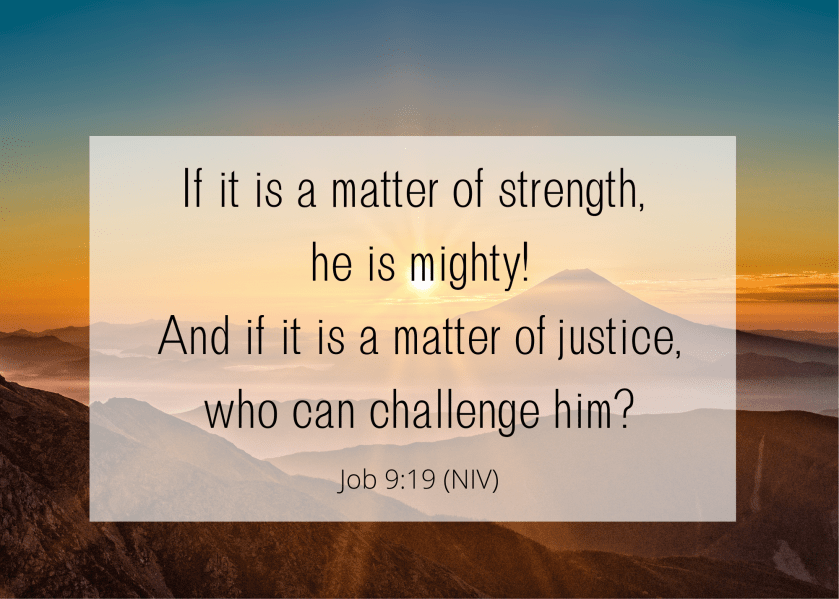
Along with their good intentions, they also were armed with some very true and accurate knowledge of God.  Throughout the passages of Job there will be many times when Job’s friends – and Job himself – will share solid truths about God, His majesty, sovereignty, power, love, justice and faithfulness.  In today’s chapter 9 Job is speaking (wisely and correctly) of the truth of God’s majesty and power.  Some of my favorites from this chapter are:

vs 4 – “His wisdom is profound, his power is vast.”

vs. 8-10 – “He alone stretches out the heavens
    and treads on the waves of the sea.
He is the Maker of the Bear and Orion,
    the Pleiades and the constellations of the south.
10 He performs wonders that cannot be fathomed,
    miracles that cannot be counted.”

I can learn a lot from Job and his friends as they relay to one another the awesome qualities of God that we sometimes casually dismiss or even forget. He is the Maker of Heaven and Earth! Nothing compares to His wisdom and power! He is in control of nature, and wonders and miracles. We can not understand all He is and all He can do. Our God is greater than anything. He is the Greatest!

But sometimes, even starting with good intentions and a knowledge of the truth (or some truth), is not enough. Sometimes we can start with a true view of God and still come up with false conclusions.  And I think that is the biggest reason the book of Job is mentally exhausting for me. It’s a little bit like playing a game of two truths and a lie – always questioning where the lie might slip in. As I read beautiful descriptions of God’s power and love I nod, smile and agree. I have the same big God. But then, sometimes in the very next verse or stanza the same speaker continues saying, “He would crush me with a storm and multiply my wounds for no reason” (9:17). Wait. No. I do not agree. I shake my head as my brows furrow. YES, God is powerful, that is true. But NO, God does not use His power to crush and wound for no reason.

As we read through Job let’s look for instances where his friends (and Job) begin with their good intentions and a truth about God and mankind – but come up with false conclusions. One example repeated many times over will be – God is just – so if you are suffering you must have done a terrible sin for which He is paying you back with trouble. 

Also, while we search for those truths that were then twisted in the ancient book of Job, let us also search our society, our community, our church, ourselves. Where do we find true descriptions of God (such as, God is love) leading to false, twisted conclusions (so His love for sinners means He won’t punish sin)? What songs do we sing, books do we read, people we listen to, that we agree with the first verse/page/post/thought, but then find untruth in the next? It can be exhausting keeping our guard up. The lies can be hard to discern when they are buried amongst truth. Stay on your guard. Don’t buy the lies and untrue conclusions the world has accepted about God. Keep seeking Him and the truth of who He is and what He does.

-Marcia Railton

(parts of today’s devotion were originally posted on January 5, 2020 for SeekGrowLove)

Reflection Questions

  1. Sometimes people start with complete untruths about God (He doesn’t exist, He exists but has no power, etc…). Those can be easier to spot as false. Where have you seen a true description of God but then a false conclusion?
  2. One thing that bothers me about the book of Job is the large part Satan plays in chapters 1 & 2, but Job and his friends seem completely unaware of Satan’s presence and power and responsibility. Are we as clueless, too? What role do you think Satan plays today?
  3. Don’t miss out on the wonderful foreshadowing found in Job 9:32 & 33. Who is able to “lay his hand upon us both” (vs 33 original NIV)? What difference could that have made for Job? What difference can it, or has it, made for you?

Lamentations of Hope

Lamentations 3

Lamentation is defined as a passionate expression of grief or sorrow. In this time Israel has been through pain and destruction.  Lament is a human response to suffering before God who can stop the suffering. Lamenting pushes us to be helpless before God who can rescue us and bring us out of our situation.

            Have you ever been in deep sorrow? The kind where all you want to do is disappear or break into a thousand pieces. Those times are hard to say the least. I know the same feeling more than I would like to admit.

            But I have realized that in those moments, the best thing we can do is go to God. Bring him our lamentations, our sorrows.

            This is what Lamentations is. In this book Israel is bringing their sorrows to God and finding peace in him. They have nothing left after the destruction and pain brought by the Babylonians, yet in Lamentations 3 it says this.

Lamentations 3:19-24

Remember my affliction and my homelessness, the wormwood, and the poison. I continually remember them and have become depressed. Yet I call this to mind, and therefore I have hope: Because of the Lord’s faithful love we do not perish, for his mercies never end. They are new every morning; great is your faithfulness! I say the Lord is my portion therefore I will put my trust in him.

            There is joy in the mourning! These people had nothing, had suffered, and yet they have all this love and trust in God and his faithfulness. Because God is good, and he knows our sorrows. He wants us to go to him with every little heartache just as the Israelites did!

There is hope in our lamentations and love for our suffering because God will use it for good.

            It is encouraging to know the good God we serve, who brings joy in the mourning. Who leads us through battle and into victory.

This is the best part.

Lamentations 3:31-33

For the Lord will not reject us forever. Even if he causes suffering, he will show compassion according to the abundance of his faithful love. For he does not enjoy bringing affliction or suffering on mankind.”

I love this part, but it is a little bit of a tough pill to swallow. God is compassion, love, and peace, but he also brings along testing and affliction when he knows we need it. Those are the hard times. But we are strong through those hard times, knowing that God is there to guide.

We won’t know how long pain may last. But what is important is not letting our grief stop us from serving God. Our pain is what we can use to reach others with God’s love.

-Hannah Eldred

Reflection Questions

  1. Where do you turn in your sorrow?
  2. What gives you hope in the midst of grieving?

The Weight of Sorrow

Matthew 11

Matthew 11 28.png


There is a destiny that makes us brothers:

None goes his way alone;

All that we send into the lives of others

Comes back into our own. —Markham


Today’s chapter is a solemn one for me. Jesus just finished the send-off of the 12 disciples out into the proving grounds and I imagine was watchful about the results. As word of the disciples broaden, John the Baptist hears about the Messiah’s latest turn of events and sends a question to Jesus in (verse 3): “Are you the one who is to come, or should we expect someone else?”


This question intrigues me because of what it doesn’t ask. “Why won’t you help me? Do you not care that I sit suffering in this prison cell?” John the Baptist was the cousin, a dear friend, and a mentor of sorts who baptized Christ himself. He knew Jesus and Jesus knew John. They most likely grew up together. Jesus simply replied, (verse 4-6)  “Go back and report to John what you hear and see: The blind receive sight, the lame walk, those who have leprosy are cleansed, the deaf hear, the dead are raised, and the good news is proclaimed to the poor. Blessed is anyone who does not stumble on account of me.


While this is a message of good report for the current gospel cause, what strikes me is what isn’t said to his friend. John would surely have known by this response that Jesus was referring to Old Testament prophecies like Isaiah 29:18-19, 35:5-6, or 61. These were the credentials of sorts that the coming Messiah would fulfill. Isaiah 61 is one of the most famous passages using phrases of comfort  like “ bind up the brokenhearted,” “proclaim freedom for captives,” and “release prisoners from darkness.” Yet, Jesus doesn’t convey any of THOSE phrases in the reply to John because he knew they couldn’t be upheld. Silence often speaks louder than words.


Have you ever had a friend or family member truly in sorrow and are unable to comfort them due in part to the schedule you must maintain? Maybe they were grieving a death, consequence, job loss, betrayal, or abandonment. You want nothing more than to stop everything and sit with them in their sorrow and to share the load. I have to believe this is what Christ wanted more than anything with John the Baptist, but his circumstances made this impossible and he ultimately knew that freeing John from prison was not the will of the Father. John was soon to die. Jesus sent a loving message of “omittance,” perhaps suggesting that he had not forgotten John, nor his sufferings. The tribute upon which Jesus bestows upon John in the next 14 verses following this makes me believe he was hurting for his brother. He wanted nothing more than to comfort, but his schedule and AGENDA would not allow.    


Jesus models a very important lesson here and later in Matthew 14 upon reaction to the terrible death of John the Baptist. SOMEtimes the best way to ease heartache is by getting back to work. Use your grief to empower your ministry. Rather than turning in on yourself and thinking “woe is me,” turn outward to serve and to love the crowds. It is ok to cry. It is ok to mourn for lost people or situations, but we must not let our emotions turn inward for long, lest it becomes pity. In our brokenness God is able to use us mightily. In desperation our dependence on Him will serve as a powerful testimony to a lost and dying world.


Is your heart broken today? Does life seem empty? Do you feel like giving up? Take hope in the example of Jesus. Take up whatever duties lie before you and dedicate them to God. Refuse the luxury of self-pity. Do something to lift the burdens of others and Jesus will strengthen you.

The final verses (28 – 30) of Matthew 11 confirm this truth. “Come to me, all you who are weary and burdened, and I will give you rest. Take my yoke upon you and learn from me, for I am gentle and humble in heart, and you will find rest for your souls. For my yoke is easy and my burden is light.”


When you serve others you will find yourself.


-Julie Driskill


matthew 11 29

The Full Gamut

Psalm 79-84

psa-80-19-ww-mf-9x

Sunday, January 8

In one of my favorite books, one character is shocked that someone could feel so much emotion at the same time. This leads him to say “One person can’t feel all that at once, they’d explode.” This comment makes his friend (a girl), chidingly reply “Just because you’ve got the emotional range of a teaspoon doesn’t mean we all have”.
At certain times or in certain churches, it feels like there is only one acceptable way to come to God, only one emotion that is allowable before the Almighty. There was a Baptist church that I visited in South Carolina that was grim and dark and full of hellfire preaching. It seemed that they believed only sorrow and repentance were acceptable before God. Other churches demand happiness, chipper-ness, cheerfulness; no matter what are your actual day-to-day circumstances, put on a smile (or else).
However, God doesn’t demand that from his people. As you read today’s reading, you will be greeted by the soaring highs of Psalm 81 (v1 “Sing for joy…shout in triumph”) and 84 (v12 “Happy is the person who trusts in You, Lord of Hosts!”). Approaching God with joy and shouting is something God admires and inspires. But this is not the only way the authors write these psalms. Psalm 79:5 reads “How long, Yahweh? Will You be angry forever? Will Your jealousy keep burning like fire?” These words are full of sorrow and pleading. It is what the broken, the hurt, the oppressed cry out to God, and it is in the inspired writing of the Psalms. But the very next verses give us EVEN more emotions, namely anger. “Pour out Your wrath on the nations that don’t acknowledge You,” because they have devastated your people. Normally we think anger is wrong; no ifs, ands, or buts. However, the inspired author is allowing his anger at the unjust system of the world, the anger at the sins that people do to one another, to be expressed to God.
If you are always happy, awesome! I’m usually a pretty happy guy myself. But if you experience emotion like a human, and if you experience some right side-by-side, the psalms provide avenues to express yourself to God and prove that you are not alone. God doesn’t demand that you come to him in only one particular way. Instead, he invites you to come as you are.
-Jake Ballard
teaspoon
Jake Ballard is a pastor of Pine Grove Bible Church in Brooklyn Park, MN, where he lives with his wife, Amber and daughter, Melody Grace. He is a gamer (board, card, video, etc.), a geek (currently watch Star Trek: Deep Space 9) and a student. He is in his third year studying to receive his Master’s of Divinity at Bethel Seminary in St. Paul, which he hopes to complete in May 2018. For questions, comments or game or show recommendations, contact him at  jakea.ballard@yahoo.com.
(Psalm 80 photo credit: http://www.alittleperspective.com/psalm-80-reverse-parallelism/)