The Prosperity Gospel vs. Giving Generously

Proverbs 22 – Monday
Prov 22-9

Proverbs 22:4 & 9

The reward for humility and fear of the Lord

   is riches and honor and life…

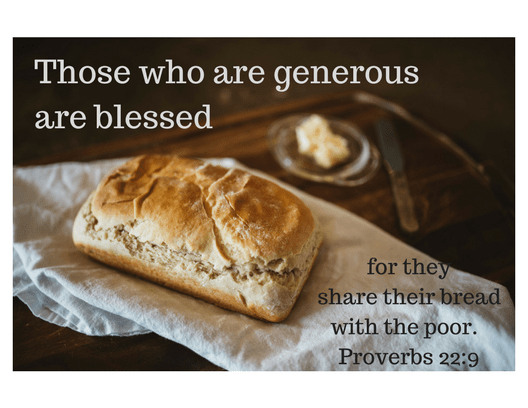
Those who are generous are blessed,

   for they share their bread with the poor.


On any given Sunday morning, I can flip on my television and find a number of ministers promising me riches, wealth, and prosperity if I only have faith.  They usually then want me to practice that faith by making an offering to their ministry – “give us $5 so that God can return it to you one hundred fold.”  These promises do indeed sound promising, but this prosperity gospel is not the message that our Lord came preaching.


Just like we can twist the words of Jeremiah 29:11 and John 10:10 to fit this perspective, we can also turn to Proverbs to try to find a God who rewards those who are faithful with riches, wealth, and health.  But our interpretation of the Proverbs would be just as tortured if we tried to find its truth in the shallow waters of the prosperity gospel.  


Rather, let’s use the Scriptures themselves to better understand the “riches and honor and life” that is promised for those who love the Lord like we find in Proverbs 22:4.  Just a few verses later, we find the clarification that we need.  It is the “generous” who are (hashtag) blessed.


The wealth of the Gospel of Christ lies not in storing up material wealth or riches or fame, but in sharing the material goodness that we have been given with those who don’t have them.  We are blessed with lives of richness, honor, and life abundant when we give away the riches we have so that those with neither riches nor basic needs can be filled as well.


To close with a parable of Jesus, there was a man whose harvest was larger than his barn could store.  He decided to build a larger barn to store his crop.  However, that night he died and all his wealth was lost.  I think that the point of this parable isn’t that we shouldn’t plan ahead or have large barns, but rather that when we have more than we need, we should share it instead of store it up for ourselves.


We can find life, wealth, and riches only when we are generous and give the very things we think we need to hoard.

-Graysen Pack


Graphic Material

Ezekiel 5-9

ezekiel 5 14

Monday, March 20

This portion of Ezekiel is, admittedly, difficult to read.  It’s a pretty graphic account of God impending judgment against the city of Jerusalem and his people, Israel.  God tells Ezekiel to shave his head and beard.  This would have been an act of mourning for most people, but it was double disturbing for Ezekiel, since he was a priest and normally forbidden from shaving his head or beard.  Ezekiel was told to burn, take a sword to, and scatter his cut hair.  This was to symbolize what was to happen to Israel.  A few hairs were kept back, symbolic of the remnant who would not be destroyed.

God accuses his people, Israel, the chosen nation, of being worse than the other nations.  They broke the law more than the nations that did not have the law.  God was bringing his judgment against His own people.  The description of the siege almost defies comprehension, including cannibalism of both parents and children.  This was to serve as a warning to the other nations: if this is how God treats his own people for their idolatry, beware of what he will do to you.

In Ezekiel six God makes it clear that their judgement is upon them because of their idolatry. However, there is a remnant that will be spared and live in captivity and will come to repentance.

In Ezekiel seven, a special emphasis is made regarding their idolatrous attachment to gold and silver.  This wealth that they turned to and fashioned into idols will be unable to save them from the coming judgment.  All the money in the world can’t save you from judgment.

In Chapter eight Ezekiel has a vision of the temple in Jerusalem.  This includes the “Idol of jealousy” which we discover is the pagan god Tammuz.  Tammuz was the Sumerian god of food and vegetation.  At the summer solstice there was a period of mourning as the people saw the shortening of days and the approaching drought.  Sacrifices were made to Tammuz at the door of the Jerusalem Temple.  This was an absolute abomination to Israel’s God, YHWH as He made it clear that He alone was to be worshipped as God (see Deuteronomy 6:4-5).

In Chapter Nine an angel is sent out to put a mark on all of the people of the city who did not commit idolatry and worship Tammuz.  They would be spared.  But then all those who did not receive a mark would be destroyed.  This is reminiscent of the story of Exodus, when the doorposts of the Israelites were to be marked with the blood of the sacrificial lamb, and those with the mark were spared their firstborn sons dying when the Angel of Death passed over their houses.  It also points to the future (See Revelation 13) when the beast will cause people to have a mark on their forehead or they would not be able to buy or sell.  This is contrasted with those in Revelation 14 who have the name of God and of the lamb on their foreheads.

God is a God of love and mercy.  God has provided a means for us to be rescued from the consequences of sin.  There is a way for each of us to be spared the final judgment of God that is coming.  Jesus Christ, the lamb of God is the only means by which we can escape judgment.  Along with God’s mercy is His holiness.  God will not allow sin and rebellion to continue on earth forever.  A day of judgment is coming for all the earth just as it did for the nation of Israel.  God tolerated their sin for only so long, and then came the time for judgment.  Mercifully, God spared those who repented by placing His mark upon them.  God has been tolerating sinful rebellion on earth, but a day is coming when He will destroy sin and sinners who have not repented and turned away from their sins and turned to him through Jesus Christ.  Ezekiel’s harsh imagery should remind us that we must not forget that God’s wrath is coming from which we all need to escape, and we need to warn others.  This won’t make us popular, but doing God’s will is seldom popular among the rebellious.

-Pastor Jeff Fletcher


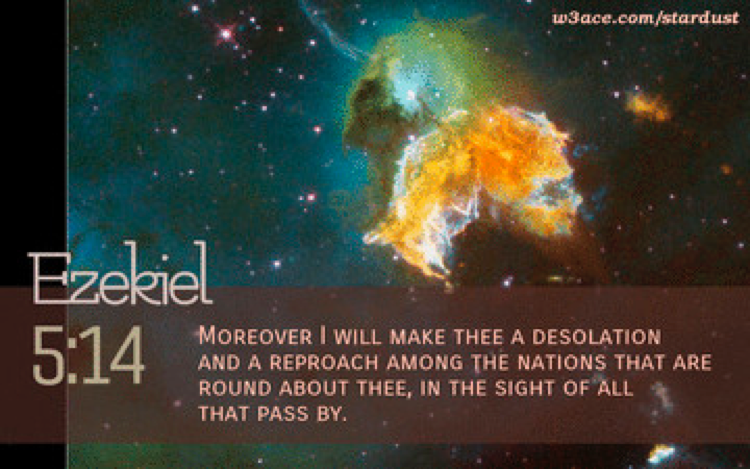
(Photo Credit: http://w3ace.com/stardust/)

Kings and Queens Make a Full House

II Chronicles 8-11

queen-of-sheba

Saturday, November 26

Solomon has completed building the Temple and his house and has moved on to building cities. Everything Solomon touched was lavished with beauty and excess. He built one entire city for the purpose of housing his many horses and chariots. That is one way to build a name and gain a reputation. As word of Solomon traveled outward to other nations, interest grew to understand what this king was all about. Solomon shows that his desire to build was for his own pleasure and he enjoyed the benefits that his talents garnered. He was a man on display. He worked hard to share how God had chosen him to bless the nation of Israel and show justice and righteousness to God’s children.

One thing that was lost on Solomon was that God was the creator of all and wanted Israel to be a light to the nations. Instead  he would not allow Israel to do certain jobs he felt beneath them and would take nations as slaves and indentured servants to do the ugly work.

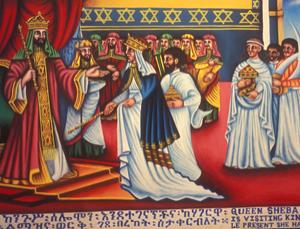
When the Queen of Sheba heard of Solomon she traveled herself to see if what she was hearing was true. And indeed she found him to be a man full of wisdom and in control of vast lands and wealth. After swooning over all his fame and power, she tells King Solomon, “It was a true report that I heard in my own land of your acts and of your wisdom. However I didn’t believe their words until I came, and my eyes had seen it; and behold, the half of the greatness of your wisdom wasn’t told me: you exceed the fame that I heard.” II Chron. 9:5-6

Even though Queen Sheba had heard the truth, it did not resonate with her until she saw it for herself. Others bringing word to her was not enough. King Solomon sounded too good to be true. This is why it is so important to be living out the word of God in our lives so that the message of Christ rings true to those who observe His truth in action. I can write this out using the electronic medium at our disposal today and maybe be a witness to some on God’s behalf; but it is the personal relationships that we create that witness into people’s lives and situations at a much more powerful level.

Solomon understood about God. He even spent an incredible amount of time and resources devoted to sharing Yahweh with others. Solomon was wonderful at telling others what would be best in any given circumstance, but he was not so good at heeding his own lessons. He is like some we witness who gain power and begin to feel they are above the law.

Years ago Brother Billie Kennedy said in a message at Camp Mack (yes, I am going back that far in my memory bank!) “Some people will miss the kingdom of God by 18 inches because that is how far it takes to get from your head to your heart.” That last few feet is the hardest step of all at times, but when we reach that final destination I am hoping for a full house and do not want anyone to miss out by just a few inches.

If the Queen of Sheba thought putting in the effort to check out the truth of who King Solomon was, how much more should we seek out the truth of God’s love and mercy toward all of his children.

-Glennis Walters