Avoid Sin, Rejoice in Justice

Revelation 18

Revelation 18 4 NIV
 
Yesterday our focus was on the identity of this Babylon the Great. Today our focus is on the destruction of Babylon. 
Babylon (Rome and other anti-God systems of the world) falls. The beast and the heads turn against her and devour her in the end of chapter 17. The nations, kings, and merchants of the world weep over the fallen city. They will no longer have the power, authority, or wealth she provided to them, and they are sorrowful for their loss, not really her destruction. All this happens in “one hour”, or an instantaneously short time. She will be brought low, but heaven is told to rejoice. 
What do we learn from this chapter? Those nations and systems that oppose God (like Babylon and Rome) will not last forever. Revelation shows us that God will bring them down. But what are we called to DO with that information? Two actions seem to be demanded of us in Revelation 18. In verse 4, the people of God are called to “come out of her”. Did this mean literally pack your bags and move? Maybe. But it most definitely meant to not participate in her sin. Don’t act like the ones who don’t know God in Babylon. Today, that is still the case. In the words of Jesus, we are in the world (that is, the world apart from God), and have not been taken out of it. We do business with those who don’t know God, we work with them, and go to school with them, and even try to love them. But we don’t act like them, we don’t participate in the sins the world, we are not “of” the world. So firstly, we must behave in such a way that we are more like Christ than our neighbors, more like Jesus than the Joneses. (Compare to John 15:19, 17:15)
Secondly, we are called to rejoice over the judgement of God. Many times the justice and severity of God makes me sad. I want all people to be saved and God wants that too! (1 Tim. 2:4) In the case of Babylon the Great, though, we are talking about a city that drank the blood of saints, and persecutes the people of God. Rejoice that God will not allow that to continue. God will not sit idly by forever, ignoring the cries of his people. There will come a day when justice will be poured out on to the heads of those who righteously deserve it. In the way that Babylon “paid” (by torturing, tormenting, murdering), that is the way she will be “paid”, the author says in 18:6. Wickedness will be eradicated, and only righteousness will remain. Praise God!
 
Avoid Sin, Rejoice in Justice. This is the calling of Revelation 18 upon the believer.
Jake Ballard
Revelation and Double Fulfillment

Revelation 17

Revelation 17 14 .png
Today is a bit longer. Please bear with me to the end.
Before we start this devotion, please go read Isaiah 7:14. 
Is that verse about Jesus? 
According to Matthew 1:23, the answer is a clear and resounding yes. Now, go back and read Isaiah 7:14, 16-17, 8:3-4, 10. It would seem that Immanuel is also a reference to Isaiah’s son, Maher-shalal-hash-baz, who is the child of a/the young woman, and his title (Immanuel) shows the people that God is with them (Immanuell literally means “with us is God”). 
I know that may be some new information for you, but this is what I want you to see : When Isaiah gave the Immanuel prophecy, he wasn’t JUST talking about something that would happen hundreds (700+) of years in the future. He was talking about something that was going to happen SOON, that would impact King Ahaz’s life in just a few years time. Did he speak about the future as well? Matthew says yes, but that’s not all he speaks about.
This bit of insight is helpful to have in mind as we read Revelation 17 (or if you have already read it, as you go now and re-read it). Many who read the text of Revelation focus on the future aspects of the book. When will it happen? (Some people say : “Always just around the corner!”) Who are Gog and Magog? (“Always enemies of our country, like Germany, China or Russia!”) Am I prepared? (“Buy your food kit now!”) But, just as the prophecies of Isaiah meant something for the people of his day, we MUST recognize that the prophecy and revelation of John meant something to readers of John’s day.
And John’s readers knew what he meant. There are things that are hard to understand about the scene he saw, but he made it clear enough that they would have understood at least SOME of it. The picture is of a prostitute/harlot/whore sitting upon a beast. She commits sexual immorality with kings, she rides upon a beast, gets drunk on the blood of the saints. She has many names.
Woman who rides upon the beast, through hints we see in this text, is Rome (and by extension, the Roman Empire). Rome is a city sat upon seven hills (v.9). Rome is the great city that has an empire over the kings of the earth (v.18). Rome, like Babylon the Great before her, destroyed the Jewish Temple, and therefore Rome was acting in the “spirit of Babylon”. (v.5) The sexual immorality committed by the kings of the Earth is their worship of the Emperor as “the son of the gods” and “god-in-flesh”, which was discussed in an earlier devotion on Revelation, when the author spoke about the imperial cult. (v.2) Most importantly for the first readers, this woman was drinking the blood of the saints; that is a poetic description of what they were experiencing under the persecution of Rome.(v.6) 
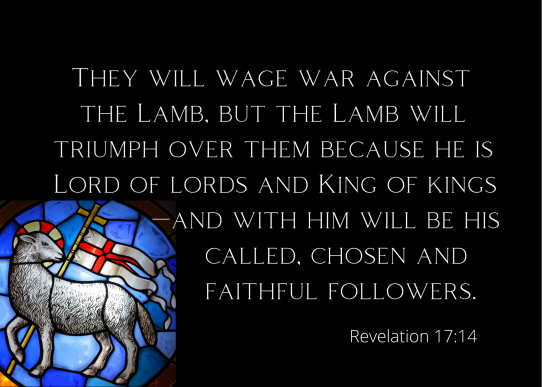
When John uses all these images, we are given a powerful picture of the spirit of any empire that moves against Christ. And that is true in every age and in every place where there are empires drinking deeply the blood of saints and worshipping that which is not God. What we must always realize is that both in the day of John and our own, the truth is that Christ will conquer them all. Verse 14 says “These will make war against the Lamb, but the Lamb will conquer them because He is Lord of lords and King of kings. Those with Him are called, chosen, and faithful.” 
Could there be another city that will sit upon 7 hills, with kings, and be Babylon the great? Maybe. All of Revelation 17 could happen again in the future, with other systems, empires, and rulers. But verse 14 will be always and forever clear : whoever makes war against the Lamb will be defeated. The Lamb will conquer them by his power.
 

Brothers and sisters, we stand with him. We are called. We are chosen. No matter the persecution of the Dragon, the Beast or the Harlot, let us remain faithful. (v 14)


Jake Ballard
(Jake Ballard is Pastor at Timberland Bible Church in South Bend, IN. He lives in the Michiana Area with his wife and daughter. If you’d like to say hi you can find him on Facebook at https://www.facebook.com/jacob.ballard.336  You can also hear more teachings at https://www.youtube.com/channel/UCs_awyI1LyPZ4QEZVN7HqKQ Otherwise, he is available on all hailing frequencies, by using the Palantir, and via carrier pigeon, though it’s getting colder in South Bend. God bless you all!)

The Choice is Yours

Revelation 16

Revelation 16 7 NIV

Yesterday, angels were sent out with plagues and bowls were prepared for pouring. Today, we get to see the dramatic moments when the bowls are poured. Each plague is horrific, especially when we recognize the wholeworld is experiencing each plague. Everyone, from everywhere, will be affected by these plagues.
(As a quick aside, that means all people who have chosen to turn their backs on God. Remember these plagues and bowls are the wrath of God upon those who chose to reject Him [see Rev. 15]. God has promised that we will not taste his wrath but his salvation, as we chose to follow him. [1 Thess. 5:9])
First, Sores cover those who worship the beast. Then, the sea becomes blood and all life dies. Rivers and streams turn to blood, so blood is the water over the whole earth. Then the sun begins to burn people, followed by the Kingdom of the Beast being plunged into darkness. Penultimately, Euphrates is dried up.
The reason we will stop at six is because I think the important part for John, what SHOULD shock his readers then and now, are the parts where he talks about the reaction to the plagues, what the people chose to do because of the plagues.
In verse 9, we see the sad and shocking reaction of those who are being effected by the plagues. Even as they have experienced the plagues and they know the plagues are coming from God, they choose to blaspheme His name and do not repent or give Him glory. Those who suffer the plagues are continuously, with full knowledge, rejecting the God of heaven after the plagues and bowls. They are not accidentally rejecting Him, or acting in ignorance. They are choosing to reject the God they KNOW is sending these plagues. They reject Him after the fourth bowl (9), and the fifth bowl (11). After the sixth bowl, demons round up the people of the world in their final rejection of God. The seventh bowl, poured out at the Mountain of Megiddo (Har Megiddo or Armageddon), is upon all those who have blasphemed God and continued to blaspheme Him.
Earlier I said it is sad and shocking that this is the reaction of those who choose not to follow God. But the truth we must see is that God is giving everyone a choice. He shows us that even with clear evidence that YHWH is the God of heaven and Earth, some will still refuse to repent and follow Him. The question for the original recipients of Revelation, and for you and I, is this : are we among those who refuse to repent and acknowledge God, or do we give Him the glory he deserves, and choose to do his will?
The choice is yours.
Jake Ballard

The Home-stretch Begins

Revelation 15

Revelation 15 4 NIV

 
In our reading of Revelation we have come across so much : scrolls, and seals, and Lambs that are Lions, and Beasts and Dragons. I can understand if your head is spinning and you just want a moment to rest in a short, easy chapter. Though Revelation 15 is short, it is not easy. However, we are in the home stretch. We are closer to the end of this great revelation given by Jesus Christ to his servants.
 
In this chapter, the main action is that God is sending out seven angels with seven plagues. Those who have won victory over the beast recognize that God is holy, and in the end, all the nations will worship Him. (Rev. 15:4) Then the angels head out from the tabernacle, and smoke comes and fills the sanctuary. Smoke coming down represents God’s glory filling this “tabernacle of testimony.” (Compare Exodus 19:18, 20:18) This opens up an interesting insight for us as the people of God. When some see the plagues and the wrath of God, they see a violent deity of a violent people, demanding something to which He is not entitled. For Christians, we see the wrath of God as an act of the glory of God. The greatest joy a person can know is to experience connection to God. In Revelation 15 God, in His glory, is doing this final act of plagues and bowls of wrath to bring the whole world to worship him. While it is harsh, it is God’s love and not hatred that drives his wrath over a world that rejects him. He wants the world to turn to him, and even THIS will not work, as our study of the previous chapters have shown.
 
Praise God that you stand among the company of the saved. 
Pray for the mercy of God upon those who have not yet believed, that they might come to believe. 
Pray that it will not take the plagues of the seven angels and the bowls of God’s wrath. 
Jake Ballard

The Eternal Gospel

Revelation 14

Revelation 14 6 NIV

As we approach chapter fourteen together, John sees four, possibly five, more visions, all depicting the fates of those who are allegiant to the Lamb (Jesus) and those who aren’t. In our world today, people want you to just let people believe what they believe and not challenge their worldview. However, if we trust what Revelation is telling us, it would not be loving for us to allow people to continue living in sin and falsehood. We need to speak up into the lives of our loved ones, because according to chapter fourteen, their fates will not be good if they don’t join the Lamb’s army (the Church). Ultimately, the letter of Revelation is meant to call people to repent and follow the Lamb before time runs out, and we need to do the same.


John sees the same 144,000 from chapter 7 that have the “mark” of God on their foreheads, standing on top of Mount Zion, looking ready for a battle. These are those who have been purchased by the blood of the Lamb; in other words, these are Christians. We learn that their fate is sealed, and their future looks bright! However, John moves forward to describe what awaits everybody else…


An angel is seen, calling people to “fear God and give Him glory”, or repent of their ways (14:7). Another angel warns that “Babylon the great” has fallen, which will be described later on in chapters 17-19. This Babylon, in my interpretation, is a vivid description of Rome once again, as those are the only two nations to ever destroy the Jerusalem Temple. However, those that are within Babylon the great, or those that have worshiped the beast, they will drink the “wine of the wrath of God”, going through torment in fire and brimstone, just like Sodom and Gomorrah (see Genesis 19). These people will eventually be burned up with this fire, but it will be an extremely painful experience.


John then uses the illustration of a grape harvest, in which grapes are thrown into a winepress and squeezed out, causing blood to flow everywhere. It is a graphic image, but a powerful one nonetheless. Those who refuse to worship God and the Lamb will face His wrath, being destroyed completely when Jesus returns. Why would anyone choose to go through this? Unfortunately, many choose to do so.


This message should motivate us to speak up to our friends and family about what Jesus has done. He has saved us from this coming wrath, and now offers that same salvation to anyone who would come follow after him. Of course we love our friends and family and don’t want them to go through the terrifying judgment to come. So speak up! Live out your faith today! Share the good news with whomever you come across! Jesus is coming, and we don’t have much time left.


Talon Paul

With God or Against God

Revelation 13

Revelation 13 16 17 NIV

666! This number has been special in the minds of believers and nonbelievers alike for thousands of years. What exactly is this number meant to represent? What is the “mark of the beast”? Is the government going to try and put a microchip in my hand? What should I do?


There is much speculation about what the number 666 means, and it all comes from this chapter in Revelation; chapter thirteen. However, before we go wandering off to try and apply this number to our situation in 21st century America, it is important to try and understand what John is trying to communicate to his audience in 1st century Asia Minor. This is an important practice for reading any passage of the Bible, and I encourage you to do your research before applying it to yourself.


John sees a vision of a terrifying beast that has ten horns and seven heads, and was like a leopard, with feet like a bear, and a mouth of a lion. It is likely that John is drawing these images from the Old Testament prophet Daniel, specifically Daniel chapter 7, where the prophet describes four great empires with beast-like imagery. Since Daniel described empires/nations with this imagery, it is likely that John also has a specific empire in mind with his description of this beast. Since we’ve already been told that this beast is responsible for killing the two Witnesses (11:7), John likely has in mind the nation of Rome, who was ruling at the time of his writing and was notorious for killing Christians during the empire’s reign.


John then sees a second beast, which is responsible for making the people worship the first beast. In the first century Roman world that John is writing in, there was a religious movement called “the imperial cult”, that was the fastest growing religion of the time. This religious movement encouraged, and sometimes forced, people to worship the Roman emperors as “gods”. If you do a little historical study on the imperial cult, you may be surprised at how much the whole New Testament addresses this issue.


This second beast forces the people to put a “mark” on their hand or forehead, demanding their allegiance to the first beast. If you don’t have this “mark”, you will be unable to do many things. This number is the number of “a man”, which is 666. This is in stark contrast to the “mark” (or seal) that God had already placed on his own people in 7:3. In other words, you are either with God or against Him.


While I don’t believe we have to worry about microchips in our world today, since that wasn’t the point John was making, we do have a responsibility of giving our allegiance to God in every decision we make. Think about each decision you make today. Is this decision honoring to God, or is it bringing glory to something else? Have you “marked” yourself with God’s grace, or are you seeking something else?


Talon Paul

Dragon at War

Revelation 12

Revelation 12 17 NIV fixed.png

If the story through Revelation wasn’t strange enough, it gets even stranger in chapter twelve. Here we see a cosmic woman giving birth to a child, who are then attacked by a great, fiery dragon, but then is ultimately defeated by an angel army… What in the world is going on now? Once again, it is important to read the Scriptures for yourself and to discuss with other Christian teachers around you in order to gain deeper insights into the text. Never assume that I know what I’m talking about, or anyone else for that matter; always question and look up the answers for yourself to see if what is being said is true.


I assume that these descriptions are further insights into the contents of the Scroll that was eaten in chapter ten; however, I am not 100% sure on that, but will be going ahead with that interpretation for this discussion. We do gain information about the cosmic battle that is happening around the person of Jesus at his death and resurrection, as Satan (depicted as a dragon) is at war with the angels of heaven during this time. Satan is unable to conquer the cosmic woman that produces Jesus (whoever/whatever that is), Jesus himself, or the angels; Satan doesn’t have as much power as we think he does.


Through frustration, Satan begins to attack the rest of the woman’s children, which are those who “hold to the testimony of Jesus”. In other words, since Satan can’t beat anyone else, he is going to attack the Christians next. We definitely experience this today still, as Satan hasn’t been fully destroyed, although he has already been defeated through the cross. We are weaker than Jesus and the angels, and are susceptible to sin; is there any hope of beating Satan, or are we as doomed as he is?


Perhaps the most practical verse for us in the whole letter of Revelation is found in this chapter. In 12:11, we are given a description about how Christians can conquer Satan. The description is three-fold; we are able to conquer Satan through the blood of Jesus, the preaching of the gospel, and not loving our lives. This should give us great hope and encouragement! We have the power to conquer Satan when he rears his ugly head, if we would only trust in these three things; the blood/sacrifice of Jesus for our sins, the power of our gospel preaching, and the power of looking beyond this life to the eternal life that God has promised us.


I encourage you today to spend some time meditating on these three questions: Do I trust that Jesus’ sacrifice was enough to pay for my sins? Am I faithfully spreading the good news to others around me? Am I truly looking forward to the life that God is bringing me in the future more than this life?


Talon Paul

The Witnesses

Revelation 11

Revelation 11 3 NIV

Following our strange detail about John eating the Scroll that God gave to him, we are finally going to learn about what the Scroll says through what John tells us! Unfortunately, it is very detailed, also strange in some ways, and has been the cause of many interpretations over the past 2,000 years. However, we are going to do our best to humbly try and understand what John says in this passage, while focusing on his main point. I don’t assume that my interpretation is 100% correct, so I invite all of you to critique it by looking at the text itself and speaking with other Christian teachers that you trust.


We are introduced to two Witnesses, or two Martyrs, who are proclaiming to people “their testimony”. Now, throughout Revelation, we see that John testified to “the testimony of Jesus Christ” (1:2, 9) and that the Christian martyrs from chapter six also had a “testimony” that they proclaimed (6:9). We will learn later that Christians are able to overcome Satan using “their testimony” as well (12:11). Narratively speaking, it is likely that these two Witnesses have the same testimony as John and the Christians. That testimony is the gospel message about Jesus’ death, resurrection and eventual return to establish God’s kingdom, as can be seen throughout the whole letter. In other words, the two Witnesses are two individuals that are faithfully preaching the gospel to those around them.


There has been speculation as to whether these are literally two individual people that are to come in the future, or whether they represent what the churches are supposed to be doing, since they are described as lampstands like the churches (compare 1:20 and 11:4). I assume that these are representatives for what the churches, and us, are supposed to be doing, but also don’t believe that John’s main point is in their identity; John’s main point to this vision is what is produced by their faithful preaching of the gospel.


After the two Witnesses are killed, resurrected, and exalted to God’s space, the people actually repent of their evils! In 11:13, it states that people “gave glory to the God of heaven”, which is repentance language. As we saw in the previous seven seals and seven trumpets, and will see in the later seven bowls, God’s judgment actions are not enough to bring about repentance; but the faithful preaching of the gospel message is enough, even if Christians die for it!


My encouragement to you today is to behave like these two Witnesses; faithfully preach the gospel, even at the expense of your own life. Whatever the cost may be for you, the reward is going to be more than you ever imagined! And just like the story of Revelation states, that reward is coming soon, after the Church does her job of faithfully preaching to the nations. Are you ready for that day to come?


Talon Paul

Sweet & Sour

Revelation Ch. 10

Revelation 10 11 NIIV.png

Every time that I go back and read through Revelation, I think about how awesome it would be to see it in a movie or comic book, since it is full of amazing imagery, suspense, and some humor. I see a little bit of dramatic humor coming out in chapter ten, as we are about to get the information that we have been desiring since chapter five… and then we don’t. I feel as if John wants to keep us on the suspense train as long as possible in order to make his point.


After the sixth trumpet sounds, we are introduced to an angel that is holding a “small” scroll in his hand. Now, this scroll is likely the same Scroll that we saw in God’s hand in chapter five, and the same Scroll that had the seven seals broken off through chapters six, seven, and eight. Narratively speaking, we have not learned the contents of that original Scroll yet, so it is unlikely that this is a brand-new scroll that is being introduced into the storyline. The size of the Scroll is not a major point; it is possible that the Scroll had to become smaller for John to later eat it. If the Scroll was the same size as it was in chapter five, being able to fit in God’s hand, John could be eating it for quite a while.


Coming back to the dramatics of the story, we are finally going to learn what the Scroll says! This is the moment when we find out what God’s message is to His people!… and then John eats it… and it is sweet in his mouth, but bitter in his stomach… What in the world is going on here?


John is acting like one of the Old Testament prophets, Ezekiel, who also was told to eat a scroll from God and then to speak the message of its contents (see Ezekiel 3:1-3). In like manner, whatever John is going to speak next in the story is going to be the contents of this Scroll. Although it is a strange method to communicate to the seven churches, it gets the job done; it is probably better that we don’t question everything God chooses to do, because we could drive ourselves crazy trying to understand it all.


What we can learn practically today from this message is that sometimes God’s message can be sweet and bitter at the same time. The gospel is fantastic news that will bring us eternal, perfect life, but is also bitter as we are called to die to ourselves daily as we follow Jesus. Just like everything in life, there are good and difficult consequences to our decisions, and the decision to follow Jesus is no different. I encourage you to look at both sides of the coin before moving forward, because it can become difficult. Is the reward enough for you to go through the bitter consequences?


Talon Paul

Refuse to Repent

Revelation 9

Revelation 9 20a NIV

If you haven’t found out by now, Revelation is a strange letter; there are all sorts of images and visions that don’t quite make sense to us most of the time. In chapter nine, things get much stranger, as we see some terrifying images of God’s judgment being sent upon unrepentant people that have killed God’s people (i.e. Christians). However, strange as it may be, this chapter is absolutely crucial to understanding what John is trying to communicate throughout the whole letter. There is a key theme that needs to be drawn out if we are to understand what John is talking about.


In chapter eight, we saw angels getting ready to blow seven trumpets that would bring about God’s judgment, in response to the prayers that God had heard from His people back in chapter six. When we come to chapter nine, the fifth trumpet is blown, bringing about this terrifying, demonic locust army that goes around tormenting people for five months. They look strange, sound strange, and behave in a strange manner. There have been many theories about what these locusts are, but I don’t believe John’s focus is on who or what these locusts are; they are more of a background image than anything.


John’s main point is found at the end of the chapter, after the sixth trumpet is blown. In 9:20-21, we learn that, even though all these terrible and strange things are happening to these people, they still refuse to repent and change their lives. That is the point of John’s message of the trumpets; even God bringing His fiercest and most terrifying judgment on people is not enough to get them to repent. We saw a similar situation in Exodus, when Pharaoh refused to repent, even though God brought 10 plagues on the land. This is also John’s point with the later seven bowls (16:10-11), and likely the point of the previous seals as well.


The question that we, as the readers, are left with is, “What will make people repent?” That question will be answered in chapter 11, when we are introduced to the Two Witnesses.


For you today, I encourage you to think about the way that you spread the gospel to others. What will work better? Preaching about God’s judgment and condemnation, or offering hope and encouragement? If God’s righteous judgment isn’t enough to bring about repentance in people’s hearts in Revelation, don’t assume that it will work for you either. Let’s offer a hope that is focused on the love of the cross and a merciful God that has offered His own Son for us all! Let’s preach the good news!


Talon Paul