Jesus’ Final Teachings

John 14-17

The contents of John 14 to 17 are Jesus’ final words to his disciples (except Judas) and his prayer to his Father moments before he is handed over. The one dominating overarching theme in these four chapters is the absolute unchallenged supremacy, beauty, and glory of our Lord Jesus Christ. Jesus states the following:

“I am the way, the truth, and the life; no one comes to the Father but through me” 

– John 14.6

“If you ask me anything in my name, I will do it” – John 14.14

“Peace I leave with you; my peace I give to you; not as the world gives do I give to you. Do not let your heart be troubled, nor let it be fearful” – John 14.27

“Just as the Father has loved me, I have also loved you; abide in my love” – John 15.9

“These things I have spoken to you, so that in me you may have peace. In the world you have tribulation but take heart I have overcome the world” – John 16.33

“…these things I speak in the world so that they may have my joy made full in themselves” – John 17.13

What Jesus prays for in chapter 17 is what he taught and instructed in chapter 14 to 16. Jesus prayed for each believer to have unity with him, to be filled with his joy, to be sanctified in the truth. The life we have in Jesus is so beautiful and precious. Jesus Christ is the living water. Let us drink from him deeply and without reservation. Let us be always dependent and in communion with Jesus. Abiding and communing with Christ is the key to realizing the fullness of joy, peace, and love. In addition, we see the work of the Father, the work of the son, and the work of the spirit active in lives of those whom God has saved. The Father has chosen us, the son has died for us and bought our salvation, and the spirit makes us alive.

To God be the glory in the name of Jesus Christ by the power of the Holy Spirit!

-Jacob Rohrer

Today’s Bible passage can be read or listened to at BibleGateway here – John 14-17

Make sure you come back tomorrow when we will read Matthew 27 & Mark 15. We are getting to the end of the gospels.
Love Like Jesus

Luke 22 & John 13

John 13 is the only chapter in the four gospels that record Jesus washing his disciples’ feet. In John 13.34 Jesus teaches “A new commandment I give to you, that you love one another, even as I have loved you, that you also love another”. What is the newness of this commandment Jesus gives his disciples and to us? I believe it is the phrase “even as I have loved you”. The way believers are to love each other is no longer patterned after how we would want to be loved (Lev.19.18) but there is a new way to love each other. The new pattern of love is Jesus himself. 

What does it mean to love other Christians like Jesus? This is a very tall order! Where do we start?! I believe the washing of the disciples feet provides a framework for what Jesus had in mind when he said love each other as I have loved you. 

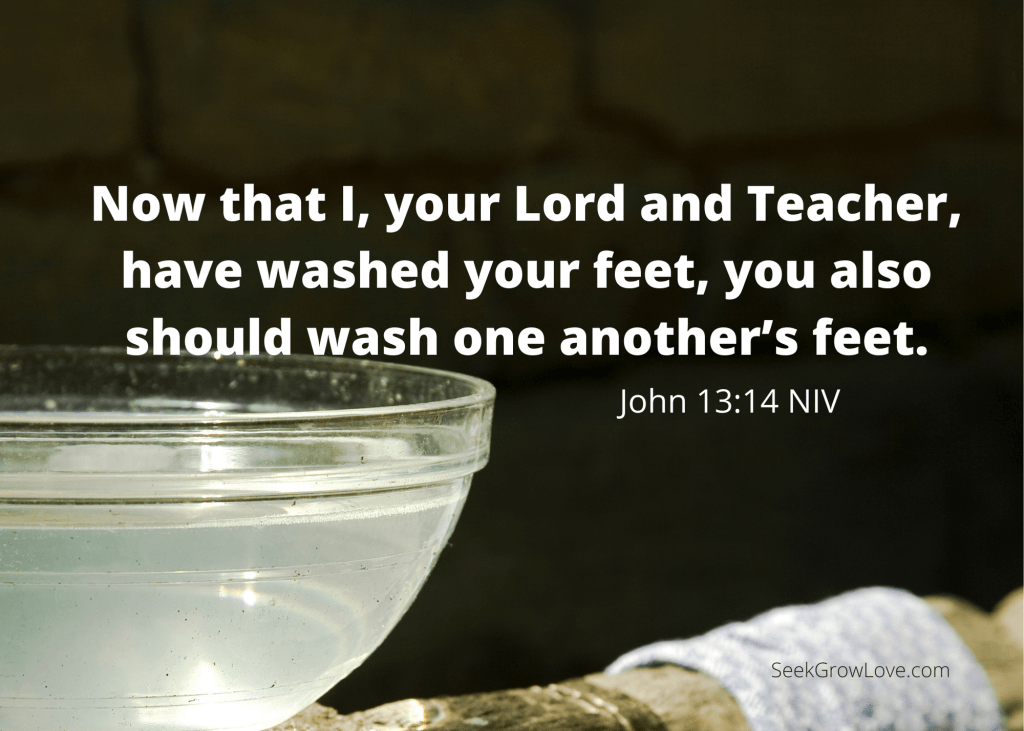
There are two lessons/principles we can learn from Jesus in this account that we can emulate in our lives towards other believers. The first one can be read in John 13.4-5,12-15. Jesus illustrates humility. Jesus as Lord and teacher took the position of a common house servant when he got on his hands and knees and girded himself with a towel to wash feet. If anyone’s feet should have been washed it was Jesus yet the holy selfless Lord and teacher put aside his rightful privileges to serve his students. Jesus humbled himself. Likewise we as Christians are called to humble ourselves before each other and seek out the interest of others before ourself (Eph. 4.2, 5.21, Phil. 2.3-5). 

The second lesson we can learn form Jesus is that to love each other involves humbling ourselves before each other and serving one another in practical ways. The act of washing feet in antiquity served a very practical purpose. Most people wore open-toed shoes or sandals and people walked everywhere. The result was people’s feet would easily become dirty, rough, and caked with filth. No one would want to track the dirt through someone’s home so either the homeowner or a servant would wash the guests feet as they came in. It was practical for the guest and the homeowner. 

What is involved in loving other Christians as Jesus loved us? Looking at the real life illustration of Jesus washing his students’ feet, we learn to love one another involves humbling ourselves before others and serving them in practical ways. 

-Jacob Rohrer

Today’s Bible passages can be read or listened to at BibleGateway here – Luke 22 & John 13

Tomorrow we will read John 14-17.

The Most Needed Ministry

Matthew 26 & Mark 14

In the closing moments of Jesus’ life after the last supper he took his three closest disciples and prayed. Jesus was a man of prayer and it is fitting that in the final moments before he is handed over he prays to his Father. I cannot emphasize enough the importance of prayer. Many of us are guilty of not praying as we ought to. Look at the degree to which Jesus expected his three closest disciples to pray. In Matthew 26.36-41 and Mark 14.32-38 he asks them to remain and watch while Jesus went off and prayed. Watch and pray are synonymous words. To watch is to pray and to pray is to watch. 

When Jesus comes back the first time he questions Peter, James, and John and says, ”You couldn’t keep watch for an hour?” Jesus expected his disciples to pray for a whole hour! Many of us can only last a few minutes let alone an hour. If prayer was important to Jesus and his ministry and his relationship with God CERTAINLY it must be a priority for us. I would venture to say prayer is one of the most neglected and undervalued ministries. Jesus never believed prayer was expendable, neither should we. 

Do you want to grow with God? Do you want to grow in spirituality? Do you want deeper intimacy in your relationship with God and other believers? Do you want to combat spiritual darkness? Do you want to see people saved? Pray. Pray. Pray. 

If we will give ourselves over to the ministry of prayer and intercession God will grow and mature us. Prayer is too valuable to discard, it’s too precious to pass over, and it’s too powerful to be ignored.

Lord Jesus stir in our hearts a desire and hunger for prayer! Raise up men and women who will pray! Amen!

-Jacob Rohrer

Today’s Bible passages can be read or listened to at BibleGateway here – Matthew 26 & Mark 14

Tomorrow we will read Luke 22 & John 13.

Test Yourself!

Matthew 25

Today as we look at Matthew 25 we should take notice that though we are starting a new chapter the context surrounding this chapter is the same as that of chapter 24. Matthew 24 and 25 are a single unit of thought. This can be seen in verse 1 with the word “then” (the NIV says “at that time”) indicating what Jesus was speaking about in chapter 24 is continuing into chapter 25. The focus of the chapter is about the end of this age when Jesus returns and the judgement that he will enact. 

There are three pictures of judgement in chapter 25. The first two are parables (the parable of the ten virgins and the parable of the talents) and the last one is a description of the judgement scene. 

In the first parable there are ten virgins who wait for the bridegroom. The bridegroom delays in appearing and all fall asleep but suddenly the bridegroom appears but only five are ready for the bridegroom while the other five are not ready and they are denied entrance into the wedding feast. The virgins denied entrance are then told by the bridegroom he never knew them. 

The second parable is about a master and his slaves. The master gives each slave a talent (an amount of money) and went on a journey. When the master returns only two of the three slaves honored the master with what they were given. The third slave squandered his talent and is rebuked by the master and the slave is thrown out into the outer darkness.

The third picture of judgement involves Jesus separating goats from sheep among the nations. The sheep and goats represent those who belong to Jesus and those who do not. The sheep (believers) are rewarded with the kingdom and the goats (non-believers) are cast into hell with satan and his demons. 

What are we to make of this chapter? What does Jesus want us to learn from these three pictures of judgement? I believe it is this.

There is a judgement coming and not everyone who calls themself a Christian will enter into life. The reality is, not everyone who calls themself a Christian is a true believer. In all three teachings there is one group of people who are then divided into those who are accepted and those who are rejected. Many people comprise the Church but not everyone who attends church is a true believer. The judgement of Christ sorts out the self-deceived from the real believers. Jesus himself teaches this earlier in Matthew 13.24-30, 36-43 in the parable of the tares. And he also teaches this in Matthew 7.21-22. 

Who are you? Are you deceived or a true believer in Christ? The five virgins were accepted into the feast because they were ready and prepared. The 2 slaves were honored by the master because they were faithful with what the master had given them. And the sheep entered the kingdom because they loved and served other Christians in need. 

A true believer will have evidence of salvation in their life. A true believer bears the fruit of the spirit, they grow in holiness, they grow in their disdain for sin, they hunger for the scriptures, they serve other Christians and people. A real believer matures and grows in Christ.

Paul tells the Corinthians in II Cor. 13.5 to test themselves against the scriptures to see if they are in the faith. Compare yourself to scripture and to the words of Jesus. Have you really received salvation from God? In addition to this, talk with mature believers closest to you about this serious matter if you question your salvation.

-Jacob Rohrer

Today’s Bible passage can be read or listened to at BibleGateway here – Matthew 25

Tomorrow we will read Matthew 26 and Mark 14.

Don’t Be Deceived

Matthew 24

Today’s devotion comes from Matthew’s account of what you read in Mark 13 yesterday. In the twenty fourth and twenty fifth verse Jesus says “For false Christs and false prophets will arise and will show great signs and wonders, so as to mislead, if possible, even the elect. Behold, I have told you in advance”. 

There is a huge difference between a good tested quality product and a cheap knockoff version. The same is with Christ but even more so. Jesus warns his disciples and us that there will be people who claim to be God’s real messiah and savior. Jesus is telling all of us don’t be fooled. I want to highlight 2 aspects of Jesus’ warning.

The first is notice the plurality of “Christs” and “prophets”. There have been and will be multiple people who seek to deceive people and other Christians. This had a very real meaning to the first century church. Before the time of Jesus and after him there were multiple Jewish men who claimed to be God’s real messiah. And even in our time there have been many who have claimed to be God’s special prophet or savior. 

The second aspect of this warning I want to highlight is that Jesus says that signs and wonders will accompany these false prophets and Christs. It’s easy to dismiss someone as crazy if they claim to be a prophet or Christ but what if miraculous events accompany their claims? What are we supposed to think!? Remember that there is a supernatural enemy that opposes God, Jesus, and Christians. For every miracle God performs a counterfeit miracle can be performed by Satan and spiritual darkness. An example of this can be found in Exodus 7.8-13. There must be other factors we must take into consideration such as – does what the person say align with scripture? Is God glorified? 

Though we probably will not encounter someone who will say, “Follow me, I’m the savior of the world” it doesn’t mean that there aren’t false teachers who teach false doctrine. We must always be critical of the teaching that we allow into our lives. Remember to test EVERYTHING against the scriptures. Whether it comes from your friends, your pastor, or even your parents. The best way to avoid deception is a two step process: one, know what the scriptures teach, and two, test everything against the scriptures. If it conforms with scripture receive it. If it doesn’t conform with scripture, reject it. 

-Jacob Rohrer

Today’s Bible passage can be read or listened to at BibleGateway here – Matthew 24

Tomorrow we will read Matthew 25

Be on the Alert!

Mark 13

Many teachings and thoughts could be extracted from the Olivet Discourse (Matt. 24, Mk. 13, Lk. 21). For us this section of the gospels will be the focal point of our devotions today and tomorrow. For our devotion this morning I want to look at the last verse of Mark 13 where Jesus concludes “What I say to you I say to all, ‘Be on the alert’”.

This section of the gospels (Matt. 24, Mk. 13, and Lk. 21) have in mind two future events. Jesus prophesies the destruction of the Jerusalem temple (AD 70) and speaks to the events that will foretell of his second coming. In Mark 13.31 the message Jesus communicates to his disciples is the one he also wants all those who follow him to know as well, namely, “Be on the alert”. The New Testament as a whole has an urgency to it. This theme of being on alert and aware of the coming of the Lord is present throughout the New Testament. Though Jesus ascended two thousand years ago and hasn’t come back yet it does not mean we should live complacent lives as Christians. Here are some other texts that speak to urgency in the Christian life:

“Love does no wrong to a neighbor; therefore love is the fulfillment of the law. Do this, knowing the time, that it is already the hour for you to awaken from sleep; for now salvation is nearer to us than when we first believed. The night is almost gone, and the day is near. Therefore, let us lay aside the deeds of darkness and put on the armor of light. Let us behave properly in the day…” —Romans 13.11-13

“Therefore be careful how you walk, not as unwise men but as wise, making the most of your time, because the days are evil. So then do not be foolish, but understand what the will of the Lord is” — Ephesians 5.15-17

“…let us be alert and sober…” (Read I Thess. 5.1-8)

What does it mean to live on the alert as a Christian? What did Jesus mean when he spoke these words? In light of these texts above and the whole of the New Testament to live alertly is to have the conduct of our lives be in line with the words of Jesus. To live alertly means to quit wasting time with sinful behaviors and practices and start living in light of eternity and the judgement seat of Christ (II Cor. 5.10). 

Is there a sense of urgency in your following of Jesus? If the day of judgement was tomorrow would you be ready? Not only in the sense of would you be saved or not but would you be proud of the life you lived and know that you were sold out for Christ with the time God had given you? Don’t be complacent, be on the alert.

-Jacob Rohrer

Today’s Bible passage can be read or listened to at BibleGateway here – Mark 13

Tomorrow we will read Matthew 24.

Not So Sweet and Mild Jesus

Matthew 23 and Luke 20-21

I have a confession to make. I really don’t like conflict and because of that I don’t always confront situations or people as I should or as is necessary. Now thankfully the Lord is growing me in this area because the reality is confrontation and conflict is necessary. Actually the New Testament teaches that there is a time and place for believers to hold each other accountable with regard to sin. Many Christians and churches struggle with this. It’s uncomfortable, awkward, and scary yet our Lord himself exemplified this in today’s chapter of Matthew 23 (read Matt. 18.15). 

Seven times in Matthew 23 Jesus says “woe to you” with reference to the Pharisees. “Woe” is a prophetic denunciation that the prophets in the Old Testament used to warn people that their behavior was not pleasing to God and if they didn’t correct their actions God’s punishment and judgement would come. 

The crime of the Pharisees was that they were so caught up in religious activities that it compromised true obedience God really desired. Jesus loves and forgives but he will not tolerate empty obedience and religious service. He will not be sweet to that which God hates and opposes. Likewise as followers of Jesus we must strive to become like him in all respects including standing up for the truth even when that means calling out sin and that which God hates. 

This must be done with great wisdom and care and love. I’ll include passages that speak to this theme. I’d encourage you to read them and get exposed to this New Testament teaching. We as Christians have a duty to lovingly hold other believers accountable with regard to sin. 

Passages for further study:

.Matt. 16.21-23

.Matt. 18.15-20

.I Cor. 5.1-5

.Gal. 2.11-14

.Gal. 6.1

.Eph. 5.11-14

.I Tim. 5.20

.Tit. 3.10-11

.Jam. 4.17

Jacob Rohrer

Today’s Bible passages can be read or listened to at Bible Gateway here – Matthew 23 and Luke 20-21.

Tomorrow we will read Mark 13.

The Greatest Commandment

Matthew 22/Mark 12

There’s a song on K-Love (Christian radio station) called “Love God and Love People” by Danny Gokey. The chorus goes “Gotta keep it real simple, keep it real simple bring everything back down to ground zero, cause it all comes down to this love God and love people”. The song is very catchy, yet while this command is simple at the same time it takes an entire lifetime to grow and mature in living out the greatest command God has given to his people. 

The greatest commandment is found in today’s passage and it comes from the lips of the greatest teacher who ever walked the earth, our Lord Jesus Christ. I could say much on this topic yet I will keep it brief and to the point. The two commandments Jesus states as the first and second most important come from the Old Testament. The first and greatest commandment, love God, comes from Deuteronomy 6.4-5. The second commandment, love people, comes from Leviticus 19.18. These two texts Jesus sees as the greatest commandments because the whole law of God can be summed up in these two commands. Also, Jesus not only tells us the two most important commandments but he gives us the divine priority of Christian love. God comes first and only then people. As Christians we do not love people first and then God. We love God first in priority then our neighbor. A blessed Christian life is one that seeks to love God before all else.

For the rest of this devotion, I want to focus on the first and greatest commandment. What does it mean to love God? To love God means to love him with our entire person or being. There are three aspects of our person that we are to love God with in Deuteronomy 6.4-5. These three are; the mind, the soul, and our might. 

To love God with our mind means primarily that we engage with the truth God has revealed about himself in scripture. In short, we love God when we read, study, and meditate upon the Bible. To love God with our soul means to love him with our emotions, affections, and desires. If we say we know God yet are unmoved by him, we don’t know him. It is impossible to love God and remain cold and indifferent. Our emotions do not form the foundation of our relationship with God but they do accentuate and enhance our experience of God. Lastly, to love God with our might is to love him with our physical body and ability and the resources he has given us. To love God with our body can mean using it for serving other people. 

To love God means to love him first in priority and to love him with every area of our life and being.

-Jacob Rohrer

Today’s Bible passages can be read at BibleGateway here – Matthew 22 and Mark 12

Tomorrow we will read Matthew 23 and Luke 20-21.

We are the Temple of God

Mark 11 & John 12

Tracing the history of the temple of God throughout scripture is a fascinating study. The temple of Jerusalem and Jesus’ pronouncement of judgement on it comes into focus in our passage today. Before we look at this pericope in Mark and John, I want to give a brief overview of the history of God’s temple leading up to this point. 

The first time we hear of a structure that God dwells in is the tabernacle in Exodus (read Ex. 25-40). This was not a temple but a portable structure that represented God’s presence among his people. This was used for hundreds of years until the time of Solomon. David (Solomon’s father) desired to build a temple for God but God wanted Solomon to build it. The construction and dedication of the first temple can be read in I Kings 6-8. However, after Solomon the people of Israel engaged in generational sin and idolatry for hundreds of years and in 586 BC, the glorious temple that was erected was utterly destroyed by the Babylonians. Roughly 70 years later (516 BC) a second temple was constructed and it is in this second temple that our passage takes place in. 

Why does Jesus flip tables over and make a ruckus? Because the temple was originally meant to be a sanctuary of holiness and worship to God. However, it morphed into a commercial center for trade, business, and politics. The glory and holiness of God was lost. So Jesus as the rightful king of Israel pronounced God’s judgement upon the temple. Forty years later (AD 70) the temple would be destroyed again, this time by the Romans. 

You may be wondering – was another temple built? No. But Paul teaches in his letters, the church, the group of redeemed human beings in the Messiah, now become the temple of God. Whereas God’s presence filled the tabernacle and previous temple, now his presence dwells among his people by means of his holy spirit. Whereas the previous temples were places of worship and holiness now the church is the epicenter of worship to God. Listen to the apostle Paul:

“Do you not know that you are a temple of God and that the spirit of God dwells in you? If any man destroys the temple of God, God will destroy him, for the temple of God is holy, and that is what you are” – I Cor. 3.16-17

-Jacob Rohrer

Today’s Bible passage can be read or listened to at BibleGateway here – Mark 11 & John 12

Tomorrow we will read Matthew 22 and Mark 12.

Possessions or Jesus?

Text: Luke 18.15-19.48

At the time this devotion is being written, the release of the new iPhone 12 will be announced tomorrow. Many people, as usual, will drool over this fresh piece of technology and feel compelled to get it even though they probably don’t need it. And my oh my how this is true with so many other material items in our life. We don’t really need them but feel as though we do. This is the world we live in as 21st century Americans. However, though having material possessions IS NOT BAD, as disciples of Jesus we MUST be aware of the ever lurking sin of greed and ungodly consumption. 

In today’s text we read about two rich men who respond to Jesus in complete opposite ways. The two rich men are the Young Rich Ruler and Zacchaeus. The reality is both of these men represent two groups of people. One group who says they want to follow Jesus but do not want to give up their supreme desire for possessions/wealth and the other group are those who equally love money and wealth but repent of it and replace the greatest desire of their life (wealth) with Jesus. 

In the account of the rich young ruler, Jesus plainly tells us it is impossible for a rich man to enter the kingdom of God. Worldly riches and treasures and possessions mean absolutely nothing to the sovereign creator of the universe. It is ok to have money, it is absolutely not ok to love money (and what you get with it) more than God. The former is God’s gift to us, the latter is idolatry. Love the giver not the gift. 

In the account of Zacchaeus we learn that it is never too late to repent of our sin (in this case greed) and come to Jesus and receive salvation. Zacchaeus was likely a career tax collector who made a living stealing from his own Jewish people. He shows us the way to repent from greed. He gives away many of his possessions and repays four times what he stole from people. Zacchaeus’ heart changed therefore his actions and lifestyle changed. True repentance is always evidenced in life change. 

Who are you? Do you say you love Jesus but really wealth and consumerism has your heart? Or do you recognize greed has no place in the life of a believer. Our greatest treasure is Christ not the Iphone 12. 

Other passages on greed and wealth:

.Luke 8.14

.Luke 12.16-21

.Luke 16.19-31

.Proverbs 11.4

.Proverbs 11.28

.Matthew 6.19-21

-Jacob Rohrer

P.S. The next 2 weeks of devotions will be authored by me. All my scriptural citations will come from the New American Standard Bible (NASB).

Today’s Bible reading passage can be read or listened to at BibleGateway here – Luke 18.15-19.48

Tomorrow we will read Mark 11 & John 12.