What would you do if you knew you would die in less than a week? Is there anywhere you would want to go? What changes would you make in your schedule and priorities? Less TV, pinterest or social media? More meaningful interactions with those who mean the most to you? Would your tone change? Would you give more hugs? Are there any difficult conversations you wouldn’t put off any longer? If there was anything you could do to prolong your life would you do it?
Jesus was in a very unique situation as he was coming into Jerusalem in Matthew 21. He knew he was quickly approaching both the time and place for his agonizing death by crucifixion. Many would run in the other direction. Maybe if he laid low and avoided Jerusalem longer the chief priests and leaders of the law would forget about him and find some other religious teacher to get mad at and crucify. Think of how many more people he could heal and teach if he could stay away from them just another month? Wouldn’t it be worth it?
But, Jesus didn’t hide or try to dodge the bullet. If anything he boldly intensified his work and purpose. Previously he had mostly stuck to the smaller towns and villages rather than camping out in Jerusalem – the holy city of all Jews. Often he had told those he healed to be quiet about it. He was never trying to draw a crowd – but the crowds still had a way of finding him anyways. Now, as he made preparations to enter Jerusalem on the back of a donkey (to fulfill Zechariah’s prophecy) he knew the crowds couldn’t be held back any longer. On this day they would shower Jesus with shouts of praise, but in a few days they will cry out for crucifixion.
We don’t know the day or hour or location of our death. We also don’t know how long the tomb will hold us. But, like Jesus – and because of Jesus’ resurrection and God’s promise to send Him to earth again – we can be sure of a resurrection to come. How will that impact the intensity of your ministry today – how you spend your time, what conversations you have, what passion you have for the Father’s work and will?
May we not be like the fig tree that had life but failed to bear fruit for Him.
May we not be like the son who said he would do the Father’s work – but then didn’t.
Today we have more jostling and trying to get to the front of the line, despite what Jesus just taught about the proper order – keep God first, then others before yourself. The first shall be last and the last shall be first. One of the last verses from yesterday’s Matthew 19 was Peter asking, “What then will there be for us?” (19:27b NIV) In today’s reading of Matthew 20, James’ and John’s mother will ask if her two sons can sit at Jesus’ right and left when Jesus sits on his throne. What’s in it for me (and my kids)? How can I be first, best, greatest?
Jesus’ reply isn’t what they were looking for. First, in continuing his answer to Peter, he tells the Parable of the Workers in the Vineyard. The workers hired first worked all day and worked well and got what they had worked for – one denarius (a fair wage for a day of work). It would have been fine, except that, all day long the boss kept hiring others to come get the job done – some ended up just working the last hour. And, they too, received one full denarius! Where was the extra reward and recognition and pat on the back for being first, for putting more time on the clock, for working harder than any of the others? It wasn’t fair. But the boss didn’t say, “Thank you so much for pointing that injustice out to me, here’s your bonus.” Instead, he said it was time for an attitude check. You did your work well, but your selfish complaining attitude isn’t pretty. Stop questioning the master’s generosity. Stop comparing your work load and pay rate with your neighbors’. God’s got this – He’s a good boss. Your job isn’t to be boss, your job is to keep working in the vineyard – with a good attitude – not selfish and resentful but thankful and joyful for the grace and mercy the boss shows to others.
For the 3rd time in the book of Matthew – Jesus prepares his disciples for his upcoming death – this time revealing it will be through crucifixion. But they don’t get it. They still expect his kingdom to start soon in a grand and glorious manner.
The mother of James and John is planning ahead. She knows Jesus has a very special relationship with her boys so it’s time to secure their place at his side – how about the thrones on the right and left of Jesus when he becomes king? The boys agree they are ready for these places of honor. Jesus said if you are trying to be great – if you are trying to be first – SERVE OTHERS. Give up your life, your time, your pride and selfishness. Put the needs of others before your own. Just as Jesus did – over and over again – with his life and then with his death.
The world doesn’t need more Christians trying to be first and greatest. The world needs more Christian servants joyfully working in the vineyard and caring for the needs of others.
I remember a song we used to sing in Sunday School:
“Jesus and Others and You, what a wonderful way to spell J-O-Y!
Jesus and Others and You, in the life of each girl and each boy.
J is for Jesus for he has first place. O is for Others we meet face to face.
Y is for You in whatever you do. Put yourself third and spell Joy.”
It’s not just a sweet song with a catchy tune for little girls and boys. There is a lot of truth in those lyrics. And it comes to play in two passages in Matthew 19 – Jesus’ teaching on divorce and his conversation with the rich young man regarding materialism. Let’s look first at divorce.
Too often marriages start to crumble when the relationship becomes a ‘his side’ vs ‘her side’. Gone is the teamwork and working together and dream of always being together that brought them together in the first place. It is replaced with selfish goals and pursuits, quick tempers and irritations, and eventually seeing their mate tragically not as their better half but as their enemy. It is not a new thing – it was a problem 2,000 years ago as well. The Pharisees asked Jesus, “Is it lawful for a man to divorce his wife for any and every reason.” (Matthew 19:3). She doesn’t make me happy any more. He never picks up his dirty socks. This isn’t as fun as I thought it would be -it’s too hard. I think I love someone else. He’s changed too much. She never has time for me. He works too much – or not enough. Times have indeed changed, but people, not so much. We would do well to remember and put to daily use Jesus’ reply.
Marriage was created by God – for a male and female to become one – for life. What God created is good. Humans have a way of messing up his creation – including finding ways out of marriage. So how do we avoid the hard hearts that lead to divorce? Remember the proper order. Jesus-Others-You. As you and your spouse draw closer to God and His Son it draws you closer to one another so your spiritual health is a great place to start. And nothing breaks the viscous his side/her side battle like seeing yourself as one – the way God intended. It’s harder to go into attack mode when you are actually shooting yourself, or your other half. Before you know it – you are naturally putting him or her ahead of yourself because you realize the team benefit. And the JOY creeps back into your marriage – the way God intended.
And then we have the rich young man who wanted to know what he had to do to ensure eternal life. Jesus said start by following God’s law – that is the part about putting Jesus first since Jesus came to do and teach God’s will. The man was pleased to report he did that well – but what else could he do? Sell your possessions, give the money to the poor and follow Jesus – that is putting others before yourself in a big way. “When the young man heard this, he went away sad, because he had great wealth.” (Matthew 19:22). He lost his JOY because he was too attached to what he had amassed to keep himself comfortable. He boasted of how well he kept God’s commands – but it was too hard to love his neighbors like himself. He got himself out of order. That’s the trouble with wealth – it often makes us forget to put God and others first. Jesus didn’t say NO rich man would gain eternal life, but it would be very hard. Rather than solving problems wealth often creates more. It becomes harder and harder to keep priorities straight and in the proper order when you have more and more to juggle and prioritize.
Jesus – Others – and You. Put yourself at the end of the line because at the judgment, “Many who are first will be last, and many who are last will be first.” (Matthew 19:30). It’s the order that leads to lasting life and joy.
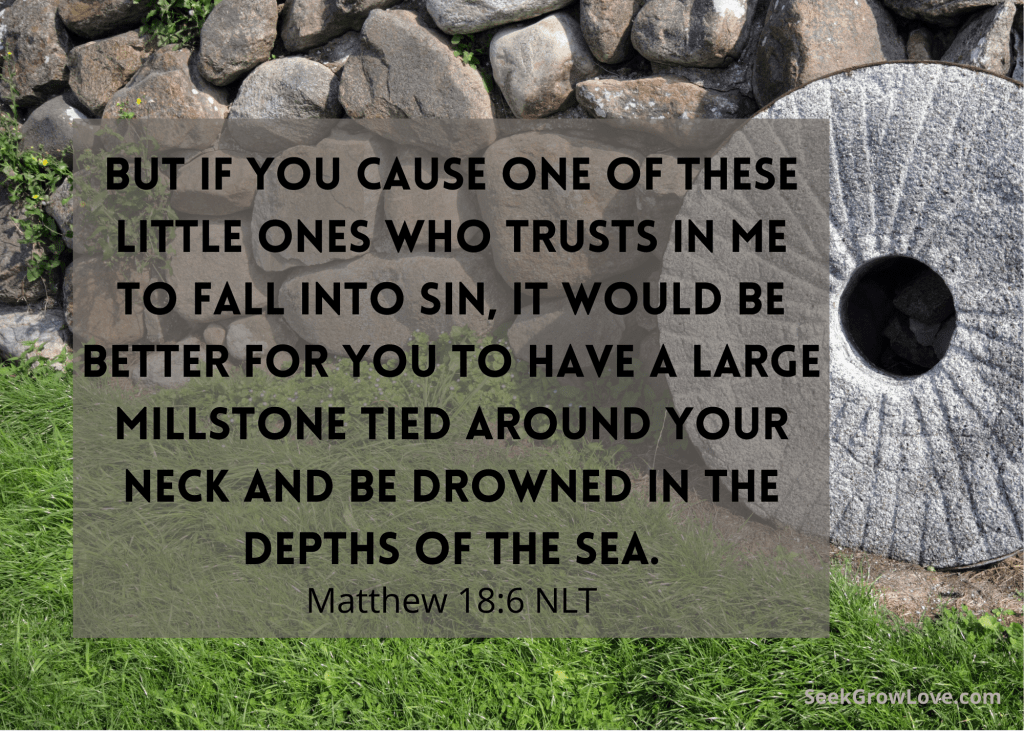
I have watched just enough mobster movies to know the awful fate of those who anger the mafia boss and receive the “cement shoes” treatment. That is the vision that always comes to mind when I read of the seriousness of leading a child to sin. “And whoever receives one such child in My name, receives Me; but whoever causes one of these little ones who believe in Me to sin, it is better for him that a heavy millstone be hung around his neck, and that he be drowned in the depths of the sea.” (Matthew 18:5,6 NASB) Jesus was giving a pretty heavy answer to the disciples who had asked who would be greatest in the kingdom. He answered that instead of trying to be great, they should focus on being childlike instead – not immature (we see enough of that), but humble, knowing that they don’t know everything and they need a Father and a Savior. And while the child is standing in their midst – Jesus commends those who welcome a child and blasts those who recklessly (or accidentally?) lead a child to sin. As a parent and a Christian this is a strong warning that I will be judged based on how I am spiritually leading and guiding God’s children. I do not know where the line will be drawn. We might be able to safely point out some cases that would definitely receive Jesus’ condemnation (those who exploit children and youth for sex trafficking, pornography, cults or gangs). But what of the parent who signs their child up for the youth sports, campouts and Sunday morning jobs knowing it will take them away from opportunities for God’s little children to grow closer to Him? I don’t know. But it seems wise to do my best to err on the side of caution. What else can I be doing to spiritually guide His children away from sin? Life is easier when you don’t feel the weight of a millstone around your neck or cement hardening in your shoes.
And, if that isn’t scary enough – Jesus broadens the picture next – to all people and sinners and the extreme measures that need to be taken to keep oneself from falling into sin. “Woe to the world because of the things that cause people to stumble! Such things must come, but woe to the person through whom they come!” (Matthew 18:7 NIV). And then comes the gruesome cutting off of body parts that causes you to sin. This gives a strong mental picture of doing whatever it takes to hold oneself accountable and keep oneself from sin. If your eye causes you to sin, cut it out, to save yourself from judgment and hell. This is definitely true in a metaphorical sense. We need to do all we can, even what would be considered extreme measures, to keep ourselves from sin. And, sometimes that will mean cutting off the influence some people hold over us – cutting off a friend or family member or social media/entertainment who entices us to sin. It’s a hard thing to do, just like cutting off your hand – but it could save your eternal life. And, we must watch ourselves to make sure we are not the ones enticing others to sin!
While I love the parable of the lost sheep and it hurts to skip over it…I am going to skip ahead to the next two passages in Matthew 18 which both deal with the brother who sins against you. Having just established the seriousness of sin, the consequences for those who lead others to sin and the extreme measures we are to employ to keep us from sin – it is easy to assume that the best course of action is to shun all sin and sinners. But, wait, what kind of cut off, silent, lonely, bitter world would that be? While we are all sinners – God gave us a way to be forgiven and to restore relationships. Jesus begins to explain it here.
First, if a brother sins against you – go and talk to him. Matthew 18: 15-17 goes through an important series of steps to work towards either resolution or healthy distance and cutting off -and it starts with talking to the “offender”. Too often when we feel someone has sinned against us we talk to others about it. I know I am guilty of this and need to do a better job of lovingly confronting the person I have an issue with – first. So the steps Jesus laid out are: talk privately to the person, if he doesn’t listen take 1-2 witnesses and try again, if he doesn’t listen tell the church, if he still doesn’t listen cut him off. The goal is always to win him back to ‘God’s saving side’, not to humiliate, point fingers or feel better about ourselves or peace at any cost. But, sometimes repentance doesn’t happen, and then we must be willing to cut the ties that would bring others down to sin as well.
So, let’s assume we correctly followed the steps Jesus left. Peter asked how many times he needed to forgive a brother who sinned against him. He thought 7 sounded like a lot. But Jesus said no – 77 or 70 x 7 or whatever number you want to use to remind yourself to keep forgiving – the same way you want others to forgive you. And the same way God has forgiven you. I think we can safely assume this is not the brother who was unrepentant and cast out of the church, but a brother who was repentant and seeking to live a godly life – but still tripped up – like you and me. And so Jesus lays out the powerful Parable of the Unmerciful Servant (make sure you read it again). Now the harsh words and judgment are not for the sinner who tripped up, or even the one who caused him to sin, but for the one who didn’t forgive. “Then the master called the servant in. ‘You wicked servant,’ he said, ‘I canceled all that debt of yours because you begged me to. Shouldn’t you have had mercy on your fellow servant just as I had on you?’ In anger his master handed him over to the jailers to be tortured, until he should pay back all he owed.” (Matthew 18:32-34).
It isn’t that sin is nothing – and easily forgiven. Sin (of all kinds) is something huge and serious and able to block us from eternal life. If we could see how much our sin hurts others, handicaps ourself and damages our relationship with God we might more readily run from it. But we don’t always, and God in His mercy still lays out a way for us to restore a relationship with Him, ultimately it would cost Him the death of His Son Jesus. To accept the forgiveness offered to you, but not extend it to others puts you again in grave danger. Sin is a big deal – and so is mercy.
Here we are beginning the 3rd full week of 2021 and so much has happened already. 7 days of careful investigation revealing solid scientific evidence supporting a Biblical view of a miraculous creator (and destroyer) God. And then 7 days of the Old Testament patriarchs of Genesis and fathers of the faith: Abraham, Isaac and Jacob – and what they teach us still today about following God with the faith of Abraham. This week our devotions will be following our New Testament readings in the book of Matthew (one chapter a day) to see what God is doing…
Matthew 17 begins with an awe-inspiring mountain-top experience (often called the Transfiguration) in which God’s glory radiates through and around Jesus Christ – showing a snippet of the beauty, majesty and glory of God’s coming Kingdom which will feature His dazzling Son amongst the risen heroes of the faith. Peter, James and John were there to see it – and they were shaking in their boots at the power of the moment and the voice of God heard from the cloud saying, “This is my Son, whom I love; with him I am well pleased. Listen to Him.” (Matthew 17:5)
But wait…we really can’t start there. Our spiritual journey doesn’t exist only on the glorious mountaintop. What comes before the glory? About a week before the events of Matthew 17, Jesus was telling his disciples that he would face much persecution and even death (before being raised to life) (Matthew 16:21). Bold, strong, impetuous Peter who thinks he knows better than the Son of God tries to correct Jesus – Peter would never let that happen to Jesus. But Jesus isn’t encouraged or amused by Peter but rather calls him “Satan…a stumbling block….you do not have in mind the things of God, but the things of men.” (Matthew 16:23). Jesus continues to prepare his disciples, letting them know that he would not be the only one expected to suffer – but that they too would be required to endure the agony of “taking up their cross” to follow him.
It doesn’t sound fun or exciting. It is hard to get people to sign up for suffering. Peter and the disciples didn’t like the sound of it. Most people today don’t. But it is not suffering without a goal. It is a fight worthy of the cause and the prize. Jesus said those who would suffer for him and lose their life would find it – because after the suffering for Christ – comes the glory. Jesus explained, “For the Son of Man is going to come in his Father’s glory with his angels, and then he will reward each person according to what he has done. I tell you the truth, some who are standing here will not taste death before they see the Son of Man coming in his kingdom.” (Matthew 16:27-28 NIV)
And, a week later, Peter, James and John found themselves on a mountain-top getting a taste of the splendor that will be when God tells His Son, Jesus, it is time to go to the earth to set up a kingdom like none have ever seen before. A kingdom greater than anything set up in the time of the Law (Moses) or the prophets (Elijah) or Jesus’ first coming. God was revealing His perfect plan for His perfect Son and all those who will listen to him.
Contrary to both today’s “prosperity gospel” and Peter’s human thinking, God’s perfect plan does not consist solely of beautiful, bright mountain-top experiences. There is also the ugly, dark and painful cross. For Jesus – and for those who listen to him and carry their cross. But don’t fear, God’s got this. He’s got those who listen to His Son. Our trials will not last forever – but His Kingdom will. “Therefore we do not lose heart. Though outwardly we are wasting away, yet inwardly we are being renewed day by day. For our light and momentary troubles are achieving for us an eternal glory that far outweighs them all. So we fix our eyes not on what is seen, but on what is unseen, since what is seen is temporary, but what is unseen is eternal.” (2 Corinthians 4:16-18 NIV)
How can you be sure your suffering will have a reward? Are you suffering for Christ – or yourself? Is your master plan for your life from the mind of man (how can I get ahead and protect myself best?) or from the mind of God (suffer for the sake of God’s Son and look forward to the reward to come)? What will listening to Jesus look like for you in 2021? What will suffering before glory look like for you today?
After Jacob had served Laban in Padan Aram for 20 years, God told him to go back home. It was finally time for him to face his past. Remember, he had cheated his brother Esau, and had run for his life. He had about 500 miles to go to get home. He sent some servants ahead to let Esau know he was coming home. When the servants returned, they told Jacob that Esau was coming to meet him with 400 men. Jacob was terrified, and prayed a beautiful prayer that is recorded in Genesis 32:9-12.
He started, “Oh God of my father Abraham, God of my father Isaac…”. In this section, I see Jacob acknowledging the history his family had with following God, ever since God called Abraham in Genesis 12.
He continued, “O Lord, who said to me, ‘Go back to your country and to your relatives, and I will make you prosper’. ” In this section, I see Jacob acknowledged what God had told him to do, and he had followed what God had told him to do.
Next, he acknowledged his own unworthiness, praying, “I am unworthy of all the kindness and faithfulness you have shown your servant. I had only my staff when I crossed this Jordan, but now I have become two groups.” And he acknowledged what God had done for him, even though he was unworthy.
He continued, “Save me, I pray, from the hand of my brother Esau, for I am afraid he will come and attack me, and also the mothers with their children.” In this section, he admitted his fear to God, and then he finally got around to begging God for what he needed help with – “save me”. Note that he didn’t give God suggestions as to how God could solve the problem. He just turned it over to God.
He concluded with, “But you have said, ‘I will surely make you prosper and will make your descendants like the sand of the sea, which cannot be counted.’.” He closed with reminding God of His promises.
In this prayer, I see a potential model for our own prayers. It goes sort of like this:
Start by thanking God for his provision until now for our family, including for our ancestors.
Today, God speaks to us through His word. I think it is important to be familiar with his word and follow his word. And I think that’s a perfectly fine topic to bring up in prayer, “God, you said to …, and I have done that as you commanded.”
I believe we need to humble ourselves before God, and acknowledge that we don’t deserve all he has done for us. I think it also helps to remind ourselves in our prayers what God has done for us. (We don’t need to remind God. He already knows.)
We should admit whatever we’re feeling to God. (He already knows anyway, but it helps us maintain an open channel of communication with Him.)
We are finally at the point in our prayer where we should clearly lay out the problem we’re facing. And we don’t need to offer God suggestions as to how He could solve our problems. He can come up with solutions better than we can even imagine.
I think in the closing of Jacob’s prayer, he was not just reminding God of the promises God had made. I think he was also looking forward to those promises himself. We should do the same.
And I think it’s fine to pray something like, “God, you promised that everything works for the good of those who love you. I don’t understand how that is possible in the situation I’m in right now. Please open my eyes to understand that, or at least to accept it as truth. I know you have promised that nothing can separate us from your love, not even death. God, things aren’t looking very good from my perspective right now, but I’m holding on to your promise that when Christ returns, you will wipe every tear from our eyes, and there will be no more death or mourning or crying or pain. God, I’m really wanting that now. Please keep me focused on you, and living for you. And please send Jesus soon. Amen.”
In Genesis 29, Jacob arrived in Padan Aram and found his first cousin, Rachel, at a well. I’m immediately reminded of Genesis 24, where Abraham’s servant came to this same place, probably to this same well, and found Rebekah, the then-future wife of Isaac. We’re not told if Jacob had prayed for God’s direction like Abraham’s servant did in Genesis 24. But we do know Jacob went there not only to run away from his brother, whom he had cheated, but also to find a wife. And bonus, Rachel was a virgin and was gorgeous.
After spending a month working for Laban, Jacob’s uncle, and working hard the whole time, Laban asked what wages Jacob would like as he continued to work for Laban. In Genesis 29:18, we read, “Jacob was in love with Rachel and said, I’ll work for you seven years in return for your younger daughter Rachel.” He must have really been in love, because we’re told, “So Jacob served seven years to get Rachel, but they seemed like only a few days to him because of his love for her.” Wow, that sounds like a romance novel (although I haven’t actually ever read one).
At the end of seven years, there was a big wedding ceremony. When Jacob woke up the next morning, he woke up with Rachel’s older sister, Leah. Laban had tricked Jacob, and had him marry the wrong girl! Personally, I can’t imagine how this happened. Did Jacob celebrate a little too much to notice who he was marrying? Leah had to be complicit in this subterfuge. Did Leah keep her veil on until it was dark? Did she not talk, because presumably the two sisters’ voices sounded different. Where was Rachel while all this was happening?
Regardless of the answer to any of these questions, Jacob had been tricked into marrying the wrong sister. After complaining to Laban, he agreed to work another 7 years for the wife he really wanted, and married her a week later.
Polygamy may sound wrong to us, but there are several examples in the Old Testament of men marrying multiple women. Having said that, there are no examples of this working out well anywhere in the Bible. According to Jesus in Matthew 19:4-9, God intended from the beginning that one man would be married to one woman for life.
Anyway, Jacob had tricked his father, and had cheated his brother. Now, Jacob was tricked by his father-in-law, and (spoiler alert) he would be cheated by his father-in-law repeatedly for 20 years.
This is an example of a principle that we see demonstrated throughout scripture, and in our lives today. We read in Galatians 6:7, “Do not be deceived, God cannot be mocked. A man reaps what he sows.” You may have heard the old axiom, “What goes around comes around.” Basically, these both mean the same thing – everyone eventually has to deal with the consequences of their actions.
But wait, God had promised rich blessings to Jacob. Shouldn’t God have prevented Jacob’s problems? Sorry, it doesn’t work that way. Followers of God are promised, in 1 John 1:9, “If we confess our sins, he is faithful and just and will forgive us our sins and purify us from all unrighteousness.” This takes away God’s punishment for our sins, but it doesn’t take away the natural consequences of our actions.
Despite this, we can still rely on another promise, found in Romans 8:28, “And we know that in all things God works for the good of those who love him, who have been called according to his purpose.”
In his early life, Jacob was opportunistic and deceitful – looking out for number one. After working for Laban for 20 years of hardships, Jacob grew to understand that God was looking out for him (See Genesis 31: 38-42).
I think this isn’t just the story of a historical character and his family. I think these truths still hold true for us today, and we can learn from them. God will forgive us if we confess and repent. But we will receive natural consequences for our actions. Despite this, if we are living in a right relationship with God, everything, even those natural consequences will turn out for our good.
There is an easier way. We can save ourselves a lot of pain and trouble by just following God from the start. But we each have to make that choice for ourselves. What’s your choice?
In Genesis 28, we find the story of “Jacob’s Ladder.” Jacob had deceived his father, Isaac, and had “stolen” the blessing intended for Esau. Jacob was on the run to move in with his uncle, roughly 500 miles away, so his brother Esau wouldn’t kill him. That night Jacob had a dream with angels going up and down a ladder between God and Jacob. When God spoke to Jacob, He didn’t condemn him for his trickery; instead, He extended the covenant to Jacob that He had made with Abraham and with Isaac. God promised Jacob that he and his descendants would inherit the promised land, his descendants would be numerous, and all nations on earth would be blessed through Jacob and his descendants. God also promised He would be with Jacob wherever he went.
When Jacob woke up, his first response was surprise and fear. He named the place “Bethel” which means “the house of God”. He set up this stone pillow as an altar and worshiped. Finally, he dedicated his life to God.
According to “The Wiersbe Bible Commentary” by Warren Wiersbe, “The ‘if’ found in many translations of verse 20 can also be read ‘since’. Jacob wasn’t making a bargain with God; he was affirming his faith in God. Since God had promised to care for him, be with him, and bring him back home safely, then Jacob would affirm his faith in God and would seek to worship and honor Him alone.”
I see several applications for us.
As I understand it, the ancients believed gods (with a little “g”) were local, and if you left an area, you left the protection of the local god. In this encounter, Jacob thought he had stumbled into the “house of God”, but found that God isn’t limited like that. Since God would be with him everywhere, everywhere can be the house of God. According to James 4:8, if we come near to God, God will come near to us.
Once Jacob encountered God, his first response of surprise and fear quickly turned to worship. When we first encounter God, we may also be struck with surprise and depending on the circumstance, fear too. I think it is important for us to continue on to the worship stage as Jacob did. Note that the altar he built wasn’t for offering sacrifices, it was really more of a memorial that reminded him of his encounter with God. When we encounter similar milestones in our own lives when God has done something noteworthy for us, I think it is important for us to set up a memorial of some sort. Ideally this is something physical, that we can look at and be reminded of what God has done for us.
Jacob’s next step was to dedicate his life to following God. I think this step is imperative for us. Given what God has done for us so far, our natural response should be, “Since you have brought me this far, and since you have made such great promises to me – the promise of eternal life if I remain faithful until Christ’s return, because of these things, I will live the rest of my life for you, God.”
As the story continues, Jacob had many hardships throughout his life. Despite them all, God was still with Jacob. And Jacob remained true to God for the rest of his life.
Psalm 46:7 says, “The Lord of hosts is with us; the God of Jacob is our refuge.” God kept his promises to Jacob, and he will keep his promises to us.
The real question is, will you remain true to Him?
After serving God for 100 years, “Abraham breathed his last and died at a good old age, an old man and full of years”. This fulfilled a promise God had made to him in Genesis 15:15, when God had promised Abraham that he would die in peace at a good old age.
In addition to a great quantity of life, I think Abraham had also enjoyed a great quality of life for all those years. At the end of his life, he could look back with satisfaction, and even then could still look forward with anticipation to God’s promises. Promises including: Abraham and his descendants would inherit the promised land forever, his descendants would be as numerous as the sand and the stars, and that all nations on earth would be blessed through him.
I suspect only a small minority of people can face death like this. I’m guessing most look back at their life with regret, and look ahead with fear.
You may be wondering how Abraham could die in peace, with peace. I believe it all comes back to his relationship with God. We’re told that Abraham was God’s friend (2 Chron 20:7, Isaiah 41:8, James 2:23). In Hebrews 11, we’re told that Abraham died in faith, having not received what was promised, looking forward to the city with foundations, whose architect and builder is God.
You may be wondering how Abraham developed such a close relationship with God. I’ll give you a hint, it wasn’t by following the law. He died hundreds of years before God would give the law to Moses. He didn’t become righteous by circumcision, because he was declared righteous years before he was circumcised. Back in Genesis 15, God made a promise to Abraham, and in verse 6, “Abram believed the Lord, and He credited it to him as righteousness.” Abraham became right with God, because Abraham believed God. And in so doing, Abraham became a model of how all of us can become right with God. Paul used this example in Romans 4 to argue that all are justified through faith alone.
Ephesians 2: 8-10 tells us, “For it is by grace you have been saved, through faith —and this is not from yourselves, it is the gift of God — not by works, so that no one can boast. For we are God’s handiwork, created in Christ Jesus to do good works, which God prepared in advance for us to do.”
In chapter 2, James used Abraham as an example to demonstrate the importance of proving faith by deeds. We aren’t saved by works, but those works prove our faith. And lack of works proves lack of faith.
Abraham left quite a legacy. When God reiterated His promise to Isaac, as recorded in Genesis 26:3-6, we read, “…I will be with you and will bless you. For to you and your descendants I will give all these lands and will confirm the oath I swore to your father Abraham. I will make your descendants as numerous as the stars in the sky and will give them all these lands, and through your offspring all nations on earth will be blessed, BECAUSE (emphasis added) Abraham obeyed me and kept my requirements, my commands, my decrees, and my laws.” Did you catch that? All of this was because Abraham was faithful to God.
The New Testament starts with, “A record of the genealogy of Jesus Christ the son of David, the son of Abraham.” God had promised Abraham that all the world would be blessed through him, and God kept his promise.
I’d like to leave you with a few questions..
Have you thought about preparing now to face death when it comes? Ecclesiastes 12 encourages us to start young. Ecclesiastes 12:1 says, “Remember your Creator in the days of your youth, before the days of trouble come and the years approach when you will say, “I find no pleasure in them.” Verses 13-14 go on to say, “Now all has been heard; here is the conclusion of the matter: Fear God and keep his commandments, for this is the whole duty of man. For God will bring every deed into judgment, including every hidden thing, whether it is good or evil.”
Are you living by faith? Hebrews 11:6 says, “And without faith, it is impossible to please God, because anyone who comes to him must believe that he exists and that he rewards those who earnestly seek him.” And are you demonstrating your faith by your actions?
Finally, what legacy are you leaving? Exodus 20: 5-6 says, “…I, the Lord your God, am a jealous God, punishing the children for the sin of the fathers to the third and fourth generation of those who hate me, but showing love to a thousand generations of those who love me and keep my commandments.”
In Genesis 24, we find the story of Abraham sending his servant to find a wife for his beloved son Isaac. It’s interesting that the story of creation as recorded in Genesis 1 required only 31 verses, but that this chapter about a wife for Isaac, with its 67 verses is the longest chapter in Genesis. In addition to the obvious story we read in this chapter, I think there are additional things we can learn from this chapter. As I read about the story of finding a wife for Isaac, I see a parallel with GOD (Abraham in this story) finding a bride (the church for Christ, Rebekah for Isaac) for His beloved son, Jesus (Isaac in this story). I also see lessons for us to consider when seeking a spouse. This will get long, but I’ll try to touch briefly on the story, the comparison with God, and application for marriage.
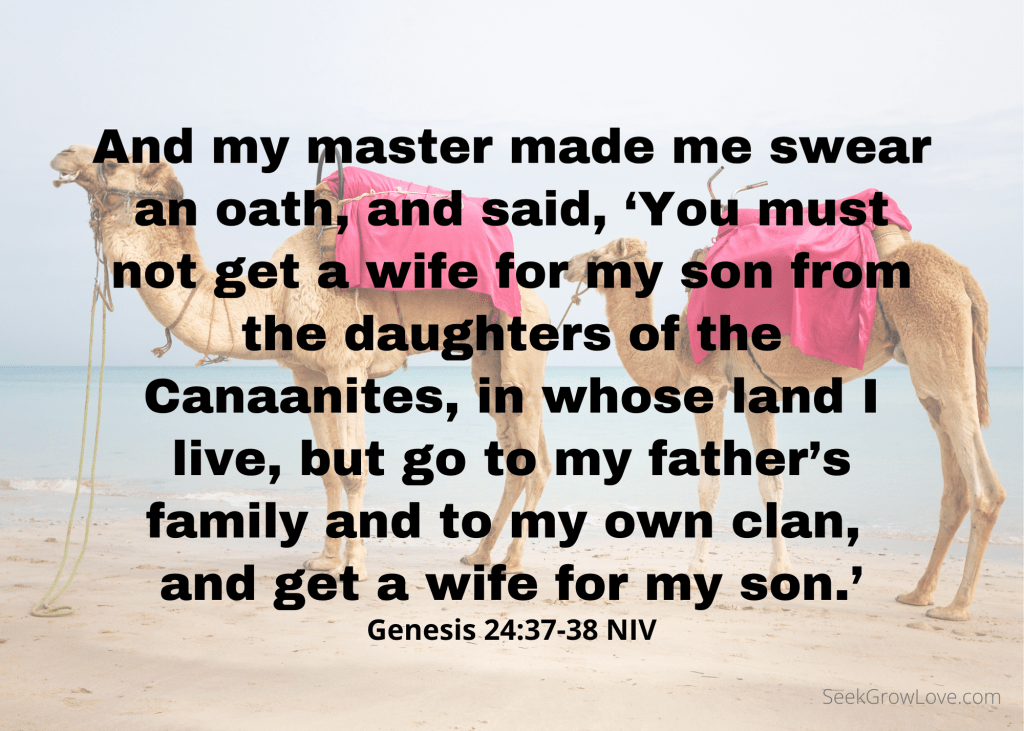
Abraham had been following the Lord for 65 years by this point in our story. Abraham wanted to arrange the marriage for Isaac to the right wife, before he died. The story starts with Abraham giving instructions to his servant. Genesis 24: 3-4 says, “I want you to swear by the Lord, the God of heaven and the God of earth, that you will not get a wife for my son from the daughters of the Canaanites, among whom I’m living, but will go to my country and my own relatives and get a wife for my son Isaac.”
The servant travelled hundreds of miles (possibly nearly 500 miles) with servants and 10 camels loaded with gifts to get to where Abraham’s relatives lived. Once he got there, before doing anything else, he prayed, as recorded in Genesis 24: 12-14, “O Lord, God of my master Abraham, give me success today and show kindness to my master Abraham. See, I am standing beside this spring and the daughters of the townspeople are coming out to draw water. May it be that when I say to a girl, “Please let down your jar that I may have a drink. And she says, ‘Drink, and I’ll water your camels too.’ – let her be the one you have chosen for your servant Isaac.” He not only prayed, he also asked for a sign to know who was the right one.
While he was still praying, Rebekah came out to draw water. He asked her to give him some water – which she did, and then went ahead and watered his camels too, without being asked. (Note: a single thirsty camel can drink up to 40 gallons of water – she was obviously a hard worker.) During all this, the servant just watched quietly and waited.
He then asked, “whose daughter are you.” Once he found out she was related to Abraham, he immediately bowed down and worshiped God. When he did this, Rebekah ran back home to tell her mom what happened – leaving the servant at the well.
Rebekah’s brother, Laban, came out to invite the servant to come home with him. Before the servant would even eat, he wanted to tell the reason for his visit. Once he told them about Abraham, and Isaac, he asked the family if Rebekah could marry Isaac. They decided to leave that up to Rebekah, who said, “Yes.”
The servant gave both Rebekah and her family many gifts. The servant also told how rich Abraham was, and that he had given everything to his son Isaac – indicating how rich Rebekah would be once she married Isaac.
The next day, the servant wanted to take Rebekah and go back home. Her family wanted to wait a while. They asked Rebekah, and since she was eager to go too, they left right away.
As soon as they got back to Isaac, the servant gave an account to Isaac of all he had done. Then Rebekah married Isaac, and they lived happily ever after – or at least, “So she became his wife, and he loved her; and Isaac was comforted after his mother’s death.”
Parallel: I see similarities between Abraham as a loving father, and God. And between Isaac, who had a miraculous birth, and was obedient to the point of being sacrificed, and Jesus. Rebekah, the bride for Isaac, reminds me of the church as the bride of Christ (Ephesians 5:22-24).
Neither Abraham nor Isaac went to find a bride, instead, Abraham sent a faithful servant, who swore to be obedient to Abraham’s wishes. The unnamed servant referred to Abraham as “my master” 19 times in this chapter. Everything he did was to obey and serve his master. (We would do well to take this to heart ourselves, as servants of God.) Neither God nor Jesus are physically present today to build the church. God sends faithful servants to invite “sinners” to become “the bride of Christ”.
The servant was eager to complete his master’s mission. Once the bride accepted the invitation, she too was eager to complete the task. I think it’s imperative that we faithfully serve God eagerly. Also, once a person decides to accept the invitation to join God’s family, I think it is imperative they respond quickly, otherwise, they may slip away.
The servant gave gifts that were sort of a down payment of immeasurable wealth Rebekah would receive once she joined the family, which is reminiscent of 2 Cor 1:22 which says God’s Holy Spirit in believers is a deposit, guaranteeing the promise that is to come.
Finally, when the servant got back, he had to give an account to Isaac, which reminds us that one day, each of us will have to give an account of our lives (Romans 14:12) and even for every idle word we say (Matthew 12:36). Will we be a “good and faithful servant?”
Application for marriage: Christians should not marry non-Christians. 2 Corinthians 6:14 says that believers should not be unequally yoked to unbelievers. 1 Corinthians 7:39 says that if a woman’s husband dies, she is free to marry anyone she wants, but only a believer.
Christian’s should pray for God’s direction, ask God for confirmation, watch the person’s character to see if this may be the right one, verify they are a hard worker and they are in the right family (the family of God) – all before ever considering asking (or accepting) “will you marry me”.








 Seek Grow Love