Passing on the Faith to the Next Generation

The righteous who walks in his integrity - blessed are his children after him. Proverbs 20:7

OLD TESTAMENT: 1 KINGS 20

POETRY: PROVERBS 20

NEW TESTAMENT: LUKE 4

I have had a few different titles and roles in my life, pastor, reverend, spiritual director, chaplain, doctor.  Of all of them, the one that I am most proud is Dad/Papa/Grandpa.  If you do not know me from Adam, I have eleven children, six sons/daughters in law, and fifteen, soon to be sixteen grandchildren.  Along with my wife Karen who I talked about earlier this week, these are my greatest loves and joys on this whole earth.  One of Proverbs we looked at earlier this week included the following: “Grandchildren are the crown of the aged, and the glory of children is their fathers.” (Proverbs 17:6).  This speaks of the importance of our families to our lives.

In today’s Proverb, I want to look at verse 7, which also speaks of the importance of family: “The righteous who walks in his integrity—blessed are his children after him!” (Proverbs 20:7).  Growing up in the United States I have been exposed to important words like freedom.  As a person who has spent the majority of my life in more conservative institutions I have been surrounded by ideas of “rugged individualism.”  Since the emergence of neoliberalism in the 1970’s there has been this ongoing emphasis of personal responsibility.  I grew up when the threat of Communist expansion was at a high point.  Being surrounded by that cultural mindset it is easy to drift over into hyper-individualism.  But is this what the Bible teaches?

There is a sense in which ultimately we are all responsible for the decisions that we make in life.  If I make the decision to sin, I am the one who is answerable to God for my sin.  I can’t say “it was my parents’ fault” or “it was my wife’s fault”.  If you go back to the beginning of the Bible and the story of Adam and Eve in the garden, you can see how quick everyone was to try to shift the blame onto someone else.  Adam famously tried to blame Eve, (or was he really blaming God?)  “This woman that you made, she gave me the fruit”.  The woman in turn blamed the serpent.  God was having none of it.

A clear spiritual principle of the Bible is- each individual is accountable for their sins.  Ezekiel 18:19-20 spells it out in very clear terms:  “Yet you say, ‘Why should not the son suffer for the iniquity of the father?’ When the son has done what is just and right, and has been careful to observe all my statutes, he shall surely live. The soul who sins shall die. The son shall not suffer for the iniquity of the father, nor the father suffer for the iniquity of the son. The righteousness of the righteous shall be upon himself, and the wickedness of the wicked shall be upon himself.”

You could have the most wonderful, godly, spiritual parents in the world, but you do not automatically get to ride their coattails into the Kingdom of God.  Once you reach a place of accountability, you alone are responsible for your commitment to follow Jesus Christ, or not.  There are no legacy Christians.  At the opposite extreme, you might have had the worst parents in all the world and suffered abuse or deprivation, maybe they never taught you about God or brought you to Sunday School or Vacation Bible School.  You are still responsible when you grow to maturity.  There are many people who came from terrible childhoods with not good parental spiritual support who meet Jesus Christ and allow him to transform their lives.  From a spiritual/legal accountability standpoint, you are ultimately responsible for your sins and accepting Jesus Christ and following him.

Having said all of that, let me also say that we do NOT live only for ourselves.  All of my children are now adults and they are accountable to God, but as a parent, I am accountable to God for how I parent my children.  This was a clear principle give to God’s people, Israel from a very early time. Deuteronomy 6:6-7 says: “And these words that I command you today shall be on your heart. You shall teach them diligently to your children, and shall talk of them when you sit in your house, and when you walk by the way, and when you lie down, and when you rise.”  Parents are instructed by God to diligently instruct their children in the teachings of God. 

 It became fashionable in the 1960’s in America for parents to say “I’m not going to impose my religious faith and values on my children.  I’ll let them decide for themselves.”  That is one of the stupidest ideas in the history of ideas.  The world is constantly trying to impose its values on children.  It begins with some of the baby books designed to be read to babies and toddlers, children’s television shows, childhood education in schools, social media, the music and entertainment industry, advertising, their peers etc…Everyone tries to impose their values on children, especially those who try to tell parents not to impose their values on children.  God says to parents, you have got to start indoctrinating (aka teaching good doctrine to) your children with God’s teaching from the time they are small.  Talk about God and God’s teachings to your children all day long.

I’m writing to some of you who are now or soon expect to be parents, and even for you younger ones, file this away so that if you do become a parent you will remember it.  How you live your life and how faithfully you teach your children will have a major influence on them.  Proverbs 22:6 says that we should “train up a child in the way he (she) should go”.  Should is a word that contains judgment.  You need to decide what is right and wrong in God’s word and you need to train your child to adopt those same values.  There is no 100% guarantee that you will be successful and that your children will choose to follow your training and God’s Word when they grow up, but you can do all that is in your power to set them up for success.

I was blessed with a mother and father who loved God, brought me to Church throughout my childhood, practiced prayer in the home and demonstrated their faith in God and taught me to do the same.  Were they perfect?  No, no parent is.  But they helped to prepare me to choose to live a life of faith as an adult.  Did I have failures and setbacks in living as a follower of Jesus.  Absolutely.  I am 100% responsible for my sinful choices both as a teenager and now as a 60-year-old man.  But I have been the blessed recipient of having had parents of faith.  I have tried to pass along those benefits to my children.  Was I a perfect Dad?  Are you kidding?  I have eleven eyewitnesses who could tell you stories about some of the stupid and sinful stuff that their dad has done. (Good thing they have a really good mom).  And yet, I hope that I was able to teach and model faith to my children diligently, and continue to try to live out my faith today (I think I’ve gotten a little better at figuring out how to be a good dad as I’ve gotten older).  Now, some of them are parents and having to navigate the same thing in their lives.  Now they are responsible for how they parent their children.  

Sorry, but when you stand before the Lord, you can’t blame your parents for your sinful choices, you are responsible.  You are also responsible for how you parent any children God gives you, and you can help to better set them up for spiritual success by teaching them diligently God’s Word, until the time that they themselves are accountable to God.  Faith is learned and lived in a community.  We are responsible for how we live it in our families, in our churches, and in our world.

~ Jeff Fletcher

QUESTIONS:

  1. How have your parents influenced you to follow (or not follow) God?
  2. What values do you want to pass on to your current or future children?
  3. What responsibility do parents have to pass on their faith to their children?
  4. How can you prepare yourself to pass on this faith well to the next generation?

Don’t Be A Sloth

Slothfulness casts into a deep sleep, and an idle person will suffer hunger.

OLD TESTAMENT: 1 KINGS 19

POETRY: PROVERBS 19

NEW TESTAMENT: LUKE 3

Have you ever seen a sloth in the zoo or on tv?   Baby sloths are so cute.  Sloths live in Central and South America and spend their lives “hanging around” in trees.  About once a week they climb down from the tree and go to the bathroom, then they slowly climb back up again.  Sloths name means literally “lazy”.  This is because they are some of the slowest creatures on earth.  The avg. land speed of a sloth is 9 feet per minute.  That is roughly .1 mph.  I mean, I am a slow old man, but even I could win a foot race with a sloth.

The word, sloth or slothful means lazy or indolent.  The slothful person fails to engage life in a meaningful way.  They are essentially withholding energy or effort to do the things that need to be done.  Proverbs 19:15 points out this truth about the danger of sloth: “Slothfulness casts into a deep sleep, and an idle person will suffer hunger.”  Slothfulness is essentially falling asleep to life.  The consequences of sloth or laziness can be life-limiting.  So, Solomon warns the reader that the wise person who wants to live a flourishing life as God has designed will pay careful attention to the times when laziness gains control of their lives.

Now, let us pause for a moment.  Human beings were not created to work non-stop.  Workaholism is not health to our bodies, our minds, or our relationships with others and with God.  We all know people who seem like they are never able to stop working, relax, enjoy time with family and friends.  We know people who are too “busy” to God to Church, pray, read their Bibles, visit a friend who needs support or just appreciate all the gifts of life.  

God created us to be human beings, not human doings.  God built into creation a certain rhythm and flow to life.  Human beings need sleep.  It is a biological imperative.   You “have” to sleep in order to live.  In the same way, God built into creation the need to not only sleep, but to cease productive activities, to rest from work.  God said it is necessary to take one day of the week to “cease” working.  He called this Shabbat/Sabbath which means literally, to cease.  Solomon is not here prescribing workaholism.  In fact elsewhere in the Bible it says: “It is in vain that you rise up early and go late to rest, eating the bread of anxious toil; for he gives to his beloved sleep.” (Psalm 127:2).

But just as it is bad to work all the time and never get rest, it is equally bad to be perpetually slothful and not do the work you need to do.  Back to Proverbs 19 Solomon says: “The sluggard buries his hand in the dish and will not even bring it back to his mouth.”  Here Solomon introduces another term “sluggard”.  A slug is a tiny shellless gastropod.  It is a snail without a shell.  They hang around your garden all day munching on your vegetables.  Like the sloth, they also do not move very much.  A sluggard is essentially a person who is habitually lazy.  In Solomon’s example this person is so lazy that they can’t even do the simple task or moving their food from their dish to their mouth so they can eat… and live.

In short, Solomon wants us to understand that the wise person who will flourish in life as God designed will not be perpetually lazy.  You have things that you need to do to live a good and flourishing life.  If you want to reap a harvest in the Fall you must first do the work of planting the seeds in the Spring.  If you are too lazy to plant, to weed, to harvest, then you won’t have a flourishing garden, and you personally won’t flourish.

Important note: you can be busy and active doing stuff and still be slothful about what is truly important.  If you have ever sat down with your laptop to work, and three hours later realized that you have been on your computer for three hours and haven’t gotten any work done, but you’re all caught up on your social media and binge watched several episodes of your favorite show on Netflix, you know that you can be doing activities when you planned to do work.  The world is full of distractions.  And human beings are easily bored.  

Part of sloth is not being able to focus on what you really need to be doing in the moment.  Many times in my life I have found myself procrastinating on a task that I needed to do, but instead reorganized my sock drawer, rearranged my shirts by color and researched and planned my next vacation.  It is easy to get distracted away from important but unpleasant or difficult tasks by the low hanging fruit of something easy.  Do not get me wrong, we all do this once in a while and It is certainly okay at times to say, “I Do not have the mental energy at this moment to tackle that task.”  It is when it becomes habitual, when we become habitually slothful about important things that the real danger becomes apparent.

Now, finally, I must say that sometimes people have underlying health issues that reduce their energy.  For some people, sloth can be a response to trauma, a sign of clinical depression or other mental health concerns.  If you detect lethargy in your life, it might not be a character flaw, it might be a sign of a health concern, so get health.  Do not ignore sloth.  It could be a sign of a spiritual problem.  The ancient Church used the term “acedia” as a kind of substitute for sloth.  Acedia means literally, without care.  Acedia is a kind of apathy, you just do not care any more- which can be a kind of spiritual depression and it can impact our relationship with God. Do not ignore sloth: it could be a sign of a physical problem. See a doctor and get it checked out.  Do not ignore sloth: it could be a sign of an undiagnosed mental health issue, get it checked out.  Do not ignore sloth: it could be a bad habit that you have fallen into, and if it becomes a perpetual habit it will change your character and keep you from flourishing.   If this is a problem for you, talk to God about it in prayer, talk to your pastor, your parent, a trusted friend, a counselor, but do not ignore it.

~ Jeff Fletcher

QUESTIONS:

  1. In what areas of your life are you slothful? What areas are you more of a workaholic?
  2. Why can slothfulness (or acedia) be damaging to your relationships with God and others? Have you experienced some of that damage yourself?
  3. Make a list of actions or habits that you could begin to practice to fight against slothfulness in your life.

One Key to a Flourishing Life: A Spouse that Fears the Lord

He who finds a wife finds a good thing and obtains favor from the Lord.”

OLD TESTAMENT: 1 KINGS 18

POETRY: PROVERBS 18

NEW TESTAMENT: LUKE 2

As I was reading through today’s chapter in Proverbs I felt pulled in several directions.  There’s so much really good stuff in this one chapter and I had a hard time choosing which of the many wonderfully wise sayings I wanted to talk about.

Verse one was tempting: “Whoever isolates himself seeks his own desire; he breaks out against all sound judgment.”  We could think about the wisdom in having connection to a community of wise and trusted others to help us navigate challenges and get their feedback on important decisions.

Verse eight was also tempting: “The words of a whisperer are like delicious morsels; they go down into the inner parts of the body.” We could spend some time with that thinking about the effects of gossip and slanderous speech and how much time people invest in reading or sharing gossip about others.  In fact, this chapter has a lot of little Proverbs that have to do with our speech.  Those who want to live a flourishing life should pay careful attention to what comes out of their mouths.

I finally settled on verse twenty-two: ”He who finds a wife finds a good thing and obtains favor from the Lord.”  I cannot resist taking the opportunity to think with you about how important this is.  Dr. Dustin Smith recently published an excellent book Wisdom Christology in the Gospel of John.  In his book he spends time looking at the book of Proverbs and how it lauds “lady wisdom” as being a very important part of God’s creation.  He shows how the book of Proverbs refers to this lady wisdom throughout and builds to a climax in the final chapter with a description of an exemplary wife as the embodiment of wisdom. (You should check the book out, It is available on Amazon in both print and Kindle).

Throughout Proverbs there is a close connection between wisdom and a “good wife”.  King Solomon who wrote or assembled much of the material in Proverbs certainly had a somewhat complicated life in relation to women or wives.  His own mother, Bathsheba, became his father David’s wife in a very ungodly way.  His father committed adultery with her and then had her husband killed in battle to try to cover it up.  Talk about family skeletons.  Solomon himself took the trapping of being a king way too far and had a whole harem of wives and concubines.  As wise as he eventually was, it was a challenge to live out the truth.  Perhaps Solomon came to the wise insight of this problem as he reflected on the challenges and costs of having multiple wives and a stable of sexual partners.  This might appear to be the perfect life (think Hugh Heffner, the founder of Playboy magazine, constantly surrounded by beautiful young women- isn’t that the fulfillment of every young man’s fantasies?

Yet, at some point in his life, Solomon finally comes to the wise realization that having a large number of sexual partners is in fact, not very satisfying, not very wise and in fact is not the path to a flourishing life.  Solomon comes to realize that true joy, true flourishing comes in finding “a wife”, one, singular woman with whom to enter into a lifetime covenant.  This was God’s design from the beginning of creation.  God created Adam from the earth, but recognized that Adam would not flourish in isolation.  He needed a companion, someone alongside him to share his life.  So God created Eve and told them to work together to bring flourishing to the earth.  This was God design for flourishing.  

Solomon came to wisely recognize the truth that having a wife, not 700 wives and 300 girlfriends, is the truly good thing and is a true gift from God and a sign of God’s gracious favor.  It is too bad that Solomon did not learn this lesson earlier, as the Bible says his multiple wives turned his heart away from God.  But at least in his honest and reflective moment he could come to terms with his own mistakes and sins and see where the truth really is in God’s design.  And that is true for all of us.  Wisdom is not poured into our brains, it comes by experience and we make many mistakes on the way to wisdom.

As I write this devotion I am getting ready to go on a special trip with my wife.  This year we are celebrating 40 years of marriage so we are going to a beautiful place far away to celebrate our life together.  During that 40 years we have been blessed with eleven children and fifteen, soon to be sixteen grandchildren.  Our marriage has not been perfect.  I did plenty of really stupid stuff when I was younger.  (And, to be honest, I still do stupid stuff sometimes.)  My Karen has been by my side throughout.  She loves me, she bore, nursed, fed and clothed and cared for my eleven children.  She accompanied me to each place I did ministry, packing up everything and organizing massive relocation projects.  She has helped me navigate challenges in my ministry, my spiritual growth, my ongoing education and my ongoing health challenges.   I can honestly say that she has made me a better person.  Apart from my decision to accept Jesus Christ as my savior and follow him, my decision to marry Karen is the wisest thing I have ever done.  She is a daily reminder to me that Solomon’s wise words are 100% true, ”He who finds a wife finds a good thing and obtains favor from the Lord.”

When I was young, I didn’t understand the wisdom of these words.  Even when I was newly married I failed to appreciate just how true these words are.  I am speaking this from the perspective of a man married to a woman.  A woman’s view of her husband may be different in some respects, but I would say that there is much you can apply in your life as well.  The importance is taking the time to truly appreciate the value that your spouse brings to your life and if you are unmarried, consider how truly important the decision on who you will marry is, and when married, the importance of gratitude for the one God has provided for you.  They are not perfect just as you are not perfect, but they are a gift from God and a part of a flourishing life so appreciate them, value them, cherish them.

~ Jeff Fletcher

QUESTIONS:

  1. In modern culture, we often use the term life partner when talking about spouses. Why is it so important to ‘partner’ with someone who has the same values as you?
  2. A spouse always influences you. What are traits of a spouse that would influence you to live a godly life?
  3. If you are already married, how can you show love and appreciation for your spouse? How can you influence each other to live a godly life?

Wishing the Best for Your Enemies

But I tell you love your enemies and pray for those that persecute you that you may be children of your Father in heaven.

OLD TESTAMENT: 1 KINGS 17

POETRY: PROVERBS 17

NEW TESTAMENT: LUKE 1

Do you ever secretly celebrate inside when someone you Do not like very much gets in trouble, or hurt, or worse?  Be honest.  Maybe It is when the class bully gets taken down.  You have that secret satisfaction of seeing the bad guy finally get his.  I confess that whenever I watch the movie A Christmas Story each yet I get a certain bit of satisfaction when Ralphie loses it and goes to town on Scut Farkas and nearly pulverizes his long-time nemesis.  People often do it instinctively.  The cheer when the opposing quarterback gets sacked for the third time or when the opposing teams best player fouls out of the basketball game you sing, “Na-na-na-na, na-na-na-na, hey, hey, hey, goodbye.” (Do they still do that at basketball games?”  I am sure more than a few haters of former President Donald Trump took great delight in seeing him on trial and hearing the lurid details drug out before Melania and the rest of the world to see.

Did you know that there’s actually a word for that?  It is a German word called Schadenfreude and it is an emotional experience of finding joy in another’s misfortune or struggle.  The Very Well Mind website says: “Schadenfreude is a German term that translates to “damage” (schaden) “joy” (freude).It is the ripple of delight you get from watching fail compilation videos, or the twinge of excitement you feel when a rival coworker doesn’t get the promotion they expected.”

The day back when President Trump announced that he had Covid Webster’s Dictionary says that Schadenfreude was the most looked up word that day.  Lots of people took great delight in seeing Trump get Covid.  Or when notorious child molester Jeffrey Epstein was found dead in his jail cell a lot of people were celebrating.  And if you were around and conscious when they finally found and killed Osama Ben Laden you know there was a lot of celebrating going on that day.

If Schadenfreude is so common, we all do it, it must be okay, right?  Well….. let’s go back to yesterday when we talked about God’s desire for us to flourish.  We said that the book of Proverbs provides wisdom to help us pursue a flourishing life.  Does taking delight in the pain, suffering trauma of people that we Do not like lead to a flourishing life?  Today’s Proverb, Proverb 17… By the way, did you notice that this week the Proverbs match the day of the month.  Today’s the 17th and we’re looking at Proverbs 17.  By the way, you can start on the first day of the month reading 1 Proverb a day and essentially read the entire book of Proverbs through every month (when there are 31 days in the month it matches up perfectly.)  Among the many excellent little nuggets in today’s Proverb we read: “Whoever mocks the poor insults his Maker; he who is glad at calamity will not go unpunished.”

Oops!  You know all those things we just said about schadenfreude?  This Proverb is saying that It is not very wise to engage in in finding joy in someone else’s suffering.  The path to a flourishing life does not include celebrating when our frenemy gets in trouble, gets hurt, fails a test, loses their job, breaks up with their boyfriend/girlfriend or any of the other things you can think of celebrating.

Those of you who are particularly clever might say “now wait just a darn minute there, doesn’t God sometimes celebrate when his enemies get theirs?” You make a good point.  Psalm 2:1-6 says: 

Why do the nations conspire

    and the peoples plot in vain?

2 The kings of the earth rise up

    and the rulers band together

    against the Lord and against his anointed, saying,

3 “Let us break their chains

    and throw off their shackles.”

4 The One enthroned in heaven laughs;

    the Lord scoffs at them.

5 He rebukes them in his anger

    and terrifies them in his wrath, saying,

6 “I have installed my king

    on Zion, my holy mountain.”

Here we have God laughing derisively at His enemies failed attempts to destroy his anointed King (that would be Jesus, by the way).  If God can do it, why can’t we?  

I Do not have a lot of time and space to unpack the theological complexity of that question, so I will simply say “He can, because He is God and he knows everything including what’s in a person’s heart.  We are not God, and we aren’t the judge and can’t know what’s truly in the heart of another.

What I can say is what Jesus, who came to teach us how to have an abundant, flourishing life said.  Jesus said that we are to love our enemies and pray for those who persecute us (see Matthew 5:43-48).

What about that first bit in today’s Proverb where we are told that when we mock poor people we are actually insulting God?  What does that mean?  It is so easy to judge others harshly without having all of the facts.  In ancient society in many cultures it was believed that the reason people suffer is  because they did something wrong to tick off God or in other cultures “the gods”.  Even among God’s people the Israelites it was a commonly held misconception that people who suffer physically or financially or relationally are just getting what they deserve for the bad stuff they must have done.  The Book of Job goes to great lengths to debunk that false belief.  Job was a very righteous man who suffered terribly for no good reason.  Bad things really do happen sometimes to good people and It is not our place to judge others or mock them for their suffering because we think that they deserve it.

And while the Bible does talk about God laughing at those who oppose his anointed King there in Psalm two, we need to look at the greater story of God in all of the Bible.  This is well captures in Ezekiel 33:11 “Say to them, ‘As surely as I live, declares the Sovereign LORD, I take no pleasure in the death of the wicked, but rather that they turn from their ways and live. Turn! Turn from your evil ways! Why will you die, people of Israel?’

God gets not joy from seeing even wicked people suffer or die.  God was not celebrating when Jeffrey Epstein killed himself (or was murdered) in his jail cell.  There were no parties in heaven the day Osama Ben Laden was killed.  God doesn’t take joy in seeing the wicked suffer, and neither should we.  God’s heart is for even the most broken, evil or lost people to change direction and turn to Him for forgiveness and healing.  That should be our attitude as well.  We need to practice love and grace not mocking judgment and schadenfreude… even when our worst frenemy gets dumped right before senior prom.  That’s the way of wisdom, the way to true flourishing.

~ Jeff Fletcher

QUESTIONS:

  1. Have you ever felt Schadenfreude (or joy at someone else’s misfortune) before?
  2. How does it change our hearts to ‘love our enemies and pray for those that persecute us’? Does that kind of attitude lead to a hardened or softened heart?
  3. How can you practically practice loving your enemies? What are some ways you can put this teaching into practice this week?

Are you flourishing?

I have come that they may have life, and have it to the full. John 10:10

OLD TESTAMENT: 1 KINGS 15-16

POETRY: PROVERBS 16

NEW TESTAMENT: EPHESIANS 6:18-24

I have spent the last 3 years of my life and academic studies focusing on the subject of human flourishing.  Let me ask you a question this morning…Are you flourishing in your life?  Would you like to?  To flourish is to grow healthy, to thrive.  I believe it is God’s ultimate goal for us to flourish.  If you look at the Bible from beginning to end, it is all about flourishing.  In Genesis God creates the heavens and the earth.  He fills the earth with abundant plant and animal life and that places humans on the earth to act as his stewards.  Humanities first job was to cultivate and enjoy a flourishing garden.  God’s first command to humans was “be fruitful and multiply.”  That is all flourishing language.  At the end of the Bible, in Revelation 22 it shows the culmination of God’s plan to live with humans on a restores and renewed earth where there is flourishing.  There is a picture of a river flowing from God’s throne and along the banks of the river are the tree of life that bears fruit all year long and whose leaves bring healing.  This is, once again, flourishing language.  

Throughout his ministry, Jesus uses the language of flourishing as well.  He says things like “I have come that they might have abundant life.” (John 10:10). That is the language of flourishing.  In John 15 he says that he is the vine and we are the branches.  We must remain connected to him to bear fruit.  This is flourishing language.  Later, the Apostle Paul picks up this same language of flourishing.  In Galatians 5:22-23 he speaks of the “fruit of the spirit” as love, joy, peace, patience, etc…  This is most definitely flourishing language.

God wants His children to flourish.  As we know, in order for a plant to flourish it needs certain conditions.  It needs good soil with good nutrients, it needs the right amounts of sunlight and rain, it needs to be nurtured, weeds to be pulled, pruning, pests and parasites need to be kept away.  In the same way, God’s children need to have conditions that are favorable to our flourishing.  God lays these out throughout the Bible.

The week we are going to focus on Proverbs.  I think it is helpful for us to think of the Proverbs as very simple and clear instructions on how to spiritually, emotionally, relationally and even physically flourish.  To learn how to grow a flourishing garden you might want to talk to a wise and seasoned gardener who can give you insights into how to get the most flourishing.  How to prepare the soil, when to plan the seeds of plants, how deep to plant, how far apart to space them, how much watering is needed, do they need more sun or more shade, when and how to prune.  Proverbs give these kinds of practical wisdom instructions to help God’s people flourish.

Consider one of the short Proverbs in today’s reading: “Gracious words are like a honeycomb, sweetness to the soul and health to the body.” (Proverbs 16:24).  Raw honey has health benefits, it contains antioxidants and other good things, and it tastes sweet.  I remember as a child seeing my very English grandfather put a giant teaspoon of honey into his cup of tea which he drank several times a day.  He lived to be almost 100 (hey maybe I need to start putting honey in my tea?).  So honey tastes good and is good for you, win-win, right?  In that same way, in our spiritual, emotional and relational life, speaking gracious words or words that are full of grace also taste good and are good for you.  Jesus is the ultimate example of what a flourishing human life looks like and it was said of Jesus that he was “full of grace and truth.” (John 1:14).  Colossians 4:6 says: “Let your speech always be gracious, seasoned with salt, so that you may know how you ought to answer each person.”

Maybe I am just getting old, but it seems to me that people are often not very gracious in the ways they speak to each other.  In many ways, social media makes it easier to speak very ungracious words to others behind the safety of anonymity or the filter of a phone or computer screen.  Now, when I hear someone speaking graciously in public or on social media, I am like, “Wow, that was nice to hear for a change.”

God wants us, His children, to experience flourishing lives.  One way toward flourishing is to monitor how we speak and intentionally choose to speak words that convey grace to others.  We do not always have to agree with others and even Jesus spoke truth to his opponents, but even hard truth can be spoken with grace.  That is part of being wise in our speaking and that is one-step towards a fruitful, productive and flourishing life.

~ Jeff Fletcher

Jeff is a pastor and chaplain who lives in the beautiful mountains of Virginia. He has spent his life in ministry and recently earned his doctorate from Vanderbilt University. He has a large, loving family and is very active in all the COG events and ministries.

Questions:
  1. In what ways are you flourishing in your life? Where do you feel like you are not flourishing?
  2. Have you noticed flourishing language in the Bible before? How does the Bible speak about flourishing? What is flourishing according to the Bible?
  3. How does the wisdom of Proverbs help you to flourish in your life?

The Sword of the Spirit

Old Testament: 1 Kings 13-14

Poetry: Proverbs 15

New Testament: Ephesians 6:17b

Ephesians 6:17b – “…and the sword of the Spirit, which is the word of God.”

We have been given the most powerful weapon of all – God’s Word. It’s so powerful that Jesus used the Word of God as he engaged in battle during his forty days in the wilderness. Three times, the devil proposed a tempting offer to the Son of God. And three times, the Son of God used the Word to fight back. After strike three, the devil turned tail and left Jesus alone. 

Have you ever used the Word of God while experiencing a spiritual attack? There have been nights where I have been lying in bed consumed with wonders and worries not able to sleep. I laid my Bible open on the edge of my bed, placed my hand upon the written word and eventually drifted off to a peaceful sleep. 

One particular day, anxiety was getting the better of me and the only thing that kept my mind from spiraling out of control was reading aloud 2 Samuel 22. I must have read that chapter twenty-two times that day. That day wasn’t easy, I was emotionally exhausted by the time the sun went down. But with the help of God’s Word, I managed to fight back and extinguish the flaming arrows that bombarded my mind. 

The author of Hebrews declares that “the word of God is living and active”. This is not just any sword, it is a double-edged sword that does damage going in and coming out of its intended target. It’s not a sword that will go dull or become irrelevant, it’s a sword that has withstood the test of time. It’s not just a sword for the elite warrior, it’s a sword that someone on the front lines of battle would use for both defensive and offensive maneuvers. It’s not a sword that is meant to be a decorative display, it’s a sword that is meant to be used.

An experienced soldier isn’t someone who has just seen a lot of battles. A soldier of high caliber is one who took their “basic training” seriously and continues to practice and hone their skills, even when they are not on “active duty”. 

Any professional athlete knows that their off season is not a multi-month vacation. It’s an opportunity to recover from injuries, cross train in other physical activities, continue with proper nutrition, and work on the finer skills of their game. 

Likewise, when we find ourselves in a period of peace, it is not time to lay aside our swords and eat grapes all day long. We need to be preparing for the next attack. If the Word of God is living and active – then we must also be living and active. Daily engagement with the Word is crucial, but so is being part of a church fellowship. Staying involved in local ministry, putting your spiritual gifts to good use is a way to stay ‘living and active’. 

While I am thrilled that you are reading these words, have you opened up your Bible today? It is a powerful weapon, forged with priceless materials, intended to protect and defend against the enemy’s attacks. Use it in times of battle. Use it in times of peace. Know this weapon inside and out. And may you be victorious as “you stand your ground, and after you have done everything, to stand.”

-Bethany Ligon

Reflection Question

  1. How can you use the Sword of the Spirit during times of war? And in times of peace? What has God’s Word provided for you at different times?
  2. Can you tell of a time that God’s Word was exactly the weapon you needed? What did you find there? What did it provide for you? How did it change the battle? Who can you share this testimony with?
  3. Where do you tend to turn when you don’t turn to the Bible? How do those battles go?

Head Protection

Old Testament: 1 Kings 11-12

Poetry: Proverbs 14

New Testament: Ephesians 6:17a

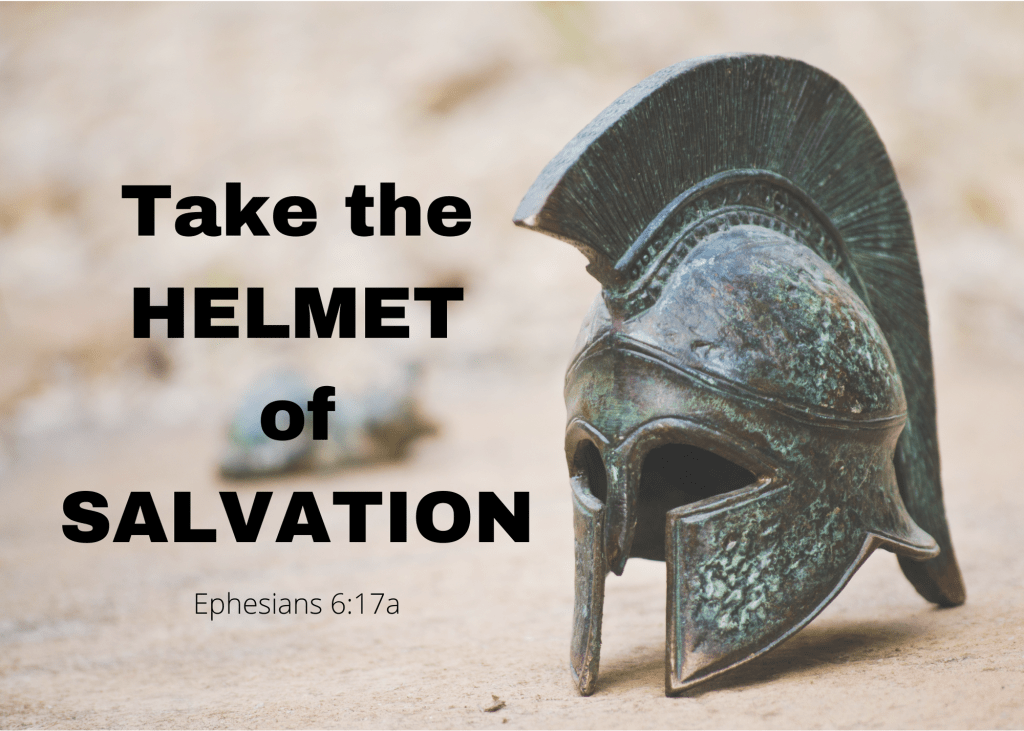
Ephesians 6:17a – “Take the helmet of salvation…”

Here’s a disquieting fact to start our devotion today: According to the International Brain Injury Association, 5.3 million Americans are living with some kind of disability due to a traumatic brain injury. 5.3 million is the population of South Carolina! Of course there are varying degrees of injury, but most are due to car accidents and sports-related incidents. 

And while 5.3 million is a staggering number, I’m willing to bet that there are so many more people living with spiritual battle scars in their minds. 

Our minds are such a vulnerable space and it’s one of the enemy’s favorite areas to attack. At least, that’s been my experience. Anyone else struggle with random thoughts popping up that obviously aren’t from God? 

But why attack the mind? Why not make the heart the primary target? Because our thoughts turn into words, which turn into actions, which turn into habits, which turn into our character. James, the half brother to Jesus, said it this way, “It is the evil that a person wants that tempts him. This desire causes sin. Then the sin grows and brings death.” (James 1:14-15, ICB) This is why it is imperative to protect this part of our body. 

For the apostle Paul, the author of this Epistle, the helmet was the perfect metaphor; after all, he was under house arrest when he wrote this letter. He probably had a lot of face time with a Roman guard who most likely wore some kind of helmet. Each piece of the helmet added another layer of protection against injury or death.

Paul calls this piece of the armor the helmet of salvation. The Greek form of the word for salvation is used only in this verse in all of the New Testament and it means “peace”. As we don this piece of armor, we can have the “peace of God that transcends all understanding will guard your hearts and your minds in Christ Jesus”. (Philippians 4:7)

Where does this salvation or peace come from? It comes from being in the Word of God daily: reading, studying, meditating, and memorizing it. We need to be intentional about the media that we consume and the conversations that we participate in. We need to be aware of entertaining the thoughts that seem to come out of nowhere. Protecting our minds against the thoughts that flow in and out should be something that is carefully monitored as we go about our daily living.

If you want to be in God’s Shalom peace while you engage in spiritual battle, be sure to wear the helmet of salvation.

-Bethany Ligon

Reflection Questions

  1. How do you think the enemy attacks minds? What about yours in particular?
  2. Describe the progression from thoughts to words to action to habits to character. Give an example that leads to ungodly character. Give an example that leads to godly character. Which type of thoughts do you work at thinking most?
  3. What protection is available to you against the thoughts that lead to ungodliness and death? In what ways can salvation and peace mean the same thing? What can you do (today) to strengthen your protection that God has made available to you?

Your Shield of Faith

Old Testament: 1 Kings 9-10

Poetry: Proverbs 13

New Testament: Ephesians 6:16

Do you ever feel like you’re being bombarded with issues, concerns, or worries? Have you ever heard yourself saying, “If it’s not one thing, it’s another”? Maybe you’re just having a typical ‘Monday’ even though it’s Thursday. Or maybe you find yourself clumsy dropping things, forgetting why you walked into a room, or having to deal with “that one person” more often than normal? It’s not so much one big thing, it’s just one little thing after another that really tests your patience. 

My friend, those big things, those small things, those things in quick succession, those repeated things…those very well could be “flaming arrows of the evil one”.

So why does the author of Ephesians, Paul, specifically use the term “flaming” arrows…why not just regular arrows? If a vulnerable soldier were hit by a normal arrow, it would likely only cause damage to himself. But if a flaming arrow hit him, the flame could catch onto nearby flammable material and cause significant damage.  

The comparison leads us to think about how these spiritual attacks affect us and those around us. When we’re experiencing trials and tribulations, how are we treating others? Are we still kind and compassionate or do we take our frustration out on others? When the challenges are mounting up all around us, do we hide out and disengage or do we press on with our commitments and ministries? When the attacks start coming from every angle, are we able to keep our head on straight and make responsible decisions, or are we tempted to act recklessly with our resources and health? 

You see, from the evil one’s perspective, the more damage that can be done with a single flaming arrow, the more successful the attack. It’s not just you and your personal faith; it’s your physical and spiritual health, your relationships and ministries that are under attack.

This is why taking up the shield of faith is so vital when engaging in spiritual warfare. A Roman soldier would have his wooden shield soaked in water so that when a flaming arrow hit its intended target, the flame would be extinguished and not cause collateral damage. 

Likewise, when we are soaked in the Word of God, those attacks become a little less hazardous to how we choose to carry on in the battle. 

In John 7:38, Jesus says, “Whoever believes in me as Scripture has said, rivers of living water will flow from within them.”

The more of the living water that we have flowing through us, the more protected we are from the enemy’s attacks on our faith. We need to stay spiritually hydrated by engaging in the Word of God on a regular and consistent basis. This will build up our faith and protect us from the flaming arrows that are pointed in our direction.

-Bethany Ligon

Reflection Questions

  1. What do you see and recognize as flaming arrows of the evil one? How can recognizing them as flaming arrows of the evil one improve your response to them? Which ones have attacked you or caught you off-guard most recently?
  2. Where/when have you seen a flaming arrow in action – with the potential of injuring or taking down more than just the one it hit? How can we guard against the effect of the flames of these arrows?
  3. How strong is your shield of faith? Does it have weak spots that make you more vulnerable? What can you do to strengthen your shield?

Fitted Feet

Old Testament: 1 Kings 7 & 8

Poetry: Proverbs 12

New Testament: Ephesians 6:15

When was the last time you regretted wearing a pair of shoes? I recently was on the hunt for a pair of gray sandals and I found some that I thought I might like from an online store. I ordered them and at first, they seemed to be very cushy and comfortable. As I wore them throughout the day, I noticed that the straps were rubbing the bottom of my ankle. It never caused a blister, thankfully, but it was just irritating. 

Anyone who is on their feet all day can tell you the value of having comfortable and supportive shoes. Whether it be someone in the medical field, law enforcement, military, food service industry, or in the classroom, having a good pair of shoes is a necessity. 

But what does having supportive footwear have to do with the Armor of God? A soldier’s boots (or sandals as ancient Roman soldiers would wear) are likely the one piece of their attire that they use for hours on end, every single day. They train with their weapons while wearing their boots. They go on marathon-long hikes while wearing their boots. They eat their meals while wearing their boots. And sometimes, they will even sleep while wearing their boots. If a soldier’s feet are sore or tired or have blisters, he or she becomes limited in what they can do – at least without any pain.  

Our verse today talks about being “fitted with readiness”. A soldier must be ready to go at any given moment. Likewise, as believers fighting in a spiritual battle, we must be prepared to take action at any point in time. 

And just what are we to take action with? The Gospel of Peace. This gospel includes the message of salvation and the Kingdom of God. As warriors in a spiritual battle, we need to remember whose army we fight for. When we are laser-focused on what we’re fighting for, we can be empowered and strengthened to fight against anyone or anything that is our opposition. So when temptation or persecution comes our way, we can make sure that we are in the ready position, set to take our Commander’s orders.

But also, the Gospel of Peace is something that we should be comfortable sharing with others who have not yet discovered it for themselves. Being ready to explain to others what we believe and why we believe it is another way to wield this piece of armor. Conversations with our friends, family, work buddies, and even random people you encounter in your day-to-day life can sometimes lead to discussions about our faith. When we are ready to share the Good News, we are showing ourselves to be prepared soldiers in the Lord’s army.

So let’s lace up our boots, and get ready to share the Good News of the Gospel of Peace!

-Bethany Ligon

Reflection Questions

  1. The gospel is only called the “gospel of peace” here in a passage about the spiritual war we are in. How would you describe the gospel of peace and why do you think this wording was chosen for this passage?
  2. Do you feel like you are ready to take action to follow your Commander’s orders today? What do you think could happen if you ARE ready? What could happen if you AREN’T ready for action? What could you do now to be more prepared? Do you think you have ever used an excuse of not being ready when God wanted you to do something?
  3. How can you share the gospel of peace with others this week?

the Breastplate of Righteousness

Old Testament: 1 Kings 5 & 6

Poetry: Proverbs 11

New Testament: Ephesians 6:14b

As we continue our study on the Armor of God, we come across two terms that are not frequently used in our day to day vernacular: breastplate and righteousness. So let’s dig a little deeper in order to come to a better understanding.

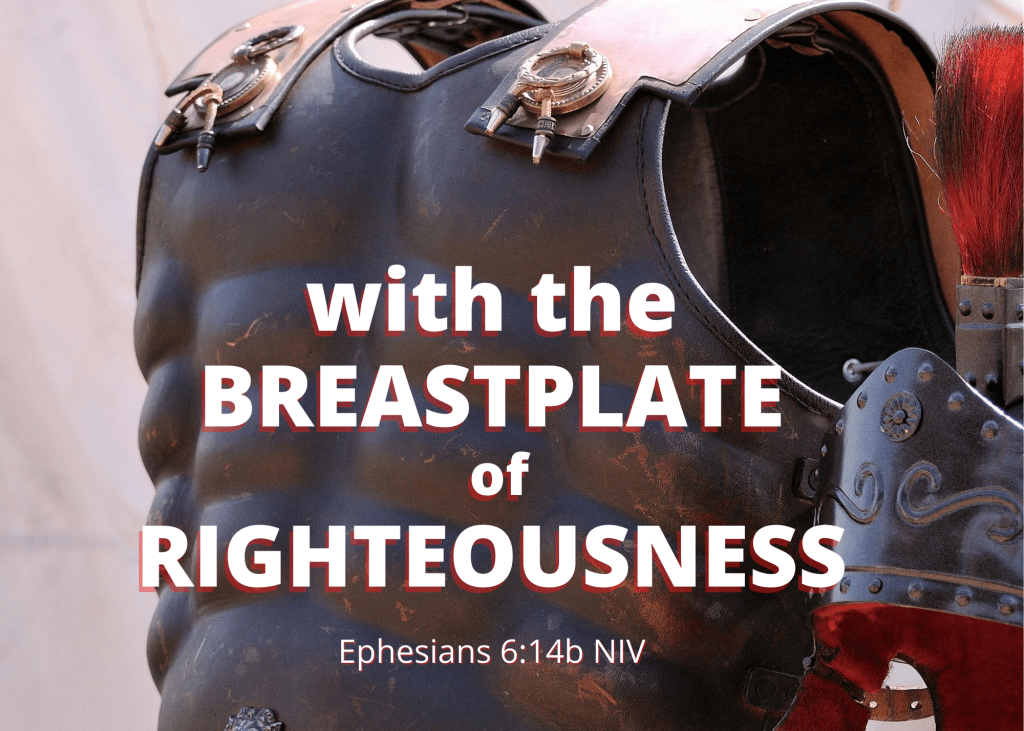
The breastplate is the piece of armor that goes directly on top of the chest, protecting the heart, lungs, spleen, liver, and even the stomach. Longer breastplates would also cover and protect the intestines. Without this vitally important piece of the armor, any direct impalement by a sword, spear, or arrow could prove to be fatal. 

In modern warfare protection, soldiers wear vests made of a material called Kevlar. Invented by Stephanie Kwolek in 1965, its usefulness is not limited to body armor, but extends to brake pads, space suits, and drum heads. It’s been tested to be ten times stronger than steel, is capable of absorbing high-velocity impacts, and withstand extreme hot and cold temperatures. (Thanks Google AI for the information!) Today’s warriors don it knowing that their life could depend on it!

Righteousness is a word that is typically limited to “churchy conversations”. (Unless you were in high school in the early 90’s and claimed that something thrilling was “totally righteous”.) But what does this word really mean? Basically, it means to be in right standing before God; morally and ethically sound; to do the right thing with a pure heart. 

So how does a person become righteous? Romans 3:22-24 says, “This righteousness from God comes through faith in Jesus Christ to all who believe. There is no difference for all have sinned and fall short of the glory of God, and are justified freely by his grace through the redemption that came by Christ Jesus.”

Let’s try to tie this together. When we wear the breastplate of righteousness, we are literally layering on spiritual protection upon our hearts. Without this gear, we are vulnerable to the attacks from the enemy that could prove to be fatal. When we wear this armor of righteousness, we are able to stand before God and be seen worthy and faithful. His Holy Spirit will protect us. 

Some may be tempted to try to shortcut the cost and find cheap substitutes for this level of protection. Whether it be trying to buy our own righteousness by being a “good person” or living an inauthentic lifestyle, where your words and actions cover up a deceitful heart, the Bible is clear that there is only ONE source for a legitimate breastplate of righteousness. We must have faith in Jesus. Faith that accepts Jesus as Savior and Lord. Faith that believes the Lord will fight for us. Faith that commits to standing firm when everything around us crumbles. Faith that submits everything, our hopes and dreams, our plans and purposes, our resources and relationships, our past, present and future to the One who is called Jesus, the Christ, the Son of the Living God. 

Yes, it is costly. But the protection and confidence that it provides is invaluable for the fight that we must fight. “For our struggle is not against flesh and blood, but against rulers, against the authorities, against the powers of this dark world and against the spiritual forces of evil in the heavenly realms.” (Eph 6:12)

-Bethany Ligon

Reflection Questions

  1. How would you rate your righteousness: “to be in right standing before God; morally and ethically sound; to do the right thing with a pure heart”?
  2. How would you rate your faith in Jesus? What happens if you try to have righteousness apart from faith in Jesus? What does faith in Jesus lead you to be and do?
  3. How does a breastplate of righteousness protect you from the powers of this dark world? What would Satan want you to believe about the breastplate of righteousness? Where do you see this attitude/belief in the world?