Remind the People

Old Testament: 2 Chronicles 31-32

Poetry: Psalm 105

New Testament: Titus 3

Life is so busy and complicated that I have to create lots of reminders for myself.  Fortunately, my phone and computer and watch all have features where I can set reminders for myself.  “Doctors appointment Tuesday at 3:00.  Take the garbage to the dump on the way to work in the morning.  Stop by the store after work and pick up some milk and bread.” I can even set reminders months or years in advance.  I can set alarms to remind me that in 2 hours I have a meeting.  In 1 hour I have a meeting.  In 15 minutes I have a meeting.  The Meeting is now starting.  Maybe I’m too busy or maybe I’m getting old, but I find myself more and more needing reminders.

Do you ever need reminders?  Little kids need to be reminded to brush their teeth, make their bed, do their homework.  What do you need reminders for?

The Apostle Paul thought reminders were important for Christians.  I guess he understood how easy it can be to forget what’s important when we are busy living life and doing  what’s necessary or urgent.  Do Christians ever forget important things about God, about Jesus, about how we are supposed to live?  Yep, we sure do.

In Titus 3 Paul tells Titus to remind the believers of some important things.

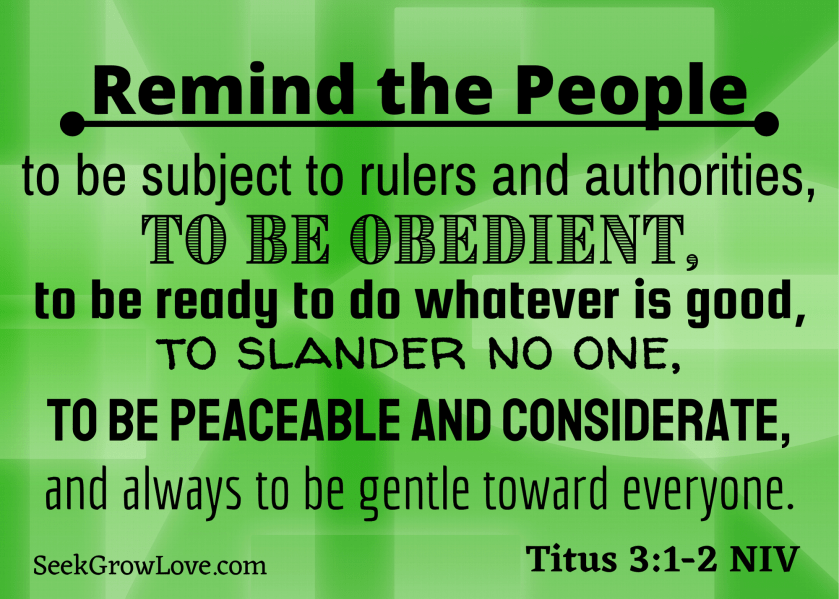
“Remind the people to be subject to rulers and authorities, to be obedient, to be ready to do whatever is good, to slander no one, to be peaceable and considerate, and always to be gentle toward everyone.” -Titus 3:1-2

Those reminders were important in the first century when Christianity was brand new and people were still learning the basics, but it’s been 2000 years.  We’ve certainly got being a Christian all figured out by now, don’t we?  Do we really need to be reminded to obey people in authority?  Do we need to be reminded to always be ready to do good?  Don’t all Christians always do what is good?   Certainly we never  slander or falsely accuse someone of wrong doing.  I’m always peaceable and considerate and gentle toward everyone, aren’t you? (My tongue is in my cheek- that means I’m kidding).

To tell the truth, I still need to be reminded of all of those things.  Just because I’ve been reading the Bible for over 50 years doesn’t mean I always remember to do good.  I still need to be reminded to be considerate and gentle, and so do you.  That’s why Christianity was never designed to be lived in isolation, but in community.  We need each other.  There’s a passage in Hebrews (a different book from today’s reading,  but important) Hebrews 10:24-25 says that Christians shouldn’t get out of the habit of meeting together, because we need to encourage (I think Hebrews says “spur one another on”, like a rider spurs on a horse) each other.  

Following Jesus is hard some times.  Being obedient to God is hard some times.  Remembering to do good and be gentle is hard sometimes.  I need help, I need encouragement to keep on doing what is right.  I need you, and you need me, we need each other.

I’ve read the Bible many times in my life and I need to keep on reading it to help me remember all the important things I need to remember.  Today’s readings in Isaiah 63-64 and Titus 3 remind us both about God’s wrath and about God’s mercy.  God has both.  God hates sin, he hates it when his children are brutal to each other.  He hates it when his children fight and argue.  He hates sin because he loves us and he knows that sin hurts us.  We hurt each other when we sin.  No parent likes to see their children hurt each other.  We learned that from our Father, God.

So keep reading your Bible and keep coming to Church and meeting with other believers so that you can remind them and they can remind you to keep on following Jesus.

“Hey Siri  set a reminder for 7 a.m. tomorrow:  be considerate and gentle to everyone.”

“Alexa, remind me to get up for Church Sunday at 8:00.”

-Jeff Fletcher

(Originally posted here on October 4, 2021 – when we were reading Titus and Isaiah together. This year, we get to start Isaiah tomorrow.)

Reflection Questions

  1. What do you need reminders for?
  2. Look at the list of things Paul told Titus to remind the people to do. For each one ask yourself why is this important and how well am I doing this? If you were to choose one to focus on reminding yourself to do for the next 14 days, which one needs your most attention right now?
  3. What is your attitude toward those who give you reminders?
  4. How can you encourage others to do what is right?
He Made Them All

Old Testament: 2 Chronicles 29 & 30

Poetry: Psalm 104

New Testament: Titus 2

Our family loves camping and traveling and finding new places to hike or kayak through God’s beautiful world. The variety of his creation is truly amazing! Desert, forest, plains, mountain, ocean. We love them all and the chance to explore a new little corner of His world we haven’t seen yet. And, along the way, trying to capture a photo to remind us of the beauty and creativity we had the privilege to see.

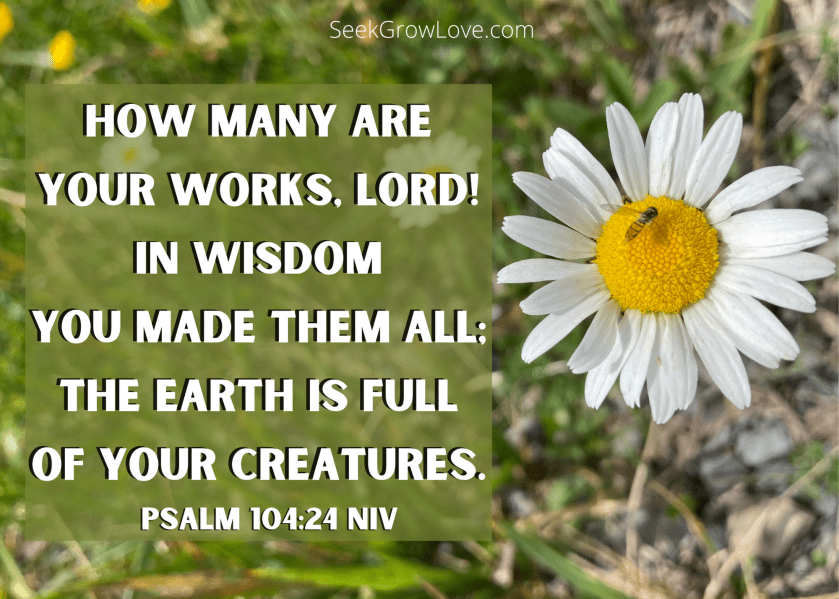
Psalm 104 is a beautiful poem of creation. I would love to make a photo book or photo wall with pictures from our family hikes and travels depicting each verse and phrase.

“he stretches out the heavens like a tent” (vs 2) – expansive blue sky from horizon to horizon

“He makes the clouds his chariot” (vs 3) – white and multi-shades of gray amazing textured rolling clouds with shafts of sunlight shining through with the brilliant blue sky behind

“He makes springs pour water into the ravines” – hot springs bubbling from the ground and flowing down the mountain side

You get the idea. There would be photos of waterfalls, lightening, mountaintops, ocean waves on the shore, rainstorms, the moon, plants and animals, sunrises, sea creatures, and people. Each one accompanied with God’s text.

I recently taught a unit on creation to the adorable children in children’s church. And it was so much fun spending a week (or often more) on each aspect of God’s amazing creation. We brought in shells and rocks and leaves and bird feathers to touch and play with. We matched plant photos to foods we eat and counted plant products in ingredient labels. (Do you know how many plants are in a box of Cheerios or mac’n cheese?) We classified plants and animals and brought in a bird expert. We watched videos and explored books on clouds and planets and sea creatures and the animal kingdom and the incredible human body. And all the things that we take for granted everyday.

Not only is God’s world a beautiful world – but so incredibly functional, too! He thought of EVERYTHING! The more I learn of science and the human body in particular, the more I am amazed at His creation.

I have never made anything nearly as intricate or useful as the smallest, tiniest, most simplistic, most ‘insignificant’ part of God’s creation. But, I do like to create quilts – little scraps of colored fabric (which came from a cotton plant) sewn together in patterns to make a cozy cover to bring comfort and warmth. I can’t imagine how I would feel if I were to meet someone who explained that those quilts just came to be one day – that it grew from nothing and became strings that wove themselves together and the fabrics cut themselves into the perfect shapes and even stitches magically formed just as they were needed to piece the top together and the materials used to create the final layered project appeared at just the right time and space and lined up just so to automatically go through the final steps to create my quilt. Foolishness. It is foolishness that leaves out the thought, intention, desire, creativity, vision, purpose and ability of me, the quilt creator. Or, equally painful – maybe they would give all the credit for the making of the quilt to another.

It makes sense that the Creator of the Heavens and Earth wants us to enjoy and admire His creation – and give Him all the credit He so much deserves. But, what happens when people don’t? What happens when they take away the glory that belongs to God and call it chance instead or give it to another? What happens when they refuse to listen to God’s words – His first recorded words being – “Let there be light”? What happens when they attribute God’s creation to another? We see in the book of Jeremiah. “These wicked people, who refuse to listen to my words, who follow the stubbornness of their hearts and go after other gods to serve and worship them, will be like this belt—completely useless!” Jeremiah goes on in today’s reading to describe the drought, famine and sword that will be used in judgment of those who have stubbornly turned from God. Jeremiah 14 ends with God telling Jeremiah to speak to the people, telling them to acknowledge their guilt and wickedness and sins against Him and ask God to remember His covenant. The final verse of chapter 14 says,

“Do any of the worthless idols of the nations bring rain?
    Do the skies themselves send down showers?
No, it is you, Lord our God.
    Therefore our hope is in you,
    for you are the one who does all this.” (vs 22 NIV)

Not only did Our Great God create this world for us – He made a covenant with us – He has power still today – and He holds out a blessed hope for those who acknowledge and worship Him for all He has done, is doing and will do.

Thank you God for your incredible Creation – help me see and appreciate each amazing part!

Thank you God for the rains today – help me see you at work today!

Thank you God for the hope you set before those who believe and worship you alone – a New Heavens and Earth that will be beyond all we can ever dream or imagine!

You are our hope – for you are the one who does all this!

-Marcia Railton

(taken from a devotion originally posted here on Oct 12, 2021)

Reflection Questions

  1. What do you love most about God’s creation? What do you often take for granted in His creation? In your opinion what are some of the most useful things He created? What are some of the most creative things He created?
  2. What have you created? Has anyone ever disregarded your creation or the part you played in its creation? What are the biggest problems with the theory of evolution?
  3. Looking at the final verses of Psalm 104 (verses 31-35), what response to all that God has done does the psalmist have – and also ask for? What response does he expect, ask or look for from God? What response do you have to God’s creation?

Take Your Child to Work Day

Old Testament: 2 Chronicles 27 & 28

Poetry: Psalm 103 (5th day)

New Testament: Titus 1

Today is our fifth and final day of our questioning look into Psalm 103. So far we have spent some time looking at God’s character, love, compassion, righteousness, justice, forgiveness and eternal qualities as well as mankind’s sin, gifts from God, frailty, brief existence, and duty to praise, fear and obey God. We have been looking at God’s relationship with man, and man’s relationship with God, here on earth, which is the view of God we are most familiar with. But today we have an interesting conclusion to Psalm 103 as the focus of our eyes shifts and looks up and up and up and up…

VERSE 19 – Where is God’s throne? How far is heaven above the earth? (Oh, never mind, we already covered that two days ago when David had us asking how deep is the Father’s love for those who fear Him.) What does the Bible teach us about heaven? What does the world tell us about heaven and how are the two views very different? (You might be interested in doing a word study on heaven in the Bible and see what you find.) Who established the Lord’s throne? What does God’s kingdom rule over? Have you ever participated in a Take Your Child to Work Day? Consider how it could open the eyes of the child to see this whole new side of Dad and what he can do, and does do, and the associates he works with, and who listens to him, and what he spends his day doing when he goes off to work. How could this same thought apply to you and I getting a glimpse of God in His heavenly throne room? How might your view of God change if you witnessed His throne room, everything He did at work, and the authority He has over the heavenly host?

VERSE 20 – Who is instructed to praise God in this verse? What does the Bible teach us about angels? What does the world tell us about angels and how are the two views very different? What description is used for the angels in this verse? What are the angels doing, besides being told to praise? What are some Biblical examples of angels doing God’s bidding? How often do you pause to consider what is going on in heaven right now? What jobs might God be handing out to His angels today? What other verses can you find about the work God’s angels do for God?

VERSE 21 – Do we have any new information in this verse or is David saying the same thing as the previous verse using different words? What is the parallel between mighty ones (in verse 20) and servants (in verse 21)? What is the parallel between obeying His word (in verse 20) and doing His will (in verse 21)? Do you think this applies to human servants of God and God’s will for humans as well as for angelic servants?

VERSE 22 – Who is told to praise the Lord in this verse? Who and what does that include? What are God’s works? Does it include you? What is His dominion? Does it include you? How does this psalm end? How did it begin? How will you praise the Lord today? What will you be envisioning as you praise the Lord? Why are you praising the Lord?

What thoughts and feelings or other questions do you have after reading verses 19-22? What is the value of picturing God in the heavens? Why do you think David included these 4 verses as the conclusion of Psalm 103?

What is your biggest take away from Psalm 103 as a whole? Have you gained anything from your time in Psalm 103? What might God want to show you in Psalm 104?

-Marcia Railton

From Everlasting to Everlasting

Old Testament: 2 Chronicles 25-26

Poetry: Psalm 103 (day 4)

New Testament: 2 Timothy 4

Welcome to the 4th day of questions on Psalm 103. Yesterday we focused our questions on verses 11-14, looking at God’s love, forgiveness, and compassion as well as the incredible facts that, “he knows how we are formed, he remembers that we are dust.” (Psalm 103:14). This verse says so much about God – and about man. The next couple verses continue on the topic of mankind.

VERSE 15 – Why do you think David compared man’s days to grass – what are the similarities? If you compared yourself to a flower of the field which kind of flower in what field would you be most like? Why? What might make the flower flourish? What else could have David compared man to? What ideas about mankind was David using poetry to explain? How might a scientist or a psychologist have explained these same ideas?

VERSE 16 – What happens to the flourishing flower of verse 15 in verse 16? What does David say caused this to happen? What do you think the wind symbolizes? What do you think of when you think of a flourishing flower suddenly gone? What emotions come with these thoughts? What do you feel when you read the second line of verse 16? What truths are David expressing in a poetic form?

VERSE 17 – What do the words, “But from everlasting to everlasting…” mean? What changes as we go from verse 16 to 17? How is God different from mankind? Is the Lord’s love for one generation more so than another? In what other verses in Psalm 103 have we seen a similar thought as we see in the first half of verse 17? What would it look like for God’s righteousness to be with your grandchildren? Will His righteousness be with ALL grandchildren? If not, then with whose? Do you fear the Lord? (Interestingly, this concept of fearing the Lord – and instructing others to do the same – came up in our Old Testament reading for the day as well. Did you find it in 2 Chronicles 26? How were similar ideas shared in the New Testament reading of 2 Timothy 4?) Do people just automatically know how to fear the Lord? What happens if it is not taught? If you do fear the Lord, who do you know that you want to see also fearing the Lord?

VERSE 18 – Who is verse 18 referring to? Who do you picture as part of this group? Are you included? What do they do? What will they receive (see verse 17)? What is a covenant? Do you have a covenant with the Lord God? If so, what does it say you will do? What does it say God will do? What are precepts? How is your memory? Do you remember to obey his precepts? When did you recently forget to obey and which precept did it involve? How can you work on further developing your memory so as not to forget God’s laws? What else is needed to stand firm against temptation?

What did you take away from these 4 verses? How will you live today because of them? Who will you share these truths with?

-Marcia Railton

How Far is Heaven Above the Earth?

Old Testament: Joel 3

Poetry: Psalm 103 (day 3)

New Testament: 2 Timothy 3

Yesterday we left off seeking to recognize our sin and what we deserve because of our sins. It is an important place to be, but thankfully, God doesn’t leave us there. So today we get to continue our question format for Psalm 103 verses 11-14, some of my personal favorite verses from this Psalm.

My very first question for verse 11 was actually for Google because I wasn’t sure it was very fair of me to ask you, “How far is heaven above the earth?” So of course AI was happy to give an answer. AI’s answer did not disappoint as I found it surprisingly accurate: “The Bible doesn’t provide any linear measurements for heaven’s distance from Earth, so its exact size is unknown.”  I loved that AI recognized the authority of the Bible for this question. If only AI, you, I and the rest of the world would be so wise with all our answers. Since we are accepting verse 11 and 12 as figurative language we don’t really need to know how high heaven is above the earth or how far the east is from the west – as long as we know what God says in His authoritative Word about His great love and forgiveness. So, let’s open up His Word and ask some questions!

VERSE 11 – How great is God’s love for you? What other figurative language could be used to attempt to describe God’s indescribable love? What does it feel like to be loved by such love? Is there a limit to God’s love? What does the rest of this verse say – who is this love for? (You might be interested in reading the verse in some additional Bible translations here. ) What does it mean to fear God? How should we treat God if we truly fear/revere/worship Him? Do you fear God? Do you think it is possible to believe in God – and perhaps even love Him – but not fear Him? Does this verse say anything about God’s love for those who don’t fear Him? How important do you think it is to fear God?

VERSE 12 – Remember back to yesterday and consider again, what are your sins? And what do you deserve because of them? What does it feel like to have your transgressions or sins laid on you? What weights, burdens, shame, guilt, questions do they add to your life when you are carrying them around with you, or only slightly better, when they are hanging over your head? What would it feel like if these same sins were flung as far as only God could fling them? What other descriptions could be used for having sins removed? Does having transgressions removed mean there are no more consequences for those sins? Are all of everyone’s transgressions removed? Why or why not? How does God’s love and forgiveness compliment one another?

VERSE 13 – What does a healthy father/child relationship look like? What is the role of dad? What is the role of the child? What does it look like when the child tries to be in charge? In your relationship with God do you more often try to play the part of adult or child? What does it feel like to be a child of God? What are the benefits? Give some examples of what it looks like when a human father has compassion on his child(ren). Give some examples of when our Heavenly Father has shown compassion on you (and/or His other children). According to verse 13 who does God show compassion to? Where else have we seen this wording? So we could ask again, how important do you think it is to fear God? Can you think of any times where you have not feared God? Is there anything you might consider doing now to help you fear God more or better or more consistently?

VERSE 14 – What does it mean to you that God knows how you are formed? What do the facts that God knows how we are formed and remembers you are dust say about God? What do these facts say about you? What questions do you have for God about His creation process and reasoning, especially as it relates to creating people? How does this verse relate to the previous verse about God’s compassion as a father? Do you think it is important for us to remember that God remembers our creation and how we are formed? What happens when people decide that we just came to be? How many Bible authors referenced God creating? Do you accept the authority of God’s scriptures?

What qualities or characteristics of God do you find in these 4 verses today? What other questions do you have from these verses? Hope to see you back tomorrow as we continue on with verse 15.

-Marcia Railton

The Lord Is..

Old Testament: Joel 2

Poetry: Psalm 103 (day 2)

New Testament: 2 Timothy 2

Today we continue what we started yesterday – a list of questions to consider for each verse of Psalm 103. Open your Bible and let’s get to work on five more verses.

VERSE 6 – What groups of people do you think would make up the “oppressed” spoken of here? Who do you know personally who falls into the oppressed category? What might adding righteousness look like in their life? What might adding justice look like? Have you seen God working righteousness and justice in their situation – yet? In what ways have you seen and heard of the oppressed receiving righteousness and justice? If this is important to God should it be important to us? How might God want to see you work righteousness and justice for the oppressed?

VERSE 7 – What did God make known to Moses about Himself and His ways? Why? What deeds did God do for the people of Israel? Why? What is the spiritual use of learning history and studying the Old Testament? What about in more recent history? What did God make known about Himself and what deeds did He perform in the New Testament? What about in your family’s history? What ways of God does He want us to know about today? What deeds has He done for you?

VERSE 8 – Where else in the Bible do we find a similar description of God as we find here in Psalm 103 verse 8? (There are multiple places, but don’t miss it in our Old Testament reading for today. God lined that up pretty well for us today! It is also included when God reveals Himself and His ways to Moses as referenced in the previous verse. Where is that passage? HINT: the search feature in BibleGateway.com is pretty useful. Try searching something like compassionate gracious. Sometimes searching in different Bible versions helps.) How would you define/describe and give a Biblical example for each of these qualities of God: compassionate, gracious, slow to anger, and abounding in love. Now, when have you experienced each of these characteristics from God in your own life? When have you shown others God’s character by reflecting these characteristics to others in the way you treat them? Which one is the biggest struggle for you? How can remembering God’s character help you act more godly towards others?

VERSE 9 – Have you ever known someone who is ALWAYS accusing? What is it like to be with him/her? Would the perfect God still be RIGHT if He was always accusing – could he always find something wrong with what we do/have done? Why do you think He chooses not to always be accusing? When, in history or in your life, have you seen or experienced God giving up His right to accuse or be angry? When have you seen or experienced God letting go of His anger, not “harboring his anger forever”? How can we mirror His attitude?

VERSE 10 – What are your sins? Wait. Stop – don’t go on yet. Seriously – spend more than 2 seconds thinking about this answer. It is important. What are you guilty of? What have you done that has grieved God’s heart and the heart of others? What are you ashamed of? Also, are there sins you haven’t even acknowledged yet or feel guilty of yet, perhaps because of your pride or selfishness – 2 other sinful attitudes? When has your sins blocked the opportunity you have to share God’s characteristics with others? What do you deserve because of your sins? What repayment would be just because of your iniquities? Has God given you everything your sins deserve?

It’s not the most pleasant place to end for the day. But, recognizing our sin and what we deserve is such a vital point before we can truly appreciate the incredible verses that come next. See you again tomorrow as we Seek Grow & Love together.

-Marcia Railton

Questions, Questions, Questions

Old Testament: Joel 1

Poetry: Psalm 103

New Testament: 2 Timothy 1

Some days do you feel like you have more questions than answers? Me, too. But, that’s okay. Because, actually, every educator knows that when we can ask and eventually start to answer some really good questions on our own we learn a lot more than if we just read someone else’s answers. So, today, I have NO answers for you. But instead, here’s a whole devotion full of some reflection questions to get us thinking more about Psalm 103, a beautiful psalm of David. In our Bible reading plan we are going to spend today and the next four days reading and re-reading Psalm 103 so today we will just include questions for the first 5 verses but go ahead and read the whole Psalm over and over this week.

So, let’s open up our Bibles and start to look at Psalm 103 verse by verse. Besides thinking about these questions below – what other great questions can you think of?

VERSE 1 – How many times is the word “praise” repeated in this Psalm? What is praise? What does it look like to praise God with “all my inmost being”? How deep does your praise go, or is it more often somewhat shallow? What would be needed to praise the Lord with your inmost being – and do it more regularly? What makes God’s name holy? Do you treat it in a holy manner?

VERSE 2 – What are at least ten (feel free to list more) of the “benefits” God has given you personally? Which ones do you often take for granted? How can we work at not forgetting them – or the God who gave them? What happens when people DO forget what God has done and given to them? What is the relationship between praising and thanking and remembering?

VERSE 3 – Have you asked for and accepted God’s forgiveness for ALL of your sins? How does asking for God’s forgiveness look different now compared to what it looked like when David wrote these words? Why does God want to forgive you of all of your sins? What would it be like to serve a god who loved but never forgave? What diseases (perhaps some physical and some not) has God healed?

VERSE 4 – What does the word “redeem” mean? What pit does God redeem you from? King David says that God “crowns you with love and compassion”. What does it mean to you to be crowned by God – with His unfailing love and compassion? How does it feel? Why do you think He does it? What would it be like to serve a god who forgave but never loved? How would you explain this verse to a kindergartener?

VERSE 5 – What desires have you had that God has already satisfied with good things – perhaps in the way you were imagining, perhaps in another way? What can we learn from David in a similar (but slightly expanded passage) about the desires of our heart – Psalm 37:3-5? What desires are you still waiting for God to satisfy? What do you do while you wait (see Psalm 37)? Might that change what you desire? What might King David be thinking of/imagining/feeling/experiencing when he writes about God satisfying desires, “so that your youth is renewed like the eagle’s”? It might depend on what your actual age is, but have you ever felt like God’s blessings were knocking years off your life, renewing you, or just plain, helping you soar? Where would you be without God’s goodness and generosity in your life? How do His blessings renew you?

What can we learn about God in His Word? What can we learn about our relationship with Him?

Thank you for trying something new with us today. Enjoy your time in Psalm 103! Is there someone you can start a conversation with today by asking them a question about Psalm 103?

-Marcia Railton

The Powerful Speech Before the Big Fight

Old Testament: 2 Chronicles 24

Poetry: Psalm 102

New Testament: 1 Timothy 6

When I’m writing these, I find a section or verse that stands out to me.  Today, 1 Timothy 6:11-16 particularly stood out.  I would encourage you all to reread it before reading this article. 

Whenever I read this I can’t help but hear a rallying voice, the type of speech given in a movie right before they enter the final battle for the fate of the universe or something equally important.  It just strikes me in that way.  In a way, that’s what this section is.  It’s written from a leader of the church to a member.   Like how a leader tells his troops an inspiring thing before the battle.  For Timothy and us, every day is a battle.  Paul in verse 12 writes: “Fight the good fight of the faith.” Sounds pretty similar to me.  So, let’s look at this through the lens of an inspiring speech given to us in our daily battles.  I’m gonna go through two verses here.

Do your best here to think about this in an inspiring way.  If you’re feeling ambitious, you could even speak it aloud.  If you’re having trouble imagining it think about an actor in an intense scene, and try to channel that energy.  Verse 11 reads: “But you, man of God, flee from all this, and pursue righteousness, godliness, faith, love, endurance and gentleness.” Right here, Paul is writing about what we are to do.  He calls us to pursue righteousness, godliness, faith, and love.  These are pretty straightforward things, but we all have room to improve on all accounts, so read each with the gravity they deserve. 

In verse 16, Paul is talking about God here: “who alone is immortal and who lives in unapproachable light, whom no one has seen or can see. To him be honor and might forever. Amen.” In the idea of a rallying speech, I think this is the best way to end one for a Christian.  It’s giving God the glory; it just feels right.  We learn in the Lord’s Prayer that a fair portion of our prayers should be giving glory and praise to God.  So, in this case, it seems right too.  I also like that this verse ends with ‘amen’.

Let me close this out with a challenge.  On days when you’re maybe a bit tired and are reading your Bible, envision in your mind it as a speech, an inspiring one.  It might not work for every verse, but maybe it’ll give you the energy to focus a bit more on what you’re reading. 

-Philip Kirkpatrick

Reflection Questions

  1. What do you think Paul was preparing Timothy for? What battles are you facing? How can Paul’s words motivate and inspire you to fight the good fight of the faith? What would that look like for you?
  2. What are your favorite verses in 1 Timothy 6?

I Will

Old Testament: 2 Chronicles 22 & 23

Poetry: Psalm 101

New Testament: 1 Timothy 5

If you have the time today I would like you to read through Psalm 101 before reading this and then read it again after. 

Psalm 101 speaks of integrity.  It’s pretty clear-cut, in the ESV version, the Psalm is even called “I will walk with integrity”.  The way it’s put there speaks to me, it isn’t saying “I should”, there is no question in that statement, “I will walk with integrity”.  I’ll wrap back to the part about integrity later.

First, I want to focus on a phrase. Throughout the whole Psalm, the phrase that we read over and over is “I will”.  Throughout the world, and even in myself, I don’t hear that sort of conviction in daily life.  “I will” is substituted for “I might”, “I could”, etc.  These all convey a sense of being able to back out.  Even the term “I can” lacks the certainty that “I will” has.  “I can” can mean that you can but lack the conviction to do it.  And taking it a step further, even the phrase “I will” can lack conviction.  For example “I will go take out the trash” or “I will drive you to school”.  In Psalm 101 it’s a much different form of “I will” from those.  

So we have conviction, but for what? As said before with the heading, integrity.  When I  search for the definition of the word “integrity”, I get this in response, “integrity is the quality of being honest and having strong moral principles; moral uprightness.” I think this definition has been generalized for the public and for the rest of the world.  The word moral can be subjective in exactly what it entails.  I think we as Christians have a great example of what to look for in integrity though, Psalm 101.  It lays out our “moral principles” pretty well throughout it.  Which I think makes it a great thing to read and study. 

 As I said at the start, I would challenge you to read Psalm 101 again.  But this time, focus on the conviction behind it, and look at the integrity it talks about.  Take it one line at a time and dwell on what is said. 

-Philip Kirkpatrick

Reflection Questions

  1. What are you convicted about doing?
  2. What “I will” statements do you find in Psalm 101? Which do you already feel strongly about and would also say, “I will…”? Which seem like wise statements but you could use more conviction in this area to move from “I should” or “I can” to “I will”? Pray about these.
  3. How would you rate your own integrity? What do you admire about people you know with strong moral principles? What is God looking for as far as integrity goes?

Set an Example

Old Testament: 2 Chronicles 21

Poetry: Psalm 100

New Testament: 1 Timothy 4

My name is Philip Kirkpatrick.  I’m 17, live in Minnesota, and attend Pine Grove Bible Church.  Some of you may have met me before and some of you may have no idea who I am.  I share this for two reasons, the first is to give those who don’t know me a little bit of background on who’s writing, and the second is because it relates to what I’m writing about.  As I was reading 1 Timothy 4, one of the verses stuck out to me.  That is verse 12,  the NIV version states:

‘Don’t let anyone look down on you because you are young, but set an example for the believers in speech, in conduct, in love, in faith and in purity.’

Considering my age and youthfulness, this verse stuck out to me.  Reading it over, it seems pretty straightforward to me.  I’m going to break this up into two parts.  The first part simply states that just because of someone’s young age, it doesn’t mean they should be looked down on.  Looking back now, I can think of times that I surprised my parents by having an answer they didn’t expect me to get, or knowing a big word and casually dropping it in the middle of a sentence.  Even today I find myself surprised at times by those younger than me when they find answers I didn’t expect or know things that I don’t.  Something to keep in mind here is that just because someone is young doesn’t mean that person doesn’t have good ideas. 

This also plays into something called a logical fallacy.  A logical fallacy is an illogical argument in its simplest form.  In this case, it’s an Ad Hominem fallacy.  This logical fallacy can be used to state that someone who may typically not have good ideas, someone young and inexperienced in this case, can’t come up with good ideas. The Ad Hominem Fallacy in other words; it is an attack against the person, not the argument or idea they are proposing.  So in the case of someone young, it’s saying you can’t dismiss it simply due to age.

The second part of this verse here tells us that we should set an example for others in 5 ways: speech, conduct, love, faith, and purity.  I’m not going to dig into all those and explain them all.  Overall it can be defined by how we act.  We should act in a manner befitting a Christian.   

To the younger: set an example to the older on how to act. 

To the older: set an example to the younger on how to act. 

And to all, don’t look down on someone because of their age, listen, and consider what they have to say. 

-Philip Kirkpatrick

Reflection Questions

  1. When have you taken notice of a good example set by someone young? Have you ever been guilty of looking down on someone just because of their age?
  2. Consider each of the ways we are to set an example for believers: in speech, in conduct, in love, in faith and in purity. Think of times when you set an example in each of these areas. Are you strongest in one of those areas? Which ones could you work on more this week?