On October 7, 2023, Hamas launched a sneak attack on Israel. Nearly 1200 Israelis were killed. 251 Israelis and foreigners were taken captive and held hostage by Hamas.
This was not the first time Israel had been the victim of an attack and taken captive by enemies. They were enslaved by the Egyptians thousands of years ago. They were taken into exile by the Babylonians nearly 3000 years ago. They were attacked and occupied by the Romans and their Temple was destroyed and they went into the diaspora almost 2000 years ago. They were victims of the Holocaust nearly 100 years ago when nearly 6 million Jews were murdered in gas chambers.
Psalm 122 was one of many Psalms that were prayed by the Jewish people during many of these numerous times of attack and war.
Psalm 122. A song of ascents. Of David.
1
I rejoiced with those who said to me, “Let us go to the house of the Lord.”
2
Our feet are standing in your gates, Jerusalem.
3
Jerusalem is built like a city that is closely compacted together.
4
That is where the tribes go up— the tribes of the Lord— to praise the name of the Lord according to the statute given to Israel.
5
There stand the thrones for judgment, the thrones of the house of David.
6
Pray for the peace of Jerusalem: “May those who love you be secure.
7
May there be peace within your walls and security within your citadels.”
8
For the sake of my family and friends, I will say, “Peace be within you.”
9
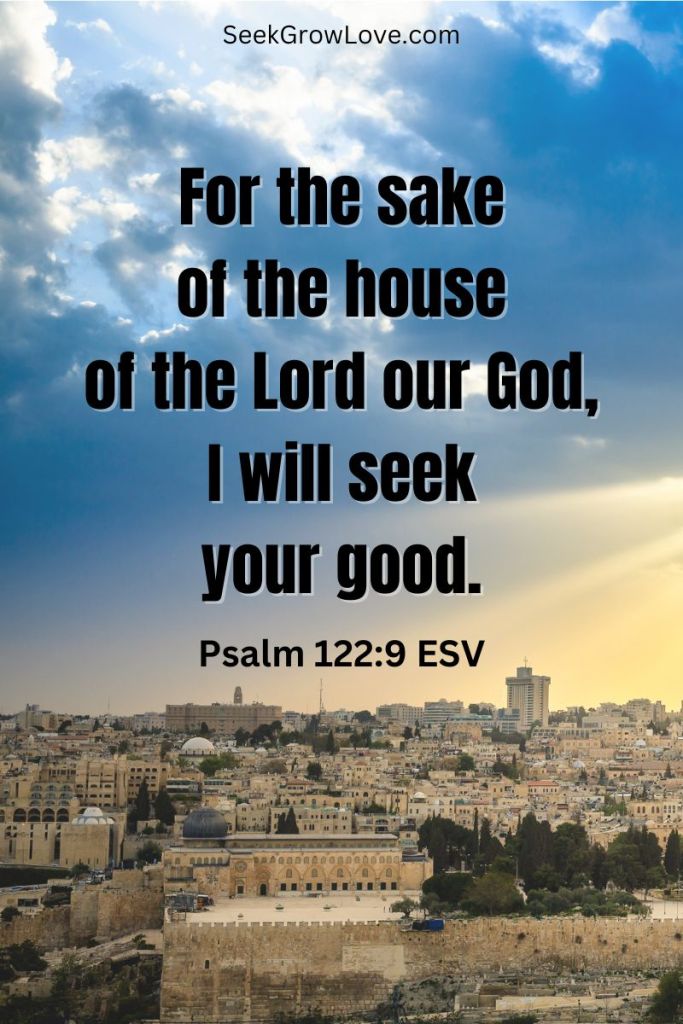
For the sake of the house of the Lord our God, I will seek your prosperity.
This Psalm is a prayer for peace in Jerusalem. It is a prayer that God’s people will live in security and protection. Today we pray for the Peace of Jerusalem. True and lasting peace will not come to Jerusalem until the Messiah, God’s anointed King, our savior Jesus Christ returns. When Jesus returns there will be Peace in Jerusalem and eventually Peace on earth in God’s Kingdom.
Let us continue to pray for the peace of Jerusalem. Let us pray for the release of those being held captive.
Pastor Jeff Fletcher
Reflection Questions
Compare and contrast Jerusalem, including it’s history and current situation, to that of the New Jerusalem we recently read about in the final chapters of Revelation. What causes the differences and the similarities?
How often do you pray for the peace of Jerusalem? Would adding a visual reminder to your home or device help you remember?
How might you be able to seek the good and prosperity of Jerusalem?
How often do you pray for the coming of the New Jerusalem and pray for its occupants, that those you know will be ready – recognized as the people of God, wearing white and not left outside?
As the year comes to an end, and the days are short and draw to a close so quickly, so we turn to the last chapter of God’s word. The last vision we are given is a river flowing from the throne of God and of the lamb, with trees lining the banks. The people of God, living forever, dwell in a paradisal city that the Garden of Eden was always supposed to grow to. In fact, a theologian once said “What is a city, but a collection of ordered gardens?” Maybe the “concrete jungles” we are familiar with don’t seem that way, but in some sense, cities are places where life is put in order, in order to grow.
It starts with a garden. It ends with a garden.
With a man in a garden in between.
“Let not what I desire, but you, God, desire, let that be done.”
The man who said those words also tells us here:
“I am coming soon! My reward is with me.”
In looking at the end, we take a look back at the beginning. God’s desires are made final, and he will be among us. God’s intentions from the beginning are made real at the end.
He has done this through the one who calls himself “the Beginning and the End.”
As this year draws to a close : may you look to the one who has written the story of your salvation in his blood as you write A to Z. May you think of the one who goes on before you into your day and follows you up at night to bring it to a close. May you honor the Lamb who was planned before the first garden was planted, who will bring about the planting of the last garden, who for our sake submitted his will in a garden, and who for God’s glory was resurrected in a garden.
The page closes. In a novel, this would be the end.
For those in Christ this is only
The beginning…
-Jake Ballard
(originally posted Dec 7, 2022 for SeekGrowLove)
Reflection Questions
Verse 7 says, “Blessed is the one who keeps the words of the prophecy written in this scroll.” If you desire this blessing – how would you keep the words of this prophecy?
Verse 12 says, “Look, I am coming soon! My reward is with me, and I will give to each person according to what they have done. ” What have you done? What do you think Jesus wants you to still do?
What thoughts and feelings do you have about “the end” which is really the beginning for those in Christ?
(As we are pulling up past devotions this week, I wanted to choose a devotion on the end of Revelation – but didn’t want to ignore the Psalm we have been reading all week either. So, today we are including 2 devotions from Jeff Fletcher, one on the end of Revelation, and one on Psalm 121.)
The Bible begins in the book of Genesis with God and his children named Adam and Eve living in a perfect garden where his children have immediate access to the presence of God and can interact with God face to face. The act of rebellion against God caused them to be separated from God. They initiated this process by hiding from God and by their failed attempts to cover over their guilt and shame. The consequence of their rebellion against God was that they were cut off from immediate fellowship with God, they were cut off from the garden which, along with all of the earth and the inhabitants of the earth including animals and humans fell under the curse of death.
Within God’s ruling of the consequences of sin and the resulting curse came a kernel of good news in Genesis 3:15. One would come who was a “seed of the woman” meaning a child, a human child, who would ultimately defeat the serpent, which represents evil. In the process of destroying the evil serpent, that human would also suffer a wound (a bruised heel).
The rest of the Bible is the story of how God’s plan to rescue the earth from the curse and restore and redeem humanity that was cut off from God is fulfilled ultimately by Jesus Christ, the human being, he was a seed of the woman, who was also the perfect and sinless son of God. In going to the cross and dying for the sins of all humanity, and being raised up by God to everlasting life, Jesus defeated the serpent.
Revelation 20-22 provides a vision of the ultimate victory of how this is ultimately realized. The serpent/dragon/devil/satan(adversary) is permitted to influence the world only so long, and then it will finally meet it’s end. Evil will be defeated by Jesus Christ. Christ will return, the dead will be raised, there will be a final judgment based upon what we have done. Some will be resurrected to everlasting life with God on a renewed earth in the city of New Jerusalem. Some will be judged and condemned by God and cast into the lake of fire, which the Bible calls the second death. (Note that it does not teach that they will be tortured for eternity, but that they will die a second and final time in a type of mass cremation). Death has to be destroyed. Those who reject God’s love and gracious gift of salvation will not have it forced upon. God allows us the freedom to accept his love and the offer of salvation, but he also gives us the freedom to reject it. Just as a bride must consent to marrying the groom in order for a marriage to be valid, we, God’s people must consent to God’s love before our covenant relationship will be valid.
For those who reject God’s love, they will finally and mercifully be brought to everlasting destruction. Those who accept God’s love through Christ, will be granted everlasting life. The Bible ends with the reversals of Genesis 2-3. God will again make his presence here upon the earth. The image John gives in Revelation is of a New Jerusalem coming down from God to take up occupancy on the earth. This new Jerusalem, interesting, is built on the same scale as the Temple in Jerusalem was… only so much larger. The new temple occupies a territory that rivals the ancient Roman empire.
For Christians living in the first century suffering under Roman oppression, this must have given them hope. Rome/ or Babylon or whatever earthly power that was anti-God would be brought to an end, and God’s Kingdom, God’s government would cover all the earth, with Jerusalem acting as a giant temple where God and his people would dwell for all eternity. Within the temple, emanating from the throne of God is a river of life surrounded by the tree of life. The tree of life was the very reason why Adam and Eve were banished from Eden, so that they would not partake of the tree of life/immortality in their sinful and broken condition. Sin had to be defeated once and for all before immortality could be enjoyed. But now, in Revelation, we are free to partake of the tree of life, we are free to embrace immortality, and we will live forever with God in His Kingdom on this renewed earth. We have, in a sense, come full circle, we are back home with God’s presence in the new Eden, and we are forever blessed. Even those who have suffered martyrdom for their faith, will enjoy the benefits and blessings of the New Jerusalem the New Eden and the New Earth.
If you’ve never said yes to God’s love, I don’t want you to miss out on this greatest of all blessings. Say yes to God, you can do it right now. And then solidify that “Yes” by entering into a covenant relationship with God through Baptism. And then live as a child of God and share this good news with as many as you can, until the day all is fulfilled and Christ returns, or the day that you draw your last breath.
-Jeff Fletcher
(originally posted on July 21, 2017 for SeekGrowLove)
We’re discussing seven different types of psalms and how to make them a regular part of our worship. Today we consider pilgrimage psalms. A pilgrimage is a journey to a place that holds special spiritual value to the person making the pilgrimage. In ancient Israel those who lived outside of Jerusalem would make several pilgrimages each year to come to Jerusalem to worship at the temple and celebrate various feasts which commemorated important elements of Israel’s sacred story. We know that Jesus was arrested and crucified at the beginning of the Passover celebration.
As people made their pilgrimage to Jerusalem they would sing joyful and festive psalms that would help them recall God’s goodness. If you’ve ever travelled to a special place and event like Fuel, or General Conference, Christian Worker’s Seminar, or summer youth camp, you know that the excitement builds as you journey and get closer to the event. Sometimes people sing some of the songs that gave meaning and joy to their previous times at those places.
Imagine as the pilgrims get closer to Jerusalem. As Jerusalem is on a mountain they can see it from a distance. As they climb Mt. Zion to get closer to the city and the temple of God their excitement grows and they begin enjoying an attitude of worship by singing and recalling God’s blessings.
Psalm 121 is a great example of a pilgrimage psalm:
Psalm 121
A song of ascents.
1 I lift up my eyes to the mountains— where does my help come from? 2 My help comes from the Lord, the Maker of heaven and earth.
3 He will not let your foot slip— he who watches over you will not slumber; 4 indeed, he who watches over Israel will neither slumber nor sleep.
5 The Lord watches over you— the Lord is your shade at your right hand; 6 the sun will not harm you by day, nor the moon by night.
7 The Lord will keep you from all harm— he will watch over your life; 8 the Lord will watch over your coming and going both now and forevermore.
This serves as a reminder that as you journey on your way, God is with you. God is your helper who watches over you wherever you go. How comforting and assuring to know that God is with you on your journey through life. Even during those times where you might not know what’s waiting for you around the next corner or over the next hill, God is there, and he doesn’t go to sleep on the job.
-Jeff Fletcher
(originally posted June 7, 2019 for SeekGrowLove)
Reflection Questions
How is your journey towards the presence of God going today?
What encouragement do you find in today’s passages? What motivation do you find in today’s passages?
Who do you know who needs to know what the Bible shares and reveals?
In Revelation 21 we have come to the climax of events. In the Garden of Eden God set out to undo the separation between Himself and us, and that goal is at last complete. Humans may have been short sighted during history and at times tied themselves in knots over other issues, but God wanted to return to our sides. With “the first things” passed away there will be no more pain. Evil is removed from the scene and God is changing the universe, making everything new. He intends to freely give the water of life to those who overcome (John 4:14).
God lists some of those who will not receive what He offers, addressing several issues that were raised in the book, murder, sorcery, idolatry – but it begins with the cowardly (v. 8). I wonder if that is directed at early readers, facing persecution in the Roman Empire and possibly hesitant to commit. But it extends to later readers, who might question if they wish to stand up for Jesus’ name and his authority and risk conflict, or if it would be simpler and safer not to, even to appear to be unsaved. Some of God’s servants, like Gideon, were called to serve while not eager to act on their own. That may seem to give a basis for seeing hiding as credible. But I think God chose from the reluctant to make a point, and to stir the hearts of others. And those were not Christ’s disciples, already gifted with the Spirit. He expects something else from us. Not that I am saying we are to be abrasive and offensive in an eagerness to act, there are proper and wise moments and ways to stand up, and we are not always the right people to do so in a situation. Like I said, the appearance of that word first in the list strikes me. It convicts me, all too often, of taking an easier route. But I work for Jesus, and I’ve never heard of anyone braver than him. I leave it to you how it makes you feel.
John is taken to a tall mountain by an angel to see “the bride, the wife of the Lamb” and arrives at “the holy city, Jerusalem” (v. 9, 10). It is reminiscent of Ezekiel being shown the new temple, which was on a mountain (Ezekiel 40). I have taught about Revelation 21 numerous times. I have considered taping a cardboard mockup on a globe of the world to show the size of New Jerusalem. I didn’t end up attaching it, and I wasn’t sure if it should be a cube or a ziggurat, or a pyramid (we are told its base is square, and the height). Just describing my idea to the students got the gist across. New Jerusalem is large.
Earth’s breathable atmosphere extends out for about eleven miles at the equator. Perhaps you have heard the idea about being able to see the Great Wall of China from orbit. You can’t. You could bump into New Jerusalem in orbit. We aren’t totally sure of the size of the city, it depends on how you understand twelve thousand stadia, the 1995 NASB says 1,380 miles and some other versions say 1,500 miles. The International Space Station orbits about 250 miles from Earth. The Hubble telescope is 340 miles out. The upper range of what are known as “low Earth orbit” satellites is 1,243 miles, so the city would tower above all of them, if they were still around. (Which they won’t be.) But the geostationary satellites are much further out, at 22,236 miles. And the Moon is 238,900 miles away, which is nowhere near it. Speaking of the Moon, it has a diameter of 2,159 miles. Earth is 7,917.5 miles in diameter. Under the smaller estimate for the city (1,380 miles) it is 15.69% of the width of Earth, and my cardboard mockup needed to be 1.88 inches wide for a standard 12-inch globe.
We are told that with God’s new heaven and new Earth there is no longer a sea (v. 1). If that refers to the Mediterranean Sea it seems like a necessary removal, to give New Jerusalem ground space to fit. If it was centered on the location of Jerusalem it would extend about halfway through Greece, assuming it was aligned square with the equator. It also couldn’t be flat on the bottom since the Earth curves, which matters at this size.
I think this raises some questions. When God replaces the Earth, will it be the same size as the old one? What is being described here sounds like God planned on expansion. The millennium just took place, a thousand years without plagues, famine, and war. It didn’t start off with very many mortal people, but I think the population had a good opportunity for growth. It may be that the number saved during human history leading up to Christ’s return will be just a fraction of those who will ultimately be saved, guided in part by the priests we are being prepared to be. Oh, may it be so.
My questions are skipping over a rather obvious point. The angel who volunteers to show New Jerusalem to John does so under the description of “the bride, the wife of the Lamb” (v. 9). It isn’t clear to me whether that is because the bride (the population) is inside the city, or because the city is simply a symbol of those who have been accepted as Christ’s bride. The names inscribed on it, of the twelve tribes and the twelve apostles, may not simply be honoring those figures but symbolizing all who came from the lineage of those figures. Consider the description of its size and splendor, and the statements that none with bad character will enter. It says that God and the Lamb provide it with temple and light and lamp. All of this fits the idea that New Jerusalem is the people of God. Now, perhaps the language here presents people and city in another of the Bible’s double fulfillments and both cases are true. Whatever God intends it will be wonderful, and the beautiful description given in this chapter leaves me in awe and anticipation. I say, rejoice in your Lord!
Thank you, Father, for giving us this glimpse of the glory that lies ahead. Thank you for your commitment to us, that you did not give up on the work of Your hands, but took such care and effort to restore what had been damaged. Please help us to value what you value, to seek what you desire. There are so many lost sheep, so many hurting hearts, that you desire to be blessed by the love of your son. Please shape me into who you desire me to be, until I am complete. Thank you, in the name of Jesus, Amen.
-Daniel Smead
(originally posted November 17, 2023 for SeekGrowLove)
Reflection Questions
What does God’s commitment to fixing what was broken tell you about Him? What does it say about how God sees us?
What are some of the “first things” that will have passed away when the events of Revelation 21 have come to be?
Might God count you among the cowardly? When have you taken a courageous stand for Him? If (when) you are tempted to hide, what helps you overcome that temptation and stand up?
I was blessed to bring you this part of Revelation because this chapter means so much to me.
Go back to Revelation 21:3-4 and read it again. And again. And again.
I don’t want you to read another sentence of this devotion until you dwell on the glorious truth of Revelation 21:3-4.
God will be with us.
That’s the goal. I don’t mean the goal of Revelation. The goal of EVERYTHING, everything collectively and every thing individually, is to be connected to the God who created it, who sustains it, who loves it. Everything God did was so that he could be among those who accepted him, so he could be their God. He would have every right to sit in the middle of the city, demanding we come and bow to him and confess our sins and honor and adore him without his speaking to us.
But the old order of things has passed. He comes to us. Instead of an unreachable, untouchable King far away and distant, He walks up to us.
He walks up to you
He walks up to me
and He wipes away our tears.
Think of all the tears you’ve cried. I’ve cried so many. Relationships I’ve hurt. Trust I’ve broken. Loved ones who have been lost. Pain seen in the eyes of my wife and daughter.
God will not remain distant. He will walk up to me, and he will say “My Son, the old things are gone, the new have come. Cry no more.” God Himself, the creator of all things, will wipe away my tears.
God Himself will wipe away your tears.
God will be among us and be our God.
Everything else, the grand city, the streets of gold and the walls of precious stones, all these images of the glorified future, everything is icing on the cake. Without God it wouldn’t mean anything. Because God is there among us, it means everything.
My brothers and sisters, I can’t wait until your tears are wiped away. I can’t wait until the old is gone and the new has come.
May the Lord Jesus come quickly, prepare the way for his Father, and may God come and be our God.
Jake Ballard
(originally posted November 23, 2019 for SeekGrowLove)
Reflection Questions
What are your favorite verse(s) in Revelation 21? Why?
What OLD things are you looking forward to being gone? What NEW things are you looking forward to coming?
Because of this passage – what ought you to do today? Do you agree about the Goal of EVERYTHING? How often do you forget this goal? How can we do a better job of remembering it and living by it?
The title of this post is unassuming. Two words: a noun, the subject, and a verb in the future tense.
I am in the business of speaking, teaching, training, sermonizing. And sometimes (less often than I’d like to admit) I may have a sermon that God uses in spite of all my failures and faults. But if I were to have all the power of the greatest speakers, the powerful conviction of Billy Graham, the clarity and precision of Andy Stanley, the dedication of pastors from Martin Luther to Martin Luther King Jr. and beyond, more than a thousand eloquent sermons could not compare to the truth of the future of the world summed up in these two words.
God wins.
I don’t want to take away from that truth, but I do want to flesh it out a bit.
In the earlier parts of Revelation, the beheaded souls have been calling out from beyond the grave to the God who will give them justice (Rev. 6:9-11). God promised the victors that they would have reward upon reward (Rev. 2:7, 11, 17, 26-28; 3:5, 12, 21). When God wins, those who placed faith in God above even their own lives have the incredible promises. For time out of mind (1000 years) they will reign with Christ, they will not be hurt by the second death. While the language of two resurrections is not common in the rest of the NT*, the truth is that they are SO ASSURED of their salvation its as if they cannot possibly be brought to judgment. The joy of this resurrection is that we who are powerless, weak, poor, and oppressed will one day win, be victorious and live forever with God and his Christ, because God wins.
And Satan can’t win. The dragon’s wings are clipped, and the serpentine body is prepared for the flames. In this world, God has power to throw the serpent of old, the devil and Satan, and bind him for 1000 years. During that time, his temptation and power are cast down. In the end, the devil who deceived the world was thrown into the lake of fire and brimstone. This is a threat and a promise. Moreover, Satan KNOWS this is his end. The battle between God and Satan is not a cinematic, climactic masterpiece. There is no worry about who will win. Satan is not trying to win, because he can’t. He IS trying to make YOU LOSE, because that is a possibility. But God will help you overcome sin, fight temptation, and come through faithful. God can protect you from the defanged, declawed, clipped-wing dragon, because God wins.
In some sense, part of the glory of God, part of his winning, is allowing humans to choose their outcomes. God allows people to determine their final state. While we are only and forever able to be saved by the glory and grace of God, God both does not force his salvific will upon us and does not preclude us from choosing him. God gives people what they desire. The books are opened; the dead are judged. Christ is our hope (Col. 1:27), our peace (Eph. 2:14), our resurrection and life (John 11:25). If any person has rejected Christ, what have they done but rejected peace with God and people? Rejected hope of eternal life? Rejected the resurrection and the life? God gives them exactly what they demanded. God doesn’t put up with those who were rebellious against him in this life. Because…
God wins.
No ifs, ands, buts.
No amount of persuasive words will make it less true.
No force of hell can stop Him, not a dragon or an atheist.
The promise is true:
God wins.
– Jake Ballard.
* There are hints of two resurrections in the rest of the NT, but nowhere is it explicitly stated like here in the apocalyptic work of Revelation.
(originally posted Dec 5, 2022 for SeekGrowLove)
Reflection Questions
How significant is the phrase “God wins” to you? To elaborate, in what areas of your life are you losing? Temptation and sin? Suffering and pain? Anxiety, depression, stress? What would it mean for you to stop trying to fix it all yourself, and let God win, allowing him to be victorious where you haven’t been yourself?
In the ultimate sense, Satan is powerless. While we might be attacked, tormented, and tempted by evil today, that is not the way the world will be forever. How does it make you feel to know that all evil and wickedness are going to be overcome by the power of God? Will you allow God to protect you, so the battle is one-sided in your favor today?
There is no peace, hope, resurrection or life without Christ. Have you given him control of your life, allowing him to be your savior and lord?
At the start of Revelation 19 heaven rejoices over God’s actions regarding Babylon the great. Soon we hear about the coming of the marriage supper of the lamb, and John is informed that the bride is clothed in fine linen which “is the righteous acts of the saints” (v. 8). He is also told to write that those who are invited to the wedding supper are blessed. This feels a bit like when Jesus commented in 16:15 “I am coming like a thief,” drawing our attention forward to coming attractions rather than remaining in sequence with events.
The voice which spoke about the marriage supper came from God’s throne, and hearing it speak caused John to fall and want to offer worship. John is corrected for this and told that only God is to be worshipped (v. 10). But it seems like in this case he made an understandable error. Throughout Revelation voices come from a variety of exalted sources, among them angels, strong angels, mighty angels, an angel standing in the sun, the Temple, the altar, and the horns of the altar. For John it may have been like experiencing holy surround sound, never knowing where the next proclamation would emerge from. Maybe degrees of grandeur are indicated by who spoke from where, giving different impacts to their statements. It wasn’t always clear to John what the intention was.
The message of the chapter proceeds, announcing the arrival of Christ, and of the armies of the world gathered for Armageddon. In fact, the word “Armageddon” is only named back in 16:16 where its origin is explained. Here the battle is previewed as “the great supper of God” – a supper for the birds, to eat the carrion it will provide, in contrast to the wedding supper of the lamb (v. 17‑18). With Jesus on the move there is no contest (2 Thessalonians 2:8). Jesus seems to be given credit for the entire victory: the gathered forces “were killed with the sword which came from the mouth of Him who sat on the horse.” That is, except for the beast and the false prophet. Those two are removed from the scene and dropped into the lake of fire, receiving their punishment for serving the dragon and for deceiving the nations.
The description of Christ includes having “a name written on Him which no one knows except Himself” (v. 12). Note that this mirrors part of Christ’s letter to the third church, Pergamum. There Christ said he would give overcomers a white stone with a new name written on it, which only the recipient would know (2:17). (That same letter identifies Christ with the sharp two-edged sword, shown in John’s opening vision sticking from Christ’s mouth, much as in chapter 19; 1:16; 2:12.) I like the idea of these names which are known only to oneself. I wonder if I am being fanciful in thinking this new name involves having a sense of your own identity. You won’t need to share that with anyone else. There will be no need to. There will no longer be self-doubt, rivalry, jealousy, any of the potential bitterness that plagues our current lives. It will be a wonderful time. I hope to see you then.
Lord, I look forward to the day when your kingdom has come on earth as you now reign in heaven. You have been waiting for a long time, allowing more people to be saved through the grace of your son. May your glory and your majesty be shown in my life while I wait for that day. Let me be empowered and enthused to perform righteous actions that will please you. Let me set my mind on the things of the Spirit, live as your humble servant, and exalt you. Let my light so shine before men that they will glorify you. Let me present my body as a living and holy sacrifice, acceptable to you. Renew my mind, so I may prove what your will is. Thank you, my God. In Jesus’ name I pray these things, Amen.
-Daniel Smead
(Originally posted November 15, 2023 for SeekGrowLove)
Reflection Questions
Do you ever think about the fact that it is our opportunity, and honor, to clothe the bride of Christ in righteous acts?
Who are some of the people you want to sit with at the wedding supper of the lamb? What do you think you will talk about there?
The prophet Ezekiel was among the Jewish exiles taken to Babylon. While there, he had amazing visions of God, which are recorded numerous times throughout the book of Ezekiel. In chapter 1, we read about his first vision. He started by describing four cherubim inside a fire in great detail, including each of the four faces per cherub, and what their feet looked like (not what you might expect), he went on to describe in detail what their wheels looked like. And that was just the introduction. He then went on to describe God’s throne, sitting on a platform above the cherubim, and then he went on to describe the glory of God that he saw sitting on the throne. If you want the details, you’ll have to read Ezekiel chapter 1.
During this encounter, God told Ezekiel that He was sending Ezekiel as a prophet to the people of Israel. God told Ezekiel in 2:7, “You must speak my words to them, whether they listen or fail to listen, for they are rebellious.”
Then, in 3:18-19, we read this, “17 “Son of man, I have made you a watchman for the people of Israel; so hear the word I speak and give them warning from me. 18 When I say to a wicked person, ‘You will surely die,’ and you do not warn them or speak out to dissuade them from their evil ways in order to save their life, that wicked person will die for their sin, and I will hold you accountable for their blood. 19 But if you do warn the wicked person and they do not turn from their wickedness or from their evil ways, they will die for their sin; but you will have saved yourself.”
Wait a minute. Does verse 18 really say that God will hold Ezekiel accountable for the blood of the wicked if he doesn’t warn them? Yes it does.
God demands obedience. And there is always punishment for disobedience. That disobedience can range from eating forbidden fruit in a garden, to doing things He prohibited, to not doing things He requires. In this case Ezekiel is commanded explicitly to warn Israel to return to the Lord, and he is warned that if he disobeys, there will be consequences. As we read throughout the rest of the book, we will find that Ezekiel obeyed faithfully, but it cost him dearly.
We have been given some similar commands. Jesus told his followers to, “Go into all the world and preach the gospel.” In 1 Peter 2:9, we find, “But you are a chosen people, a royal priesthood, a holy nation, a people belonging to God, that you may declare the praises of him who called you out of darkness into his wonderful light.”
Remember, as we’re told in 1 John 2:4, “The man who says, ‘I know him,’ but does not do what he commands is a liar, and the truth is not in him.
Will you obey?
Steve Mattison
(originally posted August 26, 2020 for SeekGrowLove)
Reflection Questions
How do you view the role of watchman?
How does God view the role of watchman?
Who do you know who needs to be warned of God’s judgment?
and the Lamb will conquer them, for he is Lord of lords and King of kings,
and those with him are called and chosen and faithful.”
In the final chapter of Zephaniah, we see a beautiful promise of restoration for God’s people. Despite the judgments and warnings throughout the book, Zephaniah reveals a God who delights in His people. The imagery of God rejoicing over His people with gladness and singing conveys a profound message of love and hope.
This promise is especially comforting when we feel weighed down by our failures or the struggles of life. No matter the circumstances, God’s presence is a source of strength and salvation. He quiets our fears and anxieties with His love, inviting us to experience His peace. Reflecting on this passage encourages us to trust in God’s ability to restore and redeem our lives, no matter how lost we may feel.
Psalm 120 begins with a cry for help from a place of distress. The psalmist’s plea reflects the reality of living in a world filled with deceit and conflict. This prayer for deliverance from lying lips and a deceitful tongue resonates deeply in a society where truth is often obscured.
In our own lives, we may face similar challenges—misunderstandings, falsehoods, or manipulation. Like the psalmist, we are reminded that we can call upon God in our times of need. He hears our cries and is ready to deliver us from the influences that seek to lead us astray. This passage encourages us to bring our concerns to God, trusting in His protection and guidance as we navigate the complexities of our world.
Revelation 17 presents a stark contrast between the forces of evil and the sovereignty of the Lamb. Despite the tumult and the power struggles depicted, the ultimate victory belongs to Christ, the King of kings. Those who stand with him are described as “called and chosen and faithful,” highlighting the significance of our relationship with him in the face of adversity.
This truth empowers us as believers. While we may encounter challenges and opposition, we can find solace in knowing that our Savior reigns supreme. The victory of the Lamb assures us that evil will not prevail in the end. This passage calls us to remain faithful, trusting in God’s promises and living out our calling as His children.
-Jeff Ransom
Reflection Questions:
How does the promise of God’s rejoicing over you impact your understanding of His love and presence in your life?
In what areas of your life do you feel distressed or overwhelmed? How can you bring those concerns to God in prayer?
Reflect on the theme of deceit in Psalm 120. How can you guard your heart and mind against falsehoods in your daily life?
What does it mean for you to be called, chosen, and faithful in light of Revelation 17? How can you live out this identity in your community?
perhaps you may be hidden on the day of Yahweh’s anger.”
Psalm 119:1-3 (LEB):
“Blessed are those whose way is blameless,
who walk in the law of Yahweh.
Blessed are those who keep his testimonies,
who seek him with their whole heart,
who also do no wrong,
but walk in his ways.”
Revelation 16:9 (LEB):
“And they were scorched by the fierce heat,
and they blasphemed the name of God who had power over these plagues.
They did not repent and give him glory.”
In Zephaniah 2, we find a poignant call to repentance directed at the humble of the land. The prophet urges them to seek Yahweh, emphasizing the importance of righteousness and humility in the face of impending judgment. This call serves as a reminder that, even amidst God’s warnings, there is hope for those who choose to align their hearts with His will.
The notion of seeking righteousness and humility resonates deeply with our spiritual journey. In a world often driven by pride and self-sufficiency, we are invited to recognize our need for God. This scripture challenges us to reflect on our own lives: Are we seeking the Lord earnestly? Are we embracing humility in our daily interactions? God promises that those who earnestly seek Him may find refuge from His anger, providing comfort amidst the chaos.
Psalm 119 begins with a declaration of blessing for those who walk in God’s ways. This passage emphasizes the joy and fulfillment found in obedience to His law. As the psalmist notes, seeking God with our whole heart leads to a life marked by righteousness.
This reflection encourages us to evaluate our own walks with God. Are we wholeheartedly pursuing Him? Are we actively aligning our lives with His commandments? The blessings promised in this passage are not just for a select few but are available to all who earnestly seek the Lord. As we immerse ourselves in His word and strive to live according to His teachings, we open ourselves to experiencing His goodness and grace in profound ways.
Revelation 16 depicts the severity of God’s judgment as the plagues are poured out upon the earth. Despite experiencing intense suffering, the response of many is to curse God rather than repent. This stark portrayal highlights the hardness of the human heart when faced with divine discipline.
As believers, we are reminded of the importance of humility and the willingness to repent. God’s judgment serves as a call to return to Him, to acknowledge our sins, and to seek His forgiveness. The refusal to repent leads to separation from God and the continued cycle of rebellion. This passage compels us to reflect on our own hearts and our responses to God’s correction. Are we quick to recognize our failings and turn back to Him, or do we resist His call to repentance?
-Jeff Ransom
Reflection Questions:
What does it mean for you to seek Yahweh with humility? How can you cultivate a humble heart in your daily life?
Reflect on the blessings promised in Psalm 119. How can you actively pursue a deeper understanding of God’s law?
In what ways have you experienced God’s correction in your life? How did you respond, and what did you learn from that experience?
How can you prepare your heart to be more receptive to God’s call for repentance and change?






 Seek Grow Love